
7 Signs Your SNF's Life Safety Documentation Program Is Invisible to the People Responsible for It

Here is a scenario that plays out in SNFs across the country more often than any administrator wants to admit: a CMS surveyor walks into the facility on a Tuesday morning, asks the maintenance director to produce the last three months of fire door inspection records for the memory care wing, and the maintenance director says, "Give me a few minutes." Twenty minutes later, they return with a binder missing one month's worth of logs. The surveyor writes it up. The citation is not for a broken door. It is for a documentation gap that nobody inside the facility knew existed.
That is what life safety documentation invisibility looks like in practice. The inspections may have happened. The door may have functioned perfectly. But if the record does not exist, or if the person responsible for compliance cannot locate and interpret it under pressure, the program has already failed, regardless of how much physical work was done. The problem is not negligence. It is structural opacity: a compliance program that generates documentation nobody is actually reading, in a format nobody can quickly interrogate, stored in a way that makes real-time accountability impossible.
The seven signs below are drawn from the most common SNF documentation gaps that produce avoidable citations. Each one describes a pattern that looks fine on the surface but reveals a deeper visibility problem when examined under survey conditions. If more than two of these apply to your facility, your documentation program is already at risk, and the next unannounced visit will find what you have not.
1. Your Maintenance Director Cannot Answer a Documentation Question in Under Two Minutes Without Physically Searching
Life safety compliance visibility starts with retrieval speed. If the person accountable for your NFPA 101 and NFPA 99 documentation cannot pull a specific record, confirm its completeness, and explain its context within two minutes of being asked, the program does not have a visibility problem, it is the visibility problem.
This is the single most reliable field test for documentation program health, and it costs nothing to run. Walk up to your maintenance director during a normal workday and ask one of the following questions: "Show me the last generator load test record and tell me whether the kW reading met threshold." Or: "Pull the last fire drill record for the night shift and confirm it included all required elements." Or: "Where is the documentation showing that the sprinkler deficiency from last quarter's contractor visit was resolved?"
In a facility with a healthy documentation program, the answer comes from a system: a screen, a dashboard, a structured log that surfaces the relevant record immediately. In most SNFs, the answer comes from a binder search, followed by a mental reconstruction of what was documented, followed by uncertainty about whether all required elements were captured. That uncertainty is not a personality flaw. It is what happens when documentation is treated as a filing task rather than a compliance intelligence function.
The two-minute threshold matters because surveyors operate on exactly this timeline. CMS survey protocols for long-term care facilities are structured to assess whether a facility can demonstrate compliance in real time, not whether it can reconstruct a paper trail over days. When a maintenance director cannot answer quickly and confidently, the surveyor's next move is to widen the scope of inquiry, which turns a documentation question into a full environment-of-care review.
How to apply this: Run the two-minute test quarterly with your maintenance director and at least one backup staff member. Document the results. If either person fails, the problem is structural, not personal, and the solution is a documentation system that surfaces records by asset, by K-tag category, and by date range without any manual searching.
Why Speed Matters More Than Volume
Many SNF administrators equate documentation quality with documentation volume. A thick binder feels like a strong compliance program. But volume without retrievability is actually worse than a thin, well-organized record set, because it creates false confidence. A surveyor who asks for one record and watches the maintenance director search through 400 pages of mixed logs is more alarmed, not less, than a surveyor who receives a clean, dated, complete record immediately. The signal a disorganized binder sends is that nobody is actually reading or managing this documentation, which is precisely the inference surveyors are trained to make.
2. Recurring Tasks Are Completed but Nobody Is Reading the Results
Completed tasks and closed compliance loops are not the same thing. One of the most common SNF compliance warning signs is a documentation program where inspections are happening on schedule, checklists are being signed, and binders are accumulating pages, but nobody with accountability is reviewing the outputs to confirm they are complete, accurate, and free of unresolved deficiencies.
This pattern emerges because most SNF life safety programs are designed around task completion rather than record review. The maintenance director assigns the generator test to the maintenance technician. The technician runs the test, fills out the form, and puts it in the binder. The director counts the task as done. But nobody asks whether the kW load reading was within the required range, whether the run time met the minimum threshold, or whether any anomaly was noted on the form that required follow-up documentation. The task was completed. The compliance loop was not closed.
The NFPA 99 Health Care Facilities Code does not require facilities to run generators. It requires them to run generators, document the results in a format that demonstrates compliance with specific performance parameters, and maintain those records in a way that supports inspection. The difference between those two requirements is where most generator-related K-tags originate: not from failed equipment, but from incomplete records that cannot demonstrate what the test actually showed.
The same pattern applies across virtually every recurring life safety task: fire drills missing elements like staff participation counts or alarm activation confirmation, sprinkler inspection reports noting deficiencies that were never formally closed, eyewash station checks completed but not dated in a way that confirms weekly cadence, and fire extinguisher tags updated without the supporting documentation that confirms the inspection met NFPA 10 requirements.
How to apply this: Separate your program's completion rate from its review rate. Completion rate measures how often tasks are done on schedule. Review rate measures how often a qualified person reads the outputs and confirms they are complete and compliant. Both numbers need to be tracked. A 100% completion rate with a 0% review rate is the most dangerous documentation profile a facility can have, because it creates the appearance of compliance while leaving every record potentially deficient.
The Deficiency Reconciliation Gap
Contractor inspection reports are particularly prone to this pattern. When an outside vendor inspects fire doors, sprinkler heads, or emergency lighting and notes a deficiency, that deficiency needs to appear in the facility's own documentation with a resolution timeline and a closure record. In most SNFs, the contractor's report goes into the binder and the facility's documentation stops there. The deficiency exists in the contractor's record. It does not exist in the facility's compliance tracking system. When a surveyor asks for evidence that the deficiency was resolved, the facility has no record, because nobody was responsible for reading the contractor report and creating a follow-up task.
3. Your Documentation Program Has One Owner and No Backup
Single-person dependency is a structural compliance risk, not an operational inconvenience. In the vast majority of small-to-midsize SNFs, the life safety documentation program lives entirely in one person's head: the maintenance director knows where every record is, understands the informal system that keeps the binder organized, and can navigate its gaps because they created it. When that person is out, on leave, or leaves the facility entirely, the program becomes functionally inaccessible to everyone else.
This is not a hypothetical risk. Maintenance director turnover in skilled nursing facilities is a persistent operational challenge across the sector. When a surveyor arrives during a period of transition and the interim maintenance contact cannot locate records, cannot confirm what was inspected and when, and cannot explain the facility's compliance posture, the facility is exposed regardless of whether the underlying inspections were completed correctly.
The deeper problem is that single-person dependency is invisible until it fails. An administrator who has never experienced a survey during a maintenance director transition has no reason to suspect that their program is fragile. The binder looks complete. The logs are current. Everything appears fine. The fragility only becomes visible when the one person who understands the system is no longer in the room.
How to apply this: Test your program's resilience by asking a second staff member, someone who is not the maintenance director, to locate and interpret a specific compliance record. If they cannot do it in a reasonable timeframe, the program is not documented at the system level, it is documented at the individual level. The fix is not cross-training alone. Cross-training helps, but it degrades over time as procedures evolve and staff change. The durable fix is a documentation system that is self-describing: where records are organized by category and asset in a way that any authorized user can navigate without institutional knowledge.
The Survey-Day Scenario Nobody Plans For
Consider the specific scenario of an unannounced survey arriving on the first day a new maintenance director is on the job following a transition. This is not a rare edge case. It happens. In that scenario, the new director has no institutional knowledge of where records are stored, what the facility's informal documentation conventions are, or which deficiencies are open versus resolved. If the documentation program requires institutional knowledge to navigate, the facility has no compliance posture on that day regardless of how much work the previous director did. A system-level documentation program gives the new director the same access as the person who built it, because the system holds the knowledge, not the individual.
4. Your Fire Drill Records Cannot Prove All Shifts and All Scenarios Were Covered
Fire drill documentation is one of the highest-frequency sources of K-tag citations in SNFs, and the citations almost never come from facilities that did not conduct drills. They come from facilities whose drill records cannot demonstrate that all required shifts were covered, that the drills included all required elements, and that staff responses were evaluated and documented according to CMS expectations.
CMS fire safety survey guidance requires SNFs to conduct fire drills at least quarterly on each shift, including the overnight shift that most facilities find operationally difficult to document well. The overnight shift documentation problem is extremely common: drills happen, but the record is completed by a day-shift supervisor after the fact, the participation roster is incomplete, the alarm activation confirmation is missing, or the drill is documented at a time that does not match the shift it was supposed to cover.
Surveyors are trained to look for exactly these patterns. When they pull four quarters of fire drill records and the night-shift drills consistently have thinner documentation than the day-shift drills, that pattern itself is a finding. It suggests that overnight drills are either not happening with the same rigor or not being documented with the same care, both of which represent compliance failures even if the physical drills occurred.
Beyond shift coverage, fire drill records must document: the date and time, the shift covered, the area of the facility involved, the number of staff participating, whether the alarm was actually activated, whether patients were involved in any evacuation movement, the name of the person conducting the drill, and any corrective actions identified. Missing any of these elements from a single drill record creates a documentable deficiency. Missing them systematically across multiple records creates a pattern finding, which is treated more seriously during a survey.
How to apply this: Build a fire drill documentation matrix that shows, at a glance, which shifts were covered in each quarter, which elements were documented in each drill record, and whether any corrective actions from previous drills were formally closed. If you cannot build this matrix from your current records in under 30 minutes, your fire drill documentation has a visibility problem that will not survive a focused survey review.
The Corrective Action Loop Nobody Closes
A subtler fire drill documentation failure involves corrective actions. NFPA 101 and CMS guidance both expect that when a fire drill identifies a staff response gap or procedural failure, the facility documents the corrective action taken. Most SNFs document the identified gap. Very few document what was done about it, and almost none have a system that cross-references the corrective action back to the original drill record. When a surveyor asks "what happened after you identified this gap," the answer "we retrained the staff" is insufficient without documentation showing that retraining occurred, who participated, and when.
5. Contractor Inspection Reports Live in a Binder That Nobody Audits
Third-party contractor reports are the most underaudited category of life safety documentation in most SNFs, and they are also one of the most surveyor-scrutinized. The combination creates a specific and predictable vulnerability: facilities collect contractor reports because regulations require them, store them in binders because that is the established practice, and then never read them carefully enough to identify what those reports actually contain, including deficiencies, recommendations, and follow-up requirements that carry their own compliance obligations.
Annual fire sprinkler inspections, fire alarm system tests, emergency lighting tests, elevator inspections, kitchen hood suppression system inspections, and medical gas system inspections all generate contractor reports. Each of those reports may contain findings that require facility action: deficiencies to be corrected, retests to be scheduled, or documentation to be produced confirming that noted issues were resolved. When those reports go directly into a binder without a review process, the facility has no visibility into what compliance obligations the reports created.
The pattern surveyors look for is the gap between what a contractor noted and what the facility did about it. A sprinkler inspection report from eight months ago that noted three heads requiring replacement is not a citation on its own. But when the surveyor asks for documentation showing those heads were replaced and the facility has no record, the original deficiency becomes a current finding, and the eight-month gap between identification and resolution becomes an aggravating factor.
How to apply this: Create a contractor report intake process that treats each report as a compliance trigger rather than a filing event. When a contractor report arrives, a designated reviewer reads it specifically for findings, deficiencies, and follow-up requirements. Each finding gets a task created in the facility's compliance tracking system with an assigned owner, a due date, and a closure requirement. The contractor report does not go into the binder until the intake review is complete and any required follow-up tasks are created.
The Unreconciled Deficiency Problem
The most dangerous contractor report pattern is the unreconciled deficiency: a finding noted in a report that was corrected physically but never documented as corrected in the facility's own records. The contractor fixed the issue on a return visit. The invoice exists. The work was done. But the facility's documentation does not contain a formal closure record tying the correction back to the original deficiency. When a surveyor follows the paper trail from the original report, it ends at the deficiency, not at the resolution. From a documentation standpoint, the deficiency is still open.
6. Your Compliance Calendar Is a Spreadsheet That Only One Person Updates
A compliance calendar that exists as a spreadsheet owned by one person is not a compliance system, it is a personal task list. The distinction matters enormously for maintenance director accountability and for the facility's ability to demonstrate to surveyors that its compliance program is institutionalized rather than improvised.
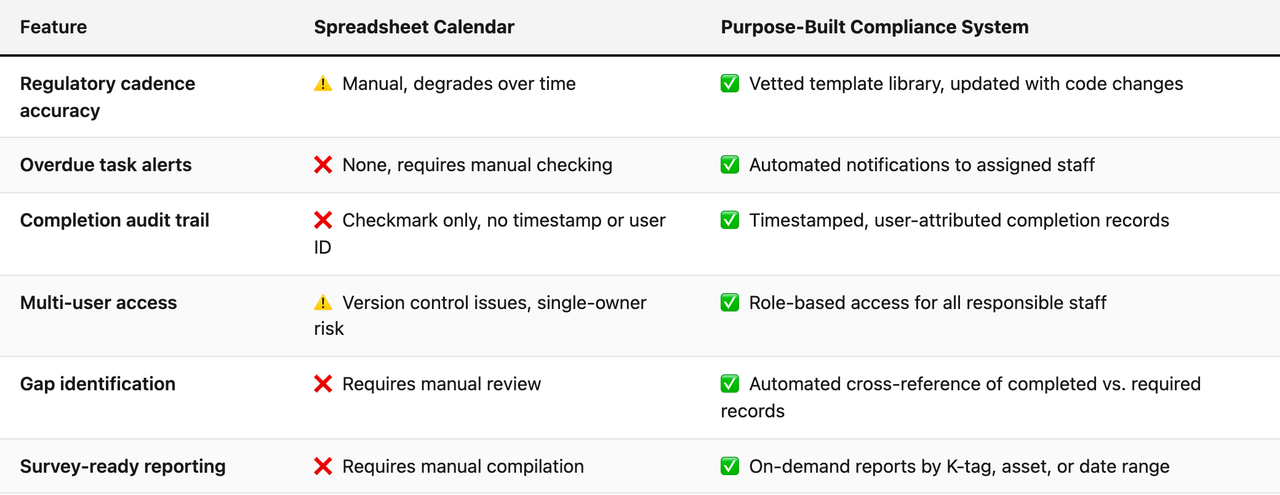
Spreadsheet-based compliance calendars are nearly universal in SNFs that have not adopted purpose-built facilities management software. They work well enough when the person who built them is present, motivated, and current on regulatory requirements. They fail in three predictable ways: they are not updated when regulatory cadences change, they do not alert anyone when a task is overdue, and they do not capture completion in a way that creates an auditable record. A spreadsheet can show that a task was scheduled. It cannot reliably show that the task was completed correctly, by whom, at what time, and with what result.
The regulatory cadence problem is particularly significant. NFPA 101 and NFPA 99 task frequencies are not uniform. Some tasks are daily (emergency lighting visual checks in certain configurations), some are weekly (eyewash stations, certain generator checks), some are monthly (fire extinguisher visual inspections, fire door self-closing tests), some are quarterly (fire drills, generator load tests), and some are annual (full fire alarm tests, sprinkler inspections). Keeping all of those cadences accurate in a spreadsheet requires active maintenance, and when regulatory guidance updates, which it does periodically as CMS issues new survey guidance and NFPA releases code updates, the spreadsheet does not update itself.
The alert failure is the other critical gap. A spreadsheet does not notify anyone when a task is approaching its due date or has passed it. The maintenance director must remember to check the spreadsheet, identify what is coming due, and assign the work proactively. In a facility where the maintenance director is also managing physical plant issues, vendor relationships, and reactive work orders, the compliance calendar is the thing that gets checked last, which means overdue tasks often go undetected until the next time someone happens to review the spreadsheet.
How to apply this: Evaluate your current compliance calendar against three criteria: Does it alert the responsible person when a task is approaching due? Does it capture completion in a format that creates an auditable record rather than just a checkmark? Does it reflect current regulatory cadences, not the cadences that were accurate when the spreadsheet was built? If any of these three criteria are not met, the calendar is a risk, not a resource.
What a Real Compliance Calendar Requires
7. Nobody in Your Facility Knows Which K-Tags Are Your Highest Risk Until After a Survey
K-tag risk awareness is a defining characteristic of a mature SNF compliance program, and its absence is one of the clearest indicators that a facility's documentation program is operating reactively rather than proactively. When the maintenance director, the administrator, and the director of nursing cannot identify, without consulting survey results, which K-tag categories their facility is most likely to be cited in during the next inspection, the compliance program has no strategic direction.
K-tags are the CMS citation codes that correspond to specific requirements under the Life Safety Code and Health Care Facilities Code. The CMS Appendix PP guidelines for long-term care facilities map each K-tag to specific documentation and physical compliance requirements. Certain K-tags appear consistently across CMS survey data as the most frequently cited categories in SNFs: fire doors (K211, K222), sprinkler systems (K351, K353), emergency lighting (K291), fire drills (K712, K714), and generator and essential electrical system documentation (K918, K923) among others.
But knowing the national frequency distribution is not enough. Facilities have different physical plants, different inspection histories, different contractor relationships, and different operational patterns that create facility-specific risk profiles. A facility with an older building is more likely to have fire door compliance challenges than a recently constructed one. A facility that has experienced maintenance director turnover is more likely to have documentation gaps in the categories the previous director managed personally. A facility that relies on a single contractor for multiple inspection types is more likely to have unreconciled deficiency issues if that contractor's report format is difficult to parse.
The facilities that are caught off-guard by survey findings in categories they did not anticipate are almost always facilities that have never conducted an internal audit against K-tag risk criteria. They have conducted inspections. They have completed tasks. But they have not mapped their compliance program to the specific citation framework surveyors use, which means they have no way to identify which categories their documentation is strongest in and which categories are most vulnerable.
How to apply this: Build a K-tag risk map for your facility. Start with the categories most frequently cited nationally, then layer in your facility's specific risk factors: building age, inspection history, contractor relationships, staff tenure and turnover, and any prior survey findings. For each high-risk K-tag category, assess your documentation against three questions: Do we have a record for every required inspection in this category? Does each record contain all required elements? Is there a clear resolution record for any deficiency identified in this category? The answers will reveal where your program is genuinely strong and where it is relying on hope rather than evidence.
The Post-Survey Learning Trap
The most common form of K-tag risk awareness in SNFs is retrospective: facilities learn which categories they are vulnerable in by receiving citations. This creates an improvement cycle that is perpetually one survey behind. The facility gets cited, fixes the documented gaps, and improves its posture in the cited categories. But the next survey will look at categories adjacent to the ones that were fixed, and the facility has no visibility into those adjacent risks because it has only ever audited in response to findings, not in anticipation of them. Breaking this cycle requires a prospective audit function, one that reads completed records against regulatory expectations before a surveyor does, which is precisely the gap that facilities management software with an analytic layer is designed to close.
How These Seven Signs Compound Each Other
Each of the seven signs above represents a distinct visibility failure, but they rarely appear in isolation. In practice, they compound: a facility with single-person dependency (Sign 3) typically also has a spreadsheet-based compliance calendar (Sign 6), because both patterns reflect the same underlying structure, a documentation program that exists as a personal system rather than an institutional one. A facility where nobody reads completed records (Sign 2) almost always also has unaudited contractor reports (Sign 5), because both reflect the same review gap. A facility that cannot identify its K-tag risk profile (Sign 7) is almost certainly also one where the maintenance director cannot answer documentation questions quickly (Sign 1), because both reflect the same absence of structured compliance intelligence.
Understanding this compounding effect is important because it reframes the problem. These are not seven separate issues to be fixed with seven separate interventions. They are seven symptoms of a single structural condition: a documentation program designed around task completion rather than compliance visibility. Fixing one symptom without addressing the underlying structure produces marginal improvement at best. The facilities that achieve durable survey confidence are the ones that redesign the structure itself, shifting from a paper-binder model to a system that makes compliance status visible, auditable, and accessible to everyone responsible for it.
The good news is that the structural redesign is not as disruptive as it sounds. The physical work does not change. Inspections still happen on the same schedule, performed by the same staff, covering the same assets. What changes is how the results are captured, reviewed, and cross-referenced. When completion is logged contemporaneously rather than reconstructed, when records are organized by K-tag category rather than by date, and when an analytic layer reads those records for gaps before a surveyor does, the documentation program becomes something a maintenance director can stand behind in real time rather than something they hope holds up under scrutiny.
What a Visible Documentation Program Actually Looks Like
Describing what visibility looks like in practice matters, because most administrators who have never operated with a truly visible documentation program do not have a clear picture of what they are working toward. Visibility is not just digital record-keeping. A facility can digitize its binder and still have all seven of the problems described above if the digitization does not include structure, review, and analytic functions.
A visible documentation program has the following characteristics: any authorized user can retrieve any record, organized by asset, K-tag category, or date range, in under two minutes without assistance. Overdue tasks generate automatic alerts to assigned staff before they become missed deadlines. Completed records are reviewed, not just filed, with a confirmation step that identifies missing elements before the record is closed. Contractor reports are processed through an intake workflow that creates follow-up tasks for every deficiency noted. Fire drill records include all required elements and are organized to demonstrate shift coverage across all four quarters. The facility's K-tag risk profile is assessed proactively and updated when inspection results, contractor findings, or operational changes alter the risk picture.
None of these characteristics require a large team or a large budget. They require a system designed for this purpose: one that knows what a complete fire drill record looks like, what a complete generator test record requires, and what the difference is between a contractor report that closes a compliance loop and one that opens a new obligation. That is the gap between a documentation system and a compliance intelligence system, and it is the gap that most SNFs have not yet crossed.
Frequently Asked Questions
What are the most common SNF documentation gaps that lead to K-tag citations?
The most frequently cited documentation gaps in SNFs involve fire drill records missing required elements or shift coverage, generator test logs with incomplete performance data (missing kW load readings or insufficient run time documentation), contractor inspection reports with unresolved deficiencies, fire door inspection records with gaps in cadence, and sprinkler system documentation where identified deficiencies lack formal closure records. These gaps are almost always invisible to the facility before a survey because the inspection was completed but the record was never reviewed for completeness.
How often should a SNF's life safety documentation program be internally audited?
An internal documentation audit should happen at minimum quarterly, aligned with the fire drill cycle, so that documentation gaps can be identified and closed within the same compliance period they occur in. For high-risk K-tag categories, a monthly review of completed records is a better standard. The audit should not just confirm that tasks were completed, it should confirm that each record contains all required elements and that any deficiency noted in any record has a corresponding resolution task with a documented closure.
What is the difference between a life safety inspection and a life safety documentation audit?
A life safety inspection confirms that physical assets and systems are functioning as required. A documentation audit confirms that the records generated by those inspections are complete, accurate, organized to demonstrate regulatory compliance, and free of unresolved deficiencies. Both are required, but they serve different functions. A facility can pass every physical inspection and still receive citations because its documentation does not demonstrate compliance in the format surveyors require. The documentation audit is what closes the gap between physical compliance and demonstrable compliance.
Can a SNF be cited for documentation gaps even if the actual inspections were done correctly?
Yes, and this is one of the most important concepts for SNF administrators to internalize. CMS and state surveyors assess compliance based on what the documentation shows, not on what staff report happened. If a fire drill occurred but the record is missing required elements, the drill is treated as non-compliant from a documentation standpoint regardless of what actually took place. If a generator load test was conducted but the kW reading was not recorded, the test does not demonstrate compliance with NFPA 110 performance requirements. The documentation is the compliance evidence, and incomplete documentation is a citation regardless of what the underlying physical reality was.
How does maintenance director turnover affect life safety compliance visibility?
Maintenance director turnover creates an acute visibility risk whenever the documentation program is structured around that individual's personal knowledge. When the director leaves, the institutional knowledge of where records are stored, how the informal filing system works, and which open deficiencies exist goes with them. A surveyor who arrives during a transition period will find that the incoming director cannot navigate the documentation, which creates the appearance of a program in disarray regardless of how much work the previous director did. The mitigation is a documentation system that holds institutional knowledge at the system level rather than the individual level.
What should a SNF maintenance director be able to demonstrate to a surveyor within the first five minutes of a survey?
Within the first five minutes, a maintenance director should be able to: confirm the date of the last fire drill on each shift, pull the most recent generator test record and confirm it met performance parameters, identify the status of any open deficiencies from the most recent contractor inspection reports, and confirm the schedule for the next required inspection in any K-tag category the surveyor asks about. The ability to answer these questions quickly and accurately signals to a surveyor that the facility's documentation program is managed actively, which sets a positive tone for the rest of the survey.
How does facilities management software improve life safety compliance visibility in SNFs?
Purpose-built facilities management software improves compliance visibility by replacing the personal-knowledge-dependent binder system with a structured, searchable, auditable record system. It ensures that tasks are scheduled at correct regulatory cadences, that completion is captured contemporaneously with all required data fields, that overdue tasks generate alerts before they become missed deadlines, and that completed records are cross-referenced against regulatory requirements to identify missing elements automatically. The analytic function, reading completed records for gaps rather than just confirming they exist, is the specific capability that transforms a documentation system into a compliance intelligence tool.
What is the risk of using a spreadsheet as a SNF compliance calendar?
Spreadsheet-based compliance calendars carry three specific risks: they do not update themselves when regulatory cadences change, they do not alert anyone when tasks are overdue, and they do not capture completion in a format that creates an auditable record. These are not hypothetical risks. Every one of them produces real citation exposure. A spreadsheet that reflects regulatory cadences from three years ago may be scheduling tasks at incorrect intervals without anyone noticing. A missed overdue task that nobody was alerted to may create a gap that looks like a systematic failure during a survey review.
How should a SNF handle a contractor inspection report that notes deficiencies?
When a contractor inspection report identifies a deficiency, the facility should immediately create a formal follow-up task in its compliance tracking system, assign it to a responsible staff member with a resolution due date, and track it to a formal closure record that includes documentation of what was done, by whom, and when. The contractor report should not be filed until this intake process is complete. When the deficiency is resolved, the closure record should reference the original report by date and deficiency number so that a surveyor following the paper trail finds a complete loop: deficiency identified, corrective action taken, resolution confirmed.
What does "contemporaneous documentation" mean for SNF life safety compliance?
Contemporaneous documentation means that inspection records, task completion logs, and compliance records are created at the time the activity occurs, not reconstructed after the fact. CMS survey guidance places significant weight on the contemporaneous nature of documentation because after-the-fact record creation creates opportunities for inaccuracy and raises questions about whether the activity actually occurred as documented. A fire drill record completed the same day as the drill by the person who conducted it is contemporaneous. A fire drill record completed three days later by a supervisor who was not present is not, and surveyors are trained to look for date patterns that suggest after-the-fact documentation.
How do multi-site SNF operators manage life safety documentation visibility across facilities?
Multi-site operators face a compounded version of the single-facility visibility problem: not only does each facility have its own documentation program, but the regional or corporate level has no consistent view into whether any facility's program is complete or compliant. The most effective multi-site documentation programs use a centralized platform that gives regional managers a dashboard view of compliance status across all facilities, flags overdue tasks and open deficiencies at any site, and allows corporate leadership to identify which facilities are approaching survey risk before a surveyor does. This visibility function is what separates a multi-site compliance program from a collection of individual facility programs.
What is the relationship between life safety documentation and CMS star ratings?
CMS five-star quality ratings for nursing homes include a Health Inspections domain that is directly affected by survey citation history, including life safety and environment of care citations. Facilities with repeated K-tag citations or pattern-level findings in life safety categories will see their Health Inspections star rating decline, which affects their overall rating, their competitive position for referrals, and their relationships with managed care organizations and hospital discharge planners. Strong life safety documentation is not just a compliance obligation, it is a business performance factor that affects census, revenue, and market position.
Key Takeaways
- Retrieval speed is a proxy for program health. If your maintenance director cannot produce and interpret a specific record in under two minutes, the documentation program has a structural visibility problem, not a personnel problem.
- Completed tasks and closed compliance loops are different things. A 100% task completion rate with no record review process creates false confidence and leaves every record potentially deficient.
- Single-person dependency is a compliance fragility risk that is invisible until a survey arrives during a period of transition. Documentation programs must hold institutional knowledge at the system level, not the individual level.
- Fire drill records are among the highest-frequency citation sources in SNFs, and the citations almost always come from missing elements and incomplete shift coverage rather than from drills that did not occur.
- Contractor reports create compliance obligations, not just compliance evidence. Every deficiency noted in a contractor report requires a formal resolution record. Filing the report without creating that record leaves the deficiency open in documentation terms regardless of whether it was physically corrected.
- Spreadsheet compliance calendars fail in three predictable ways: outdated regulatory cadences, no overdue task alerts, and no auditable completion records. Any one of these failures creates citation exposure.
- K-tag risk awareness must be prospective. Facilities that only learn their risk profile from survey findings are perpetually one survey behind. Proactive documentation audits against K-tag criteria close this gap before a surveyor opens it.
- These seven signs compound each other because they reflect a single underlying structure: a documentation program built around task completion rather than compliance visibility. Addressing the structure, not just the individual symptoms, is what produces durable survey confidence.
About the author
Benjamin Terebelo · Founder
Benjamin is the founder of SEQURA, a compliance platform purpose-built for healthcare facilities. He builds at the intersection of healthcare operations and software, maintaining a focus on bringing modern tooling to systems that the broader industry has largely left behind.
About the author
Benjamin Terebelo · Founder
Benjamin is the founder of SEQURA, a compliance platform purpose-built for healthcare facilities. He builds at the intersection of healthcare operations and software, maintaining a focus on bringing modern tooling to systems that the broader industry has largely left behind.