
Generator Testing, Eyewash Stations, and Sprinkler Checks: The Complete SNF Utility Compliance Explainer

Most skilled nursing facility maintenance directors can recite the big three from memory: run the generator, flush the eyewash, check the sprinklers. The tasks themselves are not complicated. The documentation that wraps around them, the load readings, the flow durations, the deficiency logs, the quarterly versus annual distinctions, the NFPA 99 versus NFPA 25 versus OSHA source-of-authority questions, is where facilities get into trouble. CMS surveyors do not cite facilities for forgetting to test their generator. They cite them for logs that are present but incomplete, for records that exist but cannot be produced on demand, and for compliance patterns that look fine on the surface until a surveyor asks for the last four consecutive quarterly tests and one of them is missing a transfer time entry. That is the gap this article is built to close.
This explainer treats generator testing, eyewash station inspections, and sprinkler checks as three distinct compliance systems, each with its own regulatory source, its own documentation standard, and its own failure mode. Understanding where the requirements come from, what a complete record actually looks like, and how surveyors evaluate the evidence is the foundation of genuine survey confidence. For SNF maintenance directors, EVS leads, and compliance officers managing these programs, the difference between a citation and a clean survey often comes down to documentation discipline, not operational failure.
Why Utility Asset Compliance Is Its Own Discipline in SNF Life Safety
Utility asset compliance in a skilled nursing facility sits at the intersection of three separate regulatory frameworks, and the friction between those frameworks is where documentation errors accumulate. CMS Conditions of Participation establish the survey accountability structure. NFPA 99 (Health Care Facilities Code) and NFPA 101 (Life Safety Code) establish the technical performance and documentation standards. State licensing requirements, which vary by jurisdiction, layer additional obligations on top of both. A maintenance director who understands only one of these frameworks will produce records that satisfy that framework while inadvertently failing another.
The K-tag system is how CMS organizes life safety deficiencies during survey. Each K-tag corresponds to a specific provision of NFPA 101 or NFPA 99 as adopted by CMS. Generator-related findings typically cluster around K-tags in the 900-series (emergency power supply systems). Sprinkler deficiencies appear in the K-700 and K-800 ranges. Eyewash stations, as a utility systems element, appear in K-900 series documentation requirements. Understanding which K-tag applies to each system helps maintenance staff anticipate exactly what a surveyor will be looking for, and structure records accordingly.
The Documentation Standard That Applies to All Three Systems
Before diving into system-specific requirements, one universal standard applies across all three utility asset categories: contemporaneous documentation. CMS expects records to be created at the time of the inspection, not reconstructed afterward. This matters because surveyors are trained to look for signs of retroactive documentation, dates that don't align with work order histories, handwriting that appears too uniform across multiple entries, electronic timestamps that contradict the stated inspection date. Contemporaneous records are not just a best practice; they are the evidentiary standard that makes a log legally defensible during survey.
The second universal standard is deficiency tracking with resolution documentation. For all three systems, finding a deficiency during an inspection is not itself a citation trigger, failing to document it, report it, and track it to resolution is. A sprinkler head that shows corrosion, an eyewash that doesn't achieve adequate flow, a generator that fails to reach rated load: each of these findings becomes a compliance asset when properly documented and resolved. Each becomes a citation risk when it disappears from the record.
The Unique Challenge of Multi-System Compliance in a Single Facility
A mid-size SNF with 120 beds might have one emergency generator, four to eight eyewash stations, and a full building sprinkler system with hundreds of heads across multiple zones. Each of these systems runs on a different inspection cadence, involves different staff, and produces records in different formats. The operational challenge is not performing any individual inspection, it is maintaining a documentation system that captures all of them at the right frequency, in the right format, and in a way that can be assembled coherently under survey conditions. That is the problem that paper binders handle poorly and that purpose-built compliance platforms are designed to solve.
SNF Generator Testing Compliance: What NFPA 99 Actually Requires
SNF generator testing compliance is governed primarily by NFPA 99, Health Care Facilities Code, Chapter 6 (Electrical Systems), which CMS has adopted by reference through its Life Safety Code requirements. The standard draws a clear distinction between the Type 1 Essential Electrical System (EES) found in most hospitals and the Type 3 EES applicable to most skilled nursing facilities. Understanding which EES type your facility operates under is the starting point for every other generator compliance decision.
Most SNFs operate a Type 3 Essential Electrical System, which is a simplified version of the hospital-grade Type 1 system. The Type 3 EES is required to supply power to life safety equipment, nursing station communication systems, egress lighting, and resident care equipment. The generator serving this system must be tested regularly, and the testing records must document performance against specific technical benchmarks, not just whether the machine started.
The Monthly Test: What It Requires and What Gets Logged
NFPA 99 requires that generators serving health care facilities be tested monthly under load. The specific requirement is a 30-minute load test at not less than 30% of the generator's nameplate kW rating. This is the minimum threshold, and it is worth understanding why it exists: diesel generators that run repeatedly under light load conditions develop a phenomenon called "wet stacking," where unburned fuel accumulates in the exhaust system and degrades engine performance over time. The 30% load floor is a mechanical protection requirement as much as it is a regulatory one.
A compliant monthly test log must capture the following data points:
- Date and time of test start and stop
- Generator identification (unit number or location)
- Starting method (automatic transfer switch or manual start)
- Transfer time from utility loss to generator assumption of load (in seconds)
- Load carried during the test, expressed in kW
- Oil pressure reading at steady-state operation
- Coolant temperature at steady-state operation
- Voltage output (all phases, if applicable)
- Frequency output (Hz)
- Any abnormal observations or alarm conditions
- Name and signature of the technician performing the test
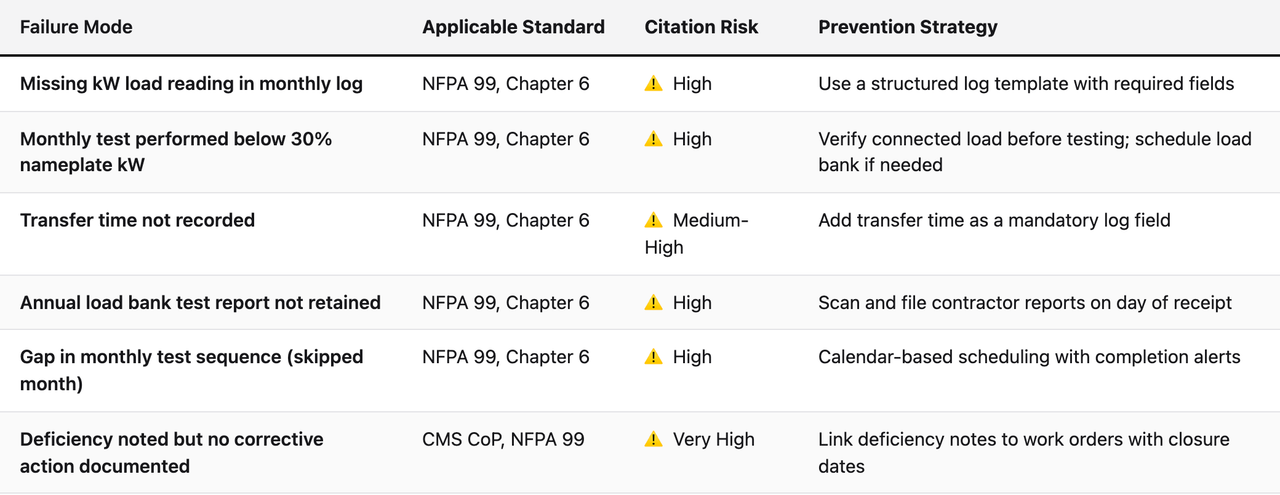
The most common documentation failure in monthly generator logs is the missing kW load reading. Facilities log the start time, the stop time, and a general observation that the test was "satisfactory," but omit the actual load measurement. A surveyor reviewing this record cannot verify that the 30% threshold was met, and the absence of that data point is treated as a deficiency even if the generator performed correctly. The measurement must be present in the record.
The Annual Load Bank Test: When and Why It Applies
NFPA 99 includes a provision for an annual test at a higher load threshold, specifically, a test at not less than 30% of nameplate kW for 4 continuous hours, or alternatively, a combination of 2 hours at 25% load, 30 minutes at 50% load, and 30 minutes at 75% load, for a total test duration that satisfies the standard's intent. The purpose is to verify that the generator can sustain rated performance over an extended period, not just during the brief monthly test window.
Many SNFs meet the annual test requirement through a load bank test, which uses an external resistive load bank to simulate facility electrical demand at a controlled and measurable level. Load bank tests produce detailed reports from the testing contractor, including time-stamped load readings at each phase of the test. These contractor reports become part of the facility's permanent compliance record and must be retained and producible under survey conditions. A facility that has a load bank test performed but cannot produce the contractor's written report during survey is in the same position as a facility that never had the test done.
Transfer Switch Testing and What It Documents
The automatic transfer switch (ATS) is the component that detects utility power loss and signals the generator to start. NFPA 99 requires that transfer switches be tested as part of the overall generator testing program. The transfer time, the elapsed seconds between utility loss and generator assumption of load, must be recorded, and it must meet the standard's performance threshold (typically under 10 seconds for life safety branch circuits).
Transfer switch testing is an area where documentation is frequently incomplete even when the physical test is performed correctly. Technicians log that the generator started, but omit the transfer time measurement. The transfer time is a distinct data element from the start confirmation, and it carries its own compliance significance because delayed transfer can mean residents on ventilators or oxygen concentrators experience a gap in power supply. That data point belongs in every monthly test record.
Common Generator Compliance Failures That Produce K-Tag Citations
Eyewash Station Inspection in SNFs: The OSHA and State Standard Intersection
Eyewash station inspection in SNF settings involves a regulatory overlap that catches many facilities off guard. While NFPA 99 addresses utility systems broadly, the primary standard governing eyewash station installation and testing is OSHA 29 CFR 1910.151, which requires that suitable facilities for quick drenching or flushing of the eyes be provided in areas where the eyes may be exposed to injurious corrosive materials. The American National Standards Institute standard ANSI Z358.1 provides the technical performance criteria that OSHA references and that state health department inspectors use when evaluating eyewash compliance in healthcare settings.
For SNFs specifically, the relevant exposure risk areas typically include the housekeeping chemical storage room, the laundry area (where chemical dispensing systems are used), the boiler room, and any maintenance area where corrosive cleaning agents, battery acid, or chemical descalers are stored. The location of eyewash stations must be within 10 seconds travel time from the hazard area, a requirement that is often interpreted as approximately 55 feet of unobstructed path, though ANSI Z358.1 uses the 10-second standard as the operative measure, not a specific distance.
The Weekly Activation Requirement: What It Means and What It Produces
ANSI Z358.1 requires that plumbed eyewash stations be activated weekly to verify that water flows to both spray heads simultaneously, that the tepid water temperature standard is met (60°F to 100°F), and that the flow is sufficient to flush both eyes simultaneously. This weekly activation is not a full performance test, it is a functional check designed to verify that the unit is operational and that stagnant water has been flushed from the supply line.
The documentation standard for weekly eyewash checks requires a log entry that captures:
- Date and time of activation
- Station identifier or location
- Confirmation that both spray heads activated simultaneously
- Water temperature observation (tepid, not hot, not cold)
- Flow duration (minimum flush to clear stagnant water, typically 3 minutes per best practice)
- Any observed deficiencies (clogged nozzles, damaged dust caps, insufficient flow, off-temperature water)
- Name of the person performing the check
In practice, many SNF eyewash check logs capture only a date and a checkmark. This minimal record is problematic under survey conditions because it provides no evidence that the station actually performed to standard, only that someone was present on that date. A surveyor who asks for the eyewash logs and finds 52 weeks of checkmarks with no supporting detail is likely to treat the record as insufficient, particularly if any station is found to be non-functional during the walkthrough.
Self-Contained Eyewash Units: A Different Inspection Standard
Some SNFs use self-contained (portable) eyewash units in areas where plumbed connections are not available. These units use a pressurized or gravity-fed saline or buffered solution reservoir instead of plumbed water. The inspection standard for self-contained units is different from plumbed units and requires more active management.
ANSI Z358.1 requires that self-contained units be inspected according to the manufacturer's maintenance schedule, which typically includes monthly inspection of the solution level and condition, annual solution replacement (or sooner per manufacturer guidance), and inspection of the seal integrity and activation mechanism. The manufacturer's instructions become the compliance document for these units, and facilities that operate self-contained eyewash stations without retaining those instructions have no documented basis for their inspection intervals.
A critical point that frequently creates compliance gaps: the solution in self-contained units has a shelf life. Units that are visually inspected monthly but never have their solution replaced on schedule can appear compliant on paper while being functionally useless. Surveyors and state health inspectors have begun checking solution expiration dates on self-contained units as part of routine walkthroughs. If the solution is expired, the weekly inspection log, however complete, does not establish compliance.
Eyewash Station Location Compliance: The Hazard Assessment Requirement
Beyond the testing and inspection documentation, CMS and state surveyors evaluating eyewash compliance will assess whether the facility has conducted a hazard assessment to identify all areas where corrosive exposure risk exists. This assessment, which should be documented in writing and updated whenever chemical use patterns change, is the foundation of the eyewash placement program. A facility that has eyewash stations in the right locations but no documented hazard assessment is operating without the analytical basis that regulators expect to see behind the physical installation.
The hazard assessment should inventory every chemical used in the facility, identify those with eye or skin corrosivity ratings under the GHS (Globally Harmonized System) classification, map the use and storage locations of those chemicals, and confirm that an eyewash station is accessible within the 10-second travel standard from each hazard location. This document does not need to be elaborate, but it must exist and it must be current.
Sprinkler Check Documentation: NFPA 25 Requirements in SNF Settings
Sprinkler system compliance in skilled nursing facilities is governed by NFPA 25, Standard for the Inspection, Testing, and Maintenance of Water-Based Fire Protection Systems, which CMS has adopted as the applicable standard through its Life Safety Code requirements. NFPA 25 establishes a tiered inspection and testing schedule for sprinkler systems, ranging from weekly visual checks of certain components to annual full-system tests to multi-year inspections of internal piping and obstruction investigation. Understanding this tiered schedule is essential for building a compliant documentation program.
The key insight about sprinkler check documentation for SNFs is that the documentation burden is substantial and multi-layered. It is not simply a matter of having a licensed fire protection contractor visit once a year. NFPA 25 requires that facility staff perform certain checks at weekly and monthly intervals, while the annual and multi-year tests are performed by qualified contractors. Both streams of documentation, facility-generated and contractor-generated, must be present and coherent for a facility to demonstrate full compliance.
Weekly and Monthly Inspections: What Staff Must Document
NFPA 25 assigns certain inspection responsibilities to the building owner (in practice, facility staff) on a weekly and monthly basis. These include:
Weekly checks (visual inspection):
- Control valves, confirm they are in the open position, not locked out or tampered with
- Fire department connection (FDC), confirm it is accessible and undamaged
- Gauges on wet pipe systems, confirm normal operating pressure is present
Monthly checks (visual inspection):
- All accessible sprinkler heads, inspect for paint overspray, corrosion, mechanical damage, or obstructions within 18 inches of the deflector
- Pipe and fittings, check for visible signs of leakage, corrosion, or physical damage
- Alarm devices, confirm they are in place and free of obstruction
The documentation for these checks must identify the specific components inspected, the date and time of inspection, the condition found (satisfactory or deficient), and the name of the person performing the inspection. A log entry that simply reads "sprinkler check, OK" does not satisfy the NFPA 25 documentation standard because it does not establish which components were inspected or to what standard.
Annual and Multi-Year Contractor Inspections: What Reports Must Contain
The annual inspection and test of the sprinkler system must be performed by a qualified contractor with the appropriate state fire protection contractor license. This inspection includes flow testing through inspector's test connections, alarm verification, main drain test with pressure readings, and a comprehensive visual inspection of all accessible components. The contractor's written report documenting this inspection is a primary compliance record.
A complete annual sprinkler inspection report from a qualified contractor should contain:
- Contractor identification and license number
- Facility name and address
- Date of inspection
- System type (wet pipe, dry pipe, pre-action, etc.)
- Main drain test results, static pressure, residual pressure, and flow
- Inspector's test connection flow test results
- Alarm activation confirmation
- List of all deficiencies found, with specific location identification
- Classification of each deficiency (Serious, Impairment, or Maintenance, per NFPA 25 categories)
- Corrective action recommendations
- Technician name, credentials, and signature
The deficiency classification system in NFPA 25 is particularly important for SNF compliance documentation. A "Serious" deficiency (one that represents an imminent threat to the effectiveness of the system, such as a missing sprinkler head, a closed control valve, or a disconnected alarm) requires immediate corrective action. An "Impairment" condition requires documented impairment procedures, including notification to the authority having jurisdiction (AHJ) and implementation of a fire watch or alternative protection measures. These are not optional steps, and the absence of documentation showing that they were followed is a significant citation risk.
The Deficiency Resolution Loop: Where Most SNFs Break Down
The most common documentation failure in sprinkler compliance is not the absence of inspection records, it is the absence of a closed-loop deficiency resolution process. An annual contractor inspection report identifies deficiencies. The facility receives the report. The deficiencies are reviewed (or not reviewed). Some are corrected. None of the corrections are formally documented in a way that links back to the original deficiency report. When a surveyor arrives six months later and asks for documentation that the deficiencies from the last annual inspection were resolved, the facility has no organized response.
A complete deficiency resolution record must show:
- The original deficiency as identified in the inspection report
- The date on which corrective action was initiated
- The work performed to correct the deficiency (with contractor or staff record)
- A final verification that the deficiency was resolved, with date and responsible person
This four-step loop applies to every deficiency, regardless of severity. Facilities that treat minor maintenance deficiencies as informal to-do items rather than documented compliance events are building invisible gaps into their records, gaps that become visible the moment a surveyor asks for the resolution documentation.
5-Year and Internal Inspection Requirements
NFPA 25 also includes requirements for internal inspections of sprinkler system piping at 5-year intervals, as well as obstruction investigation procedures when certain triggers are present (such as discolored water during a flow test, or a history of microbiologically influenced corrosion in the water supply). These longer-cycle inspections are often overlooked in facility compliance programs, particularly in buildings that have operated for 15 or 20 years without a documented internal inspection.
A surveyor who asks "when was your last internal pipe inspection?" and receives a blank stare is identifying a documentation gap that likely represents a real inspection gap. For SNFs in older buildings, scheduling and documenting the 5-year internal inspection is a compliance priority that many facilities have not addressed.
NFPA 99 Utility Compliance as a Documentation Architecture
NFPA 99 utility compliance for SNFs is best understood not as a checklist but as a documentation architecture, a structured framework that connects each piece of physical evidence (a test result, an inspection observation, a contractor report) to the regulatory expectation it satisfies. Facilities that approach utility compliance as a series of discrete tasks perform the tasks but fail to build the architecture. The result is a collection of records that individually look reasonable but collectively cannot answer the question a surveyor is actually asking: "Show me that your essential systems have been consistently maintained, that deficiencies have been identified and resolved, and that your documentation program has been operating without interruption."
NFPA 99 Chapter 6 covers essential electrical systems (including generators and transfer switches). Chapter 9 covers electrical equipment maintenance. Chapter 11 covers gas and vacuum systems. The standard's documentation requirements are explicit: records of inspections, tests, and maintenance must be maintained on-site and must be available for review by the authority having jurisdiction. The standard does not specify a format, paper, electronic, or hybrid systems all satisfy the retention requirement, but it does establish that the records must be complete, accurate, and accessible.
The Authority Having Jurisdiction (AHJ) Relationship and Its Documentation Implications
The AHJ concept in NFPA 99 is important for SNF maintenance directors to understand because it shapes how documentation is evaluated. In the SNF context, the AHJ is typically the CMS regional office and the state health department licensing agency acting jointly during survey. The AHJ has authority to impose requirements more stringent than NFPA 99 minimums, to accept alternative compliance approaches when the standard's prescriptive requirements cannot be met, and to issue findings based on their interpretation of the standard's intent, not just its literal text.
This means that a facility operating exactly to the letter of NFPA 99 may still receive a citation if the AHJ's interpretation of a particular requirement is more stringent. The practical implication for documentation is that records should be built to exceed the minimum standard, capturing more detail, not less, and documenting the rationale for any deviation from standard practice. A generator that could not be tested at 30% load during a particular month because the building load was insufficient should have a documented explanation and a plan for how the shortfall was addressed (such as scheduling an early load bank test). The absence of that explanation leaves the surveyor with only the non-compliant record.
Integrating Utility Asset Inspection Across Multiple Systems
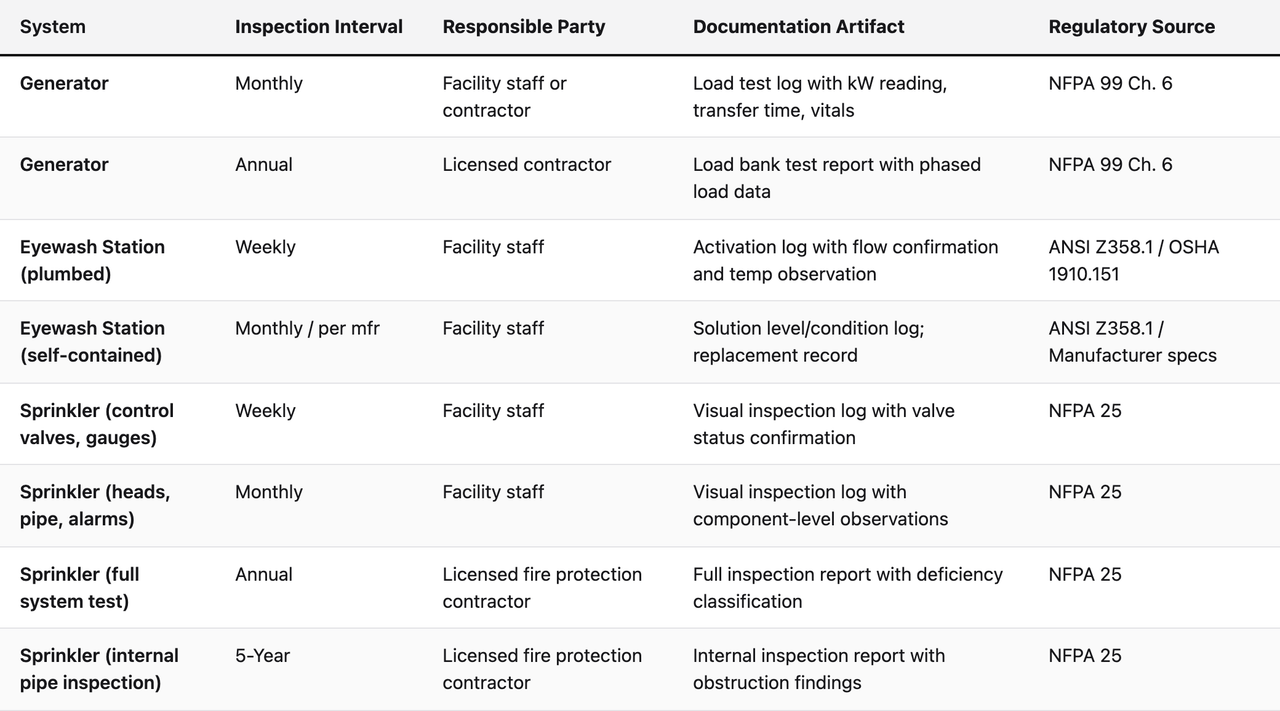
Utility asset inspection in healthcare settings becomes a coordination challenge as soon as a facility has multiple systems operating on different inspection cadences. The table below maps the primary inspection cadences for the three systems covered in this article, along with the responsible party and documentation artifact for each interval.
How CMS Surveyors Evaluate These Three Systems During an Unannounced Visit
Understanding surveyor methodology is as important as understanding the underlying technical standards. CMS surveyors conducting the Life Safety Survey portion of an unannounced SNF inspection follow a structured process that combines physical observation with record review. The physical observation confirms whether the systems are present, accessible, and appear functional. The record review confirms whether the documentation program has been operating consistently and completely. Both elements must be present for a facility to avoid citations.
The record review typically begins with the surveyor requesting the facility's life safety binder or its digital equivalent. They will ask to see generator test logs for the past 12 months. They will ask for the most recent annual load bank test report. They will ask for eyewash station inspection logs. They will ask for the sprinkler system contractor's most recent annual inspection report and any deficiency documentation. This request is made within the first hour of the survey visit, before the physical walkthrough begins.
The "Four Consecutive Quarters" Test for Generator Compliance
Surveyors evaluating generator compliance are specifically trained to look for gaps in the consecutive monthly test sequence. A facility that has 11 out of 12 monthly tests documented is not "mostly compliant", it has a gap that will be cited. The surveyor will identify the missing month, confirm it represents a genuine gap rather than a data entry error, and cite the facility for failure to maintain the required testing cadence.
The practical implication is that monthly generator testing must be treated as a non-deferrable obligation, not a task that gets pushed when the maintenance director is short-staffed or dealing with an emergency. A documented emergency that prevented testing in a given month, combined with a documented effort to make up the test as soon as possible, provides some mitigation context, but it does not eliminate the gap. The only compliant outcome is 12 tests per year, every year, with complete data in every log entry.
Physical Walkthrough Observations That Trigger Documentation Requests
During the physical walkthrough, surveyors are trained to observe conditions that may indicate documentation program failures. A sprinkler head with visible paint overspray suggests that the monthly visual inspection either was not performed or was performed without genuine attention. An eyewash station with a dust cap that has not been removed recently suggests the weekly activation may not be occurring. A generator room with a fuel tank gauge showing critically low levels suggests that the monthly test log, if one exists, may not be accurate.
These physical observations do not directly produce citations on their own, but they trigger targeted documentation requests. A surveyor who observes a painted sprinkler head will ask to see the monthly inspection logs for that area and the deficiency resolution records. If the logs show "satisfactory" observations in months when the paint was clearly present, the documentation is not just incomplete, it is contradicted by physical evidence. That is a more serious finding than a simple gap.
State Survey Additions to the CMS Framework
CMS Life Safety Surveys are conducted at the federal level, but many states conduct their own licensing inspections that apply additional or more specific requirements. Some states require generator fuel supply documentation (minimum tank level requirements, fuel quality records). Some states apply more stringent eyewash placement standards than ANSI Z358.1. Some states require that sprinkler system impairment notifications be made to the state fire marshal in addition to the local AHJ.
SNF maintenance directors and compliance officers must understand both the federal CMS standard and the state-specific overlay. The safest approach is to build the documentation program to the more stringent of the two requirements in every category, so that a state inspection that uses a higher standard than CMS does not produce findings that would have been avoidable.
Building a Documentation Program That Survives Unannounced Inspection
A documentation program that survives unannounced inspection has three structural properties: completeness, consistency, and accessibility. Completeness means every required data element is present in every log entry. Consistency means the records show an uninterrupted compliance pattern across all required intervals, without gaps or anomalies that suggest selective performance. Accessibility means the records can be retrieved, organized, and presented to a surveyor within minutes of the request, not hours, and certainly not days.
Paper binders fail the accessibility test under real survey conditions. A surveyor requesting 12 months of generator logs, 52 weeks of eyewash records, and the last annual sprinkler report, all within the first hour of an unannounced visit, is making a demand that a well-organized binder can technically satisfy, but that a typical facility binder, accumulated across staff turnover and filing system inconsistencies, frequently cannot. The practical failure mode is not that the records don't exist; it is that they cannot be found and assembled in the time available.
The Role of Template-Based Logging in Completeness
The single most effective intervention for improving documentation completeness is replacing blank-field or narrative log formats with structured templates that include every required data element as a mandatory field. A generator test log template that has a labeled field for kW load reading, transfer time, oil pressure, coolant temperature, voltage, frequency, technician name, and signature cannot be completed without capturing all of those data points. A blank log sheet that says "Generator Monthly Test" at the top can be completed with a date and a checkmark.
Template-based logging also makes training easier. A new maintenance technician performing their first generator test can follow the template as a checklist, ensuring that they capture every required element even before they fully understand why each element matters. Over time, the template becomes habitual, and the documentation quality is maintained even through staff transitions.
Contractor Report Integration: Closing the Documentation Loop
Contractor-generated reports, annual generator load bank tests, annual sprinkler system inspections, represent a significant portion of a facility's utility compliance documentation. The documentation failure that frequently occurs is that these reports arrive at the facility (by email, by mail, or handed off at the end of the service visit), are reviewed casually by the maintenance director, and then are filed in a location that is not integrated with the facility's ongoing compliance tracking system.
The result is that the annual reports exist somewhere in the facility but are not linked to the deficiency tracking process, are not accessible alongside the monthly facility-generated logs, and cannot be quickly assembled under survey conditions. Integrating contractor reports into the same documentation system as facility-generated logs, whether that system is a physical binder with a clear organizational structure or a digital platform, ensures that the complete compliance picture is always in one place.
How Digital Compliance Platforms Change the Equation
Purpose-built compliance documentation platforms like SEQURA address the structural failures of paper-based systems by enforcing completeness at the point of data entry, maintaining an auditable record of when each inspection was performed, and surfacing gaps before they become survey findings. When a generator test log is submitted without a kW reading, the system flags it as incomplete rather than accepting it. When a month passes without a generator test record, the system generates an alert before the gap extends into a second month. When a contractor uploads an annual sprinkler inspection report with deficiencies, the system creates a linked deficiency tracking record that must be closed before the item leaves the active queue.
The operational value for maintenance directors is not just efficiency, it is the elimination of the silent documentation failures that are impossible to detect in a paper system. A paper binder does not know that a log entry is missing a field. It does not know that a deficiency from six months ago was never resolved. It does not know that the eyewash station in the laundry room has not been activated in three weeks. A digital compliance platform with task-level tracking and automated gap detection does know, and it surfaces that information in time to act on it.
Frequently Asked Questions
How often must an SNF generator be tested under NFPA 99?
NFPA 99 requires monthly load testing of generators serving health care facilities, with each test lasting a minimum of 30 minutes at not less than 30% of the generator's nameplate kW rating. An annual test at higher load conditions (meeting NFPA 99's extended duration and load threshold requirements) is also required, typically performed as a load bank test by a licensed contractor.
What data must be recorded in a generator test log to satisfy CMS requirements?
A complete generator test log must include the date and time of the test, generator identification, starting method, transfer time from utility loss to generator assumption of load (in seconds), kW load during the test, oil pressure, coolant temperature, voltage output, frequency output, any observed abnormalities, and the name and signature of the technician. The kW load reading and transfer time are the most commonly missing elements in logs reviewed during survey.
What is the regulatory basis for eyewash station inspections in SNFs?
Eyewash station requirements in SNFs are primarily governed by OSHA 29 CFR 1910.151 and the technical standard ANSI Z358.1, which establishes performance criteria for emergency eyewash and shower equipment. CMS and state health department surveyors evaluate eyewash compliance as part of the utility systems and environment of care review.
How often must plumbed eyewash stations be activated?
ANSI Z358.1 requires that plumbed eyewash stations be activated weekly to verify simultaneous flow from both spray heads, confirm tepid water temperature (60°F to 100°F), and flush stagnant water from the supply line. Each activation must be documented with the station location, date, flow confirmation, temperature observation, and the name of the person performing the check.
What is the difference between weekly and annual sprinkler inspections under NFPA 25?
Weekly inspections under NFPA 25 are visual checks performed by facility staff, covering control valve positions, fire department connection accessibility, and gauge pressure readings. Annual inspections are comprehensive tests performed by licensed fire protection contractors, including flow tests through inspector's test connections, main drain tests with pressure readings, alarm activation verification, and a detailed inspection of all accessible system components. Both streams of documentation must be present and coherent for full compliance.
What happens when an annual sprinkler inspection identifies deficiencies?
Deficiencies identified during an annual sprinkler inspection must be classified according to NFPA 25 categories (Serious, Impairment, or Maintenance), documented in the contractor's report, and tracked through a closed-loop corrective action process. Serious deficiencies require immediate action. Impairment conditions require implementation of documented impairment procedures, including notification to the authority having jurisdiction. The facility must retain documentation showing that each deficiency was resolved, with the date of resolution and the work performed.
Can an SNF perform its own generator tests, or must a contractor do them?
Monthly generator tests can be performed by qualified facility staff who have the knowledge and equipment to record the required technical data (including kW load measurements). The annual extended-duration test is typically performed by a licensed electrical contractor or generator service company because it requires load bank equipment and technical expertise beyond what most facility maintenance staffs possess. Some SNFs contract all generator testing to an outside service provider, this is acceptable, but the contractor's records must be retained on-site and integrated into the facility's compliance documentation.
What is the 5-year internal inspection requirement for sprinkler systems?
NFPA 25 requires that the internal condition of sprinkler system piping be inspected at 5-year intervals (or when certain triggers such as discolored water during a flow test are present). This inspection, performed by a qualified fire protection contractor, assesses the pipe interior for corrosion, mineral deposits, or biological growth that could obstruct water flow. Many older SNFs have never documented a 5-year internal inspection, representing a compliance gap that surveyors increasingly identify.
How long must SNF utility compliance records be retained?
CMS requires that life safety and utility compliance records be available for review during survey, and the general expectation is that records covering at least the most recent 12 months be immediately accessible, with longer retention periods (typically 3 years) for records involving contractor reports and deficiency documentation. State licensing requirements may impose longer retention periods. The safest practice is to retain all utility compliance records indefinitely in a retrievable format.
What is the most common documentation failure that produces K-tag citations in generator compliance?
The most common generator documentation failure is the missing kW load reading in monthly test logs. Facilities perform the test but record only a start time, stop time, and general observation of satisfactory operation, omitting the measured load data that is necessary to verify the 30% nameplate threshold was met. The second most common failure is a gap in the consecutive monthly test sequence, a single missed month that is not documented or explained.
Do self-contained eyewash stations have the same weekly testing requirement as plumbed stations?
No. Self-contained (portable) eyewash units are inspected according to the manufacturer's maintenance schedule rather than the weekly activation requirement that applies to plumbed stations. Manufacturer schedules typically require monthly inspection of solution level and condition, plus annual solution replacement. However, the solution expiration date must be tracked and enforced, expired solution in a self-contained unit is a compliance deficiency regardless of how diligently the monthly visual inspections have been documented.
How should an SNF handle a generator test that fails to meet the 30% load threshold?
When a monthly generator test cannot achieve the 30% nameplate kW threshold due to insufficient facility electrical load, the facility should document the shortfall, explain the reason in the log, and take one of two corrective actions: connect a portable load bank to supplement the facility load, or schedule an early load bank test to achieve the required threshold before the next monthly interval. Simply logging the test as complete without noting the load shortfall is not acceptable. The documentation of both the shortfall and the corrective response demonstrates that the facility is managing the compliance obligation actively.
Key Takeaways
- SNF generator testing compliance requires monthly 30-minute load tests at not less than 30% nameplate kW, with complete technical data in every log entry, the kW reading and transfer time are the most frequently missing and most commonly cited elements.
- Eyewash station inspection in SNFs is governed by ANSI Z358.1 and OSHA 1910.151, not NFPA 99, a regulatory distinction that surprises many maintenance directors and affects how records are structured and what state surveyors look for.
- Sprinkler check documentation under NFPA 25 is a two-stream system: facility staff perform weekly and monthly visual checks, while licensed contractors perform annual and 5-year inspections. Both streams must be present and coherent in the compliance record.
- The most dangerous documentation failure across all three systems is not a missing log, it is a deficiency that was identified, not resolved, and not tracked. Closed-loop deficiency resolution documentation is the difference between a managed compliance program and a citation waiting to happen.
- Contemporaneous documentation is not a formality, it is the evidentiary standard that makes records defensible under survey conditions. Logs that appear to have been reconstructed or back-filled are treated as more serious findings than simple gaps.
- Paper binders can technically satisfy the retention requirement for utility compliance records, but they fail the accessibility test under real unannounced survey conditions. Digital compliance platforms that enforce complete data capture, maintain searchable records, and surface gaps automatically address the structural weaknesses of paper-based systems before they become survey findings.
- State licensing requirements layer additional obligations on top of CMS and NFPA standards in many jurisdictions. Building the documentation program to the more stringent of the two requirements in every category is the only approach that provides genuine survey confidence across both federal and state inspection contexts.
About the author
Benjamin Terebelo · Founder
Benjamin is the founder of SEQURA, a compliance platform purpose-built for healthcare facilities. He builds at the intersection of healthcare operations and software, maintaining a focus on bringing modern tooling to systems that the broader industry has largely left behind.
About the author
Benjamin Terebelo · Founder
Benjamin is the founder of SEQURA, a compliance platform purpose-built for healthcare facilities. He builds at the intersection of healthcare operations and software, maintaining a focus on bringing modern tooling to systems that the broader industry has largely left behind.