
How AI Reads Inspection Records to Surface Compliance Gaps Before a CMS Surveyor Does

Picture this: it's 6:47 on a Tuesday morning, and a CMS surveyor has just signed in at the front desk of your skilled nursing facility. Your maintenance director is in the boiler room. Your administrator is in a care conference. The life safety binder is on the shelf where it always is, three inches thick, organized by month, built on good intentions and institutional memory.
The surveyor asks for fire drill documentation for the past twelve months. Your administrator pulls the binder. Everything looks complete at first glance: dates, times, signatures, resident counts. But the surveyor flips to the overnight drills and notices something. Two of the four required night-shift drills list start times between 7:00 and 8:00 AM. That is not a night-shift drill. That is a citation. A K-tag. A deficiency that will appear on your facility's public inspection report, trigger a plan of correction, and cost weeks of staff time to remediate.
Nobody falsified those records. The drills happened. The logs were completed. But the documentation had a gap that no one in the facility was set up to catch, because catching it required cross-referencing drill times against CMS's definition of "night shift" in the context of NFPA 101 compliance, and doing that cross-reference systematically, across twelve months of records, while running a 120-bed facility.
That is exactly what AI maintenance management is built to do. Not to replace the maintenance director, not to automate the drills, but to read the completed documentation the way a surveyor reads it, and surface the gaps before the surveyor walks through the door. This article explains precisely how that works, why it matters for SNFs specifically, and what the underlying technology actually does when it "reads" an inspection record.
Why SNF Documentation Gaps Are Structurally Inevitable Without AI
The compliance documentation burden in a skilled nursing facility is not a paperwork inconvenience. It is a regulatory system with hundreds of discrete inspection tasks, each tied to a specific NFPA standard, CMS K-tag category, or state-level life safety requirement, each occurring on its own cadence, and each requiring documentation that meets specific content criteria. A missing signature is a gap. An incomplete kW load reading on a generator test is a gap. A sprinkler inspection report filed without reconciling the deficiency list is a gap. None of these feel catastrophic in the moment. All of them can become citations.
The structural problem is that the people responsible for completing this documentation, maintenance directors, maintenance technicians, and EVS staff, are not documentation auditors. They are practitioners. Their job is to do the inspections, run the drills, maintain the equipment, and log what happened. Asking them to simultaneously audit their own documentation for regulatory completeness is asking them to hold two cognitive frameworks at once: the operational framework of "did I do the task?" and the regulatory framework of "does my record of the task satisfy the specific content requirements a CMS surveyor will evaluate?"
Those two frameworks do not overlap cleanly. A maintenance director who has completed 47 inspections this month, supervised two contractors, coordinated a fire drill, and responded to three work orders from nursing staff is not well-positioned to step back and notice that the contractor's sprinkler inspection report is missing the required statement about the system's last full flow test. That gap is invisible to the person doing the work. It is very visible to a trained surveyor.
The Volume Problem Is Geometric, Not Linear
A single 100-bed SNF running a compliant life safety program generates a substantial volume of completed inspection records across a 12-month survey cycle. Generator tests, fire alarm inspections, sprinkler checks, eyewash station verifications, kitchen hood suppression reviews, exit sign and emergency lighting tests, fire extinguisher inspections, fire drill logs for each shift and each quarter, K-tag documentation for each life safety feature in the building, the list is long and each item has its own documentation requirements. Now multiply that across a multi-site operator with 8 or 12 or 20 facilities. The documentation review task becomes geometrically larger, while the staff capacity to perform that review grows, at best, linearly.
This is the environment in which AI-powered compliance review delivers its most concrete value. Not by replacing any single inspection or drill, but by reading the accumulated output of all those inspections and drills and asking, systematically and continuously, whether the documentation meets the regulatory standard it is supposed to satisfy.
What "Reading" an Inspection Record Actually Means for an AI System
When people hear that an AI system "reads" inspection records, the mental image is often a document scanner or a keyword search. The actual process is more structured and more purposeful than that. Understanding what the system is doing mechanically helps explain why it catches things that human review misses.
An AI compliance review system operates on structured data, not raw prose. When a maintenance technician completes a generator test log in a platform like SEQURA, they are not typing free text into a field. They are completing a structured form: date, time, technician, load kW reading, runtime, voltage, transfer switch operation, oil pressure, coolant temperature, any noted deficiencies, and technician signature. Each of those fields maps to a specific data element that the system knows how to evaluate against a regulatory expectation.
The AI layer then performs several operations on that structured record:
- Presence validation: Are all required fields populated? A generator test log missing a kW load reading is incomplete under CMS Life Safety requirements tied to NFPA 110. The system flags it immediately.
- Value range checking: Is the kW load reading within an acceptable range? A generator test recorded at 0 kW load is technically present as a data point, but it suggests the test may not have been performed under load, which is a compliance issue. The system can flag anomalous values, not just missing ones.
- Cadence verification: Does the record appear at the required frequency? Monthly generator tests need to appear monthly. If October's test is dated November 3, the system can flag that the October record is missing, even if November looks complete.
- Cross-record reconciliation: Does this record reference a deficiency that should appear on a subsequent repair or follow-up record? An annual fire alarm inspection that notes a faulty pull station should generate a deficiency tracking item. If that deficiency has no corresponding repair record within the required timeframe, the system flags the open item.
- Contextual pattern matching: Across multiple records, does the pattern of documentation suggest a systemic gap? Four fire drills in the first quarter all logged between 9 AM and 2 PM suggests that overnight shifts are not being covered, even if the quarterly count appears correct.
This is machine learning predictive maintenance applied not to equipment failure curves, but to documentation failure patterns. The system learns what complete, compliant documentation looks like for each task type, and it learns what the early warning signs of a gap look like, so it can surface them before they become citations.
The Difference Between Rule-Based Flagging and Pattern-Based Flagging
A simpler compliance tool might use pure rule-based logic: if field X is empty, trigger alert Y. That catches presence failures but misses the more subtle documentation gaps that experienced surveyors are trained to find. A more sophisticated system combines rule-based validation with pattern recognition that operates across records, across time, and across task categories.
For example: a rule-based system will flag a missing generator test. A pattern-based system will notice that generator tests at a particular facility are consistently completed on the 28th of each month, which means they frequently miss the calendar month boundary by three days, creating a documentation cadence that looks monthly but technically fails to meet the "monthly" requirement when the survey cycle is evaluated. That is the kind of gap that produces a citation. It is also the kind of gap that is genuinely invisible to the maintenance director completing the logs, because each individual log looks fine.
How the AI Maps Completed Records to K-Tag Categories
One of the more technically interesting aspects of AI-powered compliance review in the SNF context is the mapping layer that connects completed inspection records to the specific K-tag categories that CMS surveyors use to evaluate life safety compliance. This mapping is not obvious, and getting it right is what separates a generic digital maintenance log from a purpose-built compliance intelligence platform.
CMS Life Safety surveys in SNFs are organized around the CMS Survey Operations Manual and the K-tag numbering system, which categorizes deficiencies by the specific NFPA 101 or NFPA 99 provision they violate. K-tags cover everything from building construction and compartmentalization (K100s) to fire alarm systems (K300s), sprinkler systems (K300s–K400s), emergency power (K900s–K1000s), and maintenance and testing records (across multiple categories).
A completed fire alarm inspection report maps to K-tags in the fire alarm category. A generator test log maps to emergency power K-tags. A fire drill log maps to emergency preparedness and fire drill K-tags. But a single contractor report, say, an annual fire protection contractor visit, might contain documentation relevant to multiple K-tag categories simultaneously: sprinkler system testing, fire alarm panel inspection, and suppression system verification might all be covered in one report.
The AI system needs to parse that multi-category record, extract the relevant data elements for each K-tag category, and evaluate each element against its specific regulatory requirement. Missing a required data element in the sprinkler section of a combined report is a different gap than missing the report entirely, but both are gaps, and both need to surface in the pre-survey audit.
Building the Regulatory Expectation Library
The foundation of any accurate AI-powered compliance review system for SNFs is the regulatory expectation library: the structured, machine-readable representation of what each K-tag category requires in terms of documentation content, frequency, and format. This library is not something an AI can build by reading NFPA standards in raw form. It requires subject matter expertise from life safety consultants who understand how CMS interprets those standards during surveys, how state surveyors apply additional requirements, and where the documentation gaps most commonly produce citations.
SEQURA's approach is to build this library with life safety consultants who have direct SNF survey experience, then encode it as the regulatory expectation layer against which the AI evaluates completed records. This is what makes the system's gap detection relevant to actual survey outcomes, rather than just technically complete. A generator test that satisfies the raw NFPA 110 language but misses the way CMS interprets "monthly testing" in a survey context is still a citation risk. The expectation library needs to reflect CMS interpretation, not just standard text.
The Three Categories of Compliance Gaps AI Surfaces Before a Surveyor Does
In practice, the gaps that AI maintenance management surfaces before a CMS survey fall into three broad categories. Understanding these categories helps maintenance directors and administrators understand what they are actually getting from an AI review system, and why it catches things that internal review processes miss.
Category 1: Presence Gaps
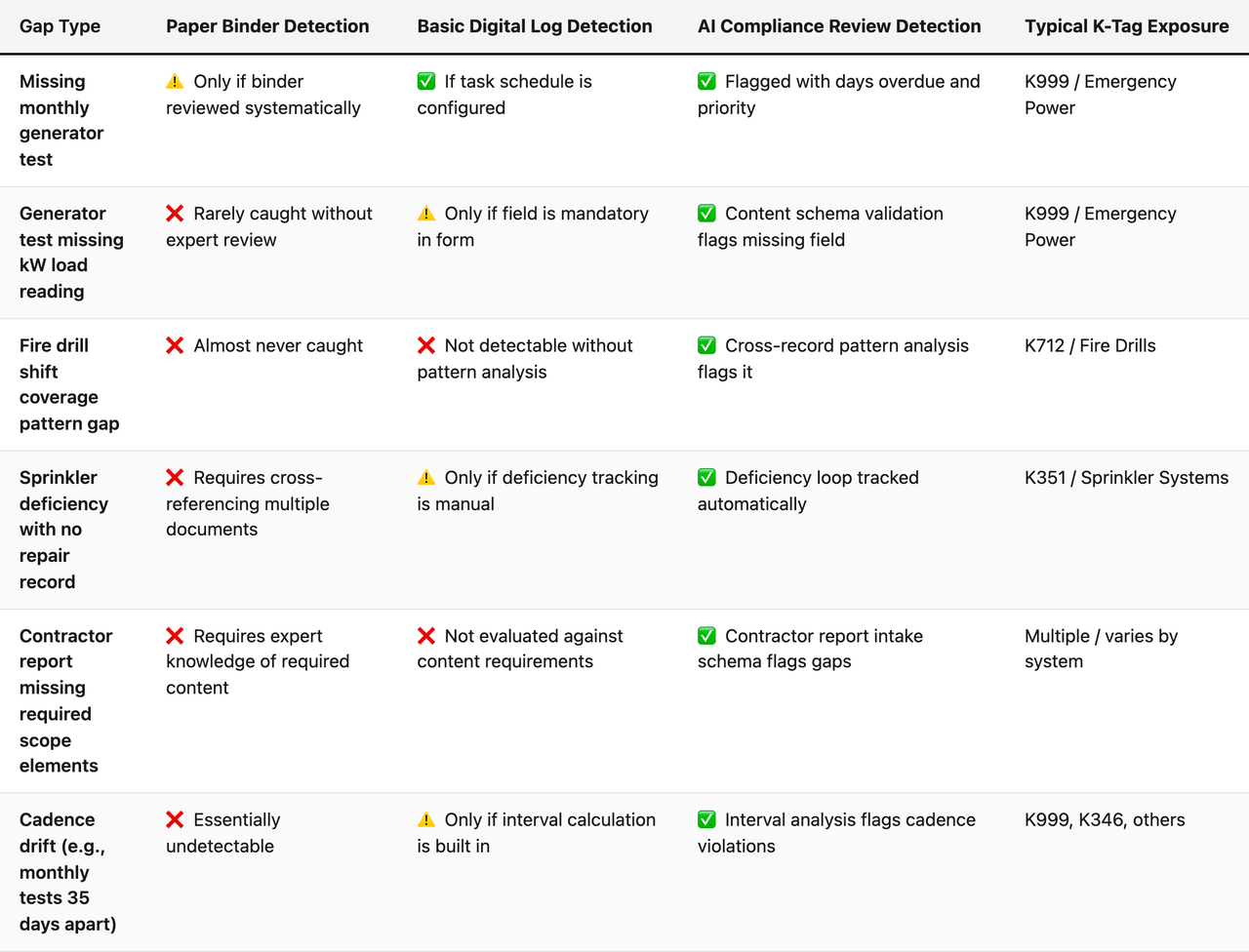
These are the most straightforward gaps: a required record that does not exist. A monthly generator test that was not completed. A quarterly fire drill that was skipped. An annual fire alarm inspection that is six weeks overdue. Presence gaps are also the easiest for a surveyor to find, because they show up as a blank in a chronological list of records.
An AI system catches these by maintaining a master schedule of required inspections for each facility, keyed to the specific cadence requirements for each task type, and comparing that schedule against the actual completed records in the system. Any task that should have a record but does not is flagged immediately, before the surveyor asks for the binder.
The value here is not just catching the gap; it is catching it far enough in advance that the facility can still complete the task before the survey. A monthly generator test flagged as missing on day 32 of the month gives the maintenance director time to schedule and complete the test before a surveyor walks in. A paper binder review process, if it happens at all, typically happens in preparation for a specific survey event, which may be too late.
Category 2: Content Gaps
These are gaps within records that exist: a completed inspection log that is missing a required data element, or that contains a value that does not satisfy the regulatory requirement. Content gaps are significantly harder to catch with manual review because the record appears complete at a glance. It takes someone who knows exactly what each field requires, and why, to notice that the kW load reading is missing, or that the fire drill log does not document resident census at time of drill, or that the contractor report does not include the required statement about the sprinkler system's last full flow test date.
These are the gaps that produce the most surprising citations, because the facility believes its documentation is complete. The AI system catches them by evaluating each completed record against the full content schema for that task type, not just checking whether the record exists.
Category 3: Pattern Gaps
These are the most sophisticated gaps and the hardest for any review process to catch without systematic, cross-record analysis. Pattern gaps occur when individual records look complete and correct in isolation, but the pattern across multiple records reveals a compliance problem. The fire drill shift coverage problem described in the opening of this article is a pattern gap. So is a generator test cadence that consistently drifts by a few days in a way that creates technical non-compliance. So is a sprinkler inspection that consistently omits the same section of the building's suppression system across multiple annual visits.
Pattern gaps require a system that can hold multiple records in view simultaneously, compare them against each other and against regulatory expectations, and recognize anomalies that only become visible at the aggregate level. This is where machine learning predictive maintenance applied to documentation genuinely outperforms human review. A maintenance director reviewing a binder reads records sequentially. An AI system evaluates them relationally.
What Predictive Auditing Looks Like in Daily Operations
The term predictive maintenance AI typically conjures images of sensors monitoring equipment wear patterns and predicting failure before it happens. In the SNF compliance context, the analogous concept is predictive auditing: a system that monitors documentation patterns and predicts citation risk before a surveyor arrives. The operational experience of using a predictive auditing system is different from what most SNF administrators expect.
It is not an alarm system. It does not produce a flood of alerts every morning. Used well, it functions more like a continuous background audit that surfaces actionable items in a prioritized queue, ordered by citation risk and urgency. A missing monthly generator test that is 15 days overdue is a higher-priority item than an annual fire alarm inspection that is 45 days from its due date. A pattern of incomplete overnight fire drill documentation is a higher-priority item than a single missing data element on a routine inspection log.
The maintenance director's morning experience shifts from "let me check the binder and see if anything is missing" (a task that typically does not happen, because there is always something more urgent to do) to "let me check the compliance queue and work through today's flagged items" (a task that is bounded, actionable, and directly tied to survey outcomes). That shift in operational rhythm is where the real value accumulates.
The Role of the Facility Kiosk and Mobile Completion
For intelligent maintenance automation to work in an SNF environment, the completion data has to be captured in a structured, timestamped format at the point of task completion, not transcribed from paper logs later. This is why the delivery mechanism matters as much as the AI layer. A shared facility kiosk or mobile completion interface that maintenance technicians use to log inspections in real time generates the structured data the AI system needs to perform its gap analysis.
Contemporaneous completion also creates an audit-ready timestamp record that demonstrates to a surveyor not just that the task was completed, but when it was completed. This is particularly important for tasks with strict cadence requirements, where the date and time of completion are as relevant as the content of the record. A generator test logged via paper binder and then transcribed to a spreadsheet the following week does not provide the same evidentiary quality as a timestamped digital record created at the moment of completion.
SEQURA's kiosk and mobile interface is designed for the actual users: maintenance technicians and EVS staff who are not documentation specialists, who may be completing tasks quickly between other responsibilities, and who need the completion process to be fast, guided, and unambiguous. The AI layer works because the front-end data capture is structured and reliable. Garbage in, garbage out applies as much to compliance AI as to any other analytical system.
How AI Handles Contractor Documentation: The Hardest Gap to Close
One of the most consistently underappreciated documentation risks in SNF life safety compliance is contractor documentation. Annual fire alarm inspections, sprinkler system testing, kitchen hood suppression servicing, elevator inspections, generator load bank testing: all of these are typically performed by outside contractors who deliver their own reports in their own formats. Those reports vary enormously in structure, content, and completeness. And they are the documentation that surveyors scrutinize closely, because they represent the facility's life safety systems at the most technical level.
A contractor report that documents a deficiency without a clear remediation plan is a compliance gap. A contractor report that is filed without verification that identified deficiencies were repaired within the required timeframe is a compliance gap. A contractor report that covers only part of the required inspection scope is a compliance gap. All of these are common. All of them are hard to catch without someone who knows exactly what each type of contractor report is supposed to contain.
This is where AI-powered compliance review applied to contractor documentation creates substantial value. The system ingests contractor reports, either via direct upload or structured data entry by the maintenance director, and evaluates them against the content requirements for that inspection type. It flags incomplete reports. It creates deficiency tracking items for any noted deficiencies and monitors for resolution records within required timeframes. It alerts the maintenance director when a contractor report is overdue relative to the facility's scheduled inspection calendar.
The AI cannot read an unstructured PDF contractor report the way a human reads it. But when contractor reports are ingested through a structured intake process, where the maintenance director confirms or completes key data elements as part of the upload workflow, the system can evaluate the content of those reports against regulatory expectations and flag gaps with the same reliability it applies to internally completed inspection logs.
Deficiency Tracking as a Compliance Gap Category
One of the most citation-productive documentation gaps in SNF life safety surveys is the unreconciled deficiency: a deficiency noted in an inspection report that has no corresponding repair record. This gap occurs because the inspection and the repair are handled by different people, in different systems, on different timelines, and nobody is systematically tracking whether the loop was closed.
An AI compliance system that tracks deficiencies from the moment they are documented in an inspection report through to the confirmation of repair creates a closed-loop deficiency management process. Every noted deficiency becomes a tracked item with a due date, an assigned owner, and a status that is visible to the maintenance director and administrator. Open deficiencies past their resolution deadline are flagged as high-priority items. This single capability, deficiency loop closure tracking, addresses one of the most common citation patterns in SNF life safety surveys.
Multi-Site Operators: Where AI Compliance Review Scales and Paper Binders Don't
For a regional facilities manager or VP of operations overseeing multiple SNF locations, the compliance documentation challenge is not just the volume of records at any single facility. It is the impossibility of maintaining meaningful visibility into documentation quality across a portfolio of facilities without a centralized system that can aggregate and evaluate records at scale.
Paper binders at each facility mean that the regional manager's only window into compliance status is a phone call with each maintenance director or a periodic site visit. Neither provides the depth of documentation review that would catch the subtle gaps described above. The result is that regional operators are effectively flying blind on compliance documentation quality until a surveyor walks into one of their buildings and finds a gap.
A platform that provides AI maintenance management at the portfolio level changes this fundamentally. The regional manager gets a dashboard view of compliance status across all facilities, with flagged items prioritized by citation risk. Facilities that are behind on required inspections are visible immediately. Facilities with open deficiencies past their resolution deadline are visible immediately. Facilities with documentation pattern gaps, like the fire drill shift coverage issue, are visible immediately.
This creates a new operational capability: proactive compliance intervention at the portfolio level. Instead of discovering a documentation gap when a surveyor finds it, the regional manager can identify the gap, contact the facility's maintenance director, and ensure it is resolved, sometimes weeks or months before a survey. For multi-site operators, this is the difference between managing compliance reactively, one citation at a time, and managing it proactively, across the entire portfolio, continuously.
The Limits of AI in SNF Compliance Documentation: What It Cannot Do
An honest account of AI maintenance management in the SNF context has to include what the technology cannot do, because overstating AI's capabilities leads to implementation failures that undermine the real value the system provides.
AI compliance review cannot verify that an inspection actually happened. It can only evaluate the documentation of an inspection. If a maintenance technician logs a completed fire extinguisher inspection without actually inspecting the extinguisher, the AI system will evaluate the log, find it complete, and not flag a gap. The system's gap detection is only as reliable as the integrity of the data being entered. This is why the human accountability layer, the maintenance director's oversight of task completion, the administrator's review of flagged items, and the organizational culture around documentation integrity, remains essential alongside the AI layer.
AI compliance review also cannot substitute for expert life safety consultation on complex compliance questions. When a facility faces a genuinely ambiguous regulatory interpretation, a question about how a specific building feature is categorized under NFPA 101, or how a state agency interprets a federal standard, that question requires a human expert with survey experience. The AI system can flag that a record exists and evaluate whether it meets the standard expectation. It cannot navigate the interpretive gray areas that sometimes arise in complex survey situations.
Finally, intelligent maintenance automation is not a set-and-forget system. The regulatory expectation library that underlies the AI's gap detection needs to be maintained as CMS updates its survey guidance, as NFPA standards are revised, and as state-level requirements change. A platform built for SNF compliance needs an ongoing commitment to keeping that library current, which is why the partnership between the software platform and the life safety consultants who maintain the regulatory layer is as important as the technology itself.
Implementation Realities: What Adoption Actually Looks Like in an SNF
For administrators and maintenance directors evaluating a platform like SEQURA, the practical question is not just whether the AI works. It is whether the implementation will actually happen, whether the staff will use the system consistently, and whether the compliance value will materialize in the real operational environment of a busy SNF.
The adoption pattern that tends to work in SNFs is a phased implementation that starts with the tasks that are highest-risk for citations, typically generator testing, fire drills, and sprinkler documentation, and expands from there. Starting with the full task library on day one creates a volume of setup work that can delay actual use. Starting with the highest-risk categories gets the AI layer working on the documentation that matters most, while the maintenance director builds familiarity with the system before expanding to the full inspection scope.
The shared kiosk model is particularly well-suited to SNF environments because it does not require every maintenance technician to have a personal device. A single touchscreen kiosk in the maintenance office or utility corridor allows any authorized staff member to log task completions, access their assigned work orders, and confirm inspection data in a structured format. For facilities where EVS staff share maintenance documentation responsibilities, the kiosk creates a consistent completion interface that generates the structured data the AI system needs, regardless of which staff member is completing the task.
Administrator buy-in is the most important adoption factor. When the administrator understands that the compliance dashboard represents real-time survey risk visibility, and treats the flagged items queue as a standing agenda item in facility operations meetings, the system's value compounds quickly. When the administrator treats it as a maintenance department tool and does not engage with the compliance output, the AI layer's gap detection does not translate into operational action. The technology surfaces the gaps. Leadership closes them.
Training the Team Without Disrupting Operations
One concern that maintenance directors commonly raise about adopting any new system is training time. SNF maintenance departments are not large. A director with one or two technicians cannot take a week off from operations to learn new software. The implementation needs to be fast, the interface needs to be intuitive, and the daily workflow needs to be simpler after adoption than before it, not more complicated.
A well-designed SNF compliance platform reduces the cognitive load on the maintenance director by converting the open-ended question "am I compliant?" into a bounded daily task: "what does the system tell me needs attention today?" That shift, from anxiety-inducing uncertainty to an actionable queue, is the operational improvement that maintenance directors consistently describe as the most valuable change in their daily experience. The AI layer is the engine that makes that queue accurate and prioritized. But the experience the maintenance director has is not "using AI." It is "having a clear, prioritized list of what to do today to stay compliant."
Frequently Asked Questions
What specific types of SNF inspection records can an AI compliance system evaluate?
A purpose-built SNF compliance AI can evaluate generator test logs, fire drill records, fire alarm inspection reports, sprinkler system inspection and testing documentation, kitchen hood suppression service reports, emergency lighting and exit sign test logs, fire extinguisher inspection records, eyewash station verification logs, elevator inspection certificates, and contractor reports across all life safety systems. The system evaluates each record type against the specific content, frequency, and format requirements associated with the relevant K-tag categories and NFPA standards.
How is AI-powered compliance review different from a digital checklist or task management app?
A digital checklist confirms that a task was marked complete. AI-powered compliance review evaluates whether the documentation of that task meets the regulatory content standard a CMS surveyor would apply. The difference is the layer of regulatory intelligence: knowing not just that a generator test was logged, but whether the log contains all required data elements, whether the values recorded fall within acceptable ranges, whether the test was completed within the required interval, and whether any noted deficiencies have been tracked to resolution. A checklist app cannot perform that level of evaluation.
Can the AI catch documentation gaps that even an experienced maintenance director would miss?
Yes, specifically for pattern gaps that only become visible when multiple records are evaluated together. An experienced maintenance director reviewing the binder sequentially will typically catch presence gaps (missing records) and may catch obvious content gaps. But pattern gaps, like a fire drill shift coverage problem that emerges across twelve months of quarterly drills, or a cadence drift in monthly testing that creates technical non-compliance, require the kind of cross-record, cross-time analysis that an AI system performs automatically and a human reviewer would need to invest significant time to replicate.
What happens when the AI flags a gap? Who sees it and what action is required?
Flagged items appear in a prioritized compliance queue visible to the maintenance director and, depending on permission settings, the administrator and regional manager. Each flagged item includes the specific gap identified, the regulatory requirement it relates to, and the recommended corrective action. The maintenance director is responsible for resolving the flagged item, either by completing the missing task, correcting the incomplete record, or escalating to a contractor or life safety consultant if the issue requires external expertise. The system tracks flagged items through to resolution, creating a documented remediation record.
How does the system handle contractor reports that come in as PDFs or paper documents?
Contractor reports are ingested through a structured intake process where the maintenance director uploads the document and confirms or completes key data elements using a guided interface. This structured intake creates a machine-readable record of the contractor report's content that the AI can evaluate against regulatory expectations. The system does not read free-form PDF text directly; the structured intake workflow ensures that the relevant data elements are captured in an evaluable format.
Is this the same as predictive maintenance for equipment?
Predictive maintenance AI in the traditional sense uses sensor data and equipment performance metrics to predict mechanical failures before they occur. SEQURA's AI layer is a different application of the same underlying principle: instead of predicting equipment failures, it predicts documentation failures, specifically, the gaps in inspection records and compliance documentation that are most likely to produce citations if a surveyor reviews them. The prediction is based on pattern recognition across documentation records, not equipment sensor data.
How current does the regulatory expectation library need to be, and who maintains it?
The regulatory expectation library needs to reflect current CMS survey guidance, current editions of NFPA 101 and NFPA 99 as adopted by CMS, and applicable state-level life safety requirements. CMS updates its Survey and Certification guidance periodically, and NFPA standards are revised on a regular revision cycle. Maintaining the library's accuracy requires ongoing engagement by life safety consultants who track regulatory changes and update the system's expectation schemas accordingly. For facilities using SEQURA, this maintenance is handled by the platform's compliance team, not the facility's maintenance director.
Can the system be used by multi-site operators to compare compliance performance across facilities?
Yes. Multi-site operators can access portfolio-level dashboards that aggregate compliance status across all facilities, sorted by citation risk, flagged item volume, open deficiency count, and task completion rate. This enables regional managers and VPs of operations to identify facilities that need attention before a surveyor does, deploy resources proactively, and establish system-wide compliance performance benchmarks. The portfolio view is one of the most significant operational advantages of a centralized AI compliance platform over facility-by-facility paper binder management.
How long does implementation typically take before the AI layer is producing useful output?
Facilities with a clear inspection schedule and existing documentation records can typically get the AI layer producing actionable gap analysis within the first few weeks of implementation. The initial configuration, setting up the task library, assigning responsibilities, and loading historical records where available, is the primary time investment. Once the task library is configured and completions begin flowing through the structured intake process, the AI has the data it needs to start cross-referencing records against regulatory expectations and surfacing gaps.
Does using an AI compliance platform reduce the need for periodic life safety consultant visits?
A well-implemented AI compliance platform reduces the frequency of gaps that a life safety consultant visit would identify, which means consultant visits become more focused on complex interpretive questions and survey preparation strategy rather than basic documentation gap finding. Some facilities use the AI platform's gap reports as the agenda for periodic consultant reviews, focusing consultant time on the items the system has flagged as high-risk rather than a comprehensive manual binder audit. The two tools are complementary: AI handles continuous monitoring, consultants handle complex judgment and survey strategy.
What is the difference between a K-tag deficiency and a documentation gap?
A K-tag deficiency is an official citation issued by a CMS or state surveyor during a Life Safety Code survey, documenting a specific violation of NFPA 101, NFPA 99, or related standards. A documentation gap is a deficiency in the facility's inspection records that, if observed by a surveyor, would likely result in a K-tag citation. An AI compliance system identifies documentation gaps before they become K-tag deficiencies. The goal is to find and close the documentation gap during the internal review cycle, so the surveyor never has the opportunity to issue the citation.
How does the system handle state-specific life safety requirements that differ from federal CMS standards?
State survey agencies can apply requirements that are more stringent than or additional to the federal CMS Life Safety standards. A purpose-built SNF compliance platform needs to incorporate state-specific requirement layers into its regulatory expectation library for each state in which its facility clients operate. SEQURA's task template library is built with state-specific variants where state requirements differ from federal baselines, so the AI's gap detection is calibrated to the actual regulatory environment the facility operates in, not just the federal floor.
Key Takeaways
- AI compliance review is not predictive maintenance for equipment. It is predictive auditing for documentation: a system that reads completed inspection records the way a CMS surveyor reads them, and surfaces gaps before they become citations.
- Three categories of gaps matter most: presence gaps (missing records), content gaps (incomplete records), and pattern gaps (systemic anomalies only visible across multiple records). AI catches all three; manual binder review reliably catches only the first.
- The regulatory expectation library is the core of the system. Without an accurate, current, CMS-calibrated library of what each inspection type requires, the AI cannot evaluate records against the standard that actually matters: how a surveyor will read them.
- Contractor documentation is the highest-risk and least-reviewed category. Structured contractor report intake and deficiency loop tracking are the capabilities that close the gap most frequently missed in traditional binder management.
- Multi-site operators gain disproportionate value from portfolio-level AI compliance dashboards that surface facility-level gaps before a regional manager could identify them through site visits or phone calls.
- The AI layer requires human leadership to create value. Flagged items need to be acted on. The system surfaces gaps; the administrator and maintenance director close them. Technology and operational accountability work together, not independently.
- Implementation is most effective when phased by citation risk priority, starting with generator testing, fire drills, and sprinkler documentation, before expanding to the full inspection scope.
- Survey confidence is the outcome. The measure of a successful AI compliance implementation is not the number of gaps flagged. It is the operational certainty that the documentation gaps a surveyor would find have already been found and closed.
Survey Confidence Starts With Documentation Intelligence
The maintenance director in the opening scenario did not fail at their job. They completed the fire drills. They logged the records. They did what they were trained to do. What they did not have was a system capable of reading their own documentation the way a CMS surveyor would read it, and surfacing the gap while there was still time to close it.
That is the gap that AI maintenance management closes. Not the gap in maintenance practice, but the gap between what the facility believes its documentation says and what a trained surveyor sees when they open the binder. Closing that gap, systematically, continuously, and across every category of life safety documentation, is what transforms compliance from a reactive, survey-driven anxiety into a proactive, operationally managed certainty.
The technology to do this exists. The regulatory intelligence to make it accurate in the SNF context exists. The implementation path is practical for facilities of all sizes, from single-site owner-operators replacing a paper binder to multi-site regional chains managing compliance across a portfolio. What it requires is the decision to treat documentation quality as an operational discipline, not a survey-week scramble, and to deploy the tools that make that discipline sustainable at scale.
For SNFs where the next unannounced CMS survey is always one sign-in away, that decision is worth making before the surveyor walks through the door.
About the author
Benjamin Terebelo · Founder
Benjamin is the founder of SEQURA, a compliance platform purpose-built for healthcare facilities. He builds at the intersection of healthcare operations and software, maintaining a focus on bringing modern tooling to systems that the broader industry has largely left behind.
About the author
Benjamin Terebelo · Founder
Benjamin is the founder of SEQURA, a compliance platform purpose-built for healthcare facilities. He builds at the intersection of healthcare operations and software, maintaining a focus on bringing modern tooling to systems that the broader industry has largely left behind.