
How Environment of Care Compliance Failures Compound Into CMS Immediate Jeopardy: A Plain-English SNF Explainer

A single missing night-shift fire drill log does not look like an emergency. Neither does a generator test record with a blank field for kilowatt load. Or a sprinkler inspection report sitting in a contractor's truck instead of the life safety binder. Each of these gaps, taken alone, produces a citation at worst. But when a CMS surveyor walks through a skilled nursing facility and finds three or four of these gaps clustered around the same system or the same resident population, something more serious happens: the individual findings stop being individual findings. They become a pattern. And patterns produce Immediate Jeopardy.
This is the mechanism that most SNF teams do not fully understand until it happens to them. The path from environment of care compliance gaps to a CMS Immediate Jeopardy determination is not a sudden cliff. It is a chain reaction, and each link in the chain is a documentation failure that could have been caught before the surveyor arrived. This article breaks down exactly how that chain works, what K-tag citations have to do with it, why the SNF life safety survey risk is higher than most operators realize, and what a maintenance director or administrator can do to interrupt the sequence before it reaches Immediate Jeopardy.
What "Environment of Care" Actually Means in a CMS Survey Context
The term environment of care compliance covers every physical, operational, and documented safety obligation a skilled nursing facility carries under the CMS Conditions of Participation. In practical terms, it means fire safety systems, emergency power, medical gas, water management, egress, and the dozens of recurring inspection tasks that demonstrate those systems are being actively maintained and monitored. During a CMS survey, surveyors assess the environment of care against two primary regulatory bodies: the Life Safety Code (NFPA 101) and the Health Care Facilities Code (NFPA 99), as adopted by CMS under 42 CFR Part 483.
The challenge for SNF teams is that "environment of care" is not a checklist with a finite number of boxes. It is a living obligation. Fire suppression systems need quarterly inspections, annual inspections, and five-year internal inspections, each documented differently. Emergency generators require weekly visual checks, monthly load tests, and annual load tests at specified kilowatt thresholds. Fire drills must cover every shift, every quarter, with written documentation of the drill scenario, staff response, and any deficiencies corrected. Water management plans under the Legionella prevention requirement must be current, facility-specific, and tied to actual sampling records.
When any of these obligations slip, even briefly, they create what surveyors call a documentation gap. A documentation gap is not necessarily evidence that the underlying work was not done. The generator may have been tested. The drill may have occurred. But if the record does not exist, or if it exists with missing data fields, the surveyor's finding is the same: the facility cannot demonstrate compliance. From a CMS survey standpoint, an undocumented inspection is a missed inspection.
This is the first thing SNF administrators need to understand. The survey does not evaluate what actually happened inside your facility over the past twelve months. It evaluates what your documentation proves happened. The gap between operational reality and documented reality is where most environment of care citations are born, and it is entirely preventable.
The Scope of the Environment of Care in a Typical SNF
For a 120-bed skilled nursing facility, the environment of care obligation typically includes several hundred recurring inspection and documentation tasks annually. These span fire alarm systems, sprinkler systems, emergency generators, fire doors, egress routes, portable fire extinguishers, medical gas and oxygen systems, eyewash stations, kitchen hood suppression systems, and HVAC systems with infection control implications. Each of these asset categories carries its own inspection frequency, its own documentation standard, and its own corresponding K-tag category in the CMS survey framework. A facility with 250 beds running multiple buildings or wings may manage upward of 600 recurring compliance tasks per year, many of them interconnected.
How K-Tag Citations Are Structured and Why They Cascade
K-tags are the citation codes CMS surveyors use to document Life Safety Code deficiencies found during the survey. Each K-tag corresponds to a specific provision of NFPA 101 or NFPA 99, and each carries a severity and scope rating that determines what happens next. Understanding the K-tag architecture is essential for understanding how environment of care compliance failures escalate toward Immediate Jeopardy.
The severity scale runs from Scope/Severity Level A (isolated, no actual harm, no potential for harm beyond minimal discomfort) through Levels B and C for isolated or widespread findings without harm, then escalates sharply at Levels D through F (potential for more than minimal harm) and reaches Levels G through J for actual harm or Immediate Jeopardy. The scope axis runs from isolated to pattern to widespread. When severity and scope intersect at the wrong coordinates, Immediate Jeopardy becomes the outcome.
The cascading problem with K-tags is not well explained in most SNF compliance training. Individual K-tags do not exist in isolation during a survey. A surveyor who identifies a K-364 citation (sprinkler system deficiency) will immediately cross-reference the maintenance records for related systems. If the fire alarm records show a gap at the same timeframe as the sprinkler deficiency, the surveyor now has evidence of a systemic documentation failure, not an isolated one. That changes the scope rating. If the building has a resident population that depends on sprinkler protection as part of their egress plan because they are non-ambulatory, the severity rating climbs as well. Two citations with a shared root cause and a vulnerable resident population is the formula for an Immediate Jeopardy finding.
The Most Frequently Cited K-Tag Categories in SNF Surveys
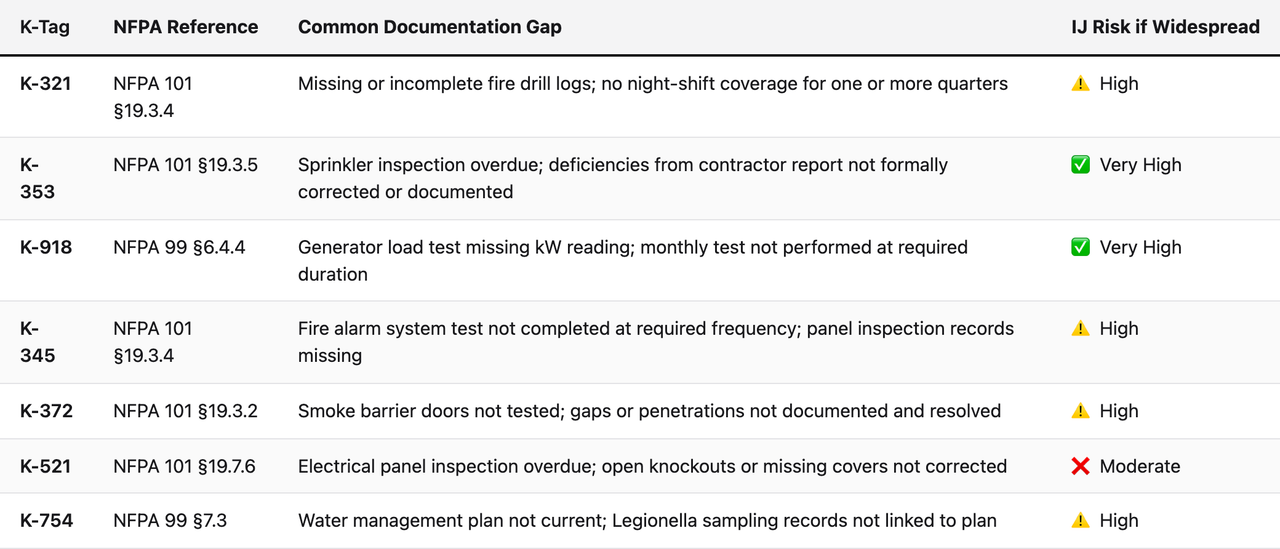
What this table does not capture is the interaction effect. A surveyor who finds K-353 (sprinkler deficiency) and K-345 (fire alarm gap) and K-321 (fire drill documentation missing night shift) in the same facility is not looking at three separate problems. They are looking at a facility where the life safety infrastructure, the detection system, and the staff response system all have documented gaps simultaneously. That is a pattern finding, and pattern findings with resident harm potential are the direct pathway to CMS Immediate Jeopardy.
The CMS Immediate Jeopardy Standard: What It Actually Requires
CMS Immediate Jeopardy is defined in the State Operations Manual as a situation in which the facility's noncompliance with one or more requirements has caused, or is likely to cause, serious injury, harm, impairment, or death to a resident. The key word is "likely." Surveyors do not need to document that a resident was actually harmed. They need to document that the conditions created a serious and immediate risk of harm. In the environment of care context, this means the physical safety systems, documentation, or staff response capabilities were in a state that left residents exposed to a realistic threat they could not protect themselves from.
For CMS survey risk purposes, the Immediate Jeopardy determination in a life safety context most commonly arises from one of three scenarios. The first is a single catastrophic finding, such as a completely nonfunctional sprinkler system in a building with non-ambulatory residents. The second is a pattern of connected deficiencies that together create a system-level failure, even if no individual deficiency would qualify alone. The third is a documentation failure that makes it impossible for the surveyor to conclude the facility's safety systems are functional, which places the surveyor in the position of assuming they are not.
That third scenario is the one most SNF operators underestimate. When records are missing, incomplete, or internally inconsistent, the surveyor's training directs them to treat the worst-case interpretation as the operative one. A generator test log with no kilowatt reading does not simply produce a citation for an incomplete record. It raises the question of whether the generator was tested at all, and whether it would function during an actual emergency. When a vulnerable resident population depends on that generator for medical equipment, oxygen concentrators, and climate control, the "likely to cause serious harm" threshold is easier to reach than most administrators realize.
The IJ Removal Process and What It Costs
Once an Immediate Jeopardy is cited, the facility must achieve removal of the IJ before surveyors leave the building, or face the prospect of termination from the Medicare and Medicaid programs. Removal requires an immediate action plan that demonstrates the specific threat to residents has been abated, with documentation. In practice, this often means emergency contractor visits during the survey, on-the-spot staff retraining with sign-in sheets, and real-time documentation of corrective actions. The operational disruption alone, measured in administrator hours, contractor fees, and staff time, can reach tens of thousands of dollars for a single IJ event.
Beyond the removal cost, the facility enters a mandatory revisit cycle. The initial civil monetary penalty structure for IJ findings typically runs in the range CMS publishes in its current CMS penalty tables for noncompliance, with per-day CMPs applying until the IJ is removed and a subsequent revisit confirms sustained compliance. For multi-site operators, a single facility IJ also triggers heightened scrutiny at sister facilities, which can produce a cascade of unannounced revisit surveys across an entire portfolio.
How Documentation Gaps Chain Into Each Other: The Compound Failure Model
The most useful mental model for understanding environment of care compliance risk is not a checklist. It is a fault tree. Each life safety system in your facility sits at the top of a branch, and every documented maintenance task, inspection record, and corrective action is a node on that branch. When a node is missing, the branch is weakened. When multiple adjacent nodes are missing, the branch fails. When multiple branches fail simultaneously, the surveyor has grounds for a systemic finding.
Consider a concrete scenario. A 180-bed SNF has a maintenance director who manages compliance largely through a paper binder updated monthly. Over a six-month period, the following events occur, each unremarkable in isolation:
- The quarterly sprinkler inspection is completed by a contractor in February, but the contractor's report is emailed to the administrator's inbox rather than printed and filed. The maintenance director never receives it, and the binder shows no February inspection record.
- The March fire drill is conducted on the day shift only. The night-shift drill is scheduled for April but gets postponed due to staffing, and then forgotten. The Q1 fire drill log in the binder shows one drill, not two.
- The generator monthly test in April is conducted, but the technician completing the log does not know to record the kilowatt load reading. The duration is recorded. The kW field is blank.
- A smoke barrier door on the second floor is noted in a shift log as "sticking" in March. A work order is created but not closed. The door is eventually fixed informally, but no completion record exists.
- The water management plan, last updated eighteen months ago, still references a cooling tower that was removed during a renovation. The plan is technically current but factually incorrect for the current facility configuration.
None of these events, in isolation, would be described as an emergency by the maintenance director or administrator. The sprinkler system is functional. The generator works. The door was fixed. But when a CMS surveyor arrives unannounced in June and pulls the life safety binder, here is what they see: a missing sprinkler inspection record (K-353), an incomplete fire drill log for Q1 (K-321), a generator test with a blank kW field (K-918), no evidence that a smoke barrier deficiency was formally resolved (K-372), and a water management plan that does not reflect the current facility (K-754). Five K-tag citations across five different system categories, all pointing to a maintenance and documentation process that is not functioning reliably. That is not five isolated findings. That is a pattern finding, and it will be documented as such.
If any portion of the resident population is non-ambulatory, cognitively impaired, or dependent on life-sustaining equipment, the surveyor now has documented grounds to elevate the pattern finding toward Immediate Jeopardy. The question they must answer is whether these combined gaps created conditions that were "likely to cause serious injury or harm." With five connected life safety systems showing documentation failures, the answer is very often yes.
Why the Night-Shift Fire Drill Gap Is the Most Underestimated Risk
Of all the environment of care compliance failures that precede Immediate Jeopardy findings in SNFs, the incomplete fire drill record is the one most likely to be dismissed by facility teams as a paperwork problem rather than a safety problem. It is neither. It is both, and the distinction matters because surveyors are trained to treat it as both.
The NFPA 101 requirement for health care occupancies specifies that fire drills must be conducted on each shift, at least quarterly, with sufficient frequency that staff response becomes automatic. For a three-shift SNF, that means a minimum of twelve drills per year, spread across all three shifts, with documentation of each drill that includes the date, time, shift, staff present, scenario, and any identified deficiencies. NFPA 101 Section 19.7.1 is explicit on this point, and CMS has incorporated it by reference into the Life Safety survey protocol.
The practical problem is that night-shift drills are operationally difficult. They disrupt sleeping residents, require coordination with nursing staff during the lowest-staffed hours, and often fall to a maintenance director who works day shift and has no direct authority over night operations. The result, in facility after facility, is that night-shift drills are conducted less frequently than required, documented less completely, or simply not conducted at all for one or more quarters. The binder shows day and evening shift drills. The night shift column is empty or shows a single annual entry.
When a surveyor sees this pattern, the citation is not merely for a missing record. The surveyor now has evidence that a significant portion of the staff who would respond to an actual fire at 3 AM have never practiced that response in a monitored, documented exercise. For a facility with cognitively impaired residents who cannot self-evacuate, this is a resident safety concern, not a paperwork concern. The distinction determines whether K-321 remains a D or E level citation or becomes the anchor for a higher-severity finding.
What Good Fire Drill Documentation Looks Like
A compliant fire drill record should capture: the date and start time, the specific shift covered (and the shift boundaries should match the facility's actual schedule, not generic labels), the names and roles of staff participating, the scenario type, the area or wing involved, the simulated actions taken, the time to complete evacuation of the designated zone, any deficiencies identified, and the corrective action taken for those deficiencies. If a surveyor looks at twelve months of fire drill logs and every record is identical except for the date, that is itself a red flag, suggesting the records were completed retrospectively or are not reflecting actual drills.
The Generator Documentation Trap That Catches Experienced Teams
Generator compliance under NFPA 99 Chapter 6 is one of the most technically specific areas of environment of care compliance, and it is one of the most commonly cited in SNF surveys because the documentation requirements are more detailed than most maintenance staff are trained to meet. The monthly test requires a minimum 30-minute run time, but it also requires documentation of the kilowatt load at the time of the test. The annual test must demonstrate that the generator can carry the facility's load at a minimum of 30% of the nameplate rating, and if the generator cannot achieve that load under normal facility conditions, a load bank test must be performed and documented separately.
The gap that produces K-918 citations most frequently is not a missed test. It is a test that was performed correctly but documented incorrectly. A maintenance technician who has been running the generator test for three years may have a reliable routine, but if they have never been trained on the specific data fields the CMS survey requires, their logs will be incomplete. A monthly test log that records "ran 30 min, no issues" satisfies the operational memory of the maintenance director but does not satisfy the survey standard. The kW load reading is missing. The transfer switch operation is not documented. The coolant temperature and oil pressure readings, which NFPA 99 also requires, are absent.
When a surveyor finds twelve months of generator logs with blank kW fields, the documentation picture is not "generator tested monthly." It is "generator testing frequency confirmed, but load adequacy unverified for twelve months." In a facility where the generator powers the nurse call system, the medication refrigerators, the oxygen concentrators in resident rooms, and the HVAC system, unverified load adequacy during an extended power outage is a potential Immediate Jeopardy scenario. The compound failure mechanism applies here as well: if the generator documentation gap is accompanied by a fire alarm battery backup gap or a missing emergency lighting test, the surveyor now has three interconnected emergency power documentation failures, which reads as a systemic problem rather than a series of isolated oversights.
How the Contractor Documentation Gap Becomes the Facility's Problem
One of the most frustrating aspects of environment of care compliance for SNF administrators is that many of the most serious documentation gaps originate outside the facility's direct control. Licensed contractors perform fire alarm testing, sprinkler inspections, kitchen hood suppression checks, and elevator safety inspections. They are required to produce written reports. But the report sitting in a contractor's system, or emailed to a general inbox, or mailed to the business office and never forwarded to the maintenance director, is not a compliant record. The CMS standard requires that the facility maintain these records on site and be able to produce them during a survey.
This means that contractor documentation management is a facility compliance responsibility, not a contractor responsibility. When a surveyor asks for the most recent sprinkler inspection report and the maintenance director says "the contractor has it," that is a citation. The facility must have received, reviewed, and retained the report. More importantly, if the report identified any deficiencies, the facility must have documented a corrective action for each deficiency, with a timeline and a completion record. A contractor report that lists three sprinkler head obstructions and a leaking control valve, with no facility follow-up record, is not merely an incomplete file. It is evidence that known life safety deficiencies were not corrected, which is a significantly more serious finding than a missing inspection date.
The practical challenge is that most SNFs receive contractor reports across multiple channels, in multiple formats, from multiple vendors, and have no systematic process for receiving, logging, reviewing, and tracking the corrective actions those reports require. The paper binder model cannot solve this problem. A contractor report received digitally must be printed, filed, reviewed for deficiencies, and tracked through correction, all through a manual process that depends entirely on the maintenance director noticing every report, every deficiency, and every required follow-up. The failure rate in this model is high, and the consequences of that failure rate are disproportionate to the administrative effort required to close the gap.
The Documentation Audit That Happens Before the Survey Arrives
The single most effective intervention in the environment of care compliance failure chain is a continuous internal documentation audit that replicates what a CMS surveyor would find, on a rolling basis, before the survey arrives. This is conceptually simple and operationally difficult for most SNFs because it requires a different kind of review than the typical "binder check" a maintenance director does before a scheduled inspection.
A surveyor does not review the binder chronologically. They pull specific K-tag categories and ask questions designed to surface gaps. For fire drills, they will ask to see all twelve months of records and verify shift coverage for each quarter. For generators, they will check for kW readings on every monthly test. For sprinklers, they will ask for the most recent contractor report and then ask what was done about each deficiency. For water management, they will ask to see the current plan and then ask for the sampling records that correspond to the plan. These are not random questions. They are the exact questions in the Life Safety Survey Protocol that CMS publishes in its State Operations Manual guidance for nursing homes.
An effective internal audit therefore requires knowing those questions in advance and being able to answer them with documentation. For a 120-bed facility, running that audit manually every month against every K-tag category is a substantial time commitment. Running it quarterly is better than nothing but still leaves a 90-day window during which a gap could develop and be found by a surveyor before the internal audit catches it. The gap between the internal audit cycle and the survey arrival date is the risk window that sophisticated compliance programs work to minimize.
A Pre-Survey Documentation Audit Framework for SNF Teams
The following framework is designed for maintenance directors and administrators who want to run a meaningful internal audit without waiting for a consultant or a survey to tell them what is missing. It organizes the audit around the K-tag categories most likely to produce pattern findings.
- Fire Drills (K-321): Pull twelve months of drill logs. Verify that each quarter has at least one drill per shift. Check that each log includes staff names, scenario, wing, and deficiency notes. Flag any quarter where a shift is missing or where all logs look identical.
- Sprinklers (K-353): Confirm the most recent quarterly and annual inspection reports are in the binder. For each deficiency listed in any contractor report, verify there is a corresponding corrective action record with a completion date. If a deficiency is listed as "corrected" by the contractor at the next visit, verify that record exists.
- Generator (K-918): Pull twelve months of monthly test logs. Verify that every log includes run duration, kW load reading, transfer switch operation, and any abnormal conditions noted. Verify that the annual load test, or load bank test if applicable, has been completed and documented within the required window.
- Fire Alarm (K-345): Confirm that the annual fire alarm test has been completed within the required timeframe. Verify that the contractor report is on file, that all devices tested are listed, and that any deficiencies are tracked to corrective action.
- Smoke Barriers (K-372): Conduct a physical walk of all smoke barrier doors. Document any gaps, damaged seals, or operational issues. Verify that any previously identified issues have a completion record.
- Water Management (K-754): Confirm the water management plan reflects the current facility configuration. Verify that Legionella risk reduction sampling records exist and are linked to the plan's identified control points.
Multi-Site Risk: How One Facility's IJ Becomes a Portfolio Problem
For COOs, VPs of operations, and regional facilities managers at multi-site SNF operators, the environment of care compliance risk calculation is fundamentally different from a single-facility operator's. An Immediate Jeopardy finding at one facility in a chain does not stay at that facility. CMS and state survey agencies apply a heightened scrutiny framework to facilities under the same ownership or management when a serious deficiency is identified at one site. This means that an IJ at Facility A is very likely to accelerate the survey timeline at Facilities B, C, and D, often with surveyors specifically looking for the same pattern of deficiencies that produced the IJ at the first site.
This creates a portfolio risk dynamic that is not well-managed by the traditional paper binder model. If each facility maintains its own binder, with its own format, its own contractor relationships, and its own maintenance director's idiosyncratic approach to documentation, there is no way for a regional manager or compliance officer to assess the organization's aggregate life safety documentation risk without physically visiting each facility and reviewing each binder. By the time that review happens, a survey may already be in progress at one of those sites.
The practical implication for multi-site operators is that environment of care compliance needs to be managed at two levels simultaneously: the facility level, where the actual inspection and documentation work happens, and the portfolio level, where patterns across sites can be identified and addressed before they become patterns that CMS identifies first. A regional facilities director who can see that three of eight facilities have generator kW log gaps in the same quarter is in a position to correct all three before any of them are surveyed. That same director, relying on paper binders at each site, has no visibility into the portfolio-level pattern at all.
What Predictive Documentation Auditing Looks Like in Practice
The concept of predictive documentation auditing is distinct from predictive maintenance. Predictive maintenance uses sensor data and equipment history to anticipate when a physical asset will fail. Predictive documentation auditing uses inspection record data and regulatory requirement logic to identify documentation gaps before a surveyor does. The two disciplines address different risks. A generator that passes its monthly test but has a missing kW reading in the log is not a maintenance risk. It is a documentation risk, and the consequence of that risk is a survey citation, not an equipment failure.
Predictive documentation auditing works by continuously cross-referencing completed inspection records against the regulatory requirements for each asset and K-tag category. When a generator test log is submitted without a kW reading, the audit system flags it immediately, before the log is filed and forgotten. When a fire drill log is submitted for the day shift in Q3 without a corresponding night-shift drill record, the system flags the quarter as incomplete. When a contractor sprinkler report arrives with deficiencies listed and no corrective action record exists 30 days later, the system generates an alert. These flags surface the exact patterns that produce K-tag citations, at the moment they develop rather than at the moment a surveyor finds them.
For the maintenance director working at a facility kiosk or on a mobile device, this kind of audit layer changes the daily experience of compliance management. Instead of maintaining a mental inventory of hundreds of recurring tasks and hoping nothing slips through, the system actively surfaces what is missing, what is approaching its due date, and what has been submitted with incomplete data. The documentation gap does not have to be caught in a monthly binder review. It is caught at the point of entry, when it is still easy to correct.
For the administrator or regional manager, the same audit layer provides a portfolio-level view that is not possible with paper binders: which facilities have open deficiencies in which K-tag categories, which contractor reports have not been received or reviewed, which asset categories are approaching inspection deadlines across multiple sites. This is the operational picture that allows environment of care compliance to be managed proactively rather than reactively.
Frequently Asked Questions About Environment of Care Compliance and CMS Immediate Jeopardy
What is the difference between a standard K-tag citation and an Immediate Jeopardy finding?
A standard K-tag citation documents a specific deficiency in life safety compliance, assigned a severity and scope level that determines its consequence. Immediate Jeopardy is a threshold determination, not a separate citation type. It is applied when a surveyor concludes that one or more deficiencies have created conditions that are likely to cause serious injury, harm, or death to a resident. IJ can arise from a single catastrophic deficiency or from a pattern of connected deficiencies that together create a system-level failure. The practical difference is significant: a standard citation requires a plan of correction within 10 days. An Immediate Jeopardy requires abatement before surveyors leave the building or the facility faces termination proceedings.
Can a documentation gap alone, without any physical deficiency, produce an Immediate Jeopardy finding?
Yes. When documentation is missing or incomplete for a critical life safety system, surveyors cannot verify that the system is functional. CMS survey protocol instructs surveyors to treat unverifiable compliance as noncompliance. If the unverifiable system is one that protects a vulnerable resident population from serious harm, and if the documentation pattern suggests systemic failure rather than an isolated oversight, the IJ threshold can be reached on documentation grounds alone, even if the underlying equipment is functioning correctly.
How many K-tag citations does it typically take to trigger an Immediate Jeopardy?
There is no fixed number. A single K-tag can produce an IJ finding if it involves a critical system and a vulnerable population. The more common IJ pathway in SNFs involves three to five connected K-tags that together describe a systemic failure in life safety documentation or management. The key factor is whether the surveyor can demonstrate that the combined deficiencies created a realistic and serious threat to resident safety, not how many individual citations are involved.
What is the first thing a facility should do when a surveyor begins a life safety review?
The maintenance director should immediately produce the life safety binder and offer the surveyor a quiet workspace to review it. While the surveyor reviews records, the maintenance director should conduct a rapid internal walkthrough to identify any physical conditions that might be cited, and the administrator should be notified immediately. Facilities should not attempt to reconstruct or backfill documentation during a survey. Surveyors are trained to identify retroactively created records, and doing so during a survey can elevate a documentation deficiency into an allegation of falsification, which carries far more serious consequences.
How often should an SNF conduct an internal environment of care audit?
Monthly audits are the minimum standard for facilities in markets with active survey programs. Quarterly audits, while common, leave a 90-day window during which documentation gaps can develop and be found by a surveyor before the facility identifies them internally. High-risk facilities, those with recent citations, recent ownership changes, or known documentation challenges, should consider continuous audit processes that flag gaps at the point of entry rather than on a scheduled review cycle.
Are fire drill logs the most commonly cited K-tag category in SNF life safety surveys?
Fire drill documentation (K-321) is consistently among the most frequently cited K-tags in SNF surveys, alongside sprinkler-related citations (K-353) and emergency power citations (K-918). The fire drill category is particularly common because the documentation requirements are specific, the operational challenges of night-shift drills are significant, and the records are easy for a surveyor to audit quickly. A surveyor can review twelve months of fire drill logs in under ten minutes and identify shift coverage gaps with no specialized technical knowledge required.
What does CMS expect to see in a generator monthly test log?
At minimum, a compliant generator monthly test log should include the date, start time, duration of the test (minimum 30 minutes), the kilowatt load at the time of the test, confirmation that the automatic transfer switch operated correctly, any abnormal conditions observed during the test (coolant temperature, oil pressure, unusual sounds or smoke), and the name or signature of the person conducting the test. Logs that record only "test completed, no issues" without the kW reading and transfer switch documentation are considered incomplete and will produce a K-918 citation.
How does a water management plan gap contribute to Immediate Jeopardy risk?
Legionella-related Immediate Jeopardy findings are among the most serious in the healthcare facility context because Legionnaires' disease carries a significant mortality rate in elderly and immunocompromised populations. When a water management plan is outdated, does not reflect the current facility configuration, or is not linked to documented sampling results, surveyors cannot verify that the facility is actively controlling Legionella risk. If a resident has experienced a respiratory illness that could be consistent with Legionella exposure, an incomplete water management plan becomes a component of a potential IJ finding rather than a standalone citation.
Can a multi-site SNF operator use a single life safety compliance system across all facilities?
Yes, and doing so is operationally advantageous for exactly the reason the IJ risk is highest for multi-site operators: portfolio-level visibility. A single compliance platform that standardizes inspection templates, tracks completion across facilities, and flags documentation gaps at the regional level allows a COO or director of facilities to manage aggregate survey risk rather than hoping each facility's binder is complete. The platform must be able to accommodate facility-specific variations in state requirements and asset configurations while maintaining a consistent documentation standard across the portfolio.
What is the difference between a Plan of Correction and an Immediate Jeopardy abatement plan?
A Plan of Correction (PoC) is a written response to standard survey citations, submitted within 10 calendar days, describing how the facility will correct each deficiency and prevent recurrence. An Immediate Jeopardy abatement plan is different in timing, urgency, and scope. It must demonstrate that the specific threat to residents has been immediately removed, and it must be accepted by surveyors before they leave the building. An abatement plan does not replace the PoC but must precede it. Facilities that cannot demonstrate abatement during the survey face mandatory termination proceedings, which is why the IJ designation is operationally devastating in a way that standard citations are not.
Does the size of a facility affect its life safety survey risk?
Larger facilities have more assets, more inspection tasks, and more documentation to manage, which increases the probability of gaps. But smaller facilities often have fewer dedicated maintenance staff and less administrative infrastructure for documentation management, which produces gaps through a different mechanism. The documentation risk profile is different by size, not necessarily lower. A 60-bed SNF with a single part-time maintenance director managing the entire life safety binder is arguably at higher documentation risk than a 200-bed facility with a structured maintenance team, even though the 200-bed facility has far more assets to track.
How should a facility handle a contractor report that identifies deficiencies?
Every deficiency identified in a contractor inspection report should be logged as an open corrective action item immediately upon receipt of the report. The log should include the deficiency description, the date the report was received, the target correction date, the person responsible for oversight, and a completion record when the correction is made. If the contractor is performing the correction on a return visit, the facility must obtain and retain written confirmation of that correction. A contractor report with unresolved deficiencies is one of the most direct pathways to a K-tag citation, because it is documented evidence that the facility received notice of a life safety deficiency and has no record of addressing it.
Key Takeaways
- Environment of care compliance failures rarely occur in isolation. The compound failure model, in which three to five connected documentation gaps across related life safety systems produce a pattern finding, is the primary pathway to CMS Immediate Jeopardy in SNFs. Each individual gap is manageable. The pattern is not.
- Documentation gaps are functionally equivalent to actual deficiencies in CMS surveys. A missing kW reading on a generator test is treated the same as a generator that was never tested, because the surveyor cannot distinguish between the two. The record is the evidence, and the evidence is what is evaluated.
- Night-shift fire drill documentation is the single most underestimated IJ risk factor in SNF life safety compliance. Incomplete shift coverage across fire drill records signals to surveyors that staff response capability during low-staffed hours is unverified, which elevates any related finding.
- Contractor documentation is a facility responsibility, not a contractor responsibility. Inspection reports must be received, filed, reviewed for deficiencies, and tracked through corrective action. Reports sitting in an email inbox or a contractor's system are not compliant records.
- Multi-site operators face compounded survey risk. An IJ at one facility accelerates survey timelines at sister facilities, often targeting the same K-tag categories. Portfolio-level documentation visibility is the only way to manage this risk proactively.
- The most effective intervention is continuous documentation auditing that catches gaps at the point of entry, not at the point of a monthly binder review or a survey visit. The audit cycle must be shorter than the survey arrival window to provide meaningful protection.
- Predictive documentation auditing is distinct from predictive maintenance. The goal is not to anticipate equipment failures but to identify documentation gaps, missing data fields, and incomplete records before a surveyor does, in the same way a surveyor would look for them.
Closing the Gap Before the Surveyor Finds It
The chain that connects a missing night-shift fire drill log to a CMS Immediate Jeopardy determination is not inevitable. Every link in that chain is a documentation gap that could have been identified and closed before the survey arrived. The challenge for most SNF teams is not a lack of intention or a lack of effort. It is a lack of visibility: the maintenance director who does not know the contractor report never made it into the binder, the administrator who does not know the Q3 night-shift drill was never completed, the regional manager who cannot see that three facilities in the portfolio have generator kW gaps in the same quarter.
Visibility is what breaks the chain. When documentation gaps surface immediately, at the point of entry, rather than weeks or months later during a manual audit or a surveyor's review, the facility has time to correct them. That is the operational difference between a facility that manages survey risk reactively and one that manages it with confidence. The paper binder model was never designed to provide that visibility. It was designed to store records, and it does that reasonably well. What it cannot do is audit itself, cross-reference its own gaps against regulatory requirements, and alert the maintenance director that something is missing before the surveyor asks for it.
For SNF administrators, maintenance directors, and multi-site operators who want to understand their current documentation risk without waiting for a survey to reveal it, the starting point is a structured internal audit using the K-tag framework described in this article. For organizations that have outgrown the paper binder model, the next step is a documentation-intelligence system that does that audit continuously, so the answer to "what would a surveyor find today?" is always available, and always actionable.
About the author
Benjamin Terebelo · Founder
Benjamin is the founder of SEQURA, a compliance platform purpose-built for healthcare facilities. He builds at the intersection of healthcare operations and software, maintaining a focus on bringing modern tooling to systems that the broader industry has largely left behind.
About the author
Benjamin Terebelo · Founder
Benjamin is the founder of SEQURA, a compliance platform purpose-built for healthcare facilities. He builds at the intersection of healthcare operations and software, maintaining a focus on bringing modern tooling to systems that the broader industry has largely left behind.