
How to Evaluate a Life Safety Compliance Platform Before You Buy: A Practical SNF Buyer's Framework

The maintenance director at a 120-bed skilled nursing facility in rural Ohio kept a binder. A good binder, actually, tabbed, color-coded, three inches thick. Fire drill logs. Generator test sheets. Sprinkler inspection reports from the contracted vendor. NFPA 101 task checklists printed from a template he'd downloaded years ago. When the CMS surveyor walked through the front door on a Tuesday morning with no advance notice, he felt reasonably confident. The binder was on his desk. The logs were complete. He'd done the work.
The facility received four K-tags that day. Not because the inspections hadn't been performed, they had. But the generator test log was missing the recorded kW load for two monthly tests. The fire drill records didn't document night-shift coverage for Q3. One sprinkler deficiency noted in the contractor's annual report had no corresponding corrective action entry. And the eyewash station inspection log showed a gap in the cadence that didn't match the required weekly frequency.
The binder wasn't wrong. It was incomplete in ways that were invisible to the person who built it.
That story plays out across skilled nursing facilities every survey cycle. The problem isn't effort or intent, it's the structural inability of paper-based and general-purpose digital systems to surface documentation gaps before a surveyor does. And now, as life safety compliance platforms purpose-built for SNFs have entered the market, facility operators face a different kind of challenge: figuring out which platform is actually worth buying, and which ones just digitize the same gaps that exist in the binder.
This guide is a practical evaluation framework for SNF administrators, maintenance directors, and operations leaders who are actively assessing life safety compliance platforms. It's built around the criteria that actually predict survey confidence, not the feature lists that look impressive in a demo.
Before You Open a Demo: Define What You're Actually Solving
The single most expensive mistake in any software evaluation is starting with vendor demos before defining the problem with precision. Most SNF operators who buy the wrong compliance platform don't buy the wrong one because they weren't careful, they buy the wrong one because they evaluated it against the wrong criteria. They compared interface design, pricing, and integrations when they should have been comparing regulatory coverage, gap detection logic, and documentation completeness.
Before you take a single sales call, answer these four questions honestly:
What caused your last life safety citation?
Pull the last survey report with K-tags or life safety deficiencies. Look at each one and categorize it: Was the inspection not performed? Was it performed but not documented? Was it documented but with missing required data elements (like load readings, temperatures, or witness signatures)? Was a deficiency noted by a contractor but never linked to a corrective action? The answer changes which platform capability matters most. If your citations come from tasks not being done, you need scheduling and accountability tools. If tasks are done but documentation is incomplete, you need data-field validation and gap detection. Most facilities have both problems, but the ratio matters.
Who actually does the documentation at your facility?
The platform that works for a dedicated full-time maintenance director with an office and a desktop is not the same platform that works for a two-person maintenance team sharing a single mobile device while covering three floors and two campuses. Map your actual workflow before evaluating interfaces. If your maintenance tech does rounds with a phone, the platform needs a mobile-first interface that works offline. If your EVS staff use a shared kiosk near the utility closet, the login and task flow has to be designed for that context. Platforms that are designed for administrators, not for the people doing the work, produce exactly the kind of undercompletion that leads to documentation gaps.
What is your regulatory exposure profile?
NFPA 101 and NFPA 99 are federal baselines, but state survey requirements add significant complexity. Some states layer additional frequency requirements for generator testing, fire drills, and medical gas inspections that exceed CMS minimums. If your facilities operate in a state with heightened oversight or if you've had recent state-level citations, you need a platform with state-specific task libraries, not just the federal template. A platform that covers NFPA 101 comprehensively but has no visibility into your state's addenda is covering roughly 70% of your actual compliance surface.
Are you solving for one facility or many?
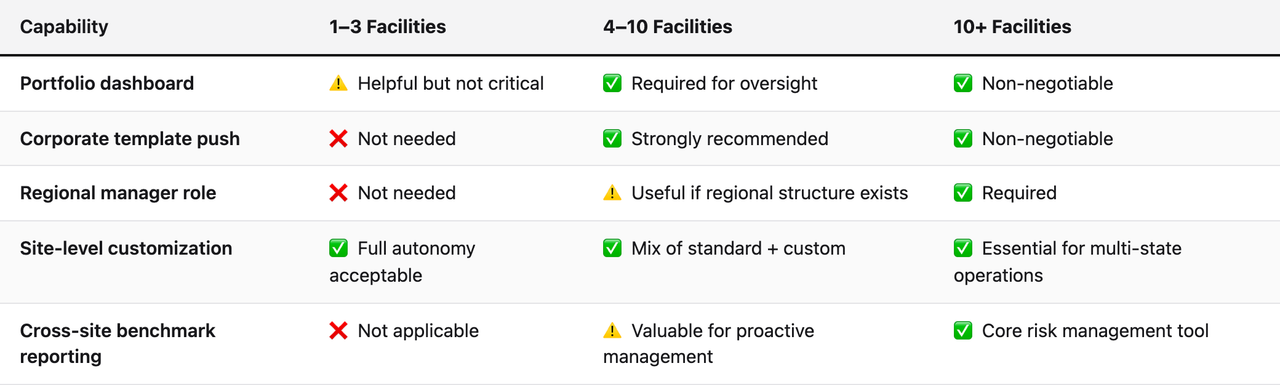
Single-facility operators and multi-site chains have fundamentally different needs. A 10-facility SNF chain needs portfolio-level visibility, the ability to see compliance status across all sites from a single dashboard, identify which facilities are trending toward citation risk, and standardize task cadences across locations without losing site-specific customization. A single-facility operator needs depth, not breadth. Evaluating a platform designed for enterprise portfolios when you operate one building means paying for infrastructure you'll never use. The reverse creates a ceiling you'll hit the moment you add a second site.
How to Evaluate the Regulatory Task Library
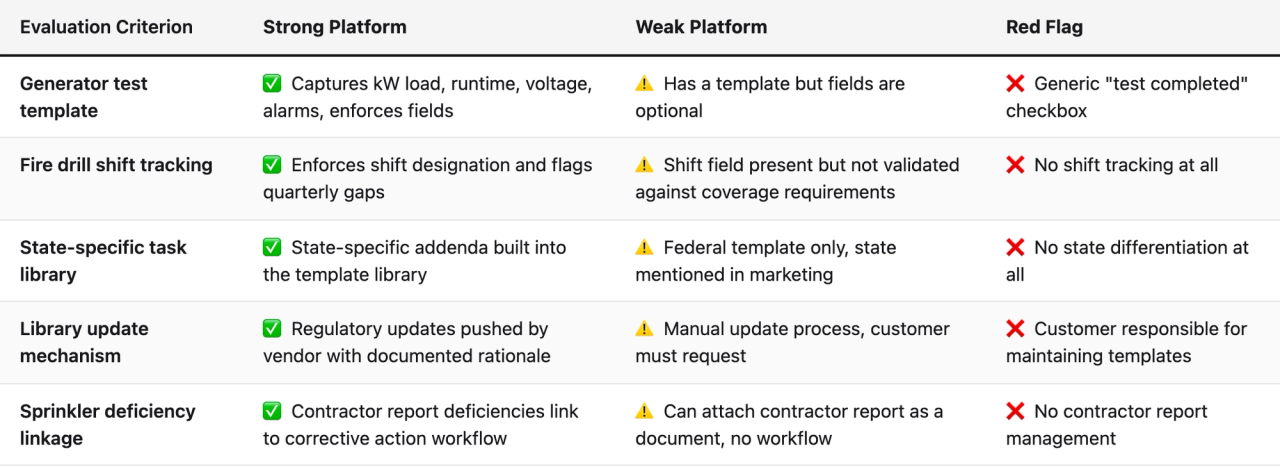
The regulatory task library is the most important component of any life safety compliance platform, and it's the one most commonly evaluated superficially. A platform can claim to cover NFPA 101, NFPA 99, CMS Conditions of Participation, and state regulations, and still deliver a template library that was built by a software developer referencing the table of contents of those documents rather than by people who have actually managed life safety compliance in a healthcare facility. The difference is significant and auditable.
Test for cadence accuracy, not just task presence
Ask the vendor to show you the task library for generator testing. A compliant SNF generator maintenance program under CMS and NFPA 110 requirements includes weekly visual inspections, monthly load testing (30-minute minimum at or above 30% of nameplate kW rating), and annual full-load tests. Each of these tasks requires specific data capture: start time, stop time, load percentage, voltage readings, any alarms triggered. If the platform's generator task template doesn't prompt for load readings, it will produce logs that look complete but will fail surveyor scrutiny, exactly the gap that produced K-tags in the Ohio facility described at the opening of this article.
Do the same for fire drills. A compliant fire drill program requires drills on each shift, each quarter, with documentation of the time, location, staff count, and any deficiencies noted. Ask the vendor: does the fire drill task template enforce shift coverage tracking? Does it flag when a quarter ends without documented coverage of all three shifts? If the answer is no, if the system allows a fire drill log to be submitted without capturing shift designation, it will produce the same Q3 night-shift coverage gap that generates citations in routine surveys.
Evaluate whether the library was built with clinical regulatory expertise
Ask the vendor directly: who built this task library? The answer should involve life safety consultants, former surveyors, or clinical compliance officers, not just a product team that read the NFPA documents. Platforms built by pure software companies without healthcare regulatory expertise typically have gaps in nuanced areas: the distinction between Category 1 and Category 2 electrical systems under NFPA 99, the specific documentation requirements for medical gas system inspections, or the difference in fire drill requirements for facilities with sprinkler systems versus those without. These are exactly the areas surveyors probe once they've found an initial deficiency.
Check for state-specific addenda
Request a side-by-side comparison of the federal NFPA 101 task library versus the state-specific task library for your state. If the vendor can't produce this in under 10 minutes, they either don't have it or it doesn't exist. Some platforms claim state coverage that amounts to a single checkbox on a settings page with no actual regulatory content behind it.
Regulatory Task Library Evaluation Matrix
How to Evaluate Gap Detection and Documentation Audit Capability
This is where most platforms fail, and where the difference between a documentation system and a compliance intelligence platform becomes concrete. Any software can record that a task was completed. The question is whether the platform can read what was recorded and determine whether it's actually compliant, and surface the gap before a surveyor does.
The distinction maps directly to the two most common types of life safety citations: tasks that weren't completed at all (a scheduling and accountability problem) and tasks that were completed but documented in a way that doesn't satisfy regulatory requirements (a documentation quality problem). Most compliance platforms address the first category adequately. Almost none address the second with any sophistication.
Ask for a live demonstration of gap detection
Do not accept a presentation slide that describes gap detection. Ask the vendor to open a live environment and show you what happens when a generator test log is submitted with the load field blank. Does the system accept it? Does it flag it immediately? Does it surface it in a compliance dashboard? Does it produce an alert to the maintenance director? If the system accepts an incomplete generator test log without surfacing a gap, it is not a compliance intelligence platform, it is a digital form with no audit capability. You are building the same binder in a different format.
Then ask: what happens to a fire drill record that's submitted for Q2 but Q1 never had a night-shift drill documented? Can the system recognize that the quarterly shift coverage pattern is incomplete, even though each individual drill record looks fine? This cross-record pattern recognition is the analytic capability that separates documentation tools from true compliance platforms. It's also the capability that most closely mirrors what a CMS surveyor does when they review your records, they look at the pattern across time, not just the most recent record.
Understand the AI or rules engine behind gap detection
Some platforms use rule-based logic (if field X is blank, flag it). Others use AI systems that read narrative text in inspection reports, contractor notes, and shift logs to identify compliance-relevant content that structured fields would miss. Both approaches have value, but they address different gap types. Rule-based logic is reliable and auditable for structured data gaps, missing fields, frequency violations, cadence breaks. AI-based analysis is more powerful for unstructured content: a contractor's inspection report that notes a sprinkler head with "moderate corrosion, monitor" buried in paragraph four, which no structured field would capture but which represents an unresolved deficiency under NFPA 25.
Ask the vendor to describe the mechanism specifically. If the answer is vague ("our AI reviews your records"), ask for a concrete example of a gap it would catch that a rule-based system would miss. If they can't provide one, the AI claim is marketing language, not functional capability.
Evaluate the output: what does "gap detected" look like?
Gap detection only has value if it produces actionable output that reaches the right person in time to act. Ask to see the gap detection output in context. Is it a dashboard item? An email alert? A work order automatically generated and assigned? An item in the maintenance director's daily task queue? The gap between detecting a documentation problem and actually resolving it before survey day depends entirely on how that gap is communicated and to whom. A compliance dashboard that requires someone to log in and check it proactively is meaningfully less effective than an alert that reaches the maintenance director's phone within 24 hours of the gap being created.
How to Evaluate Fit for the People Who Do the Work
Compliance software fails most often not because the technology is wrong but because the implementation doesn't match how maintenance and EVS staff actually operate. This is one of the most underweighted evaluation criteria in enterprise software buying, and it's particularly acute in skilled nursing facilities where maintenance teams are small, often stretched across multiple responsibilities, and frequently working in environments where stopping to interact with software is a friction cost they'll route around.
Walk through the mobile experience as a maintenance technician
Do not evaluate the platform from the administrator's desktop interface. Ask to be given a mobile device logged in as a frontline maintenance technician, and walk through the experience of completing a weekly fire extinguisher inspection. How many taps does it take to find the task? Can the technician log the result without typing if they're wearing gloves? Does the platform work when the facility's WiFi signal is weak in the basement mechanical room? Can an inspection be completed offline and synced when connectivity returns?
These are not minor usability preferences. They are adoption predictors. A platform that requires five steps to log a completed task will be used inconsistently, which means the compliance record it produces will have gaps that reflect the friction in the interface rather than gaps in the actual work. When a surveyor finds those gaps, they won't ask whether the software was hard to use.
Evaluate the shared kiosk workflow
Many SNF maintenance operations use a shared kiosk model, a tablet or desktop mounted near the utility room or nurses' station that multiple staff members use across shifts. If this describes your facility, the platform needs to handle fast user switching, clear task assignment by individual, and logging that captures which specific person completed each task. Shared login is a compliance risk: if a surveyor asks who performed a specific inspection and the log shows a shared account name, it raises documentation integrity questions. The platform should support individual staff accounts with fast login (PIN, badge scan, or face ID) in a shared-device context.
Assess training time to competency
Ask the vendor: what is the average time from account setup to a maintenance technician independently completing their first full round of tasks without assistance? If the answer is "a few days of onboarding," that's a red flag for a frontline use case. The platform should be navigable by a maintenance technician with no prior experience with the software in under 30 minutes of guided setup. If the interface requires ongoing training to use correctly, it will be used incorrectly, which means the compliance record will be incorrect.
How to Evaluate Multi-Site and Portfolio Visibility
For operators managing more than one skilled nursing facility, the platform evaluation needs to extend beyond what any single site can see. Portfolio-level visibility is not just a convenience feature, it's a risk management tool. The facilities that generate surprise survey deficiencies are rarely the ones you're actively worried about. They're the ones you haven't looked at closely because they seemed fine. A platform that gives you genuine portfolio visibility changes that dynamic.
Define what "portfolio dashboard" actually means for your operation
Ask the vendor to show you the multi-site view and describe specifically what you can see from it. A genuine portfolio dashboard should show compliance completion rates by facility, by task category, and by time period, not just a green/yellow/red status indicator per site. You need to be able to see that Facility C has 94% task completion overall but only 67% completion on generator-related tasks over the last 90 days, because that specific pattern is your leading indicator of a life safety citation risk before you receive the survey findings report.
The dashboard should also support regional management workflows. If you have a regional facilities manager responsible for five sites, they should be able to view their portfolio, drill into any facility, and see the same depth of data available to the site-level maintenance director, without requiring them to log in and out of five separate facility accounts.
Evaluate standardization versus site-specific customization
Multi-site operators face a genuine tension: the desire to standardize task libraries and compliance cadences across all facilities for consistency and audit-readiness, versus the reality that facilities in different states have different regulatory requirements, different physical plants, and different equipment inventories. A strong platform supports both: a corporate-level task template library that pushes standard tasks to all sites, with site-level customization capability for local regulatory requirements and asset-specific tasks. Ask the vendor to demonstrate how this works. If the answer is "you either standardize everything or each site manages its own templates," the platform is not designed for multi-site operators.
Multi-Site Capability Evaluation Framework
How to Evaluate Survey Readiness and Audit Documentation Output
Survey readiness is not a feature, it's an outcome. But it's an outcome that depends on very specific platform capabilities around documentation formatting, record retrieval speed, and audit trail integrity. When a CMS surveyor arrives at your facility, you have hours, sometimes less, to produce organized documentation in response to their requests. The platform you choose either makes that moment manageable or turns it into a crisis.
Test record retrieval under simulated survey conditions
Ask the vendor to simulate a surveyor request during the demo: "I need all fire drill records from the last 12 months, organized by shift and quarter, plus your generator test logs with load readings." Time how long it takes to produce that output. If the answer involves navigating multiple screens, filtering by date, exporting to Excel, and then reformatting the spreadsheet, that's a problem. Not because the data isn't there, but because under survey conditions, a 45-minute document production process is a 45-minute window where the surveyor is waiting and forming impressions about your organizational competence.
A strong platform should produce a survey-ready compliance report package, organized, formatted, and complete, in under five minutes. This is a concrete, testable capability. Make it part of your evaluation criteria.
Evaluate audit trail integrity
Every entry in your compliance documentation needs to be timestamped, attributed to a specific individual, and tamper-evident. This matters for two reasons. First, CMS surveyors are trained to look for records that appear to have been backdated or modified, a common response to an impending survey when a facility knows it has documentation gaps. A platform with a proper audit trail makes backdating impossible and demonstrates documentation integrity to the surveyor. Second, if a citation is disputed, the audit trail is your evidentiary record. Ask the vendor specifically: can a record be edited after submission? If yes, is the edit logged with the original entry preserved? If records can be silently overwritten, the platform is a liability, not an asset, in a dispute scenario.
Understand how contractor reports integrate
A significant portion of life safety documentation comes from contracted vendors: fire protection companies doing annual sprinkler inspections, licensed electricians performing NFPA 99 electrical system tests, biomedical vendors servicing medical gas equipment. These contractors produce their own reports, PDFs, printed forms, sometimes handwritten sheets. How the platform handles this external documentation is a critical but often overlooked evaluation point.
At minimum, the platform should allow contractor reports to be uploaded and linked to the specific inspection task and asset they relate to. A stronger capability is the ability to flag when a contractor report notes a deficiency and then track whether a corrective action has been documented and closed. The weakest platforms treat contractor reports as file attachments with no workflow connection, which means the sprinkler deficiency noted in the contractor's report sits in a folder somewhere while the corrective action deadline passes unnoticed.
How to Evaluate Pricing Structure and Total Cost of Ownership
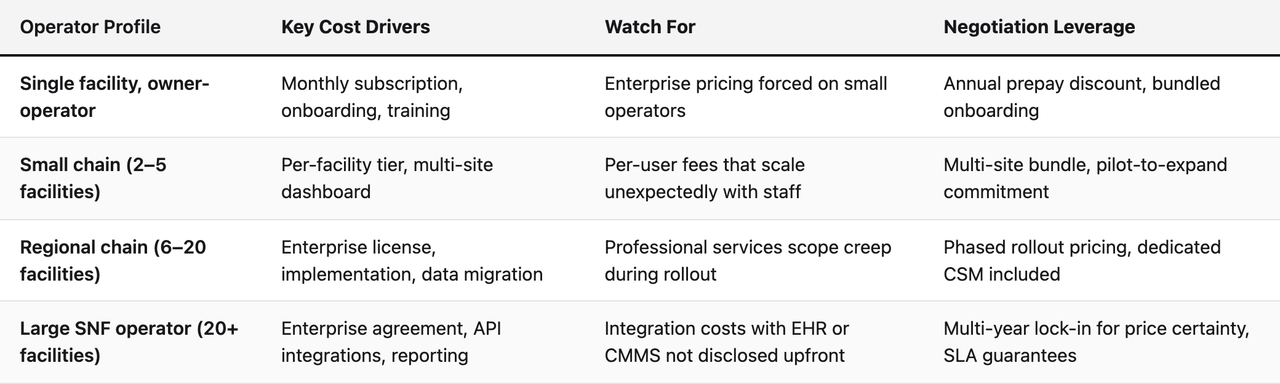
Life safety compliance platform pricing in the SNF market varies significantly, and the visible per-facility or per-bed pricing rarely represents the total cost of ownership. A thorough pricing evaluation requires surfacing the costs that appear after the contract is signed.
Map the full cost structure before comparing quotes
Request a complete breakdown of all costs associated with the platform over a 24-month period, including:
- Base subscription fee: Per facility, per bed, or per user. Understand exactly how the tier changes as you add facilities or staff.
- Implementation and onboarding: Is initial setup included? Is data migration from your current system (even if that system is a spreadsheet) included or billed separately?
- Task library customization: If you need to add state-specific tasks or modify templates to match your specific equipment inventory, is that included or billed as professional services?
- Training: Is onboarding training for maintenance staff included? What about training for new hires after initial setup?
- Support: What is the support model, email only, phone, dedicated account manager? What is the response SLA for a critical issue (e.g., the platform is inaccessible the morning of an unannounced survey)?
- Regulatory update maintenance: When CMS updates Conditions of Participation or a state changes its inspection frequency requirements, does the vendor update the task library, and is that included in the subscription or billed separately?
Calculate the cost of not buying
Life safety citations in skilled nursing facilities carry real financial consequences. A single deficiency cited under CMS Conditions of Participation for nursing facilities can range from a plan of correction requirement to civil monetary penalties depending on scope and severity. For immediate jeopardy citations, penalties can reach tens of thousands of dollars per day. Beyond direct penalties, repeated life safety deficiencies affect Five-Star Quality Rating scores, which directly influence census, referral relationships with hospital discharge planners, and managed care contracting leverage.
The calculation is not: "Is this platform worth $X per month?" The calculation is: "What is the expected cost of a K-tag citation that this platform would have prevented, multiplied by the probability that such a citation occurs in the next 24 months without it?" For most SNF operators who have had life safety citations in the last three years, the math resolves in favor of the platform at almost any reasonable price point.
Pricing Structure Comparison by Operator Type
How to Run a Structured Vendor Evaluation Process
With evaluation criteria defined, the structure of the vendor evaluation process itself matters. An unstructured evaluation, taking demos in whatever order vendors schedule them, comparing notes informally, and making a decision based on the strongest sales pitch, reliably produces poor outcomes. Here is a structured process that produces defensible, outcome-aligned decisions.
Step 1: Issue a written Requirements Brief to all vendors (estimated time: 2 hours)
Before any demo, send each vendor a one-page Requirements Brief that describes your facility profile (number of sites, beds, staff using the platform), your current compliance infrastructure (paper binder, spreadsheet, existing software), your specific regulatory exposure (states of operation, recent citation history), and your top three evaluation priorities. This does two things: it filters out vendors who can't credibly address your requirements before you spend time in a demo, and it forces each vendor to prepare a demo that addresses your actual situation rather than running their standard product tour.
Step 2: Score demos against a structured rubric (estimated time: 1 hour per vendor)
Use the evaluation criteria from this guide to build a scoring rubric before the first demo. Score each vendor on the same criteria, with the same weights, immediately after each demo while the details are fresh. Criteria to score (each on a 1–5 scale):
- Regulatory task library depth and accuracy
- Data field enforcement and gap detection capability
- Mobile and kiosk interface usability
- Survey readiness documentation output
- Audit trail integrity and tamper evidence
- Contractor report management and deficiency tracking
- Multi-site portfolio visibility (if applicable)
- Pricing transparency and total cost clarity
- Vendor regulatory expertise (not just product knowledge)
- Implementation and ongoing support model
Step 3: Conduct a structured reference check focused on survey outcomes (estimated time: 30 minutes per reference)
Ask each vendor for three references at facilities similar to yours in size and operational context. Do not use the reference call to validate general satisfaction, use it to ask specific survey outcome questions:
- Did you have life safety citations before implementing this platform? Have you had any since?
- Has the platform ever caught a documentation gap before survey that you know would have been cited?
- How did the platform perform during an actual unannounced survey, specifically around document retrieval?
- What documentation gaps did implementation reveal that you didn't know existed before?
- If you had to do it over, what would you evaluate differently?
These questions are uncomfortable for vendors to facilitate because they require references to describe pre-implementation problems. A vendor who pushes back on this line of questioning is telling you something important.
Step 4: Request a pilot or proof-of-concept at one facility before full commitment
For multi-site operators, a pilot at a single facility for 60–90 days before full rollout is a reasonable and standard request. Use the pilot to test real-world adoption rates, verify gap detection accuracy against your known compliance record, and surface implementation friction before it affects your entire portfolio. A vendor who resists a structured pilot for a multi-site commitment is prioritizing contract execution over your outcomes.
How to Evaluate Vendor Regulatory Expertise, Not Just Product Features
The vendor behind a life safety compliance platform matters as much as the platform itself, particularly in a regulatory environment that changes when CMS updates its Survey and Certification memos, when NFPA releases a new edition of NFPA 101 or NFPA 99, or when your state health department revises its inspection protocols. A platform built and maintained by a team without deep healthcare regulatory expertise will fall behind these changes, and you'll discover the lag when a surveyor cites you for a task that was updated in the most recent CMS guidance but never reflected in your platform's task library.
Ask for the vendor's regulatory update history
Request a log of the last five regulatory updates the vendor made to the task library, including what triggered each update (a specific CMS Survey and Certification memo, a NFPA edition change, a state regulation revision), when the update was pushed to customers, and how customers were notified. A vendor with genuine regulatory expertise will have this documented. A vendor who built a task library once and hasn't updated it systematically since will struggle to answer the question.
Probe the team's actual healthcare background
Ask who on the vendor's team has direct experience managing life safety compliance at a healthcare facility, working as a life safety consultant, or serving as a CMS surveyor. This is not a credential requirement, it's a quality signal. A platform designed by people who have personally managed a NFPA 101 binder through an unannounced survey will have made different product decisions than one designed by a pure software team that interviewed a few maintenance directors before building the product. The difference shows up in the specific data fields in each task template, in the gap detection logic, and in the edge cases the platform handles correctly.
SEQURA, for example, was built with life safety consultants embedded in the product development process, a structural choice that shows up in the specificity of its task library and the sophistication of its documentation audit layer. That kind of regulatory depth is worth asking about explicitly with any vendor you evaluate.
Common Evaluation Mistakes That Lead to Wrong Platform Decisions
Drawing on patterns observed across SNF operators who have gone through compliance platform evaluations and ended up with a product that didn't deliver survey confidence, several recurring mistakes show up consistently:
Mistake 1: Optimizing for the administrator experience over the frontline experience
Platform demos are almost always conducted with the administrator-facing interface. Administrators see a clean dashboard, reporting tools, and compliance analytics, and score the platform highly. The maintenance technician who will use the platform 40 times per week for task logging never sees it until implementation. This is the most common source of adoption failure, and adoption failure produces documentation gaps. Always evaluate the frontline interface separately and explicitly.
Mistake 2: Treating "NFPA 101 compliant" as a meaningful differentiator
Every vendor in this space claims NFPA 101 coverage. The claim is almost always true and almost always insufficient as an evaluation criterion. The meaningful question is not whether NFPA 101 is covered, it's how it's covered. Are the data fields for each task specific enough to satisfy surveyor scrutiny? Is the cadence enforced or just suggested? Are the task descriptions written in regulatory language that maps to K-tag categories, or in generic maintenance language that a surveyor can't directly reconcile to the standard? "NFPA 101 compliant" is a starting point, not a differentiator.
Mistake 3: Underweighting implementation support
The gap between a platform working well in a demo and working well in your facility six months after go-live is almost entirely determined by implementation quality. Ask specifically: who manages your implementation? Is it a dedicated implementation specialist with healthcare background, or a generic customer success manager working 30 accounts simultaneously? What does the implementation include, just account setup and training, or actual configuration of your facility's task library, asset inventory, and staff accounts? Implementation quality is a leading indicator of long-term adoption and compliance record quality.
Mistake 4: Not testing offline functionality
Mechanical rooms, basement utility spaces, and exterior equipment locations often have poor or no WiFi coverage. If the platform requires a live internet connection to log task completions, your maintenance team will either skip logging in those areas (producing documentation gaps) or batch-log everything from the office later (producing documentation that doesn't reflect contemporaneous completion, which raises audit trail questions). Test offline functionality explicitly, in the specific physical contexts where your team works.
Frequently Asked Questions: SNF Life Safety Compliance Platform Evaluation
What is the difference between a CMMS and a life safety compliance platform for SNFs?
A Computerized Maintenance Management System (CMMS) is designed primarily to manage work orders, equipment maintenance schedules, and asset inventories across a facility. It tracks what maintenance was done and when. A life safety compliance platform for SNFs is designed to ensure that the specific inspections required by NFPA 101, NFPA 99, CMS Conditions of Participation, and state regulations are performed at the required cadence, documented with the required data elements, and audited for completeness against regulatory expectations. The critical difference is the audit layer: a CMMS records that a task was done; a compliance platform determines whether what was recorded is actually compliant. Many SNFs use a general CMMS and discover during surveys that complete-looking records have specific documentation deficiencies that a compliance-specific platform would have caught.
How do I know if my current paper binder or spreadsheet system has documentation gaps?
The most direct method is a mock survey audit conducted against your current records. Pull the last 12 months of documentation for your five highest-risk K-tag categories (typically K130/K147 for electrical systems, K321 for generator testing, K321 for fire drills, K351 for sprinkler systems, and K900 for utilities management). For each record, verify: Is every required data field present? Does the cadence of completions match the required frequency? Are there any contractor-noted deficiencies without corresponding corrective action documentation? Most facilities conducting this exercise find at least two to three gap categories that they weren't aware of. A life safety compliance platform surfaces these gaps continuously, not just when you decide to audit manually.
Can a life safety compliance platform actually prevent K-tag citations, or does it just organize documentation?
The most impactful platforms do both, and the distinction matters. Documentation organization, having records available, formatted, and retrievable during a survey, addresses the documentation retrieval problem. Gap detection and pre-survey auditing addresses the documentation quality problem. A platform that only organizes what you've already documented will still produce K-tags if what you've documented is incomplete. A platform with genuine gap detection capability surfaces the incompleteness before survey day, giving you the opportunity to complete corrective documentation. The platforms that most reliably prevent K-tags are the ones that function as continuous auditors, not just digital filing systems.
What K-tag categories are most commonly affected by documentation gaps versus actual compliance failures?
Based on patterns in CMS survey data and the structure of NFPA 101 requirements, the K-tags most frequently generated by documentation gaps rather than actual compliance failures include K321 (emergency generator testing, incomplete load data), K130 and K147 (electrical systems, missing data elements in inspection records), K351 and K353 (sprinkler systems, unresolved contractor deficiencies), and fire drill records across K712 and related categories (shift coverage gaps). These are distinct from K-tags that reflect actual physical deficiencies, blocked exits, inoperable fire doors, damaged sprinkler heads, which require physical remediation rather than documentation correction.
How long does it typically take to implement a life safety compliance platform at a single SNF?
Implementation timelines vary significantly by platform and by how much existing data needs to be migrated or configured. A well-structured implementation at a single facility, including account setup, asset inventory configuration, task library customization, and frontline staff training, typically takes two to four weeks from contract signing to full operational use. Platforms that require extensive professional services for setup tend to take longer and cost more. The more relevant question is: how long until the platform is producing reliable compliance records? That depends on adoption, which depends on how well the frontline interface matches actual workflow. Expect 30–60 days to reach stable adoption in most facilities.
What should I look for in a vendor's support model for an SNF environment?
The support model needs to account for the operational reality of skilled nursing facilities: maintenance staff work evenings and weekends, surveys happen without notice, and a platform issue the morning of an unannounced survey is a genuine operational crisis. At minimum, look for a support SLA that includes same-day response for critical issues during business hours, and a documented escalation path for after-hours emergencies. A dedicated account manager (not a shared support queue) for your facility or portfolio is a meaningful quality signal. Also ask about platform uptime guarantees, if the platform is cloud-based, what is the guaranteed availability SLA, and what is the protocol if the platform is inaccessible during a survey?
Do life safety compliance platforms integrate with EHR systems used at SNFs?
Direct integration between life safety compliance platforms and EHR systems (such as PointClickCare, MatrixCare, or similar platforms used in the SNF market) is not common, because the data domains don't naturally overlap, life safety documentation lives in the facilities management domain, while EHR data lives in the clinical domain. Where integration does occur, it's typically for shared staff directory data (ensuring that staff assignments in the compliance platform match the current employee roster) or for reporting purposes at the corporate level. If EHR integration is important to your workflow, ask the vendor specifically what integration capability exists and whether it requires custom development.
How should I evaluate a platform's approach to regulatory updates when NFPA or CMS changes requirements?
Ask the vendor to describe their process from the moment a CMS Survey and Certification memo is published to the moment the corresponding task library update reaches your facility's task queue. The answer should include: who on the vendor's team monitors CMS and NFPA regulatory publications, what is the typical lag between a regulatory change and a platform update, and how are customers notified of changes to their task library. A vendor without a defined process for this is implicitly putting the regulatory monitoring burden on you, which defeats a significant part of the platform's value proposition.
Is a life safety compliance platform worth the investment for a single-facility SNF?
The investment calculus for a single-facility operator centers on citation risk and administrative time. On the risk side: a single K-tag citation at immediate jeopardy scope can produce civil monetary penalties that exceed a year's subscription cost in a single survey cycle. On the administrative side: the time a maintenance director spends manually building and organizing paper documentation, typically estimated at several hours per week across weekly, monthly, quarterly, and annual tasks, represents a real labor cost that a platform reduces significantly. For facilities with recent citation history or upcoming survey windows, the investment is almost always justified. For facilities with clean recent survey records, the platform functions as risk insurance with operational efficiency benefits.
What is the most important question to ask a vendor that most buyers don't ask?
Ask: "Show me a documentation gap your platform would catch that a well-maintained paper binder would miss." If the vendor can give you a specific, concrete example, ideally demonstrated live in the platform, with a clear explanation of why the binder would miss it and why the platform catches it, you're evaluating a genuinely capable product. If the answer is a general description of dashboard features or a reference to AI capabilities without a concrete example, the gap detection capability is either not mature or not designed for the regulatory specificity that SNF compliance requires.
How do I handle staff resistance to switching from paper-based compliance documentation?
Staff resistance to new compliance systems is almost always a function of perceived friction, not principled objection. Maintenance directors and technicians who have managed paper binders for years aren't attached to paper, they're attached to a workflow that works for them. The adoption approach that works is to demonstrate, in the first training session, a specific scenario where the platform prevents a problem they've personally experienced: a fire drill log that got lost, a generator test that was done but not properly documented, a contractor report that sat in a folder without triggering a corrective action. When frontline staff see the platform solving a real problem they recognize, resistance converts to engagement. Platforms with genuinely intuitive mobile interfaces accelerate this conversion significantly.
What contract terms should I negotiate before signing with a life safety compliance platform vendor?
Key contract terms to negotiate include: a defined SLA for regulatory task library updates when CMS or NFPA changes requirements (with a remedy if updates are delayed); data portability provisions ensuring you can export your complete compliance history in a readable format if you change platforms; uptime guarantees with defined remedies for downtime; and a clear scope of implementation services included in the base price versus billed separately. For multi-site operators, negotiate pricing lock-ins that account for facility additions at a defined per-facility rate, preventing unexpected price increases as your portfolio grows. Always have legal counsel review data handling and HIPAA-adjacent provisions, even though life safety documentation typically does not include protected health information.
Key Takeaways: Your SNF Life Safety Compliance Platform Evaluation Checklist
Use this framework as a structured checklist when evaluating life safety compliance platforms for your skilled nursing facility or portfolio:
- Define the problem before the demo. Know whether your citations come from tasks not performed, documentation incompleteness, or missing corrective action linkage, the answer shapes your evaluation priorities.
- Test the task library with specific regulatory scenarios. Ask for the generator test template, the fire drill template, and the sprinkler deficiency workflow. Evaluate whether required data fields are enforced, not just present.
- Require a live demonstration of gap detection. Submit an incomplete record in the demo environment and observe exactly what happens. If the system accepts it without surfacing a gap, the audit layer is not functional.
- Evaluate the frontline interface separately from the administrator interface. Walk through the mobile or kiosk experience as a maintenance technician completing a real task. Adoption at the frontline determines the quality of your compliance record.
- Test document retrieval under simulated survey conditions. Time how long it takes to produce a complete, organized compliance package in response to a specific surveyor request. Under five minutes is the target.
- Verify audit trail integrity. Confirm that records cannot be silently edited after submission, and that every entry is timestamped and attributed to a specific individual.
- Evaluate contractor report integration. Confirm that contractor deficiencies link to a corrective action workflow, not just a file folder.
- Map total cost of ownership over 24 months. Include implementation, training, regulatory updates, and support in your cost comparison, not just the base subscription fee.
- Ask about the vendor's regulatory update process. The platform you buy today needs to reflect the regulatory requirements of next year's survey. Confirm the vendor has a defined, documented process for keeping the task library current.
- Conduct structured reference checks focused on survey outcomes. Ask references specifically whether the platform caught gaps before survey, not just whether they're generally satisfied.
- Request a pilot before full commitment for multi-site operators. A 60–90 day pilot at one facility surfaces adoption issues and implementation gaps before they affect your entire portfolio.
The maintenance director in Ohio who received four K-tags despite a well-organized binder wasn't careless. He was working with a documentation system that had no mechanism to audit itself. The right life safety compliance platform changes that dynamic: it makes the gaps visible before the surveyor does, and it makes your documentation defensible when the surveyor arrives. That is the outcome worth evaluating for, and the framework above is designed to help you find the platform that actually delivers it.
About the author
Benjamin Terebelo · Founder
Benjamin is the founder of SEQURA, a compliance platform purpose-built for healthcare facilities. He builds at the intersection of healthcare operations and software, maintaining a focus on bringing modern tooling to systems that the broader industry has largely left behind.
About the author
Benjamin Terebelo · Founder
Benjamin is the founder of SEQURA, a compliance platform purpose-built for healthcare facilities. He builds at the intersection of healthcare operations and software, maintaining a focus on bringing modern tooling to systems that the broader industry has largely left behind.