24 min read
How to Use Compliance Gap Reports to Run a Productive Monthly Operations Review With Your SNF Leadership Team
Compliance gap reports only create value when leadership acts on them. Use this structured walkthrough to turn monthly data into survey-readiness decisions with your SNF team.
By Benjamin Terebelo

Most monthly operations reviews in skilled nursing facilities follow a predictable rhythm: the administrator prints a stack of reports, the team runs through them one by one, someone takes notes, and the meeting ends with a vague commitment to "follow up on the open items." Six weeks later, the same items are still open. Then a surveyor walks through the door.
The problem is not that SNF leadership teams lack the will to act on compliance data. The problem is that most facilities have never built a structured process for turning compliance gap reports into decisions. The data exists. The binders exist. The meetings exist. What is missing is the translation layer between "here is what the report shows" and "here is who owns this, what they will do, and when it will be closed."
This guide walks through exactly that translation. It is built around SNF compliance gap reports as the operational backbone of a monthly review, and it is designed for the administrator who wants to run a meeting that produces survey-readiness decisions, not just awareness of problems. Each step is specific, sequenced, and grounded in how CMS surveyors actually evaluate documentation during an unannounced visit.
What a Compliance Gap Report Actually Is (and What It Is Not)
A compliance gap report is a structured comparison between what your facility's documentation shows and what CMS or state regulations require it to show. It is not a to-do list. It is not a dashboard of green and red lights. It is an audit output that tells you, for each regulated asset or process category, where the evidentiary record has a hole that a surveyor would find and cite.
Understanding this distinction matters for how you run your SNF operations review. Many administrators treat gap reports as a checklist of tasks that were not completed. That framing is too narrow. A gap can exist even when a task was completed, if the documentation of that completion is missing a required element. A generator test that was performed but logged without the kW load reading is not a complete record under NFPA 110. A fire drill that covered day and evening shifts but has no documentation of a night-shift drill in the previous 12-month cycle is a gap. A sprinkler system inspection that was completed by a contractor but whose deficiency report was never formally reconciled is a gap.
The categories that produce the most life safety citations during CMS surveys cluster around a predictable set of K-tag areas:
- K211 and K225: Means of egress, corridor clearance, and door hardware compliance
- K321 and K325: Sprinkler system maintenance and deficiency follow-up documentation
- K712: Emergency generator testing, fuel, and transfer switch records
- K754: Fire drill frequency, shift coverage, and critique documentation
- K900 series: Electrical system inspections and ground fault protection records
A well-structured compliance gap report surfaces findings across these categories in a way that makes prioritization possible. Before your monthly review meeting, every member of the leadership team needs to understand that the gap report is not an indictment of their staff. It is a map of where the facility's documentation would fail under surveyor scrutiny right now, and therefore where decisions need to be made before the next unannounced visit.
Step 1: Build the Right Room Before the Meeting Starts
Estimated time: 30–45 minutes of pre-meeting preparation.
The most common failure mode in SNF operations reviews is the wrong people in the room. Compliance gap reports span multiple departments, and the decisions they generate require authority from multiple roles. If your maintenance director is the only person who sees the life safety data, the administrator learns about critical gaps secondhand and cannot make informed resource decisions in real time.
The core participants for a compliance-focused monthly operations review should include:
- The administrator or executive director (decision authority on resource allocation)
- The maintenance director or plant operations manager (owns the task completion data)
- The director of nursing or a DON designee (owns environment-of-care compliance and staff behavior in drills)
- The EVS director (owns sanitation-related inspections, eyewash stations, and shared compliance tasks)
- A regional facilities manager or compliance officer, if applicable (provides cross-facility context)
What you do not need in the room: every department head in the building. Compliance gap reviews become unfocused when they turn into all-hands status updates. The people listed above are the ones who can make decisions. Everyone else should receive a summary after the fact.
Before the meeting, distribute the gap report at least 48 hours in advance. This is not a courtesy, it is a structural requirement. If participants see the data for the first time during the meeting, the first 20 minutes will be spent reading instead of deciding. The administrator should send the report with a brief framing note: "Review the open items in your area before Thursday. Come prepared to explain the status and propose a close date."
Set a firm agenda with time allocations. A productive compliance operations review runs 60–75 minutes, not two hours. Structure it as:
- Gap report summary review (15 minutes)
- High-priority item deep dives (25 minutes)
- Owner assignments and close-date commitments (15 minutes)
- Survey-readiness posture assessment (10 minutes)
- Action log review from prior month (10 minutes)
Common mistake to avoid: Starting the meeting with the prior month's action log. This puts the team in a defensive posture before the new data is even on the table. Start with the current gap report summary so the conversation is forward-looking from the first minute.
Step 2: Open With the Gap Report Summary, Not the Details
Estimated time: 15 minutes.
The gap report summary is the 30,000-foot view: how many open gaps exist, how they are distributed across K-tag categories, and how that distribution compares to the prior month. This is the compliance dashboard for leadership that gives the administrator a posture read before the team goes into specific items.
A well-structured summary should answer four questions at a glance:
- How many documentation gaps are currently open?
- Which K-tag categories have the highest concentration of gaps?
- Which gaps are newly identified this month versus carry-forwards from prior months?
- Which gaps carry the highest citation risk if a surveyor arrived today?
The fourth question is the one most facilities skip, and it is the most important for prioritization. Not all gaps carry equal citation risk. A missing signature on a routine inspection log is a gap, but it is categorically different from an unreconciled sprinkler deficiency that has been open for 47 days. The administrator needs to understand that distinction before the team starts discussing individual items.
If your facility uses a platform like SEQURA's life safety compliance dashboard, the summary view is generated automatically from completed and incomplete inspection records, with gaps flagged by category and severity. If you are working from manual records or a spreadsheet-based system, the maintenance director should prepare this summary in advance using the same four-question framework.
During the 15-minute summary review, the administrator's role is to ask three calibrating questions:
- "Which of these gaps would a surveyor find within the first two hours of an unannounced visit?"
- "Are there any gaps here that have been open for more than 30 days?"
- "Is there anything on this report that represents a genuine safety risk to residents, not just a documentation risk?"
The third question is critical because it distinguishes between compliance risk and safety risk. Both matter, but they trigger different response timelines. A genuine safety risk requires immediate corrective action regardless of the meeting schedule. A documentation gap requires a structured remediation plan with an owner and a close date.
Pro tip: Create a visual heat map of the gap report by K-tag category and display it on a shared screen during this segment. Color-coding by recency (new gaps in red, carry-forwards in amber, items with close plans in yellow) gives the team an immediate visual read on where attention is needed without requiring everyone to parse a dense spreadsheet.
Step 3: Run Structured Deep Dives on High-Priority Gaps
Estimated time: 25 minutes, approximately 5–8 minutes per high-priority item.
After the summary review, the team moves into deep dives on the highest-priority gaps. The administrator should cap this segment at three to five items. If you try to deep-dive every open gap in a 25-minute window, you will cover none of them adequately. The goal is decision-quality conversation on the items that carry the most citation risk, not a comprehensive audit of every open item.
For each high-priority gap, the structured deep dive follows a five-part protocol:
Part 1: State the Gap Precisely
The maintenance director reads the gap exactly as it appears in the report, including the K-tag reference, the specific documentation requirement that is not met, and the last date on which a compliant record exists. Precision here is non-negotiable. "The generator records have some issues" is not a gap statement. "K712: The monthly generator exercise log for the load bank test conducted last month is missing the kW load reading and duration data required under NFPA 110 Section 8.4.2" is a gap statement.
Part 2: Identify the Root Cause
Why does this gap exist? The answer is usually one of three things: the task was not completed, the task was completed but not documented correctly, or the documentation exists but was not filed in the right location. Each root cause requires a different corrective action. A task-completion failure requires a process or staffing fix. A documentation-quality failure requires training or a template change. A filing failure requires a records management fix.
Part 3: Assess the Citation Risk Timeline
How long has this gap been open? If a surveyor arrived today, how quickly would they find it? The answers to these questions determine urgency. A gap that has been open for 60 days and sits in a category that CMS surveys routinely examine in the first hours of an inspection is a different priority than a gap that opened last week in a category that typically receives less scrutiny.
Part 4: Determine the Corrective Action
What specifically needs to happen to close this gap? "Fix the generator records" is not a corrective action. "Retrieve the original test data from the technician's notes, enter the kW reading and duration into the log, have the maintenance director countersign, and file in the K712 documentation folder by end of day Friday" is a corrective action. Every corrective action needs a verb, a specific output, and a specific person.
Part 5: Assign the Owner and Close Date
One person owns each gap closure. Not "the maintenance department." One named individual who is accountable for confirming, at next month's review, that the gap is closed and the documentation is complete. The close date should be realistic but not generous. If the corrective action can be completed in two days, the close date is two days from today, not the end of the month.
Warning: Avoid the temptation to skip root cause analysis on familiar gaps. If the same type of gap appears month after month in the same category, the root cause is systemic, not situational. A systemic root cause requires a process change, not another corrective action on the same item.
Step 4: Use the K-Tag Framework to Prioritize Across Categories
Estimated time: Built into the deep dive segment.
Not all K-tags carry equal weight in CMS survey outcomes. Understanding the surveyor's typical inspection pathway helps the administrator allocate attention appropriately during the operations review. While CMS surveyors have discretion in how they conduct life safety surveys, certain K-tag categories appear in a high proportion of cited deficiencies across skilled nursing facilities.
The following prioritization framework, grounded in the CMS life safety survey protocols, can help your team triage gap report items before the meeting even starts:
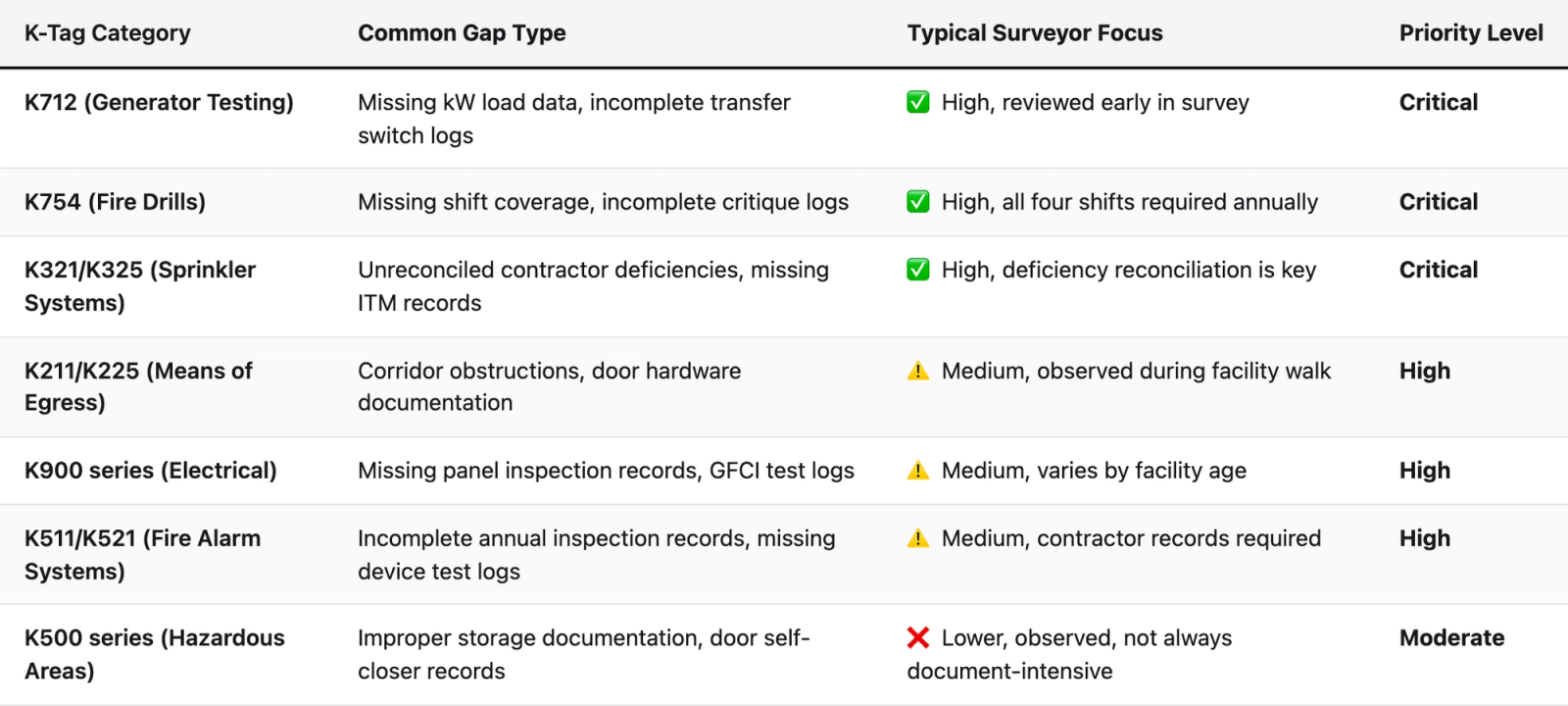
Use this framework as a triage filter before the meeting. When you have 12 open gaps and 25 minutes for deep dives, the K-tag priority level tells you which three to five items get the structured five-part protocol and which items get a quick owner-assignment without a deep dive.
Step 5: Conduct the Owner Assignment and Commitment Round
Estimated time: 15 minutes.
After the deep dives, the administrator runs a rapid ownership round that covers every open gap in the report, not just the high-priority items. The goal is to ensure that every gap has a named owner and a specific close date before the meeting ends. This is the accountability infrastructure that makes the monthly review a functional CMS survey preparation review rather than a data-sharing exercise.
The format is simple and deliberately fast. For each remaining gap, the administrator reads the item and asks two questions:
- "Who owns this?"
- "What is your close date?"
The owner states their name and a specific date. The administrator or a designated note-taker logs it in the action register. No discussion. If an item requires discussion, it should have been in the deep dive segment. If something comes up during the ownership round that genuinely requires decision-making, the administrator has two options: schedule a brief side meeting with the relevant parties after the main review, or bump a lower-priority deep dive from next month's agenda to accommodate it now.
The action register that comes out of this segment is the most important document the meeting produces. It should contain:
- The gap description and K-tag reference
- The corrective action required
- The named owner
- The committed close date
- A status field (open, in progress, closed) that is updated between meetings
Send the action register to all meeting participants within 24 hours of the meeting. This is not optional. A commitment made in a room and never documented is not a commitment. The 24-hour distribution creates a written record that every owner has received and acknowledged their assignment.
Common mistake to avoid: Letting owners set close dates at the end of the month by default. If today is the 8th and the close date is the 30th, that is 22 days for a corrective action that might take two hours to complete. Push back on artificially padded timelines. The right close date is the date by which the corrective action can realistically be completed, not the date that feels administratively convenient.
Step 6: Assess Your Survey-Readiness Posture
Estimated time: 10 minutes.
After the ownership round, the administrator conducts a brief survey-readiness posture assessment. This is a structured conversation, not a report review, and it produces a single output: a posture rating that the administrator carries into the next month as a benchmark.
The posture assessment answers three questions:
Question 1: If a Surveyor Arrived Tomorrow, What Would They Find?
The maintenance director and administrator walk through the surveyor's likely first steps: requesting the life safety binder or documentation system access, walking the egress corridors, reviewing fire drill logs, and asking for the generator test records. Based on the current state of the gap report, how would the facility perform in the first two hours of that survey? This is the most honest signal of actual survey readiness, and it is more useful than any aggregate compliance score.
Question 2: What Is Our Highest-Risk Open Item Right Now?
There is always a highest-risk item. Naming it explicitly during the posture assessment creates urgency without panic. The administrator asks: "If I had to pick the one open gap that could produce a citation next week, what is it?" The answer to this question should already have an owner and a close date from the prior segment. If it does not, it gets one now.
Question 3: Are There Any Systemic Patterns in This Month's Gaps?
If the same type of gap has appeared in three consecutive monthly reviews, the facility has a systemic problem that individual corrective actions will not fix. The posture assessment is the right moment to name that pattern, because it requires a different kind of decision: a process change, a staffing change, a training initiative, or a technology intervention. The administrator cannot solve a systemic pattern by assigning it to the maintenance director as a task. It requires a structural fix with leadership backing.
At the end of the posture assessment, the administrator states a posture rating using a simple three-level scale:
- Survey-ready: All critical gaps have close plans, no open items in the highest-risk categories, documentation is current and accessible.
- Manageable exposure: Some open gaps exist, but none are in critical categories without close plans. The facility could receive a survey and defend its position.
- Elevated risk: One or more critical gaps are open without close plans, or a pattern of recurring gaps suggests a systemic issue. Immediate corrective action is required before the next scheduled review.
This rating is not shared publicly, but it is documented internally and shared with regional leadership if the facility operates within a multi-site group. It gives the administrator a one-word summary of where the facility stands at month-end, and it creates a longitudinal record of whether survey readiness is improving or deteriorating over time.
Step 7: Close With the Prior Month's Action Log Review
Estimated time: 10 minutes.
The final segment of the meeting closes the loop on last month's commitments. The administrator reads each item from the prior month's action register and asks the owner to confirm its status. There are only three acceptable statuses:
- Closed: The corrective action is complete, the documentation is filed, and the gap no longer appears on the current report. The owner briefly confirms the close date and what was done.
- In progress with a revised close date: The corrective action is underway but not complete. The owner states the reason for the delay and commits to a new close date. The administrator accepts or challenges the new date.
- Not started: This is the status that requires the most direct response from the administrator. If a committed corrective action has not been started in 30 days, the administrator needs to understand why. The conversation should be direct and problem-solving in orientation, not punitive, but the failure to start a committed action is a process signal that something is broken, whether that is capacity, priority confusion, or unclear ownership.
The prior-month log review takes 10 minutes because it is structured, not open-ended. The administrator is not re-litigating decisions from last month. The administrator is verifying that commitments were honored and that the facility's documentation posture is actually improving month over month.
If the same item appears on three consecutive action logs without being closed, the administrator escalates it. At that point, the item is not a corrective action, it is a systemic failure, and it needs a different kind of intervention: additional resources, outside contractor support, a process redesign, or a direct conversation with the owner about whether they have what they need to close the gap.
Pro tip: Track the close rate on your monthly action log as a facility performance metric. If your team consistently closes 85% or more of committed items by their due dates, your operations review process is working. If your close rate is below 60%, the problem is not the gap report, it is the meeting structure or the commitment quality. Revisit how you are setting close dates and assigning owners.
How SEQURA's Life Safety Reporting Changes What Is Possible in This Meeting
The process described in this guide can be run with any documentation system, including paper binders and spreadsheets. But the quality of the decisions you can make in 75 minutes is directly proportional to the quality of the gap data you bring into the room. This is where the difference between manual documentation systems and purpose-built life safety reporting for administrators becomes operationally significant.
When the maintenance director manually compiles the gap report before the monthly review, two things happen. First, the report reflects what the maintenance director knows about and has noticed. Gaps that exist in contractor records, shift logs, or inspection fields the director does not routinely review are invisible. Second, the compilation takes time, often several hours, that the maintenance director spends on report preparation instead of remediation.
SEQURA's AI review layer changes both of those constraints. Because the platform reads completed inspection records, contractor reports, and shift logs against the regulatory expectations for each K-tag category, the gap report it generates reflects what the documentation actually shows, not what the maintenance director remembers. Missing kW load readings, unreconciled sprinkler deficiencies, fire drill logs missing night-shift coverage: these are the gaps that are typically invisible to the person doing the documentation and therefore invisible in a manually compiled report.
For the monthly operations review, this means the administrator walks into the meeting with a gap report that has already done the cross-referencing work. The team's 75 minutes is spent on decisions, not discovery. The deep dives go deeper because the gap descriptions are precise. The ownership round is faster because the items are specific. The posture assessment is more accurate because the data is complete.
For multi-site operators, the value compounds. A regional VP of operations can compare posture ratings across facilities, identify which sites have recurring systemic gaps, and allocate compliance support resources based on actual risk data rather than anecdotal reports from site administrators.
Building the Monthly Review Into a Sustainable Rhythm
A single well-run compliance operations review produces decisions. A sustained monthly rhythm produces a culture of survey readiness that fundamentally changes how CMS surveys feel when they happen.
Facilities that run this process consistently for six months or more typically see three behavioral shifts in their teams. First, the maintenance director begins thinking about documentation quality proactively, because they know the gap report will surface deficiencies that will be discussed in front of the administrator and the DON. Second, corrective actions get closed faster, because the 30-day accountability cycle creates a visible consequence for open items. Third, the administrator develops a more accurate intuitive sense of the facility's survey-readiness posture, because the monthly posture assessment gives them a consistent signal to track over time.
To sustain the rhythm, protect three things:
- The meeting date: Schedule the compliance operations review as a standing monthly commitment, not a meeting that gets scheduled when it is convenient. If it competes with other priorities, it will lose. Block it in advance for the full year.
- The preparation window: The 48-hour pre-distribution of the gap report is not optional. If participants see the data for the first time in the meeting, the meeting quality degrades immediately. Build the preparation window into the process as a non-negotiable step.
- The action register: The action register is the institutional memory of the process. If it is not maintained and distributed consistently, the accountability loop breaks. Assign one person, usually the administrator's designee, as the keeper of the action register and make them responsible for distribution within 24 hours of each meeting.
Consider a quarterly review of the process itself, separate from the monthly content review. Every three months, the administrator and the maintenance director spend 30 minutes asking: Is the gap report giving us the right information? Are our deep dives producing the right decisions? Are our close dates realistic? Is our posture improving? This meta-review prevents the process from becoming ritualized without remaining useful.
Integrating the Operations Review With Your Annual CMS Survey Preparation Review
The monthly operations review is not a substitute for the more intensive annual or semi-annual CMS survey preparation review that most SNFs conduct before their anticipated survey window. It is the foundation that makes that annual review less stressful and more focused.
When your facility has run 12 consecutive monthly compliance operations reviews, the annual survey preparation review becomes a different kind of meeting. Instead of discovering gaps that have been accumulating for months, the team reviews a longitudinal record of gap patterns, closure rates, and posture ratings. The administrator can point to specific months where systemic issues were identified and corrected. The maintenance director can demonstrate that the documentation system has been consistently maintained, not recently assembled in anticipation of a survey.
This longitudinal record is itself a form of survey defense. CMS surveyors evaluate not just whether documentation is current, but whether there is evidence of an ongoing compliance management process. A facility that can show 12 months of monthly compliance reviews, with action logs, owner assignments, and documented posture assessments, is presenting a fundamentally different picture than a facility that produces a binder of records without any evidence of how those records were managed over time.
The CMS State Operations Manual Appendix PP makes clear that facilities are expected to have systematic processes for identifying and correcting compliance deficiencies, not just current documentation. The monthly operations review, run consistently and documented properly, is direct evidence of that systematic process.
Frequently Asked Questions
How often should an SNF run a compliance gap report review?
Monthly is the minimum effective cadence for a formal compliance gap report review with leadership. For facilities that have recently received citations, are in a remediation period, or are operating in a state with a high survey frequency, bi-weekly reviews of the gap report with the maintenance director are appropriate. The monthly leadership meeting remains the decision-making forum; the bi-weekly touchpoint is a status check on corrective action progress.
Who should own the gap report compilation process?
The maintenance director or plant operations manager owns the gap report compilation when the facility uses a manual or spreadsheet-based system. When the facility uses a purpose-built platform like SEQURA, the gap report is generated automatically from the system's AI review layer, and the maintenance director's role shifts from compilation to interpretation. In either case, the administrator is the consumer of the report and the decision-maker, not the compiler.
What is the difference between a gap report and a deficiency report?
A deficiency report, in the CMS context, is a formal citation issued by a surveyor during or after an inspection. A compliance gap report is an internal document that identifies where the facility's documentation would not satisfy surveyor scrutiny if an inspection occurred today. The gap report is a pre-survey tool; the deficiency report is a post-survey consequence. The purpose of running monthly gap reports is to eliminate the documentation conditions that produce deficiency reports.
How detailed should gap report items be?
Each gap report item should be specific enough to enable a corrective action without further investigation. It should identify the K-tag category, the specific documentation element that is missing or deficient, the date or date range of the deficiency, and the regulatory standard that establishes the requirement. Vague gap descriptions like "generator records incomplete" are not actionable. Precise descriptions like "K712: Monthly load bank test log for the past month is missing kW reading and duration data per NFPA 110 8.4.2" enable immediate corrective action.
What happens if the same gap appears every month?
Recurring gaps are systemic failures, not individual task failures. When the same gap appears in three or more consecutive monthly reports, the administrator should initiate a root cause analysis that goes beyond the immediate corrective action. Common systemic causes include inadequate documentation templates, unclear task assignments, staff turnover that breaks knowledge continuity, or contractor documentation practices that do not meet facility requirements. Each of these requires a structural fix, not a repeated corrective action.
Can the monthly operations review replace a formal life safety audit?
No. The monthly compliance operations review is an internal management process, not a formal audit. Facilities should still conduct periodic formal life safety audits, either with internal compliance officers or external life safety consultants, that evaluate the physical environment, equipment, and documentation systems comprehensively. The monthly review is designed to maintain compliance momentum between formal audits, not to substitute for them.
How should a multi-site operator adapt this process?
Multi-site operators should run the individual facility review at the site level, with the site administrator and maintenance director, and then conduct a regional roll-up review with the regional VP or facilities director that aggregates posture ratings and identifies cross-facility patterns. The regional review is typically shorter (30–45 minutes) and focuses on relative risk across sites and resource allocation decisions. A compliance dashboard that aggregates gap data across facilities makes the regional review significantly more efficient.
What documentation should the facility retain from each monthly review?
The facility should retain the gap report itself, the meeting agenda, the action register with owner assignments and close dates, and the posture assessment rating. These documents collectively constitute the facility's compliance management record and provide evidence of a systematic compliance process if questioned during a survey. Retain these records for a minimum of three years, consistent with general CMS documentation retention guidance.
How does the operations review interact with the QAPI process?
The monthly compliance operations review and the facility's Quality Assurance and Performance Improvement (QAPI) process are complementary but distinct. QAPI under CMS requirements for skilled nursing facilities addresses clinical quality and resident safety across all care domains. The compliance operations review is specifically focused on life safety and environmental documentation. Systemic patterns identified in the compliance review, particularly those that affect resident safety, should be escalated into the QAPI process for formal performance improvement tracking.
What is the right level of detail for fire drill gap items?
Fire drill gap items should specify the shift that is missing coverage, the quarter in which coverage is required, and the specific documentation element that is absent. Under NFPA 101 and CMS requirements, skilled nursing facilities must conduct fire drills on each shift at least once per year, with documented critiques. A gap item for fire drills should state: which shift is uncovered (day, evening, or night), which quarter the drill needs to occur in to maintain the annual cycle, and whether the issue is a missing drill or a drill that occurred but lacks required documentation elements like critique notes or staff participation records.
How should the administrator handle a gap that requires significant capital expenditure to close?
Gaps that require capital expenditure, such as replacing non-compliant door hardware, upgrading fire suppression components, or installing required safety equipment, cannot be closed with a simple corrective action. The administrator should document the gap as "in progress with a capital plan," specify the capital request that has been submitted or will be submitted, and establish an interim mitigation plan that reduces the citation risk while the capital process moves forward. Interim mitigation might include increased monitoring, temporary compensatory measures, or an accelerated contractor engagement timeline. The administrator should also consider whether the gap represents an immediate life safety risk that requires expedited capital approval outside the normal budget cycle.
Is there a standard format for the compliance gap report?
There is no CMS-mandated format for internal compliance gap reports. The standard is fitness for purpose: the report should enable the administrator and maintenance director to identify, prioritize, and act on documentation deficiencies with enough specificity to close them before a survey. Facilities using a platform like SEQURA receive a standardized report format aligned to K-tag categories and NFPA standards. Facilities using manual systems should develop a consistent template that includes the fields described in this guide: K-tag reference, specific gap description, date of deficiency, regulatory standard, and space for corrective action, owner, and close date.
Key Takeaways for Running a Productive SNF Compliance Operations Review
- The gap report is a survey simulation, not a task list. Its value is in showing you what a CMS surveyor would find if they arrived today, not in cataloguing incomplete work orders.
- Right people, right preparation. Distribute the gap report 48 hours before the meeting and limit attendance to decision-makers. Everyone else gets a summary afterward.
- Precision drives accountability. Vague gap descriptions produce vague corrective actions. Every item needs a specific K-tag reference, a specific documentation element, and a specific regulatory standard.
- The five-part deep dive protocol (state the gap, identify the root cause, assess citation risk, determine corrective action, assign owner and close date) produces decisions in 5–8 minutes per item when it is followed consistently.
- The K-tag priority framework tells you which gaps to deep-dive and which to assign quickly. Not all gaps carry equal citation risk.
- The action register is the meeting's most important output. Distribute it within 24 hours, track close rates month over month, and treat recurring items as systemic failures that require structural fixes.
- The posture assessment (survey-ready, manageable exposure, elevated risk) gives the administrator a longitudinal signal that a compliance score alone cannot provide.
- Twelve months of documented reviews constitute evidence of a systematic compliance management process, which is itself a form of survey defense under the CMS State Operations Manual.
- Purpose-built platforms like SEQURA change the economics of this process by automating gap identification across K-tag categories, freeing the maintenance director's time for remediation rather than report compilation, and enabling regional roll-up views for multi-site operators.
About the author
Benjamin Terebelo · Founder
Benjamin is the founder of SEQURA, a compliance platform purpose-built for healthcare facilities. He builds at the intersection of healthcare operations and software, maintaining a focus on bringing modern tooling to systems that the broader industry has largely left behind.
About the author
Benjamin Terebelo · Founder
Benjamin is the founder of SEQURA, a compliance platform purpose-built for healthcare facilities. He builds at the intersection of healthcare operations and software, maintaining a focus on bringing modern tooling to systems that the broader industry has largely left behind.
Topics
- SNF compliance gap reports
- SNF operations review
- life safety reporting for administrators
- compliance dashboard for leadership
- CMS survey preparation review


