
The Complete Asset Lifecycle Management Guide for SNF Plant Operations Teams

Most SNF maintenance directors can tell you the age of every HVAC unit on their roof. What they cannot always tell you is whether the documentation trail for that unit is actually defensible in a CMS survey. That gap, between knowing your equipment and proving its compliant lifecycle management, is where citations are born.
Asset lifecycle management in skilled nursing facilities is not fundamentally a maintenance problem. It is a documentation architecture problem. The physical work, the inspections, the filter changes, the generator load tests, gets done. What fails, consistently and expensively, is the structured record that connects each piece of equipment to every regulatory obligation it carries from the day it is commissioned to the day it is retired. This guide is written for the plant operations teams who own that gap and need a framework to close it permanently.
Why the Traditional Asset Binder Fails at Lifecycle Scale
The paper binder sitting in the maintenance director's office represents a structural mismatch between how SNFs operate and how CMS evaluates them. The binder is organized by document type. CMS surveys, by contrast, are organized by asset and by outcome. A surveyor asking about your fire alarm panel is not looking for a folder called "Fire Alarm." They are tracing a chain of evidence: commissioning record, annual inspection report, deficiency log, corrective action documentation, re-inspection confirmation, and any interim testing that NFPA 72 requires between full inspections. If any link in that chain is missing, the asset's entire compliance posture is compromised regardless of how well the physical equipment is functioning.
Paper binders fail at this because they were never designed to answer the question a surveyor is actually asking. They were designed to store documents. Asset lifecycle management, done properly, answers a different question entirely: for every regulated asset in this facility, can you prove that every required action was completed, documented correctly, and reconciled against the applicable standard, for the full period under review?
The Commissioning-to-Retirement Gap
Most SNF documentation systems, paper or digital, are reasonably good at the middle of asset life. Recurring inspection logs get completed. PM schedules get followed, more or less. Where systems break down is at the beginning and end of asset life. When a new HVAC unit is installed, who creates its compliance record in the master inventory? Who assigns it the correct NFPA 101 inspection cadence? Who links it to the K-tag categories it is relevant to? Who ensures the first post-installation inspection is scheduled within the required window?
The answer in most facilities is: nobody does this systematically. The unit gets installed. The contractor leaves paperwork. The paperwork goes into a folder. The folder goes into the binder. And the next time that unit appears in a structured context is when it fails inspection or triggers a citation. The commissioning record, which should be the anchor document for everything that follows, gets filed and forgotten rather than activated as the starting point of a living compliance record.
The retirement end is equally problematic. When an aging fire panel is decommissioned and replaced, the old panel's inspection history needs to be archived in a way that surveyors can access if they are reviewing a period when that panel was operational. The new panel needs a fresh compliance identity that carries forward any open deficiencies from the transition period. In practice, retirement documentation is often simply the absence of documentation, which creates ambiguity that surveyors treat as a gap.
What Asset Tracking Software Actually Needs to Do in an SNF
Generic asset tracking software was built for manufacturing, hospitality, or commercial real estate. It tracks location, age, depreciation, and maintenance history. That is useful, but it is not sufficient for a regulated healthcare environment. SNF plant operations teams need asset tracking that is regulation-aware, meaning the system understands that a particular generator has a monthly load test requirement under NFPA 110, a weekly visual inspection requirement, an annual full-load test requirement, and a specific documentation format that CMS surveyors will expect to see, including the kilowatt load reading that technicians routinely omit because nobody told them it was required.
The difference between generic asset tracking and compliance-grade asset lifecycle management is the difference between knowing an asset exists and knowing what that asset owes the regulatory record at every point in its life.
Building a Compliant Asset Inventory: The Foundation Layer
Before lifecycle management can function, the asset inventory itself has to be structured correctly. This is less obvious than it sounds. Many facilities maintain asset lists, in spreadsheets, in CMMS systems, in the maintenance director's head, but these lists are typically organized for operational convenience rather than regulatory accountability.
A compliance-grade asset inventory for an SNF has three structural requirements that most current systems do not meet.
Regulatory Classification by Asset Type
Every asset in the inventory needs to be classified not just by type (HVAC, fire alarm, sprinkler, generator) but by the specific regulatory framework that governs it. An HVAC unit in a skilled nursing facility is not just a mechanical system. It is an asset governed by NFPA 101 requirements for heating and ventilation in healthcare occupancies, potentially by CMS Conditions of Participation for environment of care, and by any state-specific engineering standards that add requirements on top of the federal baseline. The asset's compliance identity, which standards apply to it and at what inspection cadence, needs to be established at commissioning and maintained through its entire operational life.
This classification work is where most facilities underinvest. It requires someone who understands both the physical asset and the regulatory framework, a combination that does not always exist in a single person on a typical SNF maintenance team. Life safety consultants and NFPA-certified engineers are the appropriate resources for initial classification, and their work should be codified into the asset management system so that it persists regardless of staff turnover.
Location and Zone Mapping
Regulatory inspections are not just about asset type. They are about where the asset is located within the facility and what occupancy classification that zone carries. A smoke detector in a resident sleeping room has different inspection implications than the same model detector in a mechanical room. The asset inventory needs to capture location at a level of specificity that allows the compliance record to reflect these distinctions accurately.
Zone mapping also matters for fire drill documentation, which is one of the most frequently cited areas in SNF life safety surveys. Drill records need to demonstrate coverage of all facility zones, all shifts, and all resident populations. An asset inventory that includes zone classification makes this cross-referencing possible. One that does not makes it guesswork.
Contractor and Vendor Assignment
For many regulated assets, the inspection and maintenance work is performed by licensed contractors rather than in-house staff. Fire alarm systems, sprinkler systems, elevators, and medical gas systems all typically require licensed third-party inspection. The asset inventory needs to capture not just which contractor is responsible for each asset but also the contractor's license documentation, the contract terms that govern inspection frequency, and the reporting format the contractor uses, because contractor reports frequently omit information that CMS requires even when the inspection itself was thorough.
Contractor report reconciliation is one of the most significant hidden risks in SNF asset lifecycle management. A contractor completes a sprinkler inspection, finds no deficiencies, and submits a report. The report is filed. Six months later, a surveyor asks for documentation of the test and discovers that the report does not include the water flow rate data required under NFPA 25. The inspection happened. The documentation is incomplete. The citation is real. Effective asset lifecycle management includes a verification step where contractor reports are checked against the documentation standard before they are accepted into the compliance record.
The Inspection Cadence Architecture: Getting the Schedule Right
Scheduling recurring inspections is the operational core of asset lifecycle management, and it is where the difference between a compliant facility and a cited facility is most often determined. The challenge is not that SNF maintenance teams do not know inspections need to happen. The challenge is that the regulatory inspection universe for a mid-size SNF is genuinely complex, with dozens of distinct inspection types governed by different standards, at different frequencies, with different documentation requirements.
Mapping NFPA Requirements to Asset-Specific Schedules
NFPA 101, the Life Safety Code, and NFPA 99, the Health Care Facilities Code, together with NFPA 25 (sprinkler systems), NFPA 72 (fire alarm systems), and NFPA 110 (emergency power systems) create a regulatory landscape that requires careful translation into operational schedules. Each standard specifies inspection frequencies that are not always intuitive. NFPA 110 requires monthly generator tests under load for a minimum of 30 minutes, but also requires annual full-load tests, and requires specific data points to be recorded during each test. Missing any of these elements, even if the generator ran fine, creates a documentation deficiency.
The practical implication for asset lifecycle management is that the inspection schedule cannot be a simple calendar. It needs to be a regulation-aware task library that assigns specific data collection requirements to each inspection event, not just a reminder that the inspection is due. When a technician completes a monthly generator test, the system should require them to enter the kilowatt load reading, the run time, the voltage, and any anomalies observed. Not because the maintenance director wants that information, but because the CMS surveyor will.
Frequency Tiers and High-Risk Assets
Not all assets carry equal regulatory risk, and the inspection cadence architecture should reflect this. A useful framework for SNF plant operations teams is a three-tier frequency model based on regulatory exposure and consequence severity.
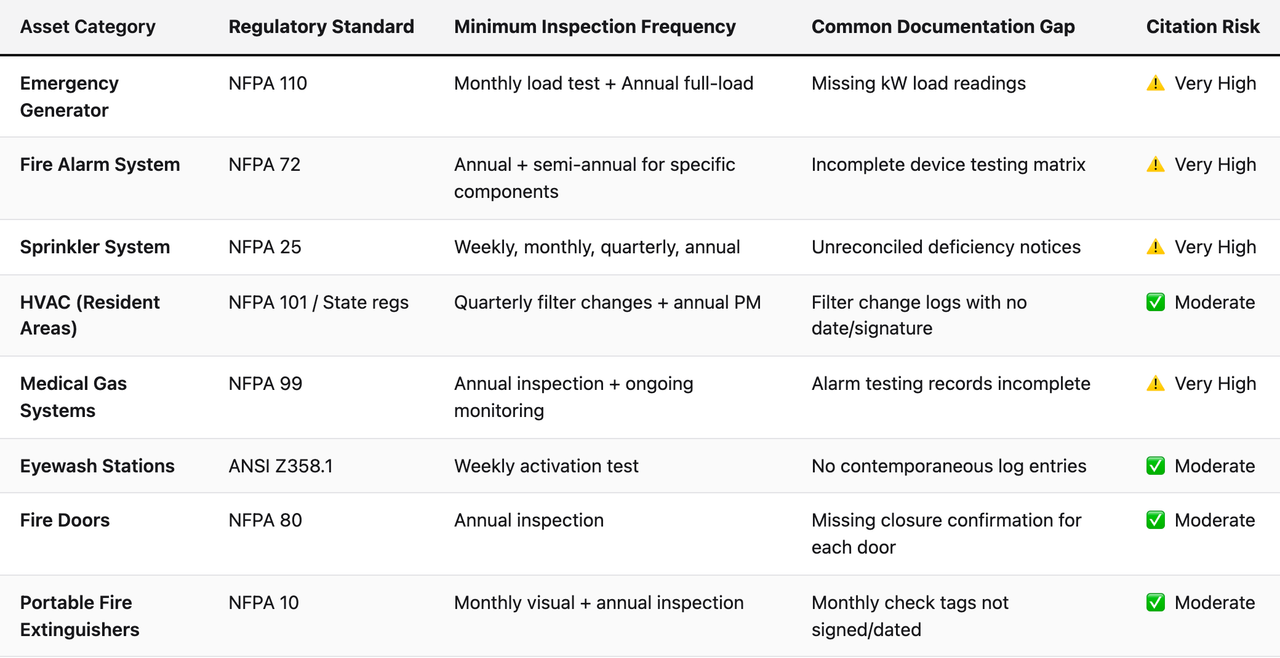
The tier distinction matters for resource allocation. High-citation-risk assets need not just more frequent inspection but more rigorous documentation verification. A missed monthly generator test that is caught internally and rescheduled within the compliance window is a manageable operational event. The same miss discovered by a surveyor, with no record of the test and no corrective action documentation, is a K-tag citation with potential immediate jeopardy implications.
Seasonal and Event-Triggered Inspections
Beyond the standard recurring cadence, effective asset lifecycle management must account for inspection requirements that are triggered by events rather than calendar dates. These include post-maintenance inspections after any work is performed on a life safety system, inspections required following a utility disruption or generator activation, and seasonal inspections that are required in some state regulations before and after heating and cooling seasons. Event-triggered inspections are the most commonly missed in SNF documentation systems because they require the person performing the maintenance work to simultaneously initiate a documentation workflow, a handoff that fails in busy facilities without a structured system to enforce it.
How AI-Powered Documentation Review Changes the Lifecycle Equation
The ability to extend asset lifespan with AI is frequently discussed in terms of predictive maintenance, using sensor data and machine learning to forecast equipment failure before it occurs. That application has real value in industrial and hospital settings. But for SNF plant operations teams, the more immediate and impactful AI application is in documentation review, using machine learning to audit completed inspection records for the gaps that human reviewers routinely miss.
This distinction matters because SNF maintenance teams are not typically resourced to implement sensor-based predictive maintenance infrastructure. What they can implement is AI-assisted audit of the documentation they are already generating. The question changes from "will this equipment fail?" to "does our documentation of this equipment's lifecycle pass regulatory scrutiny?" These are related questions, but the second one is the one that determines survey outcomes.
Pattern Recognition Across Inspection Records
Human reviewers, including experienced maintenance directors, tend to evaluate inspection records one at a time. They check whether a form is complete. They look for obvious omissions. What they are less effective at is pattern recognition across many records over time, identifying that the monthly generator tests for the past six months all recorded the same kilowatt load figure to the nearest hundred, suggesting the technician is estimating rather than reading the meter. Or that fire drill records for the night shift consistently show completion times within five minutes of each other, which is statistically unlikely and suggests possible after-the-fact documentation.
AI review systems that are trained on CMS and NFPA documentation standards can surface these patterns automatically. They can flag the generator logs where the data is too uniform. They can identify the sprinkler inspection report where the contractor noted a deficiency that does not appear in the corrective action log. They can catch the fire drill record that is missing the required documentation of resident response, which is required under CMS guidance but routinely omitted. These are not errors a surveyor would miss. They are exactly the patterns that experienced surveyors have been trained to look for.
Cross-Referencing Assets Against K-Tag Categories
One of the most powerful applications of AI in SNF asset lifecycle management is the ability to cross-reference each asset's inspection record against the K-tag categories that govern it. The CMS K-tag framework maps life safety deficiencies to specific regulatory requirements. An AI system that understands this mapping can evaluate whether a given asset's documentation is complete not just in general terms but against the specific evidentiary requirements of each relevant K-tag.
This matters because K-tags are not all equivalent. Some K-tags carry immediate jeopardy potential, meaning a single documentation gap can trigger enforcement action that threatens the facility's Medicare and Medicaid participation. Others are lower-severity but accumulate into patterns that surveyors use to assess the facility's overall compliance culture. AI-assisted cross-referencing can prioritize remediation based on K-tag severity, directing limited maintenance staff time toward the gaps that carry the highest regulatory risk.
Contemporaneous Logging and the AI Verification Layer
CMS guidance places significant weight on contemporaneous documentation, meaning records that were created at the time the inspection or maintenance activity occurred rather than reconstructed after the fact. This is one of the most consistently cited documentation failures in SNF surveys, and it is one that AI can address through automatic timestamping and anomaly detection.
When a technician logs an inspection completion through a mobile device or facility kiosk, the system can capture metadata including the time of submission, the location of the device, and the time elapsed between when the task was assigned and when it was logged. An AI layer can analyze this metadata to flag records where the logging pattern is inconsistent with contemporaneous completion. Records submitted in a batch on a Friday afternoon for tasks that were due throughout the week. Inspection logs completed at times when the facility's maintenance staff are not scheduled. These patterns do not definitively prove backdating, but they create documentation quality flags that can be investigated before they become surveyor concerns.
Equipment Maintenance Tracking Software: What SNF-Specific Requirements Look Like
General-purpose equipment maintenance tracking software handles work orders, PM schedules, parts inventory, and labor time tracking. These are genuinely useful functions. But SNF plant operations teams evaluating maintenance tracking software need to assess it against a set of requirements that most commercial CMMS platforms were not designed to meet.
Regulation-Native Task Templates
The most important differentiator for SNF-specific maintenance tracking is whether the platform includes task templates that are native to the regulatory standards governing healthcare occupancies. Building a PM schedule for an emergency generator from scratch in a generic CMMS requires the maintenance director to know every specific data point required by NFPA 110, translate that into task fields within the CMMS, and verify that the resulting documentation format will satisfy CMS surveyors. This is expert work that most maintenance directors should not have to do alone, and in practice, many do not do it fully, which is why generator documentation gaps are among the most common citations.
A regulation-native task template for a generator load test pre-populates every required data field: run time, kilowatt load, voltage output, frequency, transfer switch operation, cooling water temperature, and any anomalies observed. The technician cannot submit the form without completing these fields. The documentation is complete by construction, not by hope.
Multi-Facility Visibility for Regional Operations Teams
For directors of facilities and regional operations managers overseeing multiple SNF locations, the most significant capability gap in standard maintenance tracking software is the absence of cross-facility visibility. Each facility runs its own system. The regional manager reviews facility-level reports. There is no aggregated view of which facilities have open inspection deficiencies, which have upcoming inspection deadlines, or which are showing documentation quality patterns that suggest survey risk.
A facilities maintenance management platform built for multi-site SNF operators needs to deliver this aggregated view as a standard feature, not a custom report. Regional managers should be able to see, at a glance, which facilities in their portfolio have upcoming regulatory deadlines in the next 30 days, which have open corrective actions that are past due, and which have documentation quality scores below the acceptable threshold. This is the operational intelligence layer that allows regional teams to intervene before a facility's documentation gaps become survey citations.
Contractor Report Integration and Verification
As noted earlier, contractor-performed inspections represent a significant documentation risk for SNF facilities. The maintenance tracking platform needs to provide a structured workflow for contractor report intake that includes format verification against the applicable standard, automatic flagging of missing required data elements, and linkage of contractor reports to the specific asset records and inspection events they document. Without this integration, contractor reports exist as isolated documents rather than as components of a coherent asset lifecycle record.
The verification workflow does not require the platform to replace the maintenance director's judgment. It supports that judgment by flagging the contractor report that is missing the required deficiency narrative, or the annual sprinkler inspection report that does not include the identification numbers for each inspector who performed the work, which NFPA 25 requires. These are details that are easy to overlook in a busy facility and easy for a surveyor to find in a document review.
The Asset Retirement Process: Closing the Loop Without Creating Gaps
Asset retirement is the lifecycle phase that receives the least attention in SNF compliance programs, and it is one of the more reliable sources of documentation gaps during surveys. When a piece of life safety equipment reaches end of useful life and is replaced, the transition period between the old and new asset creates regulatory exposure that needs to be actively managed rather than assumed to resolve itself.
Documenting the Retirement Event
The retirement of a regulated asset should be treated as a compliance event requiring its own documentation package. This package should include the date and circumstances of retirement, the disposition of the asset (removed from service, disposed of, or transferred), confirmation that any open deficiencies on the retired asset have been resolved or formally closed, and the commissioning record for the replacement asset if applicable. The retirement documentation package becomes part of the permanent facility record, accessible to surveyors who are reviewing any period when the retired asset was operational.
This is particularly important for fire panel equipment, which is frequently cited as an example in discussions of aging SNF infrastructure. A fire panel that is approaching end of manufacturer support may still be operationally functional, but the inability to obtain replacement parts means that any deficiency found during an annual inspection cannot be remediated through standard repair. The retirement decision, the transition timeline, and the interim compensatory measures required during the replacement period all need to be documented with the same rigor as any other life safety compliance event.
Managing the Transition Period
When a life safety system is being replaced rather than simply retired, the transition period between decommissioning the old system and commissioning the new one requires interim compensatory measures under NFPA 101 and CMS guidance. These measures, which might include increased fire watch rounds, temporary detection equipment, or enhanced evacuation protocols, need to be documented contemporaneously. A surveyor reviewing a period that includes a fire panel replacement will look for evidence that the facility maintained appropriate life safety coverage throughout the transition, not just before and after.
The interim compensatory measure documentation is one of the areas where SNF facilities most commonly have the intent but not the record. The facility does conduct enhanced fire watch rounds during a panel replacement. Nobody creates a contemporaneous log of those rounds that connects them to the specific life safety gap they are compensating for. The documentation gap is not evidence that the rounds did not happen. It is, from a regulatory standpoint, evidence that cannot be evaluated, which produces the same outcome as if the rounds had not happened.
Archiving for Survey Lookback Periods
CMS survey lookback periods for life safety documentation typically extend to the previous survey cycle, which may be two to three years. An asset that was retired two years ago but was operational during the last survey period needs its lifecycle record to be accessible and organized for surveyor review. Archiving strategies that simply move retired asset records to a "closed" folder without maintaining their structural relationship to the facility's regulatory record create retrieval problems when surveyors request historical documentation during an unannounced visit.
Effective archiving preserves the asset's complete lifecycle record, including all inspection logs, contractor reports, deficiency notices, corrective action documentation, and the retirement event package, in a format that can be retrieved by asset, by date range, by K-tag category, or by regulatory standard. This retrieval flexibility is the difference between producing requested documentation in minutes during a survey and spending hours searching through a binder while a surveyor waits.
Building the Lifecycle Management Workflow Your Team Will Actually Use
The most technically sophisticated asset lifecycle management system fails if the maintenance technicians, EVS staff, and plant operations managers who need to use it daily find it too cumbersome to operate consistently. SNF maintenance teams are not technology teams. They work in physically demanding environments, often with limited administrative time. The workflow needs to meet them where they are.
The Kiosk-Mobile-Desktop Triad
Effective SNF lifecycle management platforms recognize that different users interact with the system in fundamentally different ways. A maintenance technician completing a generator test in the mechanical room needs a mobile interface that allows quick, field-level data entry with minimal navigation. An EVS staff member checking eyewash stations on a weekly round needs a simplified checklist interface accessible from a shared facility kiosk. A maintenance director reviewing documentation quality and preparing for a potential survey needs a desktop interface with reporting, analytics, and document retrieval capabilities.
Designing a single interface that serves all three use cases equally well is difficult. The practical solution is a platform architecture that provides role-appropriate interfaces for each user type, with all data flowing into a unified compliance record regardless of which interface was used for entry. The technician's field data and the maintenance director's review notes should both appear in the same asset lifecycle record, with clear attribution and timestamps for each entry.
Reducing Friction at the Point of Documentation
Every additional step required to complete a documentation entry is a step at which the documentation may not happen. The design principle for SNF lifecycle management workflows should be minimum friction at the point of work. This means pre-populated task forms that require only the variable data to be entered, not the asset information, the regulatory standard, or the inspection type, which should all be automatic based on the task assignment. It means barcode or QR code scanning to confirm asset identity rather than manual ID entry. It means offline capability for mobile users who may be working in areas of the facility with poor wireless coverage.
The friction reduction goal is not to make documentation easier to fake. It is to eliminate the legitimate operational barriers that cause real inspections to go undocumented because the documentation process is too burdensome relative to the competing demands on a maintenance technician's time.
Escalation and Alert Architecture
A lifecycle management workflow that only records completed tasks is reactive. An effective system for SNF plant operations teams needs a proactive escalation architecture that surfaces upcoming deadlines, overdue tasks, and documentation quality issues before they become compliance gaps. This architecture should include tiered alerts: a reminder to the assigned technician when a task is approaching its due date, an escalation to the maintenance director when a task passes its due date without completion, and a facility-level alert when a pattern of incomplete tasks creates a regulatory exposure threshold that warrants attention from senior leadership.
The escalation thresholds should be calibrated to the regulatory risk of each task category. A missed eyewash station weekly check warrants a reminder and a make-up task. A missed monthly generator load test warrants immediate escalation, because depending on the timing, a single missed test may create a documentation gap that cannot be remediated before a surveyor visit.
Integrating Asset Lifecycle Data With Survey Readiness Programs
Asset lifecycle management data should not exist in isolation from the facility's broader survey readiness program. The most effective SNF compliance programs treat lifecycle data as the evidentiary foundation for mock survey preparation, corrective action planning, and staff training, using the data to build a continuously updated picture of the facility's compliance posture rather than conducting point-in-time readiness assessments.
Mock Survey Integration
A mock survey that uses the facility's actual lifecycle management data is fundamentally more valuable than one conducted from a generic checklist. When the mock surveyor can pull up the actual inspection records for the emergency generator, the actual contractor reports for the annual sprinkler inspection, and the actual fire drill logs for the past 12 months, the exercise reveals the real gaps rather than hypothetical ones. Facilities that integrate their lifecycle data into mock survey processes identify documentation gaps that would otherwise be discovered by a real CMS surveyor.
The CMS survey process for SNFs includes a document review phase in which surveyors systematically request and evaluate lifecycle documentation for life safety assets. Preparing for this phase requires knowing, in advance, what documentation exists, what its quality looks like, and where the gaps are. Lifecycle management data provides this knowledge continuously, not just in the weeks before an anticipated survey.
Corrective Action Tracking Within the Asset Record
When an inspection identifies a deficiency, whether during a contractor inspection, an internal review, or a mock survey, the corrective action process needs to be tracked within the asset's lifecycle record rather than in a separate corrective action system. This integration matters because surveyors evaluating an asset's compliance history will look at the complete record: the deficiency was identified, corrective action was initiated within the required timeframe, the corrective action was completed, and a follow-up inspection confirmed resolution. If the deficiency is in one system and the corrective action is in another, producing this complete record during a survey requires manual assembly under time pressure, which is a reliability problem.
Staff Training and Competency Documentation
Asset lifecycle management extends to the people who perform the inspections and maintenance, not just the equipment. CMS and NFPA standards require that certain inspection and maintenance tasks be performed by qualified individuals, and the definition of "qualified" may include specific training, certification, or supervised experience requirements. The lifecycle management record for regulated assets should include documentation of the competency of the individuals who performed each inspection, not just the fact that the inspection occurred.
This requirement is most acute for tasks that require licensed or certified performers. Generator testing, medical gas system maintenance, and fire alarm testing all have qualification requirements that the documentation record needs to reflect. But competency documentation is also relevant for in-house tasks performed by maintenance technicians. A technician who was trained on the correct data collection procedure for monthly generator tests produces more defensible documentation than one who was not, and the training record is part of the evidence that supports the documentation's credibility.
Frequently Asked Questions
What is asset lifecycle management in an SNF context?
Asset lifecycle management in a skilled nursing facility is the structured process of tracking every regulated asset, including fire alarm systems, generators, HVAC units, sprinkler systems, and medical gas equipment, from commissioning through retirement, with documentation that satisfies CMS and NFPA regulatory requirements at every stage. It is distinct from general maintenance management because it is designed to produce a defensible compliance record, not just an operational maintenance history.
Why do SNFs get cited for assets that were actually maintained?
Citations most often result from documentation gaps rather than actual maintenance failures. A generator that was tested every month but whose test logs are missing required data fields, or a sprinkler system that was inspected annually but whose contractor report does not include all NFPA 25 required elements, will generate citations even if the physical equipment is functioning correctly. The regulatory standard is documentation of compliance, not just compliance itself.
What should be included in an asset's commissioning record?
A commissioning record for a regulated SNF asset should include the asset's identification information (manufacturer, model, serial number, installation date), the regulatory standards that govern it, the inspection cadence assigned at commissioning, the contractor or vendor responsible for licensed inspections, the initial baseline inspection or acceptance test documentation, and any manufacturer-specified maintenance requirements that supplement or exceed the regulatory minimums.
How does asset tracking software differ from a CMMS?
A CMMS (computerized maintenance management system) is designed to manage work orders, PM schedules, and labor resources across all facility equipment. Asset tracking software focused on SNF compliance adds a regulatory layer: regulation-aware task templates, K-tag cross-referencing, documentation quality verification, and survey-ready reporting. The operational functions overlap, but the compliance architecture is fundamentally different and is not present in most generic CMMS platforms.
What are the most commonly cited life safety documentation gaps in SNF surveys?
The most frequently cited categories include emergency generator documentation (particularly missing kW load readings and incomplete transfer switch testing records), fire drill records (especially missing night-shift coverage and resident response documentation), sprinkler system deficiency reconciliation (contractor-identified deficiencies with no corrective action documentation), and fire alarm testing records where the device testing matrix is incomplete. These patterns are consistent across CMS survey data and reflect the areas where documentation requirements are most specific and most commonly misunderstood.
How far back do surveyors typically look at asset lifecycle records?
CMS surveyors typically review documentation covering the period since the previous standard survey, which may be up to 15 months for facilities with strong compliance histories and shorter for those under more frequent oversight. State agencies may have different lookback practices. For life safety systems, surveyors may request records extending back further if they are investigating a specific incident or pattern of deficiency. Archiving asset records for a minimum of three years is a conservative and generally defensible practice.
What is the difference between a preventive maintenance record and a compliance inspection record?
A preventive maintenance record documents work performed to maintain equipment performance, typically following manufacturer specifications. A compliance inspection record documents that a specific regulatory requirement was satisfied, with the data elements and format specified by the applicable NFPA standard or CMS guidance. For many SNF assets, a single maintenance event may need to produce both types of records, and the compliance inspection record must meet a higher evidentiary standard than the PM record.
Can AI actually improve asset lifecycle management outcomes in SNFs?
Yes, but the most relevant application for most SNF facilities is AI-assisted documentation review rather than predictive maintenance. AI systems trained on CMS and NFPA documentation standards can review completed inspection records for data gaps, pattern anomalies, and cross-reference failures that human reviewers routinely miss. This capability directly addresses the most common source of SNF life safety citations: documentation that was created but is incomplete or internally inconsistent.
How should multi-site SNF operators structure asset lifecycle management across facilities?
Multi-site operators should implement a centralized platform that provides facility-level data collection with regional-level visibility. Each facility maintains its own asset records and inspection documentation, but regional managers and compliance officers should have access to aggregated reporting that identifies facilities with upcoming regulatory deadlines, open corrective actions, or documentation quality indicators that suggest survey risk. Standardized task templates across facilities ensure that documentation quality is consistent regardless of which facility's maintenance team performed the work.
What happens to asset lifecycle records when a maintenance director leaves?
This is one of the most significant risks in SNF compliance programs that rely on individual knowledge rather than systematic documentation. When lifecycle records exist only in a physical binder that a maintenance director has organized according to their personal system, or in the director's institutional memory, a staffing transition creates immediate compliance exposure. Digital lifecycle management systems that store records in a structured, role-independent format eliminate this risk by making the compliance record a facility asset rather than an individual one.
What is the regulatory basis for contemporaneous documentation requirements?
CMS Conditions of Participation require that facility records be accurate and complete. NFPA 101 and associated standards require that inspection records be maintained and available for review, with specific data elements that must be present. CMS survey guidance instructs surveyors to evaluate not just whether documentation exists but whether it appears to have been created at the time of the activity it documents. Records that appear to have been reconstructed after the fact, based on metadata, format anomalies, or implausible completion patterns, are treated with skepticism and may result in citations even if the underlying activity occurred.
How should SNFs handle contractor-performed inspections from a lifecycle management perspective?
Contractor inspection reports should be formally received into the asset lifecycle management system rather than simply filed. The intake process should include verification that the report includes all required data elements under the applicable NFPA standard, that any deficiencies identified are entered into the corrective action tracking system, and that the report is linked to the specific asset record and inspection event it documents. Contractors should be informed of the facility's documentation requirements at the time of contracting, and contracts should specify the format and content requirements for inspection reports.
Key Takeaways
- Asset lifecycle management in SNFs is fundamentally a documentation architecture problem, not a maintenance operations problem. Physical maintenance work is generally performed. What fails is the structured record that connects each asset to every regulatory obligation it carries.
- Commissioning and retirement are the highest-risk lifecycle phases because they receive the least systematic attention. Every regulated asset needs a formal compliance identity established at installation and a formal closure record at retirement.
- Inspection cadence architecture must be regulation-aware, not just calendar-based. Each inspection event should require specific data fields determined by the applicable NFPA standard, not by what the technician thinks is relevant.
- AI-assisted documentation review addresses the most common source of SNF citations: completed inspection records that contain data gaps, pattern anomalies, or cross-reference failures invisible to human reviewers working record by record.
- Contractor report verification is a non-negotiable step in SNF lifecycle management. Contractor inspections that did not capture all required data elements create documentation gaps that appear as citations regardless of whether the physical inspection was thorough.
- Multi-site operators need aggregated compliance visibility that standard CMMS platforms do not provide. Regional managers cannot manage survey risk across a portfolio without cross-facility reporting on inspection status, corrective action backlogs, and documentation quality indicators.
- Contemporaneous logging is both a regulatory requirement and a documentation quality signal. Platforms that capture submission metadata and flag anomalous completion patterns give maintenance directors the ability to identify and correct documentation quality problems before they become surveyor findings.
- Staff turnover is a lifecycle management risk that paper-based and individual-knowledge-dependent systems cannot survive. Digital lifecycle management systems make the compliance record a facility asset rather than an individual one.
The gap between a well-maintained SNF facility and a survey-ready one is almost never about the condition of the equipment. It is about the completeness, structure, and retrievability of the documentation that proves the equipment's regulated lifecycle has been managed correctly. Plant operations teams that build systematic lifecycle management into their daily workflows, with the right platform support, close that gap permanently rather than scrambling to close it in the days before a surveyor arrives.
About the author
Benjamin Terebelo · Founder
Benjamin is the founder of SEQURA, a compliance platform purpose-built for healthcare facilities. He builds at the intersection of healthcare operations and software, maintaining a focus on bringing modern tooling to systems that the broader industry has largely left behind.
About the author
Benjamin Terebelo · Founder
Benjamin is the founder of SEQURA, a compliance platform purpose-built for healthcare facilities. He builds at the intersection of healthcare operations and software, maintaining a focus on bringing modern tooling to systems that the broader industry has largely left behind.