25 min read
10 Documentation Patterns That Tell a CMS Surveyor Your SNF Has a Systemic Compliance Problem
Surveyors are trained to spot systemic failure through documentation patterns. These 10 signals tell a CMS inspector your SNF has a compliance program problem.
By Benjamin Terebelo

A CMS life safety surveyor does not walk into your skilled nursing facility looking for a single broken sprinkler head or a missing fire drill log. They walk in looking for a pattern. The difference matters enormously, because a single isolated deficiency is a correctable problem. A pattern is a compliance program failure, and it produces a fundamentally different survey outcome: broader scope findings, higher severity designations, and the kind of enforcement attention that does not resolve itself with a one-page plan of correction.
The documentation your facility keeps, or fails to keep, is the primary surface through which surveyors read your compliance culture. Before they observe a single piece of equipment or speak to a single staff member, they are already forming a picture from the records on your table. The question is not whether your documentation will be reviewed. The question is what story it tells when it is.
What follows is a ranked list of the ten documentation patterns that most reliably communicate systemic compliance failure to a trained CMS surveyor. These are not theoretical risks. They are the patterns that surface repeatedly when SNFs receive multi-tag life safety findings. Understanding them is the first step toward eliminating them.
1. Inspection Logs That Show No Deficiencies Across Multiple Years
A log that never records a deficiency is not proof of excellent maintenance. To an experienced surveyor, it can be a signal that the log was not the product of genuine inspection activity. Real buildings accumulate real findings: doors that need adjustment, suppression system components that require attention, equipment that drifts out of tolerance. A multi-year record showing nothing but passing results across every inspection category warrants closer scrutiny during a survey.
This pattern is particularly conspicuous when it appears in systems with known maintenance demands. Fire suppression components, emergency power supply systems, and smoke barrier assemblies all require ongoing attention in operational healthcare facilities. When a facility's records show years of unbroken perfect results, surveyors may cross-reference those records with what they observe on-site. A single visual discrepancy between the physical state of the building and the documented record can shift a surveyor's entire frame of interpretation for every log they review afterward.
The underlying problem: Inspection programs that treat documentation as a formality rather than a record of actual findings. Technicians check a box, note "satisfactory," and move on, even when they observed minor issues that should have been recorded and tracked to resolution.
How to apply this: A healthy inspection log includes deficiency entries, corrective action notes, and closure documentation. If your logs contain only passing marks, audit whether your technicians are recording what they actually find. Building a corrective action workflow into your documentation process, one that requires technicians to log deviations and track them to completion, produces the kind of record that demonstrates active compliance management rather than passive box-checking. Platforms like SEQURA are designed specifically to capture this corrective action chain so that the record of a deficiency and its resolution exists in the same system, linked to the same inspection event.
2. Fire Drill Records That Cover Only Daytime Shifts
Fire drill documentation that shows drills conducted exclusively or predominantly during daytime hours is one of the most commonly cited documentation deficiencies in SNF life safety surveys. The applicable life safety requirements under NFPA 101 require drills to be conducted on each shift, at least quarterly per shift, meaning a three-shift facility needs significantly more than four drills per year to satisfy the requirement across all shifts.
The pattern surveyors look for is not just the total number of drills. They look at the distribution across shifts. A facility that can show twelve or more drills annually but clusters them all between 9 a.m. and 5 p.m. has documented non-compliance as clearly as a facility that only ran four drills. Night-shift and evening-shift staff, by definition, will not have participated in required drills, and the documentation makes that gap unmistakable.
Why this signals systemic failure: Daytime-only drills suggest that fire drill compliance is being managed around administrative convenience rather than regulatory requirements. It tells a surveyor that whoever owns this process does not understand, or does not follow, the shift-distribution requirement, which in turn raises questions about whether other life safety processes are similarly managed for convenience rather than compliance.
How to apply this: Build fire drill scheduling into your compliance calendar with explicit shift designations assigned at the start of each year. For a standard three-shift operation, that means scheduling at minimum quarterly drills on each of the three shifts, with documentation that captures shift designation, time of drill, staff participants, and any observed deficiencies in evacuation response. CMS Survey and Certification guidance on life safety makes clear that drill records are a standard document request during any standard health survey or life safety code survey, so this documentation needs to be complete and defensible before surveyors arrive, not assembled afterward.
3. Timestamps That Cluster Suspiciously Around Survey Preparation Periods
When inspection records, maintenance logs, or training documentation show a burst of entries concentrated in the days or weeks immediately before a known survey window, the timing itself becomes a documentation problem. Surveyors review the chronological distribution of entries as part of their record review, and a pattern of sparse activity followed by dense clustering is a recognizable signal.
This pattern appears in several forms. A facility might show months of sparse generator test logs followed by a dense cluster of entries in the weeks before a state inspection cycle. Or fire alarm inspection records might show gaps during the year with a rush of entries in a narrow recent window. The content of the entries may be technically accurate, but the timing pattern suggests they were not the product of contemporaneous documentation practice.
What surveyors can cross-reference: Generator logs can be compared against fuel delivery records, utility bills, and maintenance work orders. Contractor inspection reports have their own dates. Training sign-in sheets can be compared against payroll records for staff listed as attendees. When documentation timing does not align with these corroborating sources, the discrepancy can support a finding of inadequate documentation practice, regardless of whether the underlying inspections actually occurred.
How to apply this: The solution is consistent, contemporaneous documentation practice throughout the year, not improved record assembly before surveys. A digital platform that time-stamps entries at the point of completion, rather than allowing backdated entry, creates an audit trail that reflects actual operational practice. This protects the facility by making the contemporaneous nature of its records verifiable, not just claimed.
4. Corrective Action Records That Do Not Close Out
Finding a deficiency and documenting it is only the first half of a compliant inspection record. The second half is the corrective action chain: what was done, by whom, when, and whether the issue was resolved and re-inspected. When facilities document deficiencies without corresponding corrective action closure records, they have essentially created a permanent written record of an unresolved life safety problem.
This pattern is particularly problematic for systems covered under the CMS life safety tag for sprinkler testing and maintenance, the fire alarm testing and maintenance tag, and the emergency power supply system requirements. These are high-scrutiny systems where surveyors specifically look for the complete cycle of identification, remediation, and verification. An open deficiency with no documented resolution is, from a regulatory standpoint, an ongoing deficiency.
The compounding effect: Incomplete corrective action chains do not just expose the specific deficiency. They tell a surveyor that the facility's maintenance management system does not include a verification step. That structural gap affects the surveyor's confidence in every other record they review. If the facility cannot demonstrate that it tracks deficiencies to resolution, then every "passing" entry in the log becomes less credible.
How to apply this: Every deficiency entry in an inspection log should have a linked corrective action record that includes the assigned responsible party, target completion date, actual completion date, and a verification note confirming the issue was resolved. This does not require sophisticated software, but software that enforces this workflow by preventing a deficiency from being marked "closed" without completion documentation is substantially more reliable than a manual paper process that depends on individual discipline.
5. Generator Load Test Records Missing Required Performance Data
Emergency power supply system documentation is one of the most technically specific areas of CMS life safety review. The applicable NFPA standard for emergency power supply systems specifies not just that load tests must be conducted at defined intervals, but that the written record of each test must capture specific performance parameters, including the load percentage achieved, the duration of the test, and any transfer time measurements.
A generator log that records only "test conducted, passed" without the supporting performance data is a documentation deficiency regardless of whether the underlying test was properly performed. The record does not demonstrate compliance because it does not contain the information required to evaluate compliance. Surveyors reviewing generator documentation are trained to look for these specific data fields, and their absence produces a finding against the emergency power supply system tag.
Why this pattern signals systemic problems: Missing performance data in generator logs usually reflects one of two things: a testing contractor who is providing a verbal report without a written test record, or a facility staff member who is conducting informal tests without understanding the documentation requirements. Either way, the gap reveals that whoever owns this process has not aligned their practice with the regulatory standard, which raises questions about whether the same misalignment exists in other technically demanding documentation areas.
How to apply this: Generator test records should be structured around the specific data fields required by the applicable NFPA standard, not around a generic "test log" template. If a third-party contractor conducts the load test, their written report should be retained as part of the facility's documentation and should contain all required performance data. Facilities should not accept a contractor verbal confirmation as a substitute for a written test record with performance parameters. Review the NFPA 110 standard for emergency and standby power systems for the specific documentation requirements applicable to your system class.
6. Life Safety Documentation Owned by a Single Person With No Coverage Protocol
When a surveyor asks to see life safety documentation and is told it is all maintained by the maintenance director who is currently on vacation, or on leave, or who recently left the facility, the documentation problem is already apparent. Single-person ownership of an entire life safety documentation program is itself a systemic vulnerability, and it becomes a documented systemic failure the moment that person is unavailable.
This pattern surfaces during surveys in several ways. The documentation may be physically inaccessible (stored on a personal computer, in a locked office, or in a binder that only one person knows how to navigate). Or the documentation may be accessible but incomplete because the person who maintained it was the only one who knew what tasks were required and when. Or the documentation may be present but the facility cannot produce a knowledgeable person to walk the surveyor through it.
The regulatory implication: CMS survey protocols require facilities to demonstrate not just that documentation exists, but that their compliance program is operational and systematically managed. A program that functionally ceases to operate when its sole owner is absent is not a systematically managed program. It is an individual's personal project, and the documentation record will reflect the gaps that personal projects accumulate during illness, vacation, turnover, and competing priorities.
How to apply this: Life safety documentation ownership should be distributed across at least two individuals with defined backup responsibilities, and the documentation system itself should be accessible to authorized staff regardless of who is on-site on any given day. This is one of the structural advantages of a platform-based documentation approach over a personal binder system: the platform is always accessible, always organized the same way, and does not depend on any one person's institutional memory to navigate.
7. Contractor Inspection Reports That Are Stored but Not Reviewed
Most SNFs rely on licensed contractors for inspections of fire suppression systems, fire alarm systems, and emergency power systems. The contractor provides a written inspection report. The facility files it. And that is frequently where the process ends, creating a documentation pattern that is subtly but meaningfully different from an active compliance program.
The problem is not the contractor report itself. The problem is that contractor reports frequently contain deficiency notations, recommendations, and impairment records that require facility follow-up. When those reports are stored without review, the follow-up actions never happen. The facility has a record of a deficiency it was formally notified of, with no corresponding corrective action record, which is a more serious documentation problem than simply not having a record at all.
What surveyors look for: During record review, surveyors may compare the deficiency sections of contractor reports with the facility's internal corrective action records. A contractor report noting three items requiring attention, followed by no facility corrective action entries in the subsequent weeks, is a clear signal that the facility's compliance program does not include a step for processing contractor findings. This gap is particularly significant for the CMS life safety tags covering sprinkler system maintenance and testing and fire alarm testing and maintenance, where contractor reports are the primary documentation source and the facility's responsibility to act on findings is explicit.
How to apply this: Establish a formal intake process for contractor inspection reports that includes: receipt confirmation, deficiency review by a named responsible party, corrective action assignment for any items requiring follow-up, and a notation in the facility's internal records linking the contractor finding to the corrective action record. The contractor report is the starting document in a compliance workflow, not the ending document.
8. Smoke Barrier and Corridor Door Inspection Records That Are Missing or Generic
Smoke barrier integrity and corridor door function are physical life safety features that require documented inspection, and they are features that surveyors can directly observe during a walk-through. This creates a specific and powerful cross-reference opportunity: a surveyor who observes a compromised smoke barrier penetration or a corridor door that does not latch correctly can immediately compare that observation against the facility's inspection records for that area.
When the inspection record shows a recent "satisfactory" finding for the same area where a surveyor is currently observing a deficiency, the credibility of the entire inspection record is challenged. This is one of the clearest ways that documentation patterns and physical observation interact during a CMS life safety survey. The physical deficiency may produce one citation; the documentation discrepancy may produce a second.
The generic record problem: Many facilities maintain smoke barrier and corridor door inspection records that record only a facility-wide "satisfactory" without identifying specific locations reviewed. A facility-wide generic pass entry does not demonstrate that any specific area was inspected. It demonstrates only that someone signed a form. Surveyors reviewing this type of record have no way to determine whether the inspection covered the area where they observed a deficiency, which shifts the burden back to the facility to demonstrate that its inspection was genuine and comprehensive.
How to apply this: Smoke barrier and corridor door inspections should be documented by specific location, using a room-by-room or zone-by-zone format that creates a verifiable record of what was inspected and what was found. Photography of inspection points, linked to specific inspection records, adds another layer of verification that is increasingly valued in both internal audits and survey response. When a surveyor observes a deficiency in a specific location, a facility that can produce a location-specific inspection record for that area, including the date it was last inspected and any findings, is in a substantially stronger position than a facility that can only produce a facility-wide generic log.
9. Training Records That Do Not Match Staffing Records
Life safety training documentation, including fire safety training, emergency preparedness training, and hazard-specific education, is subject to the same cross-reference scrutiny as inspection logs. When training sign-in sheets or completion records list staff members who were not working on the documented date, or when the roster of "trained" staff does not align with the facility's actual staffing complement, the discrepancy is a documentation red flag.
This pattern appears most often in facilities that maintain training records as a separate administrative function disconnected from HR and scheduling systems. The person responsible for training records may not have access to current staffing data, leading to records that reflect an outdated or inaccurate staff roster. Alternatively, training records may show completion for staff who transferred, resigned, or had not yet been hired at the time of the documented training session.
The staffing roster connection: CMS survey protocols include review of staffing records alongside training records during the environment of care and emergency preparedness components of a survey. A facility whose training records cannot be reconciled with its staffing records has a documentation gap that extends beyond training compliance into the broader question of whether its administrative records are reliable. Surveyors are looking for coherence across document types, and incoherence is itself a finding.
How to apply this: Training completion records should be linked to current HR data, with a process for updating training records when staff join or leave the facility. Training programs should include a mechanism for tracking which current staff members have not yet completed required training, so that the record reflects an active compliance gap rather than a false completion. For multi-site operators, this coordination challenge is particularly acute, because training records for each facility need to reflect that facility's actual current staff, not a consolidated or approximated roster.
10. No Evidence of Internal Audit or Self-Assessment Activity
Of all the documentation patterns on this list, the absence of any internal audit or self-assessment record may be the most consequential signal of systemic compliance failure. Every other pattern on this list represents a gap in a specific documentation category. This pattern represents a gap in the compliance program's feedback mechanism, which is the structural element that should be identifying and correcting all the other gaps before a surveyor arrives.
A facility that has never documented an internal life safety audit, a self-assessment against its K-tag obligations, or a proactive gap analysis is a facility that is entirely dependent on external surveyors to identify its compliance deficiencies. That is not a compliance program. It is a reactive posture that guarantees surveyors will find problems, because there is no internal process designed to find them first.
What the absence communicates: When surveyors review a facility's documentation and find no evidence of self-assessment activity, it supports a finding that the facility's compliance program lacks the self-monitoring component that CMS expects as part of a functioning quality assurance and performance improvement process. The connection between life safety documentation and the broader QAPI framework means that life safety audit gaps can surface not just in the life safety component of a survey but in the QAPI review as well.
The internal audit advantage: Facilities that conduct and document regular internal life safety audits gain two things. First, they find and correct their own gaps before surveyors arrive. Second, they create a documentary record of active compliance management that surveyors can observe. A surveyor who sees that a facility identified a documentation gap, tracked it to correction, and updated its process as a result is looking at evidence of a functioning compliance program, not a reactive one. That documentary evidence of self-correction is one of the most powerful things a facility can show during a survey.
How to apply this: Internal life safety audits should be scheduled at defined intervals, documented with a structured format that mirrors the K-tag categories that surveyors review, and linked to corrective action records for any gaps identified. The audit record itself should be retained as part of the facility's compliance documentation. Platforms designed for life safety compliance management, like SEQURA, are built around this audit-first model: the system continuously audits the documentation against regulatory expectations and surfaces gaps before they become survey findings, creating an ongoing internal audit record as a byproduct of normal operation.
How These Patterns Interact: The Documentation Coherence Problem
These ten patterns rarely appear in isolation. A facility with incomplete fire drill shift coverage is often the same facility with generic smoke barrier inspection records and no internal audit documentation. A facility with timestamp clustering in its generator logs is often the same facility with contractor reports that were filed but never reviewed. The reason these patterns cluster is structural: they all reflect the same underlying compliance culture, one in which documentation is treated as a formality rather than a genuine record of operational activity.
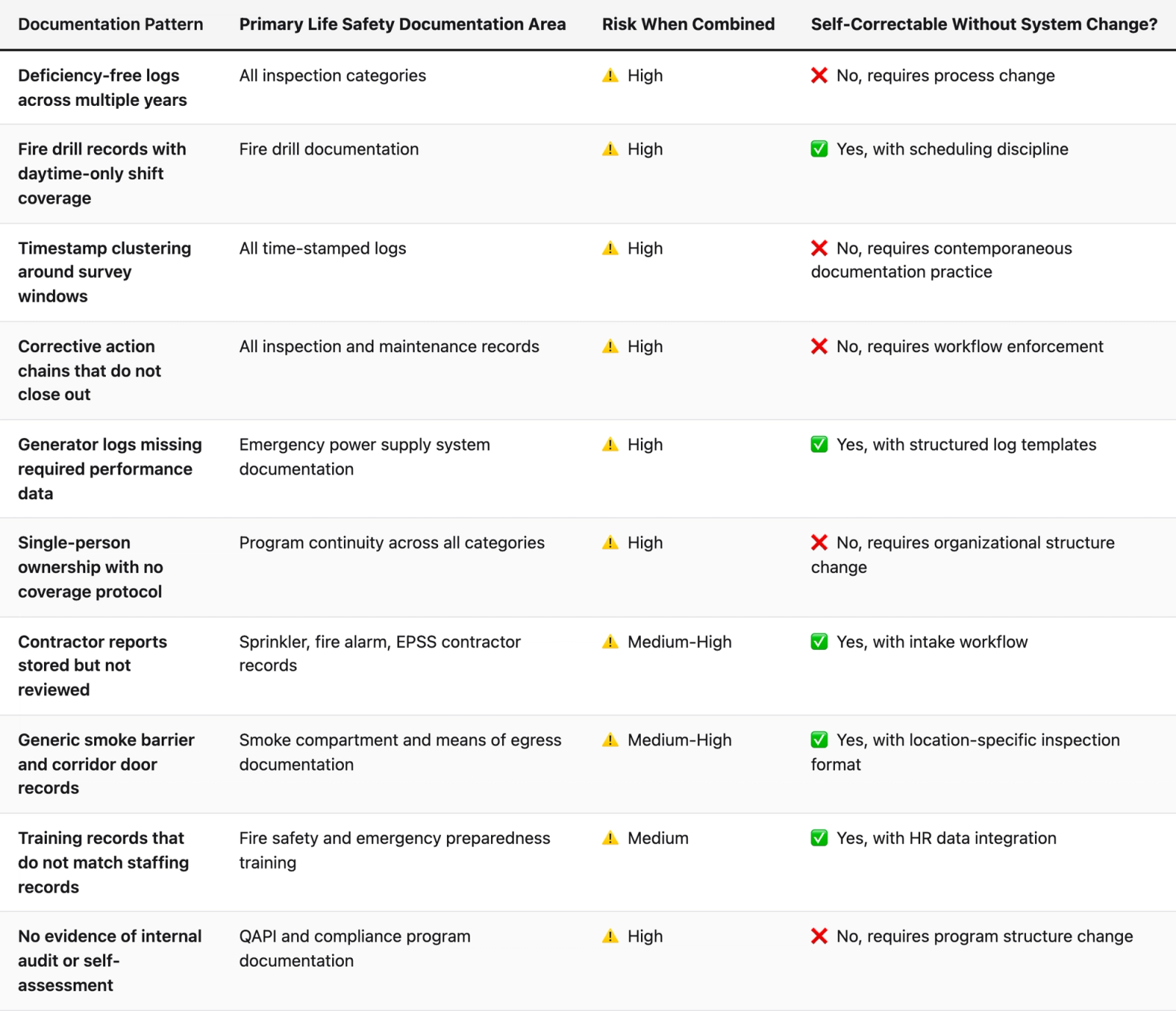
When surveyors encounter multiple patterns from this list during a single record review, the cumulative effect is a finding of systemic failure rather than isolated deficiency. The scope and severity designations that result from systemic findings are categorically different from those that result from isolated gaps. A finding of widespread or systemic deficiency across a K-tag category can affect the facility's overall survey outcome, its enforcement posture, and the depth of scrutiny it faces in subsequent surveys.
The table below maps each documentation pattern to the primary CMS life safety documentation category it affects, and the risk level it carries when found in combination with other patterns on this list.
The Common Approach vs. What Actually Works
The most common approach to life safety documentation in SNFs is what can be called the binder model: a physical or digital folder organized by inspection category, populated by whoever is responsible for each task, and assembled for surveyor review when needed. This approach is not wrong in concept. It becomes a compliance liability in practice because it has no audit layer. Nobody reviews the binder to ask whether the entries reflect genuine inspection activity, whether corrective actions have been closed, whether contractor reports have been processed, or whether the distribution of entries across time looks like an active program or a periodic catch-up exercise.
What actually works is a documentation program that audits itself. Not a program that produces records, but a program that reviews records against the regulatory expectations for each asset and each K-tag category, surfaces gaps while there is still time to correct them, and creates a compliance history that a surveyor can read as evidence of active management. The difference between these two approaches is not primarily technological. It is a question of whether the facility's compliance program includes a feedback loop that closes the gap between what is required and what is documented.
For facilities managing this with internal resources, that feedback loop requires a structured internal audit process, a corrective action tracking system, and someone with enough regulatory knowledge to evaluate records against the applicable standards. For facilities using a platform like SEQURA, that feedback loop is built into the documentation process itself: the system compares completed records against regulatory expectations, surfaces discrepancies in real time, and creates an ongoing audit trail that reflects the facility's compliance posture at any point in time.
What Multi-Site Operators Need to Understand
The documentation patterns described in this article are amplified in multi-site SNF operations because the same structural failures tend to replicate across facilities. A maintenance program that does not include corrective action closure tracking at one facility is unlikely to include it at any facility in the same chain, because the underlying process design is the same. A fire drill scheduling approach that covers only daytime shifts at one building is likely being replicated at every building managed by the same regional operations team.
For regional facility managers and COOs overseeing multiple SNF locations, the documentation audit challenge is compounded by scale. Reviewing life safety documentation across ten or twenty facilities manually is not a realistic compliance strategy. The only scalable approach is a platform that aggregates documentation status across facilities and surfaces gaps at the portfolio level, so that a regional manager can see which facilities are current on all required inspections, which have open corrective actions, and which have documentation patterns that would concern a surveyor, without having to physically review each facility's binder.
This portfolio-level visibility is one of the structural advantages that platforms like SEQURA offer to multi-site operators: the ability to apply a consistent documentation standard across all facilities and to identify the outliers before a surveyor does.
Frequently Asked Questions
What does a CMS life safety surveyor actually review when they arrive at an SNF?
During a standard survey, life safety code surveyors typically request documentation for fire drill records, fire suppression system inspection and testing reports, fire alarm inspection and testing reports, emergency power supply system logs, smoke barrier and means of egress inspection records, and hazardous materials documentation. They cross-reference these records with physical observations during the building walk-through and with staff interviews. The CMS Survey and Certification program provides the framework under which these reviews are conducted.
How do surveyors distinguish between a single deficiency and a systemic compliance failure?
Surveyors use the scope and severity grid to characterize findings. A single isolated deficiency with limited potential for harm is treated differently from a pattern of deficiency that affects multiple residents or reflects a breakdown in the facility's compliance program. When multiple documentation patterns from the same underlying cause appear across different inspection categories, surveyors may characterize the finding as systemic rather than isolated, which affects the scope designation and can influence enforcement decisions.
Can a facility be cited for documentation problems even if the underlying inspections were actually performed?
Yes. CMS life safety citations are based on the facility's ability to demonstrate compliance through documentation, observation, and interview. If the documentation does not contain the information required to evaluate compliance, the fact that the underlying activity may have occurred does not resolve the documentation deficiency. A generator load test that was performed but not documented with required performance data is a documentation deficiency regardless of the quality of the test itself.
How often should fire drills be conducted in a three-shift SNF?
The applicable NFPA 101 requirement for existing healthcare occupancies requires fire drills to be conducted at least quarterly on each shift. For a facility running three shifts, that means a minimum of twelve drills per year distributed across shifts, not four total drills. The specific requirement should be verified against the current edition of NFPA 101 and any applicable state amendments, as state requirements may exceed the federal baseline.
What is the correct documentation format for contractor inspection reports?
Contractor inspection reports should be retained in their original format as provided by the licensed contractor. The facility should also maintain an internal record of its review of each contractor report, including identification of any deficiency items noted in the report and the corrective actions taken in response. Storing a contractor report without reviewing it and documenting the facility's response to any findings creates a record gap that surveyors may cite.
Are internal audit records required by CMS, or are they just best practice?
CMS requires SNFs to maintain a Quality Assurance and Performance Improvement program that includes systematic identification and correction of quality and compliance deficiencies. While the specific format of internal life safety audits is not prescribed, the QAPI requirement creates a regulatory basis for expecting that facilities have a self-monitoring mechanism. The absence of any internal audit or self-assessment documentation can surface in the QAPI component of a survey as well as in the life safety component.
How should SNFs handle the transition when a maintenance director leaves?
Facilities should maintain a documented succession protocol for life safety documentation ownership that includes: the location and organization of all active documentation, the schedule of upcoming required inspections and drills, the contact information for all licensed contractors, and the status of any open corrective actions. This protocol should be tested periodically, not just documented, to ensure that a replacement or interim responsible party can actually access and navigate the documentation program from day one.
What is the relationship between K-tag citations and a facility's Five-Star quality rating?
Life safety code citations are tracked and reported separately from health inspection findings under the CMS Five-Star Quality Rating System. Life safety findings do not directly affect the health inspection component of the Five-Star rating. However, significant life safety findings can influence the overall survey outcome and may affect the facility's enforcement posture, including the potential for complaint surveys or focused revisit surveys that generate health inspection citations.
How can a facility demonstrate that its inspection logs reflect genuine activity rather than paper compliance?
The most effective way to demonstrate genuine inspection activity is through contemporaneous documentation with corroborating evidence. This means entries are logged at the time of the inspection, not after the fact; location-specific findings are recorded rather than generic facility-wide results; deficiencies are noted when found; and corrective actions are tracked to closure. Physical evidence such as photographs linked to specific inspection events, and records that can be cross-referenced with contractor reports and maintenance work orders, adds further credibility to the documentation record.
What should a facility do if it discovers a documentation gap before an upcoming survey?
The appropriate response is to document the gap, document what corrective action was taken, and ensure that the underlying activity occurs and is documented going forward. Attempting to reconstruct backdated records or create entries that misrepresent when an activity occurred creates a more serious problem than the original gap. Surveyors reviewing records alongside physical observations and other corroborating sources may identify inconsistencies between reconstructed entries and other facility records, which can shift the nature of the finding. Honest acknowledgment of a gap and a documented corrective response is a more defensible position than a documentation record that does not hold up to scrutiny.
Do documentation patterns affect how surveyors approach the physical walk-through?
Yes. The record review typically occurs before or alongside the physical walk-through, and the picture formed during record review shapes the areas of focus during the building inspection. A surveyor who identifies concerning documentation patterns during record review is likely to pay closer attention to the physical systems associated with those records during the walk-through. This is one of the reasons why documentation quality has a compounding effect on survey outcomes: poor documentation can direct surveyor attention toward the physical areas most likely to have been inadequately maintained.
What is the single most important thing a facility can do to improve its documentation posture before the next survey?
Conduct a structured internal audit against the K-tag categories most commonly reviewed during life safety surveys, and document the results. This single activity accomplishes two things: it identifies the gaps that need to be corrected before surveyors arrive, and it creates a record of active compliance management that surveyors can observe. A facility that has recently completed and documented an internal life safety audit, with corrective actions tracked and closed, presents a fundamentally different compliance picture than a facility presenting documentation with no evidence of self-review.
Key Takeaways for SNF Compliance and Operations Leaders
- Documentation patterns communicate compliance culture. Surveyors read the structure and consistency of records as evidence of how a facility manages its compliance program, not just whether individual tasks were completed.
- Fire drill shift distribution is a specific regulatory requirement. Total drill count is not sufficient. The distribution of drills across all shifts, at quarterly frequency per shift, is what the applicable NFPA 101 provision requires, and the documentation must reflect that distribution.
- Corrective action chains must close out. A documented deficiency with no documented resolution is a standing written record of an unresolved problem. Every inspection log that records a deficiency must have a corresponding corrective action record that tracks the issue to verified completion.
- Contractor reports are the beginning of a compliance workflow, not the end. Filing a contractor report without reviewing it and processing any findings it contains is a documentation gap that surveyors can identify by comparing the contractor report's deficiency section with the facility's internal records.
- Generator load test records must contain specific performance data. The applicable NFPA standard specifies what performance data must be captured. A log entry that records only "test completed" without performance parameters does not demonstrate compliance.
- Single-person documentation ownership is a structural vulnerability. A compliance program that functionally depends on one person's availability is not a systematically managed program. Coverage protocols and accessible documentation systems are not optional features, they are program continuity requirements.
- Internal audits create both a corrective opportunity and a documentary record. Facilities that conduct and document regular self-assessments find their own gaps before surveyors do, and they create a record of active compliance management that surveyors can observe and credit.
- The patterns on this list cluster together. They share a common root cause: a documentation culture that treats records as administrative formalities rather than genuine evidence of operational compliance. Addressing the root cause, rather than each pattern individually, is what produces durable survey readiness.
The gap between a facility that surveyors view as well-managed and one they view as systemically non-compliant is often narrower than administrators expect. It is not primarily a gap in the physical condition of the building or even in the actual inspections being performed. It is a gap in how those activities are documented, reviewed, and acted upon. Closing that gap requires a documentation program with a feedback loop, one that audits its own records, surfaces its own gaps, and produces a compliance history that tells the right story when a surveyor sits down to read it.
About the author
Benjamin Terebelo · Founder
Benjamin is the founder of SEQURA, a compliance platform purpose-built for healthcare facilities. He builds at the intersection of healthcare operations and software, maintaining a focus on bringing modern tooling to systems that the broader industry has largely left behind.
About the author
Benjamin Terebelo · Founder
Benjamin is the founder of SEQURA, a compliance platform purpose-built for healthcare facilities. He builds at the intersection of healthcare operations and software, maintaining a focus on bringing modern tooling to systems that the broader industry has largely left behind.
Topics
- CMS surveyor documentation patterns
- SNF systemic compliance failure
- life safety citation patterns
- K-tag documentation
- survey deficiency signals


