
10 Life Safety Documentation Habits That Separate Survey-Ready SNFs From Cited Ones

Most skilled nursing facilities that receive life safety citations were not ignoring their documentation. They were doing it. Inspections were logged, fire drills were conducted, contractor reports were filed. The problem was not effort, it was the invisible gaps between what was done and what was recorded in a way a CMS surveyor would accept. A generator test logged without a kW load reading. A fire drill completed on the day shift three surveys in a row, with no night coverage documented. A sprinkler deficiency noted in a contractor report, never formally reconciled. These are not catastrophic failures. They are documentation habits, or the absence of them, and they separate facilities that pass surveys from facilities that collect K-tags.
This article breaks down ten specific documentation habits that survey-ready SNFs build into daily operations. Each one maps to a real citation pattern, explains the gap that produces it, and gives you a concrete method to close it before a surveyor finds it first. The order is intentional: habits ranked earlier produce more citations, more frequently, and are harder to correct retroactively once a surveyor is on-site.
1. Logging Inspection Data at the Point of Performance, Not Later That Day
Contemporaneous documentation is not a preference, it is a regulatory expectation. CMS Life Safety surveyors are trained to identify documentation that appears backdated, batch-entered, or completed away from the asset being inspected. When a maintenance director logs three weeks of generator tests on a Friday afternoon, the timestamps, specificity, and internal consistency of those records will often betray the method. This is one of the most common K-tag citation patterns, and it is entirely self-inflicted.
The underlying issue is workflow design. Paper-based logging systems create a natural lag because the binder lives in the office, not next to the fire pump or the generator. A technician completes the inspection, makes a mental note, finishes their shift, and then either logs it from memory or skips it entirely. By the end of the week, they are reconstructing rather than recording. The record that results may contain all the right values, but it will lack the specificity that contemporaneous documentation naturally carries: the exact start time, the ambient conditions that day, the anomaly that was observed and resolved, the name of the person who performed the task.
Survey-ready SNFs solve this by moving the logging interface to the point of performance. Whether that is a mobile device, a shared tablet mounted near the asset, or a facility kiosk near the maintenance bay, the entry happens at the moment the task is completed. This produces timestamps that match the inspection cadence, readings that are asset-specific rather than generic, and a record that reflects what actually happened rather than what the technician remembers happening.
How to apply this: Audit your current logging workflow by asking a simple question: where does the technician physically record the inspection? If the answer is "back at the office" or "on a paper form they bring to me later," your documentation is not contemporaneous. The fix is not disciplinary, it is structural. Move the recording interface to the asset. For facilities using paper, a single laminated log sheet posted at each asset, transferred to a central record weekly, is a meaningful improvement. For facilities using a digital platform, ensure the mobile or kiosk interface is configured for each asset's inspection checklist, not a generic work order form.
2. Capturing Every Required Data Field, Not Just Proof of Completion
A completed checkbox is not the same as a compliant record. CMS surveyors reviewing K-tag documentation are not simply looking for evidence that an inspection occurred, they are looking for evidence that the inspection captured the specific data points required by the relevant NFPA standard. A generator test log that shows "tested" with a date and signature satisfies the spirit of the task but fails the letter of the requirement. NFPA 110, for example, requires monthly generator tests to document starting battery voltage, coolant temperature, oil pressure, and load in kilowatts. A log that captures none of those values is citable even if the test was performed correctly.
This is a systemic problem across life safety documentation categories. Fire pump tests require specific flow readings. Sprinkler system checks require documentation of the inspector's credentials. Smoke detector testing requires identification of each device tested, not just a blanket notation that "smoke detectors were tested." Emergency lighting inspections require duration of the test, not just a pass/fail notation. The gap between what facilities log and what standards require is often wide, and surveyors know exactly where to look.
The reason this happens is not negligence. It is that the people doing the documentation were never given a field-by-field checklist mapped to the underlying standard. They were handed a form someone designed years ago, or a paper log that captures whatever the previous maintenance director decided to capture. No one verified that the form fields matched the current regulatory requirement for each asset class.
How to apply this: Pull your current inspection logs for your top five high-risk assets: generator, fire pump, sprinkler system, emergency lighting, and fire alarm panel. For each, pull the relevant NFPA standard and identify every data field the standard requires to be documented. Compare that list to what your current log captures. The gaps you find are your citation risk. Build or adopt inspection templates that are field-mapped to the standard, not just to what feels like enough information.
3. Documenting Fire Drills Across All Shifts, Not Just the Convenient Ones
Fire drill documentation skewed toward day-shift coverage is one of the most reliably cited life safety deficiencies in SNFs. CMS expects that fire drills are conducted on all shifts, at varying times, and with documentation that demonstrates staff at every coverage level understand evacuation procedures. A facility that has conducted twelve fire drills in the past year, all between 9:00 AM and 4:00 PM, will be cited regardless of how well those drills were executed.
The CMS State Operations Manual guidance for SNFs under the Life Safety Code requires that fire drills be held at unexpected times and under varying conditions, with at least some drills conducted during sleeping hours. This is not an obscure requirement, it appears in the survey worksheet that surveyors use on-site. Yet facilities consistently fail it because the operational burden of running a 2:00 AM drill falls entirely on the night supervisor, and there is no system in place to ensure it happens, gets documented correctly, and the documentation is captured in a format the surveyor will accept.
Survey-ready SNFs treat fire drill scheduling as a compliance calendar item, not an ad-hoc operational decision. They assign responsibility for each quarterly drill to a specific person, specify the required shift window, and have a documentation template that captures: date, time, shift, number of staff present, evacuation route used, any anomalies observed, and the name of the person who conducted and recorded the drill. That template is completed at the time of the drill, not reconstructed afterward.
How to apply this: Review your last twelve months of fire drill records and map each drill to the shift it covered. If you see a pattern of day-shift concentration, you have a citable gap. Build a rolling drill calendar that assigns each quarter's drill to a specific shift window: day, evening, and night, rotating through the year. Give each shift supervisor a laminated drill documentation card so the record is captured on the spot, then transferred to your central log. If you use a digital platform, configure fire drill tasks with shift-specific scheduling and a required completion window that forces the night drill to happen at night.
4. Reconciling Contractor Reports Against Your Own Records Before Filing Them
A contractor report that identifies a deficiency and sits unreconciled in a binder is not a compliance asset, it is a liability. When a CMS surveyor reviews a fire sprinkler inspection report and finds a notation of impairments or deficiencies, the next question is always: what did the facility do about it, and when? If the answer is not documented in the facility's own records, the surveyor treats the deficiency as unaddressed, regardless of whether it was actually corrected.
This is one of the most consequential documentation gaps in SNF life safety compliance, because contractor reports arrive in a format the contractor designed, not a format optimized for regulatory review. They may use terminology that does not map cleanly to K-tag categories. They may note a deficiency as "advisory" when the standard treats it as mandatory. They may identify an item as repaired in a follow-up report that the facility has not yet received or filed. The facility's own documentation record needs to reflect not just that the inspection occurred, but that every deficiency identified was received, reviewed, assigned for resolution, completed, and verified.
Survey-ready SNFs have a contractor report intake process. When a report arrives, whether from the sprinkler contractor, the fire alarm service company, the elevator inspector, or the hood cleaning vendor, it goes through a defined review step before it is filed. That review step asks: does this report identify any deficiencies? If yes, has each one been entered into the facility's corrective action log with a responsible party, target date, and completion status? Has the completed correction been documented in a way that ties back to the original deficiency notation in the contractor report?
How to apply this: Create a simple contractor report intake checklist. When any third-party inspection report arrives, someone (the maintenance director or their designee) reviews it against the checklist before it goes into the binder or the digital record. The checklist asks: any deficiencies noted? Any impairments? Any follow-up required? Each yes answer triggers a corrective action entry. File the contractor report and the corrective action record together, linked by asset and date. This takes fifteen minutes per report and eliminates one of the most common citation triggers in SNF surveys.
5. Maintaining a Living Deficiency Log That Surveyors Can See Is Being Managed
The presence of open deficiencies is not automatically citable. The absence of evidence that those deficiencies are being managed is. CMS surveyors understand that buildings have issues. What they look for is whether the facility has identified those issues, documented them, assigned accountability, and is actively tracking resolution. A facility with ten open deficiencies on a well-maintained log, each with a status, a responsible party, and a target date, is in a far better position than a facility with two open deficiencies and no documentation of how they are being managed.
Most SNFs have no formal deficiency log. Problems are tracked in the maintenance director's head, in email threads, or in informal lists that do not survive staff transitions. When a surveyor asks "how are you tracking your open life safety deficiencies?", the answer "I know what's going on" is not acceptable. The answer needs to be a document the surveyor can review, showing that the facility has a systematic approach to identifying, categorizing, prioritizing, and resolving life safety issues.
A compliant deficiency log includes, at minimum: the date the deficiency was identified, the source (routine inspection, contractor report, staff observation), the asset affected, the K-tag category if applicable, the severity classification, the assigned responsible party, the target resolution date, interim safety measures if the deficiency presents an immediate hazard, and the date and method of resolution. It should be updated in real time, not reconstructed before a survey.
How to apply this: If you do not have a deficiency log, build one today. A spreadsheet is better than nothing. A purpose-built digital system is better than a spreadsheet. The format matters less than the discipline of maintaining it. Review it weekly. Close items promptly. When a contractor resolves a deficiency, enter the resolution date and the verifying documentation reference. When a surveyor arrives, you can open the log and show them a facility that is actively managing its life safety posture, not scrambling to reconstruct records.
6. Documenting Interim Life Safety Measures (ILSMs) With the Specificity CMS Requires
ILSMs are among the most underspecified documentation categories in SNF life safety records. Whenever a life safety feature is impaired, a fire door is held open for construction, a sprinkler zone is taken offline for maintenance, a corridor is obstructed, the facility is required to implement and document Interim Life Safety Measures. NFPA 101 and the associated CMS interpretive guidelines specify what those measures must include, and CMS surveyors routinely find that facilities either did not implement them at all, or implemented them without the documentation to prove it.
The documentation requirements for ILSMs are specific. The record must identify the impairment, the life safety feature affected, the date and time the impairment began, the ILSM measures implemented (increased patrols, staff notification, posted signage, temporary barriers), the person responsible for monitoring compliance with the ILSM, and the date and time the impairment was resolved and normal operation restored. A notation that says "sprinkler zone 3 offline for repairs" with a date is not a compliant ILSM record.
This documentation gap is particularly common during construction and renovation projects, where impairments are frequent, overlapping, and managed by contractors who are not thinking about CMS compliance. The facility's own team must maintain the ILSM log independently of whatever the contractor is tracking.
How to apply this: Create an ILSM trigger checklist that any maintenance technician or supervisor can use when they identify or create a life safety impairment. The checklist walks through the required documentation fields and the required measures for each impairment type. Post it prominently in the maintenance office and in any active construction staging area. Make the ILSM log a standing agenda item in your weekly facilities meeting so open impairments are visible and being actively managed.
7. Verifying Staff Training Records Are Current and Tied to Specific Life Safety Competencies
Life safety training records that show completion dates but not competency content are a citation risk that facilities routinely overlook. CMS surveys assess not just whether staff received training, but whether that training covered the specific life safety topics required by the Life Safety Code and the facility's own emergency plans. A training record that shows "fire safety training completed" with a date gives a surveyor nothing to verify against. A training record that shows the employee completed training on evacuation procedures for their assigned unit, use of portable fire extinguishers, fire door operation, and response to fire alarm activation gives the surveyor a verifiable competency profile.
The K-tag categories associated with staff training (particularly those related to fire safety and emergency preparedness) require that training be role-specific and competency-based, not just attendance-based. A housekeeper and a charge nurse have different life safety responsibilities, and their training records should reflect those differences. A training record system that treats all staff the same regardless of role does not meet this standard.
Survey-ready SNFs maintain training records that are linked to specific competency domains, tied to the employee's role and assigned unit, and updated on a schedule that ensures currency. They also document that staff who missed scheduled training received make-up sessions, a gap that surveyors specifically look for when reviewing training logs.
How to apply this: Audit your current training records for your highest-risk roles: maintenance technicians, nursing assistants assigned to high-acuity units, and any staff with specific life safety responsibilities (fire watch, ILSM monitoring). For each role, define the competency domains required by your emergency plan and the Life Safety Code. Verify that your training records capture completion of those specific domains, not just generic fire safety training. Update your training calendar to ensure all roles receive role-specific training on the required cadence.
8. Using a Pre-Survey Self-Audit That Mirrors the CMS K-Tag Survey Worksheet
Facilities that conduct internal mock surveys using the actual CMS survey tool consistently outperform those that rely on informal self-assessment. The CMS Life Safety Survey worksheet, which surveyors use during an unannounced visit, is a publicly available document. It itemizes the specific documentation records surveyors will request, the observation points they will check, and the questions they will ask staff. A facility that has never reviewed this document through the lens of their own records is operating blind.
The CMS Survey and Certification guidance for life safety includes the specific K-tag categories and the evidence surveyors use to evaluate each one. Walking through that document with your actual records in hand, rather than with a general sense that your documentation is in order, will surface gaps that no informal review will catch. The difference is specificity: the survey tool asks for the last twelve months of fire drill records across all shifts, not just confirmation that drills were done.
Survey-ready SNFs conduct a formal mock survey at least quarterly, using the CMS K-tag worksheet as the review framework. They assign the mock survey to someone who was not responsible for creating the records being reviewed, either an internal auditor, a peer facility manager, or a life safety consultant. The findings go into the deficiency log and are tracked to resolution before the next survey window.
How to apply this: Download the CMS Life Safety Survey worksheet and K-tag appendix from the CMS website. Schedule a half-day mock survey with your maintenance director and a second reviewer. Pull every category of documentation the worksheet references and evaluate it against the standard. Score each category: compliant, partial, or non-compliant. Everything scored partial or non-compliant goes into your deficiency log. Do this before every anticipated survey window, and do it unannounced within your own organization so the records you review are the records as they actually exist, not as they have been prepared for review.
9. Building a Documentation Chain That Connects Inspection to Deficiency to Resolution
Disconnected records are nearly as problematic as missing records. A facility may have a complete set of contractor inspection reports, a complete set of work orders, and a complete set of training logs, and still receive citations because those records do not connect to each other in a way a surveyor can follow. When a surveyor identifies a deficiency in a contractor report and asks to see the corrective action, the facility needs to produce a single, traceable chain: this deficiency was identified on this date, it was assigned to this person on this date, the corrective action was completed on this date, and this is the record that verifies the correction.
This chain-of-evidence approach is what distinguishes documentation as a compliance system from documentation as a filing system. Most SNFs have filing systems. Survey-ready SNFs have compliance systems. The difference is whether each record is linked, by asset, by deficiency, by date, and by K-tag category, to every other record in the chain.
Building this chain manually is difficult. It requires consistent naming conventions, cross-referencing disciplines, and a filing structure that supports retrieval by asset and by deficiency rather than just by date. For facilities using paper or generic digital tools, this is genuinely hard to maintain. For facilities using a purpose-built life safety documentation platform, the chain is built automatically as records are created and linked.
How to apply this: Choose one high-risk asset, your fire pump or your generator, and trace its documentation chain for the past twelve months. Start with the inspection log, move to any contractor reports, identify any deficiencies, and follow the chain to the corrective action record. If you cannot complete that chain without going to multiple locations, multiple binders, or multiple systems, you have a documentation architecture problem. Fix it by creating a single master record for each high-risk asset that serves as the anchor for all related documentation, with deficiencies and resolutions linked directly to that record.
10. Treating the Documentation System Itself as a Regulable Asset
The most survey-ready SNFs do not just maintain good documentation, they maintain a defensible documentation system. This is a subtle but critical distinction. A good documentation system produces good records. A defensible documentation system produces records that a CMS surveyor can evaluate for completeness, accuracy, contemporaneous completion, and chain of custody, and find no basis for citation in the system itself, independent of the content of individual records.
What makes a documentation system defensible? Several things. First, it operates on a defined schedule that is visible and auditable: every required inspection is scheduled, assigned, and tracked to completion, and the schedule itself matches the regulatory cadence required by the relevant NFPA standard and CMS condition of participation. Second, it captures metadata that demonstrates contemporaneous completion: timestamps, user IDs, device identifiers, and GPS or location data where available. Third, it has an audit trail that shows when records were created, modified, or reviewed, so a surveyor cannot credibly allege backdating. Fourth, it produces summary reports that give the facility's leadership visibility into compliance status across all K-tag categories, not just the categories where a problem is already known to exist.
Paper binders do not meet this standard. A well-maintained paper binder can contain accurate records, but it cannot demonstrate contemporaneous completion, cannot produce an audit trail, and cannot give leadership real-time visibility into compliance gaps. This is why the transition from paper to purpose-built digital documentation is not just an efficiency upgrade, it is a survey defense upgrade.
How to apply this: Evaluate your current documentation system against four questions: (1) Can I prove when each record was created, by whom, and on what device? (2) Does the system alert me when a required inspection has not been completed on schedule? (3) Can I produce a compliance summary by K-tag category in under ten minutes? (4) Does the system connect inspections to deficiencies to corrective actions in a single traceable record? If the answer to any of these is no, your documentation system has gaps that are independent of your documentation content, and those system gaps are themselves a survey risk.
The Citation Pattern These Habits Are Designed to Break
Life safety citations in SNFs cluster into a recognizable pattern. The CMS Certification and Compliance page for SNFs reflects a consistent pattern in life safety deficiency findings: the most frequently cited K-tags are not associated with facilities that ignored their obligations. They are associated with facilities that completed the inspections but failed the documentation. The fire drill happened. The generator test ran. The sprinkler inspection was conducted. But the record of each was incomplete, disconnected, or demonstrably not contemporaneous.
The ten habits described in this article address the documentation failures behind those citations, not the inspection failures. That distinction matters because most SNF administrators already believe their facilities are doing the work. The problem is that doing the work and proving the work to a CMS surveyor are two different disciplines. Survey-ready facilities have closed that gap.
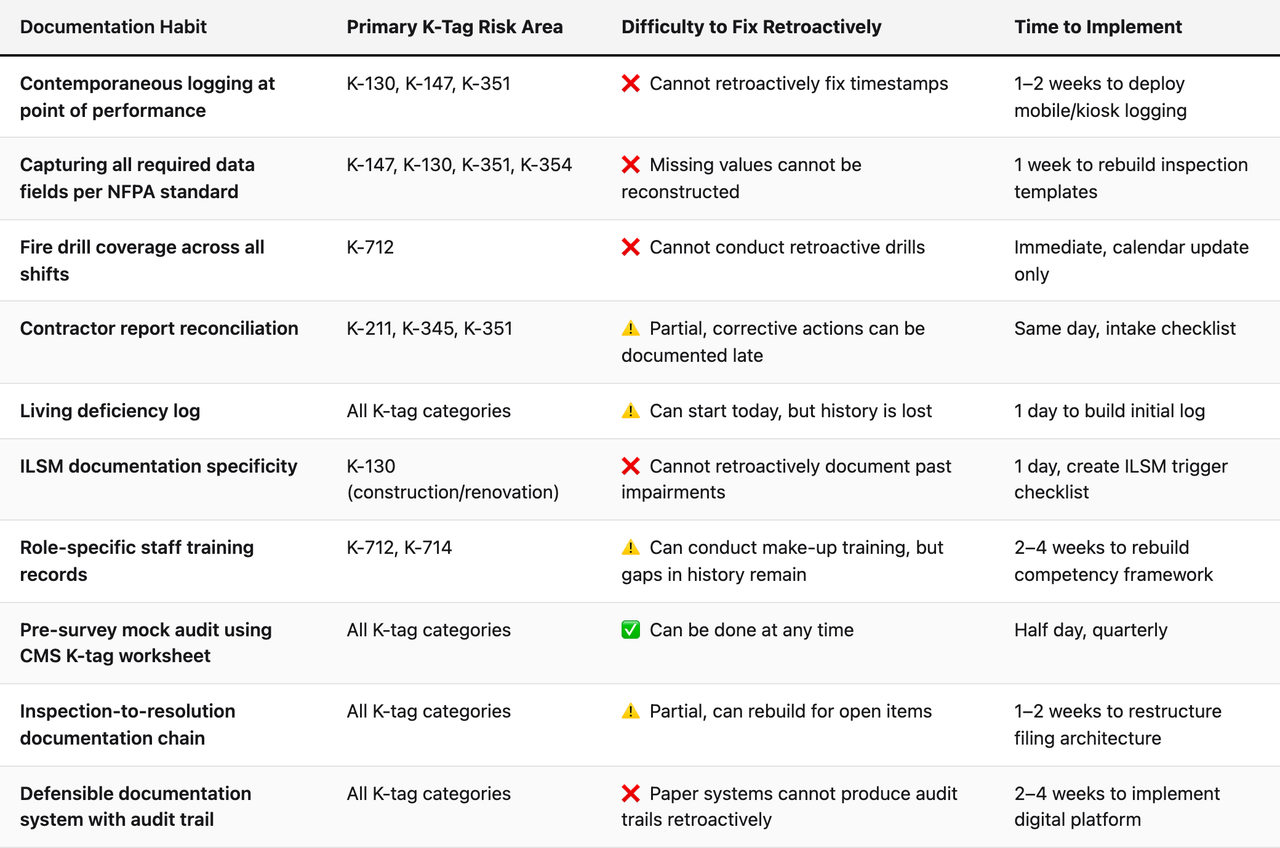
What the Gap Between Survey-Ready and Cited Looks Like in Practice
The table above reveals something important: six of the ten habits produce citation risks that cannot be corrected retroactively once a surveyor is on-site. Timestamps cannot be changed. Fire drills cannot be conducted after the fact. ILSM records for an impairment that ended three months ago cannot be created today. This is why survey readiness is a continuous operational discipline, not a pre-survey preparation exercise.
The facilities that consistently avoid life safety citations are not better resourced than the facilities that receive them. They are not running more inspections. In many cases, they are running the same inspections with the same staffing levels. The difference is that their documentation infrastructure captures, connects, and surfaces that work in a format that holds up to regulatory scrutiny. Their maintenance directors are not spending the week before a survey pulling records from three different binders and hoping the dates align. They are operating with confidence because their system has already done the audit they would otherwise be doing manually.
That shift, from reactive documentation scramble to proactive documentation intelligence, is what separates survey-ready SNFs from cited ones. It is not a philosophical difference. It is a systems difference. And it is addressable.
Frequently Asked Questions About Life Safety Documentation in SNFs
What are the most commonly cited K-tags in SNF life safety surveys?
The most frequently cited K-tags in skilled nursing facilities relate to fire alarm system maintenance and testing, sprinkler system documentation, emergency power system testing records, fire door compliance, and fire drill documentation across all required shifts. K-130 (general building construction and maintenance), K-211 (means of egress), K-345 (fire alarm testing), K-351 (sprinkler systems), and K-712 (fire drills) appear with high frequency in life safety survey findings. The common thread across most of these citations is documentation failure rather than physical system failure.
How far back will a CMS surveyor typically look at life safety records?
CMS life safety surveyors typically review the most recent twelve months of documentation for recurring inspection categories such as fire drills, generator tests, and sprinkler inspections. For some categories, particularly those tied to contractor inspection cycles or equipment that has a longer inspection interval, surveyors may look further back to verify the full required inspection history. Any deficiency identified in a contractor report that falls within the review window is subject to scrutiny, regardless of when the report was filed.
Does SEQURA replace the need for a licensed life safety contractor?
No. SEQURA is a documentation-intelligence platform, not a physical inspection service. Licensed contractors are required by NFPA standards and state regulations for many categories of life safety inspection and testing. What SEQURA does is ensure that the records produced by those contractors, and by the facility's own staff, are complete, correctly filed, cross-referenced to deficiencies, and tracked to resolution. It also surfaces documentation gaps before a surveyor finds them. The platform complements licensed contractor relationships rather than replacing them.
What is the difference between a K-tag deficiency and a condition-level deficiency in a life safety survey?
K-tags are the deficiency codes assigned to life safety findings under the Life Safety Code conditions of participation. Most K-tag citations result in standard deficiency findings, which require a plan of correction but do not immediately threaten a facility's certification status. A condition-level deficiency is a finding so serious that it constitutes a substantial failure to meet a condition of participation, these can trigger immediate jeopardy designations and, in severe cases, civil monetary penalties or termination proceedings. Repeated or uncorrected life safety deficiencies can escalate from standard to condition-level on subsequent surveys.
How should a maintenance director organize life safety records for a CMS survey?
The most defensible organization structure groups records by K-tag category rather than by date or by asset type alone. Within each K-tag category, records should be ordered chronologically and should include: the scheduled inspection date, the actual completion date, the person who performed the inspection, all required data fields for that inspection type, any deficiencies identified, and the corrective action chain for each deficiency. Contractor reports should be filed with the facility's own reconciliation record, not in a separate contractor file.
Can a facility be cited for a life safety deficiency if the physical system is compliant?
Yes. A facility can receive a K-tag citation for failure to document required inspections, testing, or maintenance even if the physical system is functioning correctly and has been properly maintained. The Life Safety Code requires documentation of compliance, not just compliance itself. A generator that runs perfectly but has no contemporaneous test records with required data fields is a citable finding. This is why documentation is not administrative overhead, it is the regulatory proof of physical compliance.
What should an ILSM record include to satisfy CMS requirements?
A compliant ILSM record should include: the date and time the life safety impairment began, a description of the impaired feature and the nature of the impairment, the ILSM measures implemented (increased patrols, temporary barriers, staff notification, posted signage, fire watch if required), the person responsible for monitoring ILSM compliance, any staff training conducted related to the impairment, and the date and time the impairment was resolved with the life safety feature restored to full operation. Each of these elements should be documented contemporaneously, not reconstructed after the fact.
How often should a SNF conduct a mock life safety survey?
A quarterly mock survey cadence using the CMS K-tag worksheet as the review framework is the minimum standard for survey-ready facilities. Higher-risk facilities, those with recent citation history, active construction, or significant staff turnover in maintenance roles, should conduct mock surveys monthly. The mock survey should be conducted by someone who did not create the records being reviewed, and findings should be tracked in the facility's deficiency log to resolution.
What is the best way to ensure fire drill records satisfy CMS requirements?
Fire drill records should capture: the date and exact time the drill was conducted, the shift covered by the drill, the name and title of the person who conducted the drill, the evacuation route used, the number of staff participating, any problems observed during the drill and how they were addressed, and the name of the person who completed the documentation. The drill calendar for the year should show coverage across all three shifts with varied timing, and no single shift should be over-represented in the annual drill record. Documentation should be completed at the time of the drill, not later.
Is a digital documentation platform required for CMS life safety compliance?
CMS does not require a digital platform for life safety documentation, paper records are permissible if they are complete, contemporaneous, and organized in a manner that supports surveyor review. However, paper systems have structural limitations that make several of the most important compliance habits difficult to maintain: they cannot enforce contemporaneous completion, cannot generate alerts for missed inspections, cannot produce an audit trail, and cannot connect inspection records to deficiency records to corrective action records in a single traceable chain. Facilities using purpose-built digital platforms consistently demonstrate fewer documentation gaps because the system enforces the habits that paper systems leave to individual discipline.
How does staff turnover in the maintenance department affect life safety documentation compliance?
Staff turnover in the maintenance department is one of the most significant risk factors for life safety documentation gaps. When a maintenance director leaves, the institutional knowledge of where records are kept, which inspections are due, and how contractor reports are processed typically leaves with them. Facilities with paper-based systems are particularly vulnerable because the system is only as organized as the person who built it. Digital platforms with task libraries, scheduling automation, and role-based access reduce this risk significantly: a new maintenance director inherits a functioning system rather than a binder they have to interpret from scratch.
What role does the Director of Nursing play in life safety documentation compliance?
The Director of Nursing has a meaningful stake in life safety documentation compliance beyond the physical safety of residents. Staff training records tied to fire safety, evacuation procedures, and emergency response are often reviewed by surveyors as part of the life safety survey, and those records may be maintained partially by nursing leadership. Additionally, fire drill documentation that includes nursing staff participation, shift-specific coverage, and response observations requires coordination between the maintenance department and nursing leadership. DONs who treat life safety documentation as a shared accountability, rather than a maintenance department issue, tend to have more complete records in the categories that affect both departments.
Key Takeaways
- Most life safety citations result from documentation failures, not inspection failures. The inspections were done. The records did not hold up to scrutiny.
- Contemporaneous documentation is the single most impactful habit. Timestamps that do not match the inspection cadence are a red flag surveyors are trained to identify.
- Six of the ten habits listed here produce citation risks that cannot be corrected retroactively. Survey readiness is a continuous discipline, not a pre-survey preparation exercise.
- Contractor reports are a liability if not reconciled. Every deficiency identified in a third-party inspection report needs a documented corrective action chain in the facility's own records.
- Fire drill records are one of the most consistently cited documentation categories. Verify shift coverage across your last twelve months of drill records before your next survey window.
- A living deficiency log transforms open issues from citation risks into evidence of active management. Surveyors expect to find problems, they are looking for evidence the facility is managing them.
- A defensible documentation system requires an audit trail. Paper binders cannot demonstrate contemporaneous completion or chain of custody, structural limitations that digital platforms are designed to address.
- The mock survey is the most underused compliance tool in SNF operations. A quarterly review using the actual CMS K-tag worksheet surfaces gaps that no informal self-assessment will catch.
About the author
Benjamin Terebelo · Founder
Benjamin is the founder of SEQURA, a compliance platform purpose-built for healthcare facilities. He builds at the intersection of healthcare operations and software, maintaining a focus on bringing modern tooling to systems that the broader industry has largely left behind.
About the author
Benjamin Terebelo · Founder
Benjamin is the founder of SEQURA, a compliance platform purpose-built for healthcare facilities. He builds at the intersection of healthcare operations and software, maintaining a focus on bringing modern tooling to systems that the broader industry has largely left behind.