
10 Questions SNF Administrators Should Ask Their Maintenance Director Before Every Unannounced Survey Window

The surveyor is already in the parking lot. You just don't know which day.
That reality defines every operational decision a skilled nursing facility administrator makes about life safety documentation. Unannounced CMS surveys aren't a threat held in the future, they are a permanent present-tense condition. And yet the most common preparation strategy in American SNFs today is a reactive one: a frantic review of the maintenance director's binder triggered by a tip, a rumor, or the news that a nearby competitor just got tagged.
This article offers a different approach. Rather than a last-minute scramble, it proposes a structured set of diagnostic questions, ten of them, that an administrator can ask their maintenance director on a regular basis to surface the documentation gaps a CMS surveyor would find before anyone else does. These aren't inspection protocol questions. They're accountability questions, designed to reveal whether the documentation behind completed work actually holds up under scrutiny, or whether it just looks complete from the outside.
Each question below is ranked by the frequency with which the underlying gap produces actual citations. The logic: start with the areas where surveyors consistently find deficiencies, and work outward. By the end of this conversation, you'll understand not just what to ask, but why the question matters and what an honest, confident answer should sound like.
Why the Maintenance Binder Is the Wrong Starting Point
The default survey preparation ritual at most SNFs is a binder review. The maintenance director pulls the life safety binder, flips through inspection logs, confirms that dates are present, and declares the documentation current. Administrators often accept this at face value because the binder looks organized and the maintenance director is competent and experienced.
The problem is structural, not personal. The binder confirms that paperwork exists. It does not confirm that the paperwork is complete, correctly formatted, properly cross-referenced, or free of the specific gaps CMS surveyors are trained to find. A fire drill log with every date filled in can still produce a K-tag citation if the time-of-day distribution doesn't demonstrate adequate night-shift coverage. A generator test record can be fully completed and still fail if the transfer time and kW load fields were never populated. These aren't edge cases. They're the most common citation patterns in the F-tag and K-tag landscape.
The ten questions below are designed to get underneath the binder. They assume that the maintenance director is doing the work, and that the work may still be documented in ways that don't survive surveyor scrutiny. That's a different problem than negligence, and it requires a different diagnostic.
Question 1: Can You Show Me a Fire Drill Log That Would Satisfy a Surveyor, Right Now?
Fire drill documentation is the single most common source of K-tag citations in skilled nursing facilities, and it is also the most misunderstood. Most maintenance directors can confirm that fire drills were conducted. Far fewer can produce a drill log that meets the full documentation standard CMS expects.
The underlying requirement comes from NFPA 101, the Life Safety Code, which CMS adopts as the regulatory baseline for SNF survey. Under those standards, fire drill records must document not just that a drill occurred, but the date, time, shift, number of staff participating, the scenario used, any deficiencies observed, and corrective actions taken. A log entry that reads "fire drill completed, 3rd shift" with a date and a signature is not enough.
The deeper issue is shift distribution. CMS surveyors reviewing fire drill logs are specifically looking for evidence that drills cover all three shifts across all four quarters. A facility that runs every drill at 10 a.m. on weekdays will have a full log, and a clear citation pattern. The question "can you show me a fire drill log that would satisfy a surveyor" forces the conversation from "did we do the drills" to "does the documentation of those drills meet the standard."
What a confident answer looks like: The maintenance director produces a log showing drill times distributed across all three shifts over the trailing four quarters, with scenario documentation and deficiency notes for at least some drills (a log with zero deficiencies ever noted is itself a red flag for surveyors). Corrective actions are documented for any noted gap. The log is legible, dated contemporaneously, and could be handed to a surveyor without supplemental explanation.
What a concerning answer looks like: "We do the drills every quarter." Full stop. Or: "The logs are in the binder." Without the ability to immediately demonstrate shift coverage and documentation completeness, the administrator has identified a gap worth closing before the next survey window.
Question 2: Are There Any Open Sprinkler System Deficiencies, and Where Is That Documented?
Sprinkler system citations are among the most severe in the SNF life safety landscape. A cited deficiency in a wet or dry sprinkler system can trigger Immediate Jeopardy findings, which carry potential civil monetary penalties and, in extreme cases, decertification risk. The stakes are high enough that this question should be part of every regular conversation between an administrator and their maintenance director, not just pre-survey preparation.
The specific documentation challenge is this: sprinkler inspections are typically performed by a licensed third-party contractor under NFPA 25 standards. That contractor produces an inspection report listing any deficiencies found. CMS surveyors want to see two things: the original inspection report, and documentation showing that every deficiency identified was either corrected or is under a documented plan of correction with a timeline. If the contractor found three sprinkler heads requiring replacement and the facility's records show no response to that finding, the facility has a citation waiting to happen regardless of whether the heads were actually replaced.
The phrase "where is that documented" is the critical part of this question. The maintenance director may know in their head that the heads were replaced. The surveyor cannot know that unless the documentation trail is complete: the original deficiency, a work order, a completion record, and ideally a contractor follow-up confirmation. Undocumented corrections are, from a survey perspective, uncorrected deficiencies.
How to apply this in practice: Establish a standing protocol that every contractor-generated inspection report is received, logged, and reviewed within five business days. Any deficiency listed in that report triggers a work order with an assigned owner and a target completion date. Closure of that work order requires documentation of correction, not just a maintenance director's verbal confirmation.
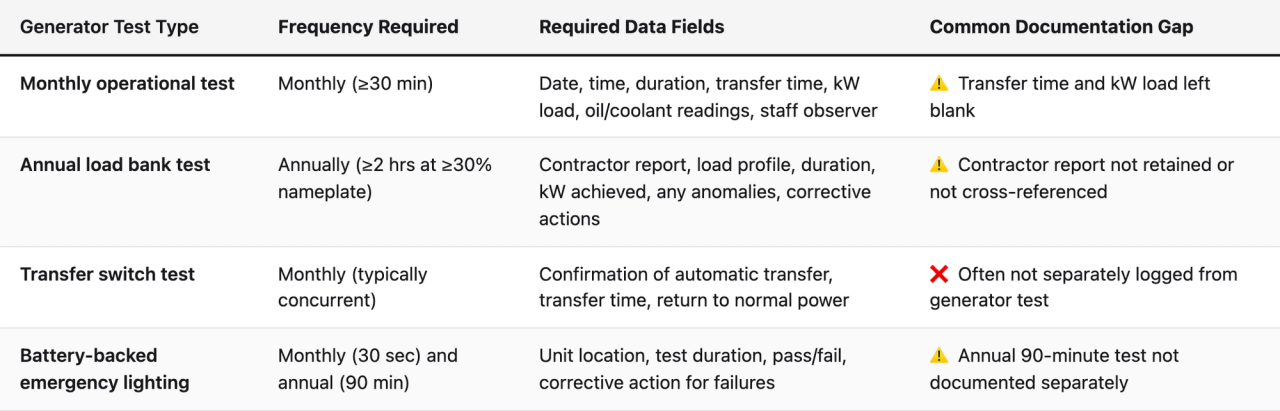
Question 3: When Was the Last Generator Test, and Do the Records Show Transfer Time and kW Load?
Emergency generator compliance is an area where SNFs frequently do the work correctly and document it incompletely, producing a citation from a test that actually passed. CMS requirements for generator testing under the Emergency Preparedness Rule and NFPA 110 require monthly operational tests and annual load tests, with specific data fields that must be captured in each record.
The fields most commonly missing are transfer time and actual kW load. Transfer time is the elapsed time from utility failure to generator assumption of load, and it must be within the standard threshold. kW load must be documented as a percentage of nameplate capacity to demonstrate that the generator is being adequately exercised. A log that records "generator ran for 30 minutes, no issues" without these fields will not satisfy a surveyor, even if the underlying test was entirely successful.
Beyond the monthly tests, annual load bank tests require their own documentation package, including load profile data, test duration, and any anomalies noted. If your facility uses a contractor for load bank testing, that contractor's report must be retained and cross-referenced with the internal test log.
The question to ask: Pull the last three monthly test records right now. Do they contain transfer time? Do they contain actual kW load readings? If those fields are blank or filled with "N/A," you have a documentation gap on a high-visibility survey item. Fix the template before the next test, and retroactively correct any incomplete records that can be corrected with supporting data.
Question 4: How Do We Know That Every Required Inspection Actually Happened, Not Just That a Form Was Filed?
This question is uncomfortable because it implies a level of distrust that most administrator-maintenance director relationships don't accommodate easily. But it's not a question about honesty. It's a question about system design.
In paper-based documentation systems, there is no structural difference between an inspection that happened and an inspection record that was filled out retrospectively. A maintenance technician who got behind on weekly extinguisher checks has no technical barrier to completing three weeks of logs on a Friday afternoon. The dates look right. The initials look right. The binder looks complete. And the facility is exposed to a citation for inspections that never occurred, because if a surveyor interviews staff or cross-references shift logs, the discrepancy can surface.
What this question is really asking is: does your documentation system have contemporaneous capture built in? Contemporaneous documentation means the record is created at the time the inspection occurs, by the person performing it, using a mechanism that creates a verifiable timestamp. Paper does not do this. A shared kiosk at the facility entrance, a mobile check-in at the asset location, or a scan-based system that logs the GPS coordinates and time of each completion does.
Beyond the integrity question, contemporaneous capture also creates audit trail clarity. If a surveyor asks "who performed the quarterly eyewash inspection on the second floor" and the answer requires the maintenance director to interpret handwriting or reconstruct memory, the documentation system has failed its second purpose. The answer should be instantly retrievable from a log that identifies the person, time, location, and completion status without interpretation.
How to apply this: Ask your maintenance director to walk you through how a completed inspection record is created. Specifically: at what point in the process is the record entered? Is it entered in the field at time of completion, or compiled later? If the answer is "compiled later," that's a system design problem worth addressing before survey season.
Question 5: Are There Any K-Tags From Our Last Survey That Still Have Open Corrective Actions?
This question has an obvious answer that many facilities get wrong. Every administrator knows that K-tags from a prior survey require a Plan of Correction (PoC). What gets missed is the gap between the PoC's stated completion date and the actual documentation of completion. A PoC submitted to CMS says "we will complete X by [date]." What happens after that date is often poorly tracked.
CMS surveyors at subsequent visits, including unannounced standard surveys, routinely revisit prior K-tag areas. If your last survey produced a K-tag for inadequate fire door inspection documentation (K211, K212, or equivalent), the next surveyor will walk directly to your fire door log. If the corrective action your PoC promised has not been implemented and documented, you are facing a repeat deficiency, which carries escalating consequences including potential for Condition-Level findings and mandatory referral patterns.
The documentation challenge specific to PoC follow-through: Most facilities track PoC completion at the administrator or DON level, but the underlying documentation that proves completion lives in the maintenance director's system. Those two tracking mechanisms are rarely integrated. The administrator believes the item is closed because the PoC due date passed. The maintenance director believes the item is closed because the work was done. But the documentation that connects "work done" to "citation requirement satisfied" may exist only in someone's memory.
A practical framework for this question: Maintain a live K-tag tracking document that lists every prior citation, the specific documentation requirement it identified, the PoC commitment made, and a direct reference to where the satisfying documentation can be found today. This document should be reviewable by the administrator at any time, not just during survey preparation, and should be updated by the maintenance director within 48 hours of any corrective action completion.
Question 6: Can We Produce the Last Twelve Months of HVAC, Medical Gas, and Utility Inspection Records in Under Ten Minutes?
Speed of retrieval is a survey performance variable that most administrators underestimate. When a CMS surveyor requests documentation, the facility typically has a short window to produce it. A surveyor who waits 45 minutes for a maintenance director to locate records in a physical binder, scan them, or reconstruct them from memory has already formed a negative impression of the facility's documentation culture, independent of what the records actually show.
The ten-minute benchmark in this question is not arbitrary. It represents the realistic expectation for a well-organized documentation system. Twelve months of HVAC preventive maintenance records, medical gas inspection documentation (critical in SNFs with oxygen concentrators and piped gas systems), and utility system inspection logs should be retrievable, organized, and presentable without a search operation.
Medical gas documentation deserves specific attention. NFPA 99, the Health Care Facilities Code, governs medical gas systems in SNFs, and CMS surveyors have become increasingly rigorous in reviewing these records. Inspection logs for oxygen storage areas, medical gas panels, and alarm systems must reflect the correct inspection intervals and must identify the qualified inspector (typically a certified medical gas verifier). Missing any link in that chain, the inspector's credentials, the inspection interval, or the deficiency resolution trail, creates a citation opportunity.
The operational test: Ask your maintenance director, without advance notice, to produce the HVAC PM records for the last 12 months. Time it. If retrieval takes more than ten minutes, or if any month is missing, the retrieval system needs redesign before survey. This isn't about the maintenance director's competence, it's about whether the documentation architecture supports rapid production under pressure.
Question 7: How Are Contractor-Generated Inspection Reports Received, Stored, and Linked to Internal Records?
A substantial portion of SNF life safety documentation is produced not by facility staff but by licensed contractors: fire alarm companies, sprinkler contractors, elevator inspectors, medical gas verifiers, generator service technicians, and others. The regulatory framework requires that contractor-generated reports be retained by the facility and be available for surveyor review. What it does not specify is how those reports are organized, which creates an enormous variation in documentation quality across facilities.
The common failure mode is a disconnect between the contractor's report and the facility's internal records. A fire alarm inspection contractor delivers an annual inspection report in PDF form. The maintenance director receives it, files it, and considers the item complete. But the report identified three addressable items requiring attention. The facility's internal work order system has no record of those items. The maintenance director knows about them and has verbally communicated them to the service contractor. But from a documentation standpoint, three open deficiencies exist with no documented resolution.
This is the gap that produces citations on otherwise well-maintained facilities. The contractor's report is not the end of the documentation chain, it is the beginning of a response documentation chain. Every deficiency listed in a contractor report must generate a traceable corrective action record within the facility's system.
A contractor documentation framework to implement:
- Designate a single point of receipt for all contractor reports (ideally a digital inbox that auto-timestamps receipt)
- Within five business days of receipt, all deficiencies in the report are entered as open work orders with assigned owners and target dates
- Contractor reports are stored in a named, organized location (physical or digital) that is indexed by system type and inspection date
- Completed corrections are closed in the work order system with a reference to the original contractor report item
- Any deficiency requiring contractor return generates a documented scheduling record, not just a phone call
Question 8: Is There Anything in the Documentation That You Would Be Uncomfortable Explaining to a Surveyor?
This question works differently from the others. It's not a technical audit question, it's a psychological one. And it's often the most revealing question on this list.
Maintenance directors are experienced professionals who know their documentation better than anyone. They also know where the gaps are. They know which inspection logs have entries that were completed late. They know which contractor report has a deficiency that hasn't been fully resolved yet. They know which month's generator test log has an incomplete field. They carry this knowledge quietly because the culture in most SNF operations doesn't create a safe channel for surfacing it.
This question creates that channel. By framing it as "what would you be uncomfortable explaining" rather than "what's wrong with the documentation," it invites an honest answer without implying blame. The maintenance director isn't being asked to confess to a failure, they're being asked for their professional assessment of documentation risk, which is exactly the expertise they have.
The administrator's role in this conversation is to listen without judgment and to treat whatever surfaces as a solvable problem. If the maintenance director says "there's a sprinkler inspection report from Q2 that has three items I haven't fully closed out," the correct response is "okay, let's look at it together and figure out the documentation path." Not "why didn't you tell me sooner."
Facilities that have this conversation regularly, before survey windows rather than during them, develop a documentation culture where gaps get surfaced and addressed instead of quietly carried. That cultural shift is often worth more than any specific process improvement.
Question 9: How Does the Night Shift Know What Life Safety Checks Are Required, and How Is Completion Documented?
Night shift documentation is a persistent blind spot in SNF life safety compliance. Several NFPA and CMS requirements apply specifically to overnight operations, fire watch protocols, certain emergency equipment checks, and specific documentation requirements that reflect round-the-clock facility operations. Night shift staff, who are often fewer in number and working with less direct supervision, are also the least integrated into the facility's documentation systems.
The fire drill coverage issue mentioned in Question 1 is only one dimension of this. The broader question is whether the documentation system that works during the day shift, whether paper or digital, is actually being used by overnight staff. A kiosk that's located in the maintenance shop and unlocked only during business hours doesn't serve night shift technicians. A paper log kept in the maintenance director's office is inaccessible to the EVS supervisor covering nights.
CMS surveyors specifically look for night-shift documentation gaps because they represent a real operational vulnerability, not just a paperwork issue. A facility that can demonstrate complete, contemporaneous documentation from night shift operations is demonstrating that its safety culture extends beyond the hours when administrators are present.
Questions to probe within this question:
- What specific tasks does night shift own for life safety documentation purposes?
- Where are those tasks listed, and who assigns them?
- How does a night shift EVS or maintenance staff member log a completed fire watch or equipment check?
- Who reviews night shift documentation, and how quickly?
- If a night shift staff member found a fire safety equipment failure, what is the documented escalation path?
If the maintenance director cannot answer these questions with specifics, the night shift documentation system needs explicit attention before the next survey window.
Question 10: If a Surveyor Walked In Tomorrow and Asked for Your Biggest Documentation Concern, What Would It Be?
This is the question that closes the conversation, and it's structured deliberately to get past the filtered, optimistic version of the maintenance director's assessment that often comes out when an administrator asks "are we ready for survey?"
"Are we ready for survey?" invites a binary yes/no answer and implicitly asks the maintenance director to perform confidence. "If a surveyor walked in tomorrow, what would be your biggest documentation concern?" invites a specific, honest answer. The framing acknowledges that concerns exist (they always do) and asks only for the most significant one.
The value of this question is that it surfaces the thing the maintenance director is already privately worried about. In nearly every facility, that thing exists. It might be a contractor report that came in late and hasn't been fully processed. It might be an annual inspection that's overdue by three weeks. It might be a documentation template that has a field that never gets filled in because nobody's sure what it's asking for. Whatever it is, it's the highest-probability citation risk in the building, and it's currently known only to the maintenance director.
What the administrator does with this answer matters as much as the answer itself. If the response to an honest disclosure is administrative frustration or blame, the maintenance director will not give an honest answer to this question again. If the response is "thank you for flagging that, let's address it this week," the question becomes a reliable early warning system that functions every time you ask it.
Build this question into every pre-survey review, every monthly operations check-in, and every post-survey debrief. Over time, the honest answer to this question is the single most useful piece of survey intelligence an administrator can have.
The Hidden Pattern Across All Ten Questions
Reading through these ten questions, a pattern emerges that's worth naming explicitly: the vast majority of life safety citations in skilled nursing facilities are not the result of work that didn't happen. They're the result of work that happened but wasn't documented in a way that surveyors can verify.
This distinction matters enormously for how administrators think about survey readiness. If the problem were non-compliance, the solution would be more inspections, more training, and more oversight. But if the problem is documentation architecture, the gap between work completed and work provably completed, then the solution is a documentation system that captures the right information, at the right time, in a format that a surveyor can review and approve without explanation from the maintenance director.
The ten questions above are diagnostic tools. They reveal where the documentation architecture has gaps. But they're only useful if they're asked regularly, not just in the final weeks before a survey window that may have already opened.
Platforms like SEQURA are built specifically for this documentation architecture problem. By replacing the paper binder with a vetted, NFPA-aligned task library that captures completions contemporaneously and audits documentation quality automatically, SEQURA closes the gap between "work done" and "work provably done", and surfaces the specific documentation gaps (missing kW load readings, unreconciled sprinkler deficiencies, incomplete fire drill shift coverage) that produce most K-tag citations. That's not compliance software as a category. It's survey confidence as a product.
Building a Pre-Survey Conversation Into Regular Operations
The ten questions above are most powerful when they're not reserved for survey season. SNF survey readiness is not a project with a start and end date, it's an operational posture that either exists or doesn't at any given moment. The goal is to make these questions part of the regular administrator-maintenance director relationship rather than an emergency audit triggered by survey anxiety.
A practical implementation framework:
- Monthly: Ask Questions 3, 4, and 6 during a standing 30-minute operations review. Focus on whether the documentation capture system is working as designed, not just whether records exist.
- Quarterly: Ask Questions 1, 2, 5, and 7 as part of a quarterly life safety documentation review. Pull actual records and review them together rather than accepting verbal summaries.
- Ongoing (any time): Keep Questions 8 and 10 in regular rotation as relationship-building questions that signal to the maintenance director that honest reporting is valued over optimistic reporting.
- After any contractor visit: Ask Question 7 specifically in relation to the most recent contractor report. Make it a reflex to ask "what did the contractor find, and where is the response documented?"
- Following a survey at any nearby facility: Ask Question 5 and review whether any of the cited K-tag areas at the other facility have analog gaps in your documentation.
The maintenance director who is asked these questions regularly develops a different relationship with their own documentation. Instead of managing a binder, they're managing a documentation system that has to hold up to a specific, known set of questions. That cognitive shift changes how records are created, stored, and reviewed, long before any surveyor arrives.
What "Survey Confidence" Actually Means in Practice
The term "survey confidence" gets used loosely in the SNF industry, often as marketing shorthand for "we help you prepare for surveys." But survey confidence has a specific operational meaning that's worth defining precisely, because the definition shapes everything about how a facility approaches life safety documentation.
Survey confidence is the state in which the documentation gaps a CMS or state surveyor would find at an unannounced visit have already been found and closed by the facility itself. It is not the state of believing the documentation is complete. It's not the state of having done all the required work. It's the state of having verified, through a process that mimics surveyor scrutiny, that the documentation is complete, correctly formatted, properly cross-referenced, and free of the specific patterns that produce citations.
That definition makes clear why the ten questions above are necessary but not sufficient. Questions create awareness of gaps. Closing those gaps requires documentation that satisfies the specific criteria a surveyor applies, and that requires either a very experienced internal audit process or a system designed to apply those criteria automatically.
The difference between a facility that has survey confidence and one that merely believes it's ready for survey is often invisible from the outside. Both facilities have binders. Both have maintenance directors who are doing their jobs. The difference is in the audit layer: whether someone (or something) has reviewed the documentation against the regulatory standard and confirmed that no gap would survive surveyor scrutiny.
Frequently Asked Questions
How often should SNF administrators formally review life safety documentation with the maintenance director?
A formal review should happen at minimum quarterly, with a shorter monthly check-in focused on high-frequency documentation items like generator tests and fire drill logs. During active survey windows, periods when nearby facilities have recently been surveyed, increasing the cadence to bi-weekly is a reasonable precaution. The goal is to make documentation review a regular operational rhythm rather than a crisis response.
What is the most commonly cited K-tag in skilled nursing facility surveys?
Fire protection and life safety deficiencies consistently represent the largest category of K-tag citations in SNF surveys. Within that category, fire door testing documentation, sprinkler system deficiencies, and fire drill documentation gaps are among the most frequently cited areas. The CMS Survey and Certification guidance documents provide the regulatory basis for each K-tag category.
What is the difference between an F-tag and a K-tag citation in a SNF survey?
F-tags are deficiencies cited under the Medicare/Medicaid Conditions of Participation that relate to resident care, staffing, and administrative requirements. K-tags are deficiencies cited under the Life Safety Code (NFPA 101) and relate specifically to the physical environment, fire protection systems, and emergency preparedness. Both types can produce significant regulatory consequences, but K-tags are uniquely associated with the maintenance director's documentation domain and are the focus of this article's diagnostic framework.
Can a SNF be cited for a K-tag even if all required inspections were completed?
Yes. Completing an inspection and documenting it in a way that satisfies surveyor scrutiny are two different things. If a required inspection was performed but the record is incomplete, missing required data fields, or cannot be located during the survey, the surveyor may cite the facility as if the inspection did not occur. Contemporaneous, complete documentation is the standard, not just evidence that work was done.
What does "contemporaneous documentation" mean in the context of SNF life safety records?
Contemporaneous documentation means that the record is created at the time the inspection or task is performed, by the person performing it, in a manner that creates a verifiable record of that moment. A maintenance technician who logs a fire extinguisher check immediately upon completing it, using a timestamped digital entry or a signed paper form filled out at the extinguisher location, is creating contemporaneous documentation. A technician who fills in a week's worth of logs on Friday afternoon is not, regardless of whether the underlying checks were actually performed.
How should SNFs handle life safety documentation for third-party contractors?
Every contractor-generated inspection report must be received, logged, and reviewed by the facility. Any deficiency identified in the report must generate a documented corrective action within the facility's own records. The contractor's report alone is not sufficient documentation of compliance, the facility must demonstrate that it received the report, understood its findings, and took documented action on every identified deficiency. Maintain a single organized repository of all contractor reports, indexed by system type and inspection date, with cross-references to internal corrective action records.
What are the most common fire drill documentation errors that produce K-tag citations?
The most common errors include: failure to demonstrate shift distribution across all three shifts in all four quarters; missing scenario descriptions or no variation in documented scenarios; absence of documented deficiencies (a log with no deficiencies ever noted is suspicious to surveyors); incomplete corrective action documentation for noted deficiencies; missing staff counts or incomplete participant documentation; and time-of-day entries that suggest drills were always conducted during low-risk periods rather than at varied times.
How does night shift documentation differ from day shift documentation requirements?
The regulatory requirements themselves do not differ by shift, all required inspections and documentation standards apply equally to all shifts. The operational challenge is that night shift staff are typically fewer in number, have less access to documentation infrastructure, and operate with less direct supervision. Facilities must ensure that their documentation systems are physically and logistically accessible to night shift staff, that night shift staff are trained on documentation requirements, and that there is a clear assignment of which documentation responsibilities belong to overnight coverage.
What should an SNF administrator do if the maintenance director surfaces a significant documentation gap during a pre-survey review?
Address it immediately and document the remediation. A discovered and corrected gap is far less damaging than a gap discovered by a surveyor. Create a written record of what was found, what corrective action was taken, and when it was completed. If the gap relates to a prior K-tag area, this documentation may also demonstrate good faith effort to comply, which can influence surveyor disposition. Avoid the instinct to minimize or defer, the time between discovery and the next surveyor arrival is the entire window available for remediation.
Is a digital documentation system required for SNF life safety compliance, or is paper acceptable?
CMS does not mandate digital documentation systems for life safety records. Paper-based systems remain acceptable provided they meet all content, retention, and availability requirements. However, paper systems have structural disadvantages for survey readiness: they cannot be audited automatically for completeness, they cannot produce alerts for missing or overdue records, and they are dependent on physical organization that can fail under the pressure of a survey. Digital systems with contemporaneous capture, automated task scheduling, and audit-ready record retrieval address all three of these vulnerabilities in ways that paper cannot.
How far back can a CMS surveyor request life safety documentation?
CMS surveyors can request documentation relevant to the current survey cycle and prior survey periods. In practice, surveyors typically request the most recent 12 months of documentation for ongoing compliance areas (fire drills, generator tests, sprinkler inspections) and may go further back when investigating a specific cited deficiency or reviewing a prior Plan of Correction. Facilities should maintain at minimum three years of life safety documentation, and many compliance frameworks recommend retaining records for the life of the equipment or system being documented.
What is the role of the SNF administrator versus the maintenance director in life safety survey readiness?
The maintenance director owns the operational execution: scheduling and completing inspections, managing contractor relationships, maintaining documentation records, and resolving identified deficiencies. The administrator owns accountability: ensuring the system for documentation is adequate, reviewing documentation quality regularly, creating a culture where gaps are surfaced rather than concealed, and making resource decisions that enable the maintenance director to meet compliance requirements. Survey citations are ultimately the administrator's regulatory exposure, which is why the diagnostic conversation between these two roles is so important.
Key Takeaways
- Survey readiness is a documentation architecture problem as much as a compliance behavior problem. Most K-tag citations result from work that happened but wasn't documented in a way surveyors can verify, not from work that didn't happen at all.
- Fire drill documentation, sprinkler deficiency resolution, and generator test records are the three highest-frequency citation areas and deserve a specific, recurring review cadence, not just pre-survey attention.
- Contemporaneous documentation is the standard, not just evidence of work done. A documentation system that allows retroactive completion creates survey exposure regardless of whether the underlying work was actually performed.
- Contractor-generated inspection reports begin a documentation chain, not end one. Every deficiency in a contractor report must generate a traceable corrective action record within the facility's own system.
- Night shift documentation is a persistent blind spot that surveyors know to look for. Facilities must ensure their documentation systems are accessible and functional for overnight staff.
- The question "what would you be uncomfortable explaining to a surveyor?" is the most valuable early warning tool an administrator can deploy, and it only works if honest answers are met with problem-solving rather than blame.
- Survey confidence is not a belief state, it's a verified state. It requires an audit process that applies surveyor-level scrutiny to documentation before the surveyor arrives, not after.
- Building these ten questions into regular operational conversations, monthly, quarterly, and after every contractor visit, transforms survey readiness from an emergency project into an ongoing operational posture.
About the author
Benjamin Terebelo · Founder
Benjamin is the founder of SEQURA, a compliance platform purpose-built for healthcare facilities. He builds at the intersection of healthcare operations and software, maintaining a focus on bringing modern tooling to systems that the broader industry has largely left behind.
About the author
Benjamin Terebelo · Founder
Benjamin is the founder of SEQURA, a compliance platform purpose-built for healthcare facilities. He builds at the intersection of healthcare operations and software, maintaining a focus on bringing modern tooling to systems that the broader industry has largely left behind.