
8 Contractor Report Documentation Errors That Create Unreconciled Deficiencies on CMS Survey Day

The surveyor arrives unannounced on a Tuesday morning. The maintenance director pulls the binder. Everything looks complete, contractor reports filed, inspection stickers on the panels, signatures on the fire drill logs. Three hours later, the exit conference lists four K-tags, two of which trace directly to contractor reports that were sitting in that binder the entire time. The documentation existed. The deficiencies existed inside the documentation. Nobody connected them.
This is not a rare scenario. It is the standard pattern behind a large share of life safety citations issued to skilled nursing facilities. The contractors showed up, did the work, and left paperwork behind. But the paperwork contained language that was too vague to satisfy a surveyor, referenced corrective actions that were never verified as complete, or omitted readings that CMS expects to see documented. The facility accepted the report as evidence of compliance and filed it. The surveyor read the same report and found a citation.
What follows is a breakdown of the eight contractor report documentation errors that produce this outcome most reliably. These are ordered by citation frequency and downstream risk, starting with the errors that appear in the broadest range of facility types and ending with the ones that are less common but almost always fatal when a surveyor finds them. Each section includes what the error looks like in practice, why surveyors flag it, and what correct documentation must contain.
1. Deficiency Notations Without a Corrective Action Status
This is the most common single source of unreconciled deficiencies in SNF life safety binders, and it is also the easiest to miss because the contractor technically documented the problem. The error is not in identifying the deficiency, it is in leaving the deficiency record open, with no documented resolution status attached to it.
Here is what this looks like in a real report: a fire sprinkler inspection report from a licensed contractor notes "one sidewall sprinkler head observed with minor corrosion, recommend replacement." The facility files the report. The maintenance director may or may not have ordered the replacement. The replacement may or may not have happened. The report, as filed, contains a deficiency with no follow-up record attached to it.
When a CMS surveyor reviews that report, they are not looking for whether the contractor noticed the problem. They are looking for whether the facility resolved it. CMS Survey and Certification Letter 16-09 makes clear that facilities are responsible for ensuring that life safety deficiencies identified by contractors are corrected and documented, not merely noted. A report that identifies a deficiency and stops there is, from a regulatory standpoint, a record of an unresolved problem.
What correct documentation requires: Every deficiency notation in a contractor report must be paired with one of three things, a documented completion record showing the correction was made (with date, parts, and technician), a written interim protection plan if correction was deferred, or a formal written deferral with an estimated completion date and administrator sign-off. The corrective action record should be physically attached to or cross-referenced with the original contractor report in whatever system the facility uses for contractor report documentation.
How to apply this: Build a tracking system that flags any contractor report containing the words "recommend," "advise," "noted," "observed," or "requires" as a report containing an open deficiency. Every one of those reports should generate a corrective action ticket that cannot be closed without a completion record. This is not optional polish, it is the minimum documentation standard CMS surveyors apply when reviewing sprinkler, fire alarm, and generator inspection records.
2. Missing or Illegible Technician Credentials on Contractor Reports
A contractor report is only as valid as the credentials of the person who performed the work. CMS surveyors and state fire marshals cross-reference the technician listed on a contractor report against the licensing requirements for that inspection type, and when the report is vague, unsigned, or lists only a company name without individual technician credentials, the inspection itself becomes questionable as a compliance document.
This error appears most frequently in three categories: fire alarm inspections (which require NICET certification or state-equivalent licensure in most states), sprinkler inspections (which require specific contractor licensing under NFPA 25), and medical gas system verifications (which require certification under NFPA 99 Chapter 5). In each category, the applicable standard specifies not just that an inspection must occur, but that it must be performed by a qualified individual, and the report is the only evidence that individual was qualified.
The NFPA 25 standard for water-based fire protection systems requires that inspection records identify the name and organization of the person performing the inspection. When a report shows only a company stamp or a signature that cannot be read, surveyors have documented grounds to question whether the inspection was performed by a qualified contractor.
What correct documentation requires: Every contractor report must include the full printed name of the technician, the technician's license or certification number where applicable, the issuing authority for that credential, and the company's state contractor license number. These should appear on every page of a multi-page report, not just the cover sheet. If a report arrives without this information, the facility should request a corrected version before filing it.
How to apply this: Create a contractor credential file separate from the inspection reports themselves. Before any contractor performs an inspection at the facility, verify and document their credentials in that file. When the inspection report arrives, confirm the technician name on the report matches a credentialed individual in your file. This two-step verification is what prevents a surveyor from discovering that an annual fire alarm inspection was performed by an uncredentialed subcontractor.
3. Generator Load Bank Test Reports Missing Required kW Readings
Generator documentation errors are among the most reliably cited life safety deficiencies in SNF surveys, and within generator documentation, the missing or incomplete load bank test record is the specific failure mode that creates the most citations. The error is technical, easy to miss if you do not know what to look for, and almost impossible to explain away during a survey exit conference.
CMS requires SNFs to conduct annual load bank testing of emergency generators when the generator does not reach a minimum exhaust temperature or load factor during monthly testing. The applicable standard is NFPA 110, Chapter 8, which specifies that load testing must be conducted at a load between 25% and 100% of the nameplate rating, and that the test record must include the load applied in kilowatts, the duration of the test, and the starting and ending parameters of the test. A report that says "annual load test completed, generator performed satisfactorily" does not meet this standard.
The specific data points surveyors look for in a generator load test report include: starting voltage and frequency, load applied in kW and as a percentage of nameplate, coolant and oil temperature at intervals during the test, exhaust temperature where applicable, transfer time when tested with automatic transfer switch, and the name and credentials of the technician. A report missing any of these is an incomplete record for CMS purposes, regardless of whether the generator actually performed correctly during the test.
What correct documentation requires: The facility should obtain a copy of the contractor's data sheet from the actual test, not just a summary letter. Many contractors produce both, a detailed data log and a summary attestation. The detailed log is what satisfies the NFPA 110 requirement. The summary letter is not a substitute.
How to apply this: Before scheduling any annual generator load bank test, provide the contractor with a written checklist of the specific data points your facility requires in the report. Put this requirement in the service agreement. When the report arrives, review it against the checklist before filing it. If data points are missing, request a corrected report immediately, not after a surveyor identifies the gap.
4. Fire Drill Records That Document Drills But Not Evaluations
SNF deficiency reconciliation reviews consistently surface fire drill records as a high-frequency citation source, not because facilities skip drills, but because their drill records document that a drill happened without documenting what the drill evaluated. CMS surveyors are not looking for proof that staff assembled in a parking lot. They are looking for evidence that the drill tested the facility's actual fire response procedures and identified any gaps.
The K-tag framework for fire drills (primarily K712 and related tags) requires that fire drills be conducted under varied conditions and that a post-drill evaluation identify any deficiencies in staff response. A drill record that lists date, time, number of staff participating, and evacuation time satisfies part of this requirement, but it does not satisfy the evaluation component. When a surveyor asks "what deficiencies did your last four drills identify?" and the answer is "none" across all four drills at every shift, that answer is itself a red flag. It suggests the facility is documenting attendance, not performance evaluation.
The drill record must include: the scenario presented (e.g., simulated fire location, type of alarm activation), the specific procedures tested, any staff responses that deviated from the facility's fire response plan, the corrective actions taken following those deviations, and the name and signature of the person conducting the evaluation. Night-shift drill coverage is a specific scrutiny point, CMS expects at least one drill per shift per quarter, and the night-shift drill records are frequently the ones that are either missing or abbreviated.
What correct documentation requires: Fire drill records should follow a structured template that forces the evaluator to document scenario conditions, observed staff performance, deviations noted, and follow-up actions. A blank or "N/A" in the deviations field should require a specific notation explaining why no deviations were observed, rather than being accepted as a default.
How to apply this: Review your last 12 months of fire drill records as if you were a surveyor. If every drill record shows zero deviations, that is a documentation pattern that will draw scrutiny. Real drills identify real gaps. If your records do not show that, either the evaluation is not being done honestly or the record template is not capturing what evaluators actually observe.
5. Contractor Reports Filed Without Facility Acknowledgment or Sign-Off
This error is structural rather than technical, and it is one that many maintenance directors do not recognize as a documentation problem at all. A contractor delivers an inspection report. The report gets filed. No one at the facility signs it, dates their receipt, or documents that a responsible party reviewed it. From a regulatory standpoint, a report with no facility acknowledgment is evidence that a contractor came and went, not evidence that the facility reviewed the findings and accepted responsibility for any required follow-up.
CMS surveyors use facility sign-off on contractor reports as a proxy for whether the facility's management actually reviewed the inspection outcome. When reports are filed without any facility acknowledgment, surveyors draw the reasonable inference that the reports were collected and stored without being read. This is particularly significant for reports that contain deficiency notations, if the facility did not sign the report, the argument that they were unaware of the deficiency becomes harder to make, but so does the argument that they were aware and took action.
What correct documentation requires: Every contractor report should receive a facility review notation that includes: the date the report was received, the name and title of the person who reviewed it, a notation of whether any deficiencies were identified, and a reference to any corrective action tickets generated from the report. This notation can be as simple as a stamp or a cover sheet attached to the report, but it must be dated and signed.
How to apply this: Establish a formal report intake procedure. When a contractor report arrives (whether by email, paper, or portal), it gets logged into the facility's documentation system with a receipt date. The maintenance director or designated reviewer signs off within a defined window (48-72 hours is reasonable). Any deficiency notations generate a corrective action ticket before the report is filed. This process turns contractor reports from passive records into active compliance documents.
6. Sprinkler Inspection Reports That Reference NFPA 25 Compliance Without Documenting Component-Level Findings
This is the documentation error that most reliably creates life safety compliance gaps in sprinkler system records, and it is also the one that contractors most commonly produce because it is faster to write. The report arrives on facility letterhead, states that the sprinkler system was inspected in accordance with NFPA 25, and concludes that the system is in satisfactory condition. No component-level data. No list of areas inspected. No notation of specific items examined or their condition. Just a summary attestation.
NFPA 25 does not allow this. The standard's inspection, testing, and maintenance (ITM) requirements are component-specific. Different components have different inspection frequencies, and the inspection record must document each component category examined, the areas of the facility where inspection occurred, specific findings by component type (sprinkler heads, control valves, gauges, waterflow devices, and more), and the results of any tests conducted (drain tests, waterflow alarm tests, and so on). A summary attestation that skips this component-level documentation is not a compliant NFPA 25 inspection record regardless of the contractor's license status.
When a CMS surveyor reviews a sprinkler inspection report and finds only a summary statement, they will ask for the detailed inspection worksheet. If that worksheet does not exist, the inspection record is insufficient. If the worksheet shows that certain areas of the facility were not inspected or certain components were not tested at the required frequency, those become the basis for a citation under the relevant K-tag.
What correct documentation requires: The complete NFPA 25 inspection record must include a facility diagram or written description of areas covered, a component-by-component inspection log, test results for each required test (with pass/fail notations), a deficiency list with severity ratings where applicable, and the technician's signature on the detailed log rather than only on a summary page. Facilities should request the detailed inspection worksheet as a contractual deliverable, not treat the summary letter as the complete record.
How to apply this: Pull your most recent sprinkler inspection report and check whether it contains component-level findings. If it does not, contact the contractor and request the full inspection worksheet. If the contractor cannot produce one, that is a significant problem with both the contractor relationship and your current inspection record. Going forward, make the detailed worksheet a required deliverable in your service contract before the inspection occurs.
7. Medical Gas and Vacuum System Documentation Missing Post-Maintenance Verification
Medical gas documentation errors represent a distinct and high-stakes category of NFPA inspection records failures because the consequences of an undetected error in a medical gas system extend beyond regulatory citation into direct patient safety risk. SNFs with piped oxygen, medical air, or vacuum systems are required to maintain documentation under NFPA 99, and the specific error that creates the most unreconciled deficiencies is the absence of post-maintenance verification records following any work on the system.
NFPA 99 Chapter 5 requires that following any maintenance, repair, or modification of a medical gas or vacuum system, a qualified verifier must test the system and document that the system meets the applicable performance parameters before it is returned to service. This verification is separate from the maintenance record itself, it is a post-work certification that the system was tested and found acceptable. When a contractor performs maintenance on a medical gas outlet, replaces a zone valve, or services a vacuum pump, the maintenance record documents what was done. The verification record documents that what was done was correct.
Many SNF medical gas maintenance records contain only the maintenance documentation and no verification record. The contractor's invoice shows the work performed. The contractor's report may describe the work. But the post-maintenance verification, the test results, the purity readings, the pressure and flow measurements, and the verifier's signature, is absent. For CMS purposes, a medical gas system that was maintained without documented post-maintenance verification is a system that was maintained but not verified as safe to use.
What correct documentation requires: Post-maintenance verification for medical gas systems must include: the system or zone tested, the specific parameters tested (pressure, flow, purity where applicable), the test results compared to applicable NFPA 99 benchmarks, the name and credentials of the verifier, and the date and time testing was completed. This documentation should be attached to the maintenance record for the same work event, not filed separately in a way that makes the connection difficult to trace.
How to apply this: For every medical gas maintenance event, require two deliverables from the contractor: the maintenance record and the post-maintenance verification record. If your current contractor does not provide verification documentation as a standard deliverable, that is a contract gap that needs to be corrected before the next maintenance event. Some facilities also benefit from engaging an independent medical gas verifier who is separate from the maintenance contractor, particularly for major repairs or system modifications.
8. Inspection Reports Filed Under Wrong Asset or Location in the Documentation System
The final error on this list is the one that is most invisible during day-to-day operations and most visible during a survey. A contractor inspection report is filed in the wrong location within the facility's documentation system, a generator test report filed under the wrong building in a multi-building campus, a fire alarm inspection report filed under the previous year's folder, a sprinkler inspection report filed under a contractor name rather than an asset or building identifier. The report exists. It is complete. It cannot be found when a surveyor asks for it.
This error is particularly damaging because it creates the appearance of a missing inspection when the inspection actually occurred. During a CMS survey, when a surveyor requests documentation for a specific system at a specific location and the maintenance director cannot produce it within a reasonable time, the surveyor does not wait. The survey continues. The documentation gap is noted. If the report is eventually found, it may or may not be accepted as timely evidence depending on the surveyor's discretion and the circumstances of the review.
The problem is compounded in multi-site organizations where documentation is centralized but the organizational structure of the filing system does not match the physical structure of the facilities. A regional director who maintains documentation for six SNF campuses across a shared system may have organized reports by contractor, by month, or by inspection type, none of which maps cleanly to a surveyor's request for "all fire alarm inspection records for Building C at the Westbrook facility."
What correct documentation requires: Every inspection report should be filed under a consistent taxonomy that mirrors the way surveyors ask for records. That taxonomy should be: facility (or building within a campus), then system type (fire alarm, sprinkler, generator, medical gas, and so on), then inspection date. This structure allows anyone, including a surveyor, to navigate to any record within seconds. Cross-referencing by contractor name or invoice number is useful for internal accounting but should be secondary to the primary regulatory filing structure.
How to apply this: Conduct a documentation retrieval drill before your next survey window. Ask someone unfamiliar with your filing system to retrieve specific records, "show me the annual generator load test for this building from last year" or "pull the NFPA 25 annual sprinkler inspection for the main building." Time how long it takes. If it takes more than two minutes to retrieve a specific record, your filing taxonomy is not survey-ready. The goal is retrieval in under 60 seconds for any record in the system.
How These Eight Errors Compound Each Other During a Survey
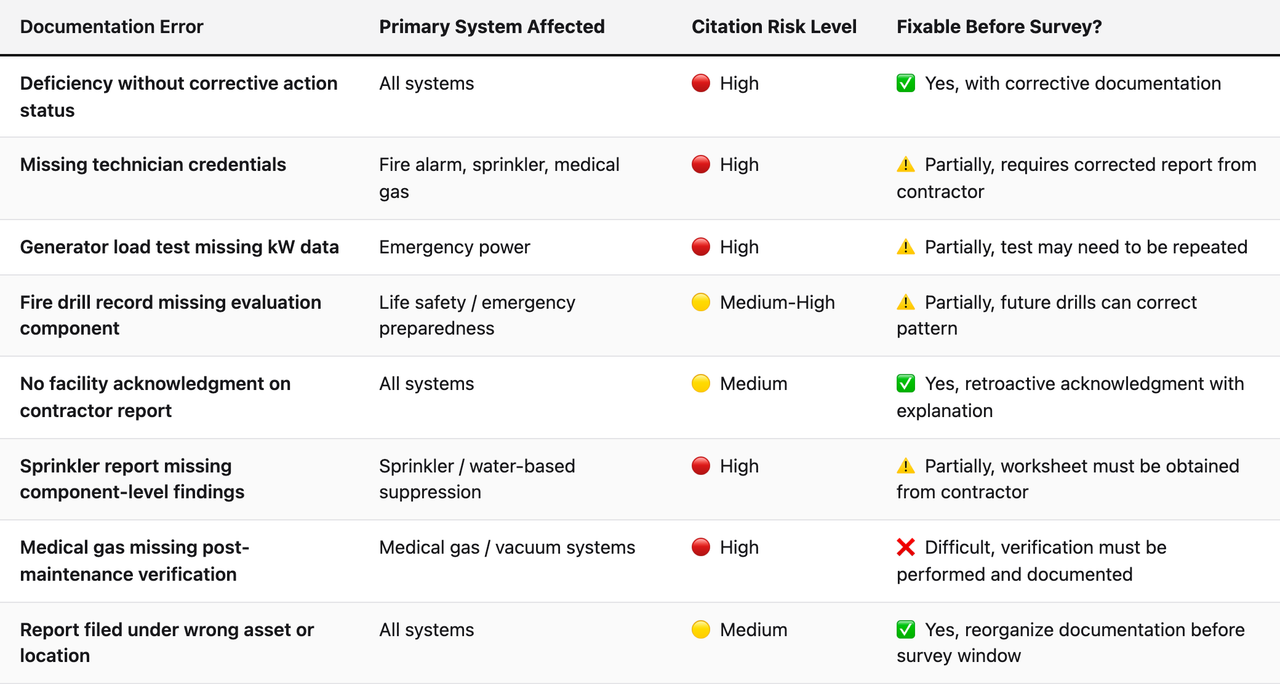
Understanding each error in isolation is useful. Understanding how they compound is essential for anyone managing CMS survey documentation errors at the facility or regional level, because surveyors do not encounter these errors one at a time. They encounter them as a pattern within a single binder or documentation system, and patterns create a different kind of citation risk than individual errors do.
Consider a realistic scenario: a surveyor reviews a facility's sprinkler inspection records and finds a report that references NFPA 25 compliance without component-level findings (Error 6). They ask for the detailed inspection worksheet and the maintenance director cannot locate it quickly (Error 8). The summary report they do find contains a deficiency notation about a control valve that was observed in a partially closed position (Error 1, no corrective action status attached). The report is signed by the contractor but has no facility acknowledgment or review date (Error 5). The technician's name is listed but no credential number is shown (Error 2).
That is four to five citation-generating errors in a single document review. Each error is a problem individually. Together, they communicate something worse than any single technical gap: they communicate that the facility's documentation management process is not functioning. That inference, once formed, sends the surveyor looking more carefully at every other system in the facility.
The pattern also affects the facility's ability to contest citations after the survey. A single documentation error in an otherwise complete record can often be addressed through a plan of correction. A pattern of errors across multiple systems, multiple contractors, and multiple inspection types is much harder to characterize as an isolated oversight. It becomes the basis for findings about systemic compliance management rather than individual technical lapses.
What a Pre-Survey Documentation Audit Should Actually Look Like
Most facilities that conduct any kind of pre-survey preparation focus on visible, physical compliance, walk-throughs to check extinguisher tags, door hardware, exit signage. Physical compliance matters, but documentation audits are what close the gap between a facility that is operationally compliant and a facility that can prove it is operationally compliant during an unannounced visit.
A documentation audit focused on contractor report errors should proceed systematically, starting with the highest-risk systems and working outward. The audit should cover every contractor report filed in the past 12 to 36 months (depending on the inspection frequency for each system) and apply a consistent checklist to each report. That checklist should include, at minimum:
- Does the report identify a qualified technician with verifiable credentials?
- Does the report contain component-level findings or only a summary attestation?
- Does the report identify any deficiencies, and if so, is there a corrective action record attached?
- Is the corrective action record complete, including a completion date and responsible party?
- Does the report carry a facility acknowledgment with a reviewer name and date?
- Is the report filed under the correct asset, building, and system category?
- For generator reports: does the report include all required NFPA 110 data points?
- For medical gas reports: is there a post-maintenance verification record for any maintenance events?
This audit should not be performed by the same person who manages the documentation day-to-day. The person who filed the reports is too close to the system to audit it objectively. An internal auditor from another department, a regional compliance officer, or a third-party life safety consultant is more likely to find the gaps that a surveyor would find.
The output of the audit should be a gap list, a specific inventory of which reports have which errors, in which systems, going back how far. That gap list becomes the priority queue for remediation. Some gaps can be closed immediately by contacting contractors for corrected reports. Others require scheduling additional inspections or tests. The gap list makes the remediation work visible and trackable rather than leaving it to individual memory and judgment.
Building Contractor Requirements Into Service Agreements Before Documentation Fails
Many of the documentation errors described in this article originate not in the facility's filing system but in the contractor's standard reporting template. Contractors produce the reports they are contracted to produce. If the service agreement does not specify what the report must contain, the contractor will produce whatever their standard template generates, and that standard template may or may not meet CMS documentation expectations.
The most effective point to address contractor report documentation quality is before the inspection occurs, in the service agreement itself. A well-constructed service agreement for a life safety inspection contractor should specify:
- The specific data fields required in every inspection report (not "an inspection report" but the specific content requirements for that system type)
- The technician credential information that must appear on every report
- The format for deficiency notation and the requirement for severity classification
- The timeline for report delivery after inspection completion
- The requirement to provide detailed inspection worksheets, not only summary letters
- For medical gas work: the requirement to provide post-maintenance verification as a separate deliverable
- For generator testing: the specific data log requirements aligned with NFPA 110 Chapter 8
This level of specificity in service agreements is not standard in most SNF contracting relationships, which is why contractor report documentation quality varies so widely from facility to facility. Facilities that specify documentation requirements contractually get better reports. Facilities that accept whatever the contractor delivers get whatever the contractor's standard template produces.
It is also worth including a report rejection provision in service agreements, a clause that allows the facility to reject a report that does not meet the specified documentation requirements and require a corrected version at no additional cost. This provision changes the dynamic of the contractor relationship in a way that benefits the facility's compliance posture without requiring adversarial enforcement.
The Role of Documentation Intelligence in Closing These Gaps Systematically
Manual audits of contractor reports, however thorough, have a practical ceiling. A maintenance director managing a 120-bed SNF may be responsible for documentation across dozens of recurring inspection types, multiple contractors, hundreds of individual assets, and thousands of inspection events per year. The cognitive load of reviewing every contractor report against every applicable documentation standard, tracking every open deficiency to resolution, and maintaining a filing taxonomy that survives staff turnover is not sustainable without a system that provides structure and automated review.
This is the operational reality that drives adoption of documentation intelligence platforms in the SNF market. The value of a system that audits completed inspection records and contractor reports against regulatory expectations is not that it replaces human judgment, it is that it makes the gaps visible before a surveyor makes them visible. A platform that flags a generator test report as missing required kW data the day the report is filed is infinitely more useful than a manual audit process that might catch the same gap six months later during survey preparation.
The same logic applies to deficiency tracking. When every deficiency notation in a contractor report automatically generates a corrective action ticket with an assigned owner, a due date, and a completion requirement, the probability that a deficiency sits unresolved in a filed report drops substantially. The deficiency is no longer invisible to anyone except the person who filed the report. It is visible to the maintenance director, the administrator, and any regional oversight function that monitors the facility's compliance posture.
Documentation intelligence also addresses the filing taxonomy problem at scale. When contractor reports are ingested into a system that organizes them by facility, building, system type, and asset, rather than by whatever filing logic the contractor or the maintenance director happened to use, retrieval time drops from minutes to seconds. That difference matters enormously during a survey, when a surveyor's impression of the facility's compliance culture is formed in the first hour of documentation review.
Frequently Asked Questions
What is the most common contractor report documentation error that leads to CMS citations?
The most common error is a deficiency notation in a contractor report with no attached corrective action record. The contractor identifies a problem, notes it in the report, and the facility files the report without documenting that the problem was resolved. CMS surveyors treat an unresolved deficiency notation as evidence of an open life safety gap, regardless of whether the physical correction was actually made.
Can a facility be cited for a deficiency that a contractor identified and the facility actually fixed?
Yes, if the documentation does not connect the deficiency to its resolution. CMS surveyors evaluate documentation, not just physical conditions. If a contractor report shows a deficiency and there is no corrective action record attached to it, the surveyor may cite the deficiency even if the physical correction was completed. Documentation of the correction is as important as the correction itself.
What credentials should appear on a fire alarm inspection report to satisfy CMS requirements?
The technician's full name, their NICET certification number and level (or state-equivalent license number), and the company's state contractor license number should all appear on the report. The requirements vary by state, but NICET Level II is commonly referenced as the minimum for testing and inspection of fire alarm systems in healthcare occupancies. Check your state fire marshal's requirements for the specific credential standard in your jurisdiction.
How often do SNFs need to conduct load bank testing on emergency generators?
Under NFPA 110, facilities must conduct an annual load test if the generator does not meet the minimum performance criteria (typically a load factor of at least 30% of nameplate rating) during monthly testing. If monthly tests consistently demonstrate adequate loading, the annual load bank test requirement may not apply, but the monthly test records must document the load achieved to support that conclusion. Facilities should review their monthly generator test logs to confirm they are capturing the data needed to make this determination.
What makes a fire drill record sufficient for CMS purposes?
A sufficient fire drill record documents the scenario presented, the procedures tested, the staff response observed, any deviations from the facility's fire response plan, corrective actions taken following those deviations, and the name and signature of the evaluator. Records that document only attendance, time, and evacuation speed without an evaluation component are generally insufficient for CMS purposes.
Is a summary attestation letter from a sprinkler contractor acceptable as a compliance record?
No. NFPA 25 requires that inspection records document component-level findings, not only a summary conclusion. A letter stating that the system was inspected in accordance with NFPA 25 and found satisfactory does not meet the standard's documentation requirements. The detailed inspection worksheet showing each component category examined, the areas covered, and specific findings is the required record. The summary letter may accompany the detailed record but cannot replace it.
What documentation is required when a contractor performs maintenance on a medical gas system in an SNF?
NFPA 99 requires two distinct records for any medical gas maintenance event: the maintenance record documenting what work was performed, and a post-maintenance verification record documenting that the system was tested and found acceptable before being returned to service. The verification must be performed by a qualified verifier (who may or may not be the same contractor that performed the maintenance) and must document the specific parameters tested and their results.
How should SNFs organize contractor reports to ensure they can be retrieved quickly during a survey?
The most survey-ready filing taxonomy organizes records first by facility (or building within a campus), then by system type (fire alarm, sprinkler, generator, medical gas, etc.), then by inspection date within each system. This structure mirrors the way surveyors request records and allows any record to be retrieved within seconds. Filing by contractor name, invoice number, or calendar month creates retrieval delays that surveyors interpret as evidence of disorganized compliance management.
Can a facility retroactively add a facility acknowledgment to a contractor report that was filed without one?
Yes, with appropriate context. A retroactive acknowledgment notation should include the date the acknowledgment is being added, an explanation of why it was not added at the time of filing, and the name and title of the reviewer. Retroactive acknowledgments are not ideal but are generally preferable to having no acknowledgment at all. Going forward, a formal report intake procedure prevents this situation from recurring.
How far back should a pre-survey documentation audit look at contractor reports?
The appropriate lookback period depends on the inspection frequency for each system. For systems with annual inspections (most fire alarm and sprinkler systems), a 36-month lookback captures three inspection cycles, which is typically what surveyors review. For systems with shorter inspection frequencies (monthly generator tests, quarterly fire drills), a 12-month lookback is typically sufficient. For systems with longer cycles (five-year sprinkler pipe inspections under NFPA 25), the lookback should cover the full inspection cycle.
What should a facility do if a contractor refuses to provide a corrected report with complete credential and component-level information?
A contractor who declines to provide documentation that meets applicable NFPA and CMS standards is a contractor whose reports cannot serve as compliance evidence. The facility should document the request and the contractor's refusal in writing, evaluate whether the original inspection can be accepted at all given the documentation gaps, and consider engaging a different contractor for future inspections. The facility may also need to schedule a repeat inspection with a contractor who will provide compliant documentation.
Do multi-site SNF operators face additional documentation risks compared to single-facility operators?
Multi-site operators face compounded documentation risks because the same errors that occur at a single facility can occur simultaneously across multiple facilities, and regional oversight structures may not catch them quickly. The most common additional risk for multi-site operators is filing taxonomy inconsistency, different facilities using different organizational systems that make centralized auditing difficult. Standardizing documentation structure and reporting requirements across all facilities in an organization is the most effective way to manage this risk.
Key Takeaways
- Deficiencies without corrective action records are the most common citation source, every open deficiency notation in a contractor report must have a documented resolution or a formal interim plan attached to it before the report is filed.
- Contractor reports are only as valid as the credentials they document, technician name, license number, and issuing authority must appear on every report for every regulated inspection type.
- Generator load test reports require specific data points, not just a passing conclusion, kW load, duration, starting and ending parameters, and transfer time are the minimum required under NFPA 110.
- Fire drill records must document evaluation findings, not just attendance, a pattern of zero deviations across all drills and all shifts is a red flag that signals documentation of attendance rather than honest performance evaluation.
- Every contractor report needs a dated facility acknowledgment, this is the documentation evidence that the facility's management reviewed the findings and accepted responsibility for follow-up.
- Sprinkler inspection reports must contain component-level findings, a summary attestation referencing NFPA 25 compliance is not a compliant inspection record under the standard.
- Medical gas maintenance events require two records, the maintenance record and a separate post-maintenance verification record are both required under NFPA 99.
- Filing taxonomy determines retrieval speed, organize by facility, then system type, then date. Every record should be retrievable in under 60 seconds during a live survey.
- Errors compound, multiple documentation errors in a single system review communicate systemic compliance management failure rather than isolated technical lapses, which escalates surveyor scrutiny across the entire facility.
- Specify documentation requirements in service agreements before inspections occur, contractors produce what they are contracted to produce. Contract language that specifies report content requirements produces better reports than accepting whatever the contractor's standard template delivers.
About the author
Benjamin Terebelo · Founder
Benjamin is the founder of SEQURA, a compliance platform purpose-built for healthcare facilities. He builds at the intersection of healthcare operations and software, maintaining a focus on bringing modern tooling to systems that the broader industry has largely left behind.
About the author
Benjamin Terebelo · Founder
Benjamin is the founder of SEQURA, a compliance platform purpose-built for healthcare facilities. He builds at the intersection of healthcare operations and software, maintaining a focus on bringing modern tooling to systems that the broader industry has largely left behind.