
9 Compliance Platform Features That SNF Maintenance Directors Actually Use — And 4 That Sound Good but Add No Survey Value

Most software vendors selling into skilled nursing facilities lead with feature counts. The more checkboxes on the comparison sheet, the better the product looks in a board-level procurement conversation. But maintenance directors, the people who actually open the software at 6:30 a.m. before a surveyor walks through the front door, have a different standard. They ask one question: does this thing help me survive a survey?
This article is built around that question. It identifies nine compliance platform features that SNF maintenance directors rely on daily, explains exactly why each one matters during a CMS or state survey, and then names four features that vendors highlight in demos but that rarely translate into real citation-prevention value. Understanding the difference is worth more than any feature comparison chart, because the wrong platform does not just waste money, it creates a false sense of survey readiness that can cost a facility its five-star rating.
The ranking below is ordered by survey impact, from the features that directly prevent K-tag citations to those that improve operational efficiency in ways that compound over time. Each section includes practical guidance on how to evaluate whether a platform actually delivers the feature, not just lists it in marketing copy.
The 9 SNF Compliance Platform Features That Actually Matter
1. Regulation-Mapped Task Libraries Built for NFPA 101, NFPA 99, and CMS K-Tags
This is the single most important feature in any life safety compliance platform for SNFs. Without a task library that is explicitly mapped to NFPA 101 Life Safety Code, NFPA 99 Health Care Facilities Code, and the CMS State Operations Manual K-tag categories, the platform is a general-purpose work order system wearing a compliance badge.
The reason this matters so acutely is that CMS surveyors do not inspect to a generic "maintenance checklist." They inspect to specific regulatory requirements, F-tag 689 for environment of care, K-tags for life safety, and state-specific equivalents that vary by jurisdiction. When a surveyor opens a citation, they cite the specific NFPA section or CMS regulation the facility failed to meet. If the maintenance director's task library was not built against those same regulatory requirements, there will be gaps. Not maybe. There will be gaps.
A regulation-mapped task library does several things a generic list cannot. First, it sets the correct inspection cadence. NFPA 101 requires annual fire alarm system inspections, quarterly sprinkler inspections, monthly fire extinguisher checks, but the exact intervals vary by asset type, and getting them wrong creates a documentation gap even if every physical inspection was completed. Second, it assigns the right data fields to each task. A generator test is not just "generator tested." CMS expects documentation of load, runtime, transfer switch operation, and any abnormalities. A task template that does not capture those fields creates an incomplete record that a surveyor can cite even if the generator ran perfectly.
Third, and most underappreciated, a regulation-mapped library eliminates the "I didn't know that was required" gap. SNF maintenance directors are skilled tradespeople, not regulatory lawyers. Most K-tag citations do not happen because someone skipped an inspection, they happen because someone did not know the inspection existed, or did not know what data it required. A properly built task library closes that knowledge gap by design.
How to evaluate this feature: Ask the vendor to show you the specific NFPA 101 section or K-tag number mapped to at least five tasks in their library. If they cannot do that, if the answer is "our tasks align with industry best practices", the library was not built by people who understand SNF survey requirements. Ask specifically about K-364 (sprinkler systems), K-341 (emergency lighting), K-521 (generator testing), and K-147 (electrical systems). These are among the most frequently cited life safety K-tags in CMS survey data.
2. Contemporaneous Completion Logging with Timestamped Records
CMS surveyors are trained to look for documentation that was completed after the fact. A binder full of inspection logs with perfect handwriting, identical pen pressure across months of records, and completion times that cluster suspiciously around the same hour of the same day is a red flag. Contemporaneous logging, documentation completed at the time the task is performed, from the location where it was performed, is the standard CMS expects and the standard that separates defensible records from correctable ones.
A compliance platform that enables contemporaneous logging through a facility kiosk, mobile device, or tablet transforms the documentation chain. When a maintenance technician completes a monthly fire extinguisher inspection, they log completion immediately, at the extinguisher location, with a timestamp that reflects the actual inspection time. That timestamp is system-generated and cannot be retroactively altered. The result is a record that carries genuine evidentiary weight during a survey.
The operational mechanics matter here. A kiosk-based system positioned in a central maintenance area allows shared access for facilities teams that do not have individual mobile devices. Mobile access extends that capability to technicians working across large buildings or campuses. Back-office computer access allows administrative completion of documentation tasks that are legitimately completed at a desk, contractor sign-offs, permit logs, vendor inspection records. A platform that offers all three access modes serves the actual workflow of a SNF maintenance department rather than forcing the team to adapt to the software's limitations.
There is a subtler point worth making here. Contemporaneous logging also protects maintenance directors personally. When a surveyor questions whether an inspection was completed, a timestamped digital record with a user ID is far more defensible than a paper log that could theoretically have been completed at any time. The platform provides documentation that protects the individual doing the work, not just the facility receiving the survey.
How to evaluate this feature: Ask whether completion timestamps are system-generated or user-entered. User-entered timestamps are not contemporaneous documentation, they are self-reported timestamps, which carry the same evidentiary weight as a handwritten date. Ask whether the system logs the device or location associated with each completion entry. Ask whether records can be edited after submission, and if so, whether edits are tracked in an audit log.
3. Documentation Gap Detection Before the Surveyor Arrives
The most valuable thing a compliance platform can do is find the problems you did not know you had. Most life safety citations are not the result of inspections that were skipped entirely, they are the result of inspections that were completed but documented incompletely, or completed at the wrong interval, or completed by the wrong type of person, or completed without capturing the specific data field the regulation requires.
This is the gap between a work order system and a compliance intelligence platform. A work order system records what was done. A compliance platform audits what was recorded against what was required and surfaces the difference. That difference is where K-tag citations live.
Consider a common scenario: a generator test is logged monthly as required. But the technician completing the log did not record the kilowatt load during the test, a specific data point that CMS expects for generator documentation under the emergency power supply system requirements in NFPA 110. The test was performed. The record exists. But the record is incomplete, and a surveyor reviewing it will note the deficiency. A documentation gap detection system reads the completed record, identifies the missing field, and flags it before the survey, giving the maintenance director time to correct the record or, if the data was genuinely not collected, to repeat the test properly.
The same logic applies to fire drill records missing night-shift coverage documentation, sprinkler inspection reports with unresolved deficiencies noted by the contractor but not formally closed out in the facility's own records, and eyewash station logs that were completed but not signed by a qualified individual as required by the applicable standard.
These are not edge cases. These are the patterns that produce the majority of life safety citations at otherwise well-run facilities. The maintenance director who completed the work is not negligent, they are operating without a system that tells them what "complete" actually looks like for each regulatory requirement.
How to evaluate this feature: Ask the vendor to demonstrate a specific gap detection scenario, not a dashboard showing overdue tasks, but an AI or rules-based review that reads a completed record and identifies a missing data field. The difference matters. Overdue task tracking is a calendar function. Documentation gap detection is a regulatory intelligence function. Ask how the system handles contractor-submitted reports, can it read an uploaded PDF and identify deficiencies that were noted but not closed?
4. Fire Drill Record Management with Shift-Coverage Tracking
Fire drill documentation is one of the most commonly cited life safety deficiencies in SNF surveys, and it is almost entirely a documentation problem rather than a safety problem. Facilities conduct the drills. The drills fail survey review because the records do not demonstrate coverage across all required shifts, or because the records do not capture the specific elements CMS and NFPA require.
Under NFPA 101 Chapter 18 and 19 requirements for health care occupancies, SNFs must conduct fire drills on each shift, day, evening, and night, at least quarterly, with at least one drill per shift per quarter. That means a minimum of 12 documented drills per year across three shifts. The documentation for each drill must capture the date, time, shift, number of staff participating, response time, and any corrective actions identified. Missing any of these elements creates a citable deficiency even if every single drill was conducted as required.
The night-shift requirement is where most facilities struggle. Night-shift drills are genuinely difficult to organize and easy to deprioritize. When they are not conducted, or when they are conducted but documented incompletely, the gap becomes visible immediately to a surveyor reviewing drill records for shift-coverage patterns. A compliance platform that tracks fire drill records with explicit shift-coverage dashboards shows maintenance directors and administrators at a glance whether the quarterly shift matrix is complete, before a surveyor checks.
Beyond coverage tracking, a platform should enable structured drill record entry that captures every required data field and flags incomplete submissions before they are finalized. A drill record missing the "corrective actions" field should not be saveable without either populating the field or explicitly marking it as "none identified." This forces completeness at the point of entry rather than at the point of survey review.
How to evaluate this feature: Ask the vendor to show you the shift-coverage matrix view for fire drills. Ask whether the system enforces required fields at submission or allows incomplete records. Ask how the system handles the scenario where a drill is conducted but not logged until the following day, does it flag the gap in contemporaneous documentation, or does it simply accept the late entry without notation?
5. Contractor Report Integration and Deficiency Close-Out Tracking
The biggest documentation blind spot in most SNF maintenance operations is the gap between what a contractor finds and what the facility records as resolved. When an outside vendor inspects a fire alarm system, a sprinkler system, or a medical gas system, they produce a report. That report may note deficiencies. The facility is responsible for closing those deficiencies, and for documenting that they were closed, with what corrective action, by whom, and when.
In a paper-based system, contractor reports often live in a folder or binder, separate from the facility's own inspection logs. Deficiencies noted in those reports may or may not have corresponding corrective action documentation. A surveyor who pulls a contractor report and finds a noted deficiency will then look for the facility's response documentation. If it does not exist, or if it exists in a different binder that no one retrieves during the survey, the deficiency becomes a citation, even if the physical repair was made.
A compliance platform that integrates contractor report management with deficiency close-out tracking creates a closed loop. The contractor report is uploaded or submitted directly into the platform. The system identifies deficiencies noted in the report, either through manual entry or, in more sophisticated platforms, through document analysis. Each deficiency is assigned a close-out task with a due date and a responsible person. When the corrective action is completed, it is documented in the same system, linked to the original deficiency, and timestamped. The result is a complete, traceable record that shows the surveyor exactly what was found and exactly how it was addressed.
This feature also protects facilities from a specific survey tactic: surveyors who request contractor reports for the past 12 months and then cross-reference them against the facility's corrective action log. Without an integrated system, this cross-reference almost always reveals gaps. With one, the gap is closed before the surveyor opens the first report.
How to evaluate this feature: Ask how the platform handles contractor-submitted PDF reports. Can deficiencies be extracted and tracked, or does the platform simply store the document? Ask how corrective actions are linked to original deficiency notes. Ask whether the system sends alerts when a deficiency close-out deadline is approaching or missed.
6. Multi-Facility Visibility for Regional and Portfolio Operators
For regional facilities managers and multi-site SNF operators, the highest-value compliance platform feature is a portfolio-level view that surfaces which facilities are at risk before a surveyor does. A single-facility dashboard is useful. A regional dashboard that aggregates compliance status across 5, 20, or 50 buildings is operationally transformative.
The challenge for regional operators is that compliance risk is invisible until a citation appears. A regional director managing 15 facilities cannot physically review every building's fire drill records, generator test logs, and sprinkler inspection documentation every month. Without a platform that aggregates this data, the regional director is flying blind, relying on facility-level maintenance directors to self-report problems that are, by nature, the kind of problems people do not immediately recognize as problems.
A multi-facility compliance platform changes this dynamic. The regional view shows, at a glance, which facilities have overdue tasks, which have incomplete fire drill shift coverage, which have open contractor deficiencies past their close-out deadline, and which have documentation gaps flagged by the system's review layer. The regional director can prioritize visits, direct resources, and intervene before a unannounced survey arrives at the highest-risk building in the portfolio.
This feature also enables benchmarking across facilities, identifying which buildings consistently maintain complete documentation and which require structural support. Patterns that emerge at the portfolio level, like a specific task category that is consistently incomplete across multiple facilities, suggest a training gap or a template design issue rather than a facility-specific failure.
How to evaluate this feature: Ask the vendor to demonstrate the regional or portfolio dashboard with real data or a realistic demo environment. Ask specifically how risk is surfaced, is it a simple overdue-task count, or does it reflect weighted compliance risk across different regulatory categories? Ask whether the platform allows a regional director to drill into a specific facility's records without requiring a separate login or account.
7. State-Specific Regulatory Template Variants
CMS sets the federal floor for life safety compliance in SNFs, but every state can and does add requirements on top of it. California's Title 22 requirements, New York's Part 415 regulations, Texas's Chapter 19 rules, and Florida's Chapter 59A standards all impose obligations that go beyond the federal baseline. A compliance platform built only to the CMS State Operations Manual will leave state-specific gaps that state surveyors, who conduct their own surveys independently of federal CMS surveys, will find.
State survey programs vary in their focus areas, their documentation expectations, and their citation patterns. Some states conduct joint surveys with CMS; others conduct independent surveys on different schedules. A facility in a state with an aggressive independent survey program faces two separate survey events, each with its own regulatory framework. A platform that does not account for the state-specific layer is providing partial compliance coverage at best.
The practical implication for maintenance directors is that the task library must include state-specific variants for every inspection type where state requirements exceed federal minimums. This is not a trivial build, it requires ongoing regulatory monitoring as state rules change, and it requires the kind of regulatory expertise that most software companies do not maintain in-house. Platforms built by teams with life safety consulting experience are meaningfully more likely to maintain accurate state-specific templates than platforms built primarily as software products that added healthcare as a vertical.
How to evaluate this feature: Ask the vendor specifically which states their template library covers at the state-specific level. Ask when each state template was last updated and what triggered the update. Ask whether the platform tracks state regulatory changes and updates templates proactively, or whether updates are reactive to customer requests. Ask for the name of the life safety consultant or regulatory expert who maintains the template library.
8. Survey-Ready Report Generation on Demand
When a CMS surveyor walks in unannounced, the maintenance director has minutes, not hours, to produce documentation. The ability to generate a complete, organized, survey-ready compliance report on demand, covering any time period, any asset category, any regulatory domain, is not a convenience feature. It is a survival feature.
Paper binders fail this test in two ways. First, they are static: whatever is in the binder at the moment the surveyor asks for it is what exists. If a record was filed in the wrong section, or was never filed, or was taken out for review and not returned, the gap is visible and immediate. Second, they are slow: organizing a paper binder to answer a specific surveyor request, "show me all your fire drill records from the past 12 months, organized by shift", can take 20 to 30 minutes in a well-organized system and much longer in a disorganized one. During an active survey, that time is not available.
A compliance platform with on-demand report generation allows the maintenance director to pull a complete fire drill report, a generator test history, a sprinkler inspection log, or a comprehensive life safety summary in the time it takes to enter a date range and click a button. The report is organized, complete, and formatted in a way that maps to the surveyor's regulatory framework rather than the facility's internal filing logic.
Beyond the immediate survey moment, on-demand reporting also supports proactive self-audits. A maintenance director who runs a monthly compliance report and reviews it before the next survey cycle is essentially conducting a mock survey, identifying gaps, correcting records, and building the documentation confidence that makes actual surveys less stressful.
How to evaluate this feature: Ask the vendor to generate a sample report during the demo. Ask how the report is organized, is it by date, by asset, by regulatory category, or by K-tag number? Ask whether reports can be filtered by shift (critical for fire drill documentation), by contractor, and by deficiency status. Ask whether reports can be exported as PDF for sharing with surveyors or administrators who do not have platform access.
9. Mobile and Kiosk Access for Non-Desk Maintenance Staff
The most technically sophisticated compliance platform fails if the people doing the work cannot use it where the work happens. SNF maintenance technicians and EVS staff spend their days in mechanical rooms, on rooftops, in corridors, and in resident care areas, not at desks. A platform that requires desktop access for task completion creates a documentation lag that defeats the purpose of contemporaneous logging.
Mobile access through a smartphone or tablet allows technicians to log task completions from any location in the facility, capturing the timestamp and user identity at the point of work. This is the gold standard for contemporaneous documentation. But mobile access alone is not sufficient for facilities where maintenance teams share devices or where staff do not have individual smartphones. A shared kiosk, a tablet or touchscreen terminal in a central maintenance area, provides a common access point that allows any team member to log completions without requiring individual device ownership.
The user interface design matters as much as the access method. A mobile interface designed for maintenance technicians should prioritize task completion speed over feature richness. The technician completing a monthly fire extinguisher check does not need to see the full NFPA regulatory citation for the task, they need to see the task, enter any required data fields, and submit. Interfaces that bury task completion under multiple navigation layers see lower adoption rates and, consequently, more documentation gaps.
For facilities with multi-lingual maintenance teams, language support in the mobile and kiosk interface reduces the risk of data entry errors and increases adoption among staff whose primary language is not English. This is a practical consideration that few vendors address directly but that matters significantly in many SNF markets.
How to evaluate this feature: Ask to see the mobile interface on an actual device, not a simulated screen in a demo. Ask how the platform handles offline access, if a technician is in a basement mechanical room without Wi-Fi, can they still log task completions that sync when connectivity is restored? Ask whether the kiosk interface is different from the mobile interface, and if so, how it is optimized for shared-device use.
The 4 Features That Sound Good in a Demo but Add Little Survey Value
These features appear prominently in vendor marketing materials and demo decks. Some are genuinely useful in other healthcare facility contexts. But for SNF maintenance directors focused on CMS and state survey readiness, they tend to consume budget and attention without reducing citation risk.
1. Predictive Maintenance Algorithms for Equipment Failure
Predictive maintenance is a legitimate and valuable technology in manufacturing, commercial real estate, and acute care hospitals with large, complex equipment inventories. The pitch is compelling: sensors and usage data identify equipment that is likely to fail before it actually fails, reducing emergency repairs and downtime.
For SNF life safety compliance, this feature addresses the wrong problem. CMS surveyors do not cite facilities for equipment that failed, they cite facilities for documentation that was missing, incomplete, or incorrect. A boiler that breaks down unexpectedly is a maintenance problem. A generator test log that is missing the kilowatt load reading is a compliance problem. Predictive maintenance algorithms are optimized to solve the first type of problem. They do almost nothing for the second.
The budget implications matter here. Predictive maintenance platforms that integrate sensor hardware with software analytics carry significant implementation costs and ongoing hardware maintenance requirements. For a single-site SNF or a small portfolio operator, that investment competes directly with the budget available for the documentation intelligence and regulatory template coverage that actually determines survey outcomes. Spending on predictive maintenance in a SNF context is often a case of solving a sophisticated problem while leaving the simpler, more consequential problem unaddressed.
There is also a practical workflow consideration. Most SNF maintenance departments are two to four people. They do not have the bandwidth to monitor equipment sensor dashboards in addition to completing their inspection rounds, managing contractor relationships, and maintaining compliance documentation. A feature that requires active monitoring to deliver value is a feature that will not be used consistently in a lean maintenance operation.
2. Resident Request Management and Help Desk Ticketing
Resident request management, a system for logging and tracking maintenance requests from residents and nursing staff, is a legitimate operational tool. It improves response time, creates accountability for completed repairs, and gives administrators visibility into facility maintenance demand. In a general-purpose CMMS, it is a core feature.
In a life safety compliance platform for SNFs, it is a distraction. Resident request tickets do not appear in CMS life safety surveys. Surveyors do not review help desk logs. They review life safety documentation: fire drill records, inspection logs, generator tests, contractor reports. The time a maintenance director spends managing resident request tickets is time not spent on the compliance documentation that determines survey outcomes.
The risk is not just misallocated attention. Platforms that combine resident request management with compliance documentation in a single interface often compromise both. The compliance documentation workflow becomes cluttered with operational noise, a technician logging a resident's broken window repair alongside a fire extinguisher inspection creates a record environment where compliance tasks are harder to identify, prioritize, and audit.
Facilities that need resident request management should use a dedicated tool for that function, separate from their compliance platform. The separation keeps compliance documentation clean, auditable, and focused on the records that actually matter during a survey.
3. Energy Management and Utility Consumption Dashboards
Energy management features, dashboards showing electricity consumption, HVAC efficiency metrics, utility cost tracking, and sustainability reporting, appear in many platforms marketed to healthcare facilities. The appeal is clear: reducing energy costs is a real financial benefit, and sustainability reporting is increasingly relevant to large operators with ESG commitments.
For SNF maintenance directors focused on survey readiness, energy dashboards are entirely orthogonal to the core problem. No K-tag citation has ever been issued for high electricity consumption or inefficient HVAC operation. The regulatory framework for SNF life safety is built around safety documentation, the presence or absence of completed inspections, the completeness of those inspection records, and the traceability of corrective actions for identified deficiencies. Energy data does not enter into that framework.
The practical risk of energy management features in a compliance platform is that they compete for screen real estate, user attention, and vendor development resources. A vendor investing engineering time in energy dashboards is a vendor not investing that time in regulatory template accuracy, documentation gap detection, or state-specific compliance coverage. The feature set reveals the vendor's primary market and product philosophy, and for SNFs, a platform whose homepage leads with energy savings is a platform built for a different customer.
4. Vendor Marketplace and Parts Procurement Integration
Some compliance platforms include an integrated vendor marketplace, a directory of contractors and suppliers, sometimes with procurement functionality that allows maintenance directors to request quotes, issue purchase orders, and manage parts inventory directly within the platform. The pitch is operational consolidation: one system for compliance, contractor management, and procurement.
The problem is that procurement integration adds significant operational complexity without adding any compliance value. A surveyor reviewing life safety documentation does not care whether the facility ordered replacement fire extinguisher cartridges through a platform marketplace or through a direct vendor relationship. The citation risk lives in the inspection record, not the procurement record.
More practically, SNF facilities departments have established vendor relationships that predate any software platform. A maintenance director who has worked with the same fire suppression contractor for seven years is not going to route that relationship through a platform marketplace because the software vendor has a partnership agreement with a competing contractor. Procurement features in compliance platforms tend to go unused because they require behavioral changes that produce no compliance benefit.
The implementation complexity of procurement integration also creates support overhead. Integrating with purchasing systems, managing vendor credentialing, and maintaining a contractor marketplace requires ongoing vendor support resources. For a platform company focused on life safety compliance, those resources are better deployed on regulatory updates and documentation intelligence than on procurement logistics.
How to Evaluate Any SNF Compliance Platform: A Practical Scoring Framework
The feature analysis above points toward a structured evaluation framework for any platform under consideration. The table below applies a weighted scoring model based on survey impact, the degree to which each feature directly reduces the probability of a K-tag citation or improves survey defensibility.
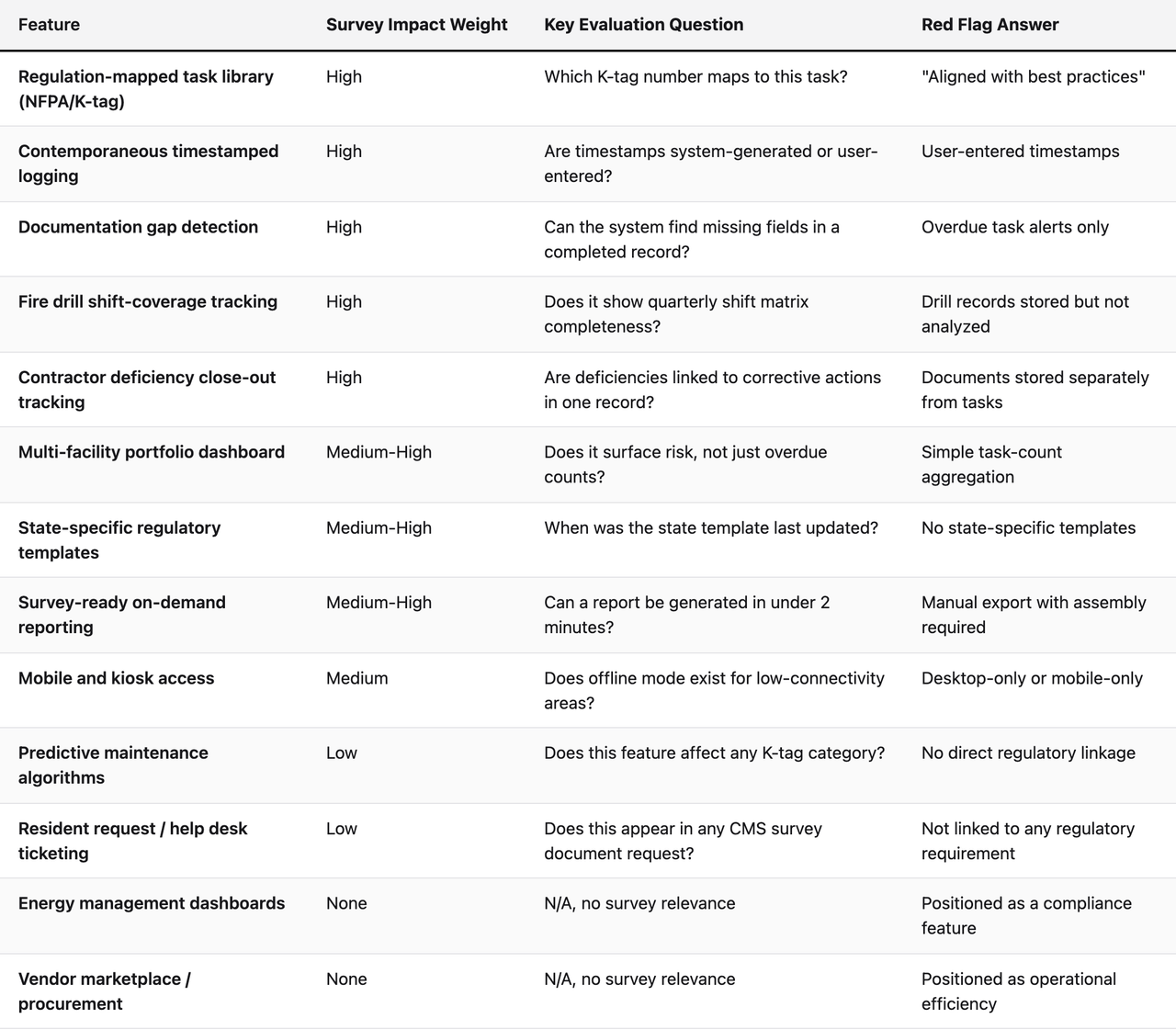
Use this table as a live evaluation tool during vendor demos. When a vendor highlights a feature, ask immediately: which survey impact category does this fall into, and how does it reduce the probability of a K-tag citation? A vendor who cannot answer that question clearly is a vendor whose platform was not built by people who understand SNF survey dynamics.
The Documentation Gap No Software Feature Can Close
There is one compliance failure mode that no platform feature addresses: a maintenance director who does not use the platform consistently. The most sophisticated documentation intelligence system in the world produces zero survey value if the generator test is logged two weeks after it was performed, or if fire drill records are entered in a batch at the end of the quarter to catch up before a survey.
This is not a technology problem. It is an adoption problem, and it is the reason that the access method and user interface of a compliance platform matter as much as its regulatory intelligence features. A platform that is difficult to use in the field will not be used in the field. The documentation will happen at a desk, after the fact, in batches, and the contemporaneous logging that gives digital records their evidentiary advantage over paper will be lost.
The facilities and platforms that produce the best survey outcomes share a common characteristic: they treat documentation as a workflow step built into the physical act of performing an inspection, rather than a separate administrative task completed later. The technician who checks the fire extinguisher and immediately logs the completion in the kiosk on their way back to the maintenance room is practicing contemporaneous documentation. The technician who checks 20 extinguishers and logs them all at the end of the day is practicing batch documentation, which is, from a CMS evidentiary standpoint, no different from paper logs filled out at the end of the week.
The implication for platform selection is that adoption enablement should be weighted as heavily as feature coverage. Ask vendors not just what the platform can do, but what their typical time-to-adoption looks like, what training is included, and what ongoing support is available when usage drops. A platform that a maintenance team actually uses is worth more than a platform with superior features that sits unused.
The CMS guidance on life safety survey protocols makes clear that surveyors are specifically trained to identify documentation that was not completed contemporaneously. The defense against that scrutiny is not better software. It is a workflow where documentation happens at the point of work, every time, without exception.
What the K-Tag Citation Data Tells Us About Where to Focus
CMS publishes deficiency data that allows a clear-eyed analysis of where SNF life safety citations actually occur. While the specific distribution shifts from year to year, the pattern is consistent: the highest-volume K-tag categories are not obscure regulatory requirements that facilities missed because they were unaware of them. They are the core life safety systems that every maintenance director knows they are responsible for, fire alarm systems, sprinkler systems, emergency power, and means of egress.
The citations happen not because facilities ignored these systems, but because the documentation of required inspections was incomplete, inconsistent, or missing entirely. The CMS Nursing Home Compare data and deficiency reporting framework reflects this consistently: documentation deficiencies in well-maintained systems are as common as deficiencies in systems that were genuinely neglected.
This is the central insight that should drive platform selection for SNF maintenance directors. The question is not "which platform helps me do more inspections?" Most facilities are already conducting the required inspections. The question is "which platform makes sure that every inspection I complete is documented in a way that will satisfy a surveyor reviewing it 12 months later?" That is a documentation intelligence question, not a work order management question, and it should drive every feature evaluation decision.
The K-tag categories that most frequently appear in SNF survey deficiency data include:
- K-211 / K-221: Means of egress, corridor width, and door requirements
- K-311 / K-321: Vertical openings and hazardous areas
- K-341: Emergency lighting documentation
- K-351 / K-353 / K-364: Sprinkler system inspections, testing, and maintenance
- K-521: Emergency power supply system testing and documentation
- K-712 / K-714: Fire drill requirements and documentation
- K-900 / K-916: Electrical systems and receptacle testing
A compliance platform that addresses these specific categories with dedicated task templates, required data fields, and documentation gap detection is a platform that addresses the actual citation risk in the average SNF. A platform that addresses them with generic "maintenance tasks" and optional data fields is a platform that will produce incomplete records in exactly the categories where surveyors look hardest.
Frequently Asked Questions: SNF Compliance Platform Features
What is the difference between a CMMS and a life safety compliance platform for SNFs?
A Computerized Maintenance Management System (CMMS) is a general-purpose tool for managing maintenance work orders, asset records, and preventive maintenance schedules. A life safety compliance platform is purpose-built for regulatory documentation in healthcare facilities, with task libraries mapped to specific NFPA codes and CMS K-tag categories, documentation gap detection, and survey-ready reporting. The distinction matters because a CMMS records what was done, while a compliance platform audits what was recorded against what the regulation requires.
How do I know if a platform's task library is actually mapped to NFPA 101 and CMS K-tags?
Ask the vendor to show you, for any task in the library, the specific NFPA 101 section number, NFPA 99 section number, or CMS K-tag number that the task fulfills. If the vendor cannot provide a direct regulatory citation for a task, the task was not built from the regulation, it was built from general maintenance knowledge, which is not the same thing. A properly built library will have this mapping documented and demonstrable on request.
Are fire drill records really one of the most common CMS life safety citations?
Yes. Fire drill documentation deficiencies appear consistently in CMS SNF survey data because the requirements are specific and the documentation is often incomplete. NFPA 101 requires documented drills on all three shifts at least quarterly, with specific data elements captured for each drill. Facilities that conduct drills but document them incompletely, or that miss night-shift drill requirements, face citation risk even when the actual safety practice is sound.
Does my compliance platform need to cover state-specific requirements, or is CMS coverage enough?
State coverage is essential if your state conducts independent surveys or imposes requirements beyond the CMS federal baseline. Many states do both. A platform that covers only the CMS State Operations Manual will leave gaps in states with supplemental requirements. Ask your platform vendor specifically which states they cover at the state-specific regulatory level, and verify that the templates were updated to reflect any recent state regulatory changes.
What should contemporaneous logging look like in a compliance platform?
Contemporaneous logging means the completion record is created at the time the task is performed, from the location where it is performed, with a system-generated timestamp. The key test: is the timestamp generated by the system (based on when the record was submitted) or entered by the user? User-entered timestamps are not contemporaneous documentation. System-generated timestamps tied to the submission event are.
How important is multi-facility visibility for a two-site SNF operator?
Even for a two-site operator, portfolio visibility is valuable because it allows a single regional view of compliance status across both buildings. The more important question is whether the platform allows a regional director or administrator to review both facilities' compliance data without requiring separate logins or manual report consolidation. For operators planning growth beyond two sites, platform scalability in this dimension matters significantly.
Can a compliance platform help with Plan of Correction documentation after a citation?
Some platforms include Plan of Correction (POC) tracking as a feature, allowing facilities to document corrective actions, timelines, and responsible parties in response to survey findings. This is a legitimate compliance-adjacent feature. It does not prevent citations, but it does support the organized response process that CMS requires after a survey finding. If POC management is a current pain point for your organization, evaluate it as a secondary feature after confirming that the core compliance documentation features meet your standards.
What is the biggest mistake SNF administrators make when evaluating compliance platforms?
The most common mistake is evaluating platforms primarily on their general feature count or their user interface aesthetics, rather than on the regulatory accuracy of their task library and the quality of their documentation gap detection. A platform with a polished interface and a generic task library will produce well-organized but incomplete compliance documentation, exactly the kind of documentation that generates citations. The regulatory depth of the task library should be the first and most heavily weighted evaluation criterion.
How does documentation gap detection work in practice?
In a well-designed platform, documentation gap detection operates as an automated review layer that reads completed inspection records and compares them against the data requirements for that specific regulatory task. If a generator test record is missing the kilowatt load field, the system flags it. If a fire drill record does not include a corrective actions entry, the system flags it. The flagged items appear in a gap report that the maintenance director or administrator can review and address before a survey. More sophisticated platforms extend this review to contractor-submitted documents, identifying deficiencies noted in outside inspection reports that do not have corresponding facility corrective action records.
How often should SNF maintenance directors run internal compliance audits using their platform?
Monthly internal audits using the platform's reporting and gap detection features are the minimum standard for facilities with a high-volume task calendar. Facilities in states with aggressive independent survey programs, or facilities that have received life safety citations in recent surveys, should consider weekly compliance reviews as a standard practice. The goal is to identify and close documentation gaps on a rolling basis, rather than conducting a comprehensive review only when a survey is anticipated.
Is it worth paying more for a platform built specifically for SNFs versus a general healthcare CMMS?
For SNF operators focused on CMS and state survey readiness, a purpose-built platform almost always justifies the price premium over a general healthcare CMMS. The regulatory specificity of NFPA 101 and CMS K-tag requirements for skilled nursing facilities is significant enough that a general-purpose system requires substantial customization to achieve equivalent compliance coverage, and that customization work is rarely done correctly without life safety regulatory expertise. The real cost of a general CMMS in an SNF context is not the subscription price. It is the citation risk created by documentation gaps that a purpose-built system would have caught.
What role does the maintenance director play in platform selection?
The maintenance director should be a primary decision-maker in platform selection, not just an end-user consulted after the fact. Administrators and COOs often lead platform evaluations from a budget and reporting perspective, but the maintenance director is the person who will use the platform daily, who understands the specific documentation challenges the facility faces, and who will bear the operational consequences of a platform that does not fit the actual workflow. Platforms selected without meaningful input from the maintenance director have lower adoption rates and produce weaker compliance outcomes.
Key Takeaways
- Regulation-mapped task libraries are the foundation of any SNF compliance platform. Without explicit NFPA 101, NFPA 99, and K-tag mapping, the platform cannot guarantee that required inspections are scheduled, documented, and captured with the correct data fields.
- Contemporaneous timestamped logging is a survey defensibility requirement, not a convenience feature. System-generated timestamps tied to field-level submissions are the evidentiary standard that makes digital records superior to paper logs.
- Documentation gap detection is the feature that separates compliance platforms from work order systems. Finding missing fields in completed records, before a surveyor does, is the core value proposition of purpose-built life safety software.
- Fire drill shift coverage is one of the most common SNF life safety citation sources. A platform that tracks quarterly shift-matrix completeness in real time directly addresses this high-frequency citation risk.
- Contractor deficiency close-out tracking closes the single biggest documentation blind spot in most SNF maintenance operations. Linking outside contractor reports to internal corrective action records in one traceable system eliminates the gap surveyors exploit.
- State-specific regulatory templates are not optional for facilities in states with independent survey programs. CMS-only coverage leaves state-specific gaps that state surveyors will find.
- Predictive maintenance, resident request ticketing, energy dashboards, and vendor marketplaces add no measurable survey value for SNFs. Budget and attention spent on these features is budget and attention not spent on the documentation intelligence that prevents citations.
- Adoption is as important as features. A platform that maintenance teams actually use consistently, at the point of work, produces better survey outcomes than a more sophisticated platform used inconsistently or in batches.
- The right evaluation question is not "what can this platform do?" but "which K-tag citations will this platform help me avoid?" Vendors who cannot answer that question clearly are vendors whose platforms were not built for SNF survey readiness.
About the author
Benjamin Terebelo · Founder
Benjamin is the founder of SEQURA, a compliance platform purpose-built for healthcare facilities. He builds at the intersection of healthcare operations and software, maintaining a focus on bringing modern tooling to systems that the broader industry has largely left behind.
About the author
Benjamin Terebelo · Founder
Benjamin is the founder of SEQURA, a compliance platform purpose-built for healthcare facilities. He builds at the intersection of healthcare operations and software, maintaining a focus on bringing modern tooling to systems that the broader industry has largely left behind.