
Compliance Documentation Platforms vs. CMMS vs. EHR-Embedded Modules: An Honest Feature Comparison for SNF Operators

There is a specific moment every SNF administrator dreads: a state surveyor walks through the door unannounced, badge in hand, and within the first hour asks to see the facility's life safety documentation binder. What happens next depends almost entirely on decisions made weeks, months, and years before that moment, not on anything you can scramble to fix in the next thirty minutes.
The software category you chose to manage that documentation is one of those decisions. And right now, the market offers three structurally different answers to the question of how a skilled nursing facility should handle compliance documentation: dedicated compliance documentation platforms, generic CMMS software (computerized maintenance management systems), and EHR-embedded maintenance modules bolted onto the clinical record system already running in the building. Each of these looks, on a vendor demo, like it solves the problem. Each of them solves a different problem.
This article is a direct, opinionated comparison of all three categories. It is written for SNF operators who have sat through enough software demos to be skeptical, and who need a framework for evaluating tools against the actual regulatory environment CMS and state surveyors operate in, not against a generic feature checklist. By the end, you will know exactly which category fits which operational profile, and where each category leaves dangerous documentation gaps.
Why "Documentation Software" Is Not One Category
The first problem SNF operators run into when evaluating software is that vendors in all three categories use nearly identical language. "Automated workflows." "Audit trails." "Survey-ready reporting." "Task management." These phrases appear in the marketing copy for a hospital-grade CMMS built for biomedical equipment, a cloud EHR with a maintenance ticketing add-on, and a purpose-built life safety compliance platform. They cannot all mean the same thing, and they do not.
The critical distinction is not features. It is regulatory specificity. A CMMS built for manufacturing plants can track when a motor was last serviced. An EHR module can log that a work order was submitted and closed. But neither of those systems was designed to know that under CMS Life Safety Survey protocols, a generator load test must include a specific kW reading to be defensible at survey, or that a fire drill conducted between 9:00 AM and 2:00 PM does not satisfy the requirement for a first-shift drill if the building's first shift starts at 6:00 AM.
That regulatory specificity is not a nice-to-have. It is the entire point. CMS K-tags, the citation mechanism for life safety deficiencies, are highly granular. K211 (means of egress), K321 (sprinkler system maintenance), K712 (emergency generator testing), each has documentation requirements that go beyond "was the task completed." The software a facility chooses either knows those requirements or it does not. And if it does not, the facility is building an audit trail that looks complete but has invisible holes exactly where surveyors are trained to look.
Category One: Dedicated Compliance Documentation Platforms
A dedicated compliance documentation platform is built from the ground up to answer a specific operational question: does this facility's documentation satisfy the regulatory requirements that will be reviewed at the next survey? Everything else, from task scheduling to mobile completion to reporting, is subordinate to that central question.
What These Platforms Are Actually Built For
The architecture of a purpose-built compliance platform starts with a regulatory task library rather than a generic work order system. That distinction matters more than it sounds. In a generic system, someone at the facility decides what tasks exist, how frequently they recur, and what data gets captured at completion. In a compliance platform, those decisions are made by regulatory subject matter experts, encoded into the system, and updated as CMS interpretive guidance and state regulations evolve. The facility does not have to know that NFPA 99 Chapter 6 requires medical gas system inspections at specific intervals, or that certain states layer additional fire drill documentation requirements on top of the federal baseline. The platform knows, and it enforces those requirements through the task structure itself.
The second architectural layer that distinguishes compliance platforms is what happens after a task is completed. In a generic CMMS, task completion closes the ticket. In a compliance documentation platform designed for SNF life safety, task completion triggers a documentation review: was the right data captured? Does the record match what a surveyor would expect to see? Are there open deficiencies from previous inspections that have not been resolved and documented? This is the difference between a logging system and an auditing system, and it is the difference that determines whether your documentation binder is defensible on survey day.
SEQURA as a Representative Example
SEQURA is built specifically in this category, with SNF and post-acute operators as its core market. The platform operates on two distinct layers. The first is operational: a vetted task template library built with life safety consultants, aligned to NFPA 101, NFPA 99, and CMS K-tag categories, that ensures inspections are scheduled at the correct regulatory cadence and completed with the correct data fields captured. Tasks are completed via facility kiosk, mobile device, or back-office computer, making it accessible to maintenance technicians and EVS staff who share a common workstation.
The second layer is what distinguishes SEQURA from other tools in this category: an AI-driven documentation review system that reads completed inspection records, contractor reports, and shift logs, cross-references them against the regulatory expectations for each asset and K-tag category, and surfaces documentation gaps before they become citations. Missing kW load readings on generator tests. Sprinkler deficiency reports that were filed but never formally closed. Fire drill logs that cover day shift but leave night-shift coverage undocumented. These are the patterns that produce the majority of life safety citations, and they are typically invisible to the maintenance director who signed off on the documentation.
The value proposition is survey confidence: the operational certainty that the gaps a CMS surveyor would find at an unannounced visit have already been found and closed by the platform before anyone from CMS walks through the door.
Strengths of Dedicated Compliance Platforms
- Regulatory specificity: Task libraries are built to match CMS and NFPA requirements, not adapted from a generic work order template. The system knows the difference between a compliant fire drill record and a non-compliant one.
- Documentation gap detection: Completion of a task does not automatically mean the documentation is defensible. Purpose-built platforms audit the content of completed records, not just the fact of completion.
- Survey-ready reporting: Reports are formatted to match the documentation surveyors request, organized by K-tag category rather than by internal department or equipment type.
- Continuous regulatory updates: When CMS releases new interpretive guidance or a state updates its life safety regulations, the platform's task library is updated by staff who track those changes professionally. The facility does not have to monitor the Federal Register.
- SNF-specific workflows: Fire drills, generator tests, eyewash station checks, sprinkler inspection reconciliation, and medical gas system documentation are first-class features, not afterthoughts.
Limitations and Honest Trade-offs
- Dedicated compliance platforms are not general-purpose maintenance management tools. If you need a full preventive maintenance program for HVAC, plumbing, and biomedical equipment beyond the life safety scope, you will likely need a separate or integrated CMMS.
- Implementation requires buy-in from maintenance and EVS staff to shift from paper-based habits. The kiosk or mobile completion model works well, but it is a workflow change that requires active management during rollout.
- Cost per facility is higher than a generic CMMS tool, though the comparison changes significantly when you factor in the cost of a single life safety deficiency citation and the corrective action plan process that follows.
Category Two: Generic CMMS Software
CMMS platforms were built to solve a real and important problem: tracking maintenance work orders, scheduling preventive maintenance, and managing asset lifecycles across complex facilities. In manufacturing, hospitality, commercial real estate, and healthcare, CMMS tools have delivered genuine operational value for decades. The question for SNF operators is not whether CMMS software is good software. It is whether good CMMS software is the right tool for life safety compliance documentation in a heavily regulated post-acute care environment.
What CMMS Software Was Designed to Do
A CMMS is fundamentally a work order and asset management system. Its core value is tracking: what maintenance tasks need to be done, who is assigned to do them, what parts were used, and when the work was completed. Leading platforms in this space, such as Maintenance Connection, Fiix, and UpKeep, offer mobile completion, preventive maintenance scheduling, inventory management, and robust reporting dashboards. For a maintenance director managing a large building with dozens of mechanical systems, that capability is genuinely valuable.
The challenge arises when a CMMS is asked to serve as the compliance documentation system for a SNF. The platform can record that a fire drill was conducted and that a technician signed off on completion. What it cannot do, without significant custom configuration, is know that the fire drill record needs to include the time of alarm, the name of the drill coordinator, the number of staff participating by shift, the simulated fire location, and a notation about any staff who did not respond correctly and what corrective action was taken. That level of regulatory specificity is not in the default CMMS workflow because the platform was not designed for CMS surveys. It was designed for maintenance departments.
The Configuration Gap Problem
Most CMMS vendors will tell you that their platform is flexible enough to capture any data fields you need through custom form configuration. That is technically true. It is also a significant operational burden that gets transferred entirely to the facility. Someone at your SNF has to know what data fields are required for every life safety task category, build those fields into the system, and then maintain them as regulations change. If that person leaves, or if CMS updates its interpretive guidance, or if your state adds a new requirement, the configuration gap opens silently. The system continues logging task completions. The documentation continues looking complete. The actual compliance gaps remain invisible until a surveyor finds them.
This is the structural weakness of using a generic CMMS for SNF life safety documentation: the regulatory knowledge burden falls entirely on the facility, not on the platform. And in most SNFs, the maintenance director who would need to carry that burden is managing a building with 50 to 200 residents, a small team, and a workload that leaves little time for monitoring CMS interpretive guidance updates.
Where CMMS Tools Genuinely Excel
It would be inaccurate to dismiss CMMS software for SNF operations entirely. For certain operational functions, a CMMS is the right tool:
- General preventive maintenance tracking: HVAC filter replacements, plumbing inspections, lighting maintenance, and other routine facility upkeep that is not directly tied to CMS K-tag categories benefit from a full-featured CMMS.
- Asset lifecycle management: Tracking equipment age, maintenance history, and replacement schedules across a large portfolio is a genuine CMMS strength.
- Vendor and contractor work order management: Coordinating external contractors, tracking service contracts, and managing vendor invoices is well-supported in most CMMS platforms.
- Multi-site maintenance operations: Large SNF chains with dedicated regional maintenance staff can get meaningful value from a CMMS for coordinating work across facilities.
The SNF Compliance Risk of Relying on CMMS Alone
The honest risk profile of using a generic CMMS as your primary life safety compliance documentation system is this: your documentation will look organized, and it will fail at survey in ways you did not anticipate. The most common failure pattern is not missing tasks. It is tasks that were completed but documented inadequately, deficiencies that were logged but never formally resolved, and inspection records that contain the right categories but the wrong level of detail for CMS defensibility.
CMMS platforms also typically lack the K-tag cross-referencing framework that makes survey preparation efficient. When a surveyor requests documentation for K321 (sprinkler system), a CMMS will give you a list of work orders tagged to your sprinkler system. A compliance platform will give you a survey-formatted report showing every scheduled inspection, completion record, deficiency finding, corrective action, and re-inspection, organized in the sequence a surveyor expects to review it. The difference in survey day performance is significant.
Category Three: EHR-Embedded Maintenance Modules
The third category is the most commonly misunderstood, and arguably the most common source of false confidence in SNF compliance documentation. EHR platforms used in post-acute care, including PointClickCare, MatrixCare, and others, increasingly offer maintenance or facilities management modules as part of their broader platform suite. The appeal is obvious: consolidation, single-vendor support, and data already living in a system the facility knows how to use.
Why EHR Vendors Added Maintenance Modules
EHR vendors added maintenance and facilities modules primarily to reduce churn and increase platform stickiness, not because they identified a critical gap in life safety documentation management. This matters because it shapes what these modules are designed to do. An EHR maintenance module is typically a work order ticketing system with basic task assignment and completion tracking. It is designed to be "good enough" for facilities that want to stay on one platform, not to be the best possible tool for managing CMS life safety survey risk.
The result is a module that handles the administrative surface of facilities management: submitting tickets, assigning staff, and logging that a task was done. The regulatory depth that distinguishes a defensible compliance record from an inadequate one is almost entirely absent. EHR maintenance modules do not typically include NFPA-aligned task templates, K-tag organized reporting, or documentation gap detection of any kind.
The Integration Illusion
The most seductive pitch for EHR-embedded maintenance modules is integration: the idea that having maintenance data and clinical data in the same system creates a unified view of facility operations. In practice, this integration rarely delivers compliance value for life safety documentation. The clinical data in your EHR is not relevant to your sprinkler inspection records. The maintenance module in your EHR does not know what your clinical census is. These systems are technically co-located, not functionally integrated in any way that helps your life safety compliance posture.
What the integration argument actually produces is vendor lock-in and a false sense of completeness. The facility believes its documentation is consolidated and therefore organized, when in reality it has traded a paper binder for a digital system that has the same structural gaps as the paper binder, just with a better user interface.
Scenarios Where EHR Modules Are Acceptable
EHR-embedded maintenance modules are not without any legitimate use case in SNF operations:
- For very small facilities with minimal maintenance staff and a tight budget, an EHR maintenance module may be sufficient for basic task tracking while a separate paper or simple digital system handles life safety documentation specifically.
- For facilities where the primary need is internal work order routing rather than external compliance documentation, the EHR module may meet that narrow need adequately.
- As a supplement to a dedicated compliance platform, EHR modules can handle general facilities tickets that do not touch life safety categories, keeping those workflows inside a familiar system while life safety documentation is handled by a purpose-built tool.
The Survey Risk Profile of EHR-Embedded Modules
Using an EHR maintenance module as the primary life safety compliance documentation system creates a specific and predictable survey risk profile. These modules produce task completion records that are not formatted for CMS review, do not cross-reference K-tag categories, do not enforce the data capture requirements that make individual records defensible, and do not surface documentation gaps between tasks. A facility relying on an EHR maintenance module for life safety compliance is, in regulatory terms, in approximately the same position as a facility using a well-organized paper binder. It is better than nothing, but it is not a compliance documentation system.
Head-to-Head Feature Comparison
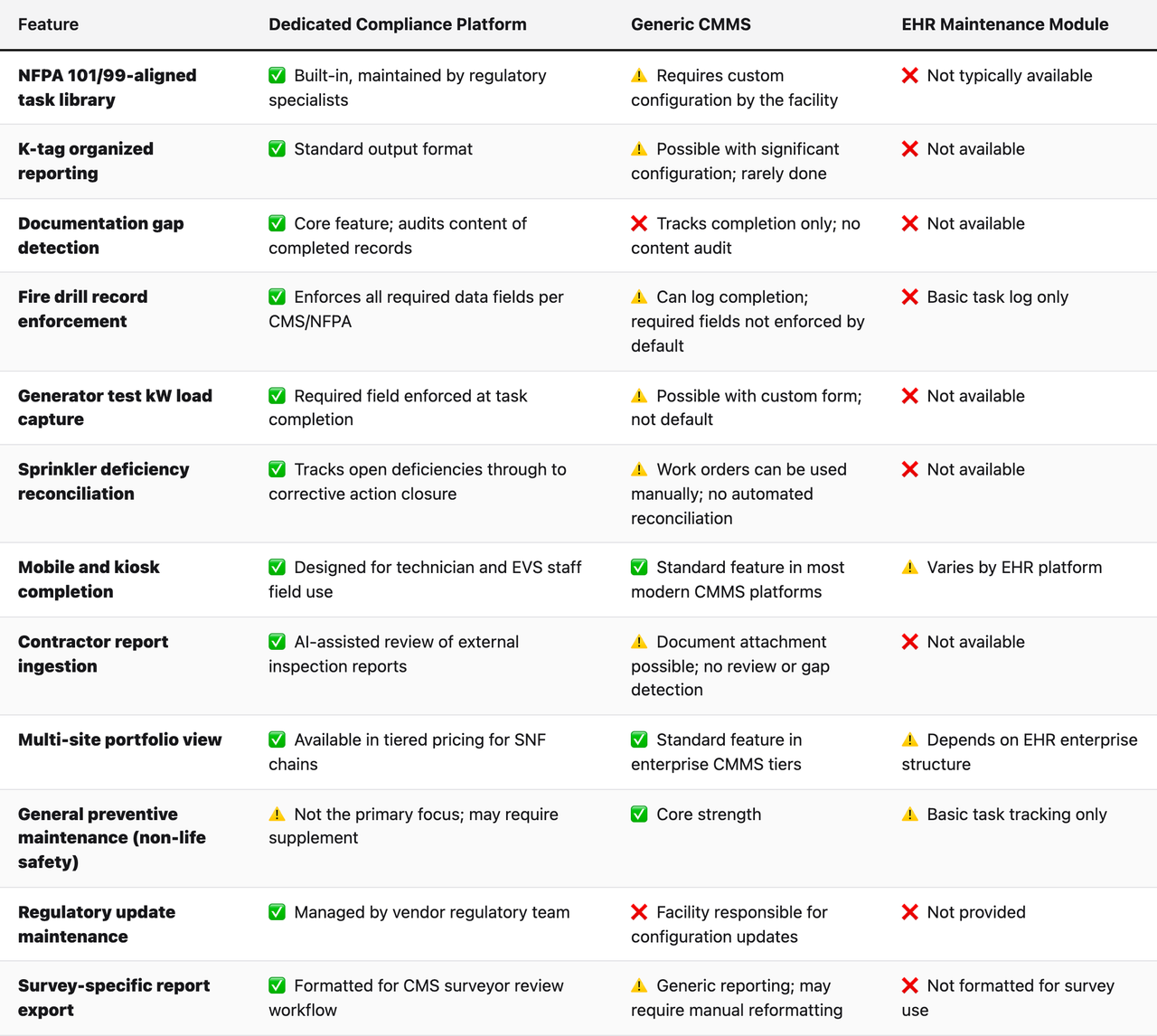
The following table compares all three categories across the features that matter most for SNF life safety compliance documentation. This comparison is based on the structural capabilities of each software category, not on specific vendor marketing claims.
The Hidden Cost of Getting This Wrong: What K-Tag Citations Actually Cost SNFs
Any honest comparison of these software categories has to account for the full cost of a documentation failure at survey, not just the licensing cost of the software. SNF operators who evaluate these tools purely on subscription price are making a category error in their analysis.
Life safety citations under the CMS survey process carry consequences that compound in ways that are not always visible at the moment of the survey. An immediate jeopardy finding related to a life safety deficiency can trigger a mandatory civil money penalty, a directed plan of correction, and in severe cases, termination from the Medicare and Medicaid programs. Even below the immediate jeopardy threshold, a pattern of life safety deficiencies can affect a facility's Five-Star Quality Rating under the CMS Five-Star Quality Rating System, which directly affects occupancy, referral volume from hospital discharge planners, and managed care contracting leverage.
The corrective action plan process following a life safety citation is itself a significant operational burden. Facilities must document root cause analysis, corrective measures, and timelines for resolution, often while managing an active survey cycle. The staff time, consultant fees, and operational disruption involved in responding to life safety citations routinely exceed the annual cost of a purpose-built compliance platform by a substantial margin.
The investment calculus changes further when you factor in the role of documentation in litigation. When a resident adverse event intersects with a documented life safety deficiency, the facility's documentation record becomes a primary exhibit in any subsequent legal proceeding. A CMMS work order log that shows a task was "completed" is not equivalent to a compliance platform record that shows the specific data captured, the individual who completed the inspection, the date and time of completion, and any deficiencies noted and subsequently resolved. The latter is defensible documentation. The former is an administrative record.
The Operational Reality: Who Is Actually Doing the Documentation
A feature comparison that ignores the human context of SNF maintenance operations is incomplete. The people completing life safety documentation in most skilled nursing facilities are not compliance specialists. They are maintenance directors managing one or two-person departments, EVS staff sharing a facility tablet or kiosk between rounds, and occasionally contract technicians who need to submit inspection records from outside the building.
This operational reality is where the three software categories diverge most sharply in practice, as opposed to in a vendor demo. A CMMS with extensive custom configuration may be technically capable of capturing all required compliance data. But if the mobile interface requires twelve steps to complete a fire drill record, and the maintenance director is managing three simultaneous building issues, the record will be completed in whatever way is fastest, not whatever way is most compliant. The same applies to EHR maintenance modules, which are typically designed for administrative staff, not for technicians completing field inspections under time pressure.
Purpose-built compliance platforms designed for SNF environments account for this operational context in their UX design. Kiosk-based completion workflows, standardized form templates with pre-populated regulatory data fields, and mobile interfaces designed for field use are not incidental features. They are the mechanism by which regulatory knowledge gets translated into actual daily practice, rather than remaining aspirational documentation policy that the paper binder was always supposed to represent.
Pricing Reality: What Each Category Actually Costs for a Typical SNF
Pricing in all three categories varies significantly based on facility size, feature tier, and contract structure. The following table reflects general pricing ranges for a typical single-site SNF with 60 to 120 beds. Multi-site operators should expect volume pricing in dedicated compliance platforms and CMMS tiers, while EHR module pricing is typically embedded in the broader EHR contract and therefore less transparent.
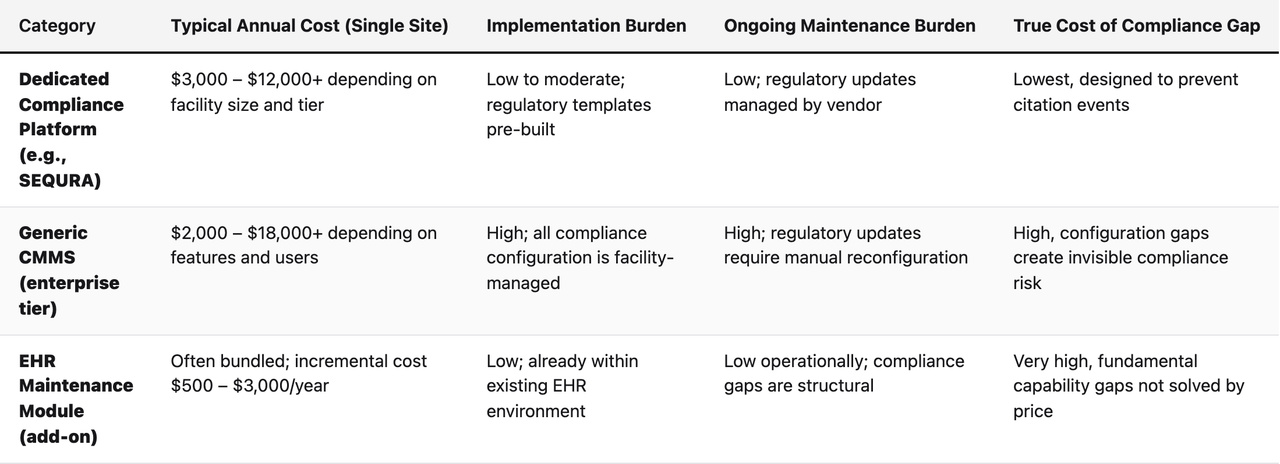
The key insight in this pricing comparison is that the cheapest option and the most expensive option in terms of true cost are not necessarily the ones with the highest or lowest subscription price. An EHR maintenance module that appears nearly free as an add-on to an existing contract creates structural compliance exposure that can cost a facility far more in citation response, corrective action plans, and reputational damage than the delta between that module and a purpose-built compliance platform.
A Decision Framework for SNF Software Selection
Rather than offering a single universal recommendation, the following framework addresses the specific operational profiles where each category is the right answer. SNF operators should use this as a decision tool, not a vendor endorsement.
Choose a Dedicated Compliance Documentation Platform If:
- Your facility has received life safety citations in the past two survey cycles and needs to demonstrably improve documentation posture
- You are a multi-site operator with 5 or more SNFs and need consistent compliance documentation standards across facilities without relying on individual maintenance directors to maintain regulatory knowledge
- Your administrator or DON is directly accountable for survey outcomes and needs visibility into the facility's compliance documentation status without depending on the maintenance director to provide manual status reports
- Your facility has experienced turnover in the maintenance director role and needs a system that carries regulatory knowledge institutionally rather than in the knowledge of individual staff
- You are replacing a paper life safety binder and want to move directly to a system that audits documentation quality rather than just digitizing the binder
- Your state has layered additional life safety documentation requirements on top of the federal CMS baseline, and you need a platform that tracks state-specific requirements alongside federal ones
Choose a CMMS (With a Compliance Platform as a Supplement) If:
- You manage a large, complex facility with significant preventive maintenance needs across HVAC, plumbing, electrical, and biomedical systems that go well beyond the life safety scope
- You have a large enough maintenance team that dedicated CMMS features like inventory management, work order routing, and contractor coordination deliver real operational value
- You have already invested heavily in CMMS configuration and want to augment it with a purpose-built compliance layer rather than replacing the entire system
Consider an EHR Maintenance Module Only If:
- You are a very small facility (under 40 beds) with no dedicated maintenance staff and primarily use the module for internal work order routing, with a separate system handling actual life safety documentation
- Budget constraints make any additional software investment impossible in the near term, and the EHR module is genuinely better than the current paper-only system as a stopgap
- You are actively planning to implement a dedicated compliance platform and the EHR module is a temporary bridge during the procurement and implementation process
The Multi-Site Operator's Perspective: Why Scale Changes the Equation
For regional and national SNF operators managing portfolios of 5, 20, or 50 facilities, the software selection question has an additional dimension that single-site operators do not face. At scale, the risk is not just that one facility has a documentation gap. It is that documentation quality is inconsistent across facilities in ways that are invisible at the corporate level until a survey cycle reveals the problem at multiple sites simultaneously.
A CMMS deployed across a multi-site portfolio will have as many different compliance documentation configurations as there are facilities, because each site's maintenance director built the system differently. An EHR maintenance module provides no portfolio-level visibility into compliance posture at all. A dedicated compliance platform with a standardized regulatory task library creates a consistent baseline across every facility in the portfolio, with centralized visibility into which sites are current on their life safety documentation and which have open gaps.
For COOs and VPs of operations at SNF chains, this portfolio visibility is not just operationally useful. It is a defensible position in front of ownership and investors. A regional facilities director who can show that every facility in the portfolio has current fire drill documentation, generator test records, and sprinkler inspection reconciliation, visible from a single dashboard, is in a fundamentally different risk position than one who has to call each maintenance director individually before every survey cycle to ask if the binder is current.
The CMS State Operations Manual guidance on life safety surveys makes clear that documentation deficiencies are among the most common citation categories across all facility types and sizes. Multi-site operators who standardize compliance documentation through a purpose-built platform are systematically reducing the probability of that pattern recurring across their portfolio.
What Surveyors Actually Look For (And What Your Software Needs to Produce)
Understanding what CMS and state life safety surveyors actually request and review during an unannounced visit is essential context for evaluating any software in this category. Surveyors conducting a life safety survey under the CMS survey process are looking for documentation that is contemporaneous, complete, and consistent with the requirements of the applicable NFPA codes and CMS interpretive guidance.
Contemporaneous means the record was created at the time the inspection or test was conducted, not reconstructed afterward. Software that requires a maintenance director to enter data on a desktop computer hours after a field inspection creates a contemporaneity gap that a well-trained surveyor will probe. Kiosk or mobile completion at the point of the inspection is the standard that eliminates this risk.
Complete means the record contains all the data elements required for that specific inspection type. Not just "fire drill conducted on this date" but the specific shift, time of alarm, simulated fire location, number of staff participating, names of staff who did not respond, and notation of any corrective action. A system that does not enforce these fields at completion produces records that are technically present but substantively inadequate.
Consistent means that the documentation pattern across time shows a facility that is systematically compliant, not one that has occasional records surrounded by gaps. Surveyors review documentation trends, not just spot checks. A platform that surfaces gaps in real time allows a facility to maintain the consistent documentation pattern that surveyors are looking for, rather than discovering gaps only when the surveyor arrives.
This is why the documentation gap detection capability of purpose-built compliance platforms is not an advanced feature for sophisticated operators. It is the baseline requirement for any system that is genuinely intended to manage life safety compliance risk in a SNF environment.
Frequently Asked Questions
Can a CMMS be configured to match the capabilities of a dedicated compliance platform?
Technically, yes, with substantial custom configuration. Practically, the configuration burden is significant and ongoing. Every time CMS releases updated interpretive guidance or a state changes its life safety regulations, someone at the facility must update the CMMS configuration. Most SNF maintenance departments do not have the bandwidth or regulatory expertise to maintain that configuration reliably. The result is a system that was compliant when configured and drifts out of alignment over time as regulations change and staff turns over.
Our EHR vendor says their maintenance module covers all our compliance documentation needs. Is that accurate?
This claim warrants careful scrutiny. Ask the EHR vendor to demonstrate, specifically, how their module enforces the required data fields for a fire drill record under NFPA 101 and CMS interpretive guidance. Ask how it handles sprinkler deficiency reconciliation from an outside contractor report. Ask how it produces K-tag organized documentation for a life safety survey request. If the answers are vague or involve significant manual processes, the module does not cover your compliance documentation needs in any meaningful sense.
What is the difference between a work order system and a compliance documentation platform?
A work order system records that a task was assigned and completed. A compliance documentation platform records that a task was completed with the specific data required to make the record defensible at regulatory review. The distinction is between administrative tracking and regulatory compliance, and it matters enormously when a surveyor is sitting across from your maintenance director asking for documentation.
How does AI documentation review work in a platform like SEQURA?
AI documentation review in this context means the system reads completed inspection records and cross-references them against the regulatory expectations for each task and K-tag category. It identifies specific gaps: a generator test record that is missing a kW load reading, a fire drill log that does not document night-shift coverage, a sprinkler deficiency report that was received from a contractor but never formally reconciled with a corrective action record. These gaps are surfaced to the maintenance director or administrator before the next survey visit, not after.
Is a dedicated compliance platform necessary for a small SNF with a clean survey history?
A clean survey history reflects past performance, not current documentation posture. Survey outcomes depend on what documentation exists at the moment of the survey. A facility with a historically clean record that has accumulated documentation gaps over the past 18 months is not in a better compliance position than a facility with previous citations that has since implemented systematic documentation practices. Compliance documentation management is a continuous operational process, not a one-time audit preparation exercise.
Can we use a CMMS for general maintenance and a dedicated compliance platform for life safety documentation?
Yes, and for larger facilities with complex mechanical systems, this is often the right answer. A CMMS handles preventive maintenance scheduling, inventory, and contractor work orders for non-life-safety systems. A dedicated compliance platform handles the NFPA and CMS documentation scope. The two systems serve different functions and can coexist without overlap, particularly if the compliance platform is designed to integrate with or import records from external systems.
What happens to our documentation if we switch platforms mid-year?
This is an important implementation question. Most dedicated compliance platforms can import historical documentation records from previous systems during implementation. The more critical issue is maintaining a continuous, unbroken documentation trail through the transition period. A well-planned implementation ensures that no inspection cycle is missed during the switchover and that historical records are accessible in the new system for the look-back period surveyors typically review.
How do we evaluate a compliance documentation platform's regulatory task library?
Request the complete task template library and compare it against the NFPA 101 Life Safety Code inspection requirements and your state's specific life safety regulations. Look specifically at fire drill documentation fields, generator test data capture requirements, sprinkler inspection reconciliation workflows, and medical gas system documentation if applicable. Then ask the vendor how the task library is updated when CMS releases new interpretive guidance. The answer to that last question is as important as the current state of the library.
Do life safety compliance platforms integrate with clinical EHR systems?
Integration between life safety compliance platforms and clinical EHR systems is not typically necessary for compliance documentation purposes, because life safety documentation and clinical records are reviewed by different surveyors and serve different regulatory functions. Some platforms offer API integrations for census data or general facility information, but the core compliance documentation function is self-contained and does not depend on EHR integration to be effective.
What does "survey-ready reporting" actually mean in practice?
Survey-ready reporting means that when a surveyor requests documentation for a specific K-tag category, the platform can produce a report organized in the format and sequence that surveyor expects to review, without requiring the maintenance director to manually compile records from multiple sources. For K321 (sprinkler system), that means a chronological record of scheduled inspections, completion records with all required data fields, deficiency findings from contractor reports, corrective actions taken, and re-inspection verification, all in one exportable document. Surveyors who receive documentation in this format can complete their review more efficiently, which typically results in a less adversarial survey interaction.
How long does it take to implement a dedicated compliance documentation platform?
Implementation timelines vary by platform and facility size, but purpose-built compliance platforms for SNFs are generally designed for rapid deployment. Because the regulatory task library is pre-built, implementation primarily involves configuring the facility's specific assets, assigning staff, and training the maintenance team on the completion workflow. A single-site SNF can typically be operational on a purpose-built platform within two to four weeks of contract signing, depending on the vendor's onboarding process and the facility's existing documentation state.
What is the SNF software comparison process for evaluating these categories?
A rigorous SNF software comparison process should include four steps. First, define your specific compliance documentation requirements by reviewing your last survey report and identifying the K-tag categories where you have had citations or near-misses. Second, request a demo from each vendor category that focuses specifically on those K-tag categories, not on the general feature set. Third, ask each vendor for a reference from a SNF of comparable size that has used the platform through at least one CMS survey cycle. Fourth, evaluate the total cost of ownership across all three categories, including implementation burden, ongoing maintenance, and the estimated cost of the compliance gaps each category leaves unaddressed.
Key Takeaways
- Regulatory specificity is the defining variable. The category of software that best serves SNF life safety compliance is determined not by feature count or price, but by whether the system knows and enforces the specific data requirements that make each inspection record defensible at CMS survey.
- Generic CMMS tools transfer the compliance knowledge burden to the facility. They can be configured for compliance, but that configuration requires ongoing regulatory expertise that most SNF maintenance departments do not have the bandwidth to maintain reliably.
- EHR maintenance modules are administrative tools, not compliance platforms. The integration appeal is real, but the compliance capability gap is structural and cannot be solved by configuration or workflow changes within the module.
- Documentation gap detection is a categorical differentiator. A system that records task completion and a system that audits the content of completed records against regulatory requirements are solving fundamentally different problems. Only the latter reliably prevents citation-producing documentation gaps.
- The true cost of software selection includes the cost of the compliance gaps each category leaves open. A lower subscription price that creates higher citation risk is not a cost saving. It is a risk transfer onto the facility's survey outcomes, occupancy, and Five-Star rating.
- Multi-site operators have the most to gain from standardization. A dedicated compliance platform with a consistent regulatory task library across every facility in a portfolio creates a defensible compliance posture at the corporate level, not just at individual sites.
- The people doing the documentation matter as much as the software. Any platform that requires complex workflows from maintenance technicians and EVS staff in the field will produce inconsistent compliance documentation regardless of its feature set. Operational accessibility is a compliance requirement, not a UX preference.
- For most SNF operators comparing these categories, the honest recommendation is clear: a dedicated life safety compliance documentation platform is the right tool for managing CMS and state survey risk. CMMS software and EHR maintenance modules serve different operational functions and should be evaluated on those terms, not as substitutes for purpose-built compliance documentation.
About the author
Benjamin Terebelo · Founder
Benjamin is the founder of SEQURA, a compliance platform purpose-built for healthcare facilities. He builds at the intersection of healthcare operations and software, maintaining a focus on bringing modern tooling to systems that the broader industry has largely left behind.
About the author
Benjamin Terebelo · Founder
Benjamin is the founder of SEQURA, a compliance platform purpose-built for healthcare facilities. He builds at the intersection of healthcare operations and software, maintaining a focus on bringing modern tooling to systems that the broader industry has largely left behind.