
Compliance Software for Assisted Living and Memory Care vs. SNF Platforms: Honest Feature Comparison

The director of facilities at a regional senior living company once described her job this way: "I run two completely different compliance programs under one roof, and the software vendors act like they're the same building." She was managing a licensed assisted living community connected by a corridor to a locked memory care wing, and both sat across the street from the company's skilled nursing facility. Same campus. Three distinct regulatory universes. One shared maintenance team.
That tension, operators with real life safety obligations being sold tools built for a different setting entirely, is exactly what this comparison is designed to address. Assisted living and memory care operators face genuine, enforceable compliance requirements. State licensure surveys, NFPA 101 life safety obligations, and increasingly rigorous local fire codes mean that the old approach of a manila folder and a handwritten checklist is no longer defensible. But the platforms that dominate the market were largely built for skilled nursing facilities (SNFs), where CMS survey pressure created a much earlier demand for structured compliance tooling.
This article compares assisted living compliance software and memory care life safety platforms against SNF-grade compliance tools honestly: what each category of platform was built to do, where the feature sets diverge, where ALF operators get oversold on SNF-grade complexity they don't need, and where they get undersold on documentation rigor they absolutely do need. If you manage a licensed assisted living facility, a memory care unit, or a behavioral health residential facility, this is the comparison that will help you make an informed decision.
Why ALF and SNF Compliance Are Related But Not Interchangeable
Assisted living facilities and skilled nursing facilities share a common ancestor: the institutional care setting. Both house medically or cognitively vulnerable populations. Both are inspected by state agencies. Both must meet life safety standards derived from NFPA 101. But the regulatory architecture that governs each setting is fundamentally different, and that difference should drive every platform selection decision.
SNFs are federally certified under Medicare and Medicaid, which means CMS has direct enforcement authority. The CMS Nursing Facility Survey, Certification, and Enforcement process involves unannounced surveys conducted against the Federal Requirements of Participation (RoPs), with citations issued under specific F-tags and K-tags. A K-tag citation for a life safety deficiency can trigger an immediate jeopardy finding, a civil monetary penalty, or, in extreme cases, termination from Medicare participation. The stakes are existential, and the documentation expectations are granular: inspectors look at specific log entries, specific time-stamped completion records, and specific evidence of corrective action for known deficiencies.
Assisted living facilities, by contrast, are licensed and regulated at the state level. There is no federal CMS certification for standard ALF operations. Each state defines its own survey standards, inspection cadence, and citation authority. The National Center for Assisted Living (NCAL) tracks this variation extensively: some states conduct annual unannounced surveys with detailed life safety checklists, others operate complaint-driven inspection programs with minimal proactive oversight. Memory care units face an additional layer, since most states now require specific memory care licensure or endorsement with distinct staffing, environmental, and programming standards beyond standard ALF requirements.
Behavioral health residential facilities add yet another regulatory dimension. Depending on state licensing structure, a behavioral health residential program may be surveyed by a behavioral health authority, a Medicaid managed care organization, The Joint Commission, CARF, or some combination. The life safety obligations often mirror those of ALFs but with added requirements around ligature risk, environmental safety, and behavioral emergency protocols.
The practical implication: ALF vs SNF compliance tools differ not just in feature depth but in which regulatory framework they were built to satisfy. A platform optimized for K-tag documentation at a CMS-certified SNF may be over-engineered for an ALF's state survey process, or it may be missing the specific state-mandated checklist items that an ALF inspector actually looks for. Neither situation is acceptable when a citation is on the table.
What SNF Compliance Platforms Were Built to Do
SNF compliance platforms emerged from a specific, urgent problem: the K-tag citation rate in skilled nursing is high, the financial consequences are severe, and the documentation requirements are specific enough that informal paper systems consistently fail. The platform category developed to solve that problem, and the best SNF-grade tools share a common architecture.
The Core SNF Compliance Stack
A purpose-built SNF compliance platform typically includes some combination of the following capabilities:
- NFPA 101 and NFPA 99 task libraries: Pre-built inspection schedules aligned to the specific code sections that CMS surveyors reference during K-tag reviews. This includes fire door inspections, sprinkler system checks, emergency generator testing (with kW load logging), fire drill documentation by shift and floor, eyewash station verification, and medical gas system checks.
- K-tag cross-referencing: The ability to map completed inspection records to specific K-tag categories so that when a surveyor asks for documentation supporting K321 (sprinkler system) or K345 (fire alarm), the facility can produce timestamped, staff-attributed records immediately.
- Documentation gap detection: Automated review of completed records to identify patterns that produce citations: missing night-shift fire drills, incomplete generator load test logs, unresolved sprinkler deficiencies from contractor reports.
- Contractor report integration: The ability to ingest or log third-party inspection reports (HVAC contractors, fire suppression vendors, elevator inspectors) and flag discrepancies or deficiencies that require follow-up documentation.
- Survey-ready reporting: The ability to produce a complete, organized compliance binder on demand, the equivalent of the paper binder every SNF maintenance director maintains, but audit-reviewed and gap-free.
Platforms like SEQURA represent the current state of the art in SNF compliance tooling. What distinguishes the most advanced platforms from basic digital checklists is the second layer of analysis: not just logging that a task was completed, but reviewing whether the completion record contains the specific data elements a surveyor would expect to see. A fire drill log that shows the drill happened but doesn't capture evacuation time, staff count, and any equipment used during the drill may technically exist in the system but still produce a K-tag citation. The best SNF platforms catch that gap before the surveyor does.
Multi-Site SNF Operator Features
For regional SNF operators managing multiple facilities, the platform requirements expand further. Corporate visibility into compliance status across the portfolio, the ability to push updated task templates when a regulatory change affects all facilities, and benchmarking of completion rates and citation risk scores across sites are all features that drive purchasing decisions at the VP and COO level. A maintenance director at a single facility may care primarily about ease of use at the kiosk. The regional VP of operations cares about which of the twelve facilities in the portfolio is most likely to receive a citation in the next ninety days.
What Assisted Living Compliance Software Actually Needs to Do
Assisted living compliance software must solve a genuinely different problem. The regulatory target is different, the survey process is different, and the staff profile doing the compliance work is often different. Understanding those differences is essential before evaluating any platform.
State-Specific Regulatory Mapping
Because ALF regulation is entirely state-driven, the single most important feature in any assisted living compliance platform is accurate, maintained state-specific regulatory mapping. A platform that offers a generic NFPA 101 task library without mapping those tasks to the specific inspection items on a given state's ALF survey tool is providing incomplete protection. A Texas ALF, a California RCFE, a New York ALP, and a Florida ALF all face different survey instruments, different inspection cadences, and different citation thresholds for the same underlying life safety conditions.
The best ALF platforms maintain state-specific template libraries that are updated when state survey tools change, and they distinguish between tasks that are universally required (because they derive from fire code) and tasks that are state-specific (because they appear on that state's licensing checklist). Operators who work across multiple states need platforms that can manage this variation at the portfolio level.
Memory Care-Specific Requirements
Memory care units present a specific compliance challenge that standard ALF platforms frequently underserve. Beyond the standard life safety requirements, memory care life safety obligations typically include:
- Secured perimeter documentation: Evidence that door alarm systems, wander management technology, and secured exit protocols are inspected and functioning at required intervals.
- Environmental safety assessments: Documentation that the physical environment has been assessed for cognitive safety hazards (sharp edges, accessible hazardous materials, unsafe furniture).
- Emergency evacuation protocols specific to cognitively impaired residents: Evidence that evacuation plans account for the behavioral and cognitive characteristics of memory care residents, not just the general resident population.
- Staffing ratio and competency documentation: Many states require memory care-specific staff training records as part of licensure compliance, separate from general ALF staffing requirements.
A platform that treats a memory care wing as identical to a standard ALF unit is missing a material portion of the compliance obligation. This is one of the most common gaps in both purpose-built ALF software and SNF platforms marketed to ALF operators.
Behavioral Health Residential Facility Compliance
For operators running behavioral health facility compliance programs, the requirements expand further. Ligature risk assessments, environmental safety rounds, and behavioral emergency documentation protocols may all be required by state licensure or accreditation standards. A platform that handles NFPA 101 fire safety documentation competently but has no framework for ligature risk logging or environmental safety rounds will leave a behavioral health operator with a significant compliance gap that no amount of fire drill documentation will close.
Head-to-Head: ALF vs SNF Compliance Platform Feature Comparison
The table below compares the core feature categories across three platform types: purpose-built SNF compliance platforms (like SEQURA), generic ALF compliance software sold primarily on state survey support, and hybrid platforms marketed to both settings. This comparison reflects the current state of the market based on the feature categories that actually matter during a survey.
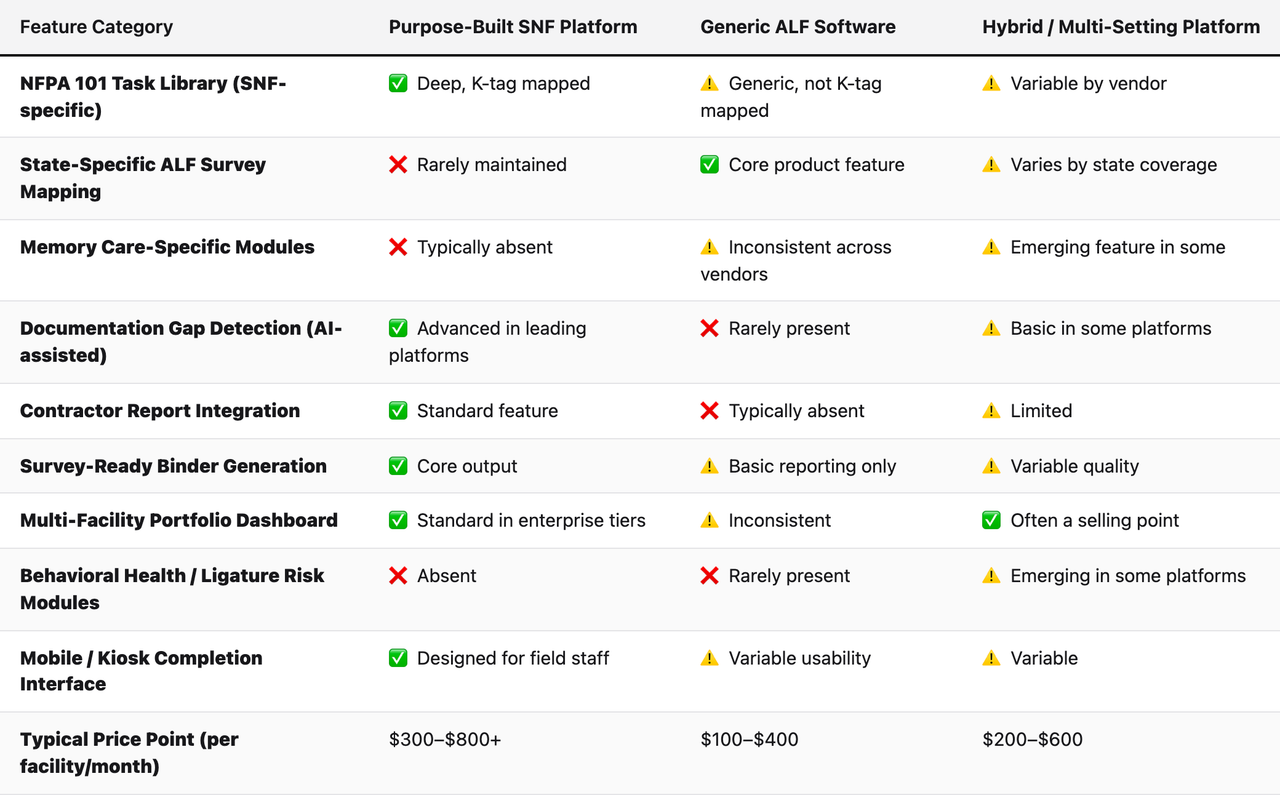
The price ranges above reflect general market positioning based on publicly available information from vendor websites and are intended as orientation, not hard quotes. Actual pricing depends heavily on facility size, number of beds, and contract terms.
The Five Feature Categories That Actually Matter During a Survey
Compliance platform marketing tends to lead with feature counts. The number that actually matters is zero, as in, zero citations. The features that drive that outcome are specific, and they are not always the ones that appear most prominently in a vendor demo.
1. Regulatory Accuracy of the Task Template Library
The task library is the foundation of any compliance platform. If the library contains the wrong tasks, the wrong cadence, or tasks mapped to the wrong regulatory standard, completing every item on the list creates a false sense of security. A fire door inspection scheduled annually when the applicable state survey tool requires quarterly inspections is worse than no checklist at all, because it documents consistent non-compliance.
For SNF operators, the question is whether the template library is explicitly mapped to current K-tag categories and updated when CMS revises its survey guidance. For ALF operators, the question is whether the library reflects the specific survey instrument used by their state licensing agency, not a generic NFPA 101 interpretation. For memory care operators, the question is whether the library includes the specific secured environment and wander management inspection items their state requires.
Vendors should be able to show you exactly which regulatory source each task template derives from. If they can't, the library is generic and the compliance protection is incomplete.
2. Documentation Gap Detection Before the Surveyor Arrives
The most consequential difference between a basic digital checklist and a genuine compliance platform is what happens after a task is marked complete. A checklist records completion. A compliance platform reviews the completion record and determines whether it contains the specific data elements a surveyor would expect to see.
The patterns that produce most life safety citations are not tasks that were skipped entirely. They are tasks that were completed but documented inadequately. A generator test log that shows the test ran but doesn't capture the load in kilowatts. A fire drill record that shows the drill occurred but doesn't document night-shift participation. A sprinkler inspection that shows no deficiencies but doesn't reference the contractor report that identified a corroded fitting two months earlier.
For SNF operators, this capability is now table stakes in the leading platforms. For ALF operators, it is largely absent from the market. A memory care life safety platform that includes documentation gap detection is genuinely differentiated from the standard ALF software category.
3. Survey-Ready Output Quality
When a surveyor arrives unannounced, the facility has a narrow window to produce organized, complete documentation. A platform that requires significant manual assembly of records into a presentable format introduces risk during that window. The best platforms produce a survey-ready compliance binder on demand: organized by K-tag or state survey category, complete, with timestamps and staff attribution for every entry.
For ALF operators, this output should be organized to match the specific survey instrument their state uses, not a generic NFPA 101 structure. A surveyor working from a state-specific ALF checklist does not want to hunt through a K-tag organized binder to find the documentation they're looking for. The organizational structure of the output should match the organizational structure of the survey instrument.
4. Contractor Report Reconciliation
Third-party inspections create a specific documentation risk that most facilities handle poorly. When a fire suppression contractor, HVAC vendor, or elevator inspector produces a report that identifies deficiencies, two things must happen: the deficiency must be documented, and the corrective action (or accepted risk documentation) must be linked to the original finding. Facilities that keep contractor reports in a separate filing system from their internal inspection logs routinely accumulate unreconciled deficiencies that become citations when a surveyor reviews both sets of records and finds the gap.
SNF-grade platforms typically include contractor report integration as a standard feature. Generic ALF software often does not. For an ALF or memory care operator who uses third-party vendors for fire suppression, HVAC, and elevator inspections, the absence of contractor report reconciliation is a meaningful compliance gap regardless of how well the internal inspection program is documented.
5. Field Staff Usability
A compliance platform that maintenance staff and EVS technicians won't use consistently is not a compliance platform. It is a liability. The documentation that matters during a survey is not the documentation entered by the administrator into a back-office system. It is the documentation entered contemporaneously by the person who performed the inspection, at the time and location of the inspection.
The best SNF platforms were designed around the reality that the person doing the fire door inspection is not sitting at a desk. They are walking the building with a mobile device or stopping at a facility kiosk between tasks. The interface must be fast, intuitive, and require minimal training. For ALF and memory care operators, many of whom have smaller maintenance teams with broader responsibilities, this usability requirement is even more acute.
Where SNF Platforms Fall Short for ALF and Memory Care Operators
The marketing pitch from most SNF compliance vendors targeting ALF operators goes something like this: "We solve compliance for the most regulated care settings in healthcare. We can certainly handle your ALF." This is true in a narrow sense and misleading in a practical one.
Over-Engineering for the Wrong Survey Process
SNF platforms are built around the federal survey process: K-tags, F-tags, CMS interpretive guidelines, and the specific documentation expectations of CMS-trained surveyors. An ALF operator using a platform organized around this framework is doing compliance work organized around a survey process that doesn't apply to their facility. The task library may include inspections that state ALF regulations don't require, while missing inspections that state ALF regulations do require. The organizational structure of the documentation may not match what a state ALF surveyor looks for. The risk scoring may be calibrated to CMS citation patterns that don't reflect state ALF citation trends.
This is not a theoretical problem. An ALF operator who invests in a SNF platform and implements it faithfully may still receive citations on items the platform didn't flag, because the platform's gap detection was calibrated to CMS K-tag patterns, not to the state's ALF survey instrument.
Missing Memory Care Specifics
Even the best SNF platforms were not built with memory care environmental safety requirements in mind. Wander management system inspection logs, secured perimeter integrity documentation, and environmental safety assessment protocols for cognitively impaired residents are not part of the CMS Life Safety Code survey framework for SNFs. A memory care operator using a SNF platform will have excellent fire safety documentation and a significant gap in the memory care-specific documentation their state licensure requires.
Pricing Mismatch for Smaller ALF Operators
SNF platforms are typically priced for facilities with 100+ beds and a dedicated maintenance director. A 40-bed ALF with a part-time maintenance coordinator and a shared facility manager is not the user profile these platforms were built for. Enterprise-grade pricing, implementation complexity, and feature sets designed for multi-shift institutional operations can make SNF platforms a poor fit for independent ALF operators, even when the underlying compliance need is real.
Where Generic ALF Software Falls Short for Serious Compliance Programs
The opposite failure mode is equally common. ALF operators, particularly those who have historically managed compliance through paper checklists and binder systems, often select lightweight digital tools that are better characterized as task management software with a compliance label than as genuine compliance platforms.
Absence of Documentation Gap Analysis
Generic ALF compliance software typically logs task completion without reviewing completion quality. The maintenance coordinator checks a box indicating the fire door inspection is complete. The software records the check. No one reviews whether the inspection log contains the specific observations a surveyor would expect: door gap measurements, latch function, self-closure verification, and damage notation. The documentation exists, but it doesn't contain the evidence the surveyor needs. The citation follows.
Weak Contractor Report Handling
Most generic ALF platforms have no mechanism for ingesting or reconciling contractor reports. Third-party inspection findings live in email inboxes or filing cabinets, entirely separate from the digital compliance record. When a surveyor asks for documentation of corrective action on a deficiency identified in the annual fire suppression inspection, the facility cannot produce it from their compliance system. This is an entirely preventable gap that purpose-built platforms solve and generic software ignores.
No Regulatory Update Mechanism
State ALF regulations change. Survey instruments are revised. New memory care licensure requirements are added. Generic ALF software vendors often lack the regulatory affairs capacity to update their template libraries when these changes occur. An ALF operator running a compliance program based on an outdated template library is documenting against obsolete standards, which means their current compliance posture may be inadequate for the next survey.
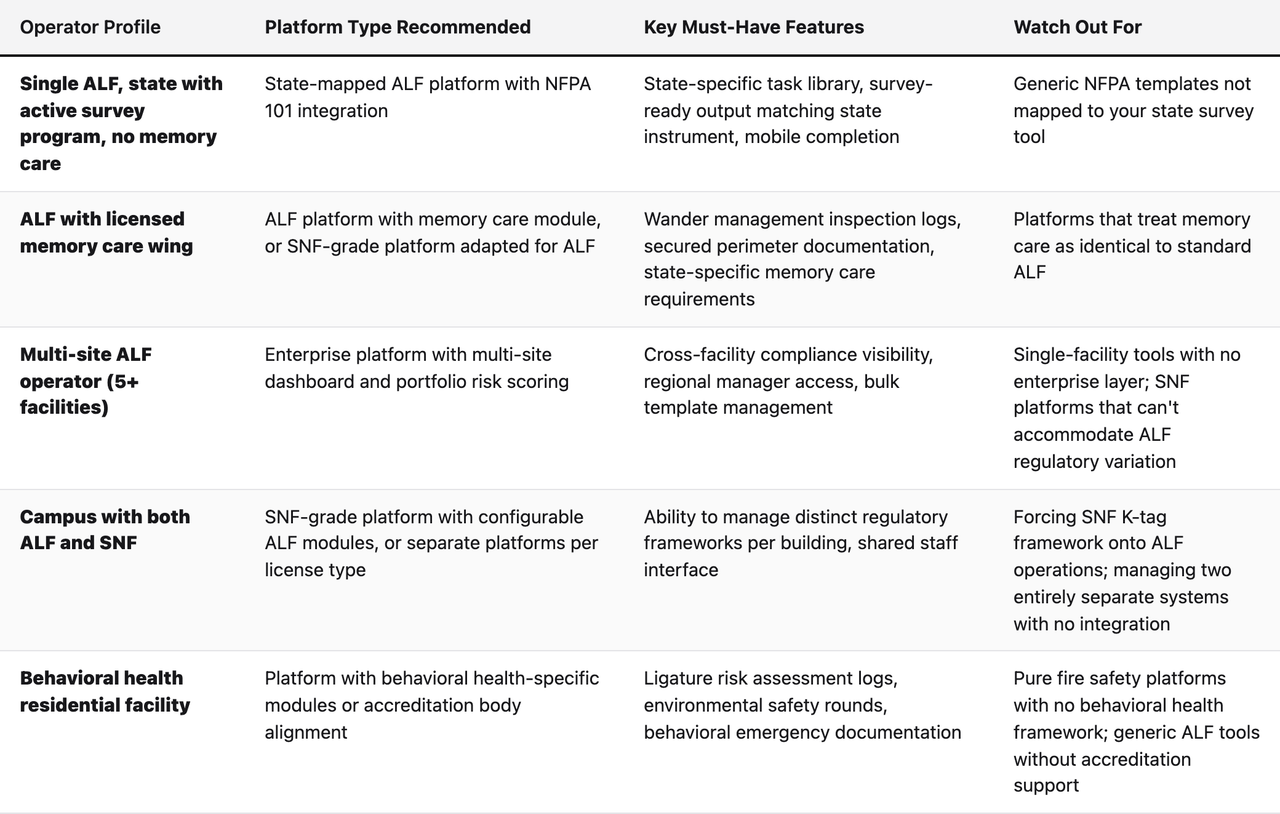
A Framework for Choosing: The ALF Compliance Platform Decision Matrix
Rather than recommending a single platform for all assisted living and memory care operators, the more useful output is a structured decision framework. The right platform depends on four variables: regulatory complexity, facility size and staff profile, portfolio composition, and current documentation maturity.
The Specific Case for SNF-Grade Documentation Intelligence in ALF Settings
Here is the honest argument for why an ALF or memory care operator should consider a platform built to SNF-grade documentation standards, even though the survey process is different.
State ALF surveys are becoming more rigorous. The trend across most states over the past several years has been toward more structured, more frequent, and more consequential ALF inspections. Several high-profile incidents involving wandering deaths, medication errors, and fire safety failures at assisted living facilities have driven state legislatures and licensing agencies to increase survey intensity. In states like California, Florida, Texas, and New York, ALF citations can now result in significant fines, license conditions, and in some cases, closure proceedings.
The documentation expectations that accompany this increased scrutiny are moving closer to the SNF standard. State surveyors who previously accepted a completed checklist are now asking for the same kind of contemporaneous, staff-attributed, gap-free documentation that CMS surveyors expect at SNFs. An ALF operator who has invested in documentation infrastructure that meets SNF-grade standards is better positioned for this trend than one relying on generic ALF software that hasn't kept pace with evolving state survey expectations.
There is also a liability argument. The documentation standard in a personal injury or wrongful death claim involving a vulnerable resident is not "did you check the box." It is "what evidence do you have that the person who performed the inspection actually performed it, what did they observe, and what did you do about it." SNF-grade documentation systems produce that evidence. Generic ALF checklists often do not.
What SEQURA Offers ALF and Memory Care Operators
SEQURA was built for SNFs, and its core architecture reflects that: a vetted NFPA and state-regulation task template library, an AI review layer that audits completed records for documentation gaps, and a survey-ready output organized around the specific evidence surveyors look for. Those capabilities are directly transferable to the documentation challenges that ALF and memory care operators face as survey pressure increases.
For an ALF operator running a serious life safety compliance program, the most relevant SEQURA capabilities are:
- Documentation gap detection: The AI review layer that identifies incomplete or inadequate inspection records before a surveyor does. This capability is rare in ALF-specific software and directly addresses the most common source of citations in both SNF and ALF settings.
- Contractor report reconciliation: The ability to log third-party inspection findings and ensure that corrective actions are documented and linked to the original deficiency. This protects against the unreconciled deficiency problem that is common across all care settings.
- Contemporaneous documentation: The mobile and kiosk completion interface that captures inspection records at the time and place of the inspection, with staff attribution. This is the documentation standard that surveyors and plaintiffs' attorneys look for, and it is achievable with the right platform.
- Survey-ready output: The ability to produce complete, organized compliance documentation on demand when a surveyor arrives. For ALF operators, this means not scrambling to assemble records from multiple systems and filing locations under survey pressure.
The honest caveat: SEQURA's template library was built around CMS K-tag requirements and SNF survey standards. ALF operators adopting SEQURA will need to work with the implementation team to ensure the task library reflects their specific state ALF survey instrument, not just a generic NFPA 101 framework. The documentation intelligence layer works on whatever inspection records the platform collects, but the records need to be the right records for the right regulatory standard.
For ALF operators on a campus with an SNF, for multi-site operators managing facilities across multiple license types, or for ALF operators whose state survey programs have become materially more rigorous, SEQURA's SNF-grade documentation infrastructure is worth serious consideration as a platform for the entire campus or portfolio.
How to Evaluate Any Compliance Platform Before You Sign
Whether you are an ALF operator evaluating purpose-built ALF software, a memory care operator looking at hybrid platforms, or a campus operator considering a SNF-grade system for your entire portfolio, the evaluation process should include these specific tests.
The Regulatory Mapping Test
Ask the vendor to show you, in the platform, exactly which task templates apply to your specific state and license type. Ask them to identify the regulatory source for each task (specific NFPA code section, specific state regulation citation, or specific state survey instrument item number). If they can't map the tasks to specific regulatory sources, the library is generic and the compliance protection is incomplete.
The Incomplete Record Test
Create a sample inspection record that is technically complete (all required fields filled in) but substantively inadequate (the specific data elements a surveyor would expect are missing or vague). See whether the platform flags the record as a gap. If the platform accepts any record that hits all required fields without reviewing the quality of the content, it does not have genuine documentation gap detection. It is a checklist tool.
The Surveyor Arrival Simulation
Ask the vendor to demonstrate what happens when you click "produce survey-ready binder." Look at the output: Is it organized to match your specific state survey instrument, or does it produce a generic NFPA 101 structure? Does it include contractor reports? Does it flag any gaps in the record set? Does it look like documentation a surveyor would find complete and convincing, or does it look like a data export from a database?
The Regulatory Update Question
Ask the vendor what happens when your state revises its ALF survey instrument. Who identifies the change? How quickly is the template library updated? Who notifies your facility? What happens to historical records that were completed under the old standard? A vendor who cannot give you a specific, procedural answer to this question does not have a regulatory affairs function capable of keeping your template library current.
The Field Staff Demo
Have a maintenance technician or EVS staff member (not the administrator who sat through the sales demo) attempt to complete three different inspection types using the platform's mobile or kiosk interface with no coaching. Observe where they get stuck, what they skip, and whether the record they produce is complete. The documentation that matters during a survey is what field staff produce, not what administrators can theoretically produce with guidance.
Senior Living Life Safety Software: The Broader Market Picture
The senior living life safety software market is in an active state of consolidation and maturation. Several dynamics are shaping where the market is heading and why the platform you choose today needs to be evaluated against the compliance environment of tomorrow, not just today's survey instrument.
State ALF regulations are converging toward more structured documentation requirements. The informal inspection culture that characterized many state ALF programs a decade ago is giving way to more systematic, document-intensive survey processes. This trend accelerated following several high-profile safety incidents and has been reinforced by advocacy organizations and resident family groups pushing for more accountability in assisted living oversight.
Memory care licensure is becoming more specific and more demanding. Most states that have enacted memory care endorsement or licensure requirements in recent years have included detailed environmental and operational standards that go well beyond standard ALF requirements. The documentation obligations that accompany these standards are not being served by current generic ALF software at most vendors.
AI-assisted documentation review, currently most advanced in SNF-grade platforms, will move into ALF platforms as the market matures. The gap detection capability that distinguishes platforms like SEQURA from basic digital checklists is becoming a baseline expectation as operators experience its value in SNF settings and demand it in other care settings. ALF operators who adopt platforms with this capability now are building institutional knowledge and documentation habits that will be competitive advantages as survey expectations rise.
For operators managing facilities across multiple license types, the consolidation pressure is real. Managing separate compliance platforms for SNF buildings and ALF buildings on the same campus creates coordination costs, training complexity, and the risk of documentation gaps at the seams between systems. The market is moving toward configurable enterprise platforms that can accommodate multiple regulatory frameworks within a single system, and operators who make that transition early will have structural compliance advantages over those managing a patchwork of purpose-built tools.
Frequently Asked Questions
Is assisted living compliance software different from SNF compliance software?
Yes, materially so. SNF compliance platforms are built around the federal CMS survey process, K-tag documentation requirements, and NFPA 101 standards as interpreted by CMS inspectors. Assisted living compliance software must address state-specific survey instruments that vary significantly by state, since ALFs are licensed and regulated at the state level without federal CMS certification. A platform built for SNF compliance may not reflect the specific inspection items on your state's ALF survey tool, which creates gaps that can produce citations even when all platform tasks are completed.
Do ALFs have to follow NFPA 101?
Most do, but the specific requirements and how they are enforced depend on the state. Many states adopt NFPA 101 by reference in their ALF licensing regulations, but the specific edition adopted, the local amendments applied, and the way state surveyors interpret the code can vary significantly. ALF operators should confirm which edition of NFPA 101 their state has adopted and whether their compliance platform's task library reflects that specific edition and any state-specific amendments.
What compliance requirements are unique to memory care facilities?
Memory care-specific requirements typically include secured perimeter documentation (wander management systems, door alarm inspections, secured exit protocols), environmental safety assessments designed for cognitively impaired residents, emergency evacuation protocols that account for behavioral and cognitive characteristics of memory care residents, and staff training and competency documentation specific to dementia care. These requirements are in addition to standard ALF life safety requirements and are defined by state-specific memory care licensure or endorsement standards that vary by state.
Can a SNF compliance platform be used for an ALF?
It can, but it requires careful configuration to ensure the task library reflects ALF regulatory requirements rather than SNF K-tag requirements. The documentation intelligence and gap detection capabilities of SNF-grade platforms are directly valuable in ALF settings, but the specific tasks that need to be completed, and the regulatory standards those tasks must satisfy, are different. An ALF operator using a SNF platform without ALF-specific configuration may be completing the wrong inspections at the wrong cadence for their actual regulatory obligations.
What is a documentation gap in the context of life safety compliance?
A documentation gap is a situation where an inspection was performed (or appears to have been performed) but the record of that inspection does not contain the specific information a surveyor would need to confirm the inspection was adequate. Examples include fire drill logs that record the drill date but not the shift covered, evacuation time, or staff count; generator test logs that confirm the test ran but don't include kilowatt load readings; and sprinkler inspection records that show no deficiencies but don't reference or reconcile a contractor report that identified deficiencies in the same period. Documentation gaps are one of the most common sources of life safety citations because the facility believes the task is covered and the surveyor finds it inadequately documented.
How often do state agencies conduct ALF surveys?
Survey frequency varies significantly by state. Some states conduct annual unannounced surveys of all licensed ALFs. Others operate primarily on a complaint-driven basis, with proactive surveys less frequent. Many states have tiered inspection programs where facilities with prior citations or complaints receive more frequent inspections. ALF operators should know their state's specific survey cadence and adjust their compliance program accordingly, rather than assuming any particular inspection frequency.
What should ALF operators look for in a compliance platform's task library?
The task library should be mapped to specific regulatory sources: the specific NFPA code section, the specific state regulation citation, or the specific item on the state's ALF survey instrument. Tasks should be scheduled at the correct cadence for each regulatory requirement, not a generic cadence. The library should be updated when state regulations or survey instruments change, and the vendor should have a documented process for identifying and implementing those updates. Generic task libraries that claim NFPA 101 compliance without state-specific mapping are insufficient for most ALF compliance programs.
What is the risk of using paper checklists for ALF compliance?
Paper checklists create several specific risks in survey situations. Records can be lost, damaged, or incomplete. Contemporaneous documentation (recording the inspection at the time and place it occurred) is difficult to verify with paper, which creates credibility issues if a surveyor questions whether inspections were actually performed. Contractor report reconciliation is nearly impossible with paper systems. Survey-ready organization requires significant manual effort under time pressure when a surveyor arrives unannounced. And pattern detection across multiple inspection cycles, the kind of analysis that would surface a recurring deficiency before it becomes a citation, is not feasible with paper records.
How do behavioral health residential facilities differ from ALFs in compliance terms?
Behavioral health residential facilities share many of the same fire safety and life safety obligations as ALFs, but add requirements specific to the behavioral health setting: ligature risk assessments (documentation that the physical environment has been assessed for items that could be used for self-harm), environmental safety rounds at specified intervals, and behavioral emergency response documentation. These facilities may also be subject to accreditation standards from The Joint Commission or CARF in addition to or instead of state licensure requirements, which adds another layer of documentation obligation that pure life safety platforms don't address.
What is the difference between a life safety platform and a facility maintenance platform for ALFs?
Facility maintenance platforms focus on work order management: tracking repairs, managing vendor relationships, and scheduling preventive maintenance for equipment. Life safety compliance platforms focus on regulatory documentation: ensuring the right inspections are performed at the right cadence, the records contain the right information, and the documentation can survive a state survey. There is overlap between the two categories, but the core value proposition is different. A facility that uses a maintenance platform for life safety compliance is optimizing for operational efficiency when it should be optimizing for survey confidence.
Should multi-site ALF operators use a single platform for all facilities?
For multi-site operators with facilities in multiple states, the platform must be able to accommodate different regulatory requirements per facility while providing a unified portfolio view for corporate oversight. A single platform that can be configured for different state survey standards at the facility level, while providing regional and corporate dashboards for compliance monitoring across the portfolio, is significantly more efficient than managing separate platforms per state or per facility. The configuration capability and the regulatory affairs capacity to maintain state-specific template libraries are the critical evaluation criteria for multi-site operators.
Key Takeaways
- ALF and SNF compliance are governed by different regulatory frameworks. SNFs operate under federal CMS certification and K-tag survey standards. ALFs are state-licensed with no federal survey authority, and survey standards vary significantly by state. The right compliance platform for each setting is different, and using a SNF platform for ALF operations without careful configuration can produce compliance gaps.
- Memory care compliance requires specific modules beyond standard ALF requirements. Wander management inspections, secured perimeter documentation, and environmental safety assessments for cognitively impaired residents are not standard ALF or SNF requirements. Memory care operators need platforms that explicitly address these obligations, not platforms that treat memory care as identical to standard assisted living.
- Documentation gap detection is the feature that separates compliance platforms from digital checklists. Most ALF software records that tasks were completed. The best platforms review whether the completion records contain the specific evidence a surveyor would expect. This capability is currently most advanced in SNF-grade platforms and largely absent from generic ALF software.
- Contractor report reconciliation is a commonly overlooked gap. Third-party inspection findings that are not reconciled with corrective action documentation are a reliable source of citations in any care setting. ALF operators should prioritize platforms that handle this reconciliation, not just internal inspection logging.
- State ALF survey standards are becoming more rigorous. The documentation expectations that accompany increased survey intensity are moving closer to SNF-grade standards. ALF operators who invest in SNF-grade documentation infrastructure now are better positioned for this trend than those relying on basic ALF software.
- Platform evaluation should include a regulatory mapping test, an incomplete record test, and a field staff usability test. The regulatory mapping test confirms the task library reflects your specific state survey instrument. The incomplete record test confirms the platform has genuine gap detection. The field staff test confirms the interface works for the people who actually produce the documentation.
- Multi-site operators and campus operators with mixed license types should prioritize configurable enterprise platforms over purpose-built single-setting tools. The coordination costs and documentation gaps created by managing separate platforms for SNF and ALF buildings on the same campus outweigh the marginal advantages of setting-specific tools.
About the author
Benjamin Terebelo · Founder
Benjamin is the founder of SEQURA, a compliance platform purpose-built for healthcare facilities. He builds at the intersection of healthcare operations and software, maintaining a focus on bringing modern tooling to systems that the broader industry has largely left behind.
About the author
Benjamin Terebelo · Founder
Benjamin is the founder of SEQURA, a compliance platform purpose-built for healthcare facilities. He builds at the intersection of healthcare operations and software, maintaining a focus on bringing modern tooling to systems that the broader industry has largely left behind.