
How NFPA 101 and NFPA 99 Actually Map to CMS K-Tags: A Plain-English SNF Explainer
Picture this: a CMS surveyor walks into your skilled nursing facility on a Tuesday morning with no advance warning. By 10 a.m., she has pulled your fire drill records, asked to see your sprinkler inspection reports, and requested documentation of your last generator load test. By noon, she has issued a K-tag citation. The citation references K211, a means of egress deficiency. Your maintenance director is confused. He ran all the drills. He filed the logs. So where did the gap come from?
The answer almost always lives in the translation layer between two NFPA standards and the CMS survey system. NFPA 101 SNF compliance and NFPA 99 healthcare requirements do not map neatly to CMS K-tags in any document your team has probably ever seen. Surveyors know the map intuitively. Most SNF maintenance directors and administrators do not. That asymmetry is where citations are born.
This article draws that map in plain English. No legal disclaimers, no committee jargon. Just a clear explanation of how the Life Safety Code and the Health Care Facilities Code become the K-tags that show up on your Statement of Deficiencies, where the documentation requirements originate, and what your team needs to produce to close the gap.
What Are NFPA 101 and NFPA 99, and Why Do CMS Surveys Use Them?
NFPA 101 and NFPA 99 are privately developed model codes published by the National Fire Protection Association. They are not federal law on their own. CMS makes them law for Medicare- and Medicaid-certified providers by adopting them into the Conditions of Participation (CoPs) through the federal rulemaking process. When CMS adopts a specific edition of either code, compliance with that edition becomes a condition of continued Medicare and Medicaid certification for every SNF in the country.
The two codes do different things, and understanding the division of labor between them is essential before you can understand K-tags.
NFPA 101: The Life Safety Code
NFPA 101 governs the built environment as it relates to occupant egress and fire protection. It sets requirements for construction type, means of egress (corridors, exits, exit signage, emergency lighting), fire suppression and detection systems, fire drills, smoke compartmentation, and hazardous areas. For a skilled nursing facility, NFPA 101 applies to the physical structure, the systems installed in it, and the operational practices that keep those systems ready to protect residents if a fire occurs.
The Life Safety Code uses an occupancy classification system. Skilled nursing facilities are classified as "health care occupancies" under Chapter 18 (new construction) and Chapter 19 (existing buildings). Most operating SNFs fall under Chapter 19, which has slightly different requirements than Chapter 18 in areas like sprinkler retrofits and construction type. When your surveyor cites a K-tag related to corridor width, exit sign placement, fire door hardware, or drill documentation, the underlying requirement almost always traces back to NFPA 101.
NFPA 99: The Health Care Facilities Code
NFPA 99 covers utility systems, medical gas and vacuum systems, electrical systems, and emergency power. Where NFPA 101 is primarily about what happens when a fire starts, NFPA 99 is about the infrastructure that must remain operational or fail safely when any emergency occurs. For an SNF, this means the essential electrical system (EES), generator testing requirements, medical gas system maintenance, gas-fired equipment, and the risk assessment framework that determines which utility systems in your facility require what level of documentation and testing.
NFPA 99 introduced a risk-based categorization approach (Categories 1 through 4) in its more recent editions, which determines the rigor of maintenance and documentation requirements for each type of system based on the consequences of failure for patients. This is why generator documentation requirements for a Category 1 system in a hospital are more stringent than those in a Category 4 system in a low-acuity setting. For SNFs, most essential electrical and medical gas systems fall into Category 1 or 2, which carry the heaviest documentation burdens.
How CMS Adopts These Codes
CMS adopts specific editions of both codes through the regulatory process. The current adoption is reflected in the CMS Survey and Certification Letter 16-31 and subsequent guidance, which established the 2012 editions of both NFPA 101 and NFPA 99 as the applicable standards for long-term care facilities. CMS periodically updates which edition applies, so facilities should verify the current applicable edition through the CMS State Operations Manual. When CMS adopts a code, it may also adopt it with specific modifications or exceptions published in the CoPs, which is why the code text alone is never sufficient, you need the CMS interpretive guidance alongside it.
How K-Tags Are Structured and Where They Come From
K-tags are CMS survey tags used to cite life safety deficiencies at healthcare facilities. They function the same way F-tags function for care quality deficiencies, each tag corresponds to a specific regulatory requirement, and a citation under that tag means a surveyor found evidence that your facility is not meeting that requirement.
The "K" prefix distinguishes life safety tags from other survey tags. K-tags are organized numerically, and the numbering system was redesigned when CMS updated its Life Safety and Emergency Preparedness Survey tools. Understanding the internal logic of the K-tag numbering system helps you anticipate which NFPA code section is driving each tag.
The K-Tag Number Ranges and Their Source Codes
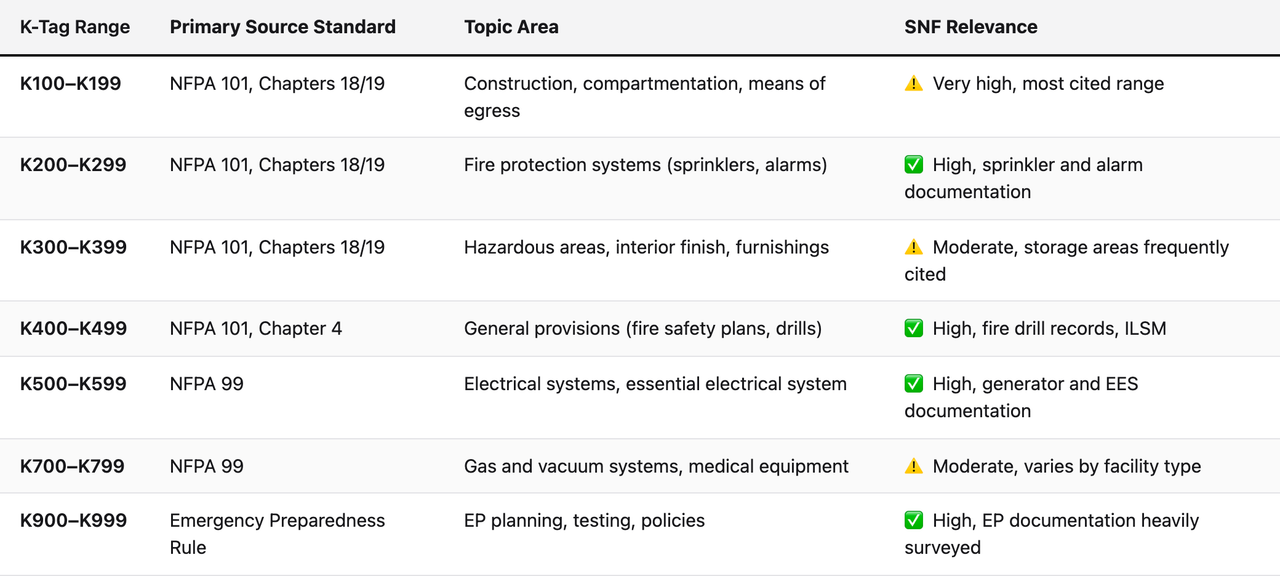
This structure matters because when your team receives a K-tag citation, the tag number tells you which standard was violated and which chapter of that standard to read. A K511 citation points directly to NFPA 99 electrical system requirements. A K211 citation points to NFPA 101 means of egress provisions. Your remediation path starts with the correct source document.
The Role of the CMS State Operations Manual
The CMS State Operations Manual, Appendix A (for long-term care facilities) contains the interpretive guidelines for each K-tag. These guidelines explain how surveyors are trained to interpret the underlying NFPA requirements, what evidence they look for, and what documentation satisfies compliance. The SOM is not the NFPA codes, it is CMS's interpretive layer on top of them. When there is tension between what the NFPA code says and what a surveyor cites, the SOM interpretation typically governs, because CMS surveyors are trained to the SOM, not to the raw code text.
This is one of the most commonly misunderstood aspects of SNF life safety compliance. Your maintenance director may have read the NFPA 101 section on fire drills and concluded that the facility is compliant. But if the SOM interpretive guidance for the corresponding K-tag adds specific documentation elements that the NFPA code text does not explicitly list, the surveyor will cite a deficiency even though the underlying action was performed.
The Most Frequently Cited K-Tags in SNFs (and Their NFPA Roots)
Not all K-tags are created equal in terms of citation frequency. Several specific tags account for a disproportionate share of life safety deficiencies at skilled nursing facilities. Understanding where each high-frequency tag originates in the NFPA code structure helps your team build documentation practices that close those gaps proactively.
K211: Means of Egress, NFPA 101 Section 19.2
K211 is one of the most cited life safety tags across all SNF types. It covers means of egress, which NFPA 101 defines broadly to include the continuous and unobstructed path from any occupied point in a building to a public way. This includes corridors, doors, exit access corridors, exit stairs, exit discharge, and all components of that path.
NFPA 101 Section 19.2 sets the requirements: corridor width minimums (typically 8 feet in new health care occupancies, with some relief in existing buildings), door hardware specifications, door opening force limits, corridor obstruction prohibitions, and exit sign and emergency lighting requirements. The documentation obligation tied to K211 citations is often overlooked. Surveyors cite K211 not just for physical obstructions they observe during the survey walk but also for missing documentation of periodic inspections of means of egress components, including exit sign and emergency lighting monthly and annual testing records.
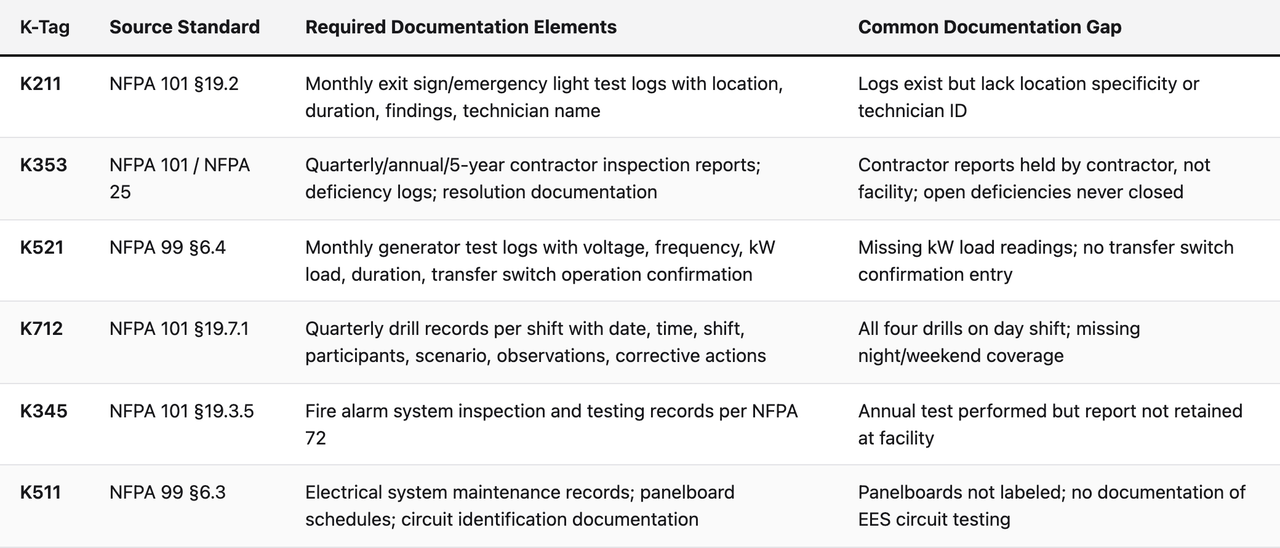
The practical implication: your maintenance team may be doing the monthly exit light test, but if the log does not record the specific location tested, the duration of the test, and the name of the person who performed it, the documentation is insufficient to satisfy a surveyor reviewing it under K211.
K353: Sprinkler System Maintenance, NFPA 101 and NFPA 25
K353 is the sprinkler system maintenance and testing tag. NFPA 101 requires that sprinkler systems in health care occupancies be maintained in accordance with NFPA 25, Standard for the Inspection, Testing, and Maintenance of Water-Based Fire Protection Systems. This creates a two-layer reference structure: NFPA 101 mandates the sprinkler system, and NFPA 25 (incorporated by reference) sets the inspection and testing cadence.
K353 citations typically arise from three documentation failures: (1) missing quarterly, annual, or five-year inspection records required by NFPA 25; (2) deficiency reports from a licensed sprinkler contractor that were never formally resolved and documented; or (3) records that exist but cannot be produced during the survey because they are filed inconsistently or held by a contractor rather than the facility.
The third failure is particularly common and particularly frustrating for SNF teams. The contractor performed the inspection. The system is functioning. But because the written report is sitting in a contractor's file cabinet rather than your binder, you cannot demonstrate compliance during the survey window.
K521: Essential Electrical System, NFPA 99 Chapter 6
K521 and related tags in the K500 range derive from NFPA 99 Chapter 6, which governs the essential electrical system (EES) in health care facilities. For an SNF, the EES includes the generator, automatic transfer switches, and the branch circuits that must remain energized during a utility power failure to protect resident safety.
NFPA 99 Chapter 6 requires monthly testing of the generator under load conditions, with specific documentation of voltage, frequency, and kilowatt load readings during each test. It also requires annual load bank testing if the monthly tests do not achieve a minimum load threshold. The specific load thresholds and test duration requirements are spelled out in the standard, and surveyors check for them explicitly.
A K521 citation for a generator that is physically operational and regularly tested is almost always a documentation citation. The generator ran. But the log did not capture the kW load. Or the monthly test was conducted by a contractor who provided a one-line "passed" notation rather than the specific readings NFPA 99 requires. That gap, invisible to the person who scheduled the test, produces a citation under K521 that can carry a Condition-level finding if the pattern is repeated across multiple months.
K712: Fire Drills, NFPA 101 Section 19.7.1
K712 covers fire drills, which NFPA 101 requires at a minimum quarterly frequency for each shift in health care occupancies. The standard requires that drills be conducted at varying times, that they involve actual response to a simulated alarm, and that they be documented with sufficient detail to demonstrate compliance.
The shift-coverage requirement is where many SNFs accumulate K712 citations. The facility may conduct four drills per year and document them carefully, but if all four drills happen on the day shift, the overnight staff has never been drilled. NFPA 101 requires coverage across all shifts, not just the most convenient one. Surveyors specifically look for night-shift and weekend drill records, and a pattern of shift imbalance is a reliable citation trigger.
Documentation elements surveyors look for in drill records include: date and time, shift covered, number of staff participating, the simulated scenario, observations about staff response, corrective actions identified, and the signature of the person who conducted the drill. Missing any of these elements can convert an otherwise adequate drill program into a documented deficiency.
The Documentation Architecture Behind K-Tag Compliance
Understanding which NFPA sections drive which K-tags is useful knowledge. But the operational question for SNF teams is more specific: what does the documentation actually need to contain, and who is responsible for producing it? This section maps the documentation architecture that underlies a defensible K-tag compliance program.
The Three-Layer Documentation Model
Compliant K-tag documentation exists at three levels, and gaps at any level can produce a citation even when the underlying work was performed correctly.
Layer 1: Task completion records. These are the primary inspection logs, the actual record of who performed what task, when, on which asset, with what findings. For generator testing, this means a log entry with date, time, load readings, and technician signature. For sprinkler inspections, it means the contractor's written report with findings and any deficiencies noted. For fire drills, it means the drill log with all required fields completed. These records must be contemporaneous, meaning they must be created at or near the time the task is performed, not reconstructed after the fact.
Layer 2: Deficiency resolution records. When a task completion record identifies a problem, there must be a corresponding record showing how that problem was resolved. An unresolved deficiency in a sprinkler inspection report is a citation risk even if the deficiency is minor. The documentation must show: the deficiency was identified, a corrective action plan was developed, the repair or correction was made, and the system was retested or reinspected as required. This chain of evidence is what surveyors look for when they review contractor reports, and it is where paper-based systems consistently fail.
Layer 3: System-level demonstration records. These are the records that demonstrate the overall program is functioning, the annual fire safety evaluation, the Interim Life Safety Measure (ILSM) assessments during construction, the written fire safety plan, and the periodic review of the overall life safety program. These records are less about individual tasks and more about the facility's systematic approach to life safety management. Surveyors review them to assess whether the facility has a functioning management process, not just a collection of individual inspection logs.
Contemporaneous Documentation: Why Timing Matters
The requirement for contemporaneous documentation is not pedantic. It is the foundation of the entire compliance framework. CMS surveyors are trained to look for signs that documentation was created after the fact to satisfy a survey, a practice sometimes called "paper compliance." Signs that documentation may not be contemporaneous include: uniform handwriting across multiple log entries that should have been made by different technicians, timestamps that cluster suspiciously around survey dates, and log entries that use language inconsistent with the education level or role of the staff member supposedly making the entry.
When surveyors find evidence of reconstructed documentation, the resulting citation is categorically more serious than a citation for missing documentation. A missing record is a deficiency. A falsified record can become a basis for broader findings about the facility's overall compliance culture, potentially triggering expanded survey scope.
For SNF teams, the practical implication is that documentation systems must make contemporaneous entry easy and natural. If logging a generator test requires the technician to walk back to the office, find the paper log binder, locate the correct form, and fill it out at a desk, contemporaneous documentation becomes difficult to sustain. Systems that allow entry at the point of task completion, via mobile device, shared kiosk, or field-accessible form, are structurally more likely to produce compliant records.
The Specific Documentation Elements K-Tags Require
NFPA 99's Risk Assessment Framework and What It Means for SNF Documentation
One of the most significant, and most frequently misunderstood, elements of NFPA 99 compliance for SNFs is the risk assessment framework introduced in the 2012 edition. This framework fundamentally changes how facilities must approach documentation for utility systems, and it is the source of many K-tag citations that facilities cannot explain.
The Category System: What It Is and Why It Matters
NFPA 99 requires that healthcare facilities conduct a formal risk assessment to categorize each of their utility systems (electrical, gas, vacuum, HVAC, and others) into one of four categories based on the potential for patient harm if that system fails. The categories are:
- Category 1: Failure of the system would likely cause major injury or death to patients or caregivers. Requires the highest level of maintenance documentation and testing rigor.
- Category 2: Failure would likely cause minor injury to patients or caregivers. Requires significant maintenance documentation but with somewhat reduced testing frequency compared to Category 1.
- Category 3: Failure would likely cause discomfort to patients or caregivers. Maintenance requirements are less stringent.
- Category 4: Failure would have no impact on patient care. Minimal formal maintenance documentation required under NFPA 99, though facility management best practices still apply.
The risk assessment itself is a documented process. NFPA 99 does not simply assign categories to system types, it requires that each facility formally assess its own systems and document that assessment. This means a surveyor looking for K-tag compliance on your essential electrical system will ask not just for your generator test logs but for the risk assessment documentation that establishes how your facility categorized that system in the first place.
For most SNFs, the generator and essential electrical system are Category 1 systems. The oxygen delivery system (where present) is typically Category 1 or 2. HVAC systems serving resident care areas may be Category 1 or 2 depending on the level of care provided. The point is that these categorizations must be documented, defended, and revisited when the facility's operations change, for example, when a new clinical service is added, when a wing is renovated, or when the resident acuity level changes materially.
The Documentation Gap the Risk Assessment Creates
Many SNFs operating under the 2012 editions of NFPA 99 have never formally documented a risk assessment. Their maintenance teams test the generator monthly and retain the logs, but there is no formal document establishing that the generator is a Category 1 system, signed by the appropriate authority having jurisdiction (AHJ), and retained with the facility's life safety records.
This is a documentation gap that produces K-tag citations not because the facility is unsafe but because the paper trail required to demonstrate the systematic approach mandated by NFPA 99 is incomplete. When a surveyor asks for the risk assessment documentation and receives a blank stare, the citation is inevitable, even if every test has been performed on schedule.
The remediation path for this gap is straightforward: conduct the formal risk assessment, document it using the NFPA 99 framework, have it reviewed and approved by the facility's governing authority, and file it with the life safety records where it can be produced during a survey. Going forward, the assessment should be reviewed and updated on a defined schedule and whenever a material change to the facility or its systems occurs.
Interim Life Safety Measures: The NFPA 101 Requirement SNFs Consistently Miss
Interim Life Safety Measures (ILSMs) are a set of compensatory actions required by NFPA 101 when construction, renovation, or maintenance activities temporarily impair a facility's life safety systems or egress paths. They are among the most commonly missed documentation requirements in SNF life safety compliance, and they generate a significant share of K-tag citations at facilities that are otherwise well-managed.
When ILSMs Apply
NFPA 101 requires an ILSM assessment any time a construction or maintenance activity creates any of the following conditions: a temporary impairment to a required means of egress, a reduction in fire protection capability (for example, temporarily taking a sprinkler system zone offline), a temporary increase in fire hazard (for example, accumulation of construction materials in a resident care corridor), or any other condition that reduces the life safety protection level below the standard required by the code.
This applies even to relatively minor work. Replacing a fire door, conducting a scheduled sprinkler impairment for maintenance, or closing a corridor for floor work can all trigger ILSM requirements. The key is that the facility must conduct a documented assessment to determine whether ILSMs are required, and if they are, must implement and document the specific compensatory measures selected from the ILSM menu defined in NFPA 101.
The ILSM Documentation Requirements
ILSM documentation must include: the nature of the impairment, the date it began, the specific ILSMs implemented (for example, additional fire watches, temporary egress routes, enhanced staff training), the dates on which each ILSM was in effect, and the date the impairment was resolved and normal life safety systems were restored. The facility must also document that affected staff were trained on temporary egress routes and any compensatory procedures during the impairment period.
The most common ILSM documentation failures in SNFs are: (1) failing to conduct any documented ILSM assessment before beginning work, (2) conducting the assessment but not documenting the specific ILSMs implemented, and (3) documenting the start of an impairment but not documenting its resolution. All three produce K-tag citations under K-tags tied to NFPA 101 Section 4.8.2, which is the general chapter provision on fire safety during construction and renovation.
For SNF maintenance teams, the operational discipline required here is a formal pre-work checklist that includes an ILSM assessment trigger question for any work order that involves a fire door, sprinkler system, alarm system, corridor, or exit path. That discipline is much easier to sustain when the work order system itself includes the prompt, rather than relying on the maintenance director to remember the requirement for every job.
The K-Tag Citation Process: What Happens From Survey Walk to Statement of Deficiencies
Understanding the mechanics of how a K-tag citation moves from a surveyor's observation to your Statement of Deficiencies (SOD) helps SNF teams understand both how to prevent citations and how to respond when they occur. The citation process has several steps, and documentation plays a role at each one.
The Survey Walk and Record Review
A CMS life safety survey has two primary components that generate K-tag citations: the physical walk of the facility and the record review. The physical walk produces observations about the built environment, obstructions in corridors, propped fire doors, damaged exit signs, visible storage in sprinkler clearance zones. These observations generate potential citations based on what the surveyor can see.
The record review is where documentation-based citations originate. The surveyor requests specific records, generator logs, fire drill records, sprinkler inspection reports, fire alarm test records, and reviews them against the requirements in the SOM interpretive guidelines. If the records are missing, incomplete, or inconsistent with the requirements, a citation follows regardless of whether the underlying system is functioning correctly.
The record review typically covers a rolling 12-month lookback period for most recurring inspection requirements, with longer lookback periods for less frequent tasks like five-year sprinkler inspections. This means that documentation gaps from 11 months ago are as citable as a gap from last week.
The Plan of Correction Process
When a K-tag citation is issued on the SOD, the facility must submit a Plan of Correction (PoC) within 10 calendar days. The PoC must address four elements: what corrective action was taken for the resident or residents affected (or, for K-tags, the equivalent correction of the life safety deficiency), how the facility will identify other residents or areas potentially affected, what systemic change was made to prevent recurrence, and how the facility will monitor compliance going forward.
The systemic change element is where many SNF PoCs are inadequate. A PoC that says "the missing generator log entry has been completed" addresses the immediate deficiency but does not demonstrate a systemic fix. A surveyor reviewing the PoC wants to see that the facility has changed something about how it manages generator documentation, whether that is a new logging protocol, a new oversight process, or a new tool that makes the required data fields mandatory. Without a credible systemic change, the PoC is likely to be rejected or to result in a follow-up survey that finds the same deficiency.
Common Patterns That Produce Multiple K-Tag Citations at Once
In practice, K-tag citations rarely arrive individually. Facilities that receive one life safety citation typically receive several, because the underlying documentation management failure that produced the first gap usually affected other areas as well. Recognizing these citation cluster patterns helps SNF teams prioritize remediation and prevent cascades.
The "Contractor Report Retention" Cluster
One of the most common citation clusters involves contractor-performed inspections. Many SNFs outsource sprinkler inspections, fire alarm testing, generator maintenance, and kitchen hood suppression system inspections to licensed contractors. The work is performed competently. But the written reports end up in the contractor's file, not the facility's. When a surveyor requests them, the facility cannot produce the records within the survey window, which is typically a few hours at most.
This single failure, contractor reports not retained at the facility, can simultaneously produce K-tag citations under K353 (sprinklers), K345 (fire alarm), K521 (generator), and K372 (kitchen suppression). Four citations from one systemic gap. The fix is straightforward: establish a documented protocol requiring that any contractor performing a life safety inspection must deliver the written report to the facility within a defined number of days, and that receipt of the report is logged and the report filed in a retrievable location.
The "Night Shift Coverage" Cluster
The shift-coverage requirement for fire drills and life safety training produces its own citation cluster. Facilities that conduct all their drills during business hours create a documented pattern that surveyors recognize immediately. A K712 citation for drill shift coverage is often accompanied by a citation for staff training records, because the staff who were never drilled were also never documented as trained in their fire response responsibilities.
The "Open Deficiency" Cluster
When a contractor inspection report identifies a deficiency and that deficiency is not formally resolved and documented, the open deficiency can produce citations across multiple K-tags. An unresolved sprinkler deficiency that is noted in a quarterly report but never documented as repaired creates a K353 citation. If the deficiency affected a specific area of the building, it may also create a citation under the means of egress or hazardous area tags if the area's fire protection was compromised. And if the facility's overall fire safety plan does not reflect the known deficiency, a citation under the fire safety plan requirements may follow.
How to Build a K-Tag Defense System That Survives Unannounced Visits
The goal of K-tag compliance is not to pass surveys. It is to maintain a facility environment that genuinely protects residents, and to document that environment in a way that demonstrates compliance at any moment, not just the moment when a surveyor calls ahead. That standard, survey-ready at all times, requires a different operational approach than periodic pre-survey preparation.
Map Every K-Tag to a Task Owner and a Cadence
The starting point is a complete mapping of the K-tags that apply to your facility type, the NFPA code section behind each tag, the specific documentation required, the frequency at which that documentation must be produced, and the person or role responsible for producing it. This mapping exercise typically reveals assignments that are unclear or unassigned, frequencies that are misunderstood, and documentation elements that are routinely omitted.
For a typical SNF, this mapping exercise produces a task library of 80 to 120 recurring life safety tasks, ranging from daily generator fuel level checks to five-year sprinkler system tests. Each task has a specific owner, a specific cadence, and a specific documentation template. When the task is completed, the documentation is created contemporaneously and filed in a retrievable system.
Build a Deficiency Tracking System That Closes the Loop
Every inspection, whether performed by facility staff or a contractor, must feed into a deficiency tracking system that records the finding, assigns a corrective action, tracks completion of that action, and marks the deficiency as resolved with supporting documentation. This is not a complex system, but it must be systematic. A spreadsheet maintained by the maintenance director works better than nothing. A purpose-built compliance management system works better than a spreadsheet, because it enforces the workflow and prevents deficiencies from falling through the cracks when the maintenance director is on vacation or leaves the facility.
Audit Your Documentation Before the Surveyor Does
The most effective K-tag defense strategy is an internal audit process that reviews life safety documentation against the specific requirements of each K-tag on a rolling basis. This means periodically pulling the same records a surveyor would request, generator logs for the past 12 months, fire drill records for all three shifts for the past four quarters, sprinkler inspection reports with deficiency resolution documentation, and reviewing them against the SOM checklist for each corresponding K-tag.
The gaps that an internal audit finds are the same gaps a surveyor would find. The difference is that an internal audit finding can be corrected before the survey, while a surveyor finding becomes a citation on the public record. Facilities that conduct systematic internal audits on a quarterly or monthly basis consistently perform better on unannounced surveys than facilities that rely on periodic pre-survey preparation.
This is precisely the operational gap that a platform like SEQURA is built to close. Rather than waiting for a human auditor to review binders of documentation, SEQURA's AI review layer cross-references completed inspection records against the regulatory expectations for each K-tag category and surfaces gaps in real time, missing kW load readings, unresolved sprinkler deficiencies, fire drill logs without night-shift coverage. The patterns that produce most life safety citations are often invisible to the person doing the documentation. An automated audit layer makes them visible before the surveyor arrives.
State Survey Variations: When Your State Adds Requirements on Top of CMS
CMS K-tags represent the federal floor of life safety compliance. Many states have adopted additional life safety requirements for licensed SNFs that go beyond the federal CMS requirements. These state requirements are enforced through state licensure surveys, which may be conducted separately from or concurrently with CMS surveys depending on the state's survey agency structure.
State-specific requirements commonly address areas such as: fire extinguisher inspection frequency and documentation, additional sprinkler coverage requirements, specific egress lighting standards, HVAC maintenance documentation, and requirements for specific types of facilities (for example, facilities with dementia care units may face additional secured environment and egress requirements). In some states, the applicable edition of NFPA 101 or NFPA 99 differs from the CMS-adopted edition, creating a compliance environment where your facility must simultaneously satisfy two different versions of the same standard.
For multi-site SNF operators, this creates a documentation management challenge that is difficult to handle with standardized paper binders. A facility in one state may require quarterly fire extinguisher inspections with specific documentation elements. A facility in another state may require monthly inspections. A compliance program that applies the same documentation template to both facilities will either over-comply in one state or under-comply in the other.
The practical approach for multi-site operators is to maintain a state-specific compliance matrix that maps the CMS federal requirements and the state-specific additional requirements for each facility's location, and to build documentation templates that satisfy both. This matrix should be reviewed whenever either the federal or state requirements change, and whenever a new facility is added to the portfolio.
Frequently Asked Questions
What is the difference between NFPA 101 and NFPA 99 for SNFs?
NFPA 101 (the Life Safety Code) governs the built environment, fire protection systems, means of egress, and fire drills. NFPA 99 (the Health Care Facilities Code) governs utility systems including the essential electrical system, medical gas systems, and HVAC. Both are adopted by CMS and enforced through K-tag citations, but they cover different aspects of facility safety.
How do I know which edition of NFPA 101 applies to my SNF?
CMS specifies the applicable edition in its Conditions of Participation and Survey and Certification Letters. Currently, the 2012 editions of both NFPA 101 and NFPA 99 apply to long-term care facilities under CMS certification. Verify the current applicable edition through the CMS State Operations Manual and any subsequent Survey and Certification guidance, as CMS periodically updates which edition applies.
What does "K-tag documentation" mean in practice?
K-tag documentation refers to the specific records a facility must maintain to demonstrate compliance with the life safety requirement associated with each K-tag. For K521 (generator), this means monthly test logs with specific data readings. For K712 (fire drills), this means quarterly drill records covering all shifts. The documentation requirements are defined in the NFPA standards and interpreted by the CMS State Operations Manual.
Can I receive a K-tag citation even if the actual life safety system is working correctly?
Yes. A large share of K-tag citations are documentation citations, not equipment or system failures. If your generator is tested monthly but the logs do not capture the required kW load readings, you can receive a K521 citation even though the generator is fully operational. This is one of the most important distinctions for SNF maintenance teams to understand.
How far back do CMS surveyors look when reviewing life safety documentation?
For most recurring inspection requirements, surveyors review a rolling 12-month lookback period. For less frequent tasks (such as five-year sprinkler inspections or triennial fire alarm tests), they may request the most recent completed cycle of documentation. Gaps from 11 months ago are as citable as recent gaps.
What are the most commonly cited K-tags in skilled nursing facilities?
The most frequently cited K-tags at SNFs typically include K211 (means of egress), K353 (sprinkler system maintenance), K521 (essential electrical system), K712 (fire drills), and K345 (fire alarm system testing). These tags consistently appear at high rates because they involve recurring documentation requirements that are easily missed over a 12-month period.
What is an ILSM and when is it required?
An Interim Life Safety Measure (ILSM) is a compensatory action required by NFPA 101 when construction, renovation, or maintenance temporarily impairs a facility's life safety systems or egress paths. ILSMs must be formally assessed and documented before the impairment begins, and the documentation must cover the specific measures implemented, the period they were in effect, and confirmation of restoration when the impairment is resolved.
What is required in a fire drill record to satisfy K712?
A compliant fire drill record under K712 typically must include: the date and time of the drill, the shift covered, the number and names or roles of staff participating, the simulated fire scenario, observations about staff response, any corrective actions identified, and the signature of the drill conductor. All three shifts must be covered across the four quarterly drills, and drills must occur at varying times rather than at a predictable schedule.
How does the NFPA 99 risk assessment requirement affect K-tag compliance?
NFPA 99 requires facilities to formally categorize their utility systems (Category 1 through 4) based on patient harm potential. The risk assessment itself must be documented and retained. Without this documentation, a facility can receive K-tag citations under the NFPA 99 tags even if all required tests and inspections have been performed, because the documentation chain that demonstrates a systematic approach is incomplete.
What happens if a contractor's inspection report identifies a deficiency and the facility does not document the resolution?
An unresolved deficiency in a contractor's inspection report is a citation risk under the K-tag corresponding to that system. The facility must document that the deficiency was identified, a corrective action was planned and executed, and the system was retested or reinspected as required. Open deficiencies that span multiple inspection cycles carry higher citation risk and may indicate a systemic compliance failure to a surveyor.
Do state life safety requirements override or supplement CMS K-tag requirements?
State life safety requirements for licensed SNFs supplement (not replace) CMS K-tag requirements. States may require additional inspections, more frequent testing, or different documentation elements beyond the federal floor set by CMS. Facilities must satisfy both state licensure requirements and CMS Conditions of Participation simultaneously, which can create compliance complexity for multi-site operators in multiple states.
How can an SNF build a documentation system that is survey-ready at all times?
A survey-ready documentation system requires: a complete mapping of all applicable K-tags to specific tasks, cadences, and responsible staff; contemporaneous documentation created at the point of task completion; a deficiency tracking system that closes the loop from identification to resolution; regular internal audits that review documentation against K-tag requirements before a surveyor does; and a retention and retrieval system that allows any requested record to be produced within the survey window. Digital platforms that automate task scheduling, enforce documentation completeness, and surface gaps through analytic review provide the most reliable foundation for this approach.
Key Takeaways
- NFPA 101 drives K-tags in the K100–K400 range, covering egress, fire protection systems, hazardous areas, and fire drills. NFPA 99 drives K-tags in the K500–K700 range, covering essential electrical systems, medical gas, and utility system management.
- Most K-tag citations are documentation citations, not equipment failures. A generator that runs every month but whose logs lack kW load readings is a K521 citation waiting to happen.
- The CMS State Operations Manual is the operative interpretive layer, not the raw NFPA code text. Surveyors are trained to the SOM, which may require documentation elements the NFPA code text does not explicitly list.
- NFPA 99's risk assessment framework requires formal documentation of how each utility system is categorized, not just records of tests performed. Missing risk assessment documentation is a stand-alone citation risk.
- ILSMs are a frequently missed documentation requirement. Any construction or maintenance activity that temporarily impairs a life safety system requires a documented ILSM assessment, regardless of how minor the impairment is.
- Citation clusters are the norm, not the exception. The same systemic documentation failure, such as contractor reports not retained at the facility, typically produces multiple simultaneous K-tag citations across different system categories.
- State requirements add a layer above the federal floor. Multi-site operators must maintain state-specific compliance matrices to ensure facility documentation templates satisfy both CMS and state licensure requirements.
- Survey readiness is not a pre-survey activity. Facilities that maintain contemporaneous, complete documentation as a routine operational practice consistently outperform facilities that rely on pre-survey preparation sprints.
- Internal audits that replicate surveyor record reviews are the most effective proactive defense against K-tag citations. Finding gaps before the surveyor does converts potential citations into closed corrective actions.
About the author
Benjamin Terebelo · Founder
Benjamin is the founder of SEQURA, a compliance platform purpose-built for healthcare facilities. He builds at the intersection of healthcare operations and software, maintaining a focus on bringing modern tooling to systems that the broader industry has largely left behind.
About the author
Benjamin Terebelo · Founder
Benjamin is the founder of SEQURA, a compliance platform purpose-built for healthcare facilities. He builds at the intersection of healthcare operations and software, maintaining a focus on bringing modern tooling to systems that the broader industry has largely left behind.