
How Machine Learning Identifies Documentation Gap Patterns Across SNF Inspection Records — A Plain-English Technical Explainer

Every SNF maintenance director has lived through the same quiet dread. The surveyor arrives unannounced, asks for the fire drill logs, and somewhere in the stack of binders a night-shift drill record is missing a staff count. Not because the drill didn't happen. Not because anyone was negligent. Because the person who filled out the form didn't know that the form required a staff count, and no one checked before it was filed. That single gap, invisible for months, becomes a K-tag citation that lands in the facility's CMS record. The documentation existed. The compliance did not.
This is the problem that machine learning is now being applied to solve, not by predicting when a boiler will fail or when a sprinkler head will corrode, but by reading the documentation a facility already produces and identifying the structural patterns that predict citation risk. The distinction matters enormously. Most conversations about AI in healthcare facilities conflate two fundamentally different applications: machine learning for physical equipment maintenance and machine learning for documentation auditing. Only one of those applications directly addresses what CMS surveyors actually cite.
This article explains, in plain English, how machine learning models detect documentation gap patterns across SNF inspection records, what the underlying technical mechanisms actually do, and why that capability changes the economics of survey readiness for skilled nursing operators.
The Documentation Gap Problem Is a Pattern Recognition Problem
Documentation gaps in SNF inspection records are not random. They cluster by record type, by shift, by season, by staff tenure, and by the complexity of the regulatory requirement being documented. That clustering is the key insight that makes machine learning applicable here, because pattern recognition at scale is precisely what these models are designed to do.
A human reviewer looking at a single fire drill log can tell you whether that specific log is complete. A machine learning model reviewing twelve months of fire drill logs across a forty-bed facility can tell you that night-shift drills conducted during the third quarter consistently omit the "staff notified in advance" field, that the omission correlates with a specific staff member completing the form, and that the same omission pattern appears in six other facilities in the same operator's portfolio. The human reviewer catches one instance. The model catches the system failure that is producing dozens of instances across the organization.
This is why framing machine learning SNF documentation gaps as a pattern recognition problem, rather than a compliance checklist problem, is technically accurate and practically important. Checklist tools tell you what fields are empty. Machine learning tells you why fields are empty, which fields are likely to be empty next month, and which asset categories are systematically under-documented relative to their CMS citation frequency.
Why SNF Records Are Particularly Well-Suited to ML Analysis
Skilled nursing facilities generate a specific type of structured, recurring documentation that is unusually amenable to machine learning analysis. Every fire drill, every generator test, every eyewash station check, every sprinkler system inspection follows a defined regulatory template with predictable fields, predictable frequencies, and predictable relationships between one record and the next. That regularity creates the labeled, structured dataset that supervised learning models need to function reliably.
Compare this to, say, nurse narrative notes, which are free-form text requiring complex natural language processing to extract meaning. Life safety inspection records are more like spreadsheet rows than paragraphs. They have fields. They have required values. They have defined relationships to other records, such as a deficiency noted in a sprinkler inspection that must be reconciled within a specific number of days. That structural regularity means a model trained on these records can achieve meaningful accuracy without requiring the enormous training datasets that more complex NLP applications demand.
The practical consequence is that AI inspection record analysis in the life safety context can be deployed at the facility level with reasonable confidence, rather than requiring industry-wide data aggregation before it becomes useful. A model can learn the documentation patterns of a single facility within months of operation, even while it is simultaneously learning from the broader portfolio of similar facilities in the same operator group.
How the Models Actually Work: Supervised Learning on Regulatory Records
The phrase "machine learning" gets used loosely enough that it has lost precision in most conversations. For SNF documentation analysis, the specific mechanism matters, so it is worth being concrete about what these models actually do.
The dominant approach in AI inspection record analysis for life safety compliance is supervised learning, specifically classification and anomaly detection applied to structured inspection data. Here is what that means in practice.
Step One: Defining What "Complete" and "Deficient" Look Like
Before a model can identify a documentation gap, it needs to know what a gap looks like relative to what is expected. This is where regulatory knowledge gets encoded into the system. For each asset type and each K-tag category that CMS inspectors evaluate, the system defines the required fields, the acceptable value ranges, the required frequency, and the required relationships to other records.
For example, a generator test record is not just complete because it has a date and a signature. It is complete when it includes runtime in minutes, transfer switch operation confirmation, load readings in kilowatts (or a documented explanation for why the load could not be tested under load), fuel level before and after, and reconciliation with any discrepancies noted in the previous test. Each of those requirements comes from NFPA 110 and the CMS interpretive guidelines for K-tags in the generator category. The model's definition of "complete" is built from those regulatory sources, not from what the facility has historically submitted.
This regulatory encoding is what separates a compliance-specific ML system from a generic document classification tool. The model is not just detecting missing text. It is detecting missing regulatory meaning, specifically the absence of fields that a CMS surveyor would look for when reviewing that record type.
Step Two: Feature Extraction from Completed Records
Once the model knows what complete documentation looks like, it reads every submitted record and extracts features: data points that describe the record's characteristics. For a fire drill log, features might include which shift conducted the drill, how many staff were recorded as participating, whether the time of day falls within the required distribution for that quarter, whether the evacuation time is recorded, whether a critique was documented, and whether the record was submitted within the required window after the drill occurred.
These features are not just binary present-or-absent flags. They include relational features that describe how this record relates to others. Did this fire drill cover the wing that was also covered in the last drill, creating an overrepresentation of one area and an underrepresentation of another? Was this generator test recorded within 30 days of the previous one, as required, or did a gap of 34 days appear? Is the contractor who signed this sprinkler inspection report the same contractor whose license number was flagged as expired in a previous report? These relational features are where ML-based analysis adds value that a simple checklist cannot replicate.
Step Three: Classification and Anomaly Detection
With features extracted, the model applies two distinct analytical processes simultaneously.
Classification assigns each record to a category: compliant, potentially deficient, or clearly deficient. This is the straightforward application of the regulatory rules encoded in step one. A record missing a required field is classified as potentially deficient. A record that has all required fields but contains a value outside acceptable ranges (such as a generator test showing zero kilowatt load when the facility's equipment requires a load test) is also classified as potentially deficient, requiring human review.
Anomaly detection goes further. It identifies records that are statistically unusual relative to the facility's own history or relative to comparable facilities in the dataset. A record that passes every individual field check but arrives six days earlier than the facility's normal submission pattern, with a different staff member's name than usual, on a day when no other maintenance tasks were logged, might be flagged as anomalous even though it technically appears complete. Anomaly detection is not an accusation. It is a signal that a human reviewer should look more closely at that record before a surveyor does.
Predictive Auditing Versus Predictive Maintenance: Why the Distinction Matters
The term machine learning predictive maintenance is familiar in industrial and healthcare facility contexts. It refers to using sensor data and equipment performance metrics to predict when a physical asset, a boiler, an HVAC unit, a generator, is likely to fail before it actually fails. This is genuinely valuable, but it addresses a different problem than what CMS surveyors actually cite in SNF surveys.
CMS life safety citations are almost never about equipment that failed. They are about documentation that failed. A generator that ran perfectly during an outage can still produce a K-tag if the test log doesn't show the required fields. A sprinkler system that has never malfunctioned can still produce a citation if the quarterly inspection report was completed by a contractor whose certification is not documented in the facility's records. The equipment worked. The paperwork didn't.
This is why predictive auditing AI, which focuses on documentation integrity rather than equipment condition, is the more directly relevant application for SNF survey readiness. Predictive maintenance tells you when to fix the generator. Predictive auditing tells you when your generator documentation is about to fail a survey.
Where the Two Approaches Can Complement Each Other
The two approaches are not mutually exclusive, and the most sophisticated life safety platforms integrate both. When a predictive maintenance signal indicates that a piece of equipment is approaching a maintenance threshold, the system can simultaneously verify that the documentation trail for that equipment is complete and survey-ready. If a generator is due for a major service, the system can confirm that all monthly test logs leading up to that service are filed correctly, that the service contractor's credentials are on file, and that the post-service inspection report will be routed through the right approval chain before it is filed.
This integration is where AI-powered maintenance management software creates compound value: it catches both the physical failure risk and the documentation failure risk associated with the same asset at the same moment in time. For a maintenance director managing forty or more recurring task categories across a facility, that simultaneous visibility is not a convenience. It is the difference between survey confidence and survey anxiety.
The Specific Gap Patterns That ML Models Detect Most Reliably
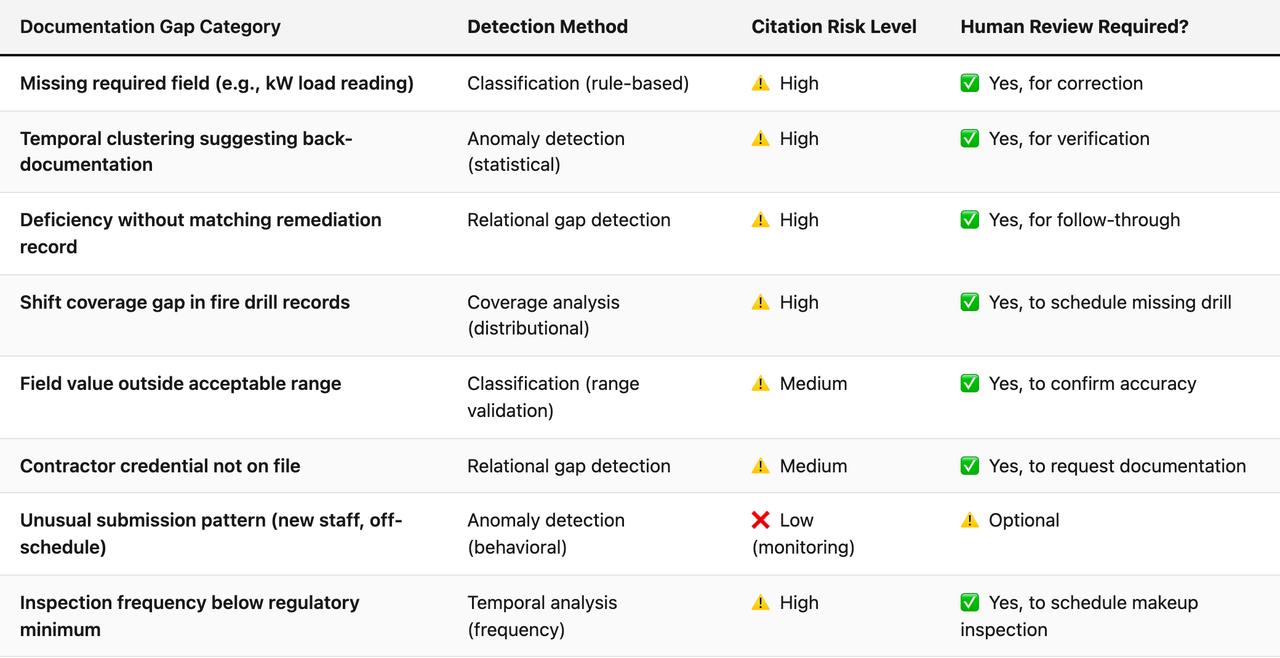
Not all documentation gaps are equally detectable by machine learning, and understanding which patterns models identify most reliably helps facilities prioritize where AI-assisted auditing delivers the highest return on investment.
Temporal Pattern Gaps
The most reliably detectable gap category involves timing: records submitted outside the required frequency window, or records that cluster in ways that suggest back-documentation rather than contemporaneous completion. A facility that completes twelve monthly generator tests in a calendar year but submits four of them within the same two-week window is exhibiting a temporal pattern that a model flags immediately. The records may be accurate, but the submission timing pattern is inconsistent with contemporaneous documentation and warrants review before a surveyor raises the same question.
CMS surveyors are trained to look for exactly this pattern. CMS guidance on nursing home survey protocols explicitly notes that surveyors examine documentation dates and submission patterns as part of assessing whether records reflect actual practice or retroactive completion. ML models apply the same logic at machine speed across every record in the facility's database.
Field Completeness Gaps by Record Type
Different inspection record types have systematically different gap profiles. Fire drill logs most commonly omit staff participation counts and post-drill critique documentation. Generator test records most commonly omit kilowatt load readings and transfer switch confirmation. Eyewash station inspection logs most commonly omit flow duration and temperature range confirmation. These are not random omissions. They are field-specific gaps that correlate with how difficult that field is to complete in the moment of inspection, rather than how important it is to the regulator.
A well-trained model learns these field-specific gap profiles for each facility and for each asset category, then uses them to generate targeted alerts. Rather than notifying a maintenance director that "some generator records may be incomplete," the system tells them that the last three generator tests are missing kilowatt load readings, which is the specific field that produces the most common generator-category K-tag citation in their state.
Relational Gaps Between Connected Records
Some of the most consequential documentation gaps are not gaps within a single record but gaps in the relationship between records. A sprinkler inspection that identifies a deficiency creates a required remediation record. If the remediation record never appears, or appears outside the required timeframe, the original inspection record and the missing remediation record together constitute a citation-producing gap that neither record alone would reveal.
This relational gap detection is where ML-based analysis most significantly outperforms manual review. A human auditor reviewing a stack of inspection records would need to cross-reference every deficiency notation against the remediation file for every asset across every inspection cycle. A model does this cross-referencing automatically, flagging every deficiency that lacks a matching remediation record within the required window. The NFPA 101 Life Safety Code and its associated CMS K-tag framework create dozens of these required record relationships, and tracking them manually across a full facility portfolio is practically impossible at scale.
Coverage Gaps by Location and Shift
Life safety compliance requires that certain inspections cover all areas of a facility and all operational periods. Fire drills must occur across all shifts. Certain equipment checks must cover all wings or floors. When a model analyzes drill and inspection records by location tag and shift identifier, it can identify structural coverage gaps that are invisible in the aggregate. A facility that conducts the required number of fire drills per year but conducts none of them on the overnight shift has a citation-level gap that only becomes visible when records are analyzed by shift distribution, not just by count.
How Models Handle Incomplete or Inconsistent Input Data
One of the most common objections to ML-based documentation analysis is that the underlying data is often messy. Handwritten forms are transcribed inconsistently. Contractor reports use non-standard terminology. Different staff members describe the same inspection in different ways. If the model's input data is unreliable, how can its outputs be trusted?
This is a legitimate concern, and the answer lies in how well-designed systems handle data quality as a first-order problem rather than an afterthought.
Structured Input Templates Reduce Ambiguity at the Source
The most effective way to improve model reliability is to improve input quality before the model ever sees the data. When inspection records are completed through a structured digital interface, such as a facility kiosk, mobile app, or back-office system with defined form fields, the model receives clean, consistently formatted data rather than transcribed free text. The field for "kilowatt load reading" accepts only a numeric value. The field for "transfer switch confirmed" accepts only yes, no, or a documented explanation. There is no ambiguity to resolve downstream.
This is why the operational layer of a platform like SEQURA, the task scheduling and contemporaneous logging function, is not separable from the analytic layer. The structured completion workflow is what makes reliable ML analysis possible. A model analyzing scanned PDFs of handwritten forms will perform materially worse than a model analyzing structured digital records, because the former requires an additional layer of document parsing that introduces its own error rate.
Confidence Scoring and Human-in-the-Loop Review
For records that the model cannot classify with high confidence, well-designed systems use confidence scoring to route flagged records to human review rather than making automated determinations. A record that triggers three weak anomaly signals but no clear classification as deficient might receive a confidence score of 0.6 on a 0 to 1 scale, appearing in the maintenance director's review queue as "needs verification" rather than "citation risk." This human-in-the-loop design is not a limitation of the technology. It is the appropriate application of the technology to a domain where false positives have real operational costs and false negatives have real regulatory costs.
The goal is not to replace human judgment about compliance. It is to make sure human judgment is applied where it matters most, rather than being exhausted on the routine verification tasks that a model can handle reliably at scale.
Training Data, Model Drift, and Regulatory Change
A machine learning model is only as current as its training data and its regulatory reference set. This creates a specific operational challenge for life safety compliance applications: CMS interpretive guidelines, state survey protocols, and NFPA code editions change, and when they do, a model trained on the previous standard may fail to detect gaps that are only gaps under the new standard.
How Regulatory Updates Get Incorporated
The highest-quality life safety ML systems maintain a living regulatory reference library that is updated when CMS releases new State Operations Manual revisions for long-term care or when NFPA adopts a new code cycle that CMS subsequently references. When the regulatory reference changes, the model's definition of "complete" for each record type is updated, and records that were previously classified as compliant may be reclassified as potentially deficient under the new standard.
This is a meaningful operational requirement. A facility that adopts an AI documentation platform and then assumes the compliance definitions are static is taking on regulatory risk. The platform's regulatory library needs active maintenance, and facilities should verify that their vendor has a defined process for incorporating regulatory updates within a reasonable timeframe of their effective date.
Model Drift and Retraining Cadence
Model drift occurs when the statistical patterns in new data diverge from the patterns in the training data, causing the model's predictions to become less accurate over time. In the SNF documentation context, drift can occur when a facility changes its documentation processes, hires new staff with different completion patterns, or transitions from paper to digital records. A model trained on two years of paper-form data may need retraining after the facility switches to a digital kiosk system, because the input format and the completion patterns both change.
Well-designed systems monitor for drift by tracking model accuracy metrics continuously and triggering retraining when accuracy falls below defined thresholds. For a facility-level compliance application, retraining cycles of three to six months are generally appropriate for stable documentation environments, with triggered retraining when significant process changes occur.
What This Means for Multi-Site SNF Operators
The value proposition of ML-based documentation auditing changes significantly when it is applied across a portfolio of facilities rather than a single site. At the portfolio level, the model can do something that no human audit team can do at reasonable cost: it can compare documentation quality patterns across all facilities simultaneously and identify systemic issues that no single facility's records would reveal.
Portfolio-Level Pattern Detection
When a model analyzes fire drill records across fifteen facilities in the same operator group, it can identify that eleven of those facilities have the same gap in their overnight drill documentation. That pattern suggests a systemic training issue, a template problem, or a policy ambiguity that is producing the same documentation failure in multiple locations. Fixing the root cause at the policy or template level eliminates the gap at all eleven facilities simultaneously, rather than requiring eleven separate remediation conversations with eleven different maintenance directors.
This is where ML-based auditing creates organizational learning that compounds over time. Each gap identified at one facility, once resolved, updates the model's alert logic in a way that catches the same pattern earlier at every other facility in the portfolio. The model gets smarter as the organization uses it, in a way that is specific to the regulatory and operational context of skilled nursing facility documentation.
Benchmarking Documentation Quality Across Sites
Portfolio-level analysis also enables benchmarking, the ability to assess each facility's documentation quality relative to its peers in the same portfolio. A regional facilities manager can see not just that Facility A has a 94% field completion rate on generator records while Facility B has a 71% rate, but also which specific fields are driving the gap, which staff members or shifts are associated with lower completion rates, and which asset categories are consistently under-documented across the lowest-performing sites.
This benchmarking function transforms documentation quality from an abstract compliance concept into a measurable operational metric that can be tracked, targeted, and improved with the same rigor as any other operational KPI. For COOs and VPs of operations at multi-site SNF organizations, that measurability is what makes survey readiness a manageable operational objective rather than a permanent source of uncertainty.
The Role of Natural Language Processing in Contractor Report Analysis
Not all life safety documentation arrives in structured form. Contractor inspection reports, particularly for fire suppression systems, elevator certifications, and HVAC inspections, are often delivered as PDF documents with narrative text, tables, and handwritten annotations. Extracting compliance-relevant information from these documents requires natural language processing (NLP), a different branch of machine learning from the classification and anomaly detection models described above.
What NLP Extracts from Narrative Reports
When a fire suppression contractor submits an inspection report, the NLP layer of a documentation intelligence platform reads the narrative sections and extracts structured data points: which areas were inspected, which deficiencies were noted, what the contractor's recommended remediation timeline is, and whether the contractor indicated that the system passed or failed the applicable NFPA standard. These extracted data points are then stored as structured fields that feed into the classification and relational gap detection models described in earlier sections.
The practical result is that a contractor report that arrives as a 12-page PDF is converted into a set of structured records that the compliance model can analyze alongside the facility's internally generated inspection logs. Deficiencies noted in the contractor report are automatically matched against remediation records in the facility's work order system. If a matching remediation record does not appear within the required timeframe, the gap is flagged for human review.
Confidence and Verification in NLP Extraction
NLP extraction from narrative documents is inherently less reliable than structured form analysis, because narrative language is ambiguous in ways that structured fields are not. A contractor who writes "minor impingement observed at head 14B, monitor at next inspection" is describing a condition that may or may not require formal remediation documentation under NFPA 25, depending on the specific nature of the impingement and the AHJ's interpretation. The NLP model can flag this language as potentially deficiency-relevant, but the final determination of whether a formal remediation record is required involves regulatory judgment that benefits from human review.
This is why NLP extraction outputs in well-designed systems are always presented with a confidence indicator and routed through a human review step before they are treated as confirmed compliance records. The model's job is to make sure nothing in a 12-page contractor report gets overlooked. The maintenance director's job is to review what the model flagged and make the judgment call about whether action is required. That division of labor is where the technology adds the most value without overreaching its reliable capabilities.
Implementation Realities: What Facilities Need to Know Before Deploying AI Documentation Analysis
The technical capabilities described in this article are real and deployable, but facilities considering AI-powered documentation auditing should approach implementation with a clear-eyed understanding of what the technology requires to function well.
Data Migration and Historical Record Digitization
A model trained only on the last 30 days of a facility's records has limited pattern recognition capability. The more historical data available, the more accurately the model can characterize the facility's normal documentation patterns and identify deviations from them. Facilities transitioning from paper binders to digital platforms should plan for a structured data migration effort that brings at least 12 to 24 months of historical inspection records into the digital system in a usable format.
This is often more labor-intensive than facilities anticipate. Paper records vary in completeness, legibility, and format across different staff members and time periods. A realistic implementation plan accounts for this migration effort as a distinct project phase, not as a background task that happens automatically when the platform is activated.
Staff Training on Structured Completion
The quality of ML analysis is directly proportional to the quality of the input data. If staff complete digital forms with the same inconsistency they applied to paper forms, the model's performance will reflect that inconsistency. Structured completion training, explaining not just how to use the digital interface but why each field is required and what value the regulator is looking for, is a necessary investment in making the AI layer reliable.
This training investment is typically modest in absolute terms, but it requires commitment from facility leadership to establish the expectation that structured, contemporaneous completion is a non-negotiable operational standard, not an optional upgrade from the previous paper process.
Defining the Human Review Workflow
Every flagged record that the model surfaces requires a human decision: is this a real gap that needs to be corrected, or is there a documented explanation that resolves the apparent discrepancy? Facilities need to define who receives these flags, how quickly they are expected to act on them, and how resolved flags are documented in the system. Without a defined review workflow, flags accumulate unresolved and the platform's value degrades to that of an alert system that no one acts on.
The most effective implementations assign flag review responsibility to a specific role, typically the maintenance director or a designated compliance coordinator, with defined response time expectations and escalation paths for flags that are not resolved within the expected window. This is an operational process design question, not a technology question, but it is one of the most important determinants of whether the platform delivers survey confidence or just survey anxiety in digital form.
Frequently Asked Questions
What specific types of SNF documentation does machine learning analyze most effectively?
Machine learning performs most reliably on structured, recurring documentation with defined fields and regulatory completion requirements. In the SNF life safety context, this includes generator test logs, fire drill records, sprinkler and fire suppression inspection reports, emergency lighting test logs, eyewash station checks, and K-tag-specific documentation like ILSM (Interim Life Safety Measure) logs. The more structured the input format, the more reliable the model's gap detection.
Is this the same as predictive maintenance software for facility equipment?
No. Predictive maintenance uses sensor data and equipment performance metrics to forecast physical equipment failures before they occur. Predictive auditing AI, the application described in this article, analyzes documentation records to detect compliance gaps before a CMS or state surveyor identifies them as citations. The two applications address different problems. Equipment can function perfectly while its documentation fails a survey, which is why documentation-focused AI is the more directly relevant tool for survey readiness.
How much historical data does a model need to be useful for a single facility?
A model can begin generating useful classification-based alerts (missing fields, out-of-range values, frequency gaps) from the first completed records, because these checks are rule-based rather than pattern-based. For anomaly detection, which requires an established baseline of the facility's normal documentation patterns, meaningful accuracy typically develops after three to six months of structured digital record accumulation. For multi-site portfolio analysis, the model benefits from cross-facility data from the outset.
How does the system handle documentation that arrives from external contractors?
Well-designed platforms use natural language processing to extract structured data from contractor-submitted PDF reports, converting narrative text into structured fields that can be analyzed by the compliance classification model. Extracted data is presented with a confidence score, and records below a defined confidence threshold are routed to human review before being treated as confirmed compliance records. Contractor credentials referenced in these reports are also cross-checked against the facility's vendor file for currency and completeness.
What happens when CMS updates its interpretive guidelines or a new NFPA code cycle is adopted?
The model's definition of "complete" for each record type is derived from a regulatory reference library that must be updated when CMS or NFPA changes the applicable standards. Facilities should verify that their platform vendor has a defined process for incorporating regulatory updates and should ask specifically about the timeline between a regulatory change's effective date and the platform's corresponding update. A static regulatory reference library in a changing regulatory environment is a meaningful compliance risk.
Can the system distinguish between a genuine documentation gap and a gap that has a documented explanation?
Yes, through the human review workflow. When a record is flagged as potentially deficient, the maintenance director or compliance coordinator can add a documented explanation that resolves the flag, such as noting that a load test was not possible due to a utility constraint that required a no-load test with documented justification. That explanation becomes part of the record and is itself reviewed by the model to confirm it contains the required elements for a valid exception under the applicable regulatory standard.
Does ML-based documentation analysis reduce the risk of survey citations, or does it just surface more issues to deal with?
Both, in the right sequence. In the initial deployment period, platforms typically surface a larger number of documentation gaps than facilities were previously aware of, which feels like more work in the short term. Over time, as gaps are systematically closed and documentation practices improve, the ongoing alert volume decreases because the underlying gap rate decreases. The long-term outcome is a lower citation rate at survey, not just better visibility into existing problems.
How does a multi-site SNF operator benefit differently from a single-facility operator?
Multi-site operators benefit from portfolio-level pattern detection, which identifies systemic documentation failures that appear across multiple facilities and suggests root causes at the policy, template, or training level rather than the individual staff level. They also benefit from cross-facility benchmarking, which makes documentation quality a measurable, comparable operational metric across the portfolio. Single-facility operators benefit primarily from the depth of analysis applied to their own records, including relational gap detection and temporal pattern analysis that would be impractical to perform manually.
Is there a risk that the AI flags legitimate records as deficient, creating unnecessary work?
False positives are a real consideration in any ML system. Well-designed platforms manage this through confidence scoring, which routes only high-confidence classifications to immediate action queues and lower-confidence flags to a softer review queue. The false positive rate decreases over time as the model learns the facility's specific documentation patterns and distinguishes between genuine gaps and unusual-but-legitimate records. Facilities should ask vendors for their false positive rate benchmarks and for how they track and reduce false positives over the system's operational lifetime.
What is the difference between a documentation gap and a compliance gap?
A documentation gap is an absence or deficiency in the written record of an inspection or test. A compliance gap is a failure to actually perform the required inspection or test. These are related but distinct. A facility can perform every required inspection correctly and still have documentation gaps if the records are incomplete or inconsistently completed. Conversely, a facility can have complete-looking documentation while having genuine compliance gaps if records are not accurate. ML-based auditing is specifically designed to detect documentation gaps. Detecting genuine compliance gaps requires operational controls, such as contemporaneous digital completion with geolocation or kiosk-confirmation, that provide evidence the work actually occurred.
How does SEQURA's AI layer fit into this technical framework?
SEQURA's analytic layer applies the classification, relational gap detection, and anomaly detection mechanisms described in this article to the inspection records, contractor reports, and shift logs that facilities generate through SEQURA's operational layer. Because records are completed through a structured digital interface rather than paper forms, the model receives consistently formatted input data, which improves detection reliability. The system surfaces gaps by K-tag category, asset type, and record type, giving maintenance directors and compliance staff specific, actionable findings rather than generic alerts.
Is AI documentation analysis a substitute for a life safety consultant?
No, and the distinction is important. A life safety consultant brings regulatory interpretation expertise, surveyor relationship knowledge, and on-site observational capabilities that no current ML system replicates. AI documentation analysis is a continuous operational tool that maintains documentation quality between consultant engagements, ensures that the gaps a consultant would identify are found and closed before a survey, and provides the audit trail that supports a consultant's recommendations. The two capabilities are complementary, not competitive.
Key Takeaways
- Documentation gaps in SNF inspection records are not random. They cluster by record type, shift, staff member, and asset category in ways that machine learning models are specifically designed to detect at scale.
- Predictive auditing AI and predictive maintenance AI solve different problems. CMS life safety citations are overwhelmingly documentation failures, not equipment failures. The more relevant AI application for survey readiness focuses on records, not sensors.
- The four primary gap detection mechanisms are field-level classification, temporal pattern analysis, relational gap detection between connected records, and coverage analysis by shift and location. Each catches a different category of citation risk.
- Structured digital input is the prerequisite for reliable ML output. Models analyzing consistently formatted digital records perform materially better than models parsing transcribed paper forms. The operational layer and the analytic layer are inseparable.
- Multi-site operators gain compounding value through portfolio-level pattern detection that identifies systemic training or template failures affecting multiple facilities simultaneously, rather than requiring facility-by-facility remediation.
- Human review remains essential for ambiguous flags, contractor report analysis, and regulatory judgment calls. The technology's role is to ensure human attention is directed where it matters most, not to replace human compliance judgment.
- Regulatory library currency is a non-negotiable platform requirement. A model trained on outdated CMS interpretive guidelines will miss gaps that are only gaps under the current standard. Facilities should verify that their platform vendor maintains and updates the regulatory reference library on a defined cadence.
- Implementation quality determines platform value. Data migration depth, staff training on structured completion, and a defined human review workflow are the three operational factors that most determine whether AI documentation analysis delivers measurable survey confidence.
From Alert to Audit-Ready: What Survey Confidence Actually Looks Like in Practice
The gap between a documentation alert and genuine survey confidence is an operational gap, not a technology gap. A platform can surface every citation-risk pattern in a facility's records with high accuracy, and that accuracy is wasted if the alerts sit unreviewed in a dashboard that no one checks before the surveyor walks through the door.
Survey confidence, the specific outcome that facilities are investing in when they adopt AI-powered documentation auditing, is the product of three things working together: a model that detects gaps reliably, a workflow that ensures those gaps are reviewed and resolved promptly, and a documentation trail that proves the resolution occurred in a form that will satisfy a surveyor's scrutiny. The technology handles the first. The facility's operational design handles the second and third.
What machine learning adds to this equation is not magic. It is scale and consistency: the ability to apply the same rigorous cross-referencing and pattern analysis to every record, every week, across every asset category in a facility's life safety program, without the fatigue, distraction, or oversight gaps that make manual auditing unreliable at the pace that CMS survey cycles demand. For a maintenance director managing hundreds of recurring compliance tasks while simultaneously handling daily facility operations, that consistency is not a technological novelty. It is the operational foundation that makes survey readiness a sustainable practice rather than a pre-survey scramble.
The night-shift fire drill log with the missing staff count, the generator test with the absent kilowatt reading, the sprinkler deficiency without a remediation record: these are the citations that machine learning finds first, before the surveyor does. That is the entire value proposition, delivered in plain English.
About the author
Benjamin Terebelo · Founder
Benjamin is the founder of SEQURA, a compliance platform purpose-built for healthcare facilities. He builds at the intersection of healthcare operations and software, maintaining a focus on bringing modern tooling to systems that the broader industry has largely left behind.
About the author
Benjamin Terebelo · Founder
Benjamin is the founder of SEQURA, a compliance platform purpose-built for healthcare facilities. He builds at the intersection of healthcare operations and software, maintaining a focus on bringing modern tooling to systems that the broader industry has largely left behind.