
How to Build a Compliant Fire Drill Program That Satisfies CMS Night-Shift Documentation Requirements
It is 2:47 a.m. on a Tuesday. The overnight shift supervisor at a 120-bed skilled nursing facility is leading twelve residents and four aides through a simulated fire evacuation on the north wing. Nobody is panicking. The drill runs clean. The supervisor signs the log, notes the time, records the head count, and files the sheet in a manila folder inside the maintenance director's binder.
Six weeks later, a CMS surveyor walks in unannounced. She asks for fire drill records. The maintenance director hands over the binder with confidence. The surveyor pages through it methodically, cross-referencing shift coverage against the drill timestamps. Then she sets down her pen and says something the facility had not anticipated: "You have three drills documented for the second shift and one for the day shift. I don't see a completed drill for nights across two of your four quarters. And the drill you did run at night is missing the number of staff on duty."
That conversation produces a K-tag citation. The facility knew how to run a fire drill. What it failed to do was build a program with the documentation architecture that CMS surveyors are specifically trained to interrogate. This guide closes that gap, step by step, for every SNF maintenance director, administrator, and compliance officer who cannot afford to learn this lesson the hard way.
Understanding What CMS Actually Requires (Before You Build Anything)
The starting point for any compliant fire drill program is the regulatory text itself, not a summary of it. CMS enforces fire drill requirements for skilled nursing facilities through its State Operations Manual Appendix PP, which incorporates by reference the NFPA 101 Life Safety Code. Reading the secondary summary documents without anchoring them to these two primary sources is one of the most common errors facilities make when building their programs.
Here is what those requirements actually say, broken down into the elements surveyors audit:
Frequency: Four Drills Per Shift Per Year
Under NFPA 101, Chapter 19 (which governs existing health care occupancies, the category that covers virtually all operating SNFs), fire drills must be conducted at least quarterly on each shift. That means a minimum of twelve drills per year for a facility running three shifts, or sixteen drills for a facility running four shifts. Many facilities document twelve drills and assume they are compliant, only to discover during a survey that the quarterly distribution across shifts was uneven.
The quarterly requirement is not "once every three months at any time of day." It means one drill must be completed during the day shift, one during evening shift, and one during night shift, within each calendar quarter. If a facility runs its three drills in January, February, and March but all three fall between 7:00 a.m. and 3:00 p.m., that is three day-shift drills in Q1, zero evening drills, and zero night drills. At the end of the year, no number of catch-up drills in Q4 will retroactively satisfy the quarterly night-shift requirement for Q1 through Q3.
The Night-Shift Documentation Problem
Night-shift drills are where the overwhelming majority of SNF fire drill citations originate. The reasons are structural, not intentional. Maintenance directors typically work days. Drill planning happens during business hours. Night-shift supervisors are managing reduced staffing, resident care needs, and the operational reality that a 2:00 a.m. evacuation drill creates genuine disruption. The result is that night-shift drills get scheduled last, postponed most often, and documented least completely.
CMS surveyors know this. Night-shift drill records are among the first documents they examine, precisely because they are the most likely to be missing or incomplete. The specific documentation elements CMS expects for every drill, including night drills, are covered in detail in Step 4 of this guide.
The NFPA 101 Exception for Sleeping Residents
NFPA 101 Section 19.7.1.8 contains a provision that is frequently misunderstood: facilities are permitted to conduct drills during night shifts without awakening sleeping residents, provided staff are notified and the drill is otherwise conducted as if it were a real event. This exception does not eliminate the drill. It does not reduce documentation requirements. It means the evacuation of sleeping residents can be simulated rather than executed. The drill must still occur, staff must still respond, and every documentation element must still be captured. Facilities that interpret this exception as permission to skip night drills or reduce their formality are reading it incorrectly.
Step 1: Audit Your Current Program Before You Build the New One
Estimated time: 2–4 hours. Tools needed: Current fire drill logs (at least 12 months), facility shift schedule, calendar.
The single most productive thing a maintenance director or compliance officer can do before redesigning a fire drill program is conduct an honest audit of the existing one. This is not a motivational exercise. It is diagnostic, and it will reveal the specific gaps a surveyor would find if they walked in tomorrow.
The Drill Distribution Audit
Pull every fire drill log from the past twelve months. Create a simple grid with four columns: Quarter, Shift (Day/Evening/Night), Date and Time, and Documentation Complete (Yes/No). Populate it from your records. When the grid is complete, look for three things:
- Missing quarters: Any shift that does not have at least one completed drill in each of Q1, Q2, Q3, and Q4 is a documentation gap that will produce a citation.
- Clustering: Drills that are all conducted within the same month of a quarter suggest the program is reactive rather than planned. Surveyors notice this pattern.
- Night-shift gaps: Any quarter where night-shift drills are absent or incomplete is your highest-priority remediation target.
The Documentation Quality Audit
For each drill that appears on your grid, pull the actual log and verify it contains every required element. Most facilities discover that their logs are present but incomplete. A drill log that exists but is missing required fields is nearly as problematic as a missing log, because an incomplete record raises the inference that the drill was not properly conducted.
Common missing elements found during documentation audits include: staff count at the time of the drill, names of participating staff (or at minimum, a count by department), scenario description, time of alarm activation, time of last person reaching assembly point, deficiencies noted, and corrective action taken. If your current logs do not capture all of these, redesign the form before the next drill cycle begins.
The Scheduling Gap Analysis
Map your existing drill records against your facility's shift schedule. If your facility runs a 7:00 a.m. to 3:00 p.m. day shift, a 3:00 p.m. to 11:00 p.m. evening shift, and an 11:00 p.m. to 7:00 a.m. night shift, verify that each documented drill falls within the correct shift window. Drills conducted during shift change periods (30 minutes before or after a shift change) can create ambiguity about which shift the drill counts toward. This is a specific surveyor concern, because facilities sometimes schedule drills during overlapping staffing to boost participation numbers without actually drilling the target shift.
Step 2: Design Your Annual Drill Schedule with Regulatory Precision
Estimated time: 1–2 hours. Tools needed: Facility calendar, shift schedule, completed audit from Step 1.
A compliant fire drill program is not built drill by drill. It is built as an annual schedule, designed backward from regulatory requirements, and locked into the facility calendar before the year begins. This is the operational shift that separates facilities that pass fire drill surveys from those that scramble to explain gaps.
The Quarterly Slot Method
Divide your calendar into four quarters. For each quarter, assign one drill slot to each shift. That produces twelve drill events for a three-shift facility. For each slot, assign a target month (not a specific date, which allows flexibility for operational disruptions) and a target week within that month. The goal is to spread drills across the quarter rather than allowing them to cluster at the quarter's end.
A practical quarterly schedule for a three-shift SNF might look like this:
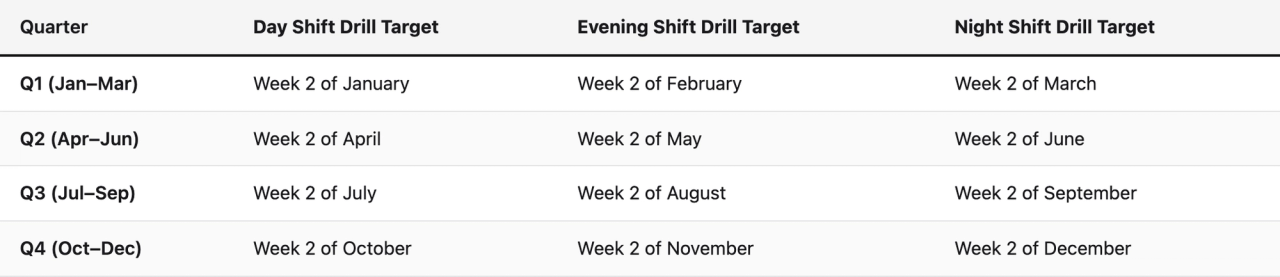
This structure ensures no shift is drilled twice in the same month within a quarter, spreads the operational burden across the year, and creates a visible pattern that surveyors read as intentional program design rather than ad hoc compliance.
Assigning Drill Ownership
Every drill on the annual schedule must have a named owner: the person responsible for ensuring the drill occurs, conducting the debrief, and submitting the completed documentation. For day-shift drills, this is typically the maintenance director or their designee. For evening and night-shift drills, the responsible party must be a supervisor with the authority to initiate the drill, access to the documentation form, and training in what a compliant drill debrief looks like.
The most common night-shift compliance failure is not that the drill did not happen. It is that the drill happened but the responsible person did not know how to document it properly. Training shift supervisors on documentation standards is as important as scheduling the drill itself.
Building in Rescheduling Protocols
Drills will need to be rescheduled. A resident medical emergency during the planned drill window, a staffing shortage that falls below minimum safe thresholds, or an actual fire alarm activation that triggers a real evacuation response can all justify postponing a scheduled drill. Build a formal rescheduling protocol into your program: if a drill is postponed, it must be rescheduled within the same quarter and the reason for postponement must be documented in writing. A documented postponement with a clear reason and a rescheduled date is defensible. An undocumented gap is not.
Step 3: Build the Right Documentation Form
Estimated time: 1–2 hours to design; ongoing per drill. Tools needed: Word processor or digital compliance platform.
The fire drill log is not a formality. It is the evidence. When a surveyor evaluates your fire drill program, they are evaluating your documentation, not your memory of how the drills went. A log that is present, complete, and internally consistent tells a story of operational competence. A log that is missing fields, inconsistently completed, or unsigned tells a different story.
Required Fields for CMS-Compliant Fire Drill Documentation
Based on NFPA 101 requirements and the specific documentation elements CMS surveyors are trained to verify, every fire drill log should capture the following:
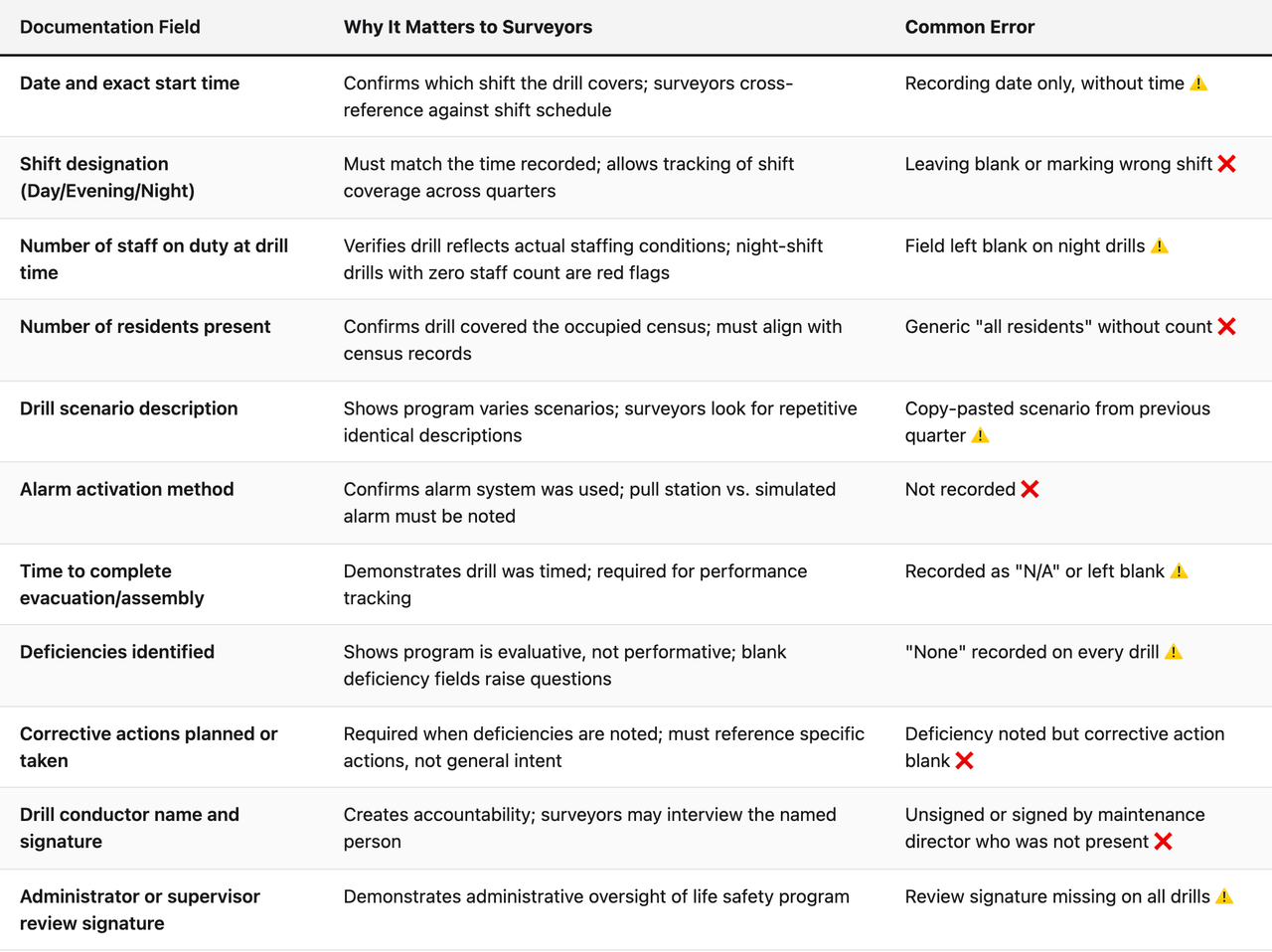
A Note on "No Deficiencies Found"
Every drill log that records "no deficiencies" in every quarter, across every shift, for an entire year, is a documentation red flag. Real fire drills in real facilities with real staffing constraints produce observable deficiencies: a door that was propped, a staff member who did not respond correctly to the alarm, a resident who required additional assistance, a communication breakdown between wings. A program that finds nothing to improve is a program that is not evaluating honestly. Surveyors read twelve consecutive "no deficiencies" logs as evidence that the drills are not being conducted with genuine rigor. Record what actually happened.
Step 4: Execute Night-Shift Drills with Documented Precision
Estimated time: 45–90 minutes per drill execution plus 20 minutes for documentation. Tools needed: Completed drill log form, facility alarm system, department communication protocol.
Night-shift drills require a specific operational approach that balances regulatory compliance with resident safety and staff realities. The NFPA 101 sleeping resident exception is the critical framework here, and applying it correctly is what allows a facility to conduct a fully compliant drill without creating a 3:00 a.m. trauma event for residents.
Pre-Drill Preparation (Night Shift Specific)
At least 48 hours before a scheduled night drill, the following preparations should be complete:
- Notify the charge nurse on duty for that night. The charge nurse needs to assess whether any residents are in a condition that creates heightened risk during a drill (post-procedure patients, residents on new medications, end-of-life care residents). A clinical decision to delay the drill for a specific resident's safety is legitimate and should be documented.
- Confirm the fire alarm company or in-house system technician knows the drill is scheduled. If your facility uses a monitored alarm system, you must notify the monitoring company before activating the alarm for a drill. Failure to do this produces a false alarm dispatch response, which creates its own documentation and liability problems.
- Brief the overnight supervisor on documentation requirements. Provide them with the completed drill log form and walk through every field. The supervisor should not be filling out a form they have never seen at 3:00 a.m.
- Stage the scenario. Unlike a day-shift drill where the scenario can involve simulated smoke in a specific room, a night-shift drill scenario should be designed to test the specific response protocols that are most critical during low-staffing hours: corridor door closure, resident accountability, and the notification chain. Document the scenario in advance so it appears on the log exactly as planned.
Executing the Drill
When the drill begins, the supervisor should note the exact time of alarm activation. Staff should respond as they would to a real fire: closing corridor fire doors, verifying residents are in safe positions (awake and ambulatory residents may be directed to assembly areas; sleeping residents may be simulated as evacuated using the NFPA exception), and initiating the communication protocol with each wing.
The supervisor should be physically moving through the facility, observing staff response, noting any deviations from protocol, and tracking time. Assigning one staff member to shadow the supervisor specifically to take notes during the drill allows the supervisor to focus on observation rather than documentation in real time.
The drill concludes when all staff have reported and all resident locations are accounted for. Record the exact end time. The delta between start time and end time is your drill duration, which should be recorded on the log and tracked across quarters to show program improvement.
Post-Drill Debrief
Conduct a brief structured debrief with all staff who participated before they return to their regular duties. This does not need to be a long meeting. A five-to-ten minute conversation covering what went well, what did not, and what will change is sufficient. The debrief findings become the content for the "deficiencies identified" and "corrective actions planned" fields on the log.
The debrief is also the moment to collect staff signatures if your facility's form requires them. Getting signatures from night-shift staff before they leave is significantly easier than tracking them down the next day.
Step 5: Create a Cross-Quarter Tracking System
Estimated time: 1 hour to set up; 15 minutes per quarter to maintain. Tools needed: Spreadsheet or compliance platform.
Individual drill logs are necessary but not sufficient for survey readiness. A surveyor evaluating your fire drill program does not review logs in isolation. They look at the pattern across the entire year: Are all shifts covered in all quarters? Is the program improving over time? Are deficiencies from one quarter being corrected in the next?
A cross-quarter tracking system translates your individual drill logs into a program-level view that answers these questions at a glance, for you and for the surveyor.
The Fire Drill Program Dashboard
Whether you build this in a spreadsheet or a digital compliance platform, the tracking system should display the following at a facility level:
- Completion status by quarter and shift: A simple grid showing which drill slots have been completed (with date) and which are pending. Any quarter with an open slot that should have been filled is immediately visible.
- Documentation completeness score: For each completed drill, a notation of whether the log is fully completed (all required fields present and signed) or has gaps. A drill that occurred but has an incomplete log should be flagged the same way an incomplete drill would be.
- Deficiency trend: A running list of deficiencies identified across drills, with the corrective action status for each. This shows the program is iterative and responsive.
- Responsible party by drill: Who conducted each drill, verified against the shift schedule to confirm they were actually on duty at that time.
How Platforms Like SEQURA Change the Tracking Equation
The challenge with spreadsheet-based tracking is that it depends on someone remembering to update it. When the maintenance director is managing forty other recurring inspection tasks, the fire drill tracking spreadsheet is the thing that gets updated after the fact, if at all. A digital compliance platform designed for SNF life safety documentation handles this differently: drill completion is logged at the point of execution (via mobile, kiosk, or back-office), the cross-quarter view is generated automatically, and any slot that approaches its quarter deadline without a completed drill triggers an alert before the gap becomes a citation.
The documentation intelligence layer goes further. When a drill log is submitted with incomplete fields, the system flags it before it enters the official record, giving the responsible party the opportunity to correct it while the drill is still fresh in memory. This is the difference between finding documentation gaps before a survey and discovering them during one.
Step 6: Integrate Fire Drill Documentation into the Broader Life Safety Binder
Estimated time: 2–3 hours for initial integration; ongoing maintenance.
Fire drill records do not exist in a vacuum in a CMS survey. Surveyors reviewing life safety compliance examine fire drill logs alongside a constellation of related documentation: fire alarm system inspection reports, sprinkler maintenance records, fire door inspection logs, corridor obstruction records, and emergency response plan documentation. When these records are inconsistent with each other, they create compounding citation risk.
Common Inconsistencies That Produce Citations
The most damaging documentation inconsistency a facility can have is a fire drill log that references the alarm system being activated while the fire alarm inspection report from the same period shows an open deficiency on the alarm panel. Surveyors are specifically trained to cross-reference these records. If the alarm system had an unresolved deficiency during the quarter when a drill was conducted, the surveyor will ask whether the drill was conducted using a functioning system. If the answer is unclear, or if the deficiency was not documented as resolved before the drill, the drill's validity can be questioned.
Other cross-document inconsistencies that produce problems:
- Fire door inspection records showing doors that do not self-close properly, combined with drill logs that note doors were closed during the drill (how were doors that do not self-close being closed?)
- Staffing records showing fewer staff on duty than the number recorded on the drill log
- Emergency response plan identifying a specific assembly point that differs from the assembly point referenced in drill logs
- Contractor maintenance reports noting alarm horn failures that are not reflected in any drill documentation from the same period
The Pre-Survey Documentation Reconciliation Review
Build a quarterly reconciliation review into your program: after each quarter's drills are complete, pull the fire alarm inspection report, the sprinkler maintenance record, and the fire door inspection log from the same period and compare them against the drill documentation. Look for inconsistencies. Resolve and document any discrepancies. This 30-minute review at the end of each quarter is one of the highest-value compliance activities a maintenance director can perform.
Step 7: Prepare Your Documentation for Surveyor Presentation
Estimated time: 1–2 hours per year for organization; 15 minutes per quarter to update.
The moment a surveyor asks for fire drill records is not the moment to begin organizing them. The documentation should be organized, indexed, and ready for presentation at all times. This is a cultural shift for many SNF facilities, where the fire drill binder is treated as a filing system rather than a survey-ready presentation.
Physical Binder Organization (If You Still Use Paper)
If your facility maintains paper records, organize the fire drill binder as follows:
- Tab 1: Annual Schedule. The planned drill schedule for the current year, showing all twelve (or sixteen) drill slots by quarter and shift, with target dates and assigned responsible parties.
- Tab 2: Completed Drill Logs, Current Year. Organized chronologically, with a cover sheet summarizing completion status by quarter and shift. Every log should be fully completed and signed before it is filed here.
- Tab 3: Completed Drill Logs, Prior Year. The same organization for the previous 12 months. CMS surveyors typically request 12 months of records; having two years accessible shows program continuity.
- Tab 4: Deficiency Log and Corrective Action Tracker. A running record of deficiencies identified across drills and the status of corrective actions. This demonstrates program improvement over time.
- Tab 5: Staff Training Records. Documentation that staff who conduct and participate in drills have been trained on fire response procedures. Night-shift supervisors who lead drills should have their training documented here.
Digital Documentation Presentation
If your facility uses a digital compliance platform, the surveyor presentation workflow is fundamentally different. Rather than handing over a binder, you pull up the program dashboard and walk the surveyor through the cross-quarter view: every drill slot, every completion date, every documentation completeness indicator, and every linked log. The AI audit layer that flags incomplete documentation before it enters the record means the surveyor sees only clean, complete records.
This presentation format also allows the surveyor to see, at a glance, that the facility's fire drill program is actively monitored and managed rather than assembled reactively before a survey. That perception matters. Surveyors are trained to distinguish between facilities that maintain continuous compliance and facilities that perform compliance. The documentation architecture is the evidence.
The Fire Drill Program Self-Assessment: A Decision Framework for SNF Operators
Before submitting to a survey, use this decision framework to assess your program's actual compliance posture. Each question represents a dimension surveyors evaluate. A "No" or "Unsure" answer on any question indicates a gap that should be closed before the next unannounced visit.
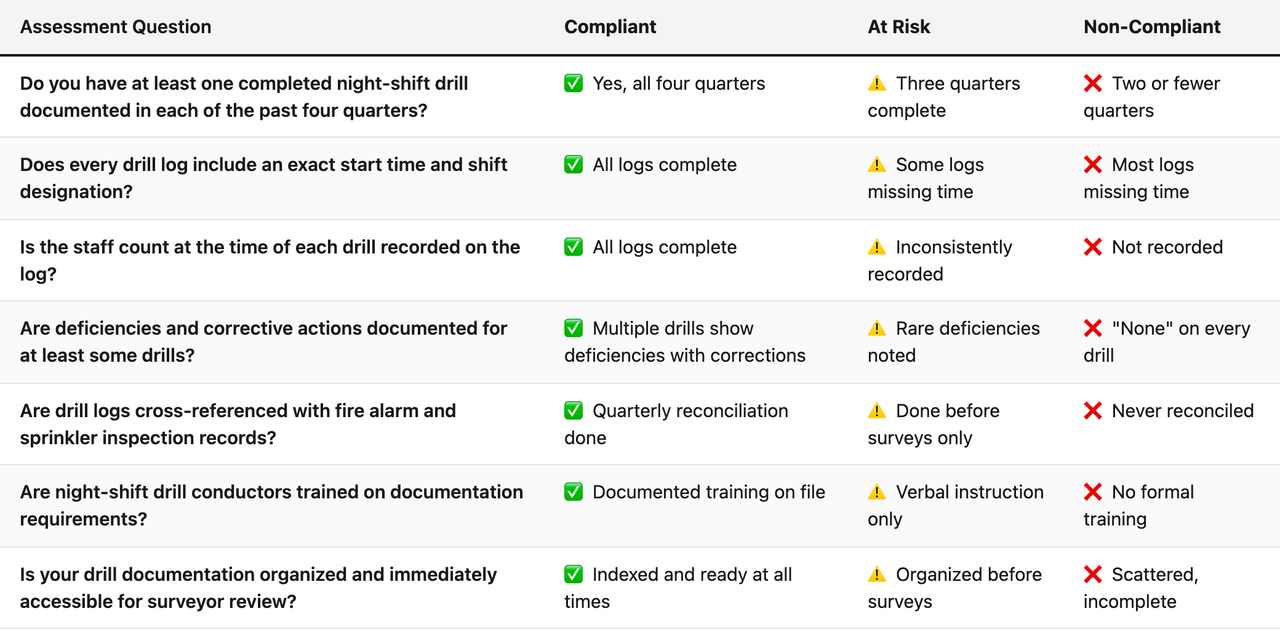
Any row in the "Non-Compliant" column is a citation waiting to happen. Any row in the "At Risk" column should be treated as a priority remediation item before the next survey cycle.
Multi-Site Operators: Scaling the Program Without Losing Control
For regional directors and VP-level operators managing fire drill compliance across multiple SNF locations, the challenge is not understanding what is required. It is knowing, at any given moment, which of your facilities are actually compliant and which have gaps they have not yet disclosed.
The structural problem with multi-site fire drill oversight using paper or facility-level spreadsheets is that the information lives at the facility and travels upward only when someone sends it. That means the regional director's view of compliance is always a lagging indicator: you see the gap after it becomes a finding, not before.
The Portfolio-Level Compliance View
A meaningful portfolio-level fire drill compliance program requires three capabilities:
- Real-time completion visibility: The ability to see, across all facilities, which drill slots for the current quarter have been completed and which are still open, without waiting for facility-level reports.
- Documentation quality signals: Not just whether a drill was logged as complete, but whether the log is fully completed. A facility that logs "drill complete" but submits an unsigned, time-missing log has not actually produced compliant documentation.
- Escalation triggers: Automated alerts when a facility reaches a defined point in the quarter without completing a scheduled drill. For night-shift drills specifically, an alert at week 10 of a quarter gives the regional director time to intervene before the quarter closes.
Platforms built for multi-site SNF compliance deliver this view natively. The facility-level documentation is entered at the facility, but the portfolio-level dashboard is visible to regional leadership without any manual aggregation. This changes the role of the regional director from retrospective auditor to real-time compliance partner, which is a fundamentally different and more effective position to be in when a survey occurs at one of your facilities.
Frequently Asked Questions: SNF Fire Drill Documentation
How many fire drills are required per year in a skilled nursing facility?
Under NFPA 101 Chapter 19, a minimum of one drill per shift per quarter is required. For a three-shift SNF, that is twelve drills per year. The drills must be distributed so that each shift is drilled at least once in each calendar quarter. Twelve drills all conducted during the day shift would not satisfy the requirement.
Can we conduct night-shift drills without waking residents?
Yes. NFPA 101 Section 19.7.1.8 permits facilities to conduct drills during sleeping hours without awakening residents. The drill must still occur, staff must still respond as they would in an actual emergency, and all documentation requirements remain in effect. The exception applies to the physical evacuation of sleeping residents only, not to the drill itself.
What happens if we miss a quarterly drill due to a real emergency or staffing crisis?
Document the reason for the postponement in writing at the time it occurs. Reschedule the drill within the same quarter if at all possible. If the quarter closes without the drill being completed, document the circumstances and consult with your administrator and legal counsel about how to handle the disclosure. A documented, explained gap with a clear corrective response is substantially less damaging than an unexplained gap. Facilities sometimes attempt to backdate drill logs to cover missed drills; this constitutes falsification of records and creates far more serious liability than the original missed drill.
Do CMS surveyors actually check night-shift drill records specifically?
Yes. Night-shift drill records are among the first documents surveyors examine when reviewing fire drill compliance, because night-shift drills are the most commonly missing or incomplete. Surveyors are trained to cross-reference drill timestamps against shift schedules and look specifically for quarterly coverage on all shifts.
What is the K-tag associated with fire drill deficiencies?
Fire drill deficiencies in SNFs are typically cited under K712, which corresponds to the emergency preparedness and fire drill requirements under NFPA 101. Depending on the nature of the deficiency, related citations may also appear under K-tags associated with fire alarm systems, staff training, and emergency plan implementation. A fire drill documentation gap that reveals a broader pattern of life safety non-compliance can trigger a scope-and-severity escalation that extends well beyond the drill records themselves.
Can a maintenance director who was not present sign the night-shift drill log?
No. The drill log should be signed by the person who actually conducted and observed the drill. If the maintenance director reviews and countersigns the log as part of an administrative oversight process, that is appropriate and encouraged, but the primary signature must belong to the person who was present. A log signed by someone who was not at the drill is a falsification risk and is inconsistent with the documentation it represents.
How far back do surveyors typically request fire drill records?
CMS surveyors typically request the most recent 12 months of fire drill records. Some surveyors request 18 months, particularly if they are reviewing a facility with a prior history of life safety citations. Maintaining organized, complete records for the most recent 24 months is a conservative and defensible practice.
What should we do if we discover a documentation gap right before a survey?
Do not falsify or backdate records. If a gap exists, document the gap honestly, including the circumstances and the corrective steps the facility is taking. Surveyors are often more concerned with a facility's response to a compliance gap than with the gap itself. A facility that acknowledges a missed drill, documents the reason, and has already rescheduled it is in a fundamentally better position than a facility that presents fabricated records. Contact your administrator and legal counsel before a survey if you have known documentation deficiencies.
Does rotating the fire drill scenario each quarter actually matter?
Yes. NFPA 101 and CMS guidance contemplate that fire drills test staff preparedness across varying conditions. Twelve identical drill scenarios across a year suggest the program is formulaic rather than genuinely preparedness-focused. Surveyors notice when every drill log uses identical language. Varying the scenario (different simulated fire origin, different time of shift, different resident census conditions) also produces more useful performance data for your internal improvement process.
Is there a requirement to notify the fire department before conducting a drill?
Requirements vary by jurisdiction. Many state and local fire codes require facilities to notify the local fire department before conducting a drill, particularly if the fire alarm system will be activated and is connected to a monitoring service. Check your state fire code and your alarm monitoring contract. Failure to notify the monitoring company before activating the alarm for a drill can result in a dispatched fire department response, which creates its own operational and documentation issues.
What role should the Director of Nursing play in fire drill compliance?
The Director of Nursing (DON) has a significant stake in fire drill compliance because nursing staff are the primary responders during a drill, and resident safety during a drill is a clinical responsibility as much as an operational one. The DON should be involved in reviewing drill results, particularly deficiencies related to resident management, and should ensure that nursing staff training on fire response is current. Fire drill compliance gaps that involve nursing staff response failures can produce citations that span both the life safety and nursing care domains of a survey.
How do we handle fire drills during a respiratory illness outbreak or isolation protocol?
This is a situation that requires coordination between the infection control program, the administrator, and the life safety program. A drill that would require moving isolation residents through common corridors creates an infection control risk that must be weighed against the regulatory drill requirement. Document the outbreak conditions, the clinical decision made, and the alternative measures taken (such as conducting a tabletop drill for affected units while the physical drill proceeds for unaffected units). Consult with your state health department about guidance for maintaining drill compliance during infection control events.
Key Takeaways: Building a Fire Drill Program That Holds Up Under Scrutiny
- Night-shift drills are the highest-risk gap in most SNF fire drill programs. Every quarter must include a documented, fully completed drill for the night shift. Missing even one quarter creates a citable deficiency.
- Documentation completeness is as important as drill occurrence. A drill that happened but is missing required fields produces the same citation risk as a drill that did not happen. Every log must include exact time, shift designation, staff count, scenario description, deficiencies, and signatures.
- Build your annual schedule before the year begins. Assign drill slots to specific months and responsible parties at the start of each calendar year. Night-shift drills should be the first slots filled, not the last.
- The NFPA 101 sleeping resident exception does not eliminate the drill. It permits simulation of resident evacuation. Every other element of the drill, including documentation, must be fully executed.
- Cross-reference your fire drill logs against alarm and sprinkler inspection records quarterly. Documentation inconsistencies across life safety records compound citation risk significantly.
- Record honest deficiencies. A program that finds nothing to improve in twelve drills across four quarters is not credible to a surveyor. Document what actually happened and show corrective action.
- Organize documentation for instant surveyor access. A survey is not the time to assemble your binder. Fire drill records should be indexed, complete, and retrievable at any moment.
- For multi-site operators, real-time visibility into facility-level compliance is the difference between managing compliance and reacting to citations. Digital platforms that surface documentation gaps before surveys close the information lag that makes multi-site oversight structurally difficult.
The 2:47 a.m. drill that opens this guide was not the problem. The problem was everything that surrounded it: the form that was missing two fields, the absence of a cross-quarter tracking system that would have flagged the gap weeks earlier, and the binder that was organized for storage rather than for presentation. The program this guide describes is the architecture that makes that scenario impossible, because the gaps are found and closed before the surveyor arrives, not after.
About the author
Benjamin Terebelo · Founder
Benjamin is the founder of SEQURA, a compliance platform purpose-built for healthcare facilities. He builds at the intersection of healthcare operations and software, maintaining a focus on bringing modern tooling to systems that the broader industry has largely left behind.
About the author
Benjamin Terebelo · Founder
Benjamin is the founder of SEQURA, a compliance platform purpose-built for healthcare facilities. He builds at the intersection of healthcare operations and software, maintaining a focus on bringing modern tooling to systems that the broader industry has largely left behind.