
What Is Predictive Auditing for Documentation? The SNF Compliance Concept Explained

Most skilled nursing facility maintenance directors believe they are compliant. They have binders. They have logs. They have inspection records from licensed contractors and completed fire drill forms signed by the shift supervisor. What they do not have, and what a CMS surveyor absolutely will find, is proof that those records are complete, internally consistent, and free of the documentation gaps that generate K-tag citations. The binder looks right. The audit says otherwise.
This is the problem that predictive auditing for documentation is designed to solve, and it represents a fundamentally different way of thinking about SNF compliance documentation. Instead of waiting for a surveyor to find what is missing, predictive auditing finds it first. Instead of reacting to citations, it eliminates the conditions that produce them. And instead of relying on a maintenance director's memory or a spreadsheet's conditional formatting, it uses AI to read your documentation the same way a well-trained surveyor reads it: looking for what should be there and is not.
This article explains what predictive auditing means in the context of life safety compliance, why it is distinct from both traditional documentation management and predictive maintenance, how it maps to the specific K-tag categories that drive the most SNF citations, and what it looks like in practice for the people who actually do the work inside a facility.
The Compliance Gap That Binders Cannot Close
The paper life safety binder is not a documentation failure. It is a documentation confidence failure. The binder exists because the documentation requirement is real, the work is real, and someone did it. The problem is that a binder cannot audit itself. It cannot tell you that the generator test from last month recorded run-time but not kilowatt load. It cannot flag that the fire drill log for the second quarter has three day-shift drills and zero night-shift drills. It cannot cross-reference a contractor's sprinkler inspection report against the facility's open deficiency list and notice that one of the listed items was never formally closed out.
These are not hypothetical gaps. They are the exact documentation patterns that appear in CMS survey citations at SNFs across the country. The CMS nursing facility health and safety standards require not just that inspections happen, but that they are documented in a specific way, at a specific cadence, with specific elements recorded. A generator test that happened is not the same as a generator test that was documented correctly. A fire drill that was conducted is not the same as a fire drill that satisfies the NFPA 101 requirement for coverage across all shifts.
The binder-based approach to compliance has one structural weakness: it is only as complete as the person who assembled it, and it is only audited when a surveyor arrives. At that point, the gap has already become a potential citation. The window to close it has closed.
Why Digitizing the Binder Is Not Enough
A number of software tools in the healthcare maintenance space have offered to solve this by taking the binder digital. Task management platforms, work order systems, and CMMS (computerized maintenance management systems) tools can schedule inspections, assign them to staff, and log completions electronically. This is a genuine improvement over paper. But it does not close the compliance confidence gap, because the fundamental problem is not that the records are on paper. The fundamental problem is that the records are not being audited against regulatory expectations in real time.
A digital task list that records "fire drill completed" is no more compliant than a paper log that says the same thing, if neither one checks whether the drill was conducted at the right time of day, whether the documentation captures all required elements, or whether the facility's quarterly drill schedule is on track to satisfy the annual distribution requirement. The format changed. The gap did not.
Predictive auditing is the layer that sits above digitization and asks the regulatory question: does this documentation actually satisfy the standard? It does not just confirm that something was logged. It reads what was logged and determines whether it would survive surveyor scrutiny.
What Predictive Auditing Actually Means
Predictive auditing, as applied to SNF compliance documentation, is the continuous, automated review of documentation records against regulatory expectations, designed to surface compliance gaps before they are observed by an external reviewer. The word "predictive" does not refer to forecasting equipment failures. It refers to forecasting citation risk based on what is present, what is absent, and what is internally inconsistent in the documentation record.
The concept borrows its logic from how experienced life safety consultants work when they do pre-survey mock audits. A skilled consultant does not just check whether a box was ticked. They read the record the way a surveyor reads it: looking for the shift-time distribution on fire drills, checking whether the load bank test result matches the generator's rated capacity, verifying that sprinkler inspection reports are signed by a licensed contractor and that any listed deficiencies have a documented corrective action. They are not auditing activity. They are auditing documentation quality and regulatory completeness.
Predictive auditing automates that logic. Instead of hiring a consultant to do a mock audit twice a year, the AI layer runs that same review continuously, on every completed record, and flags gaps as they appear rather than after they accumulate.
The Three Signals Predictive Auditing Looks For
In the context of life safety and CMS survey readiness, predictive auditing surfaces three categories of documentation risk:
- Absence signals: Required records that do not exist. A monthly fire extinguisher inspection that was not completed and not logged. A quarterly generator test that is missing from the log entirely. A fire drill that should have occurred in the current quarter but has not been conducted. These are the most straightforward gaps and the easiest for a surveyor to find.
- Incompleteness signals: Records that exist but are missing required elements. A generator test log that records run-time but omits the kilowatt load reading. A fire drill report that does not document the time of day or the number of staff participants. An eyewash station inspection that was logged as "completed" without a functional test notation. These gaps are harder to catch because the record looks like it is there.
- Inconsistency signals: Records that conflict with each other or with the regulatory pattern. A sprinkler inspection report that lists three deficiencies, but no corrective action documentation exists for any of them. A fire drill schedule that shows four drills in one quarter and none in another, violating the distribution requirement. A contractor report that references a piece of equipment by an asset ID that does not match the facility's internal records. These are the gaps that experienced surveyors specifically look for because they reveal systemic documentation failures, not just missed tasks.
The power of AI maintenance management applied to documentation is that it can process these signals across hundreds of records simultaneously, flag them in priority order, and present them to the maintenance director as a work list rather than a discovery during a survey.
How This Maps to K-Tag Citations in SNFs
K-tags are the CMS Life Safety Code survey tags assigned when a nursing facility fails to meet a specific requirement under NFPA 101 or its related standards. They are the primary mechanism by which life safety documentation failures become regulatory findings. Understanding which K-tags generate the most citations, and why, is essential to understanding what predictive auditing needs to look for.
The K-tag categories that consistently appear at the top of SNF citation data are not about dramatic equipment failures. They are about documentation. The most commonly cited K-tags in the life safety survey domain involve:
Fire Drill Documentation (K712, K711)
NFPA 101 requires that fire drills be conducted at least quarterly on each shift. The documentation requirement is specific: the time of day, the shift, the number of staff involved, and the scenario or activation method must be recorded. The most common citation pattern is not that drills were not conducted. It is that the documentation does not demonstrate the required shift distribution across four quarters, or that the drill records are missing elements that would allow a surveyor to confirm the drill met the standard.
Predictive auditing catches this by tracking the shift-time pattern of completed drills against the annual distribution requirement in real time. If three of four quarterly drills have been conducted on the day shift, the system flags the pattern before the fourth quarter drill is scheduled, giving the maintenance director time to correct the distribution rather than discovering the problem when a surveyor pulls the binder.
Generator Testing Documentation (K918, K916)
Emergency generator testing requirements under NFPA 110 are among the most technically specific in the life safety survey. Monthly tests must run for a minimum duration, and the documentation must record specific data points including voltage, frequency, and kilowatt load. Annual load bank tests have their own documentation requirements. The gap between "we ran the generator" and "we have documentation that satisfies K918" is significant, and it is almost entirely a documentation quality problem, not an equipment problem.
Missing kilowatt readings are one of the most common incompleteness signals in generator test logs. They are also one of the most predictable. Predictive auditing that reads completed generator test records and flags missing required data fields surfaces this gap at the moment of logging, not at the moment of survey.
Sprinkler System Documentation (K351, K353)
Annual sprinkler inspections conducted by licensed contractors generate reports that list any deficiencies found. CMS survey protocol requires not only that the inspection occurred and is documented, but that any listed deficiencies have a documented corrective action plan and, where applicable, proof of correction. The gap between a contractor report that lists deficiencies and the facility's documentation of what was done about them is a consistent citation source.
Predictive auditing cross-references contractor-submitted inspection reports against the facility's corrective action log. If a deficiency appears in a contractor report but no corrective action record exists, the system flags it as an open inconsistency signal. The maintenance director sees it as a task: close out the deficiency documentation before the next survey window.
Smoking Policies, Corridor Compliance, and Ongoing Documentation
Beyond the major equipment-related K-tags, a large volume of SNF life safety citations involve ongoing environmental compliance documentation: corridor width and clearance records, smoking policy enforcement logs, door hardware inspection records, and similar recurring tasks. These are often managed through paper checklists that are completed but not reviewed for completeness or pattern. Predictive auditing brings the same logic to these records: is the required element present, is it complete, and does it match the regulatory expectation?
Why This Is Different From Predictive Maintenance
The term "predictive" in technology contexts most commonly refers to predictive maintenance: using sensor data, usage patterns, and machine learning to forecast when a piece of equipment is likely to fail, so that maintenance can be scheduled proactively rather than reactively. Predictive maintenance is a valuable concept in industrial and healthcare facility management. It is not what predictive auditing for documentation does.
The distinction matters because the two approaches solve different problems for different audiences. Predictive maintenance is primarily an operational and capital planning tool. It answers the question: when will this piece of equipment need service or replacement? Predictive auditing for documentation is a regulatory and compliance tool. It answers the question: does our documentation of this equipment's service record satisfy the standard that a CMS surveyor will apply?
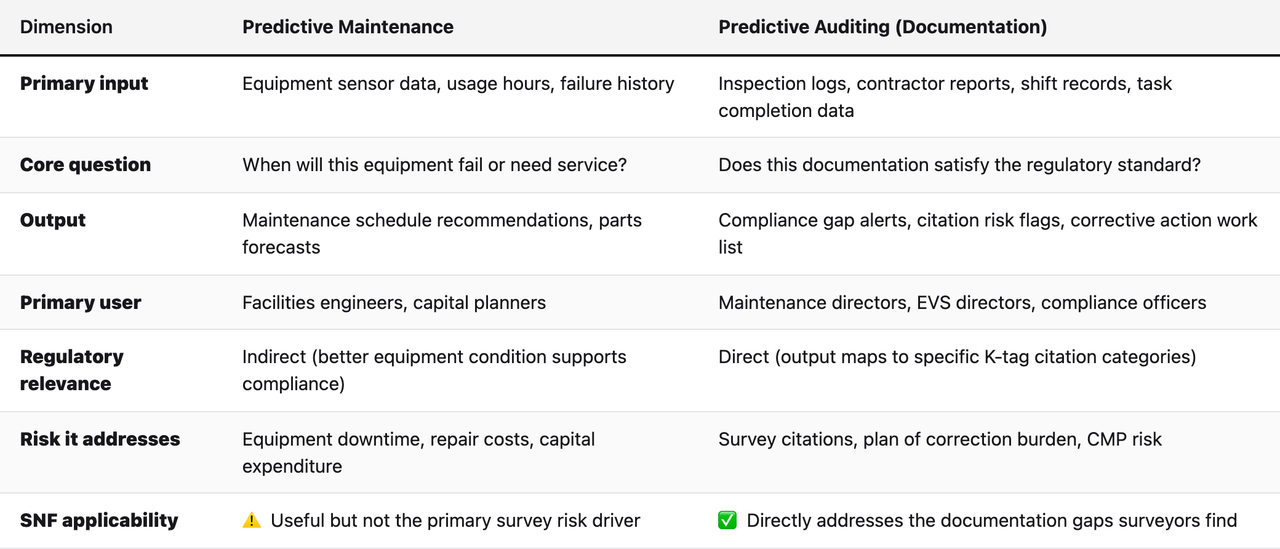
For an SNF administrator or maintenance director, this distinction is operationally critical. The equipment in most skilled nursing facilities is not the primary life safety survey risk. The documentation of that equipment's inspection, testing, and maintenance history is the risk. A generator that runs perfectly but has an incomplete test log is a K-tag. A fire suppression system that is fully functional but has an unresolved contractor-listed deficiency in the paperwork is a K-tag. The gap is in the record, not in the machine.
AI maintenance management in the context of SNF compliance therefore means applying AI to the management of the compliance record itself, not to the management of the physical equipment. The AI reads documentation. It understands regulatory requirements. It identifies where the record falls short of those requirements. That is the predictive auditing function.
The Operational Reality: Who Does This Work and How
One of the most consistent disconnects in SNF compliance discussions is the gap between how compliance is described at the administrative level and how it is actually executed at the facility level. At the administrative level, compliance is a policy, a checklist, a binder, a consultant engagement. At the facility level, it is a maintenance director managing a team of two or three people across a building that has hundreds of compliance-relevant assets, while also handling work orders, resident requests, contractor coordination, and the daily operational demands of a 24-hour care environment.
Any system that aims to improve CMS survey readiness has to work for the person doing the documentation, not just the person reviewing it. This is where most compliance technology solutions fall short. They are designed from the auditor's perspective: they produce dashboards and reports that look good to an administrator. They are not designed from the maintenance director's perspective: they do not make the work of capturing complete, correct documentation faster or easier at the point of task completion.
The Kiosk Model and Contemporaneous Logging
The single most important documentation quality principle in CMS survey preparation is contemporaneous logging. Documentation that is created at the time of the inspection or test is materially more defensible than documentation that is reconstructed afterward. Surveyors are trained to look for signs of reconstructed records: entries that are too uniform, timestamps that cluster suspiciously, handwriting that changes mid-log, or digital entries that were all created on the same day.
For a maintenance team working in a large SNF, contemporaneous logging requires that the documentation tool be available at the point of work. That is why a facility kiosk model matters. A maintenance technician who completes a monthly fire extinguisher check can log it immediately at the nearest kiosk, with the required data fields prompted by the system, before moving to the next task. The log is created at the time of the work, with the required elements captured, and the record is immediately available for the AI review layer to evaluate.
This is the operational design that makes predictive auditing possible. If documentation is captured contemporaneously, with required fields prompted by a system that understands the regulatory standard, the AI layer has complete, timely records to audit. If documentation is captured on paper and entered later, or captured in a generic task management system that does not know the difference between a generator test and a housekeeping check, the AI layer has nothing useful to work with.
Task Templates Built on Regulatory Logic
The task template library is the regulatory intelligence layer that sits at the foundation of any effective predictive auditing system for SNF compliance. A template that simply schedules a "generator test" monthly is not a compliance tool. A template that schedules a generator test monthly, prompts for the specific data fields required by NFPA 110 (voltage, frequency, kilowatt load, run duration, transfer time), and flags the record as incomplete if any required field is missing is a compliance tool.
The difference between these two approaches is the difference between a system that helps people do work and a system that helps people do work that satisfies the standard. For SNF life safety compliance, those are not the same thing. The regulatory requirements for life safety documentation are specific, technical, and numerous. They are also not static: state survey agencies can add requirements on top of federal NFPA 101 and NFPA 99 baselines, and those requirements vary by state.
A task template library that is built with life safety consultants, vetted against current NFPA editions adopted by CMS, and updated to reflect state-specific overlays is a significant operational asset. It means the maintenance director does not need to be a life safety code expert to capture documentation that satisfies the code. The intelligence is in the template. The predictive auditing layer then verifies that the template was followed correctly.
What the AI Review Layer Actually Does
The phrase "AI review" is used broadly enough in technology marketing that it has lost most of its meaning. In the context of predictive auditing for SNF compliance documentation, it is worth being specific about what the AI layer does and what it does not do.
The AI review system reads completed inspection records, contractor-submitted reports, and shift logs. It cross-references those records against the regulatory expectations encoded in the task template library and in the underlying NFPA and CMS standards. It identifies three categories of problems: records that are absent, records that are incomplete, and records that are internally inconsistent with other records or with the regulatory pattern.
What the AI layer does not do is replace the maintenance director's judgment. It does not make decisions about corrective actions. It does not file paperwork. It does not interface with CMS directly. It is an analytical layer that surfaces information the maintenance director needs to act on. The value is in the surfacing: bringing a documentation gap to the maintenance director's attention the week it appears, not the day a surveyor arrives.
Reading Contractor Reports
One of the most underappreciated documentation risks in SNF life safety compliance is the contractor report problem. Licensed contractors conduct many of the required annual inspections: sprinkler systems, fire alarm systems, kitchen suppression systems, generator load bank tests. These contractors produce inspection reports that become part of the facility's compliance documentation. But the facility does not always have a systematic process for reviewing those reports against the facility's own records, or for ensuring that any deficiencies listed in the contractor report are tracked to resolution.
A contractor report that lists a deficiency and a facility that has no corrective action documentation is a K-tag waiting to be written. The contractor did their job. The facility received the report. But the documentation bridge between "deficiency identified" and "deficiency resolved" does not exist in the compliance record. A surveyor who reviews the contractor report and then asks for the corrective action documentation will find nothing.
Predictive auditing that ingests contractor reports and cross-references them against the facility's corrective action log closes this gap. The AI reads the contractor report, identifies any listed deficiencies, checks whether a corresponding corrective action record exists in the system, and flags any unresolved items as open inconsistency signals. The maintenance director sees these as a prioritized work list rather than discovering them during a survey.
Pattern Recognition Across the Documentation Record
Beyond individual record review, the AI layer adds value through pattern recognition across the full documentation record. This is where predictive auditing goes beyond what even a careful human reviewer can do efficiently at scale.
Consider the fire drill distribution requirement. NFPA 101 requires drills on each shift at least once per quarter. Over a 12-month period, that means a facility needs documentation demonstrating that all shifts were covered across all four quarters. A human reviewer checking this at survey time looks at a stack of drill records and tries to construct the distribution pattern manually. An AI layer that has been reading drill records throughout the year knows the current distribution at any point in time and flags the pattern before it becomes a problem.
The same logic applies to any requirement with a temporal or distributional component. Which assets have not had their required inspection within the required interval? Which recurring tasks are approaching their deadline with no completion logged? Which inspection categories have had consistent completion but are missing a specific data element across multiple records? These are the questions that predictive auditing answers continuously, without requiring a human to construct the analysis from scratch each time.
The Survey Readiness Posture Shift
The most significant operational benefit of predictive auditing for SNF compliance is not any individual gap it closes. It is the structural shift in the facility's posture toward CMS survey readiness. Facilities that rely on reactive compliance processes spend significant administrative energy preparing for surveys after they are announced or after citations are received. Facilities that have predictive auditing in place maintain a state of continuous survey readiness, because the process that prepares them for a survey is the same process they run every day.
This distinction has real operational consequences. An unannounced CMS survey at a facility that has been operating in reactive compliance mode creates a period of intense administrative activity: pulling records, reconstructing logs, identifying gaps, attempting to close them before the surveyor reaches that section of the binder. In some cases, the gaps cannot be closed in time. In other cases, the reconstruction effort itself creates compliance risk (a log that was assembled after the fact is not the same as a contemporaneous record).
An unannounced CMS survey at a facility operating with predictive auditing in place is, by design, not a different state from any other day. The records are current. The gaps have been flagged and addressed as they appeared. The AI review layer has been running the same analysis that the surveyor will run, continuously, and the maintenance director has been closing the gaps the system identified. The binder is not assembled for the survey. It is maintained for compliance, and the survey is simply the occasion when an external reviewer looks at what is already there.
The Plan of Correction Burden
For SNF administrators who have been through a life safety survey with citations, the plan of correction process is a significant operational burden. Each cited K-tag requires a written plan of correction that identifies the systemic cause, the corrective action taken, the person responsible, and the monitoring mechanism to prevent recurrence. Developing, submitting, and implementing plans of correction for multiple K-tags consumes substantial administrative time and creates ongoing monitoring obligations.
From a pure operational efficiency standpoint, the cost of preventing a K-tag citation through proactive documentation management is a fraction of the cost of responding to one through the plan of correction process. Predictive auditing is, in operational terms, a substitution of low-cost proactive review for high-cost reactive remediation. The AI layer runs continuously at a fixed operational cost. The plan of correction process runs episodically at a variable and often significant cost in staff time, consultant fees, and administrative disruption.
Implementation Considerations for SNF Operators
Implementing a predictive auditing system for life safety documentation in an SNF environment involves decisions at three levels: the facility level, the operational workflow level, and the data integration level. Understanding these considerations helps administrators and maintenance directors evaluate what a transition from paper-based or basic digital documentation to a predictive auditing platform actually involves.
Facility-Level Configuration
Every SNF has a unique asset inventory: a specific set of fire suppression zones, a specific generator configuration, a specific fire alarm panel, specific egress paths, and specific construction features that determine which NFPA 101 provisions apply. A predictive auditing system must be configured to the facility's actual asset inventory to produce meaningful compliance gap analysis. A generic template that schedules sprinkler inspections without knowing how many zones the facility has, or generator tests without knowing the unit's rated capacity, cannot flag the right gaps.
The initial configuration of a facility-specific task template library is therefore a critical implementation step. For facilities working with a platform like SEQURA, this configuration draws on a vetted template library that life safety consultants have built against current NFPA editions and CMS survey protocols, then customizes it to the facility's specific assets and state-specific overlays. This is not a trivial process, but it is a one-time investment that pays recurring dividends every time the AI layer reviews a completed record against facility-specific expectations.
Workflow Integration for Maintenance and EVS Teams
The people who capture the documentation that the AI layer reviews are maintenance directors, maintenance technicians, and EVS staff. They are not compliance specialists. The system they use to log inspections and tasks needs to be fast, intuitive, and available at the point of work. A system that requires a maintenance technician to log into a web portal on a desktop computer to record a fire extinguisher check will produce documentation that is captured later, away from the point of work, and therefore less contemporaneous and less defensible.
The shared-kiosk model addresses this for facilities where individual mobile devices are not practical for all staff. A kiosk mounted near the maintenance shop or in a central operational area gives every team member a consistent, accessible point of documentation entry. The system prompts for the required data fields for each task type, so the technician does not need to remember what a compliant generator test log looks like. The required fields are presented; the technician fills them in; the record is logged contemporaneously.
Multi-Site Operator Considerations
For regional directors, VPs of operations, and COOs managing multiple SNF locations, predictive auditing adds a portfolio-level visibility function that paper-based compliance systems cannot provide. A regional director overseeing ten facilities cannot maintain real-time awareness of the documentation compliance posture at each location through binder reviews. They learn about gaps when a survey produces citations, which is the worst possible time to learn about them.
A predictive auditing platform that aggregates compliance gap data across multiple facilities gives regional leadership a real-time view of which locations have open documentation risks, which K-tag categories are generating the most flags across the portfolio, and where to focus proactive attention before the next survey cycle. This is a qualitatively different form of oversight than the periodic site visit or the after-the-fact citation review, and it directly addresses the survey preparation burden that scales poorly as the number of managed facilities grows.
Frequently Asked Questions
What exactly does "predictive auditing" mean in the SNF compliance context?
Predictive auditing for SNF compliance documentation means using an AI-powered review system to continuously analyze completed inspection records, contractor reports, and task logs against regulatory expectations, surfacing documentation gaps before a CMS or state surveyor finds them. It is not about predicting equipment failures. It is about predicting citation risk based on what is present, incomplete, or inconsistent in the documentation record.
How is predictive auditing different from a CMMS or work order system?
A CMMS or work order system records that work was done. Predictive auditing evaluates whether the documentation of that work satisfies the specific regulatory standard that applies to it. A work order system that logs "generator test completed" does not check whether the voltage, frequency, and kilowatt load readings required by NFPA 110 were recorded. Predictive auditing does. The difference is between tracking activity and auditing compliance quality.
Which K-tags generate the most life safety citations in SNFs?
The K-tag categories that consistently appear at the top of SNF life safety citation data involve fire drill documentation (K711, K712), emergency generator testing (K916, K918), and fire suppression system documentation (K351, K353). These citations are predominantly documentation failures, not equipment failures. The inspections occurred; the documentation did not satisfy the specific elements the standard requires.
What does the AI layer in a predictive auditing system actually do?
The AI review layer reads completed inspection records, contractor-submitted reports, and shift logs. It cross-references those records against the regulatory expectations for each asset and K-tag category, then identifies three types of gaps: absent records (required documentation that does not exist), incomplete records (records that are missing required data elements), and inconsistent records (records that conflict with each other or with the regulatory pattern). It presents these gaps as a prioritized work list for the maintenance director to act on.
Is predictive auditing the same as predictive maintenance?
No. Predictive maintenance uses sensor and usage data to forecast when equipment will need service or is likely to fail. Predictive auditing for documentation uses AI to review compliance records and forecast citation risk based on documentation gaps. They address different problems for different audiences. In an SNF context, the primary life safety survey risk is documentation quality, not equipment condition.
How does contemporaneous logging affect survey outcomes?
CMS surveyors are trained to evaluate whether records were created at the time of the inspection or test, or reconstructed afterward. Contemporaneous records are more defensible and more credible. Documentation systems that prompt staff to log inspections at the point of work, with required data fields presented by the system, produce records that are both more complete and more contemporaneous than paper logs entered later or generic digital systems without regulatory prompting.
What happens to contractor inspection reports under a predictive auditing approach?
Contractor inspection reports for annual fire suppression, fire alarm, and generator inspections become part of the compliance record that the AI layer reviews. The system ingests these reports, identifies any listed deficiencies, and cross-references them against the facility's corrective action documentation. Any deficiency that appears in a contractor report without a corresponding corrective action record is flagged as an open inconsistency signal, giving the maintenance director time to close it before a surveyor reviews the same documents.
How does predictive auditing help multi-site SNF operators?
For regional directors and VPs of operations managing multiple facilities, a predictive auditing platform aggregates compliance gap data across the entire portfolio, providing real-time visibility into which locations carry the highest documentation risk and which K-tag categories are generating the most flags. This replaces the reactive model of learning about compliance gaps at survey time with a proactive model of continuous portfolio-level monitoring.
Does predictive auditing require specialized staff to operate?
No. The system is designed to be operated by the people who already do the documentation work: maintenance directors, technicians, and EVS staff. The regulatory intelligence is built into the task template library and the AI review layer. Staff members do not need to be life safety code experts to capture compliant documentation. The system prompts for required elements and flags gaps automatically. The maintenance director reviews flagged items and takes corrective action.
How long does it take to implement a predictive auditing system in an SNF?
Implementation timeline varies based on facility complexity and the number of assets requiring configuration. The initial setup involves mapping the facility's asset inventory, configuring the task template library to the facility's specific equipment and state-specific regulatory overlays, and onboarding staff to the documentation workflow. For a single facility, this process typically spans several weeks. Multi-site implementations are staged by location. The regulatory intelligence embedded in a vetted template library significantly reduces the time required for initial configuration compared to building a compliance system from scratch.
What is the relationship between predictive auditing and a facility's plan of correction history?
A facility's plan of correction history from prior surveys is a roadmap of its highest-risk K-tag categories. Predictive auditing can be configured to apply additional review depth to the specific documentation types that generated prior citations, effectively operationalizing the corrective action commitments made in the plan of correction. This turns a plan of correction from a one-time response document into an ongoing monitoring framework.
Does predictive auditing replace the need for life safety consultants?
No. Life safety consultants bring expertise in interpreting ambiguous regulatory requirements, navigating state agency relationships, preparing for specific survey scenarios, and advising on construction and renovation compliance. Predictive auditing automates the routine documentation review function that consultants perform during periodic mock audits. The two are complementary: a facility that uses predictive auditing to maintain continuous documentation compliance gets more value from periodic consultant engagements because those engagements can focus on higher-level strategic questions rather than catching up on documentation gaps.
Key Takeaways
- Predictive auditing for documentation is not predictive maintenance. It applies AI to the compliance record itself, identifying documentation gaps that produce K-tag citations before a surveyor finds them. The risk it addresses is documentation quality, not equipment condition.
- The three signals predictive auditing looks for are absence, incompleteness, and inconsistency. All three produce K-tag citations. All three are typically invisible to the person doing the documentation. All three are systematically detectable by an AI layer that reads records against regulatory expectations.
- The most commonly cited life safety K-tags in SNFs are documentation failures, not equipment failures. Fire drill records missing shift distribution, generator test logs without required data fields, and contractor reports with unresolved deficiencies are the patterns that generate citations. Predictive auditing targets these patterns directly.
- Contemporaneous logging is the operational foundation of defensible compliance documentation. Systems that prompt staff for required data elements at the point of work, via kiosk or mobile device, produce records that are more complete, more accurate, and more credible to surveyors than records entered later or reconstructed from memory.
- The survey readiness posture shift is the most significant operational benefit. Facilities that implement predictive auditing maintain continuous survey readiness as a function of their daily operations, rather than preparing for surveys reactively after they are announced or after citations are received.
- Multi-site operators gain portfolio-level visibility that paper-based systems cannot provide. Aggregated compliance gap data across facilities allows regional leadership to identify and address the highest-risk locations proactively, before survey outcomes force the issue.
- Predictive auditing and life safety consultants are complementary, not competitive. Automating routine documentation review frees consultant engagements for higher-level strategic work, and provides consultants with a richer, more current data set to work from.
Putting Predictive Auditing to Work in Your Facility
The gap between a binder that looks right and documentation that survives a CMS life safety survey is almost never about the work that was done. It is almost always about how that work was documented, whether the documentation captures every required element, and whether the full record is internally consistent in the way a trained surveyor expects. Predictive auditing closes that gap by applying the same analytical logic a skilled auditor uses, continuously, to every record your facility produces.
For SNF maintenance directors, the practical question is not whether this kind of continuous documentation review is valuable. Every maintenance director who has been through a survey with citations knows it is. The question is whether it can be operationalized in a way that works for the people doing the work, without adding administrative burden to teams that are already stretched thin. The answer is that it can, if the system is designed from the ground up for the facility environment: task templates built on regulatory logic, documentation capture at the point of work, and AI review that surfaces gaps as a prioritized action list rather than a compliance report that requires interpretation.
The facilities that will have the strongest life safety survey outcomes over the coming survey cycles are not necessarily the ones with the newest equipment or the largest maintenance teams. They are the ones that have built a documentation system that finds what is missing before a surveyor does, and closes it before it becomes a citation. That is what predictive auditing for SNF compliance documentation makes possible.
About the author
Benjamin Terebelo · Founder
Benjamin is the founder of SEQURA, a compliance platform purpose-built for healthcare facilities. He builds at the intersection of healthcare operations and software, maintaining a focus on bringing modern tooling to systems that the broader industry has largely left behind.
About the author
Benjamin Terebelo · Founder
Benjamin is the founder of SEQURA, a compliance platform purpose-built for healthcare facilities. He builds at the intersection of healthcare operations and software, maintaining a focus on bringing modern tooling to systems that the broader industry has largely left behind.