
Purpose-Built SNF Compliance Platform vs. Configurable CMMS: A Feature-by-Feature Breakdown for Buyers

Most software buying decisions in healthcare facilities management come down to a familiar trade-off: a purpose-built tool that does exactly what you need, or a configurable platform that promises it can become what you need with enough setup. For skilled nursing facility operators weighing a SNF compliance platform comparison, that trade-off has real regulatory stakes. A misconfigured CMMS that misses a generator test cadence or fails to flag an unreconciled sprinkler deficiency does not just create operational friction, it creates a K-tag citation, a potential condition-level deficiency, and the kind of CMS enforcement action that follows a facility for years.
This article breaks down the functional differences between purpose-built SNF life safety compliance platforms and configurable CMMS tools marketed to healthcare facilities. It is written for the administrator who has been told a general-purpose CMMS can handle compliance, the maintenance director comparing products ahead of a contract renewal, and the regional facilities manager trying to standardize documentation across a portfolio. The comparison is feature-by-feature, structured around the actual inspection categories CMS surveyors and state agencies review, not the feature checklists vendors publish on their marketing pages.
Why the CMMS Category Was Not Built for SNF Compliance
Configurable CMMS software was designed primarily for manufacturing, commercial real estate, and industrial maintenance environments. Its core function is work order management: logging a maintenance request, assigning a technician, tracking completion, and capturing parts and labor costs. That workflow maps well onto a hotel, a university campus, or a distribution center. It maps imperfectly onto a skilled nursing facility trying to satisfy CMS life safety requirements under CMS Survey and Certification Letter 16-08 and the National Fire Protection Association's NFPA 101 and NFPA 99 standards.
The difference is not cosmetic. SNF life safety compliance is a documentation audit problem, not a maintenance scheduling problem. CMS surveyors are not primarily checking whether your HVAC was serviced. They are checking whether your documentation proves the right person performed the right inspection at the right frequency, captured the right data fields, and that any deficiency identified was reconciled within a defensible timeframe. A CMMS can schedule a task and mark it complete. It cannot, without significant custom configuration, verify that a completed fire drill log includes all required elements, or that a generator test captured both the kW load reading and the transfer switch operation time, or that a monthly fire extinguisher inspection was logged by a qualified person rather than a proxy.
This is the structural gap that separates a configurable CMMS from a purpose-built life safety compliance software platform. One manages work. The other audits documentation against a regulatory standard. Both matter, but they are not the same product.
The Configuration Tax on General-Purpose CMMS Tools
When a SNF operator selects a configurable CMMS, they are purchasing a platform that must be built into a compliance tool before it can function as one. That build-out carries a real cost: IT staff or vendor professional services hours to create task templates, assign inspection cadences, build custom forms for NFPA-required data fields, configure user roles for maintenance directors versus technicians versus contractors, and establish reporting views that approximate what a surveyor would review. For a single facility with a dedicated IT resource, this configuration effort can run weeks. For a multi-site operator standardizing across ten or twenty facilities, it can take months and still produce inconsistent results because configuration decisions are made locally rather than from a validated regulatory baseline.
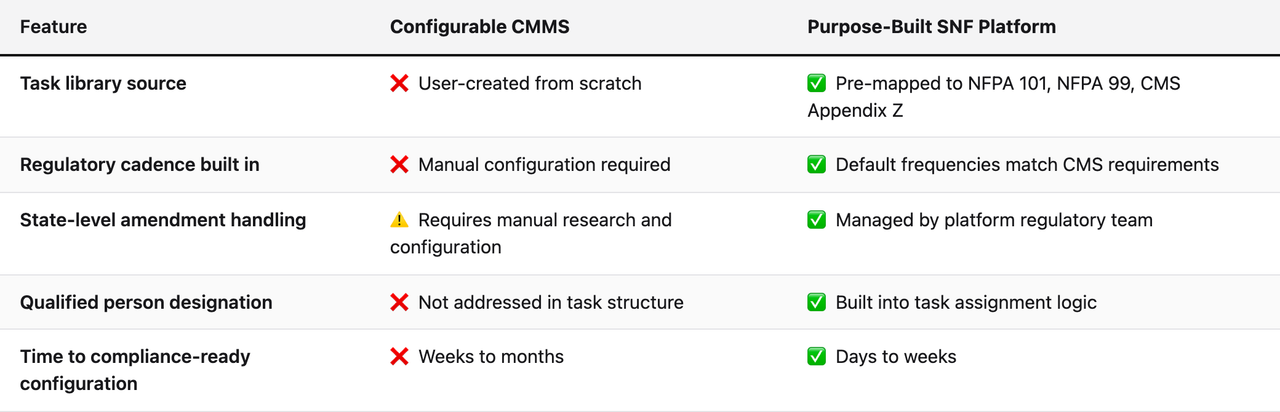
Purpose-built SNF compliance platforms eliminate this configuration tax by shipping with the regulatory baseline already built in. Task libraries derived from NFPA 101, NFPA 99, and CMS Appendix Z are not add-ons to configure, they are the default. Inspection forms include the data fields surveyors expect. Cadences reflect CMS-required frequencies. The platform does not need to be told that a fire drill must occur on each shift at least once per quarter, it already knows that, and it flags the gap if night-shift coverage is missing.
Feature Area 1: Inspection Task Libraries and Regulatory Cadence
The most immediate functional difference between purpose-built SNF platforms and configurable CMMS tools appears in how inspection tasks are created and maintained. This is the foundation of survey readiness, if the right tasks are not scheduled at the right frequency, no amount of documentation quality can save a facility from a citation for a missed inspection cycle.
Configurable CMMS: Build-Your-Own Task Management
A configurable CMMS allows administrators to create preventive maintenance tasks with custom frequencies: daily, weekly, monthly, quarterly, annually. Tasks can be assigned to specific assets, locations, or technicians. In most platforms, you can attach forms or checklists to tasks to capture inspection data. This is functionally adequate for general facility maintenance.
The problem for SNF operators is that building a compliant task library from scratch requires knowing the regulatory requirements in detail, including which tasks require specific frequency by regulation versus which are facility-elected intervals, which tasks require qualified persons under NFPA definitions, and which inspection categories have sub-requirements that must be documented separately. Most maintenance directors know their facility's routines. Fewer know the precise regulatory citation for each task cadence, and fewer still know how CMS interprets NFPA 101 Chapter 4 equivalency provisions or how state-level amendments layer on top of federal requirements. A general-purpose CMMS does not provide that knowledge. It provides a blank form.
The result is task libraries that are often incomplete in ways that are invisible until a surveyor arrives. A monthly fire extinguisher check may be scheduled but missing the annual inspection by a licensed contractor. A sprinkler system inspection may be logged quarterly but missing the 5-year internal pipe inspection requirement. A generator test log may capture runtime but omit the transfer time and kW load fields that CMS specifically reviews.
Purpose-Built SNF Platforms: Pre-Validated Regulatory Task Libraries
Purpose-built platforms for SNF life safety compliance ship with task libraries that are pre-mapped to specific regulatory citations. Every task includes its source standard (NFPA 101 section, NFPA 99 section, or CMS Appendix Z tag), its required frequency, the data fields required by that standard, and the qualified person designation where applicable. Facilities do not build their task library from scratch, they activate a validated template and customize for facility-specific assets and state-level amendments.
This distinction is significant at the multi-site level. A regional facilities manager overseeing ten SNFs in two states needs task libraries that reflect both federal baseline requirements and state-specific variations without requiring each facility to independently research and configure those differences. A purpose-built platform with a maintained regulatory library handles that automatically, flagging state-specific requirements and updating cadences when regulatory standards change.
Feature Area 2: Inspection Form Design and Data Capture
Scheduling the right task at the right frequency is necessary but not sufficient for survey readiness. The inspection record itself must capture the right data to satisfy what a CMS surveyor or state inspector will review. This is where configurable CMMS platforms and purpose-built SNF compliance tools diverge most sharply in practical day-to-day use.
What CMS Actually Reviews in an Inspection Record
Under CMS Appendix PP and the Life Safety Code Survey Protocol, surveyors reviewing fire safety and life safety documentation are not simply confirming that a task was marked complete. They are reviewing the substance of the record: Was the inspection conducted at the correct interval? Does the log include all required data elements? Were deficiencies noted? If so, were they tracked to resolution within the timeframe the facility's own ILSM (Interim Life Safety Measures) policy requires? Is there a signature or electronic authentication by a qualified person?
A CMMS task marked "complete" with a timestamp and a technician name satisfies none of those questions on its own. The form attached to that task completion must be structured to capture each required data element, and for most NFPA-governed inspections, those elements are specific and non-obvious to a non-regulatory audience.
Configurable CMMS Form Builders: Flexible but Uninformed
Most configurable CMMS platforms include a form or checklist builder that allows administrators to add fields to a task. Dropdown menus, text fields, numeric inputs, pass/fail checkboxes, and photo attachments are typical capabilities. This is genuinely useful functionality. The limitation is that the platform has no knowledge of which fields are required by which regulatory standard. It provides the form-building tool; the administrator must know what fields to build.
In practice, this creates forms that reflect what the maintenance director thinks a surveyor wants to see, not necessarily what the applicable NFPA chapter or CMS tag actually requires. The difference between those two things is often invisible until a surveyor notes a deficiency for missing documentation elements in an otherwise completed log.
Common documentation gaps found in CMMS-generated inspection records during CMS surveys include: generator test logs missing kW load readings (required under NFPA 110), fire drill records missing the scenario description and staff response narrative (required under NFPA 101 Chapter 4), fire extinguisher inspection logs missing the hydrostatic test date for applicable units, and sprinkler system quarterly inspection records missing the control valve status documentation required under NFPA 25.
Purpose-Built SNF Platform Form Design: Regulatory-Native Data Capture
Purpose-built SNF compliance platforms design their inspection forms from the regulatory standard outward. Each form field corresponds to a specific data element required by the applicable NFPA chapter or CMS tag. Required fields are marked as mandatory, preventing task completion without documentation of each element. Conditional logic handles situations where a deficiency is noted, automatically triggering a deficiency tracking workflow, an ILSM assessment prompt, or an escalation notification depending on the deficiency type and severity.
This regulatory-native form design has two practical effects. First, it prevents the incomplete-but-submitted record problem that generates citations for facilities that are genuinely doing their inspections but not documenting them correctly. Second, it makes the completed record defensible in a survey context, the form structure itself demonstrates that the facility is documenting against the regulatory standard, not just logging activity.
Feature Area 3: Documentation Gap Detection and Pre-Survey Auditing
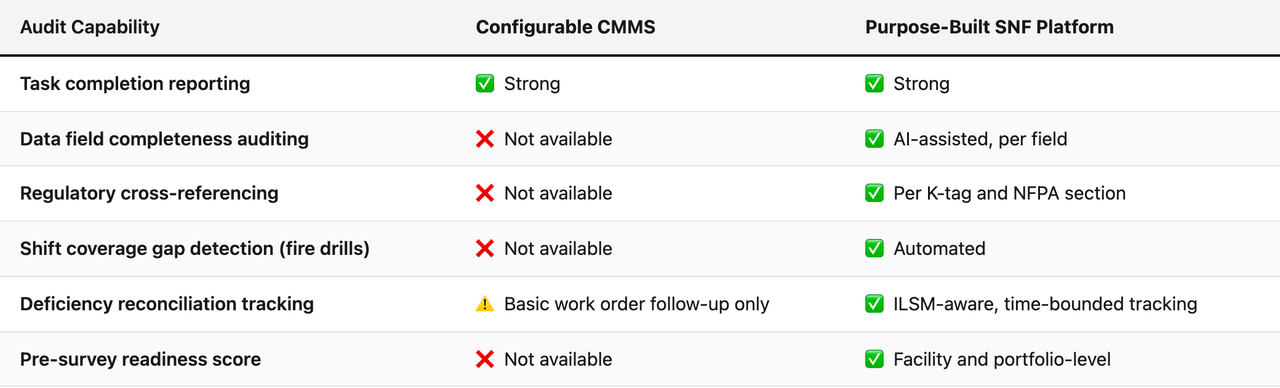
This is the feature category where purpose-built SNF compliance platforms most clearly outperform configurable CMMS tools, and where the product differentiation is hardest for a general-purpose platform to replicate through configuration alone. It is also the capability that most directly addresses the core problem SNF operators face: documentation gaps that are invisible to the people creating the documentation.
Why Documentation Gaps Are Systematically Invisible
The maintenance director who completes a fire drill log, a generator test record, and a monthly sprinkler check in the same week has no practical mechanism for knowing that the fire drill log is missing night-shift coverage, that the generator test record is missing a required data field, and that the sprinkler check is overdue by three days because of how the quarterly interval was configured in the CMMS. Each individual record looks complete from the inside. The gaps only become visible when someone audits the entire documentation set against the regulatory standard, which is exactly what a CMS surveyor does during an unannounced visit.
The challenge is compounded at multi-site operations. A regional director overseeing ten facilities cannot manually audit the complete documentation set at each facility on a rolling basis. They rely on facility-level reporting, which is only as accurate as the documentation being generated. If the documentation has gaps, the reporting reflects those gaps as compliance, until a surveyor arrives.
Configurable CMMS Reporting: Operational Visibility Without Regulatory Intelligence
Configurable CMMS platforms typically offer robust reporting on work order completion rates, overdue tasks, asset maintenance history, and labor costs. These reports are valuable for operational management. They are not designed to answer the question a CMS surveyor is asking: "Does this facility's documentation satisfy the requirements of NFPA 101, NFPA 99, and CMS Appendix Z for each applicable K-tag category?"
A CMMS report showing 94% task completion for the past quarter does not reveal that the 6% of incomplete tasks include two missed fire drills, one overdue generator test, and a sprinkler inspection that was marked complete with an insufficient record. It does not reveal that the completed generator test records for the quarter are missing kW load readings. It does not cross-reference the fire drill completion dates against the shift coverage matrix to identify that the B shift at the north building has not had a drill in five months.
These are not edge cases. They are the exact citation patterns that appear repeatedly in CMS enforcement actions against SNFs with documented maintenance programs.
Purpose-Built Platform Pre-Survey Auditing: AI-Assisted Gap Detection
Purpose-built SNF compliance platforms like SEQURA approach this problem differently. Rather than reporting on task completion, they audit completed documentation against the regulatory expectation for each task category. An AI review layer reads completed inspection records, contractor reports, and shift logs, cross-references them against the applicable NFPA requirements, and surfaces specific documentation gaps before they become citations.
This is not generic document scanning. It is regulatory-specific pattern matching: missing data fields in generator test records, fire drill logs that lack required narrative elements, sprinkler deficiency records that have not been reconciled within the facility's stated ILSM timeframe, monthly inspection cycles that have drifted beyond the allowable window. The output is a prioritized gap list that a maintenance director or compliance officer can work through before a survey, not a list they discover during one.
The practical value of this capability is difficult to overstate for a SNF administrator. The difference between finding a documentation gap two weeks before a survey and finding it during a survey is the difference between a corrected record and a K-tag citation.
Feature Area 4: Contractor Documentation and Third-Party Inspection Management
One of the most consistently underserved areas in both CMMS tools and SNF compliance platforms is contractor documentation management. For most SNFs, a significant portion of life safety inspections are performed by licensed third-party contractors: fire alarm inspectors, sprinkler system contractors, generator service technicians, elevator inspectors, and others. The documentation those contractors produce, inspection reports, service records, deficiency lists, must be captured, stored, and reconciled against the facility's compliance record in a way that satisfies CMS review.
The Contractor Documentation Problem in CMMS Tools
A configurable CMMS handles contractor work through one of two approaches: work orders assigned to an external vendor (which produces a completion record in the CMMS but not the contractor's actual report), or document attachments on completed tasks (which captures the contractor's PDF report but does not parse its content). Neither approach gives a compliance officer visibility into whether the contractor's report itself is complete, whether deficiencies noted in the report have been reconciled, or whether the report satisfies the documentation requirements of the applicable NFPA standard.
The practical consequence is that facilities often hold contractor reports in a filing system (physical or digital) that is not integrated with their compliance tracking. An annual fire alarm inspection report sits in a folder. The CMMS shows the task as complete. No one has reviewed whether the report includes all required elements, whether a deficiency noted in the report was assigned for correction, or whether the correction was documented before the follow-up inspection window closed. This is precisely the pattern CMS surveyors are trained to identify.
Purpose-Built Platform Contractor Integration
Purpose-built SNF compliance platforms address contractor documentation through structured intake workflows. When a contractor submits a completed inspection report, the platform does not simply file it, it processes the report against the regulatory checklist for that inspection type, identifies deficiencies noted in the report, creates deficiency tracking items with CMS-aligned timeframes, and flags the record as incomplete if required data elements are absent from the contractor's documentation.
For multi-site operators, this capability creates a contractor accountability layer that does not currently exist in most facilities management workflows. Regional directors can see, across all facilities, which contractor-completed inspections have unreconciled deficiencies, which reports are missing required elements, and which facilities are relying on contractor documentation that would not satisfy CMS review. That visibility transforms contractor management from a scheduling function into a compliance function.
Feature Area 5: User Experience for Frontline Staff
Survey readiness is ultimately a frontline execution problem. The maintenance director who configures the system and the administrator who reviews compliance reports are not the people completing most inspection records. Technicians, EVS staff, and facility engineers are. The usability of a platform for those users determines whether documentation is completed accurately, in real time, or retroactively and incompletely.
CMMS UX: Designed for Maintenance Professionals
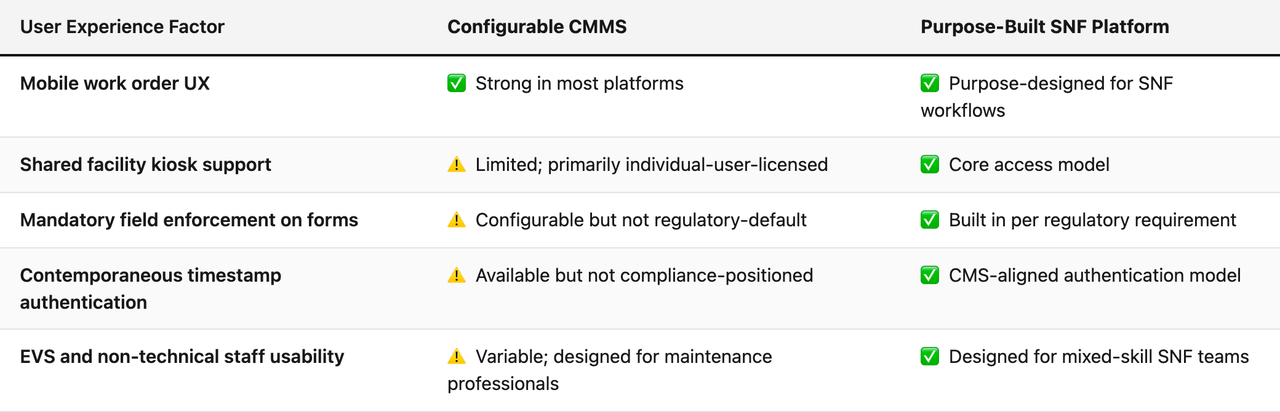
Configurable CMMS platforms have generally invested heavily in mobile UX for maintenance technicians. Work order management, asset scanning, parts lookup, and time tracking are well-designed in most modern CMMS tools. The mobile experience for a technician completing a preventive maintenance task is typically smooth and intuitive.
The gap appears when that task involves a regulatory inspection with a structured form. General-purpose CMMS mobile interfaces are optimized for work order completion, not guided regulatory documentation. A technician completing a monthly fire extinguisher inspection sees a checklist of items to check off, not a form that guides them through each required documentation element and flags a missing field before they can submit. If a field is optional in the CMMS form (because the form builder did not mark it required), the technician can submit without it. The record looks complete. The documentation is not.
Kiosk and Mobile Access in Purpose-Built SNF Platforms
Purpose-built SNF compliance platforms like SEQURA are designed around the reality of SNF maintenance staffing: a mix of full-time maintenance technicians, part-time staff, and EVS personnel who may share a facility kiosk rather than carry individual mobile devices. The UX is built for that environment, with simplified task interfaces, guided form completion, mandatory field enforcement, and photo documentation capture that is intuitive for staff who are not technology-primary workers.
The kiosk model is particularly important for SNF compliance because it enables contemporaneous documentation, logging completed at the time of inspection, at the location of the asset, with a timestamp and user authentication that satisfies CMS requirements for contemporaneous record-keeping. A paper binder filled in at the end of a shift, or a CMMS record completed from a back-office computer hours after the inspection, creates the same documentation authenticity problem that CMS surveyors are specifically trained to probe.
Feature Area 6: Multi-Site Portfolio Visibility and Standardization
For regional facilities managers, COOs, and VPs of operations overseeing multiple SNF locations, the platform comparison extends beyond per-facility functionality to portfolio-level visibility. The ability to see compliance posture across all facilities in a single dashboard, identify which locations have documentation gaps before a survey, and enforce standardized task libraries and inspection protocols across a portfolio is a different capability category from single-site task management.
Multi-Site CMMS: Aggregated Operational Data Without Regulatory Context
Enterprise CMMS platforms serve multi-site organizations effectively for operational metrics: work order volume by facility, asset maintenance cost by location, technician productivity across sites. This data is genuinely useful for facilities operations management. It does not, however, provide the compliance-specific visibility a multi-site SNF operator needs.
A portfolio dashboard showing 91% preventive maintenance completion across twelve facilities does not tell a regional director which of those facilities has fire drill records missing shift coverage, which has generator test logs with incomplete data fields, or which is three weeks into a sprinkler deficiency that should have been resolved within two weeks under its ILSM policy. That information is buried in facility-level records that would require manual review at each site to surface.
Multi-site CMMS deployments also typically produce configuration drift: each facility has configured its task library and inspection forms independently, resulting in inconsistent documentation standards that make portfolio-level compliance comparison meaningless. If one facility's generator test form captures kW load and another's does not, the completion rates are not comparable as compliance indicators.
Purpose-Built Platform Portfolio Standardization
Purpose-built SNF compliance platforms address configuration drift through centralized template management. A regional director or compliance officer can publish a standardized task library, inspection form set, and documentation protocol to all facilities in the portfolio from a single administrative interface. Facilities activate the standard template and can add facility-specific tasks, but the regulatory baseline is consistent across all sites. This makes portfolio-level compliance reporting meaningful: when the dashboard shows 91% compliance, it is measuring against the same standard at every facility.
Portfolio-level gap reporting in purpose-built platforms surfaces the specific documentation issues, not just completion rates, that create citation risk. A regional director can see, in a single view, that three facilities have fire drill records missing night-shift coverage, two have generator test data field gaps, and one has a contractor-reported sprinkler deficiency that has not been reconciled in 28 days. That view does not exist in a configurable CMMS without significant custom reporting development, and even then it requires the underlying data to be structured consistently, which configuration drift prevents.
Pricing and Total Cost of Ownership: The Real Comparison
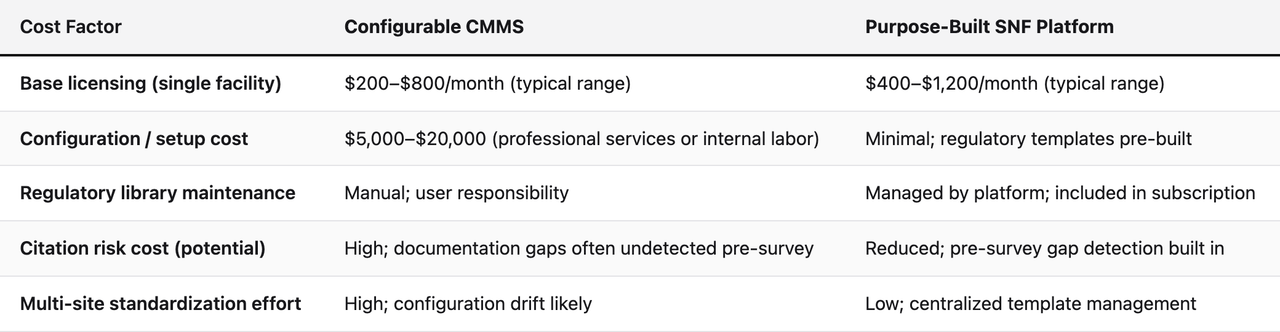
Configurable CMMS platforms are often positioned as the cost-effective alternative to purpose-built compliance software. The licensing comparison can appear to support this positioning at the surface level. But total cost of ownership in the SNF context includes dimensions that per-seat or per-facility CMMS pricing does not capture.
The Hidden Costs of CMMS Configuration for SNF Compliance
Configuring a general-purpose CMMS to approximate SNF life safety compliance functionality requires labor investment that is rarely included in licensing comparisons. Building a compliant task library, designing regulatory-aligned inspection forms, establishing deficiency tracking workflows, and creating portfolio-level compliance reports requires either internal IT and facilities management expertise or vendor professional services hours. For a single facility, this configuration effort can add $5,000 to $15,000 in effective setup costs on top of licensing fees. For a multi-site operator standardizing across ten facilities, that figure scales accordingly.
Ongoing maintenance costs are also underestimated. When NFPA standards update, or when CMS revises its interpretive guidelines for life safety requirements, a CMMS-configured compliance program requires manual identification and incorporation of those changes. A purpose-built platform with a maintained regulatory library handles those updates as part of the service.
The most significant hidden cost, however, is the cost of the documentation gaps the CMMS configuration cannot eliminate. A single K-tag citation for a missing fire drill record can trigger a Plan of Correction that consumes significant administrative and facilities management time. A condition-level life safety deficiency can threaten a facility's Medicare certification, a consequence that makes software licensing costs look trivial in comparison.
Purpose-Built Platform Pricing: Regulatory Value as the Pricing Basis
Purpose-built SNF compliance platforms are priced at a premium to general-purpose CMMS tools on a per-facility basis, reflecting the regulatory library development, AI auditing capability, and ongoing regulatory maintenance that are embedded in the product. For a single SNF, pricing typically positions between entry-level CMMS tools (which can range from $200 to $500 per month) and enterprise CMMS platforms (which can exceed $1,500 per month per facility at full configuration).
For multi-site operators, the comparison shifts further in favor of purpose-built platforms when configuration and maintenance labor costs are factored in. A platform that ships compliance-ready and maintains its regulatory library reduces the per-facility setup cost and eliminates the ongoing configuration maintenance burden, while delivering the pre-survey auditing capability that no amount of CMMS configuration can replicate.
A Decision Framework for SNF Operators: Which Tool Fits Your Situation
Not every SNF operator faces the same decision context. The right tool depends on the facility's current compliance program maturity, the operator's risk tolerance, the size of the portfolio, and the technical capacity of the team managing the system. This framework is designed to give buyers a clear starting point rather than a one-size-fits-all recommendation.
When a Configurable CMMS Makes Sense
A configurable CMMS is an appropriate primary tool when the facility's life safety compliance documentation program is already mature, well-staffed with regulatory expertise, and audited internally at a frequency that would catch documentation gaps before a CMS survey. This profile fits large health system-operated SNFs with dedicated life safety officers, in-house compliance teams, and the IT resources to maintain custom configurations. In this scenario, a CMMS handles the operational workflow, work orders, asset management, contractor scheduling, while the compliance function is managed by a dedicated team with the expertise to configure and maintain the regulatory layer.
A configurable CMMS is also a reasonable choice for operators whose primary compliance risk is not life safety documentation but other survey areas (clinical care, staffing, infection control), and who need operational workflow management more than pre-survey auditing capability.
When a Purpose-Built SNF Compliance Platform Is the Clear Choice
A purpose-built SNF compliance platform is the appropriate choice in most scenarios facing independent SNF operators, small-to-mid-size SNF chains, and any operator whose current compliance documentation program relies on paper binders, spreadsheets, or a CMMS that was not configured with regulatory specificity.
Specifically, a purpose-built platform is the right decision when:
- The facility has received life safety citations in recent surveys and is under a Plan of Correction that requires documented improvement in compliance processes
- The maintenance director or plant operations manager does not have regulatory expertise to build and maintain a compliant task library independently
- The operator manages multiple facilities and needs portfolio-level compliance visibility without a dedicated compliance analyst at each site
- The facility's current documentation is primarily paper-based and needs to be replaced with a contemporaneous electronic system that satisfies CMS requirements
- The operator's risk tolerance for unannounced survey citations is low, whether because of prior enforcement history, ownership structure, or the importance of maintaining a five-star CMS rating
The Modern CMMS Alternative for SNFs That Need Both
Some operators need both operational work order management and regulatory compliance auditing, and do not want to run two separate platforms. A modern CMMS alternative in the SNF context is a purpose-built compliance platform that includes work order management as a native capability rather than as an afterthought. This is increasingly the architecture of leading SNF compliance platforms: a compliance-first foundation with operational workflows built on top, rather than an operational CMMS with compliance features bolted on.
The distinction matters because the compliance-first architecture ensures that operational work orders and regulatory inspection tasks live in the same data environment, making it possible to track deficiencies from identification through correction in a single record without data moving between systems. This is the documentation continuity that CMS surveyors look for when reviewing how a facility manages identified life safety deficiencies.
The CMMS Software Comparison That Most Buyers Miss
When SNF operators evaluate CMMS software comparison resources, they typically find analyses focused on feature parity for maintenance management: work order workflows, asset tracking, preventive maintenance scheduling, inventory management, and reporting. These are legitimate comparison dimensions for the CMMS category. They are not the right comparison dimensions for a SNF operator buying a life safety compliance software buying guide tool.
The comparison that matters for SNF operators is not "which CMMS has the best mobile interface" or "which platform has the most integrations." It is: which platform can tell a maintenance director, before a CMS surveyor walks through the door, exactly which documentation gaps exist in the life safety binder, and which ones would produce a citation if a surveyor reviewed the file today.
That capability does not exist in any configurable CMMS. It is not a configuration problem. It requires a regulatory knowledge base, an AI layer trained on CMS citation patterns, and a product architecture that treats compliance auditing as the primary function rather than a reporting add-on. The facilities that have moved from paper binders to CMMS tools have improved their operational documentation. The facilities that have moved from CMMS tools to purpose-built SNF compliance platforms have improved their survey outcomes, which is the metric that actually matters in this market.
Frequently Asked Questions
What is the core difference between a configurable CMMS and a purpose-built SNF compliance platform?
A configurable CMMS manages work orders and maintenance tasks and can be customized to include inspection workflows. A purpose-built SNF compliance platform is designed specifically to satisfy CMS and NFPA documentation requirements, with pre-built regulatory task libraries, regulatory-aligned inspection forms, and AI-assisted pre-survey auditing that a CMMS cannot replicate through configuration alone.
Can a configurable CMMS satisfy CMS life safety documentation requirements?
A configurable CMMS can be set up to schedule inspections and log completion records, but it does not inherently satisfy CMS requirements because it does not audit completed records against regulatory standards, enforce regulatory-specific data fields, or detect documentation gaps that would produce citations. Meeting CMS requirements depends on how thoroughly the platform has been configured and how rigorously the documentation is reviewed, both of which require regulatory expertise that the platform itself does not provide.
Which NFPA standards are most critical for SNF life safety documentation?
The two primary standards are NFPA 101, Life Safety Code (which governs fire safety, means of egress, fire drills, and building systems) and NFPA 99, Health Care Facilities Code (which governs medical gas systems, electrical systems, and emergency power). CMS applies these standards through its Conditions of Participation and Appendix Z of the State Operations Manual, which maps NFPA requirements to specific K-tags that surveyors use during Life Safety Code surveys.
What are K-tags and why do they matter for platform selection?
K-tags are the specific deficiency tags CMS surveyors assign when a SNF fails to meet a Life Safety Code requirement. Each K-tag corresponds to a specific NFPA provision, K-tag K321 for generator testing, K-tag K354 for sprinkler systems, K-tag K712 for fire drills, and so on. A purpose-built SNF compliance platform organizes its task library and inspection forms around K-tag categories, making it possible to audit documentation against the specific citation risk each tag represents. A configurable CMMS has no native K-tag awareness.
How does a purpose-built SNF platform handle contractor inspection reports?
Purpose-built SNF compliance platforms intake contractor inspection reports through structured workflows that parse the report content, identify noted deficiencies, create deficiency tracking items with regulatory timeframes, and flag the record if required data elements are absent. This gives compliance officers visibility into whether contractor-completed inspections are fully documented and whether identified deficiencies are being tracked to resolution, a gap that CMMS tools typically do not address.
Is a shared kiosk model compliant with CMS contemporaneous documentation requirements?
Yes, provided the kiosk implementation includes individual user authentication (PIN, badge, or credential-based login) and captures a timestamp at the time of record completion. CMS requires that inspection records be created contemporaneously, meaning at or near the time the inspection occurs, and that the record identifies the person who performed the inspection. A shared kiosk with proper authentication satisfies both requirements and is preferable to paper binders completed retrospectively.
How long does it take to implement a purpose-built SNF compliance platform?
Most purpose-built SNF compliance platforms can be activated at a single facility within one to three weeks, with the regulatory task library pre-loaded and facility-specific customization completed during onboarding. Multi-site implementations vary depending on portfolio size, but the centralized template model means that once the baseline is configured for one facility, deploying to additional sites is significantly faster than a CMMS implementation that requires site-by-site configuration.
What happens to my existing CMMS if I switch to a purpose-built compliance platform?
Most SNF operators who transition to a purpose-built compliance platform retain their existing CMMS for general maintenance work order management (non-regulatory tasks like HVAC service requests, equipment repairs, and capital project tracking) while using the compliance platform for all life safety inspection documentation. The two systems serve different functions and can coexist. Over time, some operators consolidate onto the compliance platform if it offers sufficient work order management capability for their operational needs.
Can a purpose-built SNF compliance platform scale across a multi-state SNF portfolio?
Yes, and this is one of the strongest arguments for purpose-built platforms at the multi-site level. The centralized regulatory template library handles federal baseline requirements consistently across all facilities, while state-specific amendments are applied at the state level without requiring each facility to independently research and configure them. Portfolio-level compliance reporting is meaningful because all facilities are measured against the same regulatory standard.
What should SNF administrators look for in a life safety compliance software buying guide?
The most important evaluation criteria are: whether the platform ships with a pre-validated NFPA and CMS task library (not a blank CMMS that must be configured); whether inspection forms enforce regulatory-required data fields; whether the platform includes pre-survey auditing capability that detects documentation gaps before a survey; how contractor inspection documentation is handled; whether the platform supports multi-site portfolio visibility; and what the total cost of ownership looks like when configuration and regulatory maintenance labor are included alongside licensing fees.
Does SEQURA replace a CMMS or work alongside one?
SEQURA is designed to replace the life safety documentation function of a CMMS, the regulatory inspection scheduling, form completion, deficiency tracking, and compliance reporting that a CMMS does inadequately for SNF environments. For general maintenance work orders not tied to regulatory inspection requirements, operators can retain their existing CMMS or use SEQURA's work order capabilities depending on scope. The core value of SEQURA is the pre-survey auditing layer, which has no equivalent in any configurable CMMS regardless of how it is configured.
How does AI-assisted gap detection work in practice?
In a purpose-built SNF compliance platform, AI gap detection works by reading completed inspection records and cross-referencing them against the regulatory requirements for each task category. The AI identifies patterns that indicate documentation gaps: missing required data fields, inspection intervals that have drifted beyond the allowable window, fire drill records that lack shift coverage for a required shift, deficiency records that have not been updated within the facility's ILSM timeframe. The output is a specific, actionable list of gaps that can be addressed before a survey, not a general compliance score.
Key Takeaways
- Configurable CMMS platforms manage work; purpose-built SNF compliance platforms audit documentation. These are different problems, and solving the wrong one does not produce survey readiness.
- The configuration tax on general-purpose CMMS tools is real and significant. Building a compliant task library, designing regulatory-aligned forms, and maintaining both against evolving standards requires regulatory expertise and ongoing labor investment that most SNF operators do not account for in platform comparisons.
- Pre-survey gap detection is the capability that separates the platforms most clearly. No configurable CMMS can audit completed inspection records against NFPA and CMS requirements without a purpose-built AI layer trained on regulatory citation patterns.
- Multi-site operators face a configuration drift problem that makes portfolio-level compliance reporting in a CMMS meaningless. Purpose-built platforms with centralized template management solve this structurally.
- Contractor documentation is an underserved gap in both platform categories, but purpose-built SNF compliance platforms are more likely to address it through structured intake workflows that connect contractor reports to deficiency tracking.
- Total cost of ownership comparison must include configuration labor and citation risk, not just licensing fees. When these factors are included, purpose-built platforms are competitive or favorable for most SNF operators outside of large health systems with dedicated compliance teams.
- The right recommendation for most SNF operators is clear: if your current compliance program relies on paper binders, a spreadsheet, or a CMMS that was not configured with regulatory specificity, a purpose-built SNF life safety compliance platform will reduce your citation risk more directly and cost-effectively than any CMMS configuration project.
About the author
Benjamin Terebelo · Founder
Benjamin is the founder of SEQURA, a compliance platform purpose-built for healthcare facilities. He builds at the intersection of healthcare operations and software, maintaining a focus on bringing modern tooling to systems that the broader industry has largely left behind.
About the author
Benjamin Terebelo · Founder
Benjamin is the founder of SEQURA, a compliance platform purpose-built for healthcare facilities. He builds at the intersection of healthcare operations and software, maintaining a focus on bringing modern tooling to systems that the broader industry has largely left behind.