
Single-Facility SNF vs. Multi-Site Operator: How Life Safety Compliance Complexity Scales — And What to Do About It
A single SNF with one maintenance director, one binder, and one annual survey cycle is a compliance problem with clear edges. You know exactly where your fire drill logs live. You know which contractor did the sprinkler inspection last quarter. When a surveyor shows up unannounced, your maintenance director can walk to the shelf, pull the binder, and either hand it over with confidence or spend the next six hours backfilling records that should have been there all along.
Now multiply that facility by ten. Or twenty-five. Or sixty.
The binder doesn't scale. Neither does the mental model behind it. What worked at one facility, managed by one person who knew every corner of the building, becomes a structural liability the moment a second facility is added to the portfolio. And by the time a regional facilities manager is overseeing eight to twelve SNFs across two or three states, the compliance risk is no longer additive. It is exponential, compounding across facilities, staff turnover cycles, contractor relationships, and regulatory calendars that do not care about your organizational chart.
This article is a systematic breakdown of exactly how life safety compliance complexity scales in skilled nursing, why multi-site SNF operators face categorically different documentation risk than single-facility operators, and what operational controls actually work at scale. If you are a regional facilities manager, a VP of operations, or an owner-operator expanding beyond your first few buildings, this is the analysis your growth plan is missing.
The Single-Facility Compliance Baseline: What "Manageable" Actually Looks Like
Before examining how complexity scales, it helps to understand what a well-run single-facility life safety program actually requires. Most operators underestimate this baseline, which is why the compounding effect of adding facilities is so disorienting.
A single Medicare- and Medicaid-certified SNF operates under CMS Conditions of Participation, NFPA 101 (Life Safety Code), and NFPA 99 (Health Care Facilities Code), plus whatever state-level amendments apply in that jurisdiction. The intersection of these frameworks generates hundreds of recurring inspection, testing, and maintenance tasks. Fire alarm system tests. Sprinkler inspections at quarterly and annual intervals. Generator load tests. Emergency lighting checks. Eyewash station flushes. Fire drill records covering all three shifts, all four quarters, with documentation that names the drill observer, records the time-to-evacuation, and notes any deficiencies found. K-tag categories span from K211 (sprinkler systems) to K900 (fire alarm systems) and well beyond, each with its own documentation requirements that CMS surveyors are trained to probe.
A competent maintenance director managing a single facility can hold this in their head, supplemented by a well-organized binder and a working relationship with two or three contractors. They know the building's quirks. They know which generator needs an extra warm-up minute before load testing. They know the fire marshal prefers documentation in a specific format. This institutional knowledge is genuinely valuable, and it creates a compliance program that, while fragile, is at least coherent.
The fragility is the key problem. That single-facility model depends on:
- One person's memory and organizational habits
- Consistent contractor relationships and documentation hand-offs
- A paper or spreadsheet system that only one person truly understands
- A maintenance director who has not left, been promoted, or gone on extended leave
When any one of those four dependencies breaks, the compliance program degrades, often invisibly. The binder still looks full. The tasks appear to be completed. But the documentation has gaps that a trained surveyor will find. At a single facility, this is a serious problem. At ten facilities, it is almost guaranteed to be happening somewhere in the portfolio at any given time, and the operator has no reliable way to know where.
What this means for single-facility operators: the manual binder model is survivable, but only because the consequences of its failure are contained. The moment you add a second building, that containment disappears. The operational controls that keep a single facility survey-ready are not designed to transfer, and most operators discover this only after their first multi-site citation.
How Documentation Risk Compounds: The Multi-Site Multiplication Problem
Here is the core insight that most multi-site SNF operators miss until it costs them: documentation risk does not scale linearly with facility count. It compounds.
At a single facility, you have roughly N tasks, managed by one person, with one point of failure. At two facilities, you have 2N tasks, but the risk is not simply doubled. You now have two points of failure, two contractor ecosystems, two state regulatory calendars (if the facilities are in different states), and critically, no unified visibility into either. The person accountable for both facilities cannot be in two places simultaneously, and the documentation systems that work locally at each building do not talk to each other.
As the portfolio grows, several specific risk vectors compound in ways that are worth naming explicitly.
Contractor Documentation Fragmentation
Every SNF relies on licensed contractors for high-stakes inspections: fire alarm testing, sprinkler certification, generator load testing, kitchen hood suppression systems. At a single facility, the maintenance director manages one or two contractor relationships and knows exactly what documentation format each contractor delivers. At a ten-facility operation, you may have anywhere from fifteen to forty active contractor relationships, each with their own documentation format, delivery timeline, and filing convention. Contractor reports arrive by email, by fax, by mail, and occasionally hand-delivered on paper that gets stapled into a binder that no one outside that building will ever review.
The compliance risk here is not that contractors are performing inadequate work. It is that the documentation of that work is fragmented across dozens of channels, and no one in the organization has a complete, current picture. When a surveyor at Facility 7 asks for the annual fire alarm test report, the maintenance director at Facility 7 can probably find it. But the regional manager overseeing Facility 7 has no idea whether the report reflects a compliant test, whether the deficiencies noted in the report were subsequently resolved, or whether the contractor's certification matches the NFPA 72 requirements applicable to that specific system.
Staff Turnover and Institutional Knowledge Loss
Maintenance director turnover in skilled nursing is a persistent operational challenge. When a maintenance director leaves a single facility, institutional knowledge walks out the door, but the new hire can at least be oriented to a single building, a single binder, and a single set of contractor relationships. The recovery period is painful but bounded.
At a multi-site operation, maintenance director turnover at one facility creates a gap that the regional facilities manager must cover, often while simultaneously managing compliance obligations at seven other buildings. The new hire inherits a paper system they did not build, contractor relationships they have not established, and a documentation history they cannot fully reconstruct. If the previous director used informal shortcuts (completing log entries in batches rather than contemporaneously, for example), those shortcuts are invisible in the paper record and will not be disclosed during the transition.
This is precisely the pattern that produces the worst survey outcomes: not outright neglect, but the quiet degradation of documentation quality during transition periods, discovered only when a surveyor arrives unannounced at exactly the wrong moment.
Regulatory Calendar Divergence Across States
Multi-site operators with facilities in more than one state face a compliance calendar problem that single-facility operators never encounter. State health departments layer additional requirements on top of federal CMS standards, and those requirements vary significantly. Some states mandate quarterly fire drills for all shifts; others follow the federal minimum of four per year. Some states require annual NFPA 101 surveys by state engineers; others rely on CMS-contracted survey agencies. Electrical system testing intervals, emergency generator fuel testing requirements, and even the specific K-tag interpretive guidance used by state surveyors can differ between neighboring states.
Managing this divergence manually, across ten or twenty facilities in three or four states, requires a compliance calendar with hundreds of differentiated entries, maintained with enough granularity that each facility's specific regulatory obligations are tracked separately. Most multi-site operators do not have this. They have a shared template that was built for one state and applied everywhere, with informal adjustments made by individual maintenance directors. The result is a compliance program that looks standardized but is actually full of jurisdiction-specific gaps.
The Visibility Gap: What Regional Managers Cannot See
Regional facilities managers at SNF chains typically oversee eight to fifteen buildings, often spread across a geographic territory that makes regular in-person visits difficult. Their compliance oversight depends on what facility-level staff report upward, which creates a structural information asymmetry. The maintenance director at each facility knows exactly how behind they are on documentation. The regional manager knows only what the maintenance director chooses to surface, or what becomes visible during a periodic audit visit.
This is not a personnel problem. It is a systems problem. Without a platform that provides real-time, facility-level documentation status across the entire portfolio, the regional manager is always operating on lagged information. By the time a gap is surfaced through the reporting chain, it may already be a citation.
The K-Tag Risk Map at Scale: Where Citations Cluster in Multi-Site Portfolios
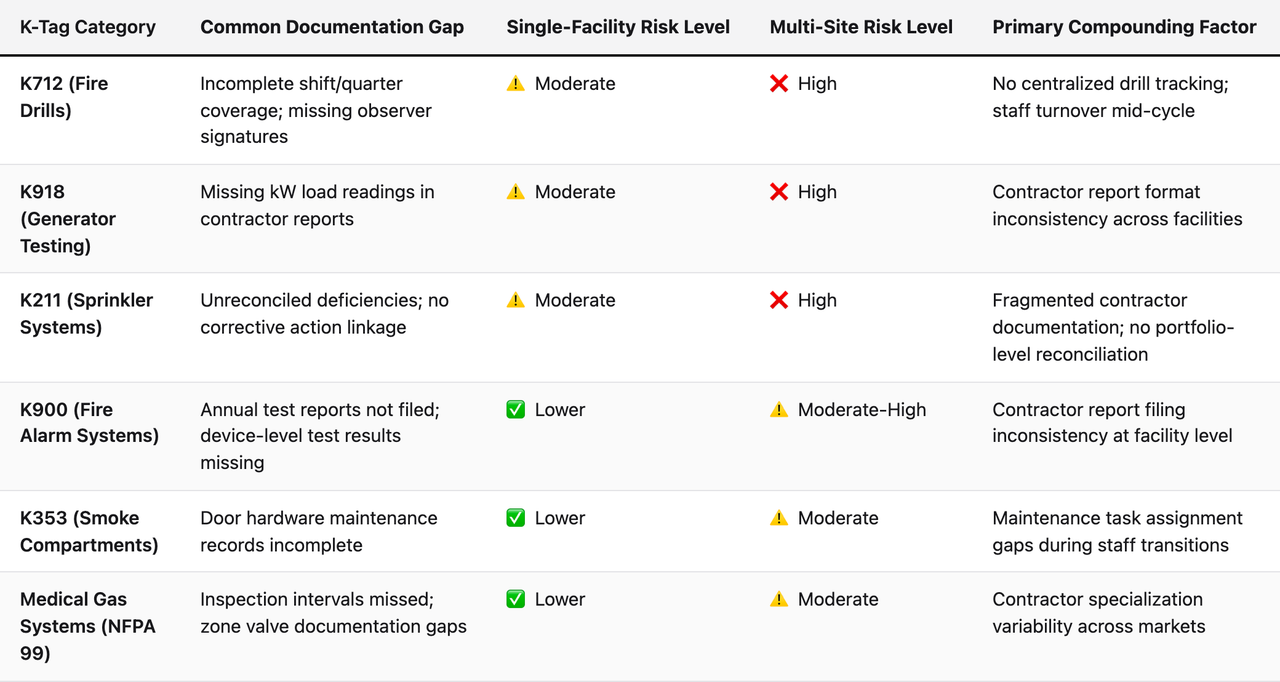
Understanding which K-tag categories produce the most citations in multi-site portfolios helps operators prioritize their compliance investments. The risk is not evenly distributed across all life safety categories. Certain documentation requirements are structurally more vulnerable to the compounding failures described above.
Fire Drill Documentation (K712 and Related Tags)
Fire drill compliance is one of the most common citation sources in SNF surveys, and it is disproportionately problematic in multi-site portfolios for a specific reason: the documentation requirements are detailed, shift-specific, and require active oversight to complete correctly. CMS requires fire drills on each shift each quarter, with documentation that includes time of drill, building response, any deficiencies observed, and corrective action taken. A single missed night-shift drill in Q3 at one facility is a citation. Across a portfolio of fifteen facilities, the probability that at least one facility has an incomplete drill record in any given quarter is high enough to plan for.
The typical failure mode is not that the drill did not happen. It is that the documentation is incomplete: the drill log is missing the observer's signature, the deficiency notation is absent, or the night-shift coverage is documented for only two of three shifts in a quarter. These are the gaps that a trained surveyor finds in the first twenty minutes of reviewing a fire drill binder.
Generator Testing and Load Documentation (K918 and Related Tags)
Emergency generator compliance requires monthly operational tests, annual load tests at or above 30% of nameplate rating, and detailed documentation of kW readings, test duration, and any deficiencies noted. The load test documentation is particularly vulnerable at multi-site operations because it requires specific technical data that contractors sometimes omit from their standard report format. A generator test report that documents that the test was performed but does not include the actual kW load readings is a documentation gap that CMS surveyors specifically look for.
In a portfolio setting, the regional manager typically has no visibility into whether contractor-delivered generator reports include the required technical specifics until a surveyor points it out at one of the facilities. By that point, the same gap may exist at five other buildings using the same contractor.
Sprinkler System Deficiency Reconciliation (K211 and Related Tags)
Quarterly and annual sprinkler inspections routinely identify deficiencies: heads that need replacement, escutcheon plates that are missing or painted over, gauges that are out of range. The NFPA 25 standard and CMS interpretive guidance require that identified deficiencies be corrected within specified timeframes, with documentation of the correction. The failure mode is not that deficiencies go unrepaired. It is that the repair documentation is not linked back to the original inspection report, creating an open deficiency record that looks uncorrected even when the work was done.
At scale, this reconciliation problem is multiplied across every facility's contractor relationship. Sprinkler inspection reports arrive from contractors; repair work is performed, sometimes by different contractors; and the linkage between the original deficiency and the corrective action exists only in paper files that no one outside the facility has reviewed.
Why Traditional CMMS Platforms Fail Multi-Site SNF Operators
Many multi-site SNF operators attempt to solve the portfolio compliance problem with a Computerized Maintenance Management System (CMMS). The logic is understandable: if the problem is task tracking and documentation, a work order management system should help. In practice, general-purpose CMMS platforms solve a different problem than the one multi-site SNF operators actually have.
A traditional CMMS is designed for preventive maintenance scheduling and work order management. It tells you when a task is due, assigns it to a technician, and records completion. For equipment maintenance (HVAC filter changes, elevator inspections, plumbing preventive maintenance), this is genuinely useful. But life safety compliance documentation in a CMS-regulated SNF has requirements that a general CMMS was not built to address.
The Regulatory Intelligence Gap
A general CMMS does not know the difference between a fire drill log that satisfies CMS interpretive guidance and one that does not. It can record that a fire drill was completed on a given date. It cannot tell you that the drill record is missing the required deficiency notation, that the observer who signed the form is not listed as a qualified fire safety officer, or that you have documented three drills this quarter on the day shift and none on the night shift. Those are compliance-layer judgments that require regulatory knowledge baked into the system, not just task management logic.
For a single facility, this gap is manageable if the maintenance director has deep regulatory knowledge. For a portfolio of fifteen facilities, the gap is structural. The regional manager cannot review every drill log at every facility for compliance completeness. They need a system that does the review for them and surfaces only the gaps that require attention.
The Contractor Integration Problem
Multi-facility CMMS implementations routinely fail at the contractor documentation layer. Work orders can be created in the system, but when a licensed contractor performs the inspection, their report arrives outside the system (by email, fax, or mail) and must be manually uploaded, filed, and cross-referenced. In practice, this step is inconsistently performed, especially at facilities with lean maintenance staff. The CMMS shows the inspection as scheduled; the contractor report exists somewhere in the facility's email inbox or paper files; the system record is incomplete without anyone flagging it.
The documentation gap that gets cited at survey is not that the inspection did not happen. It is that the documentation of the inspection is not complete, current, or retrievable in the format a surveyor expects. A CMMS that tracks work orders but does not audit the resulting documentation has solved the scheduling problem while leaving the compliance problem intact.
The Portfolio Visibility Problem
Even CMMS platforms with multi-site capabilities typically present portfolio-level data in aggregate dashboards that require significant interpretation. A regional facilities manager looking at a dashboard showing "87% task completion across portfolio" cannot tell from that number which specific facilities have open life safety gaps, which K-tag categories are at risk, or which contractor reports have been received but not reviewed for compliance completeness. The dashboard creates an illusion of visibility without delivering the actionable, gap-specific intelligence that multi-site compliance management actually requires.
What multi-site SNF operators need is not a task tracker with a portfolio view. They need a documentation auditor that operates continuously across every facility in the portfolio, knows what a compliant record looks like for each specific regulatory requirement, and surfaces gaps at the level of specificity that allows a regional manager to take action before a surveyor does.
The Operational Controls That Actually Work at Scale
Solving multi-site SNF compliance is not primarily a technology problem. It is an operational design problem that technology can support. The operators who achieve consistent survey readiness across large portfolios share a set of structural controls that work regardless of portfolio size, though the tools used to implement those controls do need to scale.
Standardized Task Libraries with Jurisdiction-Specific Overlays
The most effective multi-site compliance programs start with a standardized base task library, built against NFPA 101, NFPA 99, and CMS Conditions of Participation, that applies to every facility in the portfolio. This base library covers the federal floor: the inspections, tests, and documentation requirements that every SNF must meet regardless of state. The library is then overlaid with jurisdiction-specific additions for each state in which the operator has facilities.
This is not a complex concept, but it is surprisingly rare in practice. Most multi-site operators either have a single template that everyone uses (missing state-specific requirements) or allow each facility to build its own compliance calendar (creating inconsistency that makes portfolio-level oversight impossible). A standardized library with jurisdiction-specific overlays solves both problems simultaneously.
The critical implementation detail is that the task library must be built with specific regulatory authority, not just general knowledge. Tasks need to be tied to the specific NFPA standard section, CMS interpretive guideline, or state regulation that requires them, at the specific frequency required, with the specific documentation fields that make the resulting record defensible at survey. A task that says "check fire extinguishers monthly" is not the same as a task that captures the inspection criteria, documents the inspector, records any deficiencies, and links corrective actions back to the original inspection record.
Contemporaneous Documentation Protocols
One of the most damaging patterns in multi-site SNF compliance is the practice of batch documentation completion: maintenance staff performing inspections throughout the week and then recording them in the log at the end of the week, or completing multiple entries at once to catch up when a review visit is approaching. This practice is widespread, understandable given staffing pressures, and a significant citation risk.
CMS surveyors are trained to look for documentation patterns that suggest batch completion. Entries made at regular intervals (every seven days on the same day of the week for tasks that should be performed on variable days), multiple entries in the same handwriting made at the same time, or timestamps that do not align with other documented activity at the facility are all red flags. A paper binder cannot prevent this pattern. A documentation system that requires completion at the point of task performance, via mobile check-in or kiosk, creates a contemporaneous record that is structurally resistant to the batch-completion problem.
For multi-site operators, implementing contemporaneous documentation protocols across the portfolio requires both the right tools and explicit operational standards. The protocol needs to be part of every maintenance director's onboarding, every performance review, and every facility audit. Contemporaneous documentation is not a technology feature. It is a discipline that technology makes possible and measurable.
Regional Compliance Review Cadences
Portfolio-level compliance management requires a structured review cadence that does not depend on individual facility managers surfacing their own problems. Regional facilities managers should have a defined, recurring process for reviewing compliance status across their portfolio, with enough specificity to catch documentation gaps before they become citations.
An effective regional review cadence typically operates at three levels. First, a weekly automated status check that identifies any facility with overdue tasks or open deficiencies in high-risk K-tag categories. Second, a monthly documentation quality review that samples completed records from each facility and checks them against compliance standards. Third, a quarterly mock-survey process at each facility, modeled on actual CMS survey protocols, that tests whether the documentation a surveyor would ask for is complete, retrievable, and compliant.
The weekly and monthly reviews are only feasible with a platform that surfaces the relevant gaps automatically. A regional manager overseeing twelve facilities cannot manually review compliance status at each building every week. They need a system that does the first-pass review and delivers a prioritized list of gaps requiring attention. The quarterly mock survey, by contrast, is best performed in person, because it tests the physical retrievability of documentation and the facility staff's ability to respond to surveyor requests in real time.
Contractor Documentation Standards and Intake Protocols
Multi-site operators should establish, in writing, the documentation standards that all contractors must meet for their reports to be accepted into the compliance record. This means specifying, for each category of inspection or test, the required data fields (including the technical specifics like kW readings for generator tests, device-level test results for fire alarm testing, and pressure gauge readings for sprinkler inspections), the acceptable report format, and the delivery protocol.
Contractors who cannot meet these standards should not be used, or should be used with a supplemental documentation requirement that captures the missing data before the report is filed. This sounds demanding, and it is. But the alternative is a compliance record full of contractor reports that look complete but lack the specific technical data that CMS interpretive guidance requires, discovered only when a surveyor asks for it.
The intake protocol is equally important. Every contractor report received at a facility should be logged as received, reviewed against the documentation standard, and any gaps flagged for resolution before the report is filed. This review step is the one that almost never happens in single-facility paper-based systems, and almost never happens at scale without a platform to support it.
SNF Portfolio Management: A Decision Framework for Scaling Compliance Infrastructure
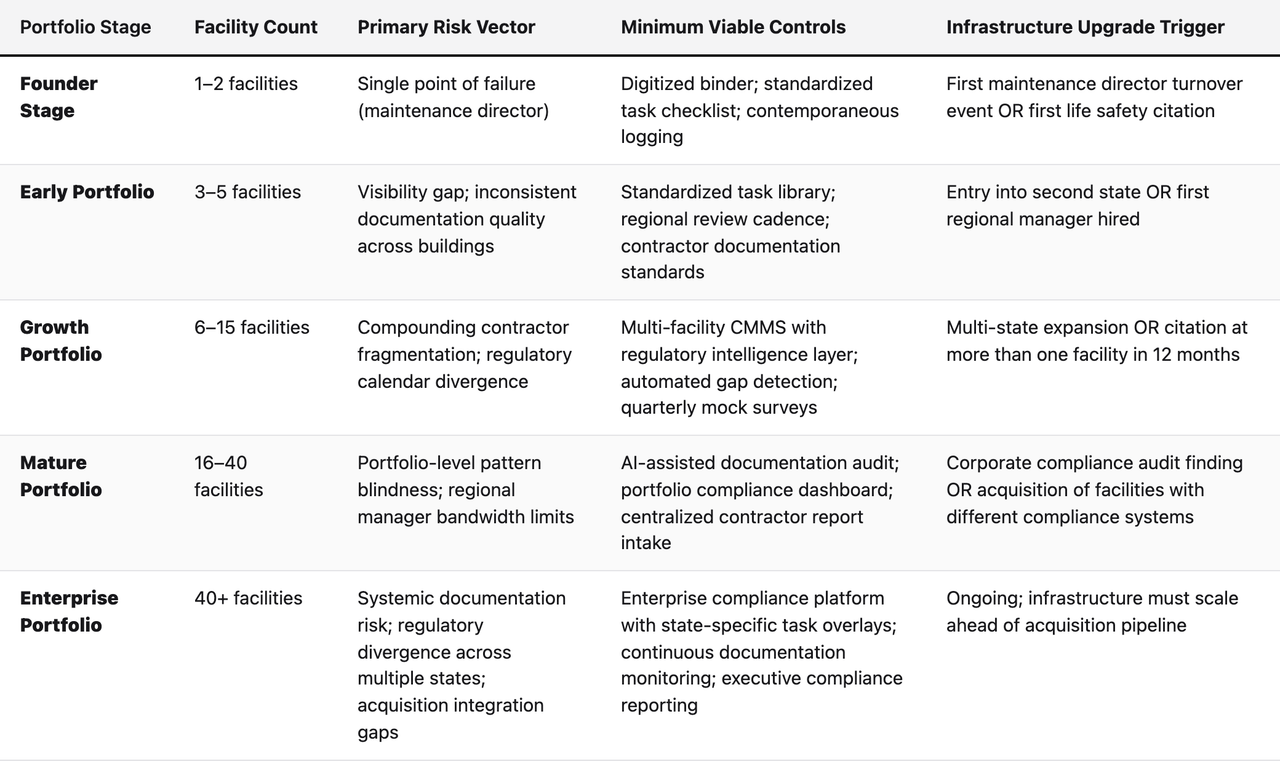
Not every multi-site operator needs the same compliance infrastructure. The right controls depend on portfolio size, state complexity, staff stability, and current citation history. The following framework helps operators identify where their compliance infrastructure gaps are most acute and prioritize investments accordingly.
The Compliance Infrastructure Maturity Model for SNF Portfolios
The Four Questions Every Regional Facilities Manager Should Be Able to Answer
The most reliable diagnostic for multi-site compliance infrastructure gaps is a simple four-question test. If a regional facilities manager cannot answer all four questions for every facility in their portfolio, on demand and without calling the facility, the infrastructure has a visibility gap that needs to be addressed before the next unannounced survey.
- Which facilities in my portfolio have an overdue life safety task right now? Not "which facilities reported completing all their tasks last month," but which facilities have a specific task that is currently past due according to the regulatory calendar.
- Which contractor reports have been received in the last 90 days but not reviewed for compliance completeness? This identifies the intake gap: reports that exist somewhere in the system but have not been validated against documentation standards.
- Which facilities have an open deficiency from a contractor inspection that does not yet have a documented corrective action? This identifies the reconciliation gap: deficiencies that are on record but not resolved in the documentation.
- If a surveyor arrived at Facility 11 tomorrow morning, which specific documentation gaps would they find? This is the hardest question and the most important one. A compliance program that cannot answer it has not achieved survey readiness at scale.
What AI-Assisted Documentation Auditing Changes for Multi-Site Operators
The promise of AI in compliance management is often overstated and underspecified. "AI-powered compliance" has become a marketing phrase that covers everything from automated reminder emails to genuinely sophisticated document analysis. For multi-site SNF operators, the distinction matters, because the specific capability that changes portfolio compliance management is not task scheduling or reminder automation. Those problems are solved by basic CMMS functionality. The capability that changes the game is automated documentation review: the ability to read a completed inspection record, a contractor report, or a fire drill log and determine whether it satisfies the specific regulatory requirements for that inspection type, at that facility, in that state.
This is a harder problem than it sounds. A fire drill log that satisfies CMS survey requirements contains specific fields (shift, date, time, building response, deficiencies noted, corrective actions, observer identity) that are not always labeled consistently across different form formats, handwriting styles, or documentation systems. A generator test report that satisfies NFPA 110 and CMS documentation requirements contains technical data (kW load, test duration, transfer switch operation, battery voltage readings) that contractors do not always include in their standard report format. An AI system that can read these records, identify which required fields are present and which are missing, and surface the gap with enough specificity that a maintenance director can resolve it, is doing something qualitatively different from a task tracker that marks a work order complete.
For a regional facilities manager overseeing twelve buildings, the practical impact of this capability is significant. Instead of spending review time reading through binders or spreadsheets trying to identify gaps, the regional manager receives a prioritized list of specific documentation gaps across the portfolio, ranked by severity and K-tag category. Instead of discovering at survey that the contractor report filed at Facility 8 three months ago was missing the kW load readings, the system flags that gap within days of the report being received, when it can still be resolved before a surveyor arrives.
The key distinction between AI-assisted documentation auditing and predictive maintenance analytics is worth emphasizing. Equipment predictive maintenance uses sensor data and failure pattern modeling to predict when a physical asset will need service. Documentation auditing uses regulatory knowledge and pattern recognition to identify gaps in the paper record that represent survey risk. These are different problems requiring different technical approaches. For SNF compliance specifically, the documentation auditing problem is the one that drives citation rates, because most life safety citations are documentation failures, not physical failures.
According to CMS nursing home survey data, life safety deficiencies consistently represent a significant share of all nursing home survey citations, with fire safety, emergency preparedness, and building systems among the most frequently cited categories. The pattern across those citations is overwhelmingly one of documentation gaps rather than actual equipment failures: the inspection happened, but the record is incomplete, the deficiency was corrected but not documented, or the contractor report does not contain the specific data the surveyor needs to verify compliance.
Building a Multi-Site Compliance Program That Survives Growth
The operators who manage life safety compliance most effectively at scale share a common architectural principle: they build their compliance program for the portfolio they intend to have, not the portfolio they have today. This means designing systems, standards, and workflows that can absorb new facilities without requiring the compliance infrastructure to be rebuilt from scratch at each stage of growth.
Designing for Acquisition Integration
One of the most common and most damaging compliance events in multi-site SNF operations is the acquisition of a facility with a materially different (and typically worse) compliance program than the acquiring operator maintains at its existing facilities. The acquired facility has its own binder system, its own contractor relationships, its own documentation conventions, and its own history of gaps that were managed informally by the previous owner's maintenance staff.
Operators who manage this well have a defined acquisition integration protocol for compliance: a structured assessment of the acquired facility's documentation within thirty to sixty days of closing, a gap remediation plan tied to specific K-tag categories, and a timeline for bringing the facility's compliance program into alignment with the portfolio standard. This process requires knowing exactly what the portfolio standard is, which means having a documented, enforceable compliance baseline rather than a collection of informal practices at each existing facility.
Training and Certification for Distributed Maintenance Teams
Multi-site compliance programs depend on distributed maintenance teams who may have widely varying levels of life safety knowledge. A maintenance technician at a newly acquired facility may never have worked in a CMS-regulated environment. A maintenance director hired to replace a long-tenured predecessor may be technically competent but unfamiliar with the specific documentation requirements that CMS surveyors look for.
Effective multi-site operators build structured training programs for maintenance staff that cover not just how to perform inspections, but how to document them in a way that satisfies regulatory requirements. This training should be standardized across the portfolio, delivered consistently to new hires, and reinforced through the compliance review cadence. The goal is to reduce the organization's dependence on any individual's institutional knowledge by building regulatory knowledge into the system itself, so that a new maintenance director following the system's guidance produces compliant documentation even before they have accumulated deep personal experience with CMS survey requirements.
The Role of the Life Safety Compliance Platform in Portfolio Scaling
A purpose-built life safety compliance platform for SNFs serves a different function at each stage of portfolio growth. At one to three facilities, it replaces the paper binder with a digital system that enforces contemporaneous documentation and provides basic task scheduling. At four to fifteen facilities, it provides the portfolio-level visibility and documentation audit capability that makes regional oversight feasible without expanding the compliance staff proportionally. At sixteen or more facilities, it becomes the operational infrastructure for a compliance program that no human team could manage manually, providing continuous monitoring, automated gap detection, and the standardized documentation record that corporate compliance audits and state survey agencies expect.
The platform's value is not in replacing the judgment of experienced maintenance directors and life safety professionals. It is in making their expertise scalable: encoding the regulatory knowledge that an experienced compliance officer holds in their head into a system that applies it consistently across every facility, every inspection, and every contractor report in the portfolio.
Platforms like SEQURA are designed specifically for this problem, combining a vetted regulatory task library with an AI review layer that reads completed documentation against compliance expectations and surfaces gaps before they become citations. For a regional facilities manager overseeing ten or fifteen SNFs, this means the difference between managing compliance reactively (discovering gaps when a surveyor finds them) and managing it proactively (finding and closing gaps on a continuous basis, before any survey visit).
Frequently Asked Questions
What is multi-site SNF compliance, and how does it differ from single-facility compliance?
Multi-site SNF compliance refers to the management of life safety, documentation, and regulatory requirements across a portfolio of two or more skilled nursing facilities. The core difference from single-facility compliance is the visibility and standardization challenge: a single facility can be managed by one person with deep institutional knowledge, while a multi-site portfolio requires systems and processes that provide consistent oversight across buildings that may be in different states, managed by different staff, and served by different contractors. Documentation risk compounds rather than simply adding up as facilities are added.
Why do multi-site SNF operators face higher citation risk than single-facility operators?
The higher citation risk at multi-site operations comes from structural factors rather than operator negligence. Contractor documentation arrives through fragmented channels. Staff turnover creates knowledge gaps that are harder to close when the regional manager oversees many buildings. State regulatory requirements differ across jurisdictions. And the regional manager lacks real-time visibility into documentation quality at each facility, meaning gaps persist until a surveyor finds them rather than being caught and closed internally.
What is a regional facilities manager's role in life safety compliance at scale?
A regional facilities manager in a multi-site SNF operation is accountable for compliance outcomes across all facilities in their territory, typically eight to fifteen buildings. Their role is to set and enforce documentation standards, conduct or oversee periodic compliance reviews, manage contractor relationships, support maintenance directors through staff transitions, and ensure that every facility in their territory is survey-ready on a continuous basis. This role is only feasible with a compliance platform that provides real-time portfolio visibility, because manual oversight of this scope is not achievable at the documentation granularity that CMS surveys require.
What does a compliant fire drill log need to include to satisfy CMS requirements?
A compliant fire drill log under CMS Conditions of Participation and NFPA 101 must document the date and time of the drill, the shift covered, the building's response, any deficiencies observed during the drill, corrective actions taken for those deficiencies, and the identity of the qualified observer who conducted the drill. Drills must cover all three shifts across all four quarters. The most common citation patterns are missing deficiency notations (even when the drill went well, "none" must be explicitly documented), missing observer signatures, and incomplete shift coverage across the year.
How does staff turnover affect life safety compliance in multi-site SNF portfolios?
Maintenance director turnover is one of the highest-risk events in multi-site SNF compliance management. When a maintenance director leaves, institutional knowledge about the facility's compliance history, contractor relationships, and documentation conventions leaves with them. The incoming director inherits a paper record they did not create, cannot fully audit, and may not understand. If the previous director used informal documentation shortcuts (batch completion, inconsistent filing), those shortcuts are invisible in the paper record and become citation risk for the new director. A digital compliance platform with complete, contemporaneous documentation history significantly reduces this transition risk.
What should multi-site SNF operators require from contractors in terms of documentation?
Multi-site operators should establish written documentation standards for every category of licensed contractor inspection. For generator testing, this means requiring kW load readings, test duration, transfer switch performance, and battery voltage data. For fire alarm testing, it means requiring device-level test results, not just a summary certification. For sprinkler inspections, it means requiring explicit deficiency itemization with a resolution timeline. Contractors who cannot provide documentation meeting these standards should not be used, or should be required to supplement their standard reports before they are accepted into the compliance record.
What is the difference between a CMMS and a life safety compliance platform for SNFs?
A traditional CMMS manages maintenance work orders and preventive maintenance scheduling. It records that a task was assigned and completed, but does not audit the resulting documentation for regulatory compliance. A purpose-built life safety compliance platform for SNFs includes a regulatory intelligence layer that knows what a compliant record looks like for each specific inspection type under NFPA 101, NFPA 99, and CMS interpretive guidance, and can identify gaps in completed documentation before a surveyor does. For multi-site operators, this distinction is significant: a CMMS solves the scheduling problem while leaving the compliance problem intact.
How do state-specific regulatory requirements affect multi-site SNF compliance management?
State health departments layer additional requirements on top of federal CMS standards, and these vary significantly across states. Fire drill frequency, emergency generator testing protocols, annual survey requirements, and even the interpretive guidance that state surveyors use can differ between adjacent states. Multi-site operators with facilities in more than one state need a compliance calendar and task library that captures both the federal baseline and the state-specific overlays for each jurisdiction. Managing this divergence manually, across a large portfolio, is one of the primary reasons multi-site operators should invest in a platform with jurisdiction-specific regulatory intelligence built in.
What is contemporaneous documentation, and why does CMS care about it?
Contemporaneous documentation means recording inspection and maintenance activities at the time they are performed, not in batches afterward. CMS surveyors are trained to look for documentation patterns that suggest batch completion: entries made at suspiciously regular intervals, multiple log entries in the same handwriting made at the same time, or timestamps that do not align with other facility activity records. Contemporaneous documentation, captured via mobile check-in or facility kiosk at the point of task performance, creates a record that is structurally resistant to these patterns and is significantly more defensible at survey than paper logs that could have been completed after the fact.
How should a multi-site SNF operator approach compliance integration after acquiring a new facility?
Acquisition compliance integration should begin within thirty to sixty days of closing with a structured documentation assessment covering all K-tag categories. This assessment should identify open deficiencies, incomplete contractor reports, missing inspection records, and any areas where the acquired facility's documentation does not meet the portfolio standard. The assessment findings should drive a gap remediation plan with specific timelines and accountability. The acquired facility's compliance program should be brought onto the portfolio's standard platform and task library before the next likely survey window, not after a citation at the new building surfaces the gaps.
What should a quarterly mock survey cover for a multi-site SNF operator?
A quarterly mock survey should model the actual CMS survey process as closely as possible. This means testing the physical retrievability of documentation (can the maintenance director produce the fire drill logs for the last four quarters in under five minutes?), reviewing fire drill records for all shifts and quarters, checking that contractor reports are complete and filed, verifying that open deficiencies have documented corrective actions, and testing the facility's response to surveyor requests in real time. The mock survey should be conducted by someone other than the facility's maintenance director, ideally the regional facilities manager or a life safety consultant, and findings should be documented and tracked to resolution.
At what portfolio size should a multi-site SNF operator invest in a purpose-built compliance platform?
The trigger for investing in a purpose-built compliance platform is not a specific facility count. It is the first event that exposes the limits of the current system: the first maintenance director turnover that creates a documentation gap, the first citation that could have been prevented with better visibility, or the first expansion into a second state that creates regulatory calendar complexity the existing system cannot manage. For most operators, this trigger occurs between three and six facilities. Waiting until the portfolio is larger means managing the compounding risk described in this article without the controls needed to contain it.
Key Takeaways
- Compliance risk compounds, not adds. Adding a second facility to a portfolio does not double the compliance risk; it multiplies it, because visibility gaps, contractor fragmentation, and staff turnover effects interact across buildings in ways that a single-facility mental model cannot capture.
- The binder model has a hard ceiling. Paper-based or spreadsheet-based compliance systems work at one or two facilities because they depend on one person's institutional knowledge. That ceiling is reached the moment a regional manager is accountable for more buildings than they can physically visit each week.
- Most life safety citations are documentation failures. The inspection happened; the documentation is incomplete, missing required data fields, or not linked to corrective actions. This is the problem that compliance infrastructure needs to solve.
- Contractor documentation is the most undermanaged risk in multi-site portfolios. Reports arrive through fragmented channels, in inconsistent formats, with missing technical data that creates citation risk months later when a surveyor asks for the underlying records.
- Regional facilities managers need systems that surface gaps automatically. Manual portfolio oversight at the documentation granularity CMS requires is not achievable across eight to fifteen facilities. The regional manager needs automated gap detection, not a better dashboard.
- Contemporaneous documentation is a structural defense against the most common citation patterns. Batch documentation completion is widespread and visible to trained surveyors. Mobile and kiosk-based logging at the point of task performance creates a record that is resistant to this risk.
- Build compliance infrastructure for the portfolio you intend to have. The operators who manage growth most effectively design their compliance systems to absorb new facilities through standardized task libraries, documented standards, and platforms that scale without requiring infrastructure rebuilds at each growth stage.
- AI-assisted documentation auditing is different from predictive maintenance. The capability that changes multi-site compliance management is not equipment failure prediction. It is the ability to read completed documentation and identify regulatory gaps before a surveyor does.
Making Multi-Site SNF Compliance a Structural Advantage
The operators who treat life safety compliance as a structural advantage rather than a regulatory burden are the ones who compete most effectively for census, for acquisition targets, and for the trust of state and federal regulators. A portfolio-wide track record of clean surveys is not just a compliance outcome. It is a business asset that affects reimbursement rates, referral relationships, and the confidence of the families choosing your facilities for their loved ones.
Getting there at scale requires accepting that the single-facility playbook does not transfer. The maintenance director with the binder, the contractor who drops off reports by fax, and the regional manager who learns about documentation gaps when a surveyor finds them are not a compliance program at scale. They are a compliance program waiting for the survey that exposes its limits.
The controls that work at scale are not complicated, but they do require deliberate design: a standardized regulatory task library with jurisdiction-specific overlays, contemporaneous documentation protocols enforced through digital tools, a regional review cadence that operates on real-time gap data rather than lagged reports, and contractor documentation standards that ensure every report in the compliance record contains what a surveyor will look for. Supported by the right platform, these controls make the regional facilities manager's job achievable and make the next unannounced survey a manageable event rather than an existential risk.
That is what survey confidence looks like at scale. Not the absence of risk, but the operational certainty that the gaps have already been found and closed before the surveyor walks through the door.
About the author
Benjamin Terebelo · Founder
Benjamin is the founder of SEQURA, a compliance platform purpose-built for healthcare facilities. He builds at the intersection of healthcare operations and software, maintaining a focus on bringing modern tooling to systems that the broader industry has largely left behind.
About the author
Benjamin Terebelo · Founder
Benjamin is the founder of SEQURA, a compliance platform purpose-built for healthcare facilities. He builds at the intersection of healthcare operations and software, maintaining a focus on bringing modern tooling to systems that the broader industry has largely left behind.