
CMMS Software vs. Life Safety Compliance Platforms: An Honest Comparison for SNF Operators

Picture this: It's 7:43 a.m. on a Tuesday. Your maintenance director, Randall, has just finished his morning rounds when he spots two unfamiliar faces in the lobby with CMS identification badges. Unannounced survey. The surveyors ask for the life safety binder within the first fifteen minutes.
Randall knows exactly where the binder is. It's the fat three-ring notebook on the shelf above his desk, organized by tab dividers he labeled himself three years ago. What he doesn't know, what no one at the facility knows, is that the generator load bank test from six weeks ago is missing the kilowatt reading the surveyor will look for. Or that the fire drill conducted last month was logged on the wrong form, missing the required "staff response" narrative for the night shift. Or that a sprinkler head deficiency flagged by the contractor in August was never formally documented as corrected.
Those three gaps, invisible in a binder that looks complete, are the difference between a clean survey and a K-tag citation. And they represent the core problem that no traditional CMMS software comparison has ever addressed honestly: work order completion is not the same thing as documentation integrity. This article is that honest comparison.
Why the CMMS vs. Compliance Platform Question Matters for SNFs
The distinction between a CMMS software tool and a life safety compliance platform is not a marketing nuance. It reflects a fundamental difference in what problem each product is designed to solve. For SNF operators choosing between them, picking the wrong category is not just a budget mistake, it is a regulatory exposure that compounds quietly until the next unannounced survey.
Computerized Maintenance Management Systems were built for industrial and commercial facilities management. Their core value proposition is asset tracking and work order workflow: assign a task, log its completion, and build a historical record of what was done to which piece of equipment. That is genuinely useful. Boilers need preventive maintenance. HVAC filters need replacement on schedule. Elevator inspections need to be tracked. CMMS platforms do this competently, and for many industries, that is sufficient.
Skilled nursing facilities are not most industries. SNFs operate under CMS Conditions of Participation that tie directly to life safety standards set by NFPA 101 (the Life Safety Code) and NFPA 99 (the Health Care Facilities Code). During an unannounced survey, CMS inspectors and state surveyors are not auditing whether your boiler was serviced on schedule. They are auditing whether the documentation of that service meets the regulatory requirements for content, completeness, contemporaneous logging, and deficiency resolution. Those are entirely different audit targets.
This creates a structural problem for any SNF relying on a general-purpose CMMS. The platform tracks work order completion, not documentation quality. It records that a task was done, not whether the record of that task contains everything a surveyor will look for. The gap between those two things is exactly where K-tag citations are born.
The SNF facilities management software market has expanded significantly in recent years, and the terminology has blurred. Vendors who sell traditional CMMS tools now market them with phrases like "compliance tracking" and "regulatory documentation." Life safety compliance platforms use language like "maintenance management" and "task scheduling." Before evaluating any product, SNF operators need a clear framework for what category it actually belongs to, and what that means for survey outcomes.
What Traditional CMMS Software Actually Does (and Doesn't Do)
A CMMS is, at its core, a database with a workflow engine layered on top. You enter your assets, set up preventive maintenance schedules, assign work orders to technicians, and log completion. The system creates an audit trail of maintenance activity. Most modern CMMS platforms also include mobile apps so technicians can close work orders from the floor, vendor management modules for contractor tracking, and dashboards for facility managers to see what's open versus completed.
For a manufacturing plant, a hotel, or a university campus, this functionality covers the majority of what facilities management requires. But SNFs face a compliance layer that general-purpose CMMS platforms were not built to address.
What CMMS Platforms Do Well
- Asset inventory and lifecycle tracking: CMMS tools excel at cataloging physical assets, recording service history, and helping facilities managers make capital planning decisions based on equipment age and maintenance cost.
- Preventive maintenance scheduling: Automated PM schedules reduce the risk of missed equipment service intervals. For assets like HVAC systems, elevators, and generators, this is genuinely valuable.
- Work order assignment and routing: Assigning tasks to specific technicians, tracking time to completion, and managing workload distribution are core CMMS strengths.
- Vendor and contractor management: Logging contractor visits, storing service reports, and tracking warranty information are well-served by most CMMS platforms.
- Cost tracking: Parts, labor, and contractor costs can be tracked against specific assets, which helps with budget planning and capital justification.
Where CMMS Platforms Fall Short for SNFs
The limitations are not product failures, they are category limitations. A CMMS is not designed to understand what a completed inspection record is supposed to contain under NFPA 101 Chapter 19 or the NFPA 101 Life Safety Code. It records that an inspection was completed, not whether the record meets the regulatory standard for completeness.
- No regulatory template library: Standard CMMS platforms do not include pre-built inspection templates aligned to CMS K-tag categories, NFPA 101, or state survey requirements. Operators must build these themselves, and errors in template design create documentation gaps from day one.
- No documentation quality auditing: A CMMS cannot read a completed generator test log and flag that the kilowatt load reading is missing, or that the transfer time was not recorded within the acceptable range. It only records that the task was marked complete.
- No cross-referencing against regulatory expectations: If a contractor flags a sprinkler deficiency in a service report, a CMMS has no mechanism to detect whether that deficiency was formally documented, a correction plan was created, and the correction was recorded. The regulatory cross-referencing required by CMS surveyors does not exist in standard CMMS architecture.
- No fire drill documentation intelligence: Fire drill records under CMS requirements need specific content elements: the time, the shift, the staff response narrative, the evacuation route tested, and the drill coordinator signature. CMMS platforms do not audit fire drill records for these elements. They record that a drill occurred.
- No K-tag awareness: The K-tag system that CMS uses to categorize life safety deficiencies is not a concept that exists in general-purpose CMMS software. Operators using a CMMS for life safety documentation are essentially organizing their records in a system that does not understand what surveyors are looking for.
This is not a criticism of CMMS vendors. Their platforms are well-designed for their intended market. The issue is that SNF operators have been using them for a compliance purpose they were never built to serve, and the consequences show up on survey reports.
What a Life Safety Compliance Platform Actually Does
A life safety compliance platform is purpose-built for the regulatory environment that healthcare facilities operate in. The design philosophy is different from the ground up: the primary output is not a work order record, it is a defensible documentation package that can survive a CMS or state survey.
The architecture of a true life safety compliance platform has two layers that work together. The first layer is operational: it provides the task library, scheduling, and logging infrastructure that ensures inspections happen on the right cadence and are recorded contemporaneously. The second layer is analytical: it reads what was recorded and evaluates whether the record meets the regulatory standard for that inspection type.
The Operational Layer: Task Library and Scheduling
The operational layer of a life safety compliance platform starts with a vetted regulatory task library. This is not a generic PM schedule. It is a structured set of inspection templates, each aligned to a specific NFPA standard, CMS requirement, or K-tag category, with the required data fields built into the form. A generator test template does not just ask "was the test completed?" It captures the test duration, the transfer switch response time, the kilowatt load reading, the oil pressure, the coolant temperature, and the name of the person who conducted the test, because those are the fields a surveyor will look for.
Task cadence is built into the platform based on regulatory requirements, not facility preference. Monthly fire drills are scheduled monthly. Quarterly generator tests are scheduled quarterly. Annual fire pump tests are scheduled annually. The platform does not wait for a maintenance director to remember to schedule them. It surfaces them automatically, assigns them to the appropriate staff member, and escalates if they are not completed on time.
Logging is designed for contemporaneous documentation. Completion is recorded at the time of the inspection via mobile device, shared facility kiosk, or back-office computer. The timestamp on the record reflects when the inspection actually happened, which is a specific requirement under CMS survey guidance for life safety documentation.
The Analytical Layer: Documentation Auditing
This is where a life safety compliance platform separates from every CMMS on the market. The analytical layer reads completed records and evaluates them against the regulatory expectation for that inspection type. It is not reviewing whether a task was done. It is reviewing whether the documentation of that task would survive a surveyor's scrutiny.
Practical examples of what documentation auditing catches include:
- A generator test log where the kilowatt reading field was left blank or entered as zero, a common documentation error that produces K-tag citations under NFPA 110
- A fire drill record missing the night-shift coverage required under CMS requirements for quarterly drills across all shifts
- A contractor sprinkler inspection report that flagged an impairment but has no corresponding corrective action documentation in the facility record
- An eyewash station inspection log that shows completion dates but is missing the water temperature or flow duration data required by ANSI Z358.1
- A kitchen hood suppression system inspection that was completed outside the required six-month interval, creating a gap in the continuous inspection record
These are not hypothetical errors. They are the documentation patterns that produce the majority of life safety citations in SNFs during CMS annual surveys and unannounced revisits. A CMMS cannot detect them because it does not understand what the record is supposed to contain. A life safety compliance platform is designed specifically to find them before a surveyor does.
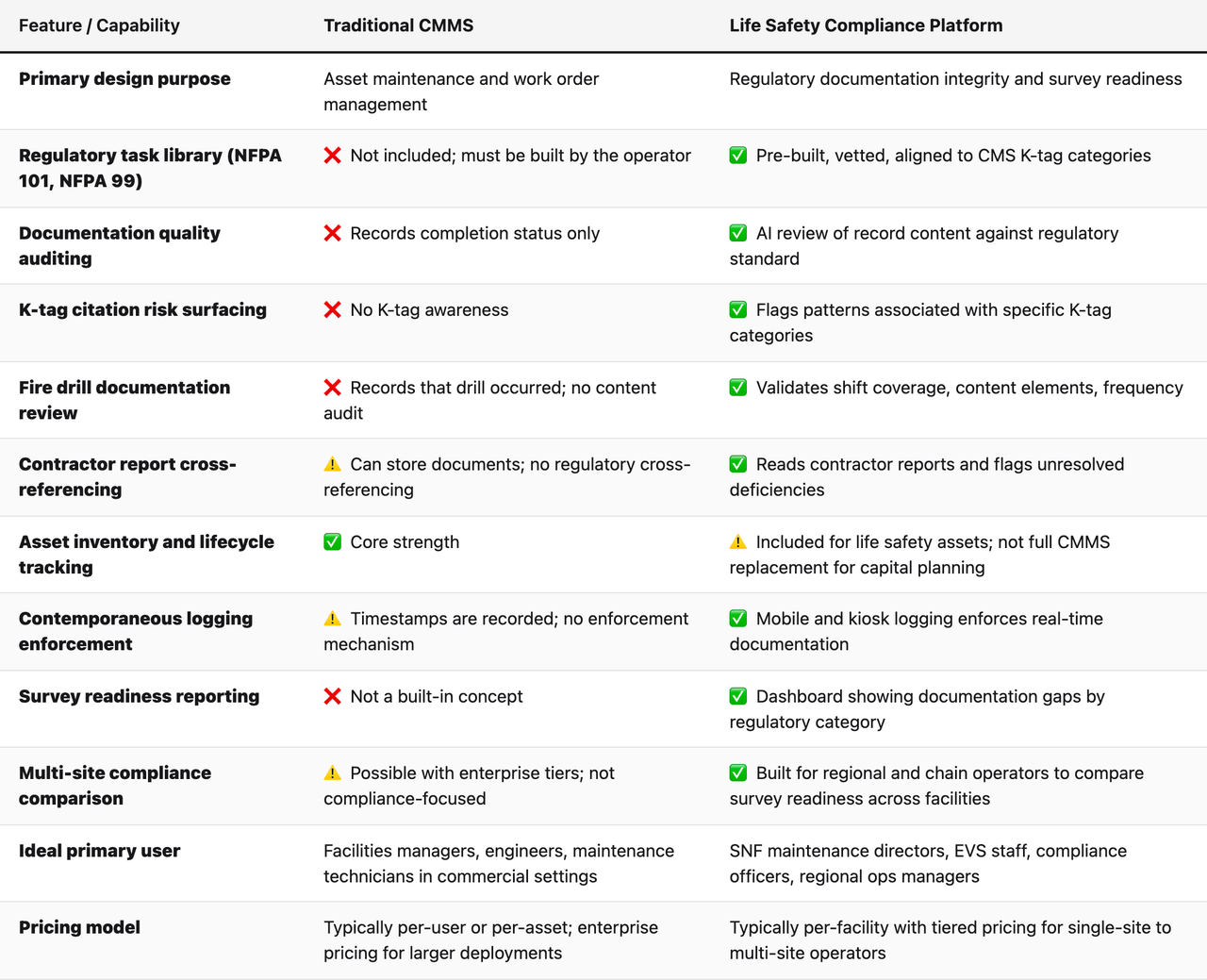
Head-to-Head: CMMS vs. Life Safety Compliance Platform
The following comparison is designed to help SNF operators make an informed category decision before evaluating specific vendors. The features compared reflect the documented architectural differences between the two product categories.
The Legacy CMMS Problem: Why Replacement Is Overdue for Many SNFs
Legacy CMMS replacement in the SNF sector has been slower than in other healthcare verticals, and the reasons are understandable. Maintenance directors who have managed their binders and their PM schedules with the same system for a decade are reluctant to migrate. Administrators who don't spend time in the plant operations office don't see the gap. And CMMS vendors have not been forthcoming about the compliance limitations of their platforms in a healthcare regulatory environment.
But the survey landscape has changed. CMS has increased enforcement focus on life safety documentation under the Fire Safety Requirements for Certain Health Care Facilities regulations, and state survey agencies have followed. The result is that documentation gaps that might have been overlooked in a less rigorous survey environment are now producing citations, and those citations carry real consequences for SNF operators.
The Hidden Cost of Documentation Gaps
The direct cost of a K-tag citation is not always the largest expense. The indirect costs compound quickly:
- Plan of correction burden: Every cited deficiency requires a written plan of correction with a specific corrective action, responsible party, and completion date. The staff time required to develop, implement, and document a plan of correction for even a single K-tag citation is substantial.
- Revisit survey exposure: Facilities that receive citations are subject to revisit surveys. Each revisit is another opportunity for surveyors to identify additional deficiencies, creating a compounding risk exposure.
- Special focus facility designation: Facilities with persistent or serious deficiencies can be designated as Special Focus Facilities, a status that carries intensified oversight, increased survey frequency, and reputational consequences that affect census.
- Civil monetary penalties: Serious or repeated life safety deficiencies can result in civil monetary penalties from CMS that dwarf the cost of any compliance software investment.
- Staff time cost: The hours a maintenance director spends responding to survey findings, pulling together documentation retrospectively, and managing plans of correction are hours not spent on facility operations. In a sector already facing workforce pressure, this is a significant hidden cost.
Against this cost structure, the question of whether to invest in a modern CMMS alternative purpose-built for life safety compliance is not primarily a technology decision. It is a risk management decision.
What Makes a CMMS "Legacy" in an SNF Context
A CMMS becomes a legacy liability for an SNF when it exhibits any of the following characteristics:
- Inspection templates were built by the maintenance director, not by life safety regulatory specialists, meaning they may be missing required data fields
- Task completion is logged but the record content is not reviewed for regulatory completeness by anyone before a survey
- Contractor service reports are stored as PDF attachments with no systematic review for flagged deficiencies
- Fire drill records are managed in a separate spreadsheet or paper log not integrated with the main system
- There is no dashboard or report that shows documentation gaps by regulatory category before a survey arrives
- The system has no concept of K-tags, NFPA chapters, or CMS survey protocols
If three or more of these apply to your current setup, you are not using a CMMS for compliance, you are using a CMMS for work order tracking while your compliance documentation lives in a parallel, unaudited paper or spreadsheet system. That is the binder problem. And it is where citations come from.
Scenario Analysis: Which Platform Fits Which SNF Operator
Not every SNF operator is in the same situation, and the right platform decision depends on the specific operational context. The following scenarios are designed to help different reader profiles identify where they sit in this comparison.
Scenario 1: The Single-Site SNF Owner-Operator Replacing a Paper Binder
If you are running one or two facilities and your current life safety documentation lives in a three-ring binder on the maintenance director's shelf, the CMMS vs. compliance platform comparison is straightforward: a general-purpose CMMS will not solve your core problem. You do not need better work order tracking. You need a system that builds the right inspection templates, schedules them correctly, logs completion contemporaneously, and then tells you whether what was logged is actually sufficient to survive a survey.
A life safety compliance platform is the appropriate choice. The operational simplicity of a single-site deployment means that implementation complexity is low, and the immediate value, knowing your documentation is survey-ready before surveyors arrive, is high. The cost of the platform is recoverable in the staff time saved managing a single K-tag plan of correction, let alone avoiding the citation entirely.
Scenario 2: The Multi-Site Regional Operator With an Existing CMMS
If you operate five to twenty facilities and already have a CMMS deployed for equipment maintenance and work order management, the question is different. You likely do not need to replace your CMMS entirely. What you need is to recognize that your CMMS is handling one problem (equipment maintenance workflow) while your life safety compliance documentation is either happening in that same system inadequately or in a parallel paper/spreadsheet process that is not audited.
The appropriate decision in this scenario is to deploy a life safety compliance platform alongside your existing CMMS, not to replace it. The CMMS continues to manage capital equipment, vendor relationships, and non-life-safety PM schedules. The compliance platform takes over all life safety documentation, inspection logging, and pre-survey auditing. This two-system approach is not redundancy, it is separation of functions by design, with each system doing what it was built to do.
Scenario 3: The SNF Chain COO Managing Survey Risk Across a Portfolio
For a VP of Operations or COO managing fifteen or more facilities, the individual facility documentation problem is a portfolio-level risk management problem. A single facility's K-tag citation does not just affect that facility's survey outcome. It affects the operator's overall CMS compliance profile, creates management distraction, and can signal to surveyors that the operator's systems are inadequate at the chain level.
This scenario demands a platform with multi-site visibility: a dashboard that shows, across all facilities, which sites have documentation gaps, which are approaching inspection intervals, and which have contractor deficiencies that have not been formally resolved. No general-purpose CMMS provides this view through a life safety compliance lens. A purpose-built compliance platform designed for multi-site operators is the only tool that gives a COO genuine pre-survey visibility at portfolio scale.
Scenario 4: The Maintenance Director Who Was Told the CMMS Handles Compliance
This is the most common and most consequential scenario. A maintenance director has been using a CMMS for several years, has been told by their administrator or their CMMS vendor that the system handles compliance documentation, and has organized their PM schedules, work orders, and inspection logs accordingly. The binder has been replaced by the system. But the system has never been audited for regulatory completeness, and the maintenance director has no way to know what they don't know.
If this describes your situation, the most important immediate action is not to switch platforms, it is to conduct a documentation audit. Pull the last twelve months of life safety inspection records from your CMMS, generator test logs, fire drill records, and contractor service reports. Review them against the K-tag categories your facility has been cited on in past surveys, or against the NFPA 101 Chapter 19 requirements for your facility type. Look specifically for missing data fields, incomplete records, and contractor-flagged deficiencies without corresponding corrective action documentation.
What you find in that audit will tell you whether your current CMMS is adequate for compliance purposes, and in most cases, it will make the platform choice obvious.
Pricing Landscape: What to Expect From Each Category
Pricing in both categories varies significantly by vendor, facility size, and feature tier. The following table reflects general market positioning rather than specific vendor quotes, and operators should request current pricing directly from vendors during evaluation.
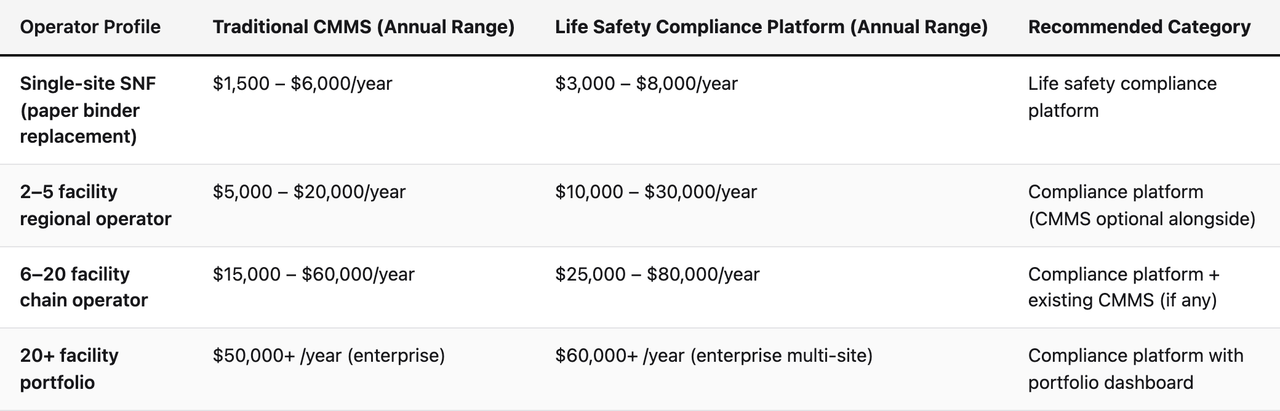
One pricing dynamic worth understanding: CMMS vendors typically price on a per-user or per-asset basis, which can make costs difficult to predict as facilities scale. Life safety compliance platforms designed for SNFs more commonly price per facility, which gives operators a predictable cost model that scales cleanly with portfolio growth. For multi-site operators managing budget across a chain, per-facility pricing is generally easier to plan around than per-user or per-asset models.
Evaluating Specific Products: A Decision Framework for SNF Operators
When evaluating specific platforms in either category, SNF operators need a structured framework that goes beyond feature checklists. The following decision framework is organized around the questions that matter most for survey readiness, not the questions that matter most for general facilities management.
The Five Questions That Matter in an SNF Platform Evaluation
1. Who built the inspection templates, and what were they built against?
This is the most important question in any platform evaluation. Generic task libraries built by software engineers are not the same as inspection templates built with life safety consultants against specific NFPA chapters and CMS K-tag categories. Ask vendors to show you the specific regulatory reference for each inspection template in their library. If they cannot, the template library is not regulatory-grade.
2. What happens when an inspection record is incomplete?
Every platform records task completion. The question is what happens when the completed record is missing a required data field. Does the system flag it? Does it surface the gap before the next survey? Does it alert the maintenance director? If the answer is "the record shows green because the task was closed," the platform is tracking work orders, not auditing documentation.
3. How does the system handle contractor service reports?
Contractor reports are one of the most common sources of unresolved documentation gaps in SNF life safety records. A platform that only stores contractor PDFs without reading and cross-referencing them for flagged deficiencies is not solving the problem that produces citations. Ask specifically how the platform handles contractor-reported deficiencies and what the workflow is for documenting correction.
4. Can the system show me my documentation gaps right now, before a survey?
This is the defining question that separates a compliance platform from a work order system. The answer should be yes, with a dashboard or report that shows, by regulatory category, which documentation gaps exist in the current record. If the answer requires manual review, the platform is not auditing, it is storing.
5. How does the system handle multi-shift fire drill requirements?
Fire drill documentation is one of the highest-frequency sources of life safety citations in SNFs. CMS requires quarterly drills on each shift, and the drill records must contain specific content elements. Ask any platform vendor to show you exactly how their system enforces shift coverage requirements and what happens when a shift's quarterly drill requirement is at risk of being missed.
Red Flags in Platform Demos
During platform demos, the following are signals that a product is not a genuine life safety compliance platform regardless of how it is marketed:
- The demo focuses primarily on work order dashboards and technician mobile apps without showing documentation quality review features
- The vendor cannot identify which NFPA chapter or CMS K-tag category each inspection template is built against
- The "compliance" features shown are primarily report generation, not proactive gap detection
- The vendor's reference customers are primarily commercial facilities, hotels, or manufacturing plants rather than healthcare providers
- The implementation plan focuses on data migration and user setup without a regulatory template review process
SEQURA as a Life Safety Compliance Platform: What It Does Differently
SEQURA was built specifically for the documentation problem that SNF operators face in the life safety survey environment. It is not a CMMS with compliance features added. It is a compliance platform with operational task management included as a component of the compliance workflow.
The distinction matters in product design. SEQURA's starting point is the regulatory requirement, not the work order. The task library was built with life safety consultants against NFPA 101, NFPA 99, and CMS K-tag categories. Each inspection template contains the data fields that CMS surveyors look for, not just the fields that make operational sense to a maintenance director building a PM schedule.
The AI review layer is the capability that most clearly separates SEQURA from the CMMS category. When a generator test is logged, SEQURA does not just record that the test happened. It reads the logged data against the regulatory expectation for that test type, flags missing or anomalous fields, and surfaces the gap in the maintenance director's dashboard before anyone else sees it. When a contractor submits a sprinkler inspection report, SEQURA cross-references the report for flagged deficiencies and creates an open item requiring corrective action documentation if any are found.
This is what SEQURA describes as predictive auditing: finding the documentation gaps that would produce citations before surveyors find them. The value proposition is not better maintenance management. It is survey confidence, the operational certainty that the record a surveyor will review on an unannounced Tuesday morning is already complete.
SEQURA is designed for the people who actually do the work in an SNF: maintenance directors, EVS staff, and technicians who share a facility kiosk. The user interface is built for the reality of a plant operations office, not for a facilities manager sitting at a desktop. Mobile and kiosk logging enforce contemporaneous documentation without requiring staff to change how they work, only to log it differently.
For multi-site operators, SEQURA provides the portfolio-level visibility that COOs and regional directors need: a cross-facility dashboard that shows documentation status, gap risk, and survey readiness across the entire portfolio. This is the capability that turns life safety compliance from a facility-level operational function into a chain-level risk management function.
Making the Decision: An Honest Recommendation
The honest recommendation for any SNF operator reading this comparison is this: if your primary concern is life safety documentation and survey readiness, a general-purpose CMMS is not the right tool. It was not built for the problem you are trying to solve, and using it for that purpose creates a false sense of documentation security that only surfaces as a problem when surveyors arrive.
If your primary concern is equipment maintenance workflow, capital planning, and vendor management across a large physical plant, a CMMS may be the right tool, but it should not be your life safety compliance system.
For the vast majority of SNF operators, the right answer is a purpose-built life safety compliance platform for all documentation that a CMS or state surveyor will review, potentially alongside a CMMS for non-life-safety equipment management if the facility's scale and complexity warrant it.
The cost difference between a CMMS and a life safety compliance platform, at the facility level, is typically in the range of a few thousand dollars per year. The cost of a single K-tag citation, including plan of correction burden, revisit survey exposure, and staff time, routinely exceeds that difference. The cost of a civil monetary penalty or Special Focus Facility designation dwarfs it by orders of magnitude.
The platform choice, framed honestly, is not a technology decision. It is a risk management decision. And the risk calculus in today's SNF survey environment strongly favors a tool that was built to find documentation gaps before surveyors do.
Frequently Asked Questions: CMMS vs. Life Safety Compliance Platforms for SNFs
Can a CMMS replace a life safety binder for CMS survey purposes?
A CMMS can digitize the records that currently live in a life safety binder, but digitizing records is not the same as auditing them. A CMMS records task completion. It does not evaluate whether the completed record contains the data fields a CMS surveyor will look for, or whether inspection cadences meet NFPA requirements. For survey purposes, a CMMS without documentation quality auditing is a digital binder, not a compliance system.
What is a K-tag, and why does it matter for platform selection?
K-tags are the citation codes CMS uses to identify life safety deficiencies during nursing home surveys. Each K-tag corresponds to a specific requirement under NFPA 101, NFPA 99, or related standards. A platform built for SNF life safety compliance organizes its task library and documentation auditing around K-tag categories. A general-purpose CMMS has no K-tag awareness, meaning it cannot alert operators to documentation patterns that are likely to produce specific K-tag citations.
Do SNFs need both a CMMS and a life safety compliance platform?
For most SNFs, the answer depends on facility size and operational complexity. Smaller facilities with a single maintenance director can typically manage all plant operations within a life safety compliance platform without a separate CMMS. Larger facilities or multi-site chains may benefit from maintaining a CMMS for capital equipment management and vendor tracking alongside a life safety compliance platform for all regulatory documentation. The key is ensuring that life safety documentation does not live in the CMMS, where it will not be audited for regulatory completeness.
How do CMS surveyors evaluate life safety documentation during an unannounced survey?
CMS surveyors follow the CMS Survey Protocol for Long Term Care Facilities and the Life Safety Code Survey Worksheet when reviewing life safety documentation. They look at specific K-tag categories, pulling inspection logs, fire drill records, generator test documentation, and contractor service reports. They evaluate not just whether inspections occurred, but whether the records contain the required content elements and whether deficiencies identified during inspections were formally documented and resolved. A platform that only records task completion will not protect an SNF from citation for incomplete or deficient records.
What is contemporaneous documentation, and why does it matter?
Contemporaneous documentation means that inspection records are created at the time of the inspection, not reconstructed after the fact. CMS surveyors are trained to identify backdated or retroactively created records, and documentation that appears to have been created in response to a survey rather than during the actual inspection can itself become a finding. Life safety compliance platforms that enforce real-time logging via mobile or kiosk entry create contemporaneous records by design. Paper binders and CMMS systems that allow records to be entered after the fact create contemporaneous documentation risk.
Can a life safety compliance platform handle non-life-safety maintenance tasks?
Most life safety compliance platforms include basic task management capabilities that can handle routine non-life-safety maintenance items. However, they are not designed to replace a full CMMS for capital equipment lifecycle management, multi-vendor tracking, or complex maintenance cost accounting. Operators who need those capabilities should plan for a two-system approach rather than expecting a life safety compliance platform to fully replace a CMMS.
How long does it take to implement a life safety compliance platform in an SNF?
Implementation timelines vary by vendor and facility complexity, but most single-site SNF deployments can be operational within four to eight weeks. The critical path is typically the regulatory template review, during which the platform's task library is aligned to the facility's specific NFPA chapter requirements and state-specific regulations. Multi-site deployments require additional coordination but benefit from standardized template deployment across facilities, which accelerates the per-facility implementation timeline after the first site is configured.
What should an SNF operator look for in a vendor's regulatory template library?
The most important questions are: which regulatory standards are the templates built against, who built them, and when were they last reviewed for regulatory updates. Templates should be traceable to specific NFPA chapters and CMS K-tag categories. They should have been built or reviewed by life safety consultants with healthcare facility experience, not by software engineers. And they should be updated when NFPA standards or CMS survey protocols change, which requires the vendor to maintain active regulatory expertise as a core competency.
Is AI-based documentation auditing reliable enough to trust for survey preparation?
AI-based documentation auditing in life safety compliance platforms works by cross-referencing completed records against defined regulatory expectations for each inspection type. This is a structured pattern-matching task that AI handles well, particularly for identifying missing data fields, anomalous values, and unresolved deficiencies across large volumes of records. The reliability of the auditing is directly proportional to the quality of the regulatory expectations the AI is cross-referencing against, which is why the regulatory template library is the most important component to evaluate in any platform.
How does a life safety compliance platform handle state-specific regulations that differ from NFPA standards?
State survey agencies often adopt NFPA standards with state-specific amendments, and some states impose additional life safety requirements beyond the federal baseline. A purpose-built SNF compliance platform should include state-specific regulatory overlays for the states in which the operator's facilities are licensed. During platform evaluation, operators should confirm that state-specific requirements for their operating states are included in the template library and ask how the vendor manages regulatory updates when state requirements change.
What does "survey confidence" mean as a product outcome?
Survey confidence means that before an unannounced CMS or state survey, the operator has a high degree of certainty that the documentation a surveyor will review does not contain the gaps that produce citations. It is not a guarantee of a zero-deficiency survey, because surveyors also observe physical conditions and interview staff. But it means that the documentation component of the life safety survey, which is where the majority of K-tag citations originate, has been proactively audited and corrected. For most SNF operators, documentation gaps are the controllable component of survey risk, and survey confidence is the outcome of controlling them systematically.
How does multi-site compliance visibility work in a portfolio deployment?
In a multi-site deployment, a life safety compliance platform provides a portfolio-level dashboard that aggregates documentation status across all facilities. Regional directors and COOs can see, at a glance, which facilities have open documentation gaps, which are approaching inspection intervals, which have contractor deficiencies requiring corrective action, and which are most at risk for citation in the near term. This view allows chain operators to prioritize compliance support resources proactively rather than reactively, shifting the operational model from survey response to survey prevention.
Key Takeaways
- CMMS platforms and life safety compliance platforms solve different problems. A CMMS tracks work order completion. A life safety compliance platform audits documentation quality against regulatory standards. SNFs need the second, not just the first.
- Task completion is not documentation integrity. A completed inspection log that is missing required data fields is not a defensible record in a CMS survey. The gap between "done" and "documented correctly" is where K-tag citations are born.
- The regulatory template library is the most important thing to evaluate in any platform. Templates built by life safety consultants against NFPA chapters and CMS K-tag categories are categorically different from generic PM schedules built by software engineers.
- Contractor service reports are a hidden citation risk. Reports that flag deficiencies without corresponding corrective action documentation are a common and frequently missed source of life safety citations. A platform that stores but does not read contractor reports does not solve this problem.
- Multi-site operators need portfolio-level visibility. Facility-by-facility documentation management is not sufficient for chain operators whose survey risk is a portfolio-level exposure. A compliance platform with a multi-site dashboard is a fundamentally different operational capability than managing documentation at each facility individually.
- The cost difference between categories is recoverable in a single plan of correction. The annual cost premium of a purpose-built life safety compliance platform over a general-purpose CMMS is typically less than the staff time and operational burden of managing one K-tag citation cycle.
- Legacy CMMS replacement for life safety documentation is overdue for most SNFs that have been using a CMMS as their primary compliance tool. A documentation audit against NFPA requirements and K-tag categories will quickly reveal whether the current system is adequate.
About the author
Benjamin Terebelo · Founder
Benjamin is the founder of SEQURA, a compliance platform purpose-built for healthcare facilities. He builds at the intersection of healthcare operations and software, maintaining a focus on bringing modern tooling to systems that the broader industry has largely left behind.
About the author
Benjamin Terebelo · Founder
Benjamin is the founder of SEQURA, a compliance platform purpose-built for healthcare facilities. He builds at the intersection of healthcare operations and software, maintaining a focus on bringing modern tooling to systems that the broader industry has largely left behind.