28 min read
Standalone Compliance Platform vs. CMMS With Compliance Modules vs. Spreadsheet-Plus-Binder: A Total-Cost-of-Survey-Risk Comparison
Price tags don't reveal total survey risk cost. This comparison calculates what each documentation approach — platform, CMMS module, or binder — actually costs when a surveyor arrives.
By Benjamin Terebelo

The line item on a compliance software proposal never shows the real number. It shows a monthly fee, maybe an implementation cost, occasionally a per-seat charge. What it never shows is the cost of the survey deficiency that your current documentation approach is quietly incubating right now. That number, the total cost of survey risk, is what this comparison is actually about.
Skilled nursing facilities evaluating how to manage life safety documentation almost always frame the decision as a software cost question. Should we buy a standalone compliance platform? Does our CMMS already have a compliance module we should activate? Can we keep doing what we're doing with spreadsheets and a binder? These feel like budget questions. They are not. They are risk questions wearing a budget disguise.
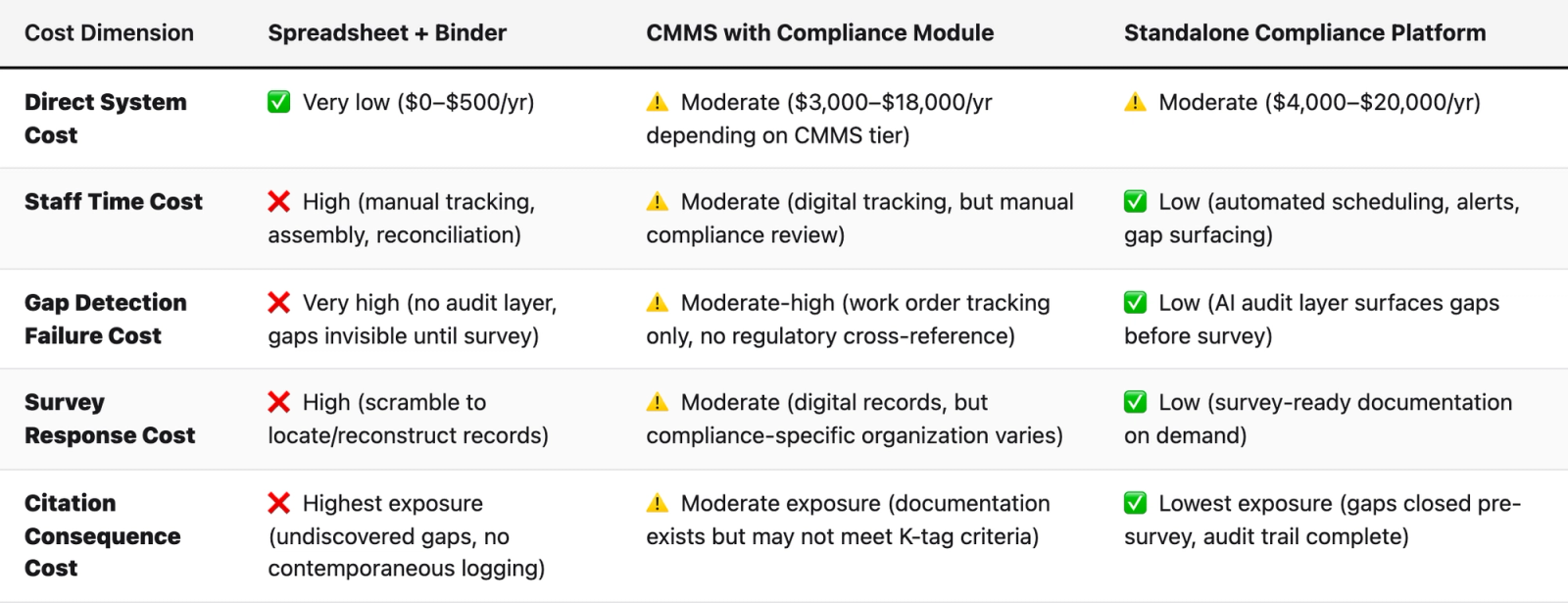
This article does something most compliance software comparisons skip: it accounts for the full cost of each approach, including what happens when a CMS or state surveyor arrives at 7:45 AM on a Tuesday and your documentation has a gap you didn't know existed. The analysis covers three approaches, standalone compliance platforms, CMMS systems with compliance modules, and the spreadsheet-plus-binder method, across five cost dimensions that collectively define total survey risk exposure.
Why "Total Cost of Survey Risk" Is the Right Framework
Standard total-cost-of-ownership analysis looks at purchase price, implementation, training, and ongoing maintenance. That framework was designed for enterprise software in industries where the cost of getting it wrong is a missed deadline or a dissatisfied customer. In skilled nursing, the cost of getting documentation wrong can be a citation, a civil money penalty, a directed plan of correction, or in the most severe cases, termination of the Medicare/Medicaid provider agreement.
The CMS Life Safety Code survey process is designed to be unannounced, thorough, and document-intensive. Surveyors are not looking primarily for malfunctioning equipment. They are looking for documentation failures: missing records, incomplete logs, non-contemporaneous entries, and gaps in inspection cadence. The K-tags that generate the most civil money penalties are overwhelmingly documentation failures rather than physical deficiencies.
That means the compliance documentation system a facility chooses is not a back-office efficiency tool. It is the primary risk management instrument for the highest-stakes regulatory exposure the facility faces. Evaluating it only on subscription cost is like evaluating a malpractice insurance policy only on the premium.
The five cost dimensions in this framework are:
- Direct system cost (licensing, implementation, training)
- Staff time cost (hours spent on documentation, audit prep, and remediation)
- Gap detection failure cost (the cost of deficiencies the system fails to surface before a surveyor finds them)
- Survey response cost (time and resources consumed during and after a survey)
- Citation consequence cost (CMP exposure, corrective action, reputation damage)
Each of the three approaches performs very differently across these five dimensions. The approach that looks cheapest on dimension one frequently looks most expensive on dimensions three through five.
The Spreadsheet-Plus-Binder Approach: Low Sticker, High Exposure
The spreadsheet-plus-binder approach is the default in a large portion of the SNF market, particularly among smaller operators and single-facility owners who have managed surveys without a major citation long enough to develop confidence in their current system. The binder sits in the maintenance director's office, filled with printed inspection logs, drill records, and contractor reports. The spreadsheet, or sometimes just a shared drive with folders, tracks what's been completed and when.
The appeal is obvious: no new software to buy, no implementation project, no staff retraining. If a facility has been doing it this way for years, the institutional knowledge is already embedded in whoever maintains the binder.
What the Spreadsheet-Plus-Binder Actually Costs
The direct system cost is genuinely low. A shared drive license, some printer paper, and a few hours of spreadsheet maintenance per month. On dimension one, this approach wins easily.
The staff time cost is where the gap begins to open. A maintenance director managing life safety compliance via binder typically spends significant time each month on manual tracking: pulling inspection logs from contractors, verifying completion dates, updating the spreadsheet, printing records, and filing them. When a survey is announced (or when word spreads that the state is in the area), that time spikes dramatically as staff scramble to locate missing records, reconstruct logs from memory or contractor invoices, and physically organize the binder for surveyor review.
The gap detection failure cost is the most significant and the most invisible. Spreadsheets and binders do not audit themselves. A spreadsheet that says "fire drill completed, night shift, Q3" does not know whether the drill log includes required staff counts, whether it was conducted within the required window, or whether the documentation is consistent with the policy in the facility's emergency operations plan. The person who completed the spreadsheet entry probably doesn't know those requirements at the K-tag level either, because that level of regulatory specificity is not built into a generic spreadsheet.
This creates what might be called the confidence trap: a binder that looks complete to the person who assembled it while containing multiple exploitable gaps for a surveyor who knows exactly what to look for. The maintenance director has high confidence in a document set that a trained surveyor can dismantle in forty-five minutes.
The Citation Cost Reality
Civil money penalties for life safety deficiencies are calculated per day of noncompliance, not per incident. Under CMS civil money penalty regulations, per-day penalties for Immediate Jeopardy citations can reach $10,000 or more per day, with the calculation running from when the deficiency began, not when it was discovered. A documentation gap that has existed for six months because no system was checking for it is not a one-day penalty. It is a potential six-month penalty, capped only by the maximum penalty structure.
Non-Immediate Jeopardy citations carry lower per-day rates but still accumulate meaningful financial exposure, particularly when a facility receives a pattern of deficiencies across multiple K-tags. A directed plan of correction requiring third-party monitoring adds consulting fees, follow-up survey costs, and staff time on top of the penalty itself.
The spreadsheet-plus-binder approach systematically underestimates this risk because the person managing the system has no visibility into whether their documentation meets the specific regulatory criteria surveyors apply. They know the binder is full. They do not know whether what's in it is sufficient.
CMMS With Compliance Modules: The Middle-Ground Trap
Computerized Maintenance Management Systems have become the operational backbone of many SNF plant operations departments. Platforms like Dude Solutions (now Brightly), eMaint, FMX, and others offer work order tracking, preventive maintenance scheduling, asset management, and vendor coordination in a single system. Several of these platforms have added "compliance" modules that allow facilities to attach regulatory tasks to their PM schedules.
For administrators evaluating documentation approaches, the CMMS-with-compliance-module option seems to offer the best of both worlds: the operational efficiency of digital work order management plus the regulatory coverage of a compliance tool, without paying for a separate system. This reasoning is understandable, and in some dimensions it is correct. But the CMMS compliance module has a structural limitation that produces a specific and predictable category of survey risk.
What CMMS Compliance Modules Do Well
A CMMS compliance module is genuinely good at two things: scheduling recurring tasks and recording completion. If a facility configures the system correctly, it will generate a PM work order for the monthly fire extinguisher inspection, route it to the right technician, and log the completion date when the technician closes the work order. That is a real improvement over a spreadsheet that someone remembers to update.
The digital audit trail a CMMS creates is also meaningfully better than a paper binder during a survey. Records are searchable, timestamps are system-generated rather than handwritten, and producing documentation for a surveyor's request takes minutes rather than the binder-search scramble that manual systems require. For facilities with multiple sites, a CMMS provides consolidated visibility into which locations are current on preventive maintenance tasks, which is genuinely useful for a regional facilities manager.
The Compliance Gap CMMS Modules Cannot Close
The structural limitation of CMMS compliance modules is that they are task management tools, not regulatory interpretation tools. A CMMS knows that a fire extinguisher inspection was assigned on a certain date and marked complete. It does not know whether the completed record contains the specific data elements that CMS surveyors require to consider the inspection documented. It does not know whether the technician who closed the work order actually recorded the pressure reading, the inspection result, and the corrective action notation that K-tag 321 requires. It does not cross-reference the completion against NFPA 10 inspection criteria.
This is not a criticism of CMMS platforms, it reflects their design intent. CMMS systems are built to manage work, not to audit regulatory compliance. The compliance modules that major CMMS vendors have added are primarily scheduling overlays: they add regulatory-sounding task names to the PM calendar, but they do not embed the regulatory criteria that make a completed record defensible to a surveyor.
The result is a documentation set that looks complete from an operational standpoint while containing systematic gaps at the regulatory specificity level. A CMMS might show that every required fire drill was completed on schedule. It will not flag that the Q3 night-shift drill log is missing the required documentation of staff response times, or that the drill was conducted during a shift overlap that CMS guidance does not count as a valid night-shift exercise.
The Configuration and Maintenance Problem
CMMS compliance modules also require substantial ongoing configuration to remain current with regulatory requirements. NFPA standards are updated on regular cycles. CMS survey protocols evolve. State-specific life safety requirements layer on top of federal requirements and vary significantly. A CMMS compliance module that was configured at implementation reflects the regulatory landscape at that moment. Keeping it current requires someone with regulatory expertise to monitor changes and update the system accordingly, a capability that most SNF maintenance departments do not have and most CMMS vendors do not provide as a service.
In practice, this means CMMS compliance configurations drift over time. A facility that configured its compliance module three years ago may be running inspection schedules that no longer reflect current NFPA or CMS requirements without anyone in the organization realizing it. The system looks active and current because work orders are being generated and closed. The underlying regulatory alignment has degraded.
CMMS Pricing Reality for SNF Operators
CMMS pricing varies widely based on module selection, number of users, number of assets, and whether the compliance module is included in the base package or sold as an add-on. For a single SNF, annual costs typically range from a few thousand dollars for basic platforms to well above $15,000 for enterprise-tier systems with full compliance module access. Multi-site operators generally negotiate volume pricing, but the per-facility cost for compliance-module access often remains significant.
More relevant to the total cost calculation: CMMS vendors rarely offer life-safety-specific regulatory expertise as part of the service. Implementation support is operational (how to configure the system) rather than regulatory (what to configure to meet K-tag requirements). The facility bears the burden of translating regulatory requirements into CMMS task configurations, a burden that most maintenance directors are not equipped to carry accurately.
Standalone Compliance Platforms: What the Category Actually Delivers
Standalone compliance platforms built specifically for healthcare life safety documentation operate on a fundamentally different design premise than CMMS systems. Rather than starting with work order management and adding compliance features, they start with the regulatory requirements and build the documentation workflow around them. The distinction matters because it determines what the system can actually catch.
The core capability that separates purpose-built compliance platforms from CMMS compliance modules is the regulatory interpretation layer: the ability to evaluate whether completed documentation meets not just the scheduling requirement but the content requirements that surveyors apply. A platform built on NFPA 101, NFPA 99, and CMS Appendix I interpretive guidelines can embed those criteria into the completion verification process, flagging records that are incomplete at the regulatory content level rather than just the scheduling level.
The Audit Layer: Where Standalone Platforms Earn Their Cost
The most important differentiator in a purpose-built compliance platform is the audit capability that runs on top of the documentation workflow. This is the layer that reads completed inspection records and asks whether they satisfy the specific criteria a surveyor would apply, not just whether they exist.
Consider how this plays out in practice. A generator load test record might show a date, a technician name, and a notation of "test completed." To the maintenance director, that record looks complete. To a surveyor applying NFPA 110 requirements, that record is missing the kilowatt load reading, the transfer time, and the voltage and frequency measurements required for a compliant generator test log. A standalone compliance platform built with those criteria embedded will flag the incomplete record. A CMMS compliance module will not, because it does not know what NFPA 110 requires in a completed generator test log.
The same principle applies across the full spectrum of life safety inspections: fire pump flow tests, sprinkler system quarterly checks, fire door inspection records, emergency lighting tests, and the dozens of other recurring inspections that accumulate in a life safety compliance program. Each inspection type has specific documentation content requirements under NFPA standards or CMS guidelines. A platform built with those requirements embedded can audit for them. A general-purpose work order system cannot.
Task Library Quality: The Hidden Differentiator
Not all standalone compliance platforms are equivalent. The quality of the underlying task template library, specifically whether it was built with regulatory expertise and kept current with NFPA and CMS updates, determines whether the platform's scheduling actually aligns with what surveyors will evaluate.
A platform built with life safety consultants and validated against NFPA 101, NFPA 99, and state-specific life safety requirements provides a materially different level of regulatory alignment than a platform that allows facilities to self-configure tasks from a generic template library. The former embeds regulatory expertise into the product. The latter simply provides a more compliant-looking spreadsheet.
For SNF operators evaluating standalone platforms, the right questions to ask are: Who built the task library? Was it validated against specific K-tag categories? How are updates handled when NFPA standards are revised or CMS survey protocols change? Is the regulatory maintenance included in the subscription, or does the facility carry that burden?
Contemporaneous Documentation and the Survey Defensibility Question
CMS surveyors are specifically trained to identify non-contemporaneous documentation: records that appear to have been assembled, reconstructed, or backdated in anticipation of a survey rather than created at the time of the inspection. Paper binders are particularly vulnerable to this challenge because the documentation is physically assembled and could theoretically be modified after the fact. Spreadsheets carry the same vulnerability.
A standalone compliance platform with system-generated timestamps, mobile or kiosk-based completion logging, and an immutable audit trail creates documentation that is inherently more defensible against a non-contemporaneous challenge. When a technician completes a fire extinguisher inspection via mobile device and the completion is logged with a GPS timestamp and device identifier, that record is structurally different from a paper log entry that a surveyor can only accept on faith.
This contemporaneous documentation advantage is not a minor procedural benefit. It is a material risk reduction in the scenario most likely to produce a citation: a surveyor who finds a documentation gap and questions whether the work was actually done or simply recorded after the fact.
The Multi-Site Calculation: Where Platform Advantages Compound
The total cost of survey risk calculation changes significantly for multi-site SNF operators. At a single facility, the spreadsheet-plus-binder approach may be manageable by a competent maintenance director who knows the building, the inspection schedule, and the contractor relationships well enough to hold the documentation together. The risk is real but bounded by the scale of one location.
At five facilities, ten facilities, or fifty, the math changes completely. Each additional facility adds another maintenance director's documentation habits, another contractor relationship to track, another set of inspection logs that may or may not be complete, and another survey risk exposure that the operator cannot monitor from a regional or corporate level without a system that provides consolidated visibility.
Regional Visibility and the Citation Clustering Problem
Multi-site operators face a specific risk that single-facility operators do not: citation clustering. When a CMS or state surveyor finds a life safety citation at one facility in a chain, sister facilities are more likely to receive scrutiny in subsequent surveys. A regional documentation gap, the same incomplete fire drill log format used at every facility because the maintenance director template was shared across the chain, can produce the same citation at every location simultaneously.
A standalone compliance platform with multi-site visibility allows a regional facilities manager or compliance officer to identify documentation patterns across facilities before a survey surfaces them. If every facility in a region is logging generator tests without kW load readings, that pattern is visible at the platform level and correctable before it becomes a citation at every location. In a spreadsheet environment, that pattern is invisible until a surveyor finds it at facility one, at which point the operator is scrambling to correct the same gap at facilities two through ten while facility one is under a plan of correction.
Staff Turnover and Documentation Continuity
Maintenance director turnover is a real operational challenge in the SNF industry. When the person who maintained the binder leaves, they frequently take the institutional knowledge of how the documentation system worked with them. A new maintenance director inheriting a paper binder or a spreadsheet inherits a documentation artifact they did not create, may not fully understand, and cannot easily audit for gaps.
A standalone compliance platform externalizes the regulatory knowledge from the individual and embeds it in the system. A new maintenance director who logs into a platform with a vetted task library, a pre-configured inspection schedule, and an audit layer that flags gaps does not need to reconstruct the compliance program from institutional knowledge. The platform carries the regulatory requirements; the director provides the execution.
This continuity benefit has a direct dollar value in the multi-site context. The cost of a compliance gap created during a maintenance director transition, if it produces a citation at the next survey, is far higher than the cost of a platform that prevents the gap from forming in the first place.
Building the Total Cost Model: A Practical Framework
The following framework is designed for SNF administrators and operators who want to calculate total survey risk cost for their specific situation rather than relying on a general comparison. It treats the five cost dimensions as inputs to a model that produces a defensible number for each approach.
Step 1: Establish Your Documentation Labor Baseline
Calculate the current annual staff hours spent on life safety documentation across three categories: routine documentation (completing and logging inspections), compilation (assembling records for internal reviews or survey prep), and remediation (locating missing records, reconstructing logs, or correcting documentation errors). Multiply by the fully loaded hourly cost for the staff involved (typically the maintenance director's rate for compilation and remediation, technician rates for routine documentation).
In most binder-based operations, this number is substantially higher than administrators expect because the labor is distributed across many small tasks that are not tracked as a category. A maintenance director who spends thirty minutes per day on documentation-related tasks is spending roughly 130 hours per year, or three-plus full work weeks, on a function that a platform can largely automate.
Step 2: Estimate Your Current Gap Exposure
This is the hardest step because it requires honest assessment of documentation quality, not just documentation volume. The questions to answer: When was the last time someone outside the maintenance department reviewed the life safety documentation against specific K-tag criteria? Has the facility received a life safety citation in the last three survey cycles? Are there inspection categories where contractor records are being filed without verification that they meet CMS documentation content requirements?
A facility that has never had a professional compliance review of its documentation should assume meaningful gap exposure, regardless of how organized the binder looks. The confidence trap is pervasive precisely because documentation gaps are not visible to the person who created the documentation.
Step 3: Assign Dollar Values to Citation Risk
The CMS civil money penalty framework provides the basis for quantifying citation consequence cost. For life safety deficiencies, the relevant penalty tiers are: Immediate Jeopardy (IJ) deficiencies, which carry the highest per-day penalties; non-IJ deficiencies with substandard quality of care, which carry intermediate penalties; and non-IJ deficiencies without substandard quality of care, which carry lower per-day penalties but still accumulate over the duration of noncompliance.
For a conservative total cost model, assign a probability-weighted citation cost to each approach based on the gap detection failure assessment in step 2. A facility with high gap exposure under the binder approach should apply a higher probability weight to the citation cost estimate. A facility using a platform with a strong audit layer should apply a lower weight.
Step 4: Factor in Survey Response Costs
Survey response costs are often overlooked in compliance budget discussions because they are not a line item until a survey happens. They include: administrator and maintenance director time during the survey itself (typically one to three days of significant time diversion); plan of correction development (often requiring outside consultant support); follow-up survey costs if the initial plan of correction is not accepted; and the ongoing monitoring burden during the correction period.
For a facility with solid documentation, survey response is primarily a time cost, a few days of focused attention to provide requested records and answer surveyor questions. For a facility that discovers documentation gaps during a survey, it becomes a multi-week project with meaningful external costs.
Step 5: Calculate and Compare
Summing the five dimensions for each approach typically produces a result that looks very different from the direct system cost comparison. The spreadsheet-plus-binder approach, which wins on dimension one by a significant margin, frequently loses on the total cost calculation by a margin large enough to justify a standalone platform several times over. The CMMS compliance module, which appears to offer a middle path, often ends up in the worst position on the total cost model: it carries meaningful direct system costs, does not eliminate the gap detection failure risk, and provides a false sense of compliance confidence that can delay corrective investment until a survey forces the issue.
SNF Spreadsheet Compliance Risk: The Patterns That Produce Citations
Understanding which specific documentation failures produce the most life safety citations helps quantify the gap detection failure cost for binder-based and CMMS-based operations. The patterns that generate citations are remarkably consistent across facilities and survey cycles, which means they are predictable, preventable, and specifically addressable by a platform with the right audit layer.
Fire Drill Documentation Gaps
Fire drill documentation is one of the most common life safety citation categories, and the failures are almost always at the content level rather than the scheduling level. Facilities conduct the drills on schedule and log them in the binder or CMMS. The citations occur because the logs are missing required elements: staff count by shift, floor-by-floor response documentation, timing of alarm activation versus evacuation initiation, or evidence that all required shifts (including overnight) received equal drill frequency over the year. A spreadsheet or CMMS records that a drill happened. It does not verify that what was recorded constitutes a compliant drill log.
Generator and Emergency Power Documentation
Generator testing documentation is highly specific under NFPA 110, and the specificity is where most citation exposure lives. Monthly load tests require documentation of kilowatt output, transfer switch operation, and specific voltage and frequency readings. Annual load bank tests require even more detailed recording. Facilities that log "generator test completed" without capturing the required data elements have documentation that will not withstand surveyor scrutiny, regardless of how frequently the tests were actually performed.
Sprinkler System Deficiency Tracking
Sprinkler inspection reports from licensed contractors frequently identify minor deficiencies that require corrective action within a defined timeframe. The citation risk is not the deficiency itself, it is the failure to document that the deficiency was received, reviewed, and resolved within the required window. A binder that contains the contractor's inspection report but no evidence of management review and deficiency resolution is a citation waiting to happen. A CMMS that logs the PM task as complete (inspection received) but does not track the deficiency resolution workflow leaves the same gap open.
K-Tag Cadence Drift
Many life safety inspections have specific frequency requirements that are more granular than "monthly" or "quarterly." Fire door inspections, for example, have specific annual requirements with particular documentation content under NFPA 80. Eyewash station checks have weekly frequency requirements under ANSI Z358.1. Facilities that track these inspections by month rather than by the specific required interval accumulate cadence drift over time, creating documentation records that show regular activity but do not meet the precise frequency requirements that surveyors apply.
The Life Safety Binder Replacement Decision: Who Should Choose What
The right documentation approach depends on facility size, operator sophistication, existing technology infrastructure, and realistic assessment of current compliance risk. The following framework addresses the most common decision scenarios.
If You Are a Single-Facility SNF Operator With No Prior Life Safety Citations
The spreadsheet-plus-binder approach is survivable but increasingly risky as CMS survey protocols have intensified focus on documentation quality. The key question is not whether you have been cited before, it is whether a professional compliance review of your current documentation would find gaps. If you have never had an independent review, assume gaps exist and evaluate a standalone platform against the cost of discovering those gaps during a survey rather than before one.
A standalone compliance platform purpose-built for SNF life safety documentation typically represents a cost-justified investment for a single facility once the total cost model is applied honestly. The staff time savings alone, eliminating manual tracking, compilation, and survey-prep scramble, often recover a significant portion of the platform cost before the gap detection benefit is even factored in.
If You Are Already Using a CMMS and Considering the Compliance Module
Activate the CMMS compliance module for operational efficiency (scheduling, work order management, digital records) but do not treat it as a substitute for regulatory-grade compliance documentation. The CMMS compliance module can improve your documentation workflow. It cannot audit your documentation against K-tag criteria. If your CMMS vendor is representing the compliance module as a full survey-readiness solution, that representation does not hold up against the specificity of what CMS surveyors actually evaluate.
The practical recommendation for CMMS users: maintain the CMMS for work order management and use a purpose-built compliance platform for the audit and gap detection function. The two systems serve different purposes and the overlap is less than it appears. Alternatively, if budget constraints make a dual-system approach impractical, the honest assessment is that the CMMS compliance module reduces some risk while leaving the most consequential risk (gap detection at the regulatory content level) unaddressed.
If You Are a Multi-Site Operator Managing More Than Three Facilities
At three or more facilities, the total cost model almost always favors a standalone compliance platform with multi-site visibility over any combination of binder and CMMS approaches. The regional visibility benefit, the citation clustering prevention value, and the staff turnover continuity benefit compound across facilities in a way that makes the per-facility platform cost increasingly easy to justify.
For regional operators, the relevant comparison is not platform cost versus binder cost at a single facility. It is platform cost across the portfolio versus the expected cost of a documentation-driven citation at one or more facilities per survey cycle, because without a platform that provides consolidated audit visibility, a documentation-driven citation at some facility in the portfolio in any given year is a near-certainty at sufficient scale.
What to Actually Evaluate When Comparing Platforms
For SNF administrators and operators who have decided that a standalone compliance platform is the right approach, the next challenge is evaluating the options in a market where several vendors make similar claims. The following evaluation criteria are specific to life safety documentation for SNFs and cut through marketing language to the capabilities that actually matter for survey risk reduction.
Task Library Regulatory Depth
Ask specifically: Was the task library built with licensed life safety consultants? Is it validated against specific K-tag categories in CMS Appendix I? How are NFPA standard updates incorporated into the library, and on what timeline? A platform that allows facility self-configuration of tasks is not providing the regulatory expertise that differentiates a purpose-built compliance platform from a sophisticated spreadsheet. The regulatory knowledge needs to be embedded in the product, not left to the facility to supply.
Audit and Gap Detection Capability
Ask specifically: Does the platform review completed records for content completeness against regulatory criteria, or does it only track whether tasks were completed? Can it identify that a generator test log is missing required data elements, or does it only confirm that the task was closed? The answer to this question is the clearest differentiator between platforms that reduce gap detection failure cost and platforms that do not.
Contemporaneous Documentation Architecture
Ask specifically: How does the platform ensure that completion records are contemporaneous? Does it support mobile or kiosk completion at the point of inspection? Are timestamps system-generated and immutable? Can a surveyor challenge the records as reconstructed or backdated? The survey defensibility of the documentation depends heavily on the technical architecture of how it is created, not just on what it contains.
Multi-Site Visibility for Regional Operators
Ask specifically: What does the platform show at the regional or corporate level? Can a compliance officer see documentation completion rates, gap alerts, and citation risk indicators across all facilities in a single view? Is the multi-site functionality built into the platform or an add-on that requires enterprise pricing? For operators managing multiple facilities, a platform that requires facility-by-facility review provides only marginally better visibility than a binder system.
Frequently Asked Questions
What is total cost of survey risk, and how is it different from total cost of ownership?
Total cost of ownership covers direct costs: software, implementation, training, and maintenance. Total cost of survey risk adds the indirect costs that compliance documentation failures produce: staff time on manual processes, the cost of documentation gaps that a surveyor finds before you do, the time and resources consumed during and after a survey, and the financial consequences of citations. For SNF compliance documentation, the indirect costs typically dwarf the direct costs.
Can a CMMS with a compliance module replace a standalone compliance platform for SNF life safety documentation?
A CMMS compliance module can replace a standalone platform for scheduling and work order management, but it cannot replicate the regulatory interpretation and gap detection functions of a purpose-built compliance platform. CMMS systems track whether tasks were completed. Purpose-built platforms evaluate whether what was completed meets the regulatory content criteria surveyors apply. That distinction determines whether your documentation is defensible at a survey.
How much do civil money penalties for life safety citations typically cost?
CMS civil money penalties are calculated per day of noncompliance, not per incident. Per-day amounts vary by deficiency severity, with Immediate Jeopardy citations carrying the highest rates. The total penalty accumulates from when the deficiency began, which for a documentation gap could be months before a surveyor identified it. Penalties are separate from the cost of corrective action, follow-up surveys, and any third-party monitoring required under a directed plan of correction.
Is the spreadsheet-plus-binder approach ever appropriate for SNF life safety documentation?
It is survivable in some circumstances, but it is structurally incapable of detecting documentation gaps at the regulatory content level. A well-maintained binder may pass a survey if the documentation happens to be complete. It cannot tell you whether it is complete before the surveyor arrives. At current CMS survey intensity, relying on luck and institutional knowledge is an increasingly high-risk strategy.
What NFPA standards are most relevant to SNF life safety documentation?
The primary standards are NFPA 101 (Life Safety Code), NFPA 99 (Health Care Facilities Code), NFPA 110 (Emergency and Standby Power Systems), NFPA 13 (Sprinkler Systems), and NFPA 10 (Portable Fire Extinguishers). Each standard specifies both inspection frequency and documentation content requirements. CMS Appendix I translates these into K-tag categories that surveyors use during life safety surveys.
How does staff turnover affect compliance documentation risk?
Significantly. Binder-based and spreadsheet-based documentation systems embed regulatory knowledge in the individual who maintains them. When that person leaves, the documentation continuity depends on whoever inherits the system understanding what was being tracked and why. A purpose-built compliance platform externalizes the regulatory knowledge into the system itself, maintaining continuity regardless of turnover.
What does contemporaneous documentation mean in the survey context?
Contemporaneous documentation means records created at the time of the inspection or immediately after, not assembled, reconstructed, or backdated in anticipation of a survey. CMS surveyors are trained to identify non-contemporaneous documentation and may challenge records that appear to have been compiled after the fact. System-generated timestamps on digital records created via mobile or kiosk at the point of inspection are more defensible against a contemporaneous challenge than handwritten log entries or spreadsheet updates.
How should multi-site SNF operators think about compliance platform pricing versus the cost of per-facility survey risk?
Per-facility platform cost should be compared against the probability-weighted cost of a documentation-driven citation at each facility per survey cycle, not against the zero-dollar cost of a spreadsheet. At sufficient portfolio scale, a documentation-driven citation at some facility in a given year is statistically probable without consolidated audit visibility. The per-facility platform cost, annualized, is almost always lower than the probability-weighted citation cost at that scale.
Can a compliance platform reduce survey response time as well as citation risk?
Yes. When documentation is organized by K-tag category, digitally accessible, and audit-trail-complete, producing records in response to surveyor requests takes minutes rather than hours or days. Reducing survey response time has real dollar value in administrator and maintenance director time, and it also reduces the risk that a surveyor perceives documentation as disorganized or unavailable, a perception that can itself trigger additional scrutiny.
What questions should SNF administrators ask compliance platform vendors during evaluation?
The most important questions: Who built the task library and what are their regulatory credentials? Is the library validated against specific K-tag categories? How does the platform audit completed records for content completeness, not just task completion? How are NFPA and CMS regulatory updates incorporated into the platform? What does multi-site visibility look like for regional operators? And critically: can you demonstrate the gap detection function with a live example from a real inspection type?
Does a compliance platform eliminate the need for a life safety consultant?
A well-designed compliance platform embedded with life safety expertise reduces the ongoing need for consultant engagement on routine documentation management. However, consultants remain valuable for survey response support, plan of correction development, and major regulatory change analysis. A platform and a consultant are complementary tools serving different functions, the platform provides continuous documentation management, the consultant provides episodic expert support for situations requiring regulatory judgment beyond what any automated system provides.
How do state-specific life safety requirements interact with federal CMS requirements in a compliance platform?
State life safety requirements layer on top of CMS requirements and can be more stringent. A compliance platform built only to federal NFPA and CMS standards may not capture state-specific requirements that vary by jurisdiction. Platforms built with state-specific regulatory templates, or that maintain state requirement libraries alongside federal requirements, provide more complete coverage for facilities operating in states with stricter life safety codes.
Key Takeaways
- The direct cost comparison (system pricing alone) systematically underestimates total survey risk cost. The five-dimension total cost model, covering system cost, staff time, gap detection failure, survey response, and citation consequences, almost always favors a purpose-built compliance platform over binder or CMMS approaches when applied honestly.
- The spreadsheet-plus-binder approach creates a confidence trap. Documentation that looks complete to the person who assembled it may contain systematic gaps at the regulatory content level that are invisible without an audit layer, and visible to a trained surveyor in under an hour.
- CMMS compliance modules are task management tools, not regulatory interpretation tools. They improve documentation workflow but cannot audit completed records against K-tag content criteria. The gap detection failure cost remains high even with a CMMS compliance module active.
- Purpose-built compliance platforms earn their cost primarily through gap detection. The ability to surface incomplete or non-compliant documentation before a surveyor finds it is the core value proposition, and it is the function that neither binders nor CMMS modules can replicate.
- Multi-site operators face compounding risk that makes platform investment increasingly clear-cut. Citation clustering, documentation pattern gaps across facilities, and staff turnover continuity challenges all compound at scale in ways that make consolidated audit visibility a near-necessity rather than a convenience.
- Contemporaneous documentation architecture is a material risk reduction factor. System-generated timestamps on mobile or kiosk-completed inspections are structurally more defensible against surveyor challenges than handwritten logs or spreadsheet entries.
- Not all standalone compliance platforms are equivalent. The regulatory depth of the task library, the sophistication of the audit layer, and the mechanism for keeping the platform current with NFPA and CMS updates are the differentiators that actually determine whether a platform reduces survey risk or simply digitizes it.
About the author
Benjamin Terebelo · Founder
Benjamin is the founder of SEQURA, a compliance platform purpose-built for healthcare facilities. He builds at the intersection of healthcare operations and software, maintaining a focus on bringing modern tooling to systems that the broader industry has largely left behind.
Topics
- compliance platform total cost comparison
- CMMS compliance module
- SNF spreadsheet compliance risk
- life safety binder replacement
- survey risk cost analysis


