
The Hidden Cost of Reactive Compliance: How SNF Operators Underestimate Survey Remediation Expenses

Most SNF operators think they know what a citation costs. They picture the civil money penalty, maybe some consulting fees, a corrective action plan with a tight deadline. They budget for the fine. What they almost never budget for is everything that surrounds the fine, the operational paralysis, the staffing redirections, the documentation reconstruction projects, the contractor emergency calls, and the reputational drag that starts the moment a Form 2567 goes public on the CMS Care Compare database. The real number is routinely three to five times larger than the penalty line item alone, and most COOs discover this only after the first serious survey cycle.
This article is a systematic breakdown of where that hidden cost actually lives. It is written for the operators who are still treating compliance as a reactive event, something you manage after a surveyor arrives, not something you engineer before one does. The argument is not subtle: reactive compliance is one of the most expensive operational postures a skilled nursing facility can maintain, and the financial case for shifting to a proactive, documentation-first model is more compelling than most finance teams realize.
Why the Citation Fine Is the Smallest Part of the Problem
Civil money penalties from CMS are visible, auditable, and finite. They appear on a remittance notice. They can be appealed. They have published schedules. What makes reactive compliance genuinely dangerous to an SNF's financial health is not the penalty itself but the cascade of secondary costs that a single unresolved documentation gap can trigger, costs that do not appear on any single invoice and are rarely aggregated into a single budget line.
Consider the mechanics of a typical life safety citation. A surveyor arrives unannounced and requests fire drill documentation for the previous 12 months. The maintenance director pulls the binder and produces records for ten of the required twelve drills. Two drills are missing, not because they did not happen, but because the person who ran the drill that quarter did not complete the log form correctly, or logged it on a sheet that has since been lost. The surveyor issues a K-tag citation under NFPA 101. The citation is real. The penalty may be modest. But what happens next is where the real expense begins.
The administrator is now required to submit a Plan of Correction (PoC) within ten calendar days. Writing a credible PoC for a life safety citation requires someone with working knowledge of NFPA 101 language, CMS survey protocol, and the facility's specific operational structure. If the administrator does not have that expertise in-house, and most single-site operators do not, they engage a consultant. A life safety consultant engaged on short notice for PoC drafting and submission support typically bills between $150 and $350 per hour. A straightforward PoC engagement runs 8 to 20 hours. That is $1,200 to $7,000 before the plan has even been submitted.
Once the PoC is accepted, the facility enters a corrective period during which it may be subject to a revisit survey. Staff time spent preparing for that revisit, organizing documentation, briefing department heads, shadowing the surveyor during the walkthrough, is time not spent on resident care or operational management. In a facility already operating at thin staffing margins, that diversion has real labor cost attached to it.
None of this appears in the CMS penalty notice. All of it is a direct consequence of a documentation gap that a proactive auditing system would have caught weeks or months earlier.
The Full Remediation Cost Stack: What Actually Gets Spent
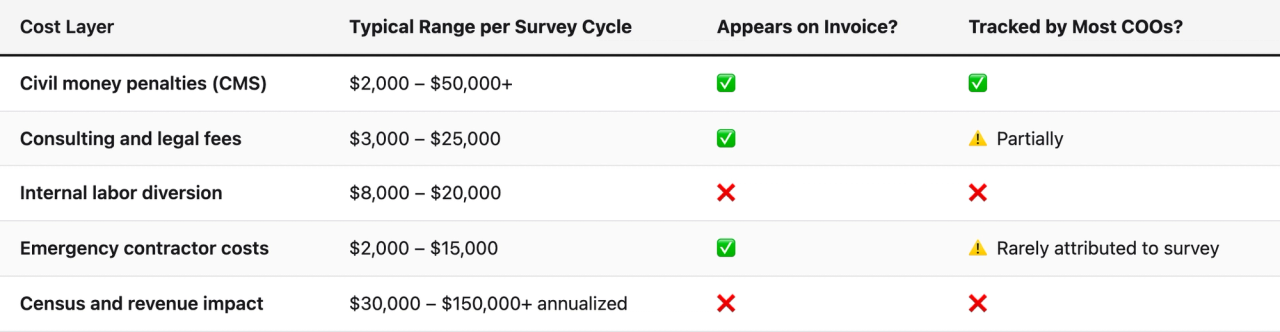
To understand the true financial impact of reactive compliance, it helps to map every cost category that gets activated when a survey produces citations. The following framework is organized into five layers, each representing a distinct type of expenditure that most operators either underestimate or fail to track as survey-related spending.
Layer 1: Direct Regulatory Costs
This is the only layer most operators consciously budget for. It includes civil money penalties, which CMS calculates based on the scope and severity of each deficiency on a per-day or per-instance basis. Under the current CMS civil money penalty framework, penalties for immediate jeopardy citations can reach several thousand dollars per day. For a facility that does not achieve compliance quickly, a single IJ-level citation can generate tens of thousands of dollars in penalties before the correction is accepted.
Below immediate jeopardy, actual harm and no actual harm citations carry lower per-day rates, but they accumulate across multiple deficiencies. A survey that produces six to eight citations, not uncommon in a facility with weak life safety documentation practices, can generate penalty exposure well into five figures even without an IJ finding.
Layer 2: Consulting and Legal Fees
This layer is consistently underestimated. When a facility receives a Form 2567 with life safety citations, the administrator faces decisions that require specialized regulatory knowledge: whether to accept or contest each citation, how to frame the PoC language to minimize future liability, whether to request an Informal Dispute Resolution (IDR) hearing, and how to structure the corrective measures to satisfy both the letter and intent of the regulation.
Very few SNF administrators have deep enough expertise in NFPA 101, NFPA 99, and CMS survey protocol to navigate all of these decisions without outside help. The result is consultant and legal fees that can easily match or exceed the underlying penalty. A facility contesting citations through IDR will pay legal preparation costs on top of consulting fees. A facility that escalates to an Administrative Law Judge hearing will pay significantly more.
Layer 3: Internal Labor Diversion
This is the most invisible layer because it never appears as an invoice. When a facility enters survey remediation, multiple staff members are redirected from their primary functions. The maintenance director stops performing scheduled preventive maintenance and spends days reconstructing documentation, scheduling emergency contractor visits, and briefing the administrator. The director of nursing is pulled into environment-of-care review meetings. The administrator is consumed by PoC drafting and communication with the state agency. The business office manager may be coordinating with legal counsel.
In a 120-bed facility with a fully loaded labor cost of $45 to $65 per hour for management-level staff, a three-week remediation cycle can consume 200 or more hours of combined management time. At $55 per hour fully loaded, that is $11,000 in diverted labor cost, labor that was budgeted for operational management and care coordination, not compliance remediation.
Layer 4: Emergency Contractor and Vendor Costs
Life safety citations frequently require physical remediation, not just documentation correction. A sprinkler deficiency that was cited because the contractor's report noted an unresolved head obstruction, or a generator test that failed because the load bank test was not conducted at the correct interval, requires a licensed vendor to come back to the facility and perform the corrective work. When that contractor call is reactive rather than scheduled, the facility pays emergency or expedited service rates.
The premium for reactive versus scheduled contractor work in the life safety space is substantial. An annual fire suppression inspection scheduled during normal business hours runs at one price. The same vendor returning on short notice to perform a corrective inspection and generate documentation suitable for a PoC submission runs at a meaningfully higher rate. The same dynamic applies to emergency lighting testing, generator load bank testing, and medical gas system inspections.
Across a typical multi-citation survey remediation cycle, emergency contractor costs can range from $2,000 to $15,000 depending on the number and type of physical deficiencies involved.
Layer 5: Reputational and Census Impact
This layer is the hardest to quantify and the most consequential over time. CMS publishes survey results, including all deficiencies and penalty amounts, on the Care Compare database. The Form 2567 is a public document. Prospective residents and their families, hospital discharge planners, and managed care contracting teams all have access to a facility's recent survey history.
A facility that accumulates life safety citations, particularly repeated K-tag citations across multiple survey cycles, will see its CMS star rating affected. The Five-Star Quality Rating System's health inspection domain is directly impacted by the number, scope, and severity of survey deficiencies. A drop from four stars to three stars in health inspection has measurable census implications. Hospital discharge planners at systems that use quality metrics to guide preferred provider lists will route fewer referrals to facilities with deteriorating survey records.
Even a modest census reduction, two to three residents per month who chose a competing facility, translates to revenue loss that dwarfs the original penalty amount. At an average Medicaid per diem of $250 to $300 and Medicare per diem of $500 to $600, two fewer admissions per month represents $60,000 to $120,000 in annualized revenue impact.
How K-Tag Citations Specifically Drive the Highest Remediation Costs
Not all survey citations are created equal when it comes to remediation cost. Life safety citations, documented under K-tags in the CMS survey framework, have a structural characteristic that makes them disproportionately expensive to remediate: they frequently require both physical corrective action and documentation reconstruction simultaneously, and they are the category most likely to recur in subsequent surveys if the underlying documentation system is not fixed.
K-tag citations map directly to NFPA 101 (Life Safety Code) and NFPA 99 (Health Care Facilities Code) requirements. The most commonly cited K-tags in skilled nursing facilities involve fire drill documentation, sprinkler system maintenance records, emergency generator testing logs, corridor and egress clearance, and fire door integrity. Each of these represents an ongoing maintenance and documentation obligation, not a one-time fix.
The remediation cost pattern for K-tag citations follows a predictable structure that most operators do not fully appreciate until they are inside it:
Phase 1: Immediate Documentation Reconstruction
When a K-tag citation is issued for incomplete records, the facility must demonstrate that it has addressed both the historical gap (explaining why the record was missing) and the prospective gap (showing how future records will be complete). This requires the maintenance director to reconstruct whatever documentation can be reconstructed, locating contractor reports, re-interviewing staff who performed drills, pulling work order logs from whatever system exists, while simultaneously implementing a new documentation protocol.
Documentation reconstruction is time-intensive and often unsuccessful. Records that were never created cannot be recreated. When the gap cannot be bridged, the facility's PoC must acknowledge the deficiency and commit to prospective compliance, which typically means implementing a new tracking system under surveyor scrutiny. That scrutiny is expensive in staff time and creates anxiety that depresses operational performance during the corrective period.
Phase 2: Physical Remediation with Accelerated Timelines
Many K-tag citations require not just documentation correction but physical remediation of a deficiency that the missing documentation was supposed to capture. A fire door that has not been documented as tested may also not have been tested, or if it was tested, the results may reveal a deficiency that now requires repair. A sprinkler system that lacked quarterly inspection documentation may have an actual maintenance deficiency that only becomes visible once a proper inspection is performed.
When physical remediation is required, the facility must work within the corrective timeframe established in the PoC, which CMS reviewers set based on the severity of the citation. For immediate jeopardy findings, that timeline can be extraordinarily compressed, days rather than weeks. Getting licensed contractors to mobilize and perform certified work on compressed timelines is expensive by definition.
Phase 3: The Revisit Survey Premium
After a PoC is accepted, CMS or the state agency will conduct a revisit survey to verify that the corrective measures are in place and working. The facility must be in a state of documentary readiness for this revisit, all records up to date, all systems operational, all staff briefed. This requires a second mobilization of management attention comparable to the original survey response. For a facility that has been through a difficult survey cycle, the revisit preparation can consume as much management time as the initial response.
Facilities that fail a revisit survey enter an escalation pathway that can include Civil Money Penalties, denial of payment for new admissions (DPNA), and ultimately termination from the Medicare and Medicaid programs. Each step in this escalation is dramatically more expensive than the previous one. DPNA, in particular, is financially catastrophic, a facility barred from accepting new Medicare admissions loses its highest-margin census segment while continuing to bear its fixed cost structure.
The Accounting Blind Spot: Why COOs Keep Underestimating Remediation Costs
Given how large the total remediation cost stack actually is, why do so many COOs continue to underestimate it? The answer lies in a structural accounting problem that is nearly universal in skilled nursing finance: survey-related costs are never aggregated into a single budget line.
The civil money penalty goes through accounts payable as a regulatory expense. The consulting fees go through professional services. The emergency contractor bills go through facilities maintenance. The management time diversion is never captured anywhere, it simply appears as reduced operational output and slightly elevated stress levels across the leadership team. The census impact shows up in the revenue variance report six months later, attributed to "competitive market conditions" or "referral source mix shift."
No one adds these numbers together. No one creates a "survey remediation cost" account in the general ledger and posts all of these entries to it. As a result, when the COO asks how much the last survey cycle cost, the answer they get is the penalty amount, and that number looks manageable. The actual cost, if properly aggregated, would look very different.
This accounting blind spot has a second consequence: it makes it nearly impossible to build a rigorous ROI case for proactive compliance investment. If the COO does not know that the last survey cycle cost $85,000 in total when all layers are counted, they will evaluate a $15,000 annual compliance platform investment against a $12,000 penalty, and the math will look marginal. When the correct comparison is $15,000 against $85,000, the ROI case becomes unambiguous.
Building a True Survey Cost Model for Your Facility
The first step toward correcting this blind spot is constructing a facility-specific survey cost model that captures all five layers. The following framework provides a starting point for that calculation:
- Direct penalties (12-month trailing): Pull all CMS penalty remittances for the past three survey cycles. Average them. This is your baseline regulatory cost.
- Consulting and legal fees (12-month trailing): Review professional services invoices and identify any engagement that was triggered by a survey finding, PoC requirement, IDR process, or state agency communication. Sum these amounts.
- Emergency contractor costs (12-month trailing): Review facilities maintenance invoices for any work that was scheduled in response to a citation rather than a planned maintenance program. Apply an estimated 30 to 50 percent premium for the reactive scheduling cost versus what the same work would have cost if planned.
- Internal labor diversion estimate: For the most recent survey remediation cycle, estimate the number of hours spent by each management-level staff member on survey response, PoC drafting, documentation reconstruction, and revisit preparation. Multiply by fully loaded hourly rate. This number will surprise most administrators.
- Census impact estimate: Review occupancy trends for the six months following a survey with significant citations. If occupancy declined relative to trend, estimate the revenue impact at the facility's average daily rate mix. Even a conservative estimate typically dwarfs the penalty amount.
Most operators who complete this exercise for the first time arrive at a total that is two to four times what they had mentally budgeted for survey risk. That gap is the true cost of reactive compliance.
The Specific Documentation Failures That Generate the Most Expensive Citations
Understanding which documentation gaps generate the most costly citations is essential for prioritizing where proactive compliance investment delivers the highest return. Not all K-tag citations are equally expensive to remediate, and the patterns are predictable enough that a systematic documentation audit program can target them specifically.
Fire Drill Documentation Gaps
Fire drill citations are among the most common K-tag findings in SNF surveys, and they are almost always the result of documentation failure rather than the actual absence of drills. The NFPA 101 requirement for skilled nursing facilities mandates fire drills at varying times of day and night, across all shifts, and at specific minimum frequencies. The documentation requirements are specific: each drill record must capture the date, time, number of staff involved, duration, and a narrative assessment of the drill's effectiveness.
The most frequent documentation failures include missing night-shift drill records (the shift least likely to have a designated person responsible for logging the drill), incomplete records that capture the date but not all required data elements, and annual records that show the correct number of drills but with time-of-day clustering that reveals they were all conducted on the most convenient shift rather than distributed across all shift periods as required.
These gaps are invisible to the maintenance director reviewing their own binder because they are looking for presence of records, not adequacy of records. An AI-assisted documentation audit looks at both, and flags records that are present but incomplete in the specific ways surveyors are trained to identify.
Generator Testing and Load Documentation
Emergency generator testing requirements under NFPA 99 and CMS Conditions of Participation require monthly load testing, annual load bank testing at specified load levels, and detailed logging of kW output, voltage, frequency, and transfer time for each test. The documentation requirements are technically specific in ways that create frequent citation patterns.
Monthly generator tests are often performed and logged, but the logs fail to capture the required technical readings. A maintenance technician who runs the generator for 30 minutes and notes "generator tested, ran OK" has performed the physical test but created a documentation record that does not meet the regulatory standard. When a surveyor reviews 12 months of generator logs and finds that none of them contain the required kW load readings, the citation is based on documentation inadequacy even though the physical testing may have occurred correctly every month.
The remediation cost for this pattern is particularly high because it requires both retrospective documentation correction (which is largely impossible for technical readings that were never captured) and the engagement of a licensed generator service contractor to establish a proper testing protocol with certified documentation going forward. The contractor engagement for emergency generator compliance documentation setup, performed reactively after a citation, typically runs $3,000 to $8,000 depending on generator size and contractor availability.
Sprinkler System Inspection Record Gaps
NFPA 25 requires quarterly, annual, and five-year inspections of fire sprinkler systems, with specific documentation requirements for each inspection type. The most common documentation failure pattern involves contractor inspection reports that are received and filed but never reviewed for open deficiencies. A contractor report that notes a corroded sprinkler head or an obstructed coverage area creates a documented deficiency that the facility is now on notice to correct. If that correction is never performed and never documented, the facility has both a physical deficiency and a documentation trail showing it knew about the deficiency and failed to act.
This pattern, known in the life safety field as "documented but unresolved", is particularly expensive to remediate because the surveyor can establish not just that a deficiency exists, but that the facility had constructive notice of it and failed to respond. This elevates the potential scope and severity rating of the citation and increases the probability of a penalty at the higher end of the applicable range.
Eyewash Station and Medical Gas Documentation
Weekly eyewash station flushing logs and medical gas system inspection records represent high-frequency, low-complexity documentation tasks that are disproportionately likely to have gaps. Because these tasks are simple and repetitive, they are often assigned to maintenance technicians or EVS staff who do not have a strong documentation habit, and they are rarely reviewed by anyone with regulatory oversight responsibility until a surveyor asks for them.
A facility that has 12 eyewash stations and requires weekly flushing logs has over 600 individual log entries to produce per year for this single requirement. One missed week across multiple stations creates a citation pattern that looks systemic to a surveyor, even if the underlying flushing was performed. The remediation cost for this type of citation is primarily in labor, the hours required to reconstruct whatever partial records exist, implement a new logging system, and brief all staff involved in the task.
What Proactive Compliance Infrastructure Actually Costs (and What It Prevents)
The life safety compliance ROI calculation for proactive infrastructure investment needs to be anchored in the real cost numbers developed above. The question is not whether proactive compliance platforms cost money, they do. The question is what they cost relative to the total remediation cost stack they replace.
A documentation-intelligence platform like SEQURA operates at the intersection of two cost-reduction mechanisms: it prevents citations by surfacing documentation gaps before a surveyor does, and it reduces the internal labor cost of compliance management by replacing manual binder-based tracking with an automated, audit-ready system. Both mechanisms have measurable financial value.
Prevention Value: The Citation Avoidance Math
If a facility's realistic total survey remediation cost per survey cycle (aggregating all five layers) is $60,000 to $90,000, and standard survey cycles occur approximately every 15 months for SNFs under the current CMS scheduling framework, the annualized remediation cost exposure is roughly $48,000 to $72,000 per facility per year. This is the baseline against which a proactive compliance investment should be measured.
A platform that eliminates even 60 to 70 percent of life safety citations through proactive documentation auditing would reduce that annualized exposure by $29,000 to $50,000 per facility. Against a software investment in the range of $10,000 to $20,000 per facility annually, the ROI is straightforward: the prevention value alone covers the investment cost with meaningful surplus, before any operational efficiency gains are counted.
Operational Efficiency Value: The Binder Replacement Math
The maintenance director's paper binder is not free. Maintaining a compliant life safety binder across all required inspection categories requires significant ongoing staff time: scheduling inspections, following up with contractors, filing reports, conducting internal audits before surveys, and responding to administrator requests for documentation status. A realistic estimate for a single-facility maintenance director is 4 to 8 hours per week spent on documentation management that a digital, automated system would handle in a fraction of that time.
At a fully loaded maintenance director cost of $35 to $55 per hour, 6 hours per week of documentation management represents $11,000 to $17,000 per year in labor cost. Replacing that manual effort with an automated platform that schedules tasks, sends reminders, logs completions, and flags gaps does not eliminate the maintenance director's role, but it redirects their time from administrative documentation to actual facility maintenance, which is where their expertise creates the most value.
For multi-site operators, this efficiency multiplier compounds significantly. A regional facilities manager overseeing eight to twelve facilities under a paper-based compliance system spends a disproportionate amount of their time chasing documentation status from individual sites before surveys. A platform that provides a single dashboard view of compliance status across all facilities converts that chase time into strategic oversight time.
The Maintenance Cost Reduction Software Case
There is a subtler financial benefit that operators often overlook: the relationship between documentation quality and maintenance cost efficiency. Facilities with strong, systematic life safety documentation programs tend to identify equipment and system deficiencies earlier in their development cycle, when they are less expensive to correct. A sprinkler head obstruction caught during a quarterly inspection and corrected in the same contractor visit costs far less than the same obstruction discovered during a survey, triggering an emergency contractor call and a citation remediation cycle.
This is the maintenance cost reduction software value proposition that goes beyond compliance: systematic documentation creates a feedback loop that produces better maintenance outcomes, not just better survey outcomes. When every generator test produces a complete log with kW readings, voltage, and transfer time, the maintenance director can track performance trends and identify a generator that is showing early signs of degraded output before it fails during an actual power outage. That predictive value is an operational benefit independent of its compliance value.
The Multi-Site Operator's Compounding Risk Problem
For operators running more than five facilities, the reactive compliance cost problem compounds in ways that single-site operators do not experience. Each facility has its own survey cycle. Each facility has its own maintenance director with their own documentation habits. Each facility has its own binder, its own contractor relationships, its own version of compliance.
The result is a portfolio-level compliance risk profile that is almost impossible to manage reactively. When any given facility in a ten-site portfolio can receive an unannounced survey on any given business day, and when the documentation gaps that generate citations are invisible without a systematic audit process, the multi-site operator is perpetually exposed to a citation event somewhere in their portfolio.
The financial impact of this portfolio-level exposure is not additive, it is multiplicative in its operational disruption effect. A single serious survey at one facility does not just consume that facility's management resources. It pulls the regional manager and sometimes the COO into the remediation process, reducing their availability for operational oversight across the rest of the portfolio. A difficult survey at one facility frequently coincides with deteriorating operational performance at other facilities in the same region, precisely because the regional oversight capacity has been diverted.
Multi-site operators who have experienced this dynamic describe it as a "compliance tax" on their management bandwidth, a recurring claim on the time and attention of their most experienced operational leaders that grows in proportion to the size of the portfolio. The only structural solution to this problem is a system that provides portfolio-level documentation visibility without requiring portfolio-level manual oversight effort.
Standardization as a Risk Reduction Mechanism
One of the most valuable but least-discussed benefits of a platform-based compliance approach for multi-site operators is documentation standardization. When every facility in a portfolio is using the same task templates, the same logging formats, and the same documentation standards, the regional manager or COO can review compliance status across the entire portfolio from a single interface and understand what they are looking at immediately.
When each facility has its own binder format, its own contractor report filing system, and its own interpretation of what "complete" documentation looks like, portfolio-level compliance review requires individual facility visits and binder inspections. A ten-site portfolio reviewed manually takes a full work week of regional manager time per review cycle. A platform-based portfolio review takes hours.
That standardization also reduces citation risk directly: a facility that is using the same documentation templates that CMS surveyors are trained to look for is structurally less likely to have the formatting gaps and missing data elements that generate citation findings even when the underlying work was performed correctly.
The CMS Citation Financial Impact on Star Ratings and Reimbursement
The CMS Five-Star Quality Rating System has a direct and underappreciated financial consequence that connects survey performance to reimbursement rates in ways that are not always obvious to SNF operators. Understanding this connection is essential for quantifying the full CMS citation financial impact of a reactive compliance posture.
The Five-Star rating system evaluates SNFs on three domains: health inspections, staffing, and quality measures. The health inspection domain is based on the number, scope, and severity of deficiencies cited across the most recent three standard surveys and any complaint investigations. Life safety citations are included in this calculation. A facility that accumulates K-tag citations across multiple survey cycles will see sustained downward pressure on its health inspection star rating.
The financial consequences of a star rating reduction operate through multiple channels:
- Managed care contracting: Many managed care organizations and Medicare Advantage plans use CMS star ratings as a threshold criterion for preferred provider networks. A facility that drops below a minimum star rating threshold may be excluded from network contracts that represent a significant share of its admissions revenue. Network exclusion is typically not immediate but follows contract renewal cycles, creating a delayed but severe financial consequence that is rarely attributed to the original survey citations.
- Hospital referral patterns: Hospital discharge planners increasingly use CMS Care Compare data to guide placement recommendations. A facility with a declining star rating and visible life safety citations on its public survey record will receive fewer referrals from hospital partners who are themselves under quality scrutiny. The revenue impact of reduced referral volume is difficult to isolate but is real and measurable over time.
- Value-Based Purchasing: CMS's Skilled Nursing Facility Value-Based Purchasing (VBP) program links reimbursement adjustments to quality performance metrics. While the VBP program currently focuses primarily on readmission rates rather than survey outcomes, the broader policy direction in CMS reimbursement design is clearly toward quality-linked payment. Operators who build strong compliance documentation infrastructure now are positioning their facilities favorably for reimbursement models that will increasingly reward survey performance.
The CMS Five-Star Quality Rating System technical user's guide provides the specific methodology for how deficiency scores are calculated and weighted. Operators who want to model the rating impact of specific citation patterns can use this framework to estimate the star rating consequence of a given survey outcome before it occurs.
A Decision Framework for Evaluating Proactive Compliance Investment
The following decision framework is designed to help SNF administrators and COOs evaluate the financial case for shifting from reactive to proactive compliance management. It is structured as a scoring model that can be applied to any facility or portfolio.
Step 1: Establish Your Baseline Remediation Cost
Using the five-layer cost model described earlier, calculate the total survey remediation cost for your most recent survey cycle. If you have not experienced a significant survey cycle recently, use the industry baseline of $50,000 to $80,000 as a conservative estimate for a facility with average life safety documentation practices. If your facility has experienced immediate jeopardy findings or DPNA actions, your baseline is significantly higher.
Step 2: Assess Your Documentation Vulnerability Score
Rate your facility on each of the following dimensions from 1 (low risk) to 5 (high risk):
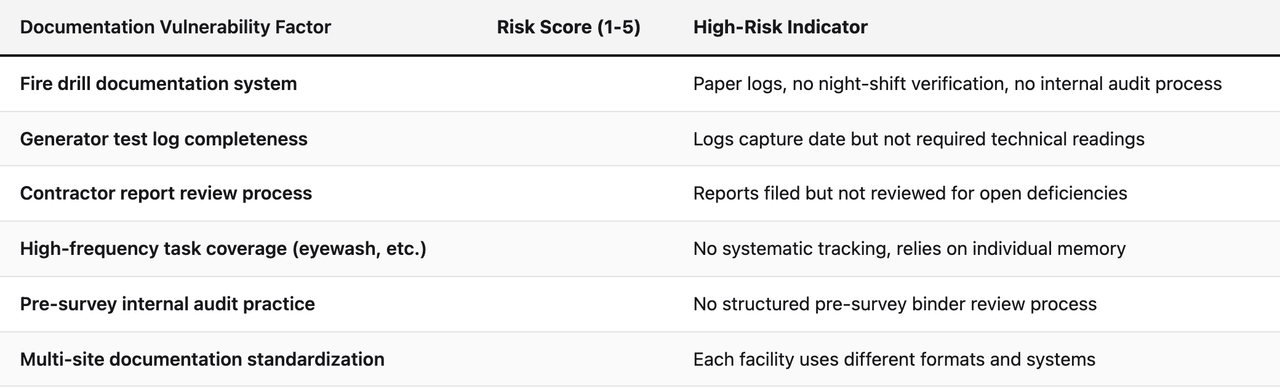
A total vulnerability score above 18 indicates a facility with significant documentation risk and a high probability of generating life safety citations in the next survey cycle. A score above 24 indicates a facility that should treat proactive compliance investment as urgent.
Step 3: Calculate the Investment Threshold
Multiply your baseline remediation cost by your vulnerability score factor (score divided by 30, expressed as a percentage of full risk exposure). This gives you the expected annual remediation cost at current documentation practices. A proactive compliance platform investment is financially justified if its annual cost is less than the expected remediation cost, which it will be in virtually every case where the vulnerability score exceeds 15.
Frequently Asked Questions
What is the average cost of a CMS life safety citation for a skilled nursing facility?
The civil money penalty for a life safety citation varies based on scope and severity. Below immediate jeopardy level, per-day penalties typically range from a few hundred to several thousand dollars per deficiency. However, the civil money penalty is only a fraction of the total remediation cost, which includes consulting fees, emergency contractor costs, internal labor diversion, and potential census impact. Total remediation costs per survey cycle routinely reach $50,000 to $100,000 when all categories are properly counted.
How does a K-tag citation affect a facility's CMS star rating?
K-tag citations are included in the health inspection domain of the CMS Five-Star Quality Rating System. Each citation is weighted by scope and severity. Multiple K-tag citations in a single survey, or repeated life safety citations across multiple survey cycles, can reduce a facility's health inspection star rating. A star rating reduction in this domain can affect managed care contracting eligibility, hospital referral volume, and the facility's competitive positioning with prospective residents and families.
What is the difference between reactive and proactive compliance in a skilled nursing facility?
Reactive compliance means responding to survey findings after they occur, drafting plans of correction, engaging consultants, performing emergency contractor work, and rebuilding documentation systems under regulatory scrutiny. Proactive compliance means systematically auditing documentation before a surveyor arrives, identifying and closing gaps in real time, and maintaining an always-audit-ready operational posture. The financial difference between these two approaches, when all cost layers are aggregated, is typically three to five times the cost of the proactive investment.
What documentation gaps most commonly generate life safety citations in SNFs?
The most frequently cited life safety documentation failures in skilled nursing facilities involve fire drill records (particularly missing or incomplete night-shift drill logs), emergency generator test logs that lack required technical readings (kW load, voltage, transfer time), sprinkler system inspection reports with unresolved deficiencies, and high-frequency maintenance logs (eyewash flushing, fire door checks) with missing entries. These patterns are consistent across survey cycles and are almost always the result of documentation system failures rather than the actual absence of the underlying maintenance work.
How much does Plan of Correction consulting typically cost for a life safety survey?
Life safety consultants engaged for Plan of Correction drafting and submission support typically bill between $150 and $350 per hour. A straightforward PoC engagement runs 8 to 20 hours. More complex situations involving multiple citations, Informal Dispute Resolution, or immediate jeopardy findings can require 30 to 60 or more hours of consultant and legal time. Total consulting and legal fees for a significant survey remediation cycle commonly range from $5,000 to $25,000.
Can a documentation platform actually prevent citations, or does it just organize paperwork?
A documentation platform that includes an AI-assisted audit layer does more than organize records, it actively reviews completed documentation against regulatory standards and flags records that are present but technically inadequate. This distinction is critical: most citation-generating documentation gaps are records that exist but are missing required data elements, not records that are entirely absent. A platform that identifies these "present but inadequate" records before a surveyor does converts what would have been a citation into a corrective action taken proactively, with no regulatory consequence.
What is the financial impact of a Denial of Payment for New Admissions (DPNA) action?
DPNA is one of the most financially severe remedies CMS can impose on a skilled nursing facility. A facility under DPNA cannot accept new Medicare or Medicaid admissions, which means its census declines as existing residents discharge while no new residents are admitted. Given that Medicare residents typically represent the highest daily rate segment in an SNF's census mix, a DPNA period of even two to four weeks can result in revenue losses of $30,000 to $80,000 or more, depending on facility size and Medicare census percentage. DPNA actions typically arise from repeated survey failures, making them the end consequence of sustained reactive compliance practices.
How do multi-site SNF operators compound their compliance cost risk?
Multi-site operators face a compounding risk structure because any facility in the portfolio can receive an unannounced survey at any time. Without portfolio-level documentation visibility, the regional manager or COO cannot assess compliance readiness across all facilities simultaneously. Each survey at any single facility diverts regional management attention from the rest of the portfolio, creating a secondary risk that operational quality deteriorates elsewhere during the remediation period. A platform that provides portfolio-level compliance dashboards converts this portfolio-wide exposure into a manageable, visible risk profile.
Is life safety compliance documentation different from clinical compliance documentation?
Yes, and the distinction is important for resource allocation. Clinical compliance documentation (MDS assessments, care plans, nursing notes) is typically managed by clinical staff with established documentation training and supervision. Life safety compliance documentation is managed by maintenance directors and EVS staff who may have strong technical skills but less systematic documentation training. The documentation requirements for life safety compliance are highly specific, technically detailed, and governed by NFPA codes that change on a publication cycle. A platform built specifically for life safety documentation, with task templates vetted against current NFPA and CMS standards, addresses a documentation challenge that clinical documentation systems are not designed to handle.
What is the typical ROI timeline for a proactive compliance platform investment?
For most SNF facilities, the ROI timeline for a proactive compliance platform investment is measured in months rather than years. If the platform prevents even a single survey citation cycle that would otherwise have generated $50,000 to $80,000 in total remediation costs, the investment pays back within the first survey cycle. For multi-site operators, the ROI calculation is even more favorable because the platform's operational efficiency value (reducing documentation management labor across all facilities) generates ongoing cost savings independent of citation prevention.
How does SEQURA specifically address the documentation gaps that generate K-tag citations?
SEQURA operates on two layers designed specifically for this problem. The operational layer provides a vetted NFPA and state-regulation task template library that ensures the right inspections are scheduled at the right cadence, assigned to the right person, and logged with the required data elements at the time of completion. The analytic layer applies AI review to completed records, contractor reports, and shift logs, cross-referencing them against the regulatory expectations for each K-tag category. This means that a generator test log missing kW readings, a fire drill record missing night-shift coverage, or a sprinkler report with an unresolved deficiency will be flagged by the platform before it is seen by a surveyor.
What should a COO do right now if they suspect their facility has documentation gaps?
The most effective immediate step is a structured internal binder audit that mirrors the documentation review a CMS surveyor would conduct. Pull the fire drill log for the past 12 months and verify that every required element is present for every drill, including time of day, shift coverage, and assessor narrative. Review generator test logs for technical data completeness. Pull the most recent contractor reports for all life safety systems and identify any open deficiencies that have not been documented as resolved. This audit will surface the highest-priority gaps. If the audit reveals systemic documentation inadequacies rather than isolated gaps, that is the signal that a platform-based solution is warranted.
Key Takeaways
- The civil money penalty is the smallest part of reactive compliance cost. The true cost of a survey remediation cycle includes consulting fees, emergency contractor costs, internal labor diversion, and census impact, a total that typically runs three to five times the penalty amount alone.
- Most COOs underestimate remediation costs because survey-related expenses are never aggregated. Penalties go to regulatory accounts, consultant fees to professional services, contractor costs to facilities maintenance. No one adds them together. Correcting this accounting blind spot is the first step toward an accurate ROI calculation for proactive compliance investment.
- K-tag citations are disproportionately expensive to remediate because they require both documentation reconstruction and physical corrective action on compressed timelines, often triggering emergency contractor costs at premium rates.
- The most common life safety citations are documentation failures, not maintenance failures. Fire drills that happened but were not logged correctly. Generator tests that were run but did not capture required technical readings. Contractor reports that were filed but never reviewed for open deficiencies. These are preventable with a systematic audit process.
- Multi-site operators face a compounding risk structure that makes portfolio-level compliance visibility not just operationally valuable but financially essential. The management bandwidth cost of reactive compliance scales with portfolio size in ways that become unsustainable above five to seven facilities.
- Star rating degradation from repeated life safety citations creates sustained revenue impact through managed care contracting, hospital referral patterns, and competitive positioning, consequences that materialize months after the original survey and are rarely attributed to compliance failures.
- The life safety compliance ROI case is straightforward when all five cost layers are properly counted. A proactive documentation platform that prevents even a fraction of the citation exposure it targets will generate a return that covers its investment cost within the first survey cycle for most facilities.
About the author
Benjamin Terebelo · Founder
Benjamin is the founder of SEQURA, a compliance platform purpose-built for healthcare facilities. He builds at the intersection of healthcare operations and software, maintaining a focus on bringing modern tooling to systems that the broader industry has largely left behind.
About the author
Benjamin Terebelo · Founder
Benjamin is the founder of SEQURA, a compliance platform purpose-built for healthcare facilities. He builds at the intersection of healthcare operations and software, maintaining a focus on bringing modern tooling to systems that the broader industry has largely left behind.