
The Real Financial Exposure of an SNF Life Safety Citation: A COO's Plain-English Breakdown of Remediation Costs

The citation itself takes less than a minute to write. A surveyor documents a K-tag deficiency, assigns a severity and scope, and moves on. What happens next, in legal fees, remediation expenses, survey revisit costs, and revenue exposure, can run well into six figures before the facility returns to normal operations. Yet most SNF financial models treat life safety citations as a compliance inconvenience rather than a balance sheet event.
This breakdown is for the COO or VP of Operations who needs to understand the full financial topology of a life safety citation before it happens, not while the Plan of Correction is already due. Every number discussed here connects to a real operational decision: whether to invest in documentation infrastructure, how to price the risk of deferred maintenance, and how to explain to ownership why proactive compliance spending is not overhead but insurance.
Why Life Safety Citations Are a Financial Category, Not Just a Compliance Category
A SNF life safety citation financial impact does not begin and end with a civil money penalty. That framing, the penalty as the cost, is the single most expensive misunderstanding in post-acute facility finance. The penalty is often the smallest line item. The real exposure comes from what happens around the penalty: the operational disruption, the documentation labor, the contractor mobilization, the revisit fees, and the revenue risk that accumulates during every day a facility operates under heightened scrutiny.
To understand why, it helps to map how CMS categorizes life safety deficiencies. Under the CMS State Operations Manual for nursing facilities, life safety deficiencies are cited under the K-tag series and evaluated on two axes: severity (from no actual harm to immediate jeopardy) and scope (from isolated to widespread). The intersection of these two axes determines the enforcement pathway, and the enforcement pathway determines the financial exposure.
What makes life safety citations particularly dangerous from a financial planning perspective is their unpredictability. Unlike clinical deficiencies, which tend to generate paper trails through incident reports and care notes, life safety deficiencies frequently arise from documentation gaps rather than actual equipment failures. A generator test that was performed but logged incorrectly. A fire drill that was conducted without capturing all required data fields. A sprinkler inspection that was done by a contractor but whose report was never reconciled against the facility's own records. These are not negligence events. They are administrative failures, and they carry the same enforcement weight as physical hazards.
The Enforcement Cascade: How One Citation Becomes Many Costs
A single life safety deficiency rarely produces a single financial consequence. The enforcement cascade works like this: a citation at or above a certain severity threshold triggers mandatory revisit activity. That revisit activity generates fees. If the revisit finds the deficiency was not corrected, or surfaces additional deficiencies, the enforcement escalates. Escalation can trigger civil money penalties that compound daily. If the facility reaches the threshold for termination from Medicare and Medicaid, the revenue exposure becomes existential rather than manageable.
Even below the Immediate Jeopardy threshold, the cascade is expensive. A Standard deficiency (Severity Level 2 or 3, meaning actual harm has occurred or is likely) triggers a standard revisit within 60 days. The facility must submit a Plan of Correction, absorb the cost of whatever remediation that plan requires, and prepare for the revisit inspection itself. If the state agency conducts the revisit and finds the deficiency unresolved, CMS can impose a per-day civil money penalty retroactive to the original citation date.
For a COO managing a multi-site portfolio, the cascade risk multiplies. A pattern of life safety deficiencies across facilities creates a regulatory profile that affects survey frequency for the entire organization. Facilities on the Special Focus Facility (SFF) list, which CMS assigns based on a weighted survey history, receive surveys twice as frequently as standard facilities. That increased frequency is itself a cost: more preparation labor, more operational disruption, more documentation review cycles.
Breaking Down the Real Costs: What Actually Hits the P&L
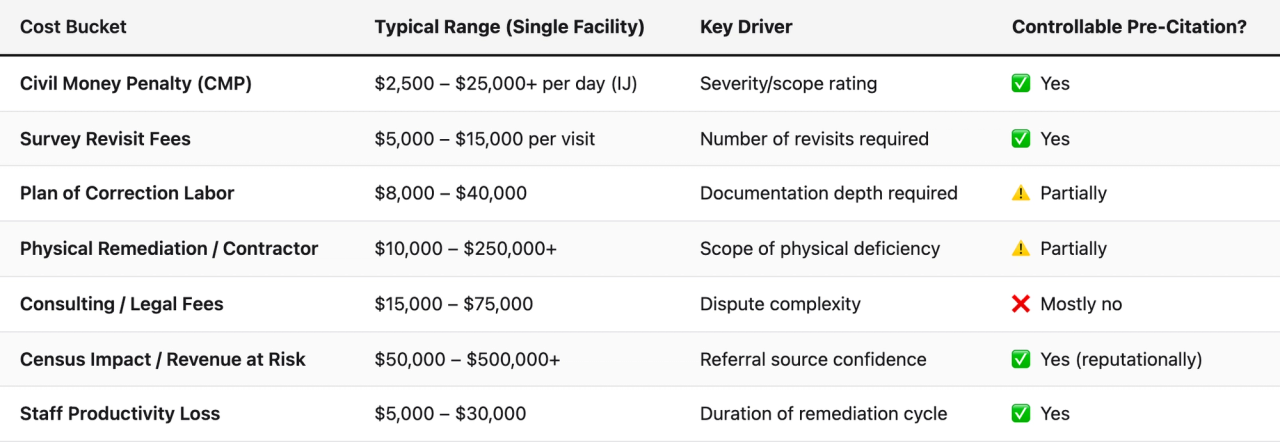
Understanding the CMS citation remediation cost structure requires separating it into distinct buckets. Each bucket has different cost drivers, different timelines, and different degrees of controllability. COOs who treat "the cost of a citation" as a single number consistently underestimate total exposure because they are only looking at one or two of these buckets.
Civil Money Penalties: The Visible Tip of the Iceberg
CMS civil money penalties for life safety deficiencies are set according to a structured matrix that accounts for severity, scope, and whether the facility has a history of repeat violations. For the most serious category, Immediate Jeopardy, per-day penalties can exceed $25,000, and CMS imposes them retroactively from the date the IJ condition is found to exist, not from the date the Plan of Correction is accepted.
This retroactivity is where facilities are most frequently surprised. A facility that takes 10 days to abate an Immediate Jeopardy condition and another 15 days to receive CMS confirmation of abatement can be looking at 25 days of per-day CMPs before the penalty clock stops. At $20,000 per day, that is $500,000, from a single citation. Even at the lower end of the IJ range, the accumulation is significant.
Below Immediate Jeopardy, per-instance penalties for Standard deficiencies typically range from several thousand to tens of thousands of dollars per citation. The per-instance model is more predictable than per-day penalties, but facilities with multiple K-tag deficiencies from a single survey can accumulate per-instance CMPs that add up quickly, particularly when scope is rated as "pattern" or "widespread."
CMS publishes current CMP ranges and updates them periodically through regulatory adjustment. The CMS Enforcement Guidance outlines how state agencies apply these ranges in practice.
Survey Revisit Fees: The Cost Nobody Budgets For
When a facility receives citations that require correction, the state survey agency returns to verify compliance. This revisit is not free. Under the current CMS fee structure, facilities bear the cost of revisit surveys, and that cost compounds with each additional revisit required.
The exact fee schedule varies by state because revisit surveys are conducted by state survey agencies under contract with CMS, and some states pass the cost directly to facilities while others absorb it differently. However, the operational cost to the facility is consistent: staff preparation time, documentation assembly, leadership availability during the survey, and the risk that additional deficiencies are found during the revisit, resetting the timeline.
A facility that fails its first revisit and requires a second revisit has now paid for two revisit cycles, extended its penalty exposure if per-day CMPs are in play, and extended the period during which referral sources are aware the facility is under active enforcement action. The compounding effect of multiple revisit cycles is one of the most underappreciated financial risks in SNF operations.
The Revenue Risk That Doesn't Show Up in the Penalty Letter
The cost of deficiency in a SNF that has the longest tail and the largest potential magnitude is not the penalty. It is the census impact. This is the component most difficult to model precisely and the one most commonly omitted from internal cost estimates, which is why so many SNF operators underestimate the true financial exposure of a life safety citation.
Census impact flows through two channels. The first is direct: if CMS imposes an admission hold or ban on Medicare and Medicaid admissions as an enforcement remedy, the facility loses the revenue from every new admission it cannot accept during that period. A facility running 120 beds at 90% occupancy with an average Medicare daily rate generates substantial daily revenue. An admissions ban lasting 30 to 60 days, not unusual for serious enforcement actions, can eliminate a significant portion of quarterly revenue.
The second channel is indirect and more persistent: referral source behavior. Hospital discharge planners, case managers, and managed care organizations monitor CMS's Care Compare database in real time. A life safety citation at a meaningful severity level is visible to every referral source who checks. The reputational damage to a facility's referral pipeline can persist long after the citation is resolved, because discharge planners are risk-averse, and a facility with a recent enforcement history is a liability they will route around when alternatives exist.
Modeling the Revenue Exposure: A Framework for COOs
Rather than treating revenue risk as unquantifiable, COOs can use a simple framework to bound the exposure. Start with three variables: average daily Medicare rate for your facility, current Medicare/Medicaid census as a percentage of total beds, and the realistic duration of an admissions restriction under different enforcement scenarios.
For a 100-bed facility running 85 beds occupied, with 40 of those Medicare at a blended daily rate of $550, the daily Medicare revenue exposure is approximately $22,000. A 45-day admissions ban, assuming gradual discharge of existing Medicare residents and inability to admit replacements, could realistically eliminate $400,000 to $600,000 in net revenue depending on how the payer mix shifts during that period.
Add to this the indirect referral impact: if the facility's referral volume drops 20% for six months following a publicized citation, at an average admission value of $18,000 to $25,000 in total revenue per stay, even a modest reduction in monthly admissions compounds into a meaningful annual revenue shortfall. This is the number that should anchor the conversation about compliance investment, not the penalty letter amount.
What a Plan of Correction Actually Costs to Execute
The Plan of Correction (POC) is the facility's formal written commitment to CMS detailing how each cited deficiency will be corrected, what systemic changes will prevent recurrence, and by what date corrections will be completed. Writing a POC that satisfies CMS review requires a combination of regulatory expertise, operational specificity, and documentation discipline that most facilities do not maintain as a standing capacity.
The labor cost of POC development is real and frequently underestimated. A substantive POC for multiple K-tag deficiencies typically requires the maintenance director, the administrator, the director of nursing (for any environment of care overlap), and often an outside consultant or life safety specialist to review. The document itself must be precise: vague commitments to "improve our process" are rejected. CMS expects specific action steps, responsible parties, completion dates, and ongoing monitoring mechanisms.
For facilities that retain outside life safety consultants to assist with POC development, billing rates typically range from $150 to $350 per hour, and a complex multi-deficiency POC can require 40 to 100 hours of consulting time. That is $6,000 to $35,000 in consulting fees alone, before any physical remediation work begins.
Physical Remediation: Where the Real Contractor Bills Live
If a life safety citation identifies an actual physical deficiency, a fire door that fails to self-close, a sprinkler head with obstructed coverage, a generator that cannot demonstrate required runtime under load, an emergency lighting system with failed batteries, the remediation cost is determined by the scope of the physical problem, not the severity of the citation language.
This is a critical distinction. A citation can be worded at a relatively low severity level and still require substantial physical remediation to correct. Conversely, a high-severity documentation deficiency might require only records correction, not physical work. The COO who budgets for remediation based on the citation's severity level rather than its physical implications will routinely underestimate costs.
Common physical remediation categories and their cost ranges:
- Fire door hardware replacement or adjustment: $500 to $3,000 per door, with multi-door facilities potentially facing $20,000 to $80,000 in aggregate corrections
- Sprinkler system modifications or head replacement: $2,000 to $15,000 per area, with complex retrofit work in older facilities running higher
- Emergency generator testing and repair: $5,000 to $50,000 depending on whether the issue is a documentation gap (lower) or an actual mechanical failure (higher)
- Fire alarm panel upgrades or notification system corrections: $10,000 to $75,000 for substantive system changes
- Egress corridor corrections (lighting, signage, obstruction clearance): $1,000 to $25,000 depending on scope
- Electrical system grounding or panel corrections: $5,000 to $40,000, with hospital-grade requirements adding cost
In older SNF buildings, many of which were constructed before current NFPA 101 editions were adopted, physical remediation to bring a deficiency into compliance can uncover adjacent deficiencies that were not originally cited. Contractors doing fire door work identify frame deterioration. Electricians correcting a panel issue find grounding problems throughout the wing. This cascading discovery pattern is common and is one reason that physical remediation estimates should always include a contingency of 20% to 40% above the initial contractor quote.
The Hidden Cost: Staff Time and Operational Disruption
Every hour a maintenance director, administrator, or director of nursing spends responding to a life safety citation is an hour not spent on their actual operational responsibilities. This opportunity cost is real but rarely appears in post-citation financial analyses, which is why the total financial picture always looks smaller in retrospect than it actually was.
To reduce unplanned downtime from citation-driven disruptions, it helps to understand where the time actually goes. The operational disruption of a life safety citation typically unfolds across three phases, each with its own labor burden.
Phase 1: Immediate Response (Days 1–10)
The immediate aftermath of a life safety citation requires rapid triage. What was cited? What physical conditions need to be addressed before the next survey visit? What documentation needs to be assembled to demonstrate good faith correction efforts? This phase typically consumes 40 to 80 hours of leadership time across the maintenance director, administrator, and any relevant department heads, time that is diverted from normal operations.
If the citation is at or near Immediate Jeopardy, the facility may also be required to have a state agency representative on-site during initial abatement activities, which adds a layer of coordination complexity and further constrains staff time available for normal operations.
Phase 2: POC Development and Execution (Days 10–60)
The POC itself requires drafting, internal review, submission, and often revision if the state agency returns comments. Once accepted, the facility must execute the corrective actions and build the monitoring documentation that demonstrates ongoing compliance. This phase can consume 60 to 120 hours of staff time across multiple roles, plus contractor coordination time that falls largely on the maintenance director.
Phase 3: Revisit Preparation and Post-Revisit Monitoring (Days 60–180)
Preparing for a revisit survey is its own labor event. Records must be organized, staff must be briefed on what surveyors will ask, and leadership must be available during the revisit itself. If the revisit finds additional deficiencies, the cycle restarts. Even when the revisit is successful, the facility typically enters a period of heightened documentation discipline that adds ongoing labor overhead for several months.
Aggregating these three phases, a single substantive life safety citation can consume 150 to 300 hours of staff time across the remediation cycle. At a blended labor cost of $45 to $75 per hour for the roles involved, that is $6,750 to $22,500 in direct labor cost, before accounting for the opportunity cost of work not done during that same period.
The SNF Compliance ROI Calculation: Framing the Investment Correctly
The SNF compliance ROI conversation is frequently framed incorrectly: compliance spending is presented as a cost to be minimized, and its benefit is described vaguely as "avoiding penalties." This framing produces underinvestment because it compares a certain, visible cost (the compliance tool or consultant) against an uncertain, invisible benefit (the citation that did not happen).
A more useful framing compares the annualized cost of proactive compliance infrastructure against the probability-weighted cost of the citation events that infrastructure prevents. This is standard risk-adjusted return analysis, and it makes the ROI case for compliance investment far more compelling than the penalty-avoidance framing suggests.
Building a Simple Expected Value Model
Start with the total expected cost of a single substantive life safety citation at Standard severity (not Immediate Jeopardy): penalties, revisit fees, POC labor, physical remediation, consulting, and a conservative estimate of census impact. A reasonable range for a single Standard-level life safety citation, all-in, is $75,000 to $200,000. For an Immediate Jeopardy citation, the range starts at $300,000 and has no practical ceiling.
Next, estimate the probability that your facility receives at least one substantive life safety citation in the next 12 months. This is not a theoretical exercise. CMS survey data is publicly available, and life safety deficiency rates across SNFs are meaningful. Facilities with known documentation gaps, fire drill records missing required data fields, generator logs with incomplete entries, contractor reports that have not been reconciled against facility records, face materially higher citation probability than facilities with clean documentation.
If the probability of a $150,000 citation event is 30% in any given year, the expected annual cost of that risk is $45,000. A compliance platform or documentation system that reduces that probability by half, to 15%, reduces the expected annual cost to $22,500, creating $22,500 in annual expected value. A system that costs $15,000 per year and delivers that risk reduction has a positive ROI on expected value alone, before accounting for the operational efficiency gains from better task management and documentation workflow.
This framework is deliberately conservative. It uses a single citation event and does not account for multi-citation surveys, the compounding cost of repeat citations, or the referral reputation effects that persist beyond the citation resolution period. A more complete model would show stronger ROI for proactive compliance infrastructure.
Where the ROI Evidence Is Strongest
The ROI case for compliance investment is strongest in three specific scenarios. The first is facilities with a recent survey history that includes life safety citations, these facilities face higher survey frequency and elevated citation probability at subsequent surveys, making the expected cost of the next citation higher than the baseline. The second is multi-site operators, where the organizational cost of a citation (leadership attention, legal exposure, reputational spillover across the portfolio) is multiplied relative to single-facility operators. The third is facilities in states with aggressive survey agencies or that are already on enhanced oversight pathways.
Documentation Gaps Are the Root Cause Most COOs Miss
A consistent pattern emerges when life safety citations are analyzed systematically: the majority of K-tag deficiencies cited at SNFs do not arise from broken equipment or ignored hazards. They arise from documentation failures, inspections performed but not logged, logs completed but missing required data elements, contractor reports received but not integrated into the facility's own records, and fire drills conducted but not documented in the format CMS surveyors expect to see.
This is not a trivial distinction. A documentation failure and an actual safety failure produce the same citation, but they have very different remediation paths and very different implications for how a COO should think about prevention. You cannot prevent equipment from failing through documentation alone. But you can prevent documentation failures almost entirely through the right systems and processes, which means that a significant fraction of SNF life safety citations are, in principle, avoidable at relatively low cost.
The Most Common Documentation Gaps That Produce Citations
Based on the structure of NFPA 101 and NFPA 99 requirements and the K-tag citation patterns visible in publicly available CMS survey data, the documentation gaps that most frequently produce life safety citations fall into predictable categories:
- Fire drill records missing required fields: NFPA 101 requires fire drills to be conducted quarterly on each shift. The records must capture specific data including time, date, shift, number of staff participating, and any deficiencies noted. Records that are missing shift coverage, that show drills clustered in favorable time windows rather than spread across the shift, or that lack the required supervisory sign-off are among the most commonly cited documentation deficiencies.
- Generator testing logs with incomplete load data: CMS requires monthly and annual generator testing with documentation of specific performance parameters including voltage, amperage, and kilowatt load at specified intervals during the test. Logs that record only "test passed" without the required numerical data are frequently cited.
- Sprinkler inspection reports not reconciled against facility correction records: Annual sprinkler inspections are required under NFPA 25. When a contractor's inspection report identifies deficiencies, the facility must document that those deficiencies were corrected. Facilities that receive contractor reports but do not maintain their own tracking of noted deficiencies and their correction frequently have unresolved items visible to surveyors.
- Fire door inspection records missing or incomplete: Annual inspection of all fire doors is required. Records must document each door inspected, findings, and any corrective action taken. Facilities that inspect doors but record results only in contractor reports, without integrating those results into facility-maintained records accessible to surveyors, are frequently cited.
- Eyewash station and medical gas inspection gaps: Monthly eyewash station inspections and regular medical gas system inspections are required. These are frequently performed but sporadically documented, particularly when the maintenance technician who performs the inspection is different from the person maintaining the log.
The common thread across all of these is that the underlying inspection was often performed. The failure was in the documentation, and specifically in the gap between what was done in the field and what was recorded in the format a surveyor would look for. This is the gap that operational systems like SEQURA are designed to close: not by performing the inspections, but by ensuring that every completed inspection produces a complete, contemporaneous record that meets the documentation standard a surveyor applies.
What Surveyors Actually Look For: The Citation Pattern Behind the K-Tags
Understanding how surveyors approach life safety documentation review helps COOs understand where investment in documentation infrastructure produces the most direct risk reduction. CMS Life Safety surveyors conducting an unannounced visit to an SNF follow a structured protocol that begins with a documentation review and moves to physical observation. The documentation review is typically the first place deficiencies are identified, and deficiencies identified in documentation review frequently lead surveyors to look more carefully at the corresponding physical systems.
The surveyor's documentation review focuses on whether the facility can produce, on demand, complete and contemporaneous records for every required inspection, test, and maintenance activity. "Contemporaneous" is the operative word. Records that appear to have been completed after the fact, because the handwriting is inconsistent, because dates cluster suspiciously, or because records for multiple months appear to have been filled out on the same day, are a significant red flag that surveyors are trained to identify.
Digital documentation systems address the contemporaneity question directly: a task logged through a mobile device or facility kiosk creates a timestamped record that is structurally impossible to retroactively falsify in the way paper records can be. This is one of the most underappreciated benefits of digital documentation from a citation-prevention standpoint, it is not just about organization, it is about the evidentiary weight of the record itself.
The Aggregation Problem in Multi-Site Operations
For COOs managing multiple SNF facilities, the documentation review challenge is compounded by aggregation. Each facility maintains its own records, in its own format, managed by its own maintenance director. The COO or VP of Operations has no real-time visibility into whether any given facility's documentation is survey-ready at any given moment. Unannounced surveys can happen to any facility on any day, and the first sign that a facility's documentation is deficient is often the citation itself.
This is the operational problem that enterprise-level compliance platforms solve at the portfolio level: providing the COO with a cross-facility view of documentation completeness, overdue tasks, and known gaps, before a surveyor arrives. The financial value of that visibility is the difference between managing a deficiency internally versus managing it publicly, under enforcement pressure, with a Plan of Correction clock running.
The Special Focus Facility Risk: When Citations Compound Into Existential Exposure
For facilities with a history of repeated or serious deficiencies, the financial exposure of individual citations is compounded by the risk of Special Focus Facility designation. The CMS Special Focus Facility program identifies nursing facilities with persistent patterns of serious deficiencies and subjects them to increased survey frequency, at minimum two standard surveys per year instead of one, along with enhanced enforcement remedies.
The financial implications of SFF designation go beyond increased survey frequency. SFF facilities face mandatory civil money penalties for any deficiency cited at Immediate Jeopardy, with reduced discretion for state agencies to accept lower penalties or alternative remedies. They face greater scrutiny from managed care organizations and hospital referral sources who actively monitor CMS databases. And they face a longer, more demanding path to removal from the SFF list, one that requires demonstrated sustained improvement over multiple survey cycles.
SFF designation is not an overnight event. It results from a pattern of deficiencies that accumulates over multiple surveys. But life safety citations, particularly repeat citations in the same K-tag categories, contribute meaningfully to the deficiency score that drives SFF designation. A COO who addresses individual citations without addressing the underlying documentation systems that produce them is managing symptoms rather than the condition.
Building the Business Case: What to Put in Front of Ownership
The COO's challenge is translating the technical financial analysis above into a business case that ownership, whether a private equity sponsor, a regional chain operator, or a family-owned SNF group, will act on. The business case has three components.
The first component is the expected value of the risk being managed. Use the framework described in the compliance ROI section above: estimate the realistic probability and cost of a citation event, compute the expected annual cost, and show how documentation infrastructure reduces that expected cost. Keep the estimate conservative, it is more persuasive to understate the case and be correct than to overstate it and invite skepticism.
The second component is the operational efficiency gain. Better documentation systems reduce the labor overhead of compliance work: less time spent assembling records for scheduled surveys, less time spent reconstructing documentation after the fact, less time spent in POC development when deficiencies do occur. This efficiency gain is real and quantifiable in hours per month across the maintenance and administrative team.
The third component is the referral reputation value. This is the hardest to quantify but often the most persuasive to ownership: a facility with a clean survey history and no public enforcement actions commands stronger referral relationships with hospital discharge planners and managed care organizations. Every incremental Medicare admission that comes through a referral relationship, rather than being lost to a competitor with a cleaner record, is directly attributable to the facility's survey reputation. For a 100-bed SNF, the difference between a strong and a weak referral pipeline can represent millions of dollars in annual revenue.
Frequently Asked Questions
What is the difference between a K-tag citation and a regular CMS deficiency?
K-tags are the specific deficiency tags CMS uses for life safety code deficiencies, those related to the physical environment, fire safety systems, egress, utilities, and related requirements under NFPA 101 and NFPA 99. Regular CMS deficiency tags (F-tags) cover clinical care, staffing, resident rights, and other operational requirements. Both types can result in civil money penalties, but K-tag deficiencies are evaluated under the Life Safety Survey protocol, which uses a separate surveyor team and a distinct documentation review process.
How long does a CMS enforcement action typically take to resolve?
The timeline varies significantly based on severity. A Standard-level deficiency with a straightforward correction might be resolved in 60 to 90 days from the original citation to the revisit confirmation of correction. An Immediate Jeopardy citation requires abatement within days, but the full enforcement resolution including penalty negotiation and formal closure can take 6 to 18 months. During that period, the facility's survey history reflects the open enforcement action.
Can a facility dispute a life safety citation and have it removed?
Yes. Facilities have the right to request an Informal Dispute Resolution (IDR) process through the state survey agency and, for more serious citations, a formal Independent IDR (IIDR) process through CMS. Successfully disputed citations can be reduced in severity, narrowed in scope, or withdrawn entirely. However, IDR and IIDR processes require significant documentation and legal support, and success rates vary. The dispute process itself is a cost that should be included in total citation expense modeling.
What is an Immediate Jeopardy designation and how does it differ from Standard deficiencies?
An Immediate Jeopardy (IJ) designation means the surveyor has determined that the facility's failure to comply with a requirement has caused, or is likely to cause, serious injury, harm, impairment, or death to a resident. IJ is the highest severity category. It triggers mandatory CMPs at the highest per-day rate, requires the facility to submit an abatement plan immediately, and must be abated before the surveyor leaves the facility or within a very short window thereafter. The financial exposure of an IJ citation is categorically different from Standard deficiencies.
How does CMS calculate civil money penalties for life safety deficiencies?
CMS uses a matrix approach that combines severity level (1 through 4, with 4 being Immediate Jeopardy) and scope (isolated, pattern, or widespread). The resulting matrix cell determines whether a per-instance or per-day penalty applies and the range within which the penalty is set. Aggravating factors, including repeat deficiencies, facility financial condition, and the degree of culpability, can increase penalties within the applicable range. CMS adjusts penalty ranges periodically for inflation.
Does a life safety citation affect a facility's Five-Star rating?
Yes. CMS's Five-Star Quality Rating System incorporates health inspection results, including life safety deficiencies, in the Health Inspections domain of the rating. Serious deficiencies, particularly those at higher severity and scope levels, reduce a facility's Health Inspections star rating. Because the Five-Star rating is visible on CMS Care Compare and is used by referral sources and families to evaluate facilities, a rating reduction has direct implications for referral volume and census.
What is the most common trigger for a life safety citation in SNFs?
Documentation deficiencies, incomplete, missing, or improperly formatted inspection records, are among the most common triggers for K-tag citations. Fire drill documentation gaps, generator testing log deficiencies, and sprinkler inspection record failures are consistently among the most frequently cited K-tag categories. The underlying inspections are often performed; the failure is in how the results are recorded and maintained.
How does a Plan of Correction differ from the actual remediation work?
The Plan of Correction (POC) is a formal written document submitted to CMS describing how the facility will correct each cited deficiency, what systemic changes will prevent recurrence, and when corrections will be completed. The POC is the administrative commitment. The actual remediation, whether physical repairs, contractor work, or documentation system changes, is the operational execution of the POC. Both have separate costs and timelines, and the POC must be accepted by CMS before the remediation timeline officially begins.
Can a facility receive citations during a revisit survey that were not in the original survey?
Yes. Revisit surveys are technically conducted to verify correction of previously cited deficiencies, but surveyors are not prohibited from citing new deficiencies they observe during a revisit. A facility that has corrected its original deficiencies but has not addressed adjacent documentation gaps can receive new citations during a revisit, resetting the remediation cycle. This is why thorough preparation for a revisit, including a comprehensive internal documentation review, is essential, not just correction of the originally cited items.
What role does state survey agency variation play in citation rates?
State survey agencies administer CMS survey protocols under federal guidelines, but there is meaningful variation across states in how aggressively agencies cite life safety deficiencies, how they interpret documentation requirements, and how they apply the severity and scope matrix. Facilities in states with historically aggressive survey agencies face higher baseline citation probability. COOs managing multi-state portfolios should account for this variation in their risk modeling and ensure that their documentation standards meet the most stringent state's interpretation, not just the federal minimum.
How do repeat citations affect enforcement remedies?
Repeat citations, defined as the same K-tag deficiency cited in two consecutive standard surveys, trigger mandatory civil money penalties under the federal enforcement framework, removing state agency discretion to use lower-level remedies. Repeat citations also contribute more heavily to the deficiency score used to determine Special Focus Facility eligibility. From a financial modeling standpoint, a repeat citation should be treated as having roughly double the expected cost of an initial citation, both because of mandatory penalties and because of the reputational signal it sends to referral sources and oversight bodies.
What is the most cost-effective way to prevent life safety citations?
The highest return-on-investment approach to citation prevention is closing documentation gaps before a surveyor identifies them. This means implementing a systematic inspection scheduling and logging system that ensures every required task is assigned, completed on time, and recorded with the data fields CMS expects to see, and then auditing those records against regulatory requirements on an ongoing basis rather than only in preparation for a scheduled survey. The cost of a robust documentation system is a fraction of the expected cost of a single substantive citation, making it the most cost-efficient risk management tool available to SNF operators.
Key Takeaways
- Civil money penalties are the smallest part of the financial exposure. The true cost of a life safety citation includes revisit fees, POC labor, contractor remediation, consulting and legal fees, staff productivity loss, and census impact, a total that routinely exceeds $100,000 for Standard-level citations and can reach seven figures for Immediate Jeopardy events.
- Documentation failures, not equipment failures, drive most K-tag citations. The majority of life safety deficiencies cited at SNFs arise from incomplete, missing, or improperly formatted inspection records, not from broken equipment. This means most citations are preventable through better documentation systems, not capital investment in equipment replacement.
- Revenue risk is the largest and least-modeled component of citation exposure. Admissions bans, referral source damage, and Five-Star rating reductions can eliminate hundreds of thousands of dollars in annual revenue, dwarfing the penalty amount that appears in the citation letter.
- The compliance ROI calculation favors proactive investment. When modeled as a probability-weighted expected value, the cost of a documentation compliance platform is a fraction of the expected annual cost of the citation events it prevents, even using conservative probability estimates.
- Multi-site COOs face compounded exposure without portfolio-level visibility. Without real-time insight into documentation completeness across facilities, a COO cannot manage citation risk proactively, only reactively. The first sign of a documentation gap should not be a surveyor's citation.
- Repeat citations carry mandatory penalties and SFF risk. A documentation system that prevents the first citation also prevents the repeat citation that triggers mandatory enforcement escalation and contributes to Special Focus Facility designation, a risk with potentially existential financial consequences.
- The contemporaneity of records matters as much as their completeness. Timestamped digital records are harder for surveyors to question than handwritten logs. Shifting from paper-based to digital documentation directly improves the evidentiary weight of inspection records, reducing citation risk even when the same inspections are being performed.
What This Means for Your Facility's Bottom Line
The financial exposure of a life safety citation is not a compliance abstraction. It is a P&L event with a realistic cost range that can be modeled, probability-weighted, and compared against the cost of the systems that prevent it. COOs and VPs of Operations who make that comparison with clear data consistently reach the same conclusion: proactive documentation infrastructure is not overhead, it is risk management with a measurable return.
The facilities that absorb the worst citation outcomes are rarely the ones with the most serious physical safety problems. They are the ones where the gap between what was done in the field and what was recorded in the binder was wide enough for a surveyor to drive through. Closing that gap, systematically, at every facility, across every K-tag category, on every inspection cycle, is the operational discipline that converts compliance from a cost center into a competitive advantage.
SEQURA is built to close exactly that gap: not by replacing the maintenance team's expertise, but by ensuring that every inspection they perform produces a complete, contemporaneous, regulation-aligned record that surveyors find nothing to cite. For a COO thinking about the financial topology of life safety risk, that is the investment case stated plainly.
About the author
Benjamin Terebelo · Founder
Benjamin is the founder of SEQURA, a compliance platform purpose-built for healthcare facilities. He builds at the intersection of healthcare operations and software, maintaining a focus on bringing modern tooling to systems that the broader industry has largely left behind.
About the author
Benjamin Terebelo · Founder
Benjamin is the founder of SEQURA, a compliance platform purpose-built for healthcare facilities. He builds at the intersection of healthcare operations and software, maintaining a focus on bringing modern tooling to systems that the broader industry has largely left behind.