
The ROI of Closing Documentation Gaps Before an Unannounced CMS Survey

Most SNF administrators approach CMS survey preparation the same way they approach dental appointments: they know they should do more between visits, but the real scramble happens when the appointment is confirmed. The problem with that analogy is that CMS surveys are unannounced. There is no confirmation. The surveyors are already in the lobby.
This article is not about survey readiness as a compliance obligation. It is about survey readiness as a financial instrument. Specifically, it examines the measurable return on investment that comes from closing documentation gaps before an unannounced CMS survey finds them for you, and why the facilities that treat their maintenance documentation platform as a cost center are systematically underestimating both the risk they carry and the value of eliminating it.
The math is less complicated than most operators assume. The penalties are larger than most operators realize. And the gap between "we think our documentation is fine" and "our documentation would survive a surveyor's full review today" is wider at most facilities than anyone wants to admit.
Why Documentation Gaps Are a Financial Risk, Not Just a Compliance Inconvenience
The conventional framing of CMS survey citations treats them as compliance problems with compliance solutions: a citation arrives, a plan of correction is filed, the process is updated, and the facility moves on. That framing systematically undercounts the actual financial exposure a citation creates, and it is why facilities consistently underinvest in the upstream work that prevents citations from occurring.
To understand the true cost of a documentation gap, you need to account for every dollar a single citation touches, not just the remediation line item on the next month's P&L.
The Direct Financial Penalties Are Larger Than Most Facilities Budget For
CMS civil monetary penalties (CMPs) for life safety and environment of care deficiencies are assessed per-day for ongoing violations, and the range is substantial. For immediate jeopardy-level citations, CMS per-day CMPs can reach into the tens of thousands of dollars per violation, and multi-deficiency surveys with scope and severity patterns that elevate a facility to Special Focus Facility (SFF) status create an entirely different tier of financial and operational consequences.
But even at the lower end of the penalty spectrum, the arithmetic adds up quickly. A K-tag citation for missing fire drill documentation covering a required shift, combined with a deficiency for an unreconciled sprinkler inspection report, combined with a generator test log missing required kW load data, is not three small problems. It is three separate deficiencies, each with its own scope and severity classification, each triggering its own remediation requirement, and collectively capable of establishing a pattern that elevates the survey outcome from a manageable correction to a focused survey trigger for the next visit.
The Hidden Cost Multipliers Most Operators Miss
The direct CMP is the number that appears in the citation letter. The actual financial impact of a life safety deficiency runs through several cost categories that rarely get consolidated into a single ROI analysis:
- Remediation and consultant costs: Facilities that receive life safety citations typically engage external life safety consultants to audit their programs and validate their corrective action plans. These engagements routinely cost several thousand dollars at minimum, and for facilities with systemic documentation gaps, the scope can extend to full program overhauls.
- Staff time diversion: A plan of correction is not a document the administrator fills out in an afternoon. It requires coordination across maintenance, nursing, administration, and often legal counsel. The hours spent on a single substantive citation response routinely reach into the double digits across department heads, and those hours are pulled from operational priorities.
- Survey follow-up costs: A cited facility does not simply return to a normal survey cycle. Revisit surveys, focused surveys, and increased monitoring all carry their own administrative burden and, in some cases, direct costs for state agency revisit fees.
- Census and referral impact: This is the financial exposure most operators are slowest to quantify, but it is often the largest. Hospital discharge planners, case managers, and families making placement decisions have access to CMS's Care Compare database, which publishes inspection results. Facilities with recent life safety citations, particularly those with immediate jeopardy designations or SFF status, see measurable effects on referral volume and admissions conversion. A single significant survey outcome can suppress census for months.
- Insurance and bonding implications: Some carriers adjust liability premiums following substantive survey citations, particularly those related to fire safety and life protection systems. The effect varies by policy and carrier, but it is a real downstream cost that belongs in any comprehensive ROI analysis.
When these cost categories are consolidated, a single life safety survey citation that appears to carry a modest direct penalty can represent a total financial impact that is several multiples of the face-value fine. The ROI calculation for preventing that citation through better documentation management starts looking very different once the full cost is on the table.
How CMS K-Tags Create Cascading Financial Exposure
K-tags are the Life Safety Code deficiency categories CMS surveyors use to classify environment of care and fire safety violations. Understanding how K-tags work mechanically is essential to understanding why documentation gaps are so financially dangerous, and why the ROI of closing them before a survey is so high.
CMS surveys are not random audits of your physical plant. They are structured reviews of your documentation against NFPA 101 (Life Safety Code) and NFPA 99 (Health Care Facilities Code) requirements, cross-referenced with the physical condition of your facility. The surveyor arrives with a defined set of K-tag categories to examine, and within each category, they look for documentation evidence that the required inspections, tests, and maintenance activities were performed at the required frequency, by a qualified person, with the required data recorded contemporaneously.
The Cascade Effect of Pattern-Based Citations
The financial risk escalates sharply when documentation gaps appear in multiple K-tag categories during the same survey. CMS scope and severity classifications are not evaluated in isolation. A surveyor who finds a pattern of documentation deficiencies across multiple life safety categories is making a different assessment than one who finds a single isolated gap. Pattern-based findings elevate scope classifications, increase the likelihood of civil monetary penalties, and most critically, they flag the facility for more intensive ongoing scrutiny.
The K-tags that most commonly appear in life safety citations at SNFs cluster around a predictable set of documentation requirements:
- K-tag 712 and related fire drill documentation: Fire drills must be conducted at the required frequency, at varied times, covering all required shifts, with documentation that captures specific data elements. Missing a shift, documenting drills at suspiciously consistent times, or failing to record required observations are all citation triggers.
- K-tag categories for sprinkler system maintenance: Annual, quarterly, and monthly sprinkler inspection records must show the specific tests performed, the results, and the disposition of any deficiencies identified. An inspection record that lacks deficiency reconciliation documentation is incomplete, regardless of whether the physical system is functioning correctly.
- Generator testing and emergency power: Monthly load tests, annual load bank tests, and transfer switch tests all require specific data points in the documentation record. Missing kW load readings, transfer times, or voltage readings create documentation deficiencies even when the generator itself performs correctly.
- Medical gas and vacuum system documentation: NFPA 99 requirements for medical gas systems generate a substantial documentation burden that many SNFs manage inconsistently, particularly around alarm testing and outlet verification.
Each of these categories represents a K-tag cluster where a documentation gap, not a physical failure, but a paperwork gap, can produce a citation. The surveyor does not need to find a broken sprinkler head. They need to find that your quarterly sprinkler inspection record does not document what it is required to document. That distinction matters enormously for ROI analysis: the risk being mitigated by better documentation management is almost entirely documentation risk, not physical plant risk.
What "Contemporaneous" Documentation Actually Means for CMS
CMS expects that inspection and maintenance records are created at the time the activity occurs, not reconstructed afterward. This requirement creates a specific vulnerability for facilities that rely on paper binders or informal documentation practices. When a surveyor reviews a paper log and finds that multiple entries appear to have been made at the same time (same handwriting, same pen, suspiciously uniform timestamps), or when digital records show that a week's worth of inspections were logged in a single session, the documentation loses its evidentiary value and may itself become a citation trigger.
Contemporaneous documentation is not just a compliance requirement. It is the mechanism by which your documentation is credible when a surveyor examines it. A maintenance management platform that logs completion at the time of task execution, with a timestamp tied to the specific kiosk or mobile device used, produces documentation that survives scrutiny in a way that a paper binder filled in periodically cannot.
Building the ROI of a Maintenance Management Platform: A Framework for SNF Operators
The ROI of a maintenance management platform in the SNF context is not primarily an operational efficiency story, though efficiency gains are real. It is a risk-adjusted return story. The value is measured against the probability-weighted cost of the adverse outcomes the platform prevents.
The following framework gives SNF administrators and regional operations leaders a structured way to calculate platform ROI against their specific facility's risk profile.
Step 1: Establish Your Baseline Citation Risk
Your starting point is an honest assessment of your current documentation program's survey-readiness. This is not about whether your maintenance director believes the documentation is in order. It is about whether your documentation would survive a structured review against the specific data requirements of each relevant K-tag category.
Facilities should audit their documentation against at minimum the following questions:
- Are fire drills documented at all required frequencies, covering all required shifts, with all required observation fields completed?
- Do sprinkler inspection records document the disposition of every deficiency identified, with follow-up verification?
- Do generator test logs include kW load readings, transfer times, and voltage data for every required test?
- Are medical gas alarm tests documented at the required frequency with required data elements?
- Are contractor-performed inspection reports filed, reviewed, and cross-referenced with internal maintenance records?
- Is there documentation evidence that required monthly and quarterly tasks were completed on time, not reconstructed after the fact?
Most facilities that conduct this audit honestly find gaps. The question is not whether gaps exist, but how material they are and how many K-tag categories they touch.
Step 2: Quantify the Citation Cost at Your Facility
Using the cost categories identified above, estimate the financial impact of a meaningful life safety survey outcome at your facility. This calculation should include:
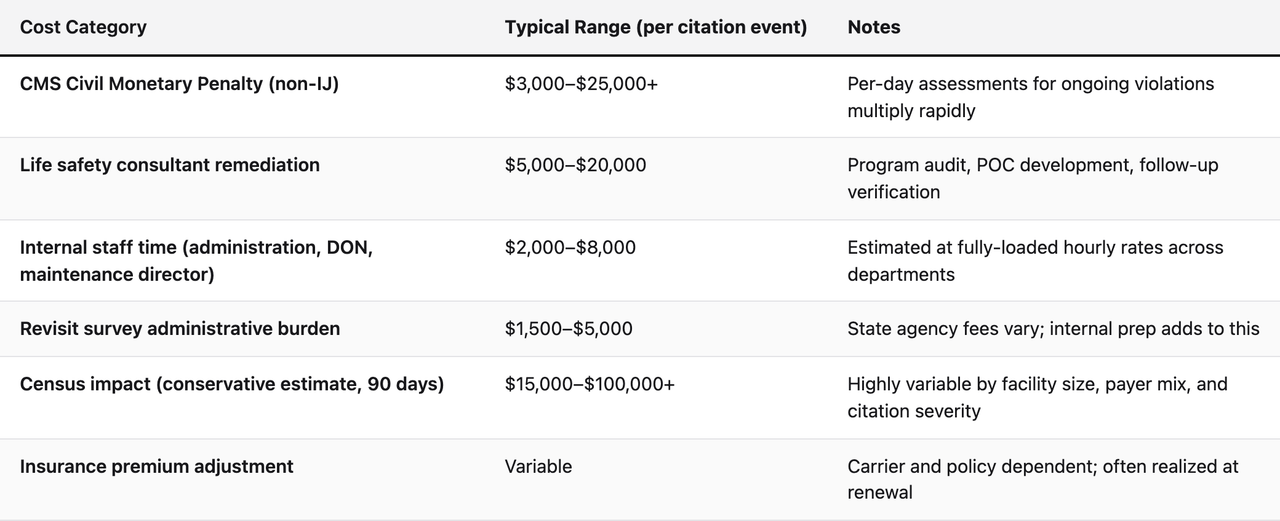
A conservative estimate for a single meaningful life safety survey event, one that produces multiple deficiencies without reaching immediate jeopardy, is a total financial impact in the range of $30,000 to $75,000 when all cost categories are included. A survey outcome that does reach immediate jeopardy or SFF-triggering patterns can easily represent $150,000 or more in combined direct and indirect costs.
Step 3: Apply Probability Weighting to Your Risk Exposure
The ROI calculation is not based on the assumption that a citation is certain. It is based on the probability that a documentation gap that exists today will be found by the next surveyor who visits your facility.
This probability is not as low as most operators assume. CMS life safety surveys follow a structured protocol that is specifically designed to surface documentation deficiencies of the type described in this article. A surveyor examining your fire drill records is not doing a cursory glance. They are checking for specific data elements in specific fields. A generator log missing a kW reading is not a subtle gap. It is exactly the kind of gap the survey protocol is designed to find.
Facilities that have not audited their documentation against the specific data requirements of each K-tag category they are responsible for should assume their probability of citation is meaningfully higher than they think it is.
Step 4: Calculate the Platform ROI
With a probability-weighted risk figure and a platform cost, the ROI calculation is straightforward:
Expected value of citation prevention = (Probability of citation event) x (Total financial impact of citation event)
Net ROI = Expected value of citation prevention + operational efficiency gains - platform cost
For a 120-bed SNF spending $12,000–$18,000 annually on a documentation intelligence platform, a citation event probability of even 30–40% against a conservative $50,000 impact produces an expected value of $15,000–$20,000 from citation prevention alone, before any operational efficiency gains are counted. That is a positive ROI on citation prevention alone, with efficiency gains as incremental upside.
For multi-site operators, the math compounds. A regional operator with ten facilities running this analysis across the portfolio is looking at a risk exposure that justifies platform investment at virtually any reasonable pricing tier.
The Operational Efficiency Layer: What Good Documentation Software Actually Saves
The citation prevention ROI is the primary case for a maintenance management platform in SNFs. But there is a genuine operational efficiency layer that belongs in the analysis, and it is larger than most facilities account for when they evaluate the cost of their current documentation approach.
The True Cost of the Paper Binder System
The paper life safety binder is not free. It has a real labor cost that is invisible because it is distributed across many small time increments rather than appearing as a line item on a budget report.
Consider what maintaining a compliant paper documentation system actually requires from a maintenance director at a typical SNF:
- Creating and distributing paper checklists for each recurring inspection task
- Collecting completed checklists from technicians and EVS staff
- Filing checklists in the appropriate binder section
- Manually tracking which tasks are overdue or approaching due date
- Preparing documentation packages for survey review (pulling records across multiple binders, organizing by K-tag category)
- Responding to contractor inspection reports and manually reconciling deficiencies
- Recreating or reconstructing records when they are lost, damaged, or incomplete
A conservative estimate of the time a maintenance director spends on documentation management and binder maintenance at a single SNF is several hours per week. At a fully-loaded cost of $35–$50 per hour for a maintenance director, that is a meaningful annual labor cost that is entirely attributable to the inefficiency of paper-based documentation.
A digital maintenance management platform does not eliminate this work entirely, but it reduces the administrative overhead substantially. Task scheduling is automated. Completion logging happens at the point of work. Overdue tasks are surfaced automatically. Survey preparation is a report pull rather than a manual binder assembly. The labor savings are real, and they belong in the ROI calculation.
The Survey Preparation Event: A Hidden Cost Center
Every SNF maintenance director who has lived through an unannounced survey knows what the first 30 minutes look like. The surveyors are in the lobby. Someone is calling the maintenance director. The director is pulling binders, trying to remember where the Q3 sprinkler report was filed, hoping the night shift fire drill from last quarter is documented the way it needs to be.
This scramble has a cost. The maintenance director is not doing maintenance. The administrator is in reactive mode. The DON is managing surveyor access while simultaneously trying to assess what might be at risk. A facility that enters a survey in reactive mode is a facility that will miss things it should catch, and those misses become POC items that generate follow-up work.
A platform that maintains a continuously audited, organized documentation record does not eliminate survey stress. But it fundamentally changes the posture of the facility's response. When a surveyor requests fire drill records, the maintenance director pulls a report. When a surveyor asks about the last generator test, the records are organized, complete, and timestamped. The facility's response time and confidence level in the first 30 minutes of a survey sends a signal to surveyors about the quality of the documentation program overall.
Contractor Report Integration: The Gap Most Facilities Don't Know They Have
One of the most common sources of documentation deficiency at SNFs is not the internal inspection records. It is the contractor inspection reports that arrive from fire suppression vendors, elevator companies, medical gas contractors, and other third-party service providers.
These reports are typically emailed to the maintenance director as PDF attachments. They contain findings, deficiencies, and recommendations. Some facilities print them and file them in the binder. Many do not. Even those that do file them frequently fail to document the follow-up actions taken in response to identified deficiencies, which is itself a citation risk.
A CMS surveyor reviewing your sprinkler inspection records will look at your contractor's most recent inspection report and then look for evidence that any deficiencies identified in that report were addressed. If the report is not in your files, that is a documentation gap. If it is in your files but there is no evidence of deficiency follow-up, that is a documentation gap. If the report documents a deficiency that your maintenance records show was corrected, but the contractor has not issued a clearance letter, that is a documentation gap.
Managing contractor report integration is one of the highest-value functions a documentation intelligence platform can perform, and it is one of the functions most poorly served by paper binder systems.
The SNF Compliance ROI Calculation for Multi-Site Operators
The ROI case for a single-facility SNF is compelling. For multi-site operators, regional chains, management companies, and owner-operators with three or more facilities, the SNF compliance ROI calculation takes on additional dimensions that make the investment case substantially stronger.
Portfolio-Level Risk Aggregation
A multi-site operator does not face citation risk at one facility. They face it across the entire portfolio, simultaneously. A regional VP of operations managing fifteen SNFs is carrying fifteen independent citation risk exposures. If each facility has a 25% probability of a meaningful citation event in any given year, the probability that at least one facility in the portfolio experiences a significant survey outcome is substantially higher than 25%.
Managing this portfolio-level risk with paper binders and facility-level documentation practices is fundamentally a decentralized approach. Each facility's documentation quality depends on the individual maintenance director's habits, organization, and awareness of the specific data requirements for each K-tag category. The quality is inconsistent, and the regional operator has limited visibility into which facilities are well-documented and which are carrying hidden exposure.
A maintenance management platform that rolls up documentation status across a portfolio gives regional leadership something paper binders cannot: a real-time view of which facilities are current on all required tasks, which have overdue inspections, and which have documentation gaps that would create citation risk if a surveyor arrived tomorrow. That visibility is itself a form of risk management that is unavailable to operators relying on paper-based systems.
Standardization as a Compliance Multiplier
One of the most underappreciated ROI drivers for multi-site operators is the value of documentation standardization. When every facility in a portfolio uses the same task library, the same documentation templates, and the same data requirements for each inspection type, the documentation output is consistent and auditable at the portfolio level. A regional compliance officer can review documentation across fifteen facilities using the same framework, identify outliers, and intervene before a surveyor does.
This standardization is impossible to achieve at scale with paper binders. It is a natural output of a well-configured maintenance management platform. The task library that defines what gets documented, at what frequency, and with what data elements is set at the platform level and applied consistently across every facility in the portfolio.
Staff Turnover and Documentation Continuity
SNF maintenance director turnover is a persistent operational challenge. When a maintenance director leaves, they often take institutional knowledge with them, including knowledge about where documentation is filed, which contractor relationships manage which systems, and which inspections are coming due. A paper binder system is only as good as the person maintaining it, and turnover creates documentation discontinuity that is itself a citation risk.
A platform-based documentation system transfers institutional knowledge from the individual to the system. When a new maintenance director joins a facility, they inherit a complete, organized documentation record with clear visibility into what is current and what is upcoming. The continuity is in the platform, not in any individual employee's habits or memory.
What the Maintenance ROI Calculator Should Actually Include
Generic ROI calculators for facility management software typically focus on work order efficiency and deferred maintenance cost avoidance. Those metrics are relevant for general facility management platforms, but they are incomplete for SNF compliance applications where the primary value driver is documentation risk reduction.
A maintenance ROI calculator designed for the SNF context should include the following inputs and outputs:
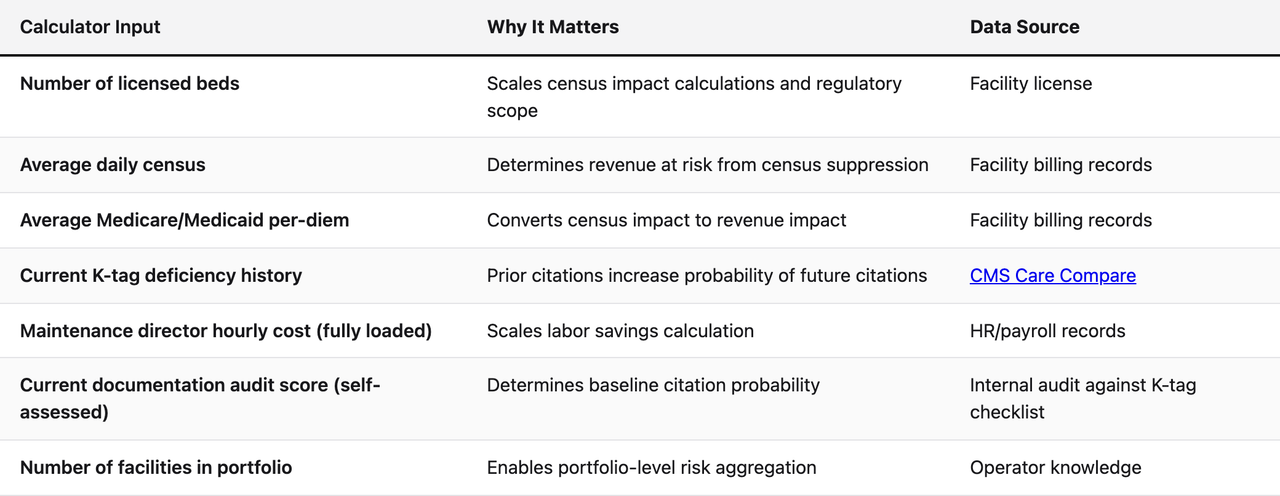
The output of a properly constructed maintenance ROI calculator for an SNF should include not just the direct platform cost savings, but the probability-weighted citation cost reduction, the census-impact risk mitigation value, and the labor efficiency gains from reduced documentation overhead. Facilities that run this analysis with honest inputs consistently find that the ROI is substantially positive, often within the first survey cycle.
The Maintenance Cost Reduction Software Framing: Why It Misses the Point
When SNF administrators evaluate platforms for their maintenance programs, they often approach the evaluation through a maintenance cost reduction software lens, looking for evidence of deferred maintenance savings, work order efficiency gains, and vendor management improvements. These are legitimate operational metrics, but they are the wrong primary lens for evaluating a documentation compliance platform in the SNF context.
The distinction matters because it changes what you are buying. A general facility management platform optimized for work order efficiency will produce different documentation outputs than a platform specifically designed to produce documentation that survives CMS survey scrutiny. The data fields that matter for CMS K-tag compliance are not the same as the data fields that matter for work order tracking. A platform that tracks that a task was completed is not the same as a platform that tracks that a task was completed with the specific data elements required by the applicable K-tag category.
The Documentation Intelligence Difference
The defining characteristic of a documentation intelligence platform, as opposed to a general maintenance management platform, is that it knows what the documentation is supposed to contain. A task template for a monthly fire pump test in a documentation intelligence platform does not just prompt the technician to mark the task complete. It prompts them to enter the specific readings, observations, and findings that the applicable NFPA standard requires, and that a CMS surveyor will look for when they review the record.
This distinction has a direct ROI implication. A general maintenance platform can confirm that a fire pump test was performed. A documentation intelligence platform can confirm that the fire pump test record contains the data elements that will satisfy a surveyor's review. The first reduces the risk of missing a test. The second reduces the risk of a citation even when the test was performed correctly.
Most SNF citation events in the life safety category are not the result of tests that were not performed. They are the result of tests that were performed but documented inadequately. The platform that addresses that specific risk is the one that generates citation prevention ROI. A general work order platform does not.
AI-Driven Gap Detection: The Analytical Layer That Changes the ROI Equation
The highest-value function of a modern documentation intelligence platform is not task scheduling or completion logging. Those functions are valuable, but they are table stakes. The function that generates the most significant ROI is analytical: the ability to read completed documentation and identify gaps that would produce citations before a surveyor finds them.
This is where AI-driven documentation review fundamentally changes the economics of SNF compliance. A maintenance director reviewing their own documentation is looking for whether tasks were completed. They are not cross-referencing completed records against the specific data requirements of each applicable K-tag category. They are not checking whether the fire drill log for last quarter documented the required observation fields, or whether the sprinkler inspection report's deficiency list was fully reconciled in the maintenance records.
An AI system trained on NFPA standards and CMS survey protocols can perform that cross-reference automatically, across every record in the system, and surface the specific gaps that create citation risk. The output is not a general compliance score. It is a specific finding: "Your Q2 sprinkler inspection report identifies three deficiencies. Your maintenance records document correction of two. The third has no follow-up documentation. This gap matches K-tag category [X] and would likely produce a citation if reviewed today."
That capability is the ROI of maintenance management platform in its most concentrated form: a system that finds the exact problems a surveyor would find, before the surveyor arrives, with enough specificity to act on the finding immediately.
Building the Business Case for SNF Leadership and Ownership
Translating the ROI analysis into a business case that resonates with SNF ownership, COOs, and boards requires framing the investment not as a software expense but as a risk management premium, similar in structure to insurance.
The framing that tends to be most persuasive with SNF leadership is comparative: what is the cost of the platform as a percentage of the financial exposure it mitigates? For a facility facing a realistic citation cost exposure of $50,000–$100,000 and a platform cost of $12,000–$20,000 annually, the platform represents a 15–25% premium against the full exposure it mitigates. No rational risk management framework would decline that coverage.
The Five-Facility Portfolio Math
For a regional operator with five SNFs, consider this scenario:
- Annual platform cost across five facilities: approximately $60,000–$90,000
- Estimated citation exposure per facility (conservative): $50,000
- Portfolio citation exposure (five facilities): $250,000
- Probability that at least one facility experiences a meaningful citation event without systematic documentation management: meaningfully high, particularly if prior citation history exists at any facility
- Expected value of citation prevention across the portfolio: substantially exceeds platform cost
This is before counting labor savings, survey preparation efficiency, or the value of real-time portfolio visibility for regional leadership. The five-facility math makes the investment case straightforwardly positive, and the case strengthens as portfolio size increases.
The Star Rating and Referral Network Dimension
CMS Care Compare star ratings are a meaningful driver of referral volume for SNFs. The inspection domain of the five-star rating system is directly affected by survey citation history. A facility that receives a substantive life safety citation is likely to see its inspection domain score decline, which affects its overall star rating, which affects the decisions hospital discharge planners make when matching patients to facilities.
The relationship between star ratings and referral volume is well-documented in the SNF industry. Facilities with higher overall star ratings and stronger inspection domain scores consistently attract more hospital referrals and achieve better admissions conversion rates. The revenue impact of a one-star difference in the inspection domain, sustained over a year, can represent a significant multiple of the annual platform cost for a mid-size SNF.
This dimension of the ROI calculation is often the most persuasive for administrators who manage the revenue side of the facility's P&L. The platform is not just preventing a fine. It is protecting the facility's competitive position in the referral marketplace.
Implementing Documentation Intelligence: What the Transition Actually Looks Like
The ROI case is compelling, but it is only realized if the platform is implemented correctly. The transition from a paper binder system to a documentation intelligence platform has predictable friction points, and understanding them upfront allows facilities to plan around them rather than be surprised by them.
The Task Library Calibration Phase
The first implementation challenge is configuring the task library to match the facility's specific regulatory obligations. Not all SNFs have identical life safety obligations. The specific mix of required inspections depends on the facility's construction type, sprinkler status, occupancy classification, state-specific requirements layered on top of federal standards, and the specific systems installed in the building.
A documentation intelligence platform with a vetted NFPA and CMS-aligned task template library reduces this calibration burden substantially, but it does not eliminate it. The facility's maintenance director and the platform's implementation team need to work through the task library together to ensure it reflects the facility's actual regulatory obligations, not a generic template that may over- or under-specify required tasks.
This calibration phase is an investment of time that pays for itself immediately. The act of building the task library forces a structured review of every regulatory obligation the facility carries, which is itself a documentation gap audit. Facilities commonly discover during task library calibration that they have regulatory obligations they were not actively managing.
Staff Adoption at the Point of Work
The documentation quality of the platform is only as good as the data that gets entered at the point of work. If technicians and EVS staff are completing tasks without entering required data fields, the platform produces incomplete records that are no better than the paper binder they replaced.
Successful implementations address this with two mechanisms. First, the task templates should be designed so that the required data fields are intuitive and fast to complete at the point of work, on a shared kiosk or mobile device, by staff who may not have a deep understanding of why each field matters. The burden of compliance knowledge belongs in the platform design, not in the individual technician's training. Second, the platform's gap detection layer should flag incomplete records immediately, so the maintenance director can follow up before the gap becomes a documentation deficiency.
The First 90 Days: Building the Documentation Baseline
The most important period of platform implementation is the first 90 days. This is when the facility transitions from its legacy documentation to the platform record, and it is when the documentation gap detection layer will surface the most findings. Those findings are not a sign that the platform is creating problems. They are the platform doing exactly what it is designed to do: finding the gaps that existed before the platform arrived.
Facilities that approach the first 90 days with the right mindset treat the gap findings as intelligence, not indictments. Each finding is an opportunity to close a documentation gap before the next survey, which is the core ROI event the platform is designed to generate.
Frequently Asked Questions
What is the typical ROI timeline for a documentation compliance platform at an SNF?
Most facilities begin to see measurable ROI within the first survey cycle following implementation. The risk-adjusted value is realized the moment a documentation gap is identified and closed before a survey, because that closure prevents a citation that would have occurred without the platform. For facilities with prior citation history, the ROI timeline is often shorter because the citation probability in the next survey cycle is elevated.
How significant are CMS survey penalties for life safety deficiencies compared to clinical deficiencies?
Life safety deficiencies can carry civil monetary penalties comparable to clinical deficiencies, and in some respects the financial exposure is greater because life safety deficiencies are more likely to be identified as ongoing violations (which trigger per-day CMPs) and because physical plant issues may require capital expenditure in addition to documentation correction. The CMS Life Safety Code survey protocols are specifically designed to surface documentation deficiencies, making documentation gaps a primary citation driver.
Can a facility's prior citation history affect its probability of receiving citations in future surveys?
Yes. Facilities with prior citations in specific K-tag categories are more likely to receive focused scrutiny in those categories during future surveys. Surveyors follow structured protocols that include reviewing the facility's prior survey history, and prior deficiencies in a category signal that the facility's program in that area warrants closer examination.
What is the difference between a general CMMS platform and a documentation intelligence platform for SNFs?
A general Computerized Maintenance Management System (CMMS) is optimized for work order management, asset tracking, and maintenance scheduling. It confirms that tasks were completed. A documentation intelligence platform is optimized to produce documentation that satisfies specific regulatory data requirements and to identify gaps between what was documented and what the applicable standard requires. For SNF life safety compliance, the critical value is in the latter function, not the former.
How does staff turnover affect documentation compliance, and how does a platform address this?
Maintenance director turnover creates documentation discontinuity that is a direct citation risk. When a maintenance director leaves, institutional knowledge about documentation practices, contractor relationships, and upcoming inspections leaves with them. A platform-based system preserves that knowledge in the platform record, giving a new maintenance director immediate access to a complete, organized documentation history and a clear view of upcoming obligations.
What K-tag categories generate the most citations at SNFs, and how does documentation management address them?
Fire drill documentation, sprinkler system inspection records, generator testing logs, and medical gas system documentation are among the most consistently cited K-tag categories at SNFs. In each category, the most common citation trigger is not a physical failure but a documentation deficiency: a required data field not completed, a deficiency not reconciled, or a required shift not covered. Documentation management directly addresses all of these by ensuring required fields are captured at the time of task execution and that the completed record is audited against regulatory requirements before a surveyor reviews it.
How should a multi-site SNF operator prioritize platform investment across their portfolio?
The highest-priority facilities for platform implementation are those with prior life safety citation history, those approaching their standard survey window, and those managed by recently hired or transitioning maintenance directors. Portfolio-level implementation is the most efficient approach because it enables standardization across facilities and gives regional leadership a unified view of documentation status across the portfolio.
Is the ROI calculation different for smaller SNFs with limited budgets?
The absolute dollar values in the ROI calculation scale with facility size, but the proportional risk profile is similar regardless of facility size. A 60-bed SNF faces the same K-tag requirements as a 200-bed SNF and the same documentation scrutiny during survey. The per-bed platform cost for smaller facilities is typically higher, but the citation cost exposure as a proportion of revenue is also significant, making the ROI case proportionally comparable.
How does the platform handle contractor inspection reports that arrive as PDF documents?
Documentation intelligence platforms designed for SNFs should have the ability to ingest contractor inspection reports, extract deficiency findings, and cross-reference those findings against the facility's internal maintenance records to verify follow-up documentation. This integration closes one of the most common documentation gaps in SNF life safety programs: contractor-identified deficiencies that are corrected in the field but not documented in the facility's records in a way that satisfies CMS review.
What is the relationship between star ratings and documentation compliance investment?
The inspection domain of CMS Care Compare star ratings is directly driven by survey citation history. Facilities that maintain clean life safety survey records sustain higher inspection domain scores, which contribute to overall star ratings that influence hospital referral decisions and admissions conversion. The revenue impact of maintaining a strong star rating is a significant component of the total ROI from documentation compliance investment.
How long does it take to implement a documentation intelligence platform at a typical SNF?
Implementation timelines vary by platform and facility complexity, but a well-designed implementation for a single SNF typically requires four to eight weeks from initial configuration to full operational use. The task library calibration and staff training phases drive most of the timeline. Multi-site implementations may run facilities in parallel or in sequence depending on the operator's preference and available implementation support resources.
What should SNF administrators look for when evaluating documentation compliance platforms?
The key evaluation criteria for SNF administrators should include: whether the task template library is specifically built against NFPA 101, NFPA 99, and CMS survey protocols (not adapted from a generic facility management library); whether the platform captures the specific data elements required by each K-tag category at the time of task execution; whether there is an analytical layer that identifies documentation gaps rather than simply tracking task completion; and whether the platform produces documentation output that is organized and accessible in the format surveyors expect to review during an unannounced visit.
Key Takeaways
- CMS life safety citations carry total financial costs that are typically several multiples of the direct civil monetary penalty, including consultant remediation costs, staff time diversion, revisit survey burdens, census suppression, and potential insurance adjustments. A complete ROI analysis must account for all of these categories.
- The primary citation risk for SNFs in the life safety category is documentation risk, not physical plant failure. Surveys surface deficiencies in what was documented, not just what was done. A maintenance management platform that produces documentation meeting the specific data requirements of each K-tag category addresses this risk directly.
- The ROI of a documentation intelligence platform is a risk-adjusted return calculation, not a simple efficiency calculation. The expected value of citation prevention, when calculated honestly against a realistic citation cost and probability, typically exceeds platform cost by a substantial margin.
- Multi-site operators carry amplified portfolio-level citation risk that makes the investment case for standardized documentation management substantially stronger than the single-facility analysis alone.
- The documentation intelligence layer, AI-driven gap detection against regulatory requirements, is the highest-value function of a compliance platform and what distinguishes it from a general work order or CMMS system. Facilities evaluating platforms should prioritize this capability over general work order efficiency features.
- Staff turnover, contractor report integration, and contemporaneous documentation requirements are the three most common sources of documentation gaps that produce citations. A platform that addresses all three closes the majority of the citation risk that exists at a typical SNF.
- The star rating and referral network impact of sustained documentation compliance represents a significant revenue protection value that belongs in the full ROI calculation, particularly for facilities competing for hospital referral volume in competitive markets.
- Implementation quality determines ROI realization. A well-calibrated task library, staff adoption at the point of work, and a productive approach to the gap findings in the first 90 days are the operational factors that convert platform investment into actual citation prevention outcomes.
About the author
Benjamin Terebelo · Founder
Benjamin is the founder of SEQURA, a compliance platform purpose-built for healthcare facilities. He builds at the intersection of healthcare operations and software, maintaining a focus on bringing modern tooling to systems that the broader industry has largely left behind.
About the author
Benjamin Terebelo · Founder
Benjamin is the founder of SEQURA, a compliance platform purpose-built for healthcare facilities. He builds at the intersection of healthcare operations and software, maintaining a focus on bringing modern tooling to systems that the broader industry has largely left behind.