
6 Ways the EVS Director's Role in Life Safety Compliance Is Underestimated — And How to Fix the Accountability Gap

Every SNF survey debrief has a version of the same uncomfortable moment: the administrator reviews the citation list, sees a K-tag tied to the environment of care, and assumes it belongs to the maintenance director. But more often than anyone in senior leadership wants to admit, the documentation failure that produced that citation ran through the EVS department. A missed cleaning log. An unreported spill near an electrical panel. A broken floor surface that sat on nobody's official work order queue for eleven days before a surveyor walked the hall. The accountability gap is not a maintenance problem. It is an organizational problem, and the EVS director is standing in the middle of it without a map.
This article is a direct examination of that gap. Not a general overview of EVS responsibilities, and not a checklist of things EVS directors already know. The focus is on the six specific ways the EVS director's life safety compliance role is systematically underestimated inside skilled nursing facilities, why that underestimation persists, and what operational changes close the gap before a surveyor finds it first.
1. EVS Directors Are De Facto Environment of Care Managers, but Almost Never Titled That Way
The SNF environment of care is a regulatory concept with real K-tag exposure. Under CMS's Life Safety Survey process, surveyors assess whether the physical environment is free from hazards, properly maintained, and documented as such. The maintenance director typically owns the mechanical side of that standard. But the lived environment that surveyors walk through, the floors, surfaces, common areas, resident rooms, soiled utility rooms, clean storage spaces, and corridors, is managed by EVS. That means EVS directors are functionally responsible for the environment of care in the spaces surveyors spend the most time examining.
The problem is structural. In most SNFs, the EVS director reports to the administrator or DON, not to the plant operations manager. Life safety documentation responsibilities are concentrated in the maintenance binder. EVS has its own infection control logs, cleaning frequency schedules, and product use records, but those documents rarely feed into the facility's formal life safety compliance record. So when a surveyor cites a finding under F-tag 584 (safe, clean, comfortable, and homelike environment) or a related environment of care standard, nobody's pre-survey process caught it because nobody formally owned the intersection between EVS documentation and life safety compliance tracking.
What "De Facto EOC Manager" Actually Means in Practice
EVS directors make daily decisions that directly affect life safety survey outcomes: which products are used near oxygen storage areas, whether corridor clutter is cleared on the night shift, how quickly a spill near a fire door is reported and resolved, whether soiled utility rooms are consistently maintained in a state a surveyor would find acceptable. These are not ancillary concerns. They are exactly the types of observations CMS Life Safety surveyors and state surveyors record during the initial facility walkthrough.
Facilities that close this gap do so by formally integrating EVS documentation into their compliance tracking system. That means EVS cleaning logs, hazard identification records, and corrective action documentation are stored in the same platform as maintenance inspection records, not in a separate binder or spreadsheet that nobody reviews before survey. When an EVS technician flags a cracked floor tile or a malfunctioning door sweep, that flag should generate a traceable work order with an assigned owner, a due date, and a completion record. Without that chain of custody, the finding exists in someone's memory but not in the facility's compliance record. Surveyors do not credit memory.
How to Apply This
Start by mapping every environment of care standard in your most recent survey scope to the staff member who generates the evidence that would satisfy it. For any standard where the answer is "EVS staff generate the evidence but it goes into a separate log," that is a documentation silo that needs to be connected to the facility's central compliance record. The EVS director should be formally named as an owner of specific environment of care documentation categories, not informally assumed to handle it.
2. Hazard Identification Without a Work Order Trail Is Not Compliance Documentation
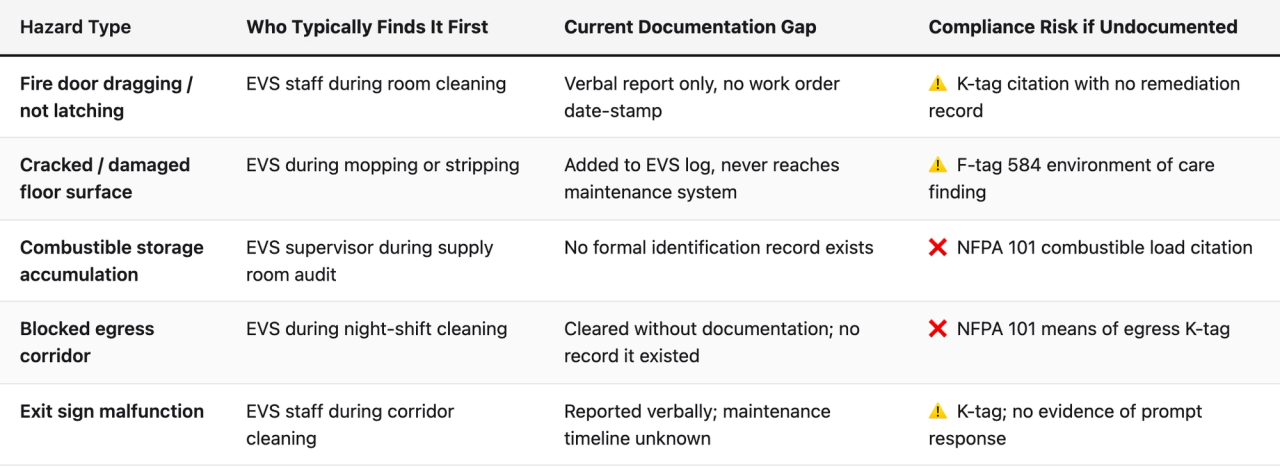
EVS staff are often the first people in a facility to encounter a physical hazard. They are moving through resident rooms, corridors, dining areas, and utility spaces at a pace and frequency that maintenance staff rarely match. A loose handrail, a floor drain that is not sealing properly, a fire door that is dragging on the carpet, a storage room that has accumulated enough material to qualify as a combustible load concern: EVS staff see these issues first. The question is what happens next.
In most SNFs, the answer is informal. An EVS technician tells their supervisor. The supervisor tells the maintenance director or puts a note on a whiteboard. The maintenance director addresses it when the workload allows. Nobody documents the initial observation date, the reporting chain, or the resolution date in a format that would satisfy a surveyor asking "when did you know about this, and what did you do?" That informal chain is not a compliance failure on its own. But when a surveyor finds that same fire door still dragging during an unannounced visit, the absence of any documentation showing when the problem was identified, who was notified, and what the resolution timeline was becomes a significant liability.
The Work Order Gap That Produces Most Preventable Citations
Work order management software is not a new concept in SNF plant operations. Most maintenance directors use some form of it, ranging from enterprise CMMS platforms to simple spreadsheet trackers. But EVS departments in SNFs are rarely integrated into the same work order system. EVS supervisors often manage their own informal task lists, and the handoff between "EVS staff identified a problem" and "maintenance has an open, documented work order for that problem" is broken more often than facility leadership realizes.
This gap creates a specific survey risk. A CMS Life Safety surveyor who observes a physical deficiency and asks the administrator for documentation of when it was identified and what the remediation plan was should receive a timestamped work order with an assigned owner and a resolution record. If the best available answer is "we think EVS mentioned it last week," the facility has no documentation to counter the finding. The citation documents the condition as if it were unknown and unaddressed, because from a documentation standpoint, it was.
How to Apply This
Establish a formal EVS-to-maintenance escalation protocol where any physical hazard identified by an EVS staff member triggers a documented work order within a defined window (four hours is a reasonable benchmark for life safety-relevant issues). The EVS director should have the ability to create work orders directly in the facility's work order management software, not just submit verbal reports. Every work order should include the date of initial observation, the staff member who identified it, the assigned resolution owner, and a completion record. That documentation chain is what transforms an EVS observation into a compliance asset.
3. Infection Control and Life Safety Documentation Overlap in Ways Most EVS Directors Are Not Trained to Recognize
The intersection of infection control and life safety compliance is one of the most underappreciated areas of EVS accountability in SNFs. CMS surveys address both domains, and while they are assessed under different regulatory frameworks, the physical evidence surveyors examine often comes from the same spaces EVS manages. The challenge is that EVS directors are typically well-trained in infection prevention protocols but are rarely given explicit guidance on where those protocols intersect with life safety standards.
Consider the soiled utility room. From an infection control standpoint, EVS manages cleaning frequency, proper waste segregation, and personal protective equipment compliance in that space. From a life safety standpoint, the same room is subject to standards governing door self-closure, proper latching, storage of flammable materials, and sprinkler system clearance. An EVS director who is rigorous about infection control documentation in the soiled utility room may have no awareness that a surveyor will also check whether that room's door closes and latches completely, and whether the sprinkler head has the required 18-inch clearance from stored materials.
Where the Two Regulatory Frameworks Collide
The CMS Life Safety Survey guidance and the infection control survey framework share physical territory in several areas that EVS manages daily:
- Soiled utility rooms: Door closure (life safety) and cleaning protocol documentation (infection control) are both surveyed in the same space.
- Clean linen storage: Proper separation from contaminated materials (infection control) and sprinkler clearance (life safety) apply simultaneously.
- Janitor closets: Chemical storage (both infection control and NFPA 101 flammable materials standards) and ventilation requirements.
- Resident bathrooms: Surface integrity (F-tag 584) and water temperature management (infection control and scalding prevention).
- Laundry facilities: Dryer exhaust maintenance (fire risk, NFPA 101) and infection control segregation protocols.
When EVS documentation exists only in infection control binders and not in life safety compliance records, a facility has no way to demonstrate to a Life Safety surveyor that these spaces are being managed properly. The infection control team's documentation does not automatically satisfy the life safety surveyor's evidence requirements, and vice versa. The gap between the two sets of documentation is where citations are born.
How to Apply This
Conduct a cross-walk between your current EVS infection control documentation schedule and your facility's life safety inspection schedule. For every space that appears on both lists, identify whether the documentation from each inspection program is stored in a format that satisfies the other program's requirements. Where it is not, create a unified inspection record for that space that captures both infection control and life safety data points in a single, time-stamped entry. This is not about doubling the documentation burden. It is about making the documentation that already exists do double duty for survey readiness.
4. Night-Shift EVS Coverage Creates a Specific Life Safety Documentation Blind Spot
Fire drill documentation requirements under NFPA 101 and CMS regulations require that drills occur across all shifts, including night shifts. Most maintenance directors know this. What is less commonly understood is that the EVS staff working those night shifts are part of the drill population, and their participation, or absence from it, is part of what a surveyor will examine in the drill logs. More importantly, the EVS night-shift crew is often the only facility staff conducting rounds in common areas, corridors, and utility spaces between approximately 11:00 PM and 6:00 AM. What they observe and what they document during those hours is a meaningful part of the facility's overnight compliance record.
The night-shift EVS documentation problem is not one of effort. Night-shift EVS staff in SNFs are typically doing the most labor-intensive cleaning work of the day, floor stripping, deep cleaning of common areas, restocking, and soiled utility management. The problem is that whatever they observe during those hours, hazards, equipment issues, door problems, lighting failures, exits blocked by late-arriving supply deliveries, rarely makes it into a formal compliance record. By morning, the hazard may have been corrected informally, the shift supervisor has gone home, and no record exists of what was found or what was done.
Why Surveyors Pay Attention to Overnight Documentation
An unannounced CMS survey can begin at any time a facility is operational, which includes early morning hours. Surveyors who arrive at 7:00 AM and observe a condition in a corridor or common area will ask when the last EVS round occurred and what the documentation from that round shows. If the answer is that night-shift EVS does not generate formal hazard observation records, the facility cannot demonstrate that the overnight environment was being monitored. That absence of documentation is itself a finding in some survey contexts, independent of whether a physical hazard is present.
Beyond survey risk, overnight EVS rounds represent the facility's only routine eyes on physical spaces during the hours when fire and safety incidents are statistically most consequential. Documenting those rounds is not bureaucratic overhead. It is the evidence that the facility's overnight safety monitoring was actually occurring.
How to Apply This
Implement a structured overnight EVS round log that captures the time of each round, the staff member conducting it, the areas covered, and any observations made, including "no issues noted" entries, which are as important as flagged issues because they demonstrate active monitoring. The log should be accessible via a shared facility kiosk or mobile device so that overnight staff can complete it without requiring paper forms to be transferred to day-shift supervisors. EVS directors should review overnight logs as a standing part of their morning routine, and any flagged observation from an overnight round should generate a work order before the day shift begins.
5. Chemical and Hazardous Material Management Is a Life Safety Compliance Category, Not Just an OSHA Category
EVS directors own the facility's chemical program. They manage Safety Data Sheets, approve product substitutions, oversee chemical dilution stations, and train staff on PPE requirements. This is well-understood. What is consistently underestimated is the degree to which EVS chemical management intersects with NFPA 101 and CMS Life Safety Survey standards, not just OSHA compliance.
The NFPA 101 Life Safety Code addresses the storage and use of flammable and combustible liquids in healthcare occupancies with specific requirements that differ from OSHA's general industry standards. CMS Life Safety surveyors are trained to look for EVS-managed chemicals stored in quantities or locations that violate NFPA 101 provisions. Common findings include: flammable cleaning concentrates stored in quantities exceeding the permitted amount outside of approved storage cabinets, aerosol products stored near heat sources in janitor closets, and chemical containers left open or improperly sealed in spaces adjacent to resident areas.
The Documentation Side of Chemical Compliance
Beyond the physical storage requirements, EVS directors carry a documentation obligation for their chemical program that most facilities underestimate. Environmental services SNF compliance expectations include maintaining current SDS documentation accessible to all staff who use each product, training records showing that each staff member has been instructed on proper use and emergency procedures, and records demonstrating that product substitutions have been reviewed and approved through a proper process.
When a surveyor identifies an SDS documentation gap, missing records, outdated sheets, or products in use that do not have corresponding SDS documentation on file, the citation typically lands in a category that also carries life safety implications. A product whose hazardous properties are not documented may also be a product whose storage requirements have not been properly assessed against NFPA 101 standards. The EVS director who has rigorous SDS documentation is not just satisfying an OSHA record-keeping requirement. They are building the evidentiary foundation that demonstrates their chemical program has been reviewed against life safety standards.
Aerosol Products: A Specific Underappreciated Risk
Aerosol disinfectant products have become a standard part of EVS inventory in SNFs, particularly following the increased emphasis on surface disinfection in post-acute care settings. Many EVS directors store these products without awareness that NFPA 101 and its referenced standards place aerosol products in a specific flammable/combustible category with quantity limits for storage in non-approved areas. A janitor closet with two dozen aerosol spray cans may be well within OSHA's general industry storage guidance and still be out of compliance with the NFPA 101 standards CMS Life Safety surveyors apply.
How to Apply This
Conduct a product-by-product review of your EVS chemical inventory against NFPA 101 flammable and combustible liquid storage standards, not just OSHA's SDS requirements. For any product classified as flammable or combustible under NFPA definitions, verify that storage locations, quantities, and container specifications meet NFPA 101 requirements for healthcare occupancies. Document this review and update it whenever a new product is added to the EVS inventory. This review should be a standing agenda item at quarterly EVS-maintenance joint meetings, and the documentation of each review should be stored in the facility's life safety compliance record alongside inspection logs and fire drill records.
6. EVS Directors Have No Formal Mechanism to Surface Compliance Gaps Before Survey, and That Is the Root of the Problem
The five issues described above share a common cause. EVS directors in SNFs are executing compliance-relevant work every day. They are managing environments, identifying hazards, overseeing chemical programs, supervising overnight rounds, and bridging infection control and life safety requirements. The problem is not effort or awareness. The problem is that there is no formal system connecting EVS documentation to the facility's life safety compliance record in a way that makes gaps visible before a surveyor arrives.
Maintenance directors have, at minimum, a life safety binder. The binder may be imperfect, but it is a structured artifact that someone reviews before survey and that a surveyor can examine during the visit. EVS directors do not have an equivalent. Their documentation lives in infection control logs, chemical program binders, training records, and informal shift notes. None of those documents are formatted to answer the questions a CMS Life Safety surveyor is trained to ask. None of them are cross-referenced against the K-tag categories that carry the most citation risk. And none of them are audited for gaps before survey in the way that maintenance inspection records should be.
The Cost of Invisible Documentation
When EVS documentation is not integrated into the facility's compliance management system, the EVS director becomes a compliance liability through no fault of their own. The work is being done. The observations are being made. The cleaning is happening. But because none of it is captured in a format that surveyors can evaluate or that facility leadership can audit, the EVS program is effectively invisible from a compliance standpoint. The facility cannot demonstrate what it cannot document, and what it cannot demonstrate, it will be cited for.
This is not a theoretical risk. F-tag 584 citations related to environment of care conditions that EVS manages are among the most common findings in SNF surveys. Many of those citations involve conditions that EVS staff identified and addressed, but for which no documentation exists showing that the identification, escalation, and resolution occurred within a timeframe that demonstrates active management. The citation is not always about the condition. It is often about the absence of evidence that the condition was being managed.
What a Formal EVS Compliance Mechanism Looks Like
Closing this gap requires treating EVS documentation as a first-class input into the facility's life safety compliance record, not a secondary category that gets reviewed if time allows before survey. Practically, that means:
- EVS inspection rounds are logged in the same system as maintenance inspections, with time stamps, staff identifiers, and observation fields that capture both "completed as expected" and "issue identified" entries.
- EVS-identified issues generate traceable work orders in the facility's work order management system, with escalation rules that trigger notifications when resolution timelines exceed defined thresholds.
- The EVS director has a formal role in pre-survey preparation, including reviewing EVS documentation for completeness and cross-referencing it against the K-tag and F-tag categories most commonly cited in the facility's state and CMS survey history.
- EVS documentation is reviewed by an audit function (whether internal or through a compliance platform) that identifies gaps, not just confirms completion. A cleaning log that shows tasks completed but does not capture any observations is not evidence of active environmental monitoring. It is evidence of task completion, which is a lower standard than surveyors expect.
How Compliance Platforms Change the EVS Accountability Equation
Platforms built specifically for SNF life safety compliance, rather than generic CMMS tools adapted for healthcare, can integrate EVS documentation into the facility's compliance record in ways that paper binders and spreadsheets cannot. When EVS staff can log observations, flag hazards, and confirm completed rounds through a shared facility kiosk or mobile interface, and when those entries are automatically cross-referenced against the regulatory standards that apply to each space and activity, the gap between EVS work and compliance documentation closes.
The analytic layer matters as much as the operational layer. A system that collects EVS documentation but does not audit it for completeness and regulatory alignment is just a digital binder. The value is in surfacing the gaps: the overnight round log that has no observations for three consecutive nights (which a surveyor will read as absence of monitoring), the chemical storage record that has not been updated since a product substitution six weeks ago, the soiled utility room inspection that shows cleaning frequency but no notation of door closure verification. These are the patterns that produce citations, and they are invisible without a systematic audit function.
How to Apply This
Start with an EVS documentation audit against your facility's most recent survey findings. For every F-tag or K-tag citation that touches a space or activity EVS manages, trace back to the documentation that existed at the time of the survey. If the documentation did not exist, identify where in the EVS workflow the observation should have been captured and what prevented it from entering the facility's compliance record. Use that analysis to define the specific documentation requirements for EVS, not as a general policy statement, but as a specific list of records, formats, frequencies, and review responsibilities. Then build those requirements into whatever system your facility uses for life safety compliance tracking, whether that is a compliance platform, a CMMS, or a structured documentation protocol. The requirements that are not built into the system will not be met consistently, and inconsistency is what surveys find.
The Accountability Framework EVS Directors Actually Need
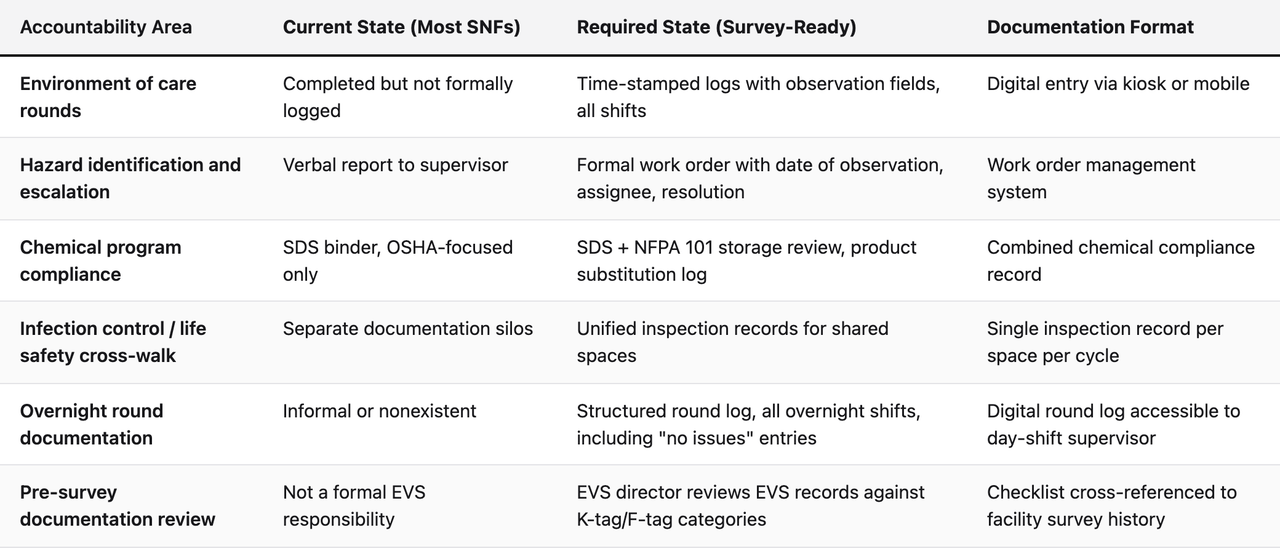
Fixing the EVS accountability gap in SNF life safety compliance is not about adding more work to an already demanding role. It is about making the work that is already happening count for compliance purposes. The EVS director who is managing their department effectively is already doing most of what the following framework describes. The gap is in the documentation architecture that makes that work visible and auditable.
Building the EVS Director into the Pre-Survey Process
Most SNFs have a pre-survey readiness protocol of some kind. The maintenance director reviews the life safety binder. The DON reviews care plan and medication administration documentation. The administrator reviews staffing and financial records. The EVS director is rarely given an equivalent review assignment because nobody has formally defined what EVS documentation should look like for survey readiness purposes.
Adding EVS to the pre-survey process means giving the EVS director a specific review checklist tied to the regulatory standards that apply to EVS-managed spaces and activities. That checklist should be derived from the facility's actual survey history, state-specific survey guidance, and the K-tag and F-tag categories most commonly cited in SNFs of the facility's size and type. It should not be a generic "check everything" list. It should be a targeted review of the specific documentation that surveyors are most likely to examine in the spaces EVS manages.
The CMS State Operations Manual provides the underlying regulatory framework for both Life Safety and standard surveys. EVS directors who have read the guidance specific to the F-tags that apply to their areas of responsibility are significantly better positioned to build documentation programs that satisfy surveyors, because they understand what surveyors are looking for rather than guessing at it.
What Multi-Site SNF Operators Get Wrong About EVS Compliance Standardization
For regional facilities managers and VPs of operations overseeing multiple SNF locations, the EVS compliance gap is compounded by the challenge of standardization. Each facility has different physical layouts, different EVS staffing structures, and different survey histories. But the regulatory standards that apply to EVS documentation are consistent across facilities, and the documentation failures that produce citations are also largely consistent. This creates an opportunity for standardization that most multi-site operators have not fully exploited.
The typical multi-site approach to EVS compliance is to set policies at the corporate level and rely on facility-level EVS directors to implement them. The problem is that without a centralized system for tracking EVS documentation across facilities, corporate leadership has no visibility into whether implementation is occurring, whether documentation is complete, or whether specific facilities are carrying elevated citation risk. A regional director who manages ten SNFs is dependent on self-reporting from facility-level EVS directors, which is the equivalent of asking someone to audit their own work.
Centralized Visibility Without Micromanagement
The goal of multi-site EVS compliance standardization is not to eliminate facility-level autonomy. It is to create centralized visibility into the documentation gaps that represent citation risk, so that corporate operations can identify and address problems before survey rather than learning about them in a deficiency report. A facility-level EVS director who knows their documentation is being reviewed at the regional level against consistent standards has a different relationship to documentation completeness than one who knows their binder will only be examined if a surveyor asks for it.
Standardizing EVS documentation across a multi-site portfolio also enables pattern recognition that is impossible at the facility level. If a specific type of documentation gap, overnight round logs missing "no issues" entries, for example, is appearing across multiple facilities, that is a training and protocol issue that needs a standardized response. Without centralized documentation tracking, that pattern is invisible until it produces citations at multiple facilities in the same survey cycle.
Frequently Asked Questions
What specific CMS survey tags most commonly apply to EVS-managed spaces in SNFs?
F-tag 584 (safe, clean, comfortable, and homelike environment) is the most directly applicable to EVS. K-tags related to means of egress, corridor obstructions, door closure, and combustible storage also frequently involve spaces and conditions that EVS manages. The specific K-tag categories most relevant to EVS include those addressing storage room conditions, utility room door compliance, and corridor clutter, all of which EVS staff encounter daily.
Is the EVS director legally responsible for life safety compliance failures in spaces they manage?
Regulatory citations under CMS are issued to the facility, not to individual staff members. However, within the facility's internal accountability structure, the EVS director's responsibility for spaces and activities under their oversight is real and should be formally defined. Facilities that clearly document EVS accountability in job descriptions, policy documents, and pre-survey review processes are better positioned to demonstrate organizational competence to surveyors.
How should an EVS director document a fire door issue they identify during cleaning rounds?
The identification should immediately generate a formal work order in the facility's work order management system, with the date and time of observation, the specific location, the nature of the issue (door not latching, dragging on floor, hardware failure, etc.), and the name of the EVS staff member who identified it. The work order should be assigned to the maintenance department with a resolution timeline appropriate to the severity of the life safety risk. A fire door that does not latch is a life safety-critical issue that should carry a same-day resolution requirement.
Do EVS staff need to be included in fire drills, and does their participation need to be documented?
Yes on both counts. NFPA 101 and CMS Life Safety Survey requirements address drill participation across all staff who work in the facility during any shift. EVS staff working a given shift during which a drill occurs are part of the drill population. Drill logs should identify the number and category of staff participating, and surveyors may ask specifically whether EVS staff are included in drill records. Drill logs that do not account for EVS staff are incomplete documentation.
What is the right cadence for EVS-to-maintenance joint documentation reviews?
A minimum of quarterly formal reviews, with a standing agenda that covers EVS-identified hazards and their work order status, chemical program compliance against NFPA 101 storage requirements, shared-space inspection records, and any documentation gaps identified since the previous review. Facilities with recent survey findings in EVS-related categories should increase this to monthly until the documentation program is demonstrably consistent.
How does SEQURA support EVS directors specifically, versus just maintenance directors?
EVS director life safety compliance is a core use case for SEQURA, not an afterthought. EVS staff can log rounds, flag hazards, and confirm completed tasks through the same facility kiosk or mobile interface that maintenance technicians use. EVS documentation is stored in the same compliance record as maintenance inspection logs, making it visible to the facility administrator and auditable against the regulatory standards that apply to EVS-managed spaces. The analytic layer surfaces EVS documentation gaps, missing overnight round entries, unresolved work orders from EVS-identified hazards, chemical program records not updated after product substitutions, before a surveyor finds them.
Can EVS documentation gaps produce immediate jeopardy findings during a CMS survey?
Immediate jeopardy (IJ) findings require a determination that a deficiency has caused or is likely to cause serious injury, harm, impairment, or death. A blocked egress corridor, a fire door that does not latch in a resident area, or a combustible storage condition that poses a fire risk could, in the right circumstances, support an IJ determination. The documentation gap itself does not produce IJ; the underlying physical condition does. But the absence of documentation demonstrating active management of the condition is what prevents the facility from arguing that the issue was being addressed.
How should an EVS director handle a situation where maintenance does not resolve a flagged issue within the expected timeline?
The EVS director should have a formal escalation path that does not depend on their personal relationship with the maintenance director. If a work order generated by an EVS observation has not been resolved within the defined timeline, the escalation should automatically notify the administrator or director of facilities. The key is that the escalation is documented, not just communicated verbally. A work order system that sends escalation notifications and logs the escalation creates a record showing that the EVS director identified the issue, escalated it appropriately, and the resolution timeline was a facility-level decision, not an EVS failure.
What training do EVS staff need to support life safety compliance documentation?
EVS staff need to understand three things that most facilities do not formally train on: which physical conditions in their work areas constitute life safety concerns (as distinct from cleanliness concerns), how to formally document an observation rather than just verbally reporting it, and what the escalation protocol is for different categories of issue. A cracked floor tile and a fire door that does not latch are both problems an EVS technician might observe, but they carry very different urgency levels and should trigger different responses. Training that does not distinguish between these categories produces documentation that does not distinguish between them either.
Is there a standard template for EVS round documentation in SNFs?
No single regulatory standard prescribes the format of EVS round logs. The documentation requirement is functional: the facility must be able to demonstrate that EVS rounds are occurring at appropriate frequencies, that observations are being recorded, and that identified issues are being escalated and resolved. Any format that captures those elements, time, staff member, areas covered, observations, and follow-up actions, satisfies the functional requirement. The advantage of using a compliance platform's standard templates is that they are built to capture the data points surveyors are trained to look for, reducing the risk that a homegrown form omits a critical field.
How does the EVS director's role differ in a small SNF versus a large multi-floor facility?
In smaller facilities, the EVS director may also function as a working supervisor, conducting rounds directly alongside EVS staff. In larger facilities, the EVS director's role is more managerial, with documentation oversight as a primary function. The compliance requirements are the same in both cases, but the documentation burden in a larger facility is proportionally greater because there are more spaces, more staff generating documentation, and more opportunities for gaps. Multi-floor facilities also have more complex egress and fire door compliance requirements, which EVS staff encounter in their daily work on every floor.
What is the single most impactful change an EVS director can make today to improve life safety compliance readiness?
Implement a formal work order creation protocol for EVS-identified hazards. The gap between "EVS staff see problems" and "those problems are in the compliance record" is the most consequential documentation failure in most SNF EVS programs. If an EVS technician who identifies a fire door issue today can generate a traceable work order with a date stamp and an assigned resolution owner, that single change closes the most common EVS-related citation pathway in CMS Life Safety surveys.
Key Takeaways
- EVS directors are functional environment of care managers in every SNF, regardless of whether their job description says so. The physical spaces surveyors examine most carefully are the spaces EVS manages daily.
- Hazard identification without a formal work order trail is not compliance documentation. Verbal reports and whiteboard notes do not satisfy the evidentiary standard CMS Life Safety surveyors apply.
- Infection control and life safety documentation overlap in soiled utility rooms, clean storage, laundry facilities, and janitor closets. Separate documentation silos for each regulatory framework create gaps that neither program covers.
- Night-shift EVS rounds are an undervalued compliance asset. Structured overnight round logs that capture both observations and "no issues" entries demonstrate active environmental monitoring across all hours of facility operation.
- Chemical management is a life safety compliance category, not just an OSHA category. NFPA 101 storage requirements apply to EVS-managed chemicals, and EVS documentation should reflect review against both frameworks.
- The root cause of the EVS accountability gap is the absence of a formal mechanism connecting EVS documentation to the facility's life safety compliance record. Closing that gap requires integrating EVS into the same documentation system that captures maintenance inspections, not maintaining a parallel and invisible EVS binder.
- Multi-site operators need centralized visibility into EVS documentation completeness across facilities. Pattern recognition across a portfolio is impossible without standardized documentation in a centralized system.
- Pre-survey preparation should formally include the EVS director with a specific review checklist tied to the K-tag and F-tag categories that apply to EVS-managed spaces and the facility's actual survey history.
About the author
Benjamin Terebelo · Founder
Benjamin is the founder of SEQURA, a compliance platform purpose-built for healthcare facilities. He builds at the intersection of healthcare operations and software, maintaining a focus on bringing modern tooling to systems that the broader industry has largely left behind.
About the author
Benjamin Terebelo · Founder
Benjamin is the founder of SEQURA, a compliance platform purpose-built for healthcare facilities. He builds at the intersection of healthcare operations and software, maintaining a focus on bringing modern tooling to systems that the broader industry has largely left behind.