
7 K-Tag Documentation Gaps That Most Commonly Trigger CMS Life Safety Citations

Walk into the life safety binder room of almost any skilled nursing facility the week before a resurvey and you will find the same scene: a three-ring binder that weighs eight pounds, a maintenance director who has not slept well in days, and a stack of contractor reports that may or may not match the inspection logs tucked behind tab seven. The binder looks complete. The documentation often is not. And the gap between those two things is exactly where K-tag citations are born.
CMS life safety citations are not primarily a facilities-management problem. They are a documentation problem. The physical systems in most skilled nursing facilities function well. The records that prove they function well are where the deficiencies pile up. Surveyors are not engineers inspecting equipment. They are auditors inspecting paperwork, and the specific patterns of missing, incomplete, or internally inconsistent records that trigger the most CMS life safety citations are well established, largely predictable, and almost entirely preventable.
This article ranks the seven SNF documentation gaps that most reliably produce NFPA 101 K-tags during unannounced CMS surveys. Each entry explains why the gap exists, what the surveyor is actually looking for, and what a compliant documentation record needs to contain. The order reflects both frequency of citation and severity of consequence, starting with the deficiency category that generates the broadest downstream risk.
1. Incomplete Fire Drill Records That Fail the Shift-Coverage Test
Fire drill documentation is the single most cited life safety deficiency category in skilled nursing facilities, and the most common failure is not missing drills entirely. It is drills that do not satisfy the shift-distribution requirement buried in NFPA 101 Chapter 19. Facilities conduct their quarterly drills. They log them. And then a surveyor points out that three of the four annual drills happened on the day shift, with only one night-shift drill recorded across a twelve-month period.
The NFPA 101 Life Safety Code requires that fire drills in health care occupancies be conducted on each shift at varying times so that all staff on every rotation participate. For a facility running three shifts, that means the annual drill schedule must demonstrate rotation across all three. A facility that conducts four drills a year but runs two in the morning, one in the afternoon, and one at a rotating-but-rarely-documented night shift will produce a record that looks complete in isolation and fails the moment a surveyor maps it to the shift schedule.
What the Surveyor Looks For
During a life safety survey, the inspector will pull drill logs and cross-reference them against the facility's posted shift schedule. They are checking four things simultaneously: the date and time of each drill, the shift in which it occurred, the number and role of staff present, and whether the drill coordinator noted any deficiencies and documented corrective action. A log that records only "drill conducted, no issues" without capturing time-of-day, staff count, shift designation, and the name and title of the person conducting the drill will typically result in a K-tag citation regardless of whether the drill physically happened.
The Deeper Documentation Problem
Many facilities log fire drills as a single event entry. The NFPA 101 framework treats each drill as a multi-element record that must stand on its own as evidence. A compliant drill log needs: the date, the exact start time (not just AM or PM), the shift designation, a list of participating staff by name or role, the location in the facility, any noted evacuation deficiencies, the name and credentials of the drill coordinator, and documentation that the drill was unannounced to non-coordinator staff. Facilities using paper logs almost universally omit at least two of these elements on at least one drill per year. That is a predictable citation.
How to Close the Gap
Build the drill log as a structured form, not a narrative entry. Each required element should be a mandatory field, not a blank text box. Assign drill scheduling at the facility level so that shift rotation is built into the calendar before the year begins, not reconstructed after the fact. And store drill records in a format that allows you to generate a shift-distribution summary on demand, because that is the first table a surveyor will ask for.
2. Generator Testing Logs Missing Required Load Readings
Emergency generator documentation is the second most common source of K-tag deficiencies, and the specific gap that drives citations is almost always the same: facilities conduct their required monthly and annual tests, but the logs do not capture the load data that CMS and NFPA 99 actually require. A log that says "generator tested, started normally, ran for 30 minutes" is not a compliant generator test record. It is a note.
Under CMS emergency preparedness and life safety requirements, and the underlying NFPA 99 Health Care Facilities Code, monthly generator tests must be conducted under load for a minimum of 30 minutes, and the test record must document the load level achieved. Annual tests must demonstrate load at or above 30% of nameplate rating for a minimum of four continuous hours, with load readings captured at regular intervals. The distinction between a "test occurred" record and a "compliant test record" is the presence of kW or percentage-of-nameplate load data.
Why Load Data Is Consistently Missing
The reason this gap is so widespread is structural. The person conducting the generator test is typically a maintenance technician whose mental model of the task is "start the generator, let it run, note that it ran." The regulatory requirement that the log also capture electrical load output is a documentation standard, not a mechanical task. It requires either a connected load meter or a manual load calculation, and it requires someone to know that the reading is required, when to take it, and where to record it. In facilities where the generator test procedure is handed down informally, load documentation is the element that gets dropped first.
What a Complete Generator Test Record Contains
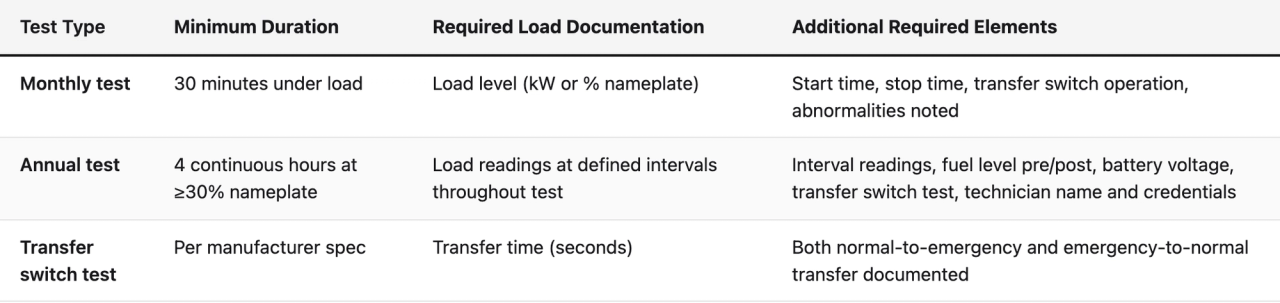
How to Close the Gap
Rebuild the generator test procedure as a structured checklist where load readings are mandatory fields, not optional notes. If the facility does not have a connected monitoring system, the test procedure must include a step that explicitly directs the technician to read the load meter and record the value at a specific point in the test. For annual tests, build an interval recording table directly into the test form so that readings cannot be submitted without multiple data points.
3. Unreconciled Sprinkler Deficiency Reports
Sprinkler system documentation deficiencies are among the most consequential K-tag categories because they sit at the intersection of two separate documentation obligations: the quarterly and annual inspection records required by NFPA 25, and the deficiency-correction tracking process required by CMS. A facility can have a fully functional sprinkler system, a legitimate contractor inspection, and a current inspection tag on every head, and still receive a K-tag citation because the paper trail between the contractor's deficiency report and the facility's corrective action record is broken.
The pattern looks like this: a licensed contractor completes the annual sprinkler inspection and issues a report that notes one or more deficiencies. The deficiencies are legitimate, they are minor, and they are corrected within the required timeframe. But the facility's documentation record contains the original contractor report and nothing else. There is no corrective action log, no re-inspection confirmation, no notation that the deficiencies were resolved. The surveyor reads the contractor report, sees open deficiencies, and issues a citation, because from a documentation standpoint the deficiencies were never closed.
The Three-Document Chain That Must Be Intact
A complete sprinkler compliance record is not a single document. It is a chain of three: the initial inspection report from a licensed contractor, a facility-level corrective action record that documents when and how each identified deficiency was addressed, and a follow-up confirmation, either from the original contractor or from a documented re-inspection, that the deficiency was resolved satisfactorily. When any link in that chain is missing, the record is non-compliant regardless of the physical state of the system.
This is a documentation architecture problem, not a maintenance problem. Most facilities think of sprinkler compliance as "get the annual inspection done." The regulatory framework treats it as a continuous documentation loop. Inspection, deficiency identification, corrective action, confirmation. Every element of that loop must be recorded, and all four elements must be traceable to the same asset at the same point in time.
Impairment Records as a Separate Citation Risk
A secondary sprinkler documentation gap that generates its own K-tag category involves impairment records. Any time a sprinkler zone is taken out of service, even for routine maintenance, the facility is required to document the impairment under the NFPA 25 impairment management program: the reason for impairment, the zone affected, the date and time impairment began, the interim fire protection measures put in place, the name of the impairment coordinator, and the date and time service was restored. Facilities frequently document that a zone was impaired and restored, but omit the interim protection measures. That omission is a citation.
How to Close the Gap
Create a dedicated sprinkler deficiency register that is separate from the inspection log. Every deficiency noted in any contractor report gets a corresponding entry in the register with fields for corrective action, responsible party, completion date, and confirmation method. The register should not close a deficiency entry without a confirmation record attached. For impairments, build a structured impairment form that makes interim protection documentation a required step, not an optional note.
4. Missing or Malformed Corridor and Door Maintenance Records
Corridor integrity and fire door compliance generate a disproportionate share of NFPA 101 K-tags because the inspection requirements are granular, the inspection frequency is high, and the documentation standard is stricter than most maintenance teams realize. The NFPA 80 Standard for Fire Doors and Other Opening Protectives requires annual inspection of every fire door assembly in the facility, with each door individually documented, each tested component individually recorded, and any deficiencies individually tracked through correction.
The failure mode that drives citations is the summary record: a single log entry that says "all fire doors inspected, no deficiencies noted" covering an entire wing or floor. That format is not compliant. NFPA 80 and the corresponding CMS interpretive guidance require door-by-door documentation. Each door assembly needs its own record showing the door number or location identifier, the inspection date, the inspector's name and credentials, the components tested (latching, closing mechanism, frame condition, hardware, smoke seals, signage), and the pass/fail result for each component.
The Corridor Obstruction Dimension
Beyond fire door documentation, corridor integrity citations frequently stem from a different documentation gap: the absence of a corridor inspection program. Facilities with compliant fire doors can still receive K-tag citations related to corridor integrity if they cannot demonstrate a documented, recurring corridor inspection process that checks for obstructions, storage in corridors, propped-open fire doors, and damaged smoke barrier integrity. The physical condition of the corridor on the day of the survey matters less than the surveyor's ability to confirm that the facility has a systematic process for checking it.
A corridor inspection program that produces survey-ready documentation needs: a defined inspection frequency (at minimum weekly for high-traffic areas), a structured form that captures corridor sections by identifier, a checklist of items reviewed (door condition, obstruction status, signage, smoke barrier integrity), and a corrective action field for any item not meeting standard. Facilities that rely on informal walkthroughs without structured records cannot demonstrate the program exists.
Automatic Door Holder and Release System Documentation
A third fire door documentation gap involves automatic door-hold-open devices. Corridor fire doors held open by electromagnetic devices must be connected to the fire alarm system and documented as part of both the fire door inspection record and the fire alarm inspection record. Many facilities document the door holder as part of the fire alarm system test and omit it from the fire door inspection record, or vice versa. A surveyor reviewing either record independently finds an incomplete picture. The gap is not in the physical system. It is in the cross-referencing of the records.
How to Close the Gap
Assign every fire door assembly a permanent identifier that appears consistently in every record that touches that door: the inspection log, the deficiency register, the corrective action record, and the fire alarm test record for any door connected to the alarm system. Never use summary entries. Build the inspection form so that each door identifier is a separate row, and each component is a separate column. When a door-hold-open device exists, create a cross-reference field in both the fire door record and the fire alarm record that confirms both documents cover the same asset.
5. Hazardous Area Protection Documentation With Incomplete Compliance Verification
Hazardous area citations under NFPA 101 Chapter 19 are among the most frequently misunderstood K-tag categories, not because facilities fail to identify hazardous areas, but because the documentation standard for verifying protection compliance is more specific than most maintenance programs recognize. A soiled utility room, a trash collection room, a paint storage area, a generator room: these are all hazardous areas under NFPA 101, and each one requires either one-hour fire-rated construction, sprinkler protection, or both, depending on its size and contents. The documentation obligation is to prove which protection method applies to each identified hazardous area and that the protection is intact and functional.
The citation pattern that recurs most often involves facilities that have correctly identified their hazardous areas and believe the protection is in place, but whose documentation cannot confirm it. A soiled utility room that is supposed to be protected by one-hour construction requires a record showing that the walls, ceiling, and door assembly meet the one-hour rating, that the door self-closes and latches, and that there are no penetrations through the rated construction that have not been properly fire-stopped. Absent that documentation, the protection cannot be verified, and verification is what the surveyor needs.
The Penetration and Fire-Stop Gap
The most commonly missing element in hazardous area documentation is the penetration survey. Pipes, conduit, and cable trays that pass through rated walls create potential fire barrier breaches. NFPA 101 requires that these penetrations be protected with listed fire-stop systems. The documentation obligation includes not only confirming that fire-stop material is present but confirming the specific listed system installed and that it is appropriate for the construction type and penetration configuration. Most facilities do not have a penetration inventory at all. Those that do frequently lack the product listing documentation that confirms the fire-stop system is appropriate for the specific penetration.
Storage and Use Tracking in Hazardous Areas
A secondary documentation gap in the hazardous area category involves the contents of those areas over time. A storage room that was correctly classified and protected at the time of a previous survey can drift out of compliance as staff add materials that change the hazard classification. Facilities that document the initial hazardous area assessment but have no recurring inspection record for hazardous area contents create a documentation gap that a surveyor can exploit even if the physical space remains compliant. A quarterly walk-through of each identified hazardous area, documented with a structured form that notes current contents and confirms protection integrity, closes this gap.
How to Close the Gap
Build a hazardous area register that lists every identified hazardous area by location, its NFPA 101 classification, the protection method (rated construction, sprinkler, or both), the basis for that protection determination, a penetration inventory with fire-stop product listings, and a recurring inspection record. The register should be updated whenever the use or contents of a hazardous area change, and each quarterly inspection should produce a timestamped, signed record that confirms protection integrity and notes any changes to contents or use.
6. Oxygen and Medical Gas System Documentation Gaps Under NFPA 99
Medical gas and oxygen documentation deficiencies are a growing source of K-tag citations as CMS surveyors apply NFPA 99 Health Care Facilities Code requirements with increasing consistency across the skilled nursing facility sector. The documentation obligations for oxygen storage, piped medical gas systems, and portable oxygen management are extensive, and the gap between what facilities document and what NFPA 99 requires is significant in many SNFs.
For facilities with piped medical gas systems, the primary documentation obligation involves annual inspection and testing by a qualified medical gas verifier, with a complete test report that includes pressure testing results, alarm function verification, labeling confirmation, and zone valve documentation. The test report must be retained and must demonstrate that all system components were tested, not just the primary distribution lines. Facilities that retain only a summary pass/fail report from their medical gas contractor, rather than the full test documentation, cannot demonstrate compliance at the component level.
Oxygen Storage Documentation Requirements
For facilities managing oxygen in bulk storage or in cylinder storage rooms, the documentation requirements extend beyond inspection records to include storage configuration compliance. NFPA 99 specifies maximum storage quantities by location, separation requirements between oxidizing and flammable materials, ventilation requirements for storage areas, and signage requirements. A compliant documentation record for an oxygen storage area includes the initial assessment confirming the area meets NFPA 99 configuration requirements, a recurring inspection record (at minimum monthly) confirming that storage quantities and configuration remain compliant, and a record of any incidents involving oxygen handling.
The most common citation in this subcategory involves facilities that store oxygen cylinders in locations that technically meet the physical requirements but whose documentation does not confirm ongoing compliance with quantity limits and separation requirements. Surveyors have found facilities where the storage area was compliant on the day of the survey but whose inspection records showed extended gaps, meaning the facility could not demonstrate continuous compliance between surveys.
Portable Oxygen Management Documentation
For SNFs managing resident-owned or facility-owned portable oxygen concentrators and cylinders at the unit level, the documentation obligation includes a portable oxygen management program with written policies, staff training records, and unit-level inspection documentation. The written policy must address storage of portable units in resident rooms, maximum quantities per room, inspection procedures, and staff responsibilities. Facilities that have informal oxygen management practices but no written program documentation consistently receive citations in this category regardless of whether their actual oxygen management practices are reasonable.
How to Close the Gap
Create a medical gas documentation portfolio that is distinct from the general life safety binder. It should contain: the full NFPA 99 inspection report from a qualified verifier (not a summary), a hazardous area assessment for every oxygen storage location, a monthly storage inspection log with quantity and configuration fields, the written portable oxygen management policy, staff training records for oxygen handling procedures, and a log of any oxygen-related incidents or near-misses. The portfolio should be organized so that a surveyor can pull any component independently and find a complete, current record.
7. Life Safety Plan and Building Documentation That Does Not Reflect Current Conditions
The most overlooked documentation gap in skilled nursing life safety compliance is the life safety plan itself. Most SNFs have a set of floor plans somewhere in the maintenance office. Those plans show corridor layouts, exit locations, smoke compartment boundaries, and fire alarm pull station positions. In many facilities, those plans were accurate when they were drawn. They have not been updated since. And the gap between the documented facility and the actual facility is a K-tag waiting to happen.
NFPA 101 and the CMS interpretive guidelines for the Life Safety Code require that facilities maintain current, accurate life safety drawings that reflect the actual condition of the building. "Current" means updated whenever a renovation, construction project, or system modification changes anything captured on the original drawings. Smoke barrier locations. Exit routes. Sprinkler zone boundaries. Fire alarm device placement. If a 2018 renovation added a wall that changed a smoke compartment boundary, and the life safety drawings still show the pre-renovation configuration, the facility has a documentation deficiency regardless of whether the physical construction is correct.
The Renovation Trigger Problem
The root cause of most life safety drawing deficiencies is the absence of a documentation update trigger in the renovation and construction management process. When a facility undertakes a project, the focus is on completing the physical work, obtaining the required permits, and getting the space back into service. Updating the life safety drawings is a documentation task that happens after the fact, if it happens at all. In many facilities, the life safety drawings are updated only when a surveyor points out that they are wrong, which is exactly the wrong time to discover the gap.
A compliant renovation documentation process includes a pre-project life safety impact assessment that identifies which drawings and records will require updating, a construction phase record that documents interim life safety measures (temporary smoke barriers, construction area fire watch documentation, etc.), and a post-project documentation update confirmation that verifies life safety drawings, equipment inventories, and K-tag records have been revised to reflect the final construction. Without this process, every renovation creates a documentation gap that persists indefinitely.
Equipment Inventory Alignment
A secondary dimension of this documentation gap involves equipment inventories. The life safety drawings should align exactly with the facility's fire alarm device inventory, sprinkler head inventory, and smoke detector placement records. If a renovation added three new smoke detectors and the fire alarm inspection record still shows the pre-renovation device count, there is a documentation inconsistency that a surveyor can identify by comparing the drawing to the inspection record. These cross-document inconsistencies are a reliable signal to surveyors that the facility's documentation is not actively managed, which invites closer scrutiny across all K-tag categories.
How to Close the Gap
Establish a formal life safety drawing control process. Each life safety drawing should have a current revision date and a revision history. Any project that triggers a physical change to the facility must include a documentation update task in its project checklist, assigned to a responsible party with a completion deadline. Before each survey cycle, conduct a physical walk-through that cross-references the current life safety drawings against actual conditions, notes any discrepancies, and generates a corrective action record. The walk-through itself becomes documentation that the facility actively manages its life safety plan currency.
The Pattern Underneath All Seven Gaps
Reading across these seven categories, a single structural pattern emerges. Every one of these documentation gaps has the same underlying cause: the person doing the physical inspection work and the regulatory standard for what the documentation of that work must contain are operating on different mental models. The maintenance technician testing the generator is thinking about the generator. The regulatory framework is thinking about the record. Closing the gap requires building the regulatory documentation standard into the inspection procedure itself, so that completing the task and producing a compliant record are the same action.
That is the problem that paper binders, spreadsheets, and informal checklists cannot solve at scale. They can capture that a task was done. They cannot enforce that the task was documented in a way that satisfies the specific evidentiary requirements of each K-tag category. And they cannot surface the gap between what was documented and what is required until a surveyor does it for you.
A structured documentation platform built specifically for SNF life safety compliance, one that encodes the regulatory documentation standard for each K-tag category directly into the inspection form, and that audits completed records against those standards before the next survey, is the operational equivalent of running your own pre-survey audit continuously. The gaps in this article are not obscure regulatory technicalities. They are the predictable outputs of documentation processes that were not designed to produce compliant records. Redesigning those processes around the documentation standard, rather than around the physical task, is the lever that moves survey outcomes.
Frequently Asked Questions About K-Tag Citations and SNF Documentation
What exactly is a K-tag citation in a CMS life safety survey?
A K-tag is a specific deficiency code used by CMS surveyors to identify violations of the Life Safety Code (NFPA 101) or related standards (NFPA 99, NFPA 25, NFPA 80) during a survey of a healthcare facility. Each K-tag corresponds to a specific regulatory requirement, and a citation is issued when the surveyor determines that the facility is not meeting that requirement based on the documentation and physical evidence reviewed during the survey. K-tags range from minor documentation deficiencies to serious immediate jeopardy findings depending on the nature and scope of the violation.
How often do CMS surveyors conduct life safety surveys at SNFs?
CMS and state survey agencies conduct standard recertification surveys of Medicare- and Medicaid-certified SNFs on an annual cycle, though the actual interval can range from nine to fifteen months. Surveys are unannounced. Facilities that receive a standard survey with significant deficiencies, or that receive a complaint-driven survey, may be subject to more frequent follow-up surveys. Life safety surveys can be conducted as a standalone component or integrated with the standard health survey.
Can a facility receive a K-tag citation if the physical system is actually compliant?
Yes. K-tag citations are documentation-based, not purely condition-based. A facility whose sprinkler system is fully functional but whose inspection records are missing required elements can receive a citation for the documentation gap even if no physical deficiency exists. This is one of the most important and frequently misunderstood aspects of life safety survey compliance: the documentation of compliance is itself a compliance requirement.
What is the difference between an Immediate Jeopardy K-tag and a standard deficiency?
An Immediate Jeopardy (IJ) finding occurs when a surveyor determines that a facility's failure to comply with a requirement has caused, or is likely to cause, serious injury, harm, impairment, or death to a resident. IJ findings require immediate corrective action and carry significant financial consequences, including potential Civil Monetary Penalties and termination from the Medicare and Medicaid programs. Standard deficiency citations that do not rise to IJ still require a Plan of Correction but carry lower immediate financial risk. Documentation gaps that reveal systemic failures in life safety management are more likely to escalate to IJ findings than isolated record errors.
How long must SNFs retain life safety documentation?
CMS generally requires that SNFs retain life safety documentation for a minimum period sufficient to cover the current survey cycle, but the practical standard is three years of records, which allows a surveyor to review the prior survey period and the current one. NFPA standards reference varying retention periods by document type. The safest operational approach is to retain all life safety inspection records, contractor reports, and corrective action documentation for a minimum of three years, with permanent retention of life safety drawings and equipment installation records.
What is the most common reason a fire drill log fails during a CMS survey?
The most common failure is missing shift-distribution documentation. Facilities conduct the required number of drills but cannot demonstrate through their records that the drills were distributed across all shifts, including nights and weekends, over the course of the year. The second most common failure is incomplete individual drill records that omit required elements such as exact time, staff count, shift designation, or the identity of the drill coordinator.
Do state surveys use the same K-tag framework as CMS federal surveys?
State survey agencies that conduct CMS-delegated surveys use the federal K-tag framework and CMS interpretive guidelines. Some states have additional state-specific life safety requirements that go beyond the federal standard, and state surveyors may cite both federal K-tags and state-specific deficiency codes during the same survey. Facilities should maintain documentation that satisfies both the federal K-tag requirements and any applicable state-specific standards.
What is an NFPA 25 impairment record and when is it required?
An NFPA 25 impairment record is required any time a sprinkler system or any portion of a sprinkler system is taken out of service. It documents the reason for the impairment, the zone or area affected, the date and time service was suspended, the interim fire protection measures implemented during the impairment, the name of the impairment coordinator, and the date and time service was restored. Impairment records are required for both planned impairments (scheduled maintenance) and emergency impairments (system failures).
How should SNFs document hazardous areas to satisfy NFPA 101 requirements?
SNFs should maintain a hazardous area register that identifies every space classified as hazardous under NFPA 101 Chapter 19, documents the protection method for each space (one-hour rated construction, sprinkler protection, or both), includes a penetration inventory for any rated construction with fire-stop product listings, and contains a recurring inspection record confirming that protection integrity and storage compliance are maintained over time. The register should be updated whenever the use or contents of a hazardous area change.
What triggers a requirement to update life safety drawings?
Any physical change to the facility that affects a condition shown on the life safety drawings triggers an update obligation. This includes renovations that change room configurations, smoke compartment boundaries, exit routes, or corridor layouts; additions or relocations of fire alarm devices, sprinkler heads, or pull stations; changes to hazardous area designations; and modifications to fire protection systems. The update should be completed as part of the project close-out process, not deferred to a future maintenance cycle.
Can a documentation platform replace a certified fire protection engineer or life safety consultant?
No. A documentation platform addresses the operational layer of life safety compliance: scheduling inspections, capturing records, enforcing documentation standards, and surfacing gaps in existing records. It does not replace the professional judgment of a certified fire protection engineer (CFPE) or a life safety consultant for complex code interpretation questions, renovation design review, or equivalency applications. The two functions are complementary. The platform ensures that the work specified by the consultant is documented in a way that satisfies the surveyor's evidentiary requirements.
What should a SNF do immediately after receiving a K-tag citation to prevent recurrence?
The immediate priority is producing a compliant Plan of Correction (POC) that addresses the specific documentation gap cited, not just the physical condition. The POC should include a root cause analysis that identifies why the documentation gap occurred, a corrective action that changes the documentation process (not just produces a one-time corrected record), a monitoring plan that includes ongoing audits of the corrected process, and a timeframe for full implementation. Facilities that produce POCs addressing the symptom rather than the process root cause tend to receive repeat citations in the same K-tag category at subsequent surveys.
Key Takeaways
- K-tag citations are primarily documentation failures, not equipment failures. Physical systems that function correctly but are not documented to the NFPA and CMS evidentiary standard will generate citations.
- Fire drill shift-distribution gaps are the most common citation trigger. The frequency of drills is less important than demonstrating that all shifts received drill coverage across the survey period.
- Generator test records without load data are non-compliant by definition. A log that confirms the generator ran but does not capture kW load does not satisfy NFPA 99 requirements.
- Sprinkler compliance requires a closed-loop documentation chain. Inspection, deficiency, corrective action, and confirmation must all be traceable in the record. An open deficiency in a contractor report is a citation regardless of whether it was physically resolved.
- Fire door documentation must be door-by-door, not summary. A single log entry covering multiple doors is not compliant with NFPA 80 regardless of the physical condition of the doors.
- Hazardous area documentation must include penetration inventories and recurring inspection records. A one-time assessment without ongoing confirmation of protection integrity leaves a continuous documentation gap.
- Medical gas and oxygen documentation requires a separate, structured portfolio that includes full NFPA 99 verifier reports, storage inspection logs, and a written portable oxygen management program.
- Life safety drawings that do not reflect current conditions are a citation waiting to happen. Every renovation should trigger a documentation update task as part of project close-out.
- The underlying cause of all seven gaps is the same: inspection procedures designed around physical tasks rather than regulatory documentation standards. Redesigning those procedures to enforce compliant records at the point of inspection is the most effective prevention strategy.
About the author
Benjamin Terebelo · Founder
Benjamin is the founder of SEQURA, a compliance platform purpose-built for healthcare facilities. He builds at the intersection of healthcare operations and software, maintaining a focus on bringing modern tooling to systems that the broader industry has largely left behind.
About the author
Benjamin Terebelo · Founder
Benjamin is the founder of SEQURA, a compliance platform purpose-built for healthcare facilities. He builds at the intersection of healthcare operations and software, maintaining a focus on bringing modern tooling to systems that the broader industry has largely left behind.