
9 Recurring Life Safety Tasks SNF Maintenance Directors Most Often Miss — And How to Fix Each One
Table of Contents
1. CDC's Water Management Program guidance addresses stagnant water risk directly and is increasingly referenced in healthcare facility surveys.
How to apply this now: Create a location-specific eyewash station log for each station in the facility. Post a laminated log sheet at or near each station. Assign weekly activation to a named staff member by role, and verify the log is being completed during monthly rounds. A simple paper log is compliant, the critical factor is that it exists and is current.
5. Fire Damper and Smoke Damper Testing Overdue or Undocumented
NFPA 80 and NFPA 105 require fire dampers and smoke dampers to be inspected and tested at one-year and four-year intervals respectively, and CMS K-tag K372 addresses this requirement. This is one of the most commonly deferred inspections in SNF facilities because it is expensive, disruptive, and requires a licensed contractor with access to ceiling spaces throughout the building. It is also one of the most frequently cited deficiencies in facilities that have not tracked their inspection cycles carefully.
The common approach is to have dampers inspected once, file the contractor report, and assume the next inspection will be triggered by someone. The four-year cycle in particular tends to get lost. A facility that had its first damper inspection in year one of operations may not realize the four-year reinspection is overdue until a surveyor asks for the inspection records and finds a gap of five or six years.
What actually works is a damper inventory. Every fire and smoke damper in the facility should be catalogued with its location, type (fire or smoke), the date of its most recent inspection, the findings from that inspection, and the due date for the next inspection. This inventory becomes the governing document that drives contractor scheduling. Without the inventory, damper inspection is purely reactive, triggered by a survey finding rather than a compliance calendar.
Damper inspection reports must also document any dampers that failed to close fully, any that were obstructed, and any corrective actions taken. Open deficiencies from a damper inspection carry the same tracking requirement as sprinkler deficiencies: they must be documented to resolution.
How to apply this now: Request a copy of your most recent damper inspection report and identify the date it was completed. Calculate when the next inspection is due under both the one-year (smoke dampers in some configurations) and four-year (fire dampers) cycles. If you do not have an inspection report, that is itself a citation risk, contact a licensed contractor to schedule the inspection and document the scheduling action immediately.
6. Medical Gas and Vacuum System Inspection Logs Incomplete or Absent
NFPA 99 Chapter 5 governs medical gas systems in healthcare facilities, and CMS K-tags K902 through K924 cover a range of medical gas and vacuum system requirements. For SNFs that operate oxygen distribution systems, vacuum systems for suctioning, or medical air systems, the inspection and testing requirements under NFPA 99 are specific and technically demanding. The citation pattern here is not that facilities ignore medical gas systems, it is that the documentation does not reflect the actual scope of the inspection required.
The most common documentation failure is the absence of zone valve inspection records. NFPA 99 requires that zone valve boxes be inspected to confirm labeling, accessibility, and operability. Many facilities have zone valves that have not been formally inspected or documented since installation. A surveyor who opens a zone valve box and finds unlabeled or mislabeled valves, or finds no inspection record, has a straightforward K-tag finding.
A secondary failure involves alarm testing. Medical gas alarm panels (area alarms and master alarms) must be tested to verify that high and low pressure conditions trigger the appropriate alarm responses. These tests must be documented with the date, the condition tested, the alarm response observed, and the name of the person who performed the test. Facilities that rely on a contractor to perform this testing must ensure the contractor's documentation captures all required fields.
For facilities that use liquid oxygen systems, the inspection requirements extend to storage area conditions, signage, and the separation of combustible materials from the storage zone. These physical conditions must be documented in inspection logs, not just maintained in practice.
How to apply this now: Identify every medical gas and vacuum system component in your facility, zone valve boxes, master alarm panels, area alarm panels, oxygen storage, and vacuum inlets. Map each component to its required inspection frequency under NFPA 99 and verify that a documentation record exists for each. Missing records should be prioritized for immediate inspection and documentation.
7. Portable Fire Extinguisher Monthly Inspection Logs with Missing Fields
NFPA 10 requires monthly visual inspections of all portable fire extinguishers, and CMS K-tag K355 addresses portable fire extinguisher maintenance. Monthly extinguisher inspection is one of the most routine tasks in any SNF, which is precisely why it is so often cited, routine tasks become invisible, and invisible tasks develop documentation gaps.
The inspection itself is straightforward: verify the extinguisher is in its designated location, the pressure gauge is in the operable range, the pull pin is in place and the tamper seal is intact, the extinguisher shows no visible damage or obstruction, and the inspection tag is signed and dated. The citation pattern is not usually that facilities skip the inspection, it is that the tag is initialed without all required fields being completed, or that extinguishers in low-traffic areas (storage rooms, mechanical spaces, laundry) are skipped because they are out of the primary inspection route.
A second common failure is the annual inspection and six-year maintenance cycle. NFPA 10 requires annual inspections by a licensed contractor and, for certain extinguisher types, a six-year internal inspection and hydrostatic testing at 12-year intervals. Facilities that cannot produce the annual contractor inspection tags and records are cited under K355. The contractor's inspection tag on the extinguisher is not sufficient documentation on its own, the facility should also retain a service report listing each extinguisher inspected, its location, its condition, and any deficiencies found.
The corrective step for facilities with incomplete monthly logs is to implement a location-specific extinguisher inventory and assign monthly inspection routes to named staff with a sign-off sheet that requires all fields. A brief orientation on what the inspection requires, not just "check the extinguisher" but "verify these specific five conditions and document each", reduces the most common gap significantly.
How to apply this now: Create an extinguisher inventory list that maps every extinguisher in the facility to its location, type, last annual service date, and assigned monthly inspector. Use this list to generate a monthly sign-off sheet that requires field-by-field confirmation rather than a single initials box. Verify that your most recent annual contractor service report is on file and covers every extinguisher on the inventory list.
8. Electrical Panel and Equipment Ground Fault Testing Gaps
NFPA 99 Chapter 6 and CMS K-tag K914 address electrical system requirements in healthcare facilities, including requirements for ground fault protection and periodic testing of electrical systems. For SNFs, the most commonly missed electrical inspection is the annual testing of ground fault circuit interrupters (GFCIs) in patient care areas, wet locations, and areas where staff use electrically powered equipment in proximity to residents.
The standard practice in many SNFs is to test GFCIs informally, a maintenance technician presses the test button on each outlet during rounds, notes that it tripped and reset, and considers the task complete. The documentation failure is that this informal testing is not logged with a location-specific record. When a surveyor asks for GFCI testing documentation, "we test them periodically" is not a compliant answer.
A more significant gap exists around the testing of isolated power systems (IPS) in wet procedure locations, if the facility has them. NFPA 99 requires that IPS systems be tested annually by qualified personnel, with specific documentation of the line isolation monitor (LIM) performance. Facilities that have IPS panels and cannot produce annual test records are exposed to a significant K-tag finding.
The broader electrical inspection picture also includes annual thermographic (infrared) scanning of electrical panels in facilities that have adopted this practice as part of their preventive maintenance program. While not universally mandated under NFPA for every SNF configuration, thermographic scanning findings, if the facility has contracted for this service, must be documented and any hot spots identified must be tracked to resolution. An unresolved thermographic deficiency documented in a contractor report is a survey finding waiting to happen.
How to apply this now: Implement a location-specific GFCI testing log that captures each outlet or device tested, its location, the test result, and the name and date of the person who tested it. Test frequency should align with your facility's preventive maintenance schedule and any state-specific requirements. If your facility has isolated power systems, verify that annual IPS testing has been performed and documented by qualified personnel.
9. Hazardous Materials and Compressed Gas Storage Documentation Gaps
CMS Conditions of Participation reference NFPA 101 and NFPA 99 for the storage and handling of hazardous materials and compressed gases, and K-tags K321 and K920 are frequently cited in this category. For SNFs, the most common hazardous materials documentation gaps involve three specific areas: the oxygen storage log, the chemical storage inspection log, and the Safety Data Sheet (SDS) management system.
Oxygen storage at SNFs, whether bulk liquid oxygen, compressed cylinders, or concentrators, must meet specific storage quantity limits, separation requirements, and physical condition standards. Many facilities store oxygen cylinders in corridors or storage closets without maintaining a log that confirms the quantity on hand, the storage conditions (chained, capped, separated from combustibles), and the date of the last inspection of the storage area. When a surveyor finds an oxygen storage area that is disorganized, over-quantity, or without documentation of routine inspection, the citation is immediate.
Chemical storage inspection is a parallel gap. Facilities that use hazardous cleaning chemicals, pool chemicals (for therapy pools), or pest control substances must maintain SDS sheets for each product, store incompatible chemicals separately, and document periodic inspections of storage areas. The most common failure is an SDS binder that is out of date, containing sheets for products no longer in use, missing sheets for products currently in use, or organized in a way that makes it difficult for a surveyor to verify completeness.
Compressed gas cylinders beyond oxygen, nitrogen, CO2 for fire suppression systems, acetylene for maintenance welding, must also be stored, secured, and documented according to NFPA and DOT requirements. Cylinders stored without security chains, stored horizontally, or stored with caps removed are physical condition citations that a surveyor can observe without asking for a single document. The documentation layer, inspection logs showing that the storage area is checked regularly, is the corrective evidence that a facility is managing these materials actively.
How to apply this now: Conduct a physical walk of every area where oxygen, compressed gases, or hazardous chemicals are stored. For each location, verify: proper quantity limits are observed, cylinders are secured and capped, incompatibles are separated, and a current SDS is accessible for each chemical present. Implement a monthly storage area inspection log for each location and assign a named staff member to complete it. Update your SDS management system to reflect only products currently in use.
The Documentation Gap Pattern Underneath All Nine Tasks
Reading across these nine tasks, a clear pattern emerges. In nearly every case, the physical work is being done. The generator runs its monthly test. The fire extinguishers are checked. The eyewash station gets flushed. The failure is not operational, it is documentary. And because documentation is what a surveyor can actually inspect, a facility that does the work without documenting it is, from a regulatory standpoint, indistinguishable from a facility that does not do the work at all.
This is the core tension in SNF life safety compliance: the people responsible for doing the work are rarely the people responsible for ensuring the documentation is complete, compliant, and audit-ready. Maintenance technicians are not trained as documentation auditors. Maintenance directors are managing dozens of competing priorities. The paper binder that sits in the office is a passive system, it captures what gets filed, but it does not flag what is missing.
The solution is not simply to add more paper or more reminder notes. The solution is an active documentation system that knows what should have been logged today, compares it to what was actually logged, and surfaces the gap before the surveyor does. That is the operational model that prevents citations, not better intentions, but better audit infrastructure.
How a Compliant Documentation System Closes Each of These Gaps
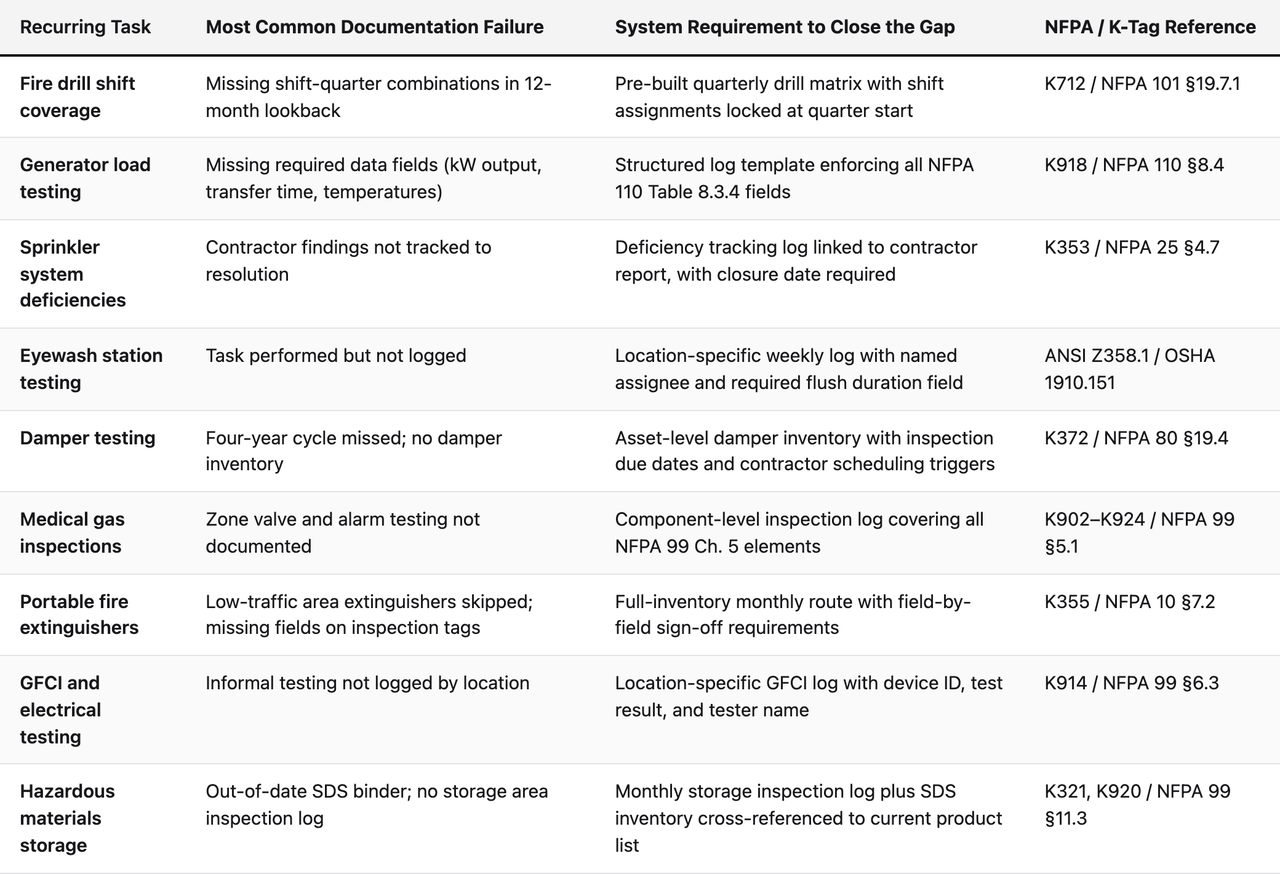
A structured, actively-audited documentation system addresses the nine tasks above in a specific way that paper binders cannot replicate. The following table maps each task to its most common documentation failure and the system requirement that closes the gap:
Why the NFPA Inspection Cadence Is the Framework Surveyors Actually Use
Understanding why these tasks are cited so frequently requires understanding how CMS surveyors approach a life safety survey. A surveyor conducting a standard survey at an SNF is not improvising. They are working from the CMS Life Safety Survey Guidance, which maps each K-tag to the relevant NFPA 101 or NFPA 99 standard, and they are cross-referencing your documentation against the cadence requirements specified in those standards.
The NFPA inspection cadence is not a suggestion, it is the governing framework. NFPA 101 specifies when drills must occur. NFPA 110 specifies when generators must be tested and what must be recorded. NFPA 25 specifies when sprinkler inspections must occur. NFPA 80 specifies when dampers must be tested. When a surveyor asks for your documentation, they are mentally checking your records against these cadences. A record that exists but shows an inspection occurring outside the required cadence is just as much a citation risk as a missing record.
This is why the NFPA inspection cadence must be built into your scheduling system, not stored in someone's memory or approximated by habit. A monthly task that drifts to every six weeks will eventually produce a cadence gap that is visible in a 12-month lookback. A four-year task that is not tracked on a calendar will simply not happen. The cadence is the compliance standard, and the calendar is the mechanism that enforces it.
For multi-site SNF operators, this creates an additional layer of complexity. Different states have different survey frequencies, different state-specific requirements layered on top of the federal NFPA framework, and different contractor relationships at each facility. Maintaining consistent NFPA cadence compliance across five, ten, or twenty facilities requires a centralized view of which inspections are current and which are approaching or past due, something that paper binders at individual facilities cannot provide.
What the Missed Inspection Citations Actually Cost
The direct cost of a life safety citation is the correction plan, the repeat survey, and the administrative time required to respond to the deficiency. For a single K-tag finding at the "D" scope and severity level, that cost is manageable. The problem is that the nine tasks described in this article rarely produce single, isolated citations. They produce clusters.
A fire drill documentation gap often reveals a broader weakness in the facility's documentation system, which leads a surveyor to look more carefully at generator records, extinguisher logs, and sprinkler documentation. A cluster of life safety deficiencies at scope "F" or "G" (widespread or actual harm) can trigger an Immediate Jeopardy determination, which carries the potential for civil monetary penalties, denial of payment for new admissions, and in the most serious cases, termination from Medicare and Medicaid participation.
Beyond the direct financial exposure, the indirect costs are significant. Facilities cited for life safety deficiencies are flagged in the CMS Care Compare database, which affects star ratings and the facility's visibility to prospective residents and their families. A facility with a pattern of life safety citations will see that pattern reflected in its Care Compare profile for years after the citations are resolved.
The cost-benefit analysis for investing in a robust documentation and audit system is straightforward: the cost of preventing citations is reliably lower than the cost of responding to them. The maintenance director who builds the systems described in this article is not doing extra work, they are preventing the much larger workload that comes with a deficient survey.
Building a Self-Auditing Life Safety Documentation System
The practical question for a maintenance director reading this article is: how do I build a system that catches these gaps before a surveyor does? The answer has three components, each of which is within reach regardless of facility size or budget.
Component 1: A Complete Task Inventory Mapped to Regulatory Cadence
Start with a master list of every recurring life safety task at your facility. Not a general list, a specific one. Every fire extinguisher, every damper, every zone valve, every GFCI location, every eyewash station, every generator. Each item on the list should have: its location, the regulatory requirement governing its inspection, the required inspection frequency, the date of the most recent inspection, the name of the person or contractor responsible for the next inspection, and the date the next inspection is due.
This inventory is the foundation of everything else. Without it, scheduling is guesswork and gap identification is reactive. With it, you can see at a glance which items are current, which are approaching their due date, and which are overdue. The inventory should be reviewed monthly by the maintenance director and updated in real time as inspections are completed.
Component 2: Structured Log Templates That Enforce Required Fields
For each inspection type, create a log template that requires every field that the relevant NFPA standard or CMS K-tag guidance specifies. Do not use a generic sign-off sheet. The generator test log should require kW output. The fire drill log should require shift designation. The sprinkler quarterly inspection log should require areas inspected and any observations noted. Field-by-field templates prevent the single most common documentation failure: a record that exists but is missing the specific data element a surveyor is looking for.
Templates should be reviewed against current NFPA standards annually and updated when standards change. The 2021 edition of NFPA 101 and the 2021 edition of NFPA 99 are the current references for CMS compliance, and any changes to required documentation elements in future editions should be reflected in your templates promptly.
Component 3: A Regular Self-Audit Process That Mimics the Surveyor's Review
Once a month, a designated person, the maintenance director, a senior technician, or an outside consultant, should conduct a documentation audit using the same methodology a CMS surveyor would use. Pull the last 12 months of fire drill logs and check shift-quarter coverage. Pull the last 12 months of generator test logs and verify all required fields are present. Pull the most recent sprinkler contractor report and verify every deficiency has a documented resolution or active correction plan.
This monthly self-audit is the mechanism that converts a passive documentation system into an active one. It is not time-consuming, an experienced reviewer can complete a meaningful documentation audit in two to three hours. What it produces is survey confidence: the knowledge that if a surveyor walked in today, the documentation would hold up to scrutiny.
Platforms like SEQURA formalize this process by running the audit continuously, comparing completed inspection records against the regulatory cadence requirements for each task and surfacing gaps in real time rather than during a monthly manual review. For facilities managing a large task inventory, or for regional operators managing multiple sites, the continuous audit model is the practical path to consistent compliance.
Frequently Asked Questions
How often are life safety citations issued at skilled nursing facilities?
Life safety deficiencies are among the most consistently cited categories in CMS SNF surveys. CMS publishes deficiency data through its Care Compare and Certification and Survey Provider Enhanced Reports (CASPER) systems, and K-tag findings, particularly in the fire protection and utilities categories, appear across a broad range of facility types and sizes. No category of SNF is consistently exempt from life safety citation risk.
What is the difference between a K-tag and an F-tag?
K-tags are life safety deficiencies cited under the Life Safety Code (NFPA 101) and related NFPA standards. F-tags are quality of care and operational deficiencies cited under the CMS Conditions of Participation. A single survey visit may produce both K-tag and F-tag findings. K-tags are specifically relevant to the physical environment, fire protection systems, utilities, and emergency preparedness, the domain of the maintenance director.
Can a facility be cited for a task that was completed but not documented?
Yes. From a regulatory standpoint, an inspection that was not documented is treated as an inspection that did not occur. The documentation is the evidence of compliance. Verbal assurances or informal records that do not meet the required format are not accepted as compliance evidence during a survey.
What NFPA edition does CMS currently use for SNF compliance?
CMS currently references the 2012 edition of NFPA 101 and the 2012 edition of NFPA 99 for existing SNF buildings under the standard adoption timeline. However, CMS has been in the process of updating to the 2012 editions and has issued guidance on specific provisions from newer editions. Facilities should verify the current adopted edition with their state health department and life safety consultant, as state adoption can vary. The NFPA codes and standards library provides reference information on current editions.
How far back can a CMS surveyor request inspection records?
CMS surveyors typically request 12 months of documentation for recurring inspection tasks. For some tasks with longer intervals, such as four-year damper inspections or five-year sprinkler testing, surveyors may request documentation going back to the last inspection cycle. Facilities should retain life safety documentation for a minimum of three years, and many compliance consultants recommend five to seven years for records tied to long-cycle inspections.
Does a contracted vendor's report satisfy the documentation requirement, or does the facility need its own records?
Contractor reports satisfy the documentation requirement only if they contain all the required data fields specified by the relevant NFPA standard. If a contractor's report is incomplete, the facility is responsible for supplementing it. The facility is also responsible for tracking any deficiencies identified in the contractor's report to documented resolution, the contractor report alone does not close the compliance loop.
What is the most cost-effective way for a small SNF to improve its life safety documentation?
For a single-facility SNF with a limited budget, the highest-impact investment is structured log templates and a master task inventory. Both can be implemented with minimal cost. The monthly self-audit process described in this article can be conducted by the maintenance director or a designated staff member without external consulting support. For facilities that have experienced recent citations or are approaching a survey cycle, engaging a life safety consultant for a documentation gap assessment is a cost-effective option that often surfaces specific risks the facility was not aware of.
How does the NFPA inspection cadence interact with state-specific requirements?
Many states impose requirements that go beyond the federal NFPA minimums. State health departments may require more frequent inspections, additional documentation fields, or specific contractor qualifications that are not specified in the NFPA standards. Facilities must comply with whichever standard is more stringent, state or federal. Maintenance directors operating in multiple states should maintain a state-specific compliance matrix that identifies where state requirements exceed federal minimums.
Are there life safety tasks that can be performed by EVS staff rather than licensed contractors?
Yes. Several recurring tasks can be performed by trained facility staff without a licensed contractor: monthly fire extinguisher visual inspections, quarterly sprinkler visual inspections (not the annual contractor inspection), weekly eyewash station activation, monthly generator visual checks (not the load test), and routine hazardous materials storage area inspections. Staff performing these tasks should receive documented training on what to look for and how to log their findings. Tasks requiring licensed contractors, annual sprinkler inspections, generator load tests, damper inspections, medical gas testing, must be performed by appropriately credentialed contractors.
What should a maintenance director do if they discover a significant documentation gap just before an anticipated survey?
Do not backfill or backdate records. Instead, conduct and document the missing inspections immediately, with contemporaneous dates. Create a brief self-identified deficiency memo that acknowledges the gap, describes the corrective action taken, and outlines the prospective process that will prevent recurrence. This approach demonstrates good faith and is consistently viewed more favorably by surveyors than facilities that appear unaware of their own documentation gaps. Consult a life safety attorney or compliance consultant if the gap is significant enough to suggest potential immediate jeopardy exposure.
How should a maintenance director prioritize which gaps to fix first?
Prioritize by citation frequency and remediation speed. Fire drill documentation gaps and generator test field deficiencies are high-frequency citations with fast remediation paths, fix the template, conduct any missing drills, and you are substantially more compliant within days. Damper inspection gaps are high-severity but require contractor scheduling and may take weeks to resolve. Start with what you can fix immediately, then schedule the contractor-dependent items. The monthly self-audit process ensures that fast-fix items do not drift back into non-compliance while you are working on the longer-cycle items.
Does SEQURA replace the need for a life safety consultant?
SEQURA's documentation audit system is designed to complement, not replace, licensed life safety consultants. The platform ensures that recurring tasks are scheduled at the correct NFPA cadence, completed with required data fields, and audited for gaps before a surveyor arrives. A life safety consultant brings engineering expertise, physical inspection capability, and regulatory interpretation that a documentation platform does not replicate. For most SNFs, the most effective compliance model combines an active documentation system with periodic consultant reviews, particularly before anticipated survey cycles.
Key Takeaways
- The nine tasks in this article are cited repeatedly not because facilities skip them, but because the documentation is incomplete, missing required fields, or fails to demonstrate the correct NFPA inspection cadence.
- Fire drill shift coverage is the single most common life safety citation pattern, verify your last 12 months of drill logs for all three shift-quarter combinations before the next survey.
- Generator test records must include specific NFPA 110-required data fields, a log that says "ran for 30 minutes, passed" is not a compliant record.
- Contractor deficiency reports must be tracked to resolution, receiving the report is not the end of the compliance obligation, it is the beginning of a documented corrective action process.
- The NFPA inspection cadence is the framework surveyors use, every recurring task must be scheduled against the specific frequency requirement in the relevant NFPA standard, not approximated by habit or memory.
- A master task inventory, structured log templates, and a monthly self-audit process are the three foundational components of a documentation system that prevents citations rather than responding to them.
- Never backdate or backfill records, self-identified deficiencies corrected prospectively are treated more favorably in survey outcomes than documentation that appears to have been created after the fact.
- Multi-site operators need a centralized compliance view, paper binders at individual facilities cannot provide the cross-facility visibility needed to identify systemic documentation patterns before they become systemic citation patterns.
- The cost of prevention is consistently lower than the cost of response, survey citations, correction plans, repeat surveys, and Care Compare star rating impacts are all more expensive than the investment required to build a compliant documentation system.
About the author
Benjamin Terebelo · Founder
Benjamin is the founder of SEQURA, a compliance platform purpose-built for healthcare facilities. He builds at the intersection of healthcare operations and software, maintaining a focus on bringing modern tooling to systems that the broader industry has largely left behind.
About the author
Benjamin Terebelo · Founder
Benjamin is the founder of SEQURA, a compliance platform purpose-built for healthcare facilities. He builds at the intersection of healthcare operations and software, maintaining a focus on bringing modern tooling to systems that the broader industry has largely left behind.