
Cloud-Based Compliance Platforms vs. On-Premise CMMS: A Feature-by-Feature SNF Comparison

Here is the uncomfortable reality most CMMS vendors won't put in their sales decks: the decision between cloud-based and on-premise software is not primarily a technology decision for skilled nursing facilities. It is a compliance decision. And the wrong choice doesn't just create IT headaches, it creates citation risk the next time a CMS surveyor walks through your door unannounced.
SNFs operate under a compliance burden that general manufacturing, retail, or even hospital facilities management simply does not share. The K-tag framework, NFPA 101 life safety code requirements, NFPA 99 health care facilities code, and state-specific inspection mandates create a documentation obligation that is continuous, granular, and legally consequential. A missed fire drill log entry. A generator test record that omits the required kW load reading. A sprinkler inspection with an unresolved deficiency that never made it into a corrective action log. These are not administrative oversights, they are the building blocks of citations that carry civil monetary penalties and, in serious cases, jeopardize a facility's Medicare certification.
The CMMS software comparison most SNF operators conduct focuses on the wrong variables: upfront cost, server requirements, number of seats. The right comparison examines how each deployment model performs under the specific operational and regulatory conditions a skilled nursing facility actually faces. This article does exactly that, a feature-by-feature evaluation across the dimensions that determine survey confidence, not just software functionality.
Why Deployment Model Matters More in SNFs Than in Any Other Industry
Most industries evaluate CMMS deployment on cost and control. SNFs must add a third dimension: regulatory defensibility. The way your maintenance records are stored, accessed, updated, and retrieved under surveyor pressure is not a technical preference, it is a compliance posture.
CMS survey teams conducting unannounced Life Safety Code surveys operate under CMS Life Safety Code enforcement guidelines that require facilities to produce documentation on demand. When a surveyor asks for the last 12 months of fire drill records, or the corrective action log for a cited sprinkler deficiency, the facility's ability to respond accurately and immediately is itself evaluated. A maintenance director who needs 20 minutes to locate binders, cross-reference paper logs, and compile records is already signaling an organizational gap.
This is where deployment model starts to matter in ways that go beyond IT preferences. On-premise CMMS installations require local infrastructure to remain operational. If a server goes down, if the local network is congested, or if the maintenance director is off-site during a surprise inspection, access to records can be impaired at exactly the wrong moment. Cloud-based platforms, by contrast, provide access from any device with an internet connection, including a phone in a parking lot while driving back to a facility after getting an urgent call.
The second dimension is documentation completeness over time. SNF compliance is not a one-time audit, it is a continuous obligation across hundreds of recurring tasks. The difference between a cloud platform and an on-premise system is not just where data lives. It is whether the system actively monitors whether documentation is complete, flags gaps before they compound, and maintains a timestamp-auditable record that surveyors find credible. Most on-premise CMMS installations were not built with that audit function. Most cloud-based CMMS software platforms weren't either, but modern SaaS platforms purpose-built for healthcare compliance are increasingly incorporating that layer.
How Cloud-Based CMMS Software Performs Across Core SNF Requirements
Cloud-based CMMS software delivers its strongest value proposition in four areas that are directly relevant to SNF compliance: accessibility, update cadence, multi-site visibility, and integration capability. Understanding each of these in the SNF context reveals where cloud genuinely outperforms on-premise and where the advantages are less clear-cut.
Real-Time Access and Survey-Readiness
The most immediate practical advantage of a SaaS maintenance management platform for skilled nursing facilities is the ability to access complete, current documentation from any device at any time. This matters during surveys, during state agency follow-up requests, and during internal compliance audits. A regional facilities director overseeing six SNF locations doesn't need to call each maintenance director and wait for emailed spreadsheets, they can view completion rates, open deficiencies, and overdue inspections across the entire portfolio in a single dashboard.
For the maintenance director on the ground, cloud access means that a technician completing a monthly fire extinguisher inspection logs it in real time via mobile or shared kiosk, and that record is immediately available, timestamped, attributed, and linked to the asset, without any synchronization step. There is no "end of day upload." The documentation exists the moment the task is completed.
This contemporaneous logging is not merely convenient. Under CMS survey protocols, documentation that appears to have been entered in bulk or backdated is treated with skepticism. Real-time cloud logging creates an audit trail that is inherently more defensible than records compiled after the fact.
Regulatory Update Management
NFPA 101 and NFPA 99 are updated on a regular publication cycle, and CMS adopts updated editions through federal rulemaking. State survey agencies layer additional requirements on top of the federal baseline. When regulations change, the inspection tasks, frequencies, and documentation requirements for SNF facilities change with them.
On-premise CMMS systems require manual updates to task libraries and inspection templates when regulatory requirements change. In practice, many facilities run on outdated task libraries for months or years after a regulatory update, because the IT effort required to update an on-premise installation is substantial and rarely prioritized until a citation makes the gap visible.
Cloud-based platforms can push regulatory updates to all customers simultaneously. For platforms built specifically for healthcare compliance, where task templates are maintained against NFPA, CMS, and state regulatory sources, this means every customer automatically receives updated inspection frequencies and documentation requirements when the regulatory baseline changes. No IT project. No version migration. No risk of running on a stale template library during a survey cycle.
Multi-Site Visibility and Portfolio Compliance
This is where cloud architecture creates a structural advantage that on-premise systems simply cannot replicate without significant infrastructure investment. For SNF operators running multiple facilities, on-premise CMMS means each facility has its own data silo. Generating a portfolio-level view of compliance status requires extracting data from each installation, normalizing it, and compiling it manually, a process that takes time and is almost always out of date by the time it is complete.
A cloud-based platform with a multi-site architecture allows a VP of Operations or regional compliance officer to see, in real time, which facilities in their portfolio have overdue life safety inspections, which have open deficiencies awaiting corrective action, and which are trending toward citation risk. This kind of visibility is not possible with distributed on-premise installations unless a costly data warehousing layer is added on top.
Integration With Clinical and Operational Systems
Modern SNF operations run on interconnected systems: EHR platforms, work order management tools, HR systems for staff assignment, and vendor management portals for contractor inspections. Cloud-based CMMS platforms can expose APIs and integrate with these systems in ways that on-premise installations make technically complex and expensive.
For life safety compliance specifically, the most valuable integration is with contractor inspection reports. When an outside fire protection contractor completes an annual sprinkler inspection and submits a report, a cloud platform can receive that report electronically, parse it for deficiencies, and flag any items requiring corrective action. An on-premise system typically receives the same report as a PDF attachment to an email that lands in someone's inbox and may or may not get logged correctly.
How On-Premise CMMS Performs Under SNF Operating Conditions
On-premise CMMS has genuine advantages in specific contexts, and any fair comparison has to acknowledge them. The question is whether those advantages are relevant to the actual operating conditions of a skilled nursing facility.
Data Control and Security Posture
The primary argument for on-premise deployment is data sovereignty. The facility owns the servers, controls the data, and is not dependent on a vendor's infrastructure for access or continuity. For healthcare organizations with mature IT departments and strong security programs, this can be a meaningful advantage, particularly for systems that handle PHI or other sensitive data subject to HIPAA requirements.
For most SNFs, however, this argument is weaker than it sounds. The average skilled nursing facility does not have a dedicated IT department. Server maintenance, backup management, security patching, and disaster recovery planning are typically handled by a single IT generalist or contracted to a regional MSP. The security posture of a locally managed server is frequently inferior to the security posture of a purpose-built cloud platform with dedicated security operations, SOC 2 compliance, and automatic patch management.
The data control argument also has a nuance specific to compliance documentation. Under CMS survey requirements, life safety documentation must be available for surveyor review. If that documentation is stored on an on-premise server that is down or inaccessible during a survey visit, the facility's inability to produce records can itself be cited. Cloud storage, with its redundancy and uptime guarantees, actually reduces this specific risk.
Offline Functionality
On-premise systems have a genuine advantage in environments where internet connectivity is unreliable. A local server installation means that technicians can log inspections and complete work orders even when the internet connection is down, because the system is running on the local network.
For SNFs located in areas with reliable broadband, which describes the vast majority of urban and suburban facilities, this advantage is minimal. For rural SNFs or those operating in buildings with poor wireless infrastructure, connectivity can be a real concern, and it is worth evaluating before committing to a fully cloud-dependent workflow. Many modern cloud platforms offer offline mobile functionality with automatic sync when connectivity is restored, which addresses most of this gap.
Customization Depth
On-premise CMMS installations can be customized at a level that SaaS platforms typically do not allow, custom database schemas, custom integrations with legacy systems, and workflow modifications that go beyond what a multi-tenant SaaS platform can accommodate for a single customer. For large health systems with complex, non-standard workflows, this flexibility has value.
For SNFs, the customization advantage of on-premise is largely irrelevant. The inspection workflows, documentation requirements, and task frequencies for life safety compliance are defined by regulation, not by facility preference. A platform that comes pre-built with the right task library and the right documentation structure is more valuable than a platform that allows infinite customization but requires the facility to build that structure from scratch.
Total Cost of Ownership Over Time
On-premise systems are often presented as lower cost over the long term because there is no recurring subscription fee. The reality is more complicated. The true cost of on-premise CMMS includes server hardware, maintenance, security patching, backup infrastructure, IT labor, version upgrades, and the opportunity cost of internal IT time spent on infrastructure management rather than other priorities.
For SNFs, where IT resources are thin and infrastructure investment is not a core competency, the total cost of on-premise ownership frequently exceeds the cost of a cloud subscription when these factors are honestly accounted for. The more important question for most SNF operators is not which model is cheaper in the abstract, it is which model delivers survey-ready documentation at a cost that is operationally sustainable.
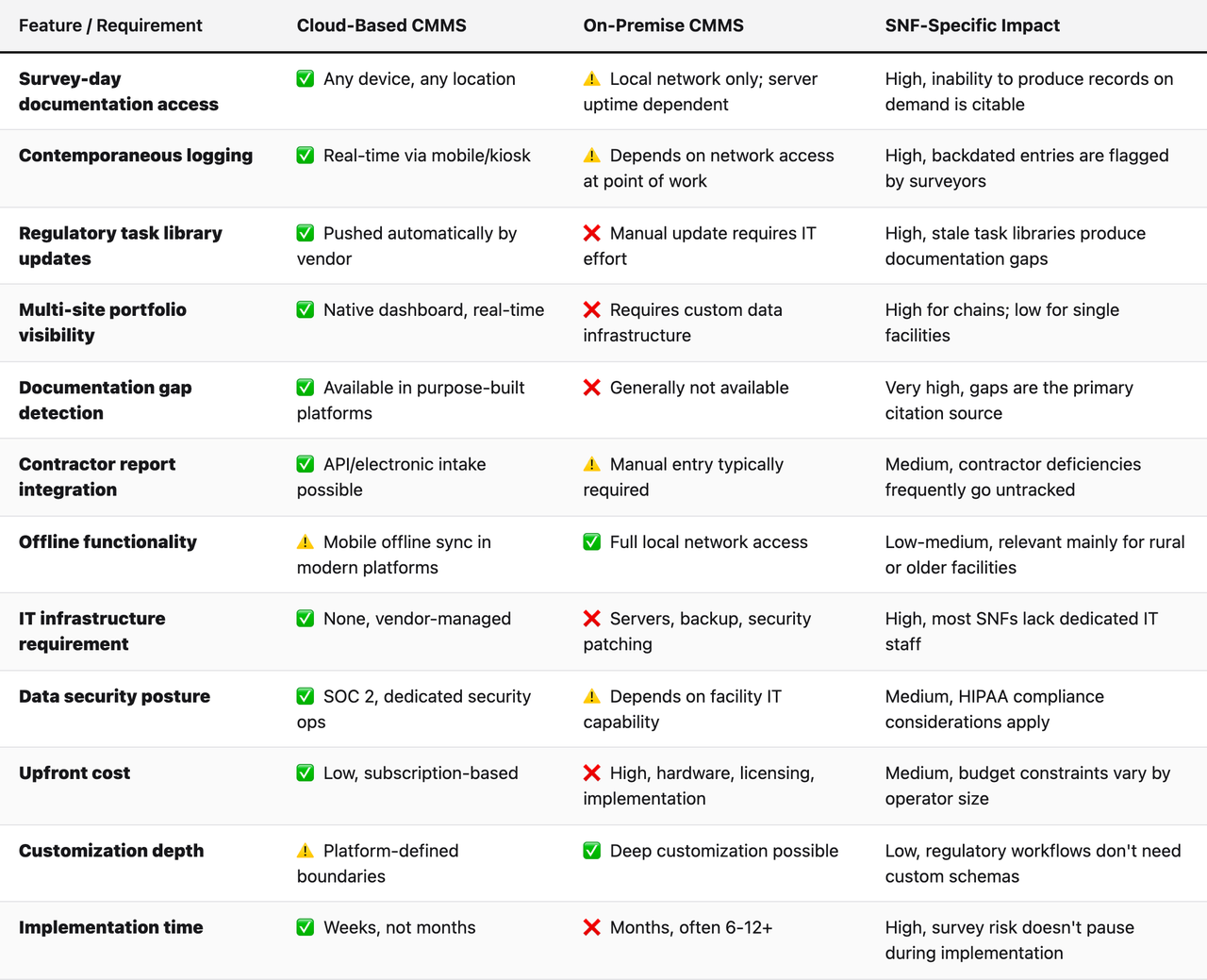
Feature-by-Feature Comparison: Cloud vs. On-Premise for SNF Life Safety Compliance
The table below evaluates both deployment models across the specific features that matter most to SNF maintenance directors, compliance officers, and multi-site operators. Ratings reflect how each model typically performs in the SNF operating environment specifically, not in general enterprise or industrial settings.
The Documentation Gap Problem: Where Most SNF Citations Actually Come From
Understanding why deployment model matters requires understanding the actual mechanics of how SNFs get cited for life safety deficiencies. The popular assumption is that citations result from physical failures: a broken fire door, a non-functional sprinkler head, a generator that won't start. Physical failures do produce citations, but they represent a fraction of the K-tag deficiencies that CMS survey teams actually document.
The majority of life safety citations in skilled nursing facilities result from documentation failures: inspections that were performed but not logged correctly, deficiencies that were identified but not tracked to resolution, test results that were recorded without required data fields, and recurring tasks that were completed inconsistently over a 12-month period. A fire drill that happened but whose log is missing the required night-shift coverage entry. A generator test that ran successfully but whose log omits the voltage and frequency readings CMS expects. A sprinkler system with a deficiency noted in an annual contractor report that never made it into the facility's corrective action log.
This documentation gap pattern is the core challenge that both cloud and on-premise CMMS systems are theoretically designed to address, but address very differently in practice.
Why Standard CMMS Systems Miss the Gap
A conventional CMMS system, whether cloud-based or on-premise, records that a task was completed. It creates a timestamped work order closure. It stores the technician's name and the date. What it does not do, unless specifically built for this purpose, is evaluate whether the completed record contains the right information. A work order closed with the note "generator test completed" looks identical in a standard CMMS to a work order closed with a full record of runtime hours, transfer time, voltage output, frequency, oil pressure, and coolant temperature. Both show as "complete." Only one satisfies CMS documentation requirements.
This is the distinction between a general-purpose enterprise asset management software platform and a purpose-built compliance documentation system. The former manages work. The latter audits documentation. For SNFs, the audit layer is not optional, it is the entire value proposition.
The Compounding Effect of Small Gaps
Documentation gaps in SNF life safety records do not remain isolated. They compound across inspection cycles. A quarterly fire drill log with a missing entry in Q1 creates a pattern that, when a surveyor reviews 12 months of records, shows incomplete drill coverage. A monthly eyewash inspection with three months of missing entries over a year looks, to a surveyor, like a facility that does not take the inspection obligation seriously, regardless of whether the physical inspections actually occurred.
The compounding effect is particularly dangerous because it is invisible to the people responsible for it. A maintenance director reviewing their binder sees a stack of completed inspection logs. They do not see the three entries that are missing the required transfer switch test duration. They do not see that their night-shift fire drills are underrepresented relative to CMS expectations. These gaps are only visible when someone performs a systematic cross-reference of every record against every regulatory requirement, which is what a survey team does, and what a purpose-built compliance platform should do continuously.
Evaluating SaaS Maintenance Management Platforms: What SNF-Specific Features to Demand
Not all cloud-based CMMS software is the same, and the generic SaaS CMMS market is dominated by platforms built for manufacturing, facilities management, and industrial maintenance, not for healthcare compliance. When evaluating a SaaS maintenance management platform for an SNF, the evaluation criteria must go beyond uptime guarantees and mobile app quality.
Pre-Built NFPA and CMS Task Libraries
The single most important differentiator between a generic CMMS and an SNF-appropriate compliance platform is the presence of a pre-built, regulation-sourced task library. Building a compliant inspection schedule from scratch in a general-purpose CMMS requires someone to know every required inspection, its required frequency, its required documentation fields, and the regulatory source for each requirement. That is not the job of a maintenance director, it is the job of a life safety consultant. A platform that comes pre-loaded with that knowledge embedded in its task templates removes the single largest source of implementation risk.
When evaluating task libraries, ask specifically: Is this library built against NFPA 101 and NFPA 99? Does it reflect current CMS adopted editions? Does it include state-specific requirements for your jurisdiction? Is it maintained and updated when regulations change? A vendor that cannot answer these questions specifically does not have a genuine compliance platform, they have a generic work order tool with a healthcare skin on it.
Documentation Quality Auditing
The audit layer that separates a compliance platform from a standard CMMS is the ability to evaluate whether completed records meet regulatory documentation standards, not just whether tasks were marked complete. This means the platform must know what a compliant generator test record looks like (required fields, required data ranges, required narrative elements) and must flag records that are complete in the work order sense but deficient in the compliance sense.
This capability is rare in the CMMS market and is the primary differentiator of platforms purpose-built for SNF compliance. When evaluating vendors, ask for a demonstration of this specific functionality with SNF-relevant examples: a fire drill record, a generator test log, and a sprinkler inspection summary. If the vendor cannot demonstrate compliance-level record evaluation, only work order completion tracking, the platform will not solve the documentation gap problem.
K-Tag Organization and Survey Navigation
CMS Life Safety Code surveys organize deficiencies by K-tag. A platform built for SNF compliance should allow maintenance directors to view their documentation status organized by K-tag category, not just by task or asset. When a surveyor arrives and asks about K-tag K353 (automatic sprinkler systems) or K-tag K130 (utilities, essential electrical systems), the maintenance director should be able to pull up a complete, organized record for that K-tag category immediately, including completed inspections, contractor reports, identified deficiencies, and corrective actions.
This K-tag navigation capability is not present in general-purpose CMMS platforms. It requires the platform to have been built with the CMS survey structure in mind from the ground up, not adapted to fit it after the fact.
Contractor Report Management
A significant portion of SNF life safety documentation comes from outside contractors: fire protection companies, elevator inspection firms, HVAC contractors, and medical gas vendors. These contractors submit reports, often PDFs, that may contain deficiencies requiring corrective action. In most SNFs, these reports go into a file folder or get scanned into a shared drive, and the deficiencies they contain are tracked (or not tracked) manually.
A purpose-built SNF compliance platform should provide a structured mechanism for receiving contractor reports, extracting identified deficiencies, creating corrective action items, and tracking those items to resolution. The failure to close contractor-identified deficiencies is a significant source of repeat citations, and it is almost entirely a documentation management problem, not a physical maintenance problem.
Pricing Models: What SNF Operators Actually Pay
The CMMS software comparison for SNFs must include a realistic look at pricing structures, because the sticker price of any platform rarely reflects total cost of ownership. The table below outlines the typical pricing structure for each deployment model at different operator scales.
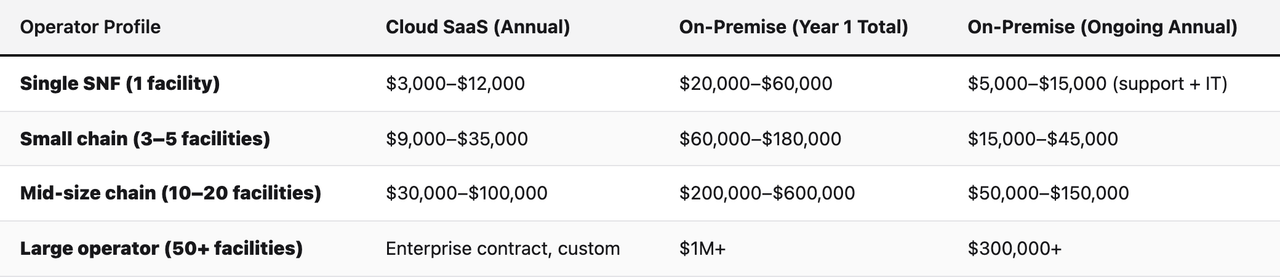
These ranges reflect general market observations for the CMMS category. Actual quotes will vary based on feature scope, user count, implementation complexity, and vendor. The critical point is that on-premise Year 1 costs routinely exceed three to five years of SaaS subscription costs before the infrastructure is even operational, and the ongoing IT and support burden continues indefinitely.
For the SNF operator deciding between models, the ROI calculation should include the cost of a single life safety citation. CMS civil monetary penalties for serious life safety deficiencies can reach tens of thousands of dollars per citation, and repeat deficiencies carry escalating penalties. A documentation platform that prevents even one citation event per year has a return on investment that dwarfs its subscription cost.
The On-Premise Argument: When It Still Makes Sense
A fair comparison requires an honest accounting of when on-premise deployment still makes sense for SNF operators. There are scenarios where it remains defensible, and pretending otherwise would misrepresent the landscape.
On-premise CMMS is most defensible for large, well-resourced health systems that operate skilled nursing units within a larger hospital or integrated delivery network. In these environments, the SNF's CMMS may be part of an enterprise-wide enterprise asset management software deployment that covers the entire health system, hospitals, clinics, medical office buildings, and post-acute units. The IT infrastructure already exists. The IT staff already manages the servers. The integration requirements are with systems that are also on-premise. In this context, adding an SNF unit to an existing enterprise on-premise CMMS is a rational decision.
On-premise deployment also retains a role in facilities with genuine internet connectivity limitations. A rural SNF in an area with unreliable broadband cannot depend on a cloud platform for its day-to-day documentation workflow. The offline functionality limitations of cloud systems are real, and for a facility where internet outages are frequent and prolonged, local server infrastructure provides continuity that a cloud platform cannot guarantee without robust offline capabilities.
Finally, on-premise systems may be preferable for operators with specific integration requirements that cannot be met by SaaS APIs, legacy billing systems, state-specific reporting platforms, or custom internal tools that require direct database access. These scenarios are less common in the SNF market but do exist.
The key question is not whether on-premise can work in theory. It is whether on-premise delivers the specific compliance functionality, the pre-built regulatory task library, the documentation quality auditing, the K-tag navigation, the contractor report management, that SNF life safety compliance requires. Most on-premise CMMS platforms do not. That is not a deployment model problem, it is a product design problem. And no deployment model solves a product that was never designed for healthcare compliance.
Digital Maintenance Management: The Transition From Paper Binders to Compliance Intelligence
Digital maintenance management in skilled nursing facilities is not a single transition, it is a spectrum. At one end is the paper binder: inspection logs in manila folders, fire drill records in a three-ring binder, generator test sheets in a folder on the maintenance director's desk. At the other end is a purpose-built compliance platform that continuously audits documentation against regulatory requirements and surfaces gaps before they become citations.
Most SNFs that have "gone digital" are somewhere in the middle of that spectrum. They may use a general-purpose CMMS to track work orders. They may use a shared drive or email system to store contractor reports. They may use a spreadsheet to track fire drill schedules. Each of these represents a partial digitization that reduces paper volume without delivering the compliance intelligence that defines the right end of the spectrum.
The transition from paper binders to genuine compliance intelligence requires a platform that was designed specifically for that purpose, not a general CMMS adapted to it. The design principles are different. A general CMMS is designed to close work orders efficiently. A compliance intelligence platform is designed to ensure that closed work orders contain documentation that satisfies regulatory requirements. The difference between those two design goals produces fundamentally different products, regardless of whether they are cloud-based or on-premise.
What "Survey Confidence" Actually Looks Like in Practice
For a maintenance director at a 120-bed SNF, survey confidence means being able to walk into a surveyor interview without a racing heart. It means knowing that when the surveyor asks for the last 12 months of fire drill records, those records are complete, correctly formatted, and include the required documentation elements for every drill, including night-shift coverage. It means knowing that when the surveyor asks about the sprinkler deficiency identified in the annual inspection report, there is a documented corrective action with a completion date. It means knowing that the generator test logs include runtime duration, transfer switch operation, and load readings, not just a "test passed" notation.
Survey confidence is not about perfect facility condition. It is about documented facility condition. A surveyor cannot cite what is properly documented and corrected. A surveyor can cite what is undocumented, incompletely documented, or documented in a way that does not align with what CMS expects to see. The entire value proposition of a purpose-built SNF compliance platform is eliminating the gap between what the facility actually does and what the documentation shows, ensuring those two things are identical, continuously, not just in the weeks before a survey.
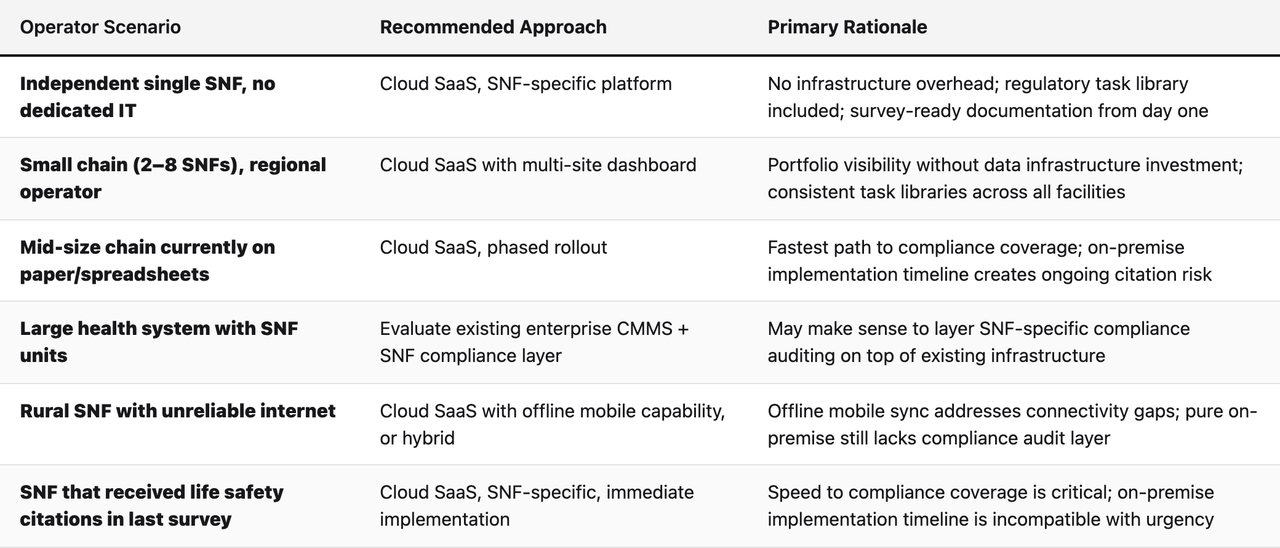
Making the Decision: A Scenario-Based Recommendation Framework
The choice between cloud-based and on-premise CMMS is not a universal one, it depends on the operator's size, IT resources, compliance maturity, and specific operational context. The following framework provides a structured way to evaluate the decision based on actual SNF operating scenarios.
The Opinionated Take: Why Cloud Wins for Most SNF Operators
After evaluating both deployment models across the dimensions that matter most to skilled nursing facility compliance, the conclusion is clear: for the overwhelming majority of SNF operators, cloud-based CMMS software is the superior choice. Not because on-premise is technically inferior in all respects, but because the specific requirements of SNF life safety compliance, regulatory task libraries that stay current, documentation quality auditing, K-tag navigation, multi-site visibility, and survey-day accessibility, align structurally with cloud-native, purpose-built platforms, not with on-premise general CMMS installations.
The on-premise argument in SNFs is largely historical. It made sense when cloud infrastructure was less mature, when internet connectivity was less reliable, and when SaaS security was genuinely less robust than local server security. None of those conditions hold in today's market. Modern cloud platforms offer uptime guarantees, SOC 2 compliance, and mobile offline functionality that address the primary objections to cloud deployment.
More importantly, the platforms that have been purpose-built for SNF compliance documentation, with pre-built NFPA task libraries, AI-assisted documentation gap detection, and K-tag-organized survey navigation, are cloud-native. They were designed as SaaS products from the ground up, and the cloud architecture is not incidental to their functionality. The real-time audit layer, the multi-site dashboard, the continuous gap detection, these capabilities require cloud infrastructure to work the way they are designed to work.
The final question for any SNF operator evaluating this decision should not be "cloud or on-premise?" It should be: "Does this platform know what a compliant SNF life safety record looks like, and will it tell me when mine falls short?" If the answer is yes, the deployment model follows from the product design. And today, the products that can answer yes are cloud-based.
Frequently Asked Questions
What is the difference between a CMMS and a life safety compliance platform for SNFs?
A standard CMMS (Computerized Maintenance Management System) tracks work order creation, assignment, and completion. A life safety compliance platform for SNFs goes beyond work order management to audit whether completed inspection records meet the specific documentation standards required by CMS and NFPA regulations. The compliance layer, checking that records contain required data fields, flagging missing documentation, and organizing records by K-tag category, is not present in generic CMMS products.
Can a cloud-based CMMS work in an SNF with poor internet connectivity?
Many modern cloud-based platforms offer offline mobile functionality that allows technicians to log inspections without an active internet connection, with records syncing automatically when connectivity is restored. For facilities with chronic connectivity issues, it is important to verify that the specific platform being evaluated offers robust offline capability, not all SaaS platforms do. For rural SNFs with prolonged or frequent outages, connectivity should be a specific evaluation criterion, not an assumption.
How long does it take to implement a cloud-based SNF compliance platform?
Implementation timelines for cloud-based SNF compliance platforms are typically measured in weeks, not months. A platform with a pre-built NFPA and CMS task library can be configured for a single SNF in two to four weeks, including asset setup, user configuration, and initial task scheduling. On-premise CMMS implementations typically take six to twelve months before a facility is fully operational, which represents an extended period of continuing citation risk during the transition.
Is cloud-based CMMS data HIPAA compliant?
Life safety maintenance documentation, inspection logs, work orders, equipment records, does not typically contain protected health information (PHI) and therefore does not trigger HIPAA compliance requirements. Where a platform does handle any data that could be considered PHI, the vendor should provide a Business Associate Agreement (BAA) and demonstrate appropriate security controls. Most enterprise-grade cloud platforms offer SOC 2 Type II compliance and can support BAA execution for healthcare customers.
What should I look for in a cloud CMMS task library for SNF compliance?
A compliant SNF task library should be built specifically against NFPA 101 (Life Safety Code) and NFPA 99 (Health Care Facilities Code), as adopted by CMS. It should include the correct inspection frequencies for each required task, the required documentation fields for each task type, and coverage of state-specific requirements for your jurisdiction. The library should be maintained by the vendor and updated automatically when regulatory requirements change. Ask vendors specifically which NFPA edition their library reflects and when it was last updated against CMS adoption changes.
How do SNF surveyors evaluate CMMS documentation during a Life Safety Code survey?
CMS Life Safety Code surveyors review documentation organized by K-tag category. They typically request records covering the most recent 12-month period and evaluate both the completeness of the inspection schedule (were all required inspections performed at the required frequency?) and the quality of individual records (do they contain the required data elements?). Surveyors are trained to identify records that appear to have been backdated, compiled after the fact, or completed in bulk rather than contemporaneously. CMS Life Safety Code enforcement resources provide guidance on what surveyors evaluate.
What is the typical cost of a life safety citation for an SNF?
CMS civil monetary penalties for life safety deficiencies vary based on the scope and severity of the deficiency. Immediate Jeopardy (IJ) citations carry the highest penalties and can reach tens of thousands of dollars per day of non-compliance. Repeat deficiencies carry escalating penalties. Beyond direct financial penalties, repeat life safety citations can trigger increased survey frequency, directed plans of correction, and in serious cases, jeopardize Medicare and Medicaid certification. The financial case for preventive compliance documentation investment is strong relative to the cost of citation events.
Can a cloud-based platform replace the paper life safety binder SNFs are required to maintain?
Yes, with appropriate configuration. CMS and most state survey agencies accept electronic documentation as a substitute for paper records, provided the records are accessible, timestamped, and auditable. A cloud-based platform that maintains a complete, searchable record of all life safety inspections, test results, and corrective actions, organized by K-tag category and accessible on demand, satisfies the documentation requirements that paper binders were designed to meet, while providing audit capabilities that paper binders cannot deliver.
What happens to my compliance documentation if my cloud vendor goes out of business?
This is a legitimate concern for any SaaS platform. When evaluating vendors, ask specifically about data export capabilities (can you export all records in a portable format?), data retention policies, and contractual provisions for data access in the event of service discontinuation. Reputable vendors provide data export tools and contractual commitments around data portability. The risk of vendor discontinuity is real but manageable with appropriate due diligence, and should be weighed against the risk of on-premise server failure, which is statistically more likely for most SNF operators.
How does multi-site compliance visibility work in practice for a regional SNF operator?
In a cloud-based platform with multi-site architecture, a regional facilities director or VP of Operations can access a portfolio dashboard showing compliance completion rates, overdue inspections, open deficiencies, and documentation gap alerts across all facilities in real time. This visibility does not require data exports or manual compilation, it is generated from the same operational data that maintenance directors use at the facility level. For operators managing survey risk across a portfolio, this aggregate view enables proactive intervention at underperforming facilities before a surveyor identifies the same gaps.
Is on-premise CMMS ever the right choice for an SNF?
On-premise CMMS may be appropriate for SNF units within large health systems that already operate enterprise-wide on-premise asset management infrastructure with dedicated IT support. It may also be relevant for SNFs with genuine, chronic internet connectivity limitations. However, in both cases, the fundamental question remains: does the on-premise platform include the SNF-specific compliance features, regulatory task libraries, documentation quality auditing, K-tag navigation, that life safety compliance requires? Most on-premise CMMS platforms do not, regardless of deployment model.
What role does AI play in modern SNF compliance platforms?
AI in purpose-built SNF compliance platforms is primarily applied to documentation review: analyzing completed inspection records against regulatory expectations to identify gaps that human reviewers would miss. This includes detecting records with missing required data fields, identifying patterns of incomplete documentation across inspection cycles, cross-referencing contractor reports against corrective action logs to find unresolved deficiencies, and flagging documentation that does not align with the expected structure for its K-tag category. This is predictive auditing, finding documentation gaps before a surveyor does, rather than predictive maintenance for physical equipment.
Key Takeaways
- Deployment model is a compliance decision, not just an IT decision. For SNFs, the way documentation is stored, accessed, and audited directly affects survey outcomes, not just operational efficiency.
- Cloud-based platforms outperform on-premise in every SNF-critical dimension except offline functionality and deep customization, neither of which is a primary compliance requirement for most facilities.
- Most life safety citations result from documentation failures, not physical failures. A platform that only tracks work order completion does not solve the documentation gap problem.
- The audit layer is what separates a compliance platform from a CMMS. SNFs need a system that evaluates whether completed records satisfy regulatory documentation standards, not just whether tasks were marked done.
- Implementation speed matters. Cloud platforms deploy in weeks; on-premise in months. Survey risk does not pause during implementation.
- Total cost of ownership for on-premise is almost always higher than it appears, once server infrastructure, IT labor, security patching, and version upgrade costs are included.
- For most SNF operators, single facilities, small chains, and mid-size regional operators, cloud-based, purpose-built SNF compliance platforms represent the only realistic path to genuine survey confidence.
- The right evaluation question is not "cloud or on-premise?" but "does this platform know what a compliant SNF record looks like, and will it tell me when mine falls short?"
About the author
Benjamin Terebelo · Founder
Benjamin is the founder of SEQURA, a compliance platform purpose-built for healthcare facilities. He builds at the intersection of healthcare operations and software, maintaining a focus on bringing modern tooling to systems that the broader industry has largely left behind.
About the author
Benjamin Terebelo · Founder
Benjamin is the founder of SEQURA, a compliance platform purpose-built for healthcare facilities. He builds at the intersection of healthcare operations and software, maintaining a focus on bringing modern tooling to systems that the broader industry has largely left behind.