
Paper Binder vs. Digital Compliance Platform vs. Generic CMMS: Which Is Right for Your SNF?

There is a binder sitting in a maintenance director's office at a skilled nursing facility right now. It is probably three inches thick. It has tabbed dividers, handwritten log entries, a few printed contractor reports stapled to the back, and at least one section that has not been updated since the last state survey. The maintenance director knows exactly where it lives. A CMS surveyor, arriving unannounced at 7:45 on a Tuesday morning, is about to find out what is actually in it.
This is the moment that separates compliance theory from compliance reality. And it is the moment that drives SNF administrators, plant operations managers, and regional facilities directors to start evaluating their documentation systems with genuine urgency. Three options sit on the table: the paper binder that has always been there, a generic commercial CMMS brought in from another industry, or a purpose-built SNF compliance platform designed specifically around CMS survey expectations and NFPA life safety requirements. Each has a real constituency. Each has a real cost. And choosing the wrong one carries consequences that show up not in the software budget, but on the survey report.
This comparison is built for the people making that decision, whether you are a single-facility owner-operator replacing a paper system for the first time, a COO overseeing a regional SNF chain evaluating a legacy CMMS replacement, or a maintenance director who has been handed a mandate to fix documentation gaps before the next unannounced visit. The goal is not to sell you on any particular path. The goal is to show you exactly what each option delivers, where it fails, and which scenario it actually fits.
What You Are Actually Comparing: Three Philosophies, Not Three Products
Before comparing features and pricing, it is worth understanding that these three options represent fundamentally different philosophies about what compliance documentation is supposed to do. The gap between them is not a gap in technology. It is a gap in purpose.
A paper binder is a record-keeping system. It captures what happened. It does not tell you what was missed, what is scheduled for next week, or whether the log entry a technician made is missing the data field a surveyor will look for. A paper system is passive by design. It waits to be checked.
A generic CMMS software platform is a work order and asset management system. It was built to schedule maintenance tasks, track equipment, and manage labor across large facilities. The healthcare-specific version of this problem, which involves regulatory cadences, K-tag categories, NFPA 101 and NFPA 99 requirements, and the specific documentation standards CMS inspectors apply, is not what generic CMMS platforms were designed to solve. They can be configured to approximate it. That configuration work is where the real cost and risk live.
A purpose-built digital maintenance management platform for SNF life safety compliance is an auditing system with operational capabilities. It does schedule tasks and log completions. But its primary function is to read the documentation that exists and identify what is missing, incomplete, or inconsistent with regulatory expectations before a surveyor does. That distinction changes everything about how the system is used and what it delivers.
The Paper Binder: Full Assessment of the System Most SNFs Still Use
The paper binder is not a relic. For a large number of SNFs, especially single-facility independent operators and smaller regional chains, it remains the primary life safety documentation system. Understanding why it persists, and where it genuinely fails, requires looking at it honestly rather than dismissively.
What the Paper System Actually Does Well
Paper documentation has a tactile credibility with surveyors who have been reviewing binders for decades. A well-maintained paper log, signed in ink, dated contemporaneously, and organized by inspection category, communicates something that a rushed digital printout sometimes does not: that a real person was present, completed the task, and recorded it in real time. Experienced maintenance directors who manage their binders meticulously can produce survey-ready documentation quickly because they know exactly where everything is.
The paper system also has zero technology failure risk. There is no software outage on survey day. There is no login issue when a surveyor asks to see the last 12 months of fire drill records. The binder is there, or it is not. That simplicity has genuine operational value in a facility environment where not every staff member is comfortable with technology.
For facilities with a single, experienced maintenance director who has managed the same binder through multiple surveys, the paper system can work adequately. The knowledge lives in the person, not the system, which creates its own risk but also creates a kind of institutional consistency that some facilities value.
Where the Paper System Fails SNFs Systematically
The paper system fails in four specific ways that produce citations, and they are worth naming precisely because they are the same failures that appear on survey deficiency reports across the country.
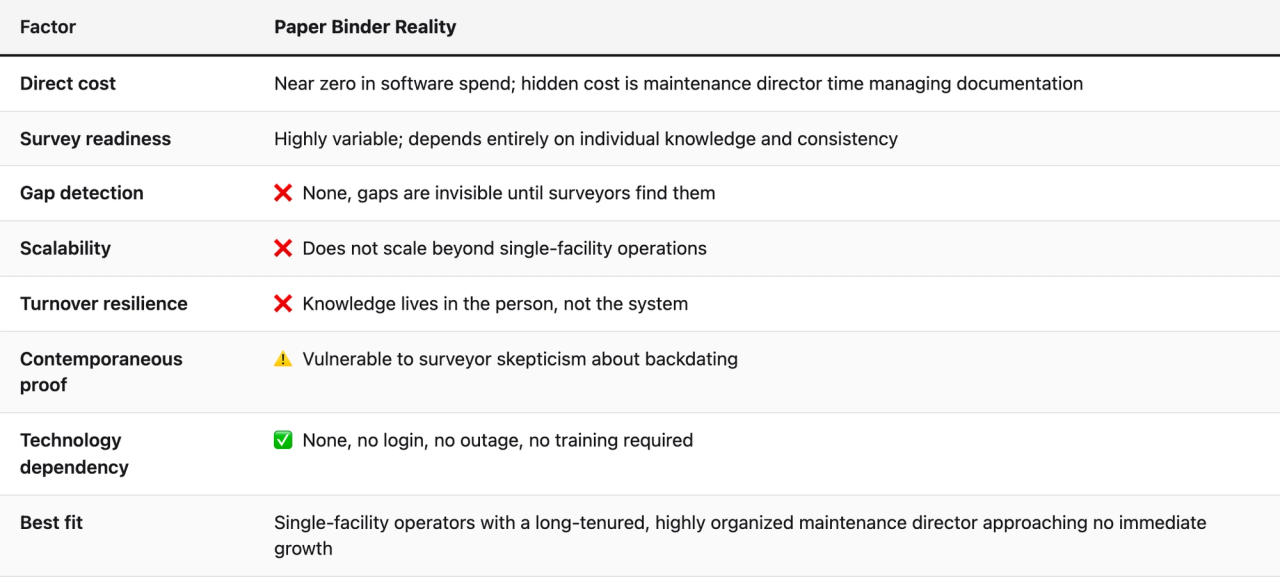
It cannot self-audit. A paper binder does not know that the generator test log from eight months ago is missing the kW load reading. It does not know that the fire drill records show three day-shift drills in a row with no night-shift coverage. It does not know that the sprinkler inspection report from an outside contractor listed a deficiency that was never formally reconciled in the corrective action log. These gaps are invisible to the system because the system has no analytical capability. They are only visible when someone with regulatory expertise reads every page looking for them, which almost never happens before a survey.
It does not scale. A maintenance director managing a single 80-bed SNF can reasonably keep a paper binder current. A regional facilities director overseeing six facilities cannot maintain meaningful visibility into six binders. The moment a facility adds a second location, the paper system creates a documentation blind spot that grows with every additional site.
It fails on turnover. When a maintenance director leaves, the institutional knowledge embedded in the binder's organization leaves with them. A new maintenance director inheriting a paper system inherits a document they did not create, organized around a logic they did not design, with gaps they cannot see until a surveyor points to them.
It cannot demonstrate contemporaneous completion. One of the patterns CMS surveyors are trained to identify is backdated documentation: logs that appear to have been filled in all at once rather than at the time of the inspection. A paper system has no metadata. It cannot prove that a log entry was made on the date it claims. This creates vulnerability even when the work was actually done correctly.
Paper Binder: Realistic Cost and Risk Profile
Generic CMMS Software: What It Is, What It Is Not, and Why SNFs Keep Buying It
Generic CMMS platforms, such as those built for commercial real estate, hospitality, manufacturing, and general healthcare facilities, represent the most commonly attempted upgrade path for SNFs moving off paper. Platforms in this category handle work orders, preventive maintenance scheduling, asset tracking, and vendor management. Many have added healthcare-specific modules or configurations. And many SNFs have invested significant time and money in them, only to discover that the gap between a general-purpose maintenance platform and a life safety compliance system is wider than the sales process suggested.
The Genuine Strengths of a Generic CMMS
A well-implemented CMMS is genuinely excellent at work order management. If a facility has ongoing deferred maintenance, a backlog of equipment repairs, or needs to manage multiple vendors and contractors across a large campus, a CMMS provides real operational value. The asset tracking capabilities in mature CMMS platforms allow facilities managers to maintain equipment histories, warranty records, and service intervals in a way that paper absolutely cannot match.
For multi-site SNF operators who also need to manage capital planning, equipment depreciation, and preventive maintenance across a diverse asset base, the asset management layer of a CMMS is genuinely useful. These are legitimate facilities management problems that a CMMS was designed to solve.
Many generic CMMS platforms also offer mobile applications that allow technicians to complete and close work orders from a smartphone or tablet, which captures a timestamp and basic completion data. This is a meaningful improvement over paper logs for demonstrating that work was completed at a specific time.
Where Generic CMMS Platforms Fall Short for SNF Compliance
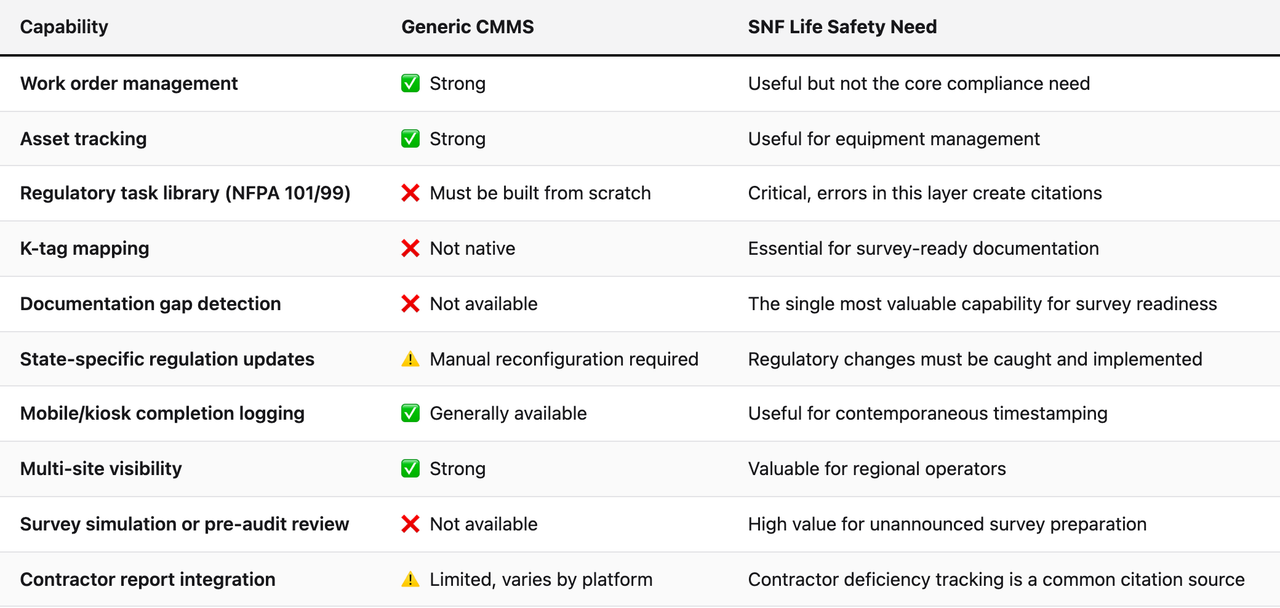
The fundamental limitation of a generic CMMS in the SNF environment is that it does not know what CMS expects. It knows what you tell it to schedule. Those are not the same thing.
When an SNF administrator or maintenance director sets up a generic CMMS, they are responsible for building the inspection schedule from scratch: identifying every required inspection, its correct frequency under NFPA 101, NFPA 99, and applicable state regulations, the specific data fields that must be captured for each inspection type, and the documentation format that satisfies CMS expectations. This configuration work is significant. It typically requires either a life safety consultant or an unusually experienced maintenance director to get right. And it is almost never fully right, because the regulatory requirements are granular and state-specific variations are real.
More critically, even a well-configured CMMS that successfully schedules and logs inspections does not audit what it captures. If a technician completes a fire extinguisher inspection and enters a checkmark in the completion field without recording the specific observations that the inspection requires, the CMMS marks the task complete. The gap is invisible. The CMMS has no mechanism to read the completed record and compare it against what the record is supposed to contain. This is the core limitation that separates a generic CMMS from a compliance intelligence platform.
The K-tag framework that CMS surveyors use to categorize life safety deficiencies is not a concept that exists in a generic CMMS. There is no native mapping between work order categories and K-tag risk levels. When a surveyor asks about K-tag K353 (sprinkler system) and the facility produces a CMMS work order printout, the surveyor is reading a document that was not designed for that conversation.
The Hidden Cost of CMMS Configuration for SNF Use
The pricing of a generic CMMS platform often looks attractive relative to a purpose-built compliance platform, particularly at the per-facility level. But the total cost of ownership includes the configuration work, the ongoing maintenance of the inspection schedule as regulations change, the training required for maintenance and EVS staff, and the consultant fees often required to build a compliant task library. These costs are real and frequently underestimated during procurement.
There is also the cost of what the CMMS does not catch. A single life safety citation at a Level G or above can trigger enforcement actions, payment suspensions, and mandatory corrective action plans under CMS's nursing home enforcement framework. The financial exposure from a preventable citation often exceeds years of CMMS subscription costs.
Generic CMMS: Full Feature and Fit Assessment for SNFs
Which SNFs Should Actually Consider a Generic CMMS
A generic CMMS makes legitimate sense for SNF operators who need robust work order management and asset tracking across a large, complex physical plant, and who are willing to invest in a dedicated life safety configuration build alongside a qualified consultant. It also makes sense for large health systems that already have an enterprise CMMS deployed across hospital and ambulatory settings, where SNF facilities are being added to an existing platform ecosystem. In those situations, the CMMS provides real value in the broader facilities management context, and the SNF compliance layer can be addressed with a complementary tool or a thorough configuration project.
What a generic CMMS should not be is a standalone answer to the question "how do we prepare for an unannounced CMS survey?" That is not the problem it was designed to solve.
Purpose-Built SNF Compliance Platforms: What the Category Actually Delivers
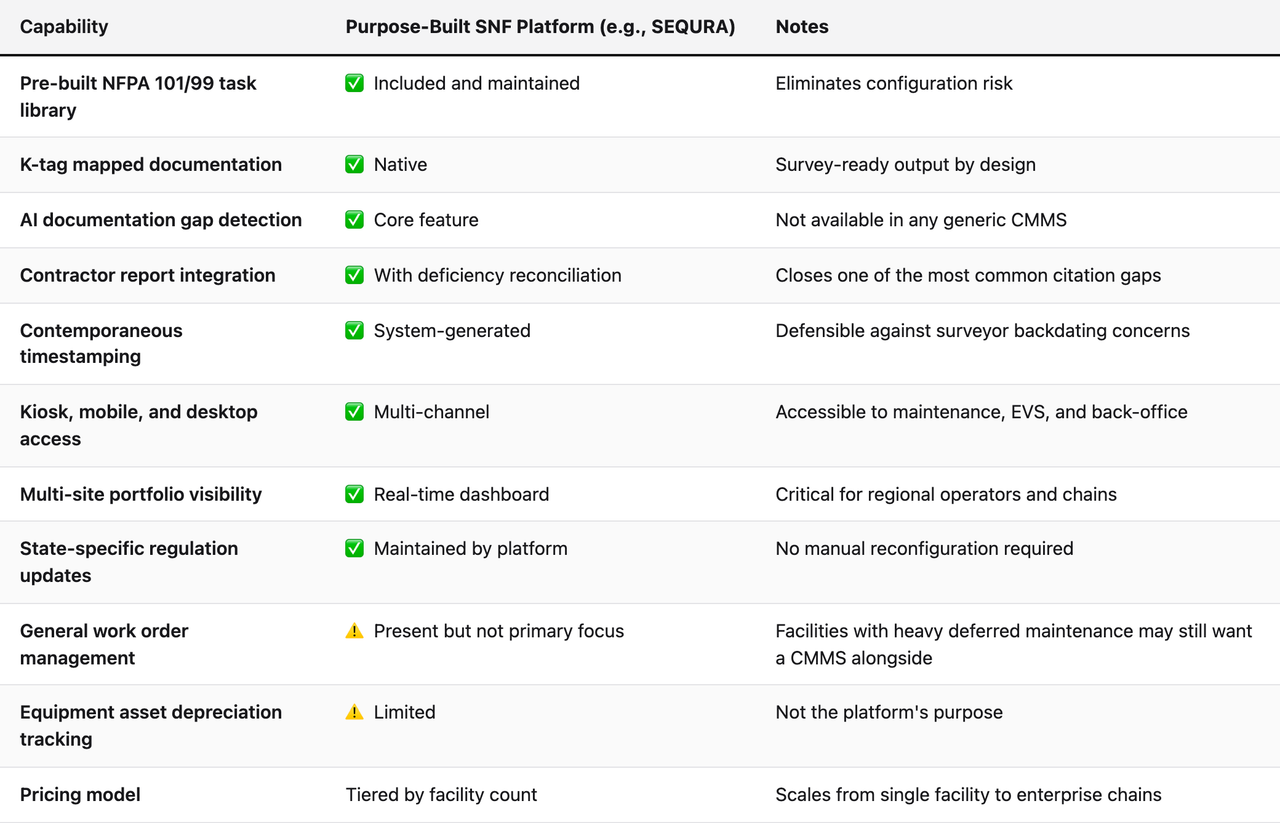
The defining characteristic of a purpose-built SNF compliance platform is that it was designed from the regulatory requirement outward rather than from the facilities management workflow inward. The task library is not something an administrator builds. It arrives pre-populated with the inspection cadences, data field requirements, and documentation standards that NFPA 101, NFPA 99, and CMS Conditions of Participation actually specify. That distinction eliminates an entire category of error before the system is ever turned on.
SEQURA is the clearest example of this architecture in the current market, and it illustrates what the category can deliver at its best. The platform operates on two distinct layers that work together to produce survey confidence rather than just documentation volume.
The Operational Layer: Task Library, Scheduling, and Completion Logging
The operational foundation of a purpose-built compliance platform is a vetted regulatory task library. At SEQURA, this library was built with life safety consultants and covers the inspection types, frequencies, and documentation requirements that CMS surveyors look for: fire drill logs with the specific data fields required for each shift and season, generator test records with load readings, sprinkler inspection documentation with deficiency tracking, eyewash station logs, emergency lighting tests, fire extinguisher checks, and the full range of recurring inspections that make up the life safety compliance calendar for a licensed SNF.
The scheduling layer assigns these tasks to the right person at the right cadence and delivers them through the channel that works for that staff member. A maintenance technician can complete an inspection on a shared facility kiosk. A maintenance director can review and close work from a desktop. A mobile interface serves staff moving through the facility. The completion is logged with a timestamp that is generated by the system, not entered by hand, which creates the contemporaneous documentation record that surveyors look for and that paper cannot reliably provide.
For EVS staff who share documentation responsibilities with the maintenance team, the kiosk model is particularly important. Life safety compliance in an SNF is not a one-person job. Eyewash station checks, common area inspection rounds, and shift-level environment of care tasks often fall to EVS staff who need a simple, accessible interface that does not require navigating a complex software application. A shared kiosk with task-specific prompts is a genuinely different user experience than a full CMMS interface.
The Analytic Layer: Documentation Intelligence and Gap Detection
The second layer is what separates a purpose-built compliance platform from everything else in this comparison. SEQURA's AI review system reads completed inspection records, contractor reports, and shift logs and cross-references them against the regulatory expectations for each asset and K-tag category. It is looking for the specific patterns that produce life safety citations.
What does that actually mean in practice? Consider a few concrete examples of the gaps it surfaces:
- A generator test log entry is present and marked complete, but the kW load reading field is blank. The task appears done in any system that only tracks completion status. The documentation gap is invisible until a surveyor asks to see the load readings and finds them missing across multiple test records.
- Fire drill records show compliant frequency for day and evening shifts but have not included a night-shift drill in the required timeframe. The records exist. They look complete at a glance. The gap is in the pattern across records, not in any individual entry.
- A third-party sprinkler contractor submitted an inspection report that noted a deficiency. The report is in the system. But there is no corrective action documentation, no follow-up work order, and no resolution record. The deficiency sits open in the contractor report with no reconciliation. This is one of the most common citation patterns in life safety surveys.
None of these gaps would be caught by a paper binder. None would be caught by a generic CMMS that tracks completion status without reading content. The analytic layer catches them because it knows what the completed record is supposed to contain, not just whether a task was checked off.
This is the operational definition of predictive auditing for documentation. It is the same function a life safety consultant performs when hired to prepare a facility for survey, except it runs continuously rather than annually, and it surfaces gaps in days rather than after a consultant engagement.
K-Tag Alignment and Survey-Ready Reporting
The CMS K-tag framework organizes life safety deficiencies into specific categories that correspond to NFPA 101 requirements. Surveyors use K-tags to cite deficiencies, and the tag category affects the severity classification and enforcement implications of the finding. A purpose-built SNF compliance platform maps its task library and documentation requirements directly to K-tag categories, which means that when a surveyor asks about a specific K-tag area, the facility can produce documentation that speaks the same language as the survey instrument.
A generic CMMS produces work orders. A purpose-built compliance platform produces survey-ready documentation organized by the same categories a surveyor uses. That difference matters enormously in the first hour of an unannounced visit.
Multi-Site Visibility for Regional Operators and Chains
For directors of facilities and regional operators overseeing multiple SNFs, the compliance platform's reporting layer provides something the paper binder and a single-facility CMMS cannot: a real-time view of documentation risk across the entire portfolio. A COO or VP of operations can see which facilities have open gaps, which inspection categories are running behind schedule, and which sites carry the highest citation risk at a given moment, without calling each maintenance director individually or waiting for a quarterly compliance review.
This visibility changes the management dynamic at the regional level. Instead of relying on self-reporting from individual facilities, the operations team has an objective, system-generated picture of compliance posture across sites. When a pattern appears, such as generator test documentation gaps appearing at three facilities in the same month, the regional team can address it proactively rather than discovering it during surveys at each affected site.
Purpose-Built SNF Compliance Platform: Full Assessment
Head-to-Head: The Three Options Across the Scenarios That Actually Matter
Feature comparisons are useful. Scenario comparisons are more useful. These are the situations SNF administrators and facilities directors actually face, and the realistic performance of each option in each situation.
Scenario 1: An Unannounced CMS Survey Begins at 8 AM
A survey team arrives with no notice. The lead surveyor asks to see the last 12 months of life safety inspection documentation, starting with fire drill records and generator test logs.
Paper binder: The maintenance director retrieves the binder. If it is well-maintained, the records are there. If anything is missing or a data field was skipped, it is visible immediately. There is no way to know before the surveyor looks.
Generic CMMS: The maintenance director runs a report. The report shows completed tasks but may not display the specific data fields the surveyor needs to see. If the report format does not align with what the surveyor expects, there is scrambling to reformat or explain the output. If there are gaps in the underlying data, the report reflects them with no prior warning.
Purpose-built SNF compliance platform: The maintenance director opens the platform and pulls the survey-ready documentation package for each category the surveyor requests. The platform has already surfaced any documentation gaps in the preceding weeks, so the maintenance director knows whether the records are complete before the surveyor asks. The output is formatted around K-tag categories, which is the same framework the surveyor is using.
Scenario 2: The Maintenance Director Leaves After Five Years
A long-tenured maintenance director gives two weeks' notice. Their replacement has facilities management experience but no SNF-specific life safety background.
Paper binder: The incoming director inherits a binder they did not create. They do not know what is missing, what the organizational logic means, or which sections are current versus stale. The institutional knowledge has walked out the door.
Generic CMMS: The incoming director inherits a system that was configured by someone else. If the configuration was correct, there is continuity. If it was not, the errors are now invisible and the new director has no framework to identify them.
Purpose-built SNF compliance platform: The incoming director logs in and immediately has access to a current task schedule, a history of completed inspections, a queue of open gaps flagged by the system, and a regulatory task library that tells them exactly what inspections are required and when. They are not dependent on inherited institutional knowledge because the knowledge is embedded in the platform.
Scenario 3: A Regional Operator Adds a Fifth Facility
A regional SNF chain adds a fifth facility to its portfolio. The COO needs compliance visibility across all five sites without hiring additional compliance staff.
Paper binder: The fifth binder is added to a problem the COO already cannot solve. There is no practical way to maintain visibility into five separate paper documentation systems from a regional operations position.
Generic CMMS: If the CMMS is deployed across all five facilities with a consistent configuration, the regional reporting layer provides meaningful visibility into work order status and task completion rates. The gap is still in the compliance-specific analytics: the COO can see that tasks were completed but cannot see whether the completed records contain what a surveyor would look for.
Purpose-built SNF compliance platform: The regional operations team has a real-time dashboard showing documentation risk posture across all five facilities. Open gaps, overdue inspections, and unreconciled contractor deficiencies are visible at the portfolio level before they produce citations at the facility level.
Scenario 4: A Contractor Submits an Inspection Report Noting a Deficiency
An outside sprinkler contractor completes the annual inspection and submits a report noting two open sprinkler heads in a mechanical room that need replacement. The report goes into the file. Three months pass.
Paper binder: The report is in the binder. The deficiency may or may not have triggered a corrective action. When the surveyor asks about it, the maintenance director looks for follow-up documentation that may not exist.
Generic CMMS: The report may be attached to a work order as a file. Whether that work order was linked to a corrective action and whether the corrective action was completed and documented depends entirely on the workflow the facility has configured. There is no automatic flag that an open deficiency exists without resolution.
Purpose-built SNF compliance platform: The contractor report is ingested into the system. The analytic layer reads it, identifies the noted deficiency, and creates an open gap in the documentation record that remains flagged until a corrective action record is attached. The deficiency cannot silently age without triggering a visibility flag.
The Decision Framework: Choosing the Right System for Your SNF
After comparing features, costs, and realistic performance scenarios, the right choice depends on four variables specific to each facility and organization. This framework is designed to produce a clear answer rather than a list of considerations.
Decision Variable 1: How Many Facilities Are You Responsible For?
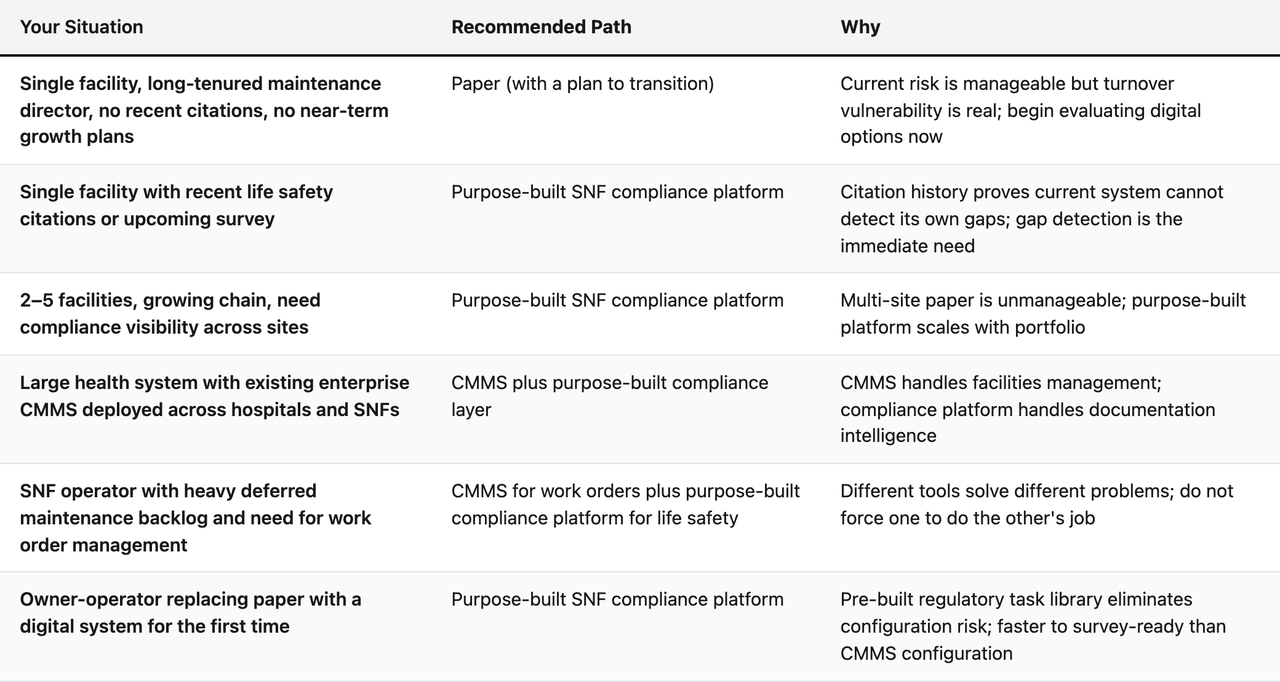
A single-facility owner-operator with a long-tenured, highly organized maintenance director can manage adequately on paper for a period of time, though the risk accumulates with every documentation gap that goes undetected. The moment an organization is responsible for two or more facilities, the paper system becomes an operational liability, not just a compliance risk.
For multi-site operators, the choice narrows to a generic CMMS or a purpose-built compliance platform, and the deciding factor is what the operator needs the system to do. If the primary need is facilities management (work orders, asset tracking, vendor management), a CMMS with a supplementary compliance configuration may serve. If the primary need is survey readiness and documentation risk management, a purpose-built platform is the right tool.
Decision Variable 2: What Is Your Current Citation History?
A facility that has received life safety citations in recent surveys, particularly in the K-tag categories related to fire protection, emergency power, or environment of care, has demonstrated that its current documentation system is not producing survey-ready records. In that situation, a paper binder or a generic CMMS is not a reasonable response. The citation history is direct evidence that the existing system cannot identify and close its own gaps.
A facility with a clean survey history and a well-managed paper system has more flexibility, but that flexibility is tied to the specific individuals maintaining the system. The risk is turnover risk, not current performance risk.
Decision Variable 3: How Much Configuration Work Can You Actually Support?
A generic CMMS requires significant configuration work to function correctly in an SNF life safety context. That work requires either a qualified internal resource who understands NFPA 101, NFPA 99, and state-specific requirements, or an external life safety consultant. If neither is readily available, the CMMS will be configured incorrectly, and the configuration errors will not announce themselves. They will show up as citations.
A purpose-built compliance platform eliminates the configuration requirement for the regulatory task library because it arrives pre-built and maintained by the vendor. The setup work is facility-specific (mapping physical assets to inspection records, configuring user access) rather than regulatory in nature.
Decision Variable 4: What Is Your Tolerance for Invisible Risk?
Both the paper binder and the generic CMMS share a common limitation: they do not tell you what they do not know. A completed task is marked complete. A gap in the underlying documentation is invisible. The only way to find it is to read every record with the same scrutiny a surveyor applies, which requires either a life safety consultant engagement or a system that does that reading continuously.
If your organization has low tolerance for the risk that a documentation gap exists in the current records without your knowledge, the only option that addresses that risk systematically is a purpose-built compliance platform with an analytic layer that reads completed records against regulatory expectations.
Decision Tree: Which System Fits Your SNF?
What the Comparison Misses: The Real Cost Is Not the Software
Every comparison of documentation systems eventually focuses on licensing fees, implementation costs, and feature lists. These are real considerations. But the comparison misses its most important number if it does not account for the cost of what the system fails to catch.
Under CMS's enforcement framework for nursing homes, a deficiency cited at Scope and Severity Level G (isolated harm) or above can trigger civil monetary penalties, directed in-service training, directed plans of correction, and in severe cases, payment suspensions and termination from the Medicare and Medicaid programs. A single enforcement action at this level carries financial consequences that dwarf any software subscription cost.
Life safety citations, specifically those in the K-tag categories covering fire protection systems, emergency power, and means of egress, are among the most common sources of higher-severity enforcement action because the regulatory requirements are specific, the documentation standards are clear, and the consequences of actual life safety failures in a nursing home are severe. CMS surveyors are trained to look for these citations specifically, and the documentation gaps that produce them follow predictable patterns.
The value proposition of a purpose-built compliance platform is not that it costs less than paper or a generic CMMS. In many cases, it costs more in direct software spend. The value proposition is that it finds the documentation gaps that produce citations before the surveyor does, which eliminates the enforcement action risk that represents the actual financial exposure. That is a different category of ROI calculation than a feature-by-feature price comparison.
For a COO or administrator evaluating this decision, the right question is not "how much does each option cost?" It is "how much does a preventable life safety citation cost, and how confident am I that my current system would have caught it before the surveyor did?"
The Legacy CMMS Replacement Conversation: When to Switch and What to Expect
For SNF operators who already have a generic CMMS in place and are evaluating whether to replace it with a purpose-built compliance platform, the transition decision involves a specific set of considerations that are different from a first-time implementation.
The clearest signal that a legacy CMMS replacement is warranted is a pattern of documentation-related citations that the CMMS did not surface before the survey. If the system is logging task completions but not detecting the gaps in those completions that surveyors find, the system is providing a false sense of compliance readiness. That false confidence is more dangerous than a paper binder managed by someone who knows its limitations, because it creates the perception that the documentation problem is solved when it is not.
A secondary signal is the configuration maintenance burden. If the CMMS requires regular manual updates to keep pace with regulatory changes, and those updates are not happening reliably, the task library is drifting out of alignment with current requirements. A purpose-built platform that maintains its own regulatory library eliminates this drift risk.
The transition from a legacy CMMS to a purpose-built compliance platform typically involves three phases: data migration (bringing historical inspection records into the new system for continuity of the documentation record), task library configuration (mapping the facility's specific assets to the pre-built regulatory task library), and staff training (which is substantially faster with a purpose-built platform because the regulatory logic is already embedded). Most facilities can achieve a functional transition within 30 to 60 days, which is relevant for operators facing an upcoming survey window.
Frequently Asked Questions
Is a paper binder sufficient for CMS survey compliance?
A well-maintained paper binder can satisfy a CMS survey if the documentation is complete, contemporaneous, and covers all required inspection types and frequencies. The problem is that a paper system has no mechanism to detect its own gaps. Most citations from paper-based systems occur not because the inspections were not done, but because the documentation of those inspections was incomplete in specific ways that the maintenance director did not know to look for.
What is the difference between a CMMS and an SNF compliance platform?
A CMMS (Computerized Maintenance Management System) is a work order and asset management platform built for facilities management. An SNF compliance platform is a documentation intelligence system built specifically for the regulatory requirements of skilled nursing facilities under CMS and NFPA standards. The key difference is that a CMMS tracks whether tasks were completed, while a purpose-built compliance platform reads what was documented and identifies gaps relative to what regulators expect to see.
Do I need both a CMMS and an SNF compliance platform?
Some facilities benefit from both, particularly large SNFs or health systems with significant deferred maintenance and complex asset management needs alongside life safety compliance requirements. For most SNFs, especially those with 50 to 200 beds, a purpose-built compliance platform covers the compliance documentation need comprehensively, and a general CMMS adds value only if there is a specific work order management or capital planning need that the compliance platform does not address.
What are K-tags and why do they matter for documentation?
K-tags are the deficiency categories that CMS surveyors use to cite life safety violations in nursing homes. They correspond to specific sections of NFPA 101 (Life Safety Code) and are organized by system type: fire protection, emergency power, means of egress, and others. Documentation that is organized by K-tag category allows a facility to respond to surveyor requests directly in the framework the surveyor is using, which speeds the survey process and demonstrates regulatory fluency.
How does AI-powered documentation gap detection actually work?
In a system like SEQURA, the AI review layer reads completed inspection records and compares them against the specific data fields and documentation standards required for each inspection type and K-tag category. It is looking for missing data fields, patterns of incompleteness across records (such as missing night-shift fire drills), and unreconciled contractor deficiencies. It does not predict equipment failure. It predicts documentation failure by reading current records against regulatory expectations.
What happens when a life safety contractor submits a report with a deficiency?
Under CMS survey standards, an open deficiency in a contractor report that has not been addressed and documented creates a citation risk. The facility is expected to have a corrective action process that tracks reported deficiencies from contractor inspections through to resolution. A purpose-built compliance platform flags open contractor deficiencies and maintains them as open gaps until a corrective action record is attached. A generic CMMS and a paper system both require manual processes to track this, and both are vulnerable to the deficiency aging without resolution.
How long does it take to implement a purpose-built SNF compliance platform?
Implementation timelines vary by facility size and data migration complexity, but most SNF facilities can achieve a functional deployment of a purpose-built compliance platform within 30 to 60 days. The regulatory task library arrives pre-built, which eliminates the configuration phase that extends generic CMMS implementations. The primary setup work is mapping the facility's physical assets and configuring user access for maintenance, EVS, and administrative staff.
Can EVS staff use a compliance platform without extensive training?
Purpose-built compliance platforms designed for SNF operations typically include a shared kiosk interface specifically to accommodate EVS and maintenance technician workflows. The kiosk model presents task-specific prompts that guide the user through the required documentation steps without navigating a complex software interface. Training requirements are substantially lower than for a general-purpose CMMS because the system presents only what is relevant to the specific task at hand.
What is the real financial risk of a life safety citation?
The financial risk of a life safety citation depends on its scope and severity classification. Citations at Scope and Severity Level D or below typically require a plan of correction but carry limited direct financial penalties. Citations at Level G or above can trigger civil monetary penalties, directed corrective actions, and in patterns of repeat violation, payment suspensions that interrupt Medicare and Medicaid revenue. The reputational impact on census and occupancy compounds the direct enforcement cost. The total financial exposure from a preventable higher-severity citation regularly exceeds annual software costs by a significant margin.
Is a purpose-built SNF compliance platform only for large chains?
No. Purpose-built compliance platforms designed for the SNF market, including SEQURA, offer tiered pricing that scales from single-facility operators to large multi-site chains. A single-facility owner-operator replacing a paper binder benefits from the pre-built regulatory task library and the gap detection capability in the same way a 20-facility chain does. The value of detecting a documentation gap before a surveyor finds it is the same regardless of portfolio size.
What should I look for when evaluating a digital maintenance management platform for my SNF?
The most important question to ask any digital maintenance management vendor is whether the platform reads completed inspection records for content gaps or only tracks task completion status. A platform that tracks completion tells you that work was logged. A platform that reads content tells you whether what was logged satisfies regulatory expectations. The second capability is the one that actually reduces citation risk. Secondary questions include whether the regulatory task library is pre-built and maintained by the vendor, whether the platform maps to K-tag categories, whether contractor reports can be ingested and deficiency-tracked, and whether multi-site visibility is included in the reporting layer.
How do I know if my current CMMS is producing survey-ready documentation?
The most reliable test is to pull the documentation that your current CMMS would produce in response to a surveyor's request for a specific K-tag category and have a life safety consultant review it against what the survey instrument actually looks for. If the output requires explanation, reframing, or supplemental documentation to satisfy the surveyor's question, the CMMS is producing facilities management records rather than compliance documentation. The gap between those two outputs is where citations come from.
Key Takeaways
- The paper binder's core failure is invisibility. It cannot detect its own documentation gaps, and those gaps are exactly what CMS surveyors are trained to find. It works when it is perfectly maintained by a specific person, and that dependency is a structural vulnerability.
- A generic CMMS solves a different problem. Work order management and asset tracking are legitimate facilities management needs, but they are not the same as compliance documentation intelligence. A CMMS tracks completion. A compliance platform reads content. That distinction determines whether documentation gaps are visible before a survey or during one.
- Purpose-built SNF compliance platforms deliver survey confidence through predictive auditing. The analytic layer that reads completed records against regulatory expectations is the capability that neither paper nor a generic CMMS can replicate, and it is the capability that addresses the specific patterns that produce most life safety citations.
- Configuration risk is a hidden cost of generic CMMS adoption. Building a compliant NFPA 101 and NFPA 99 task library from scratch in a generic CMMS requires regulatory expertise and ongoing maintenance. Errors in that library are invisible until a surveyor finds them.
- Multi-site operators have a different calculus. The paper system does not scale. A generic CMMS provides multi-site operational visibility without compliance intelligence. A purpose-built platform provides both at the portfolio level.
- The real ROI comparison is not software cost against software cost. It is software cost against citation risk. A single preventable enforcement action at Scope and Severity Level G or above typically exceeds multiple years of compliance platform subscription cost.
- For most SNFs evaluating a system today, a purpose-built compliance platform is the right answer. The exception is a large health system with an existing enterprise CMMS deployment where the compliance layer can be added as a complementary tool rather than a replacement.
About the author
Benjamin Terebelo · Founder
Benjamin is the founder of SEQURA, a compliance platform purpose-built for healthcare facilities. He builds at the intersection of healthcare operations and software, maintaining a focus on bringing modern tooling to systems that the broader industry has largely left behind.
About the author
Benjamin Terebelo · Founder
Benjamin is the founder of SEQURA, a compliance platform purpose-built for healthcare facilities. He builds at the intersection of healthcare operations and software, maintaining a focus on bringing modern tooling to systems that the broader industry has largely left behind.