
How to Build a CMS Survey-Ready Life Safety Compliance Program: A Step-by-Step SNF Guide

The surveyor arrives on a Tuesday morning with no advance notice. She shows up at the front desk, presents her credentials, and within the first thirty minutes she is walking your mechanical room, your kitchen, your generator pad, and your electrical closets. She is not looking at your equipment. She is looking at your documentation. The inspection logs on the clipboards. The fire drill records in the binder on the maintenance director's desk. The generator transfer test sheets from the past twelve months. The sprinkler system deficiency log with its corrective action column still blank from a contractor visit three months ago.
By noon, she has identified four potential K-tag citations. None of them involve anything that is actually broken. Every piece of life safety equipment in your facility is functional. The citations are documentation citations: wrong dates, missing signatures, incomplete entries, and a fire drill log that shows zero overnight coverage for the past two quarters. Your maintenance director did the work. He just did not document it the way CMS expects, and now your facility is looking at a statement of deficiency that will take months to resolve.
This scenario plays out in skilled nursing facilities across the country every week. The gap between doing life safety work and being survey-ready is almost never about equipment failure. It is about documentation architecture: whether your facility has built a system that captures the right information, at the right time, in the right format, for every task CMS and your state agency will look for during an unannounced visit. This guide walks you through building that system from the ground up, step by step, in a way that closes the gap before the surveyor walks through your door.
Step 1: Understand What CMS Is Actually Looking For (Before You Build Anything)
Before you can build a CMS survey-ready life safety compliance program, you need a precise picture of what surveyors audit. Not a general idea. A specific, exhaustive map of every K-tag category, every inspection frequency requirement, and every documentation element CMS expects to see for each one. Most SNFs skip this step and go straight to creating checklists, which is why their checklists are incomplete.
CMS surveys skilled nursing facilities under the Life Safety Code, which references NFPA 101 (Life Safety Code) and NFPA 99 (Health Care Facilities Code). The K-tag numbering system maps directly to specific chapters and requirements within these codes. When a surveyor cites a K-tag, she is citing a specific regulatory gap against a specific code provision. If you do not know which K-tags apply to your facility type and occupancy classification, you cannot build a program that covers them.
Map Your K-Tag Exposure
Start by pulling the current CMS State Operations Manual Appendix Q, which is the primary reference for Life Safety Code survey protocols. Cross-reference it against your facility's occupancy classification (most SNFs are healthcare occupancy under NFPA 101 Chapter 18 or Chapter 19 depending on existing versus new construction). The K-tags most frequently cited in SNF surveys fall into these categories:
- K211 / K212: Means of egress, corridor width, and door hardware compliance
- K321 / K325: Hazardous area protection and smoke compartmentation
- K341 / K345: Fire alarm system testing, inspection, and maintenance records
- K351 / K353 / K355: Automatic sprinkler system inspections, testing, and deficiency correction
- K521 / K523: HVAC and ventilation system maintenance documentation
- K712 / K714: Emergency generator testing, load bank testing, and maintenance logs
- K918: Emergency electrical systems and transfer switch documentation
- K900 series: NFPA 99 medical gas and electrical system requirements
For each K-tag on your exposure map, document the specific inspection or maintenance task required, the frequency (monthly, quarterly, annually), and what the completed record must contain. This is your compliance matrix, and it is the foundation everything else in this guide builds on.
Layer in Your State Requirements
CMS sets the federal floor. Your state survey agency enforces it, and in most states, the state adds requirements on top. State fire marshal inspections, state health department requirements, and local authority having jurisdiction (AHJ) conditions of licensure all generate additional documentation obligations that a purely federal K-tag analysis will miss. Pull your most recent state licensure conditions and any outstanding AHJ requirements and add them to your compliance matrix before moving on.
Time estimate for Step 1: 8-16 hours for a single facility. This is not a task to rush. The completeness of your compliance matrix determines the completeness of everything downstream.
Step 2: Conduct a Baseline Documentation Audit Against Your Compliance Matrix
A baseline audit answers one question: for every task on your compliance matrix, does your current documentation prove it was done, at the required frequency, with all required data elements? Most facilities that run this audit for the first time find gaps in 30 to 50 percent of their required documentation categories, not because inspections were skipped, but because records are incomplete, inconsistent, or impossible to locate.
This step is uncomfortable. It requires pulling every binder, folder, contractor report, and digital record your facility has related to life safety, then systematically checking each one against the compliance matrix you built in Step 1. Do not delegate this to someone who has not reviewed the compliance matrix. The person doing the audit needs to know exactly what each record must contain.
What to Look For in Each Record Type
Generic "inspection completed" entries are the most common documentation failure in SNF life safety records. CMS surveyors are trained to look for specific data elements, and an entry that says "fire extinguisher checked" with a date and initials will not satisfy a K-tag requirement that calls for a specific inspection format with pass/fail indicators for each unit, hydrostatic test dates, and service technician credentials.
For each record type in your audit, check for:
- Completeness: Are all required data fields present? For generator tests, this means kW load readings, voltage, frequency, transfer time, and any abnormal observations. For fire drills, this means shift, date, time, number of staff participating, and any evacuation issues identified.
- Frequency compliance: Are records present for every required interval? A quarterly sprinkler inspection requires four records per year. If you have three, you have a gap.
- Contemporaneous logging: Records that are clearly backdated or batch-entered after the fact are a significant survey risk. Entries should reflect the time and date of the actual inspection, not a later administrative catch-up.
- Deficiency tracking: When a contractor identifies a deficiency, is there a corrective action record showing the deficiency was resolved? Open deficiencies with no documented follow-up are consistently cited.
- Contractor credential documentation: For inspections that require a qualified contractor (sprinkler systems, fire alarm systems, elevators), does the file include documentation of contractor qualifications?
Build Your Gap Register
As you work through the audit, create a gap register: a simple table listing each compliance matrix item, its current documentation status, and the specific gap identified. This register becomes your remediation work order list and your ongoing tracking tool. Color-code it by risk level: red for gaps that would produce a likely citation today, yellow for gaps that are incomplete but partially documented, and green for items that are fully compliant.
Pro tip: When you complete this audit, do not hide the results. Bring them to your administrator and director of nursing. Life safety citations are a facility-wide risk, and the remediation plan you build in Step 3 will require resources and organizational commitment that only leadership can authorize.
Time estimate for Step 2: 16-32 hours for a single facility with 1-3 years of backlogged records.
Step 3: Build Your Master Task Schedule with Correct Frequencies and Ownership
The master task schedule is the operational backbone of your compliance program. It lists every inspection, test, drill, and maintenance task required by your compliance matrix, assigns it a frequency, assigns it an owner, and puts it on a calendar that generates work orders automatically at the correct intervals. Without this schedule, compliance depends entirely on individual memory, which is the single largest cause of documentation gaps in SNF life safety programs.
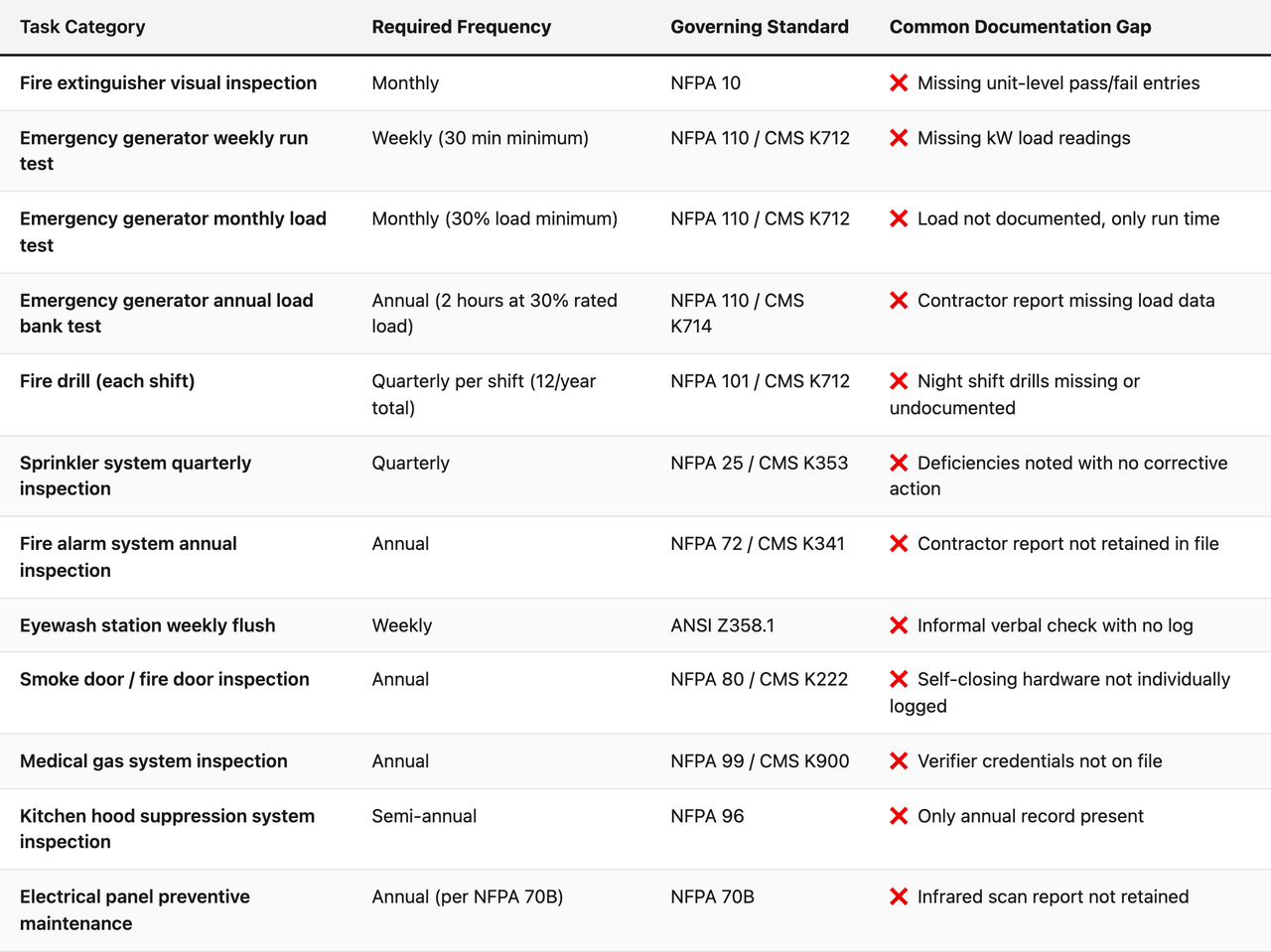
Most facilities that rely on paper binders or spreadsheet tracking have a partial version of this schedule. It covers the obvious high-frequency tasks (monthly fire extinguisher checks, quarterly fire drills) but misses the less obvious ones: annual medical gas system inspections, 36-month sprinkler pipe obstruction investigations, monthly eyewash station flushing, and semi-annual fire door inspections. These lower-frequency tasks are disproportionately cited because they fall off the radar between cycles.
The Complete SNF Life Safety Task Frequency Reference
Assign Ownership, Not Just Tasks
Every task on your master schedule needs a named owner: a specific role (maintenance director, lead technician, EVS supervisor) responsible for both completing the task and logging the completion. When tasks are assigned to "maintenance" with no further specificity, they fall through the cracks when staff turn over or schedules shift. Name the role, not just the department, and document what the backup ownership chain looks like when the primary owner is unavailable.
Time estimate for Step 3: 6-10 hours to build from scratch, plus ongoing schedule maintenance.
Step 4: Design Your Documentation Standards for Each Record Type
Defining what a completed record must contain is one of the most overlooked steps in building a survey-ready program. Most facilities create checklists and logs without specifying what level of detail constitutes a compliant entry. The result is inconsistent records, with some staff providing thorough documentation and others providing entries that would fail surveyor scrutiny.
For each task type on your master schedule, create a documentation standard: a one-page reference that specifies exactly what a compliant entry must include. Post it at the point of documentation (on the kiosk, inside the binder, on the clipboard near the generator). Make it impossible for staff to not know what a complete record looks like.
Generator Test Log Documentation Standard (Example)
A compliant generator test log entry for a weekly run test must include:
- Date and start time of test
- Name of person conducting the test (printed, not just initials)
- Generator ID or location (for facilities with multiple units)
- Starting battery voltage
- Transfer switch operation: did it transfer automatically, and how long did transfer take (in seconds)?
- kW load reading during run (not just "generator ran")
- Voltage and frequency readings during run
- Coolant temperature and oil pressure (if gauges are present)
- Any alarms, abnormal sounds, or observations
- End time and duration of run
- Signature or logged confirmation of completion
An entry that says "Generator ran OK - J.S." fails this standard on nine out of eleven required elements. That entry will produce a K712 or K714 citation. The entry that passes looks different, and your staff need to see exactly what that difference is.
Fire Drill Documentation Standard
Fire drill records are among the most frequently cited documentation gaps in SNF surveys, and the citations almost always involve either missing shift coverage (no night shift drills for one or more quarters) or incomplete records that do not capture the required elements. A compliant fire drill record must include:
- Date, start time, and end time
- Shift (day/evening/night) and unit or wing where drill was conducted
- Number of staff participating
- Whether residents were notified or relocated (and if not, why not)
- Evacuation route used and any barriers or issues encountered
- Observations and corrective actions identified
- Name and signature of the person who conducted the drill
- For facilities using a fire alarm activation: confirmation of alarm pull station used and alarm signal observed
Many facilities document fire drills with a single-line entry. That entry will not survive a thorough survey review. Build a form that forces complete documentation, and make filling it out the only option available to the person conducting the drill.
Common mistake to avoid: Do not create documentation standards that are so burdensome that staff skip them. Each standard should be specific enough to be compliant and simple enough to complete in under five minutes for routine tasks.
Step 5: Implement a Contractor Report Integration and Deficiency Tracking System
Contractor-generated reports are the most dangerous documentation gap in most SNF life safety programs. When a licensed contractor inspects your sprinkler system or fire alarm and identifies deficiencies, that report becomes a CMS exhibit: evidence that your facility knew about a deficiency and either did or did not resolve it. A contractor report with open deficiencies and no corrective action documentation is, in many cases, worse than no report at all.
The problem is structural. Contractor reports arrive by email or fax, get forwarded to the maintenance director, and then sit in an inbox or a folder without being systematically cross-referenced against a deficiency tracking register. When the surveyor asks for documentation that a sprinkler head replacement identified in last year's annual inspection was completed, no one can find the corrective action record because it was never created as a formal document.
The Contractor Report Intake Process
Every time a licensed contractor completes an inspection or service visit, your program should trigger the following intake process:
- Receive and file the report in a designated location (physical or digital) within 24 hours of receipt. Do not allow contractor reports to sit in email inboxes.
- Review the report for deficiencies. Read the full report, not just the summary. Contractors often note minor deficiencies in the body of the report that do not appear in a summary section.
- Create a deficiency entry in your deficiency tracking register for each item identified, with the asset ID, description of the deficiency, contractor recommendation, and a target resolution date.
- Assign resolution ownership to a specific person, either internal staff or a follow-up contractor engagement.
- Track to close. The deficiency entry stays open until a corrective action record is attached: either a follow-up contractor report, a purchase order and completion record, or a documented interim risk mitigation measure with a plan to complete.
- File the corrective action documentation alongside the original contractor report so that a surveyor reviewing the file can see the deficiency and its resolution in one place.
Interim Risk Mitigation Documentation
Not every deficiency can be resolved immediately. Equipment lead times, budget cycles, and contractor availability create gaps between identification and resolution. When a deficiency will remain open beyond 30 days, your program should include an interim risk mitigation record: a documented statement of the deficiency, the reason resolution is delayed, the interim measures in place to manage the risk, and the expected resolution date. This documentation does not prevent a citation, but it demonstrates an active corrective action process, which CMS considers in determining the scope and severity of a deficiency finding.
Time estimate for Step 5: 2-4 hours to design the system, then 15-30 minutes per contractor visit to maintain it.
Step 6: Build Your Pre-Survey Audit Protocol
A pre-survey audit is a structured internal review that simulates what a CMS surveyor would find if they arrived today. It is not the same as your ongoing compliance program. It is a periodic, top-to-bottom review of your documentation against your compliance matrix, designed to find gaps before the surveyor does. Facilities that run quarterly pre-survey audits consistently outperform facilities that rely on their ongoing program alone, because ongoing programs catch new gaps but sometimes miss accumulated drift in older records.
The pre-survey audit has a specific structure. It is not a walkthrough. It is a document review, conducted by someone who knows the compliance matrix and is not the person who created the records being reviewed. When the maintenance director reviews his own documentation, he will miss things that an objective reviewer would catch. Build the pre-survey audit so that it involves at least one pair of eyes that is not the primary documentation owner.
The Pre-Survey Audit Checklist Framework
Structure your pre-survey audit around the same K-tag categories that appear in your compliance matrix. For each category, the audit should answer four questions:
- Are all required records present? For the past 12 months (or the applicable lookback period for each task type), is there a complete set of records at the required frequency?
- Do the records contain all required data elements? Pull three to five records at random for each task type and check them against your documentation standard. If random samples fail the standard, the entire category is at risk.
- Are all deficiencies tracked to close? Is your deficiency register current, and does every open item have an active corrective action plan?
- Are contractor reports filed with their corrective action documentation? Is the contractor report file organized so that a surveyor could find any report within two minutes?
Document the results of every pre-survey audit and retain the documentation. A series of pre-survey audit records demonstrating that your facility actively identifies and closes gaps is itself evidence of a robust compliance program, and it tells a different story to a surveyor than a facility that has no audit trail at all.
Timing Your Pre-Survey Audits
Run a full pre-survey audit quarterly. In addition, run a targeted audit any time a significant change occurs at your facility: a new maintenance director, a major renovation, a change in occupancy classification, or a shift in your licensed contractor relationships. These transition moments are when documentation gaps most often appear, because institutional knowledge about where records are kept and how they should be completed is disrupted.
Time estimate for Step 6: 4-8 hours per quarterly audit for a single facility.
Step 7: Organize Your Survey-Ready Documentation Binder (Physical and Digital)
How your documentation is organized matters almost as much as whether it is complete. A surveyor who cannot locate a record within two to three minutes will note the absence of that record. A documentation system that requires the maintenance director to search through four binders and a shared drive folder to answer a single question is a liability, not an asset.
The survey-ready documentation binder, whether physical or digital, should be organized so that any person who knows the K-tag categories can navigate it without guidance from facility staff. That is the test: could a surveyor, working alone, find every required record in your documentation system without asking anyone for help?
Recommended Binder Organization Structure
Organize your documentation binder by K-tag category, with each section containing:
- A one-page index showing the required tasks for that K-tag category, their frequencies, and the date range of records on file
- All current-cycle records for that category, in reverse chronological order (most recent first)
- All contractor reports for that category, with corrective action documentation attached
- Any open deficiency records with interim risk mitigation documentation
- A copy of the relevant code section or regulatory citation for quick reference
When a surveyor asks for your sprinkler system inspection records, you should be able to hand her a binder section that contains every NFPA 25 inspection report for the past three years, organized chronologically, with all contractor deficiency reports and their corrective actions filed immediately behind each report. That is a survey-ready documentation file. A manila folder with a mix of contractor reports, handwritten notes, and purchase orders is not.
Digital Documentation: What Survey-Readiness Requires
Many facilities are transitioning from paper binders to digital documentation systems. Digital systems offer significant advantages for CMS survey readiness, but only if they are structured correctly. A digital system that stores files in an unstructured shared drive folder provides no advantage over a paper binder. A digital system that organizes records by K-tag category, flags incomplete entries at the time of logging, and generates an audit trail showing who logged what and when is a fundamentally different tool.
Platforms purpose-built for life safety compliance documentation, such as SEQURA, apply a second layer of review to completed records, cross-referencing entries against the regulatory requirements for each K-tag category and surfacing gaps before they accumulate. That AI review layer is the difference between a digital filing system and a true compliance intelligence system. The former stores your documentation. The latter audits it.
Time estimate for Step 7: 8-12 hours to organize an existing binder for the first time; 30-60 minutes per month to maintain.
Step 8: Train Your Team on Documentation Compliance
The most comprehensive compliance program in the world fails if the people doing the work do not know how to document it correctly. Training is not a one-time orientation event. It is an ongoing operational practice, and the content of the training must be specific to the documentation standards you built in Step 4, not generic life safety awareness.
Most SNF maintenance teams receive some version of fire safety training during onboarding, but very few receive training specifically on documentation compliance: what a compliant generator test log entry looks like, why the kW load reading matters, what happens to the facility if that reading is missing when the surveyor arrives. That connection between daily documentation behavior and survey outcomes is the core of effective compliance training, and it is almost never made explicit.
Training Content by Role
Effective life safety documentation training is role-specific. Build separate training modules for:
- Maintenance director: Full compliance matrix review, documentation standards for all task types, contractor report intake process, deficiency tracking system, pre-survey audit protocol, and binder organization. This is a 4-6 hour training program, not a 30-minute overview.
- Lead technician / maintenance staff: Documentation standards for the specific tasks they are assigned, how to use the logging system (paper form, kiosk, or mobile), what to do when they identify an issue during an inspection, and how to escalate deficiencies.
- EVS director and EVS staff: For facilities where EVS staff conduct or assist with life safety tasks (corridor checks, hazardous area inspections, eyewash flushing), role-specific documentation standards for those tasks.
- Administrator and DON: Overview of the compliance program structure, their role in resource authorization for corrective actions, and how to read a pre-survey audit report.
Documentation as a Clinical Mindset
One effective framing for life safety documentation training is the clinical analogy. In nursing, "if it wasn't documented, it wasn't done" is a foundational principle. It applies with equal force to life safety documentation. The generator ran fine this morning. If there is no log entry showing it ran, no kW reading, no transfer time, no signature, then for CMS purposes, it did not run. Building that mindset across your maintenance and EVS team is a culture shift, not just a training exercise, and it requires reinforcement through supervision, pre-survey audit feedback, and visible leadership commitment.
Common mistake to avoid: Do not train only new staff. Experienced maintenance staff often have deeply ingrained documentation habits that produce incomplete records. Retraining experienced staff on specific documentation standards, framed as a survey preparation exercise rather than a critique of their past work, is one of the highest-return training investments a facility can make.
Step 9: Establish Your Survey Response Protocol
When a CMS surveyor arrives, the first thirty minutes determine the trajectory of the entire survey. How your facility responds in those first minutes, who greets the surveyor, what documentation is retrieved first, and how staff communicate during the survey, shapes the surveyor's initial impression and the scope of her review. A survey response protocol is a documented procedure that ensures every person who might be the first point of contact knows exactly what to do.
The survey response protocol is not about managing the surveyor. It is about ensuring that your facility responds in an organized, confident, and cooperative way that reflects your genuine compliance program. Facilities that scramble, give conflicting answers, or cannot locate documentation in a timely way invite expanded review. Facilities that respond promptly and accurately with well-organized documentation reduce the likelihood of that expansion.
The First 30 Minutes: A Survey Response Checklist
- Greet and credential the surveyor. The administrator or designee greets the surveyor, reviews credentials, and asks for the survey team roster if multiple surveyors are present.
- Notify the maintenance director immediately. The maintenance director should be the first internal notification, even before the administrator contacts the DON. Life safety documentation will be requested early, and the maintenance director needs time to retrieve and organize the survey binder.
- Open the survey binder and do a 10-minute self-check. While the surveyor is completing initial paperwork, the maintenance director should do a fast scan of the binder index against the most recent pre-survey audit results to confirm the highest-risk areas are organized and complete.
- Designate a survey escort. The maintenance director or a trained designee should accompany the surveyor during any life safety walkthrough. This person answers questions about maintenance documentation and knows where every record is located.
- Do not volunteer information that is not requested. Answer questions completely and accurately. Do not proactively direct the surveyor's attention to areas of concern that are not yet on her list.
- Log all documentation requests and responses. Keep a running log of every document the surveyor requests and what was provided. This log is essential for your post-survey debrief and for any informal dispute resolution if a citation is proposed.
After the Survey: The Corrective Action Loop
Whether or not a survey produces citations, conduct a post-survey debrief within 48 hours. Review every documentation request the surveyor made, whether or not it produced a finding, and identify any areas where your response was slower or less organized than it should have been. Update your gap register, your pre-survey audit checklist, and your documentation standards based on what the survey revealed. The survey is the best external audit your compliance program will ever receive. Treat the debrief as a program improvement event, not a postmortem.
Step 10: Build a Continuous Improvement Loop with Metrics and Accountability
A survey-ready compliance program is not a project with a completion date. It is an operational system that requires ongoing measurement, accountability, and improvement. The facilities that maintain consistent survey readiness over time are the ones that have built metrics into their compliance program and review those metrics in regular leadership meetings, not just in the weeks before a survey is anticipated.
Define three to five key compliance metrics for your facility and review them monthly. Suggested metrics include:
- Task completion rate: What percentage of scheduled life safety tasks were completed on time in the past 30 days? A rate below 95 percent warrants investigation.
- Documentation completeness rate: Of the completed tasks, what percentage have fully compliant documentation entries? This is different from completion rate: a task can be completed but poorly documented.
- Open deficiency age: What is the average age of open deficiencies in your deficiency register? Any deficiency older than 60 days without documented interim mitigation is a survey risk.
- Pre-survey audit findings trend: Is the number of gaps identified in each quarterly pre-survey audit increasing, decreasing, or holding steady? A decreasing trend indicates program improvement. An increasing or flat trend indicates a systemic issue.
- Contractor report backlog: How many contractor reports have been received but not yet processed through the intake protocol? A backlog here is a specific risk indicator.
Present these metrics in your monthly leadership meeting alongside clinical and financial metrics. Life safety compliance is an operational and financial risk, not just a regulatory obligation. A statement of deficiency, an immediate jeopardy finding, or a civil money penalty from a life safety citation can cost a facility hundreds of thousands of dollars and significant reputational damage. The metrics that predict those outcomes deserve the same leadership attention as occupancy rates and staffing ratios.
Using Technology to Automate the Compliance Loop
The administrative burden of maintaining a manual compliance program at the level of rigor this guide describes is significant. For a single facility, the ongoing documentation, tracking, and audit work described in these ten steps represents 10-15 hours per week of staff time, conservatively. For a multi-site operator managing five or ten facilities, that burden multiplies proportionally, and the risk of inconsistency between facilities becomes its own compliance risk.
Purpose-built life safety compliance platforms address this directly. SEQURA's task template library, built against NFPA 101, NFPA 99, and NFPA 110 requirements with input from life safety consultants, automates the task scheduling and frequency management described in Step 3. Its contemporaneous logging system, accessible from a facility kiosk, mobile device, or back-office computer, enforces the documentation standards described in Step 4 at the point of entry: if a generator test log entry is missing the kW load reading, the system flags it before the record is submitted. And its AI review layer performs the pre-survey audit function described in Step 6 continuously, surfacing documentation gaps as they occur rather than when a quarterly audit discovers them.
The result is a compliance program that does not depend on any individual's memory, organizational skill, or bandwidth. It runs on a system architecture that produces the same quality of documentation whether the maintenance director has been in the role for ten years or ten weeks.
Frequently Asked Questions About CMS Survey Readiness and Life Safety Compliance
How far back do CMS surveyors typically look when reviewing life safety documentation?
CMS surveyors typically review the past 12 months of life safety documentation during a standard survey. For specific asset types with longer inspection cycles (such as emergency generators with annual load bank tests or sprinkler systems with 5-year internal pipe obstruction investigations), they may request documentation going back further to confirm the applicable cycle was completed. It is best practice to retain life safety documentation for a minimum of three years, and some facilities retain it for five years to cover multiple inspection cycles.
What is the difference between a CMS survey and a state fire marshal inspection?
A CMS survey under the Life Safety Code (conducted by state survey agency surveyors acting under CMS authority) focuses on documentation compliance with the CMS State Operations Manual requirements for the Life Safety Code. A state fire marshal inspection is conducted by a separate state agency and focuses on code compliance with state fire code and building code requirements. Both can produce citations and enforcement actions, but the K-tag system is specific to CMS surveys. Many SNFs face both types of inspections, and a compliant life safety documentation program should address the requirements of both.
Can a facility receive a citation even if all equipment is functional?
Yes, and this is one of the most important points for SNF administrators to understand. CMS life safety citations are documentation citations as often as they are physical condition citations. A functional generator with no compliant test logs will produce a K712 citation. A properly maintained sprinkler system with open deficiencies from a contractor report and no corrective action documentation will produce a K353 citation. The physical state of the equipment is relevant, but the documentation of its maintenance and inspection is independently evaluated.
How many fire drills does a SNF need to conduct per year?
Under NFPA 101 as adopted by CMS, healthcare occupancies are required to conduct fire drills on each shift (day, evening, and night) at least once per quarter. This produces a minimum of 12 fire drills per year: four per shift across three shifts. Each drill must be documented with the required elements described in Step 4 of this guide. Night shift drill coverage is among the most commonly cited fire drill deficiencies in SNF surveys.
What documentation is required for emergency generator testing?
NFPA 110, as referenced by CMS under K712 and K714, requires weekly no-load or load tests (30 minutes minimum), monthly tests under load (not less than 30 percent of nameplate rating), and annual load bank tests (2 hours at not less than 30 percent of rated load if monthly tests have not achieved that threshold). Each test record must include the date, duration, starting battery voltage, kW load, voltage, frequency, coolant temperature, oil pressure, any abnormal observations, and the name of the person conducting the test. Missing kW load data is the single most common generator documentation gap cited in SNF surveys.
How should a facility handle a contractor report that identifies deficiencies it cannot immediately correct?
Immediately create a deficiency entry in your tracking register with the specific deficiency, the contractor's recommendation, and a target resolution date. If resolution will take more than 30 days, document interim risk mitigation measures: what compensatory measures are in place while the deficiency is open. Obtain a written corrective action plan from the contractor if the repair requires their return visit. File all of this documentation alongside the original contractor report. CMS surveyors evaluate both whether deficiencies were identified and whether the facility responded with an active corrective action process.
What is an immediate jeopardy finding in a life safety survey, and how does it differ from other citations?
An immediate jeopardy (IJ) finding is issued when a CMS surveyor determines that a facility's noncompliance has caused, or is likely to cause, serious injury, harm, impairment, or death to a resident. In the life safety context, IJ findings most commonly arise from blocked egress routes, non-functional fire suppression systems, or documented failure to test emergency power systems. IJ findings require immediate corrective action before the surveyor leaves the facility and carry the most severe enforcement consequences, up to and including termination of the facility's Medicare and Medicaid provider agreement. The documentation gaps described in this guide, while serious, are less likely to produce IJ findings than physical condition violations, but a pattern of systematic documentation failure can support an IJ determination in combination with physical findings.
How often should a SNF update its compliance matrix?
Update your compliance matrix whenever there is a change in the applicable regulatory standard (NFPA code edition adoption by CMS or your state), a change in your facility's occupancy classification, a significant renovation or addition to the facility, a change in your licensed contractor relationships, or following any CMS or state survey that identifies a gap not previously in your matrix. At minimum, review the compliance matrix annually against the current edition of the applicable NFPA codes and CMS State Operations Manual to confirm it reflects current requirements.
What is the role of the administrator in a SNF life safety compliance program?
The administrator is accountable for survey outcomes and is the appropriate person to authorize the resources required for corrective actions. In a well-structured compliance program, the administrator reviews monthly compliance metrics, approves the corrective action budget for open deficiencies, participates in the post-survey debrief, and ensures that life safety compliance has the organizational priority it requires. The administrator does not need to manage the documentation program day to day, but she must be engaged enough to recognize when the program is underperforming and to act on that recognition before a survey.
What is the most common reason SNF life safety documentation programs fail?
The most common failure mode is the program existing only in the maintenance director's head rather than as a documented, transferable system. When the maintenance director who built the program leaves, the institutional knowledge about what needs to be documented, where records are kept, and which contractors need to be contacted for which inspections leaves with her. The second most common failure mode is treating the compliance program as a project that gets done before a survey rather than an operational system that runs continuously. Both failure modes are structural, and both are addressed by the system-building approach described in this guide.
How do digital compliance platforms improve SNF survey readiness compared to paper binders?
Paper binders store documentation passively. They cannot tell you that a record is missing, that a required data field was not completed, or that a deficiency from three months ago has no corrective action on file. Digital compliance platforms purpose-built for life safety, like SEQURA, add an active audit layer: they flag incomplete entries at the time of logging, track deficiency resolution automatically, generate compliance metrics without manual data extraction, and surface gaps before they accumulate into citations. For multi-site operators, they also provide a centralized view of compliance status across all facilities, which is impossible to achieve with paper-based systems.
What should a facility do if it discovers a significant documentation gap just before or during a survey?
Do not attempt to recreate documentation retroactively or backdate records. This constitutes falsification of records, which is a federal offense and a basis for termination of the provider agreement. Instead, acknowledge the gap, document what is currently known about the inspection history from any available secondary evidence (equipment service stickers, contractor invoices, staff recollection documented in writing), and present a corrective action plan demonstrating that the facility has identified the gap and has implemented a system to prevent recurrence. Surveyors distinguish between facilities that are unaware of their gaps and facilities that have identified and are actively addressing them.
Key Takeaways
- CMS life safety citations are more often documentation failures than equipment failures. A functional facility with incomplete records is a survey-risk facility. Building a documentation-first compliance program is not optional for SNF operators who want to avoid K-tag citations.
- Start with a compliance matrix. Before building any system, map every K-tag category, required task, inspection frequency, and documentation element that applies to your facility. This matrix is the foundation of everything else.
- Baseline audits reveal the real gap. Most facilities that run their first systematic documentation audit find gaps in 30 to 50 percent of required categories, not from skipped inspections but from incomplete records. You cannot fix what you have not measured.
- The master task schedule eliminates memory-dependent compliance. Assign every required task to a specific role, at a specific frequency, with a specific documentation standard. When compliance depends on individual memory, it degrades with every staff turnover event.
- Contractor reports are exhibits, not records. When a contractor identifies a deficiency, that report is a CMS exhibit. An open deficiency with no corrective action documentation is often worse than no inspection at all. Every contractor report requires a deficiency intake process and a tracking record.
- Pre-survey audits are the highest-return compliance investment. Quarterly internal documentation audits that simulate surveyor review catch gaps before they become citations. The cost of a quarterly audit is a fraction of the cost of a single statement of deficiency.
- Documentation standards must be specific. "Generator checked" is not a compliant entry. Every task type needs a written standard specifying exactly what a compliant record must contain, posted at the point of documentation.
- Survey readiness is an operational system, not a pre-survey scramble. The facilities that consistently perform well on life safety surveys are the ones that run their compliance program as a year-round operational discipline, not a periodic catch-up exercise.
- Technology multiplies program effectiveness at scale. For multi-site operators, purpose-built compliance platforms like SEQURA replace the fragile, person-dependent paper binder with a system that schedules, logs, audits, and surfaces gaps automatically, producing survey confidence that scales across every facility in the portfolio.
About the author
Benjamin Terebelo · Founder
Benjamin is the founder of SEQURA, a compliance platform purpose-built for healthcare facilities. He builds at the intersection of healthcare operations and software, maintaining a focus on bringing modern tooling to systems that the broader industry has largely left behind.
About the author
Benjamin Terebelo · Founder
Benjamin is the founder of SEQURA, a compliance platform purpose-built for healthcare facilities. He builds at the intersection of healthcare operations and software, maintaining a focus on bringing modern tooling to systems that the broader industry has largely left behind.