
How to Build a Contractor-to-Record Reconciliation Workflow That Closes Every Open Deficiency Before Survey Day
Picture this: a CMS surveyor walks into your skilled nursing facility on a Tuesday morning. By 10 a.m., she has already pulled three contractor reports from your fire suppression vendor, your HVAC contractor, and your elevator service company. By 10:30, she has found deficiencies listed in those reports that your maintenance log shows as "completed." By noon, you are looking at a K-tag citation that did not need to happen. The contractor found the problem. Your team flagged it. Someone checked a box. But nobody reconciled the paperwork, and now you have a finding.
This is not a hypothetical. Unreconciled contractor reports are among the most preventable sources of life safety citations in skilled nursing facilities, and they persist across facilities of every size, every staffing model, and every level of operational sophistication. The problem is not negligence. It is a workflow gap: contractor reports come in through one channel, corrective actions happen through another, and documentation of closure lives somewhere else entirely. When a surveyor asks for proof that a deficiency was corrected, the answer is scattered across three binders, two email threads, and a sticky note on the maintenance director's monitor.
This guide builds the workflow that closes that gap. It is a step-by-step system for receiving contractor reports, extracting every deficiency, tracking corrective action, and generating the documentation chain that proves closure before a surveyor ever asks for it. Follow these steps and you will never walk into a survey with an unreconciled deficiency again.
What Contractor Report Reconciliation Actually Means (and Why Most SNFs Get It Wrong)
Contractor report reconciliation is the process of matching every deficiency or observation listed in a vendor inspection report to a documented corrective action and a verified closure record. It sounds straightforward, but most skilled nursing facilities treat it as a one-step task when it is actually a five-step chain. Understanding where the chain breaks is the first prerequisite for fixing it.
When a fire suppression contractor, elevator service company, HVAC technician, or biomedical engineer completes an inspection, they produce a report. That report typically contains three categories of items: items that passed, items that require monitoring, and items flagged as deficiencies requiring correction. The passing items need to be filed. The monitoring items need to be scheduled. The deficiency items need to be assigned, corrected, and documented as closed. Most SNF maintenance workflows handle the first category acceptably. The second and third categories are where reconciliation breaks down.
The specific failure modes that produce citations look like this:
- Report receipt without intake review: The contractor emails a PDF. Someone saves it to a shared drive or prints it and puts it in the binder. Nobody formally reviews it for open items.
- Corrective action without documentation linkage: A technician fixes the problem but the fix is recorded in a work order system that is not connected to the original contractor report. The report still shows an open deficiency.
- Closure without third-party verification: For deficiencies that require contractor re-inspection, the facility closes the item internally without obtaining a sign-off from the vendor confirming the correction was adequate.
- No master tracking register: There is no single document showing every open deficiency, its assigned owner, its target closure date, and its current status. Without this, open items age invisibly.
CMS surveyors are trained to find exactly these gaps. During a CMS Life Safety Code survey, surveyors cross-reference contractor reports against maintenance logs and work orders. If the dates do not align, if a deficiency appears in a report but has no corresponding closure documentation, or if the closure documentation exists but is not linked to the original report, that is a citation. The fix is a reconciliation workflow that creates an unbroken paper trail from deficiency identification to verified closure.
Step 1: Establish a Single Intake Point for All Contractor Reports
Estimated time: 2–3 hours to set up, ongoing 5 minutes per report received.
The first and most critical step is eliminating the chaos of scattered report receipt. Contractor reports arrive by email, by fax, by postal mail, through vendor portals, and sometimes as a paper copy left on the maintenance director's desk. When reports arrive through multiple channels, the risk of a report being received but not reviewed is extremely high. The first step in building a reconciliation workflow is creating a single, designated intake point for every contractor report that enters the facility.
The intake point should be a dedicated email address (something like safety-reports@yourfacility.com) that is monitored by the maintenance director and at least one backup. Every contractor who performs work at your facility should be given this address and instructed to send all inspection reports, completion certificates, and deficiency notices to it exclusively. This single step eliminates the most common failure mode: reports that arrive, get opened, and disappear into a personal inbox without triggering any review process.
Setting Up the Intake Protocol
Once the intake address is established, build a simple intake checklist that gets completed within 24 hours of every report received. This checklist should confirm:
- Report received from: [Contractor Name]
- Date of inspection or service visit: [Date]
- System or equipment inspected: [Fire suppression / HVAC / Elevator / Generator / Other]
- Number of deficiencies or open items identified: [Count]
- Report filed to: [Location in documentation system]
- Open items logged to deficiency register: [Yes / No]
If the answer to item 6 is "No," the intake process is not complete. The report should not be filed as "received" until every open item has been extracted and entered into the deficiency register (described in Step 2). This small procedural gate prevents the most common reconciliation failure: reports that are filed before their deficiencies are tracked.
Pro Tips for Intake Setup
Contact every active contractor and update your service agreements to require electronic delivery of all reports within 48 hours of each site visit. Many contractors default to mailing paper reports or uploading to their own portals. Your agreement should specify format (PDF preferred), delivery method (your designated intake email), and the required information on the report (date of inspection, technician name, items inspected, deficiencies noted with specific location and description).
If you use a compliance or documentation platform, configure it to accept email attachments directly into a contractor report queue. This creates an automatic timestamp of receipt and prevents reports from living solely in an email inbox.
Common mistake to avoid: Do not use the maintenance director's personal work email as the intake point. When staff turn over (and in SNF maintenance, turnover is significant), that inbox leaves with them. Use a role-based or facility-based address that survives personnel changes.
Step 2: Build and Maintain a Living Deficiency Register
Estimated time: 1–2 hours to build the register template, 10–15 minutes per report to populate.
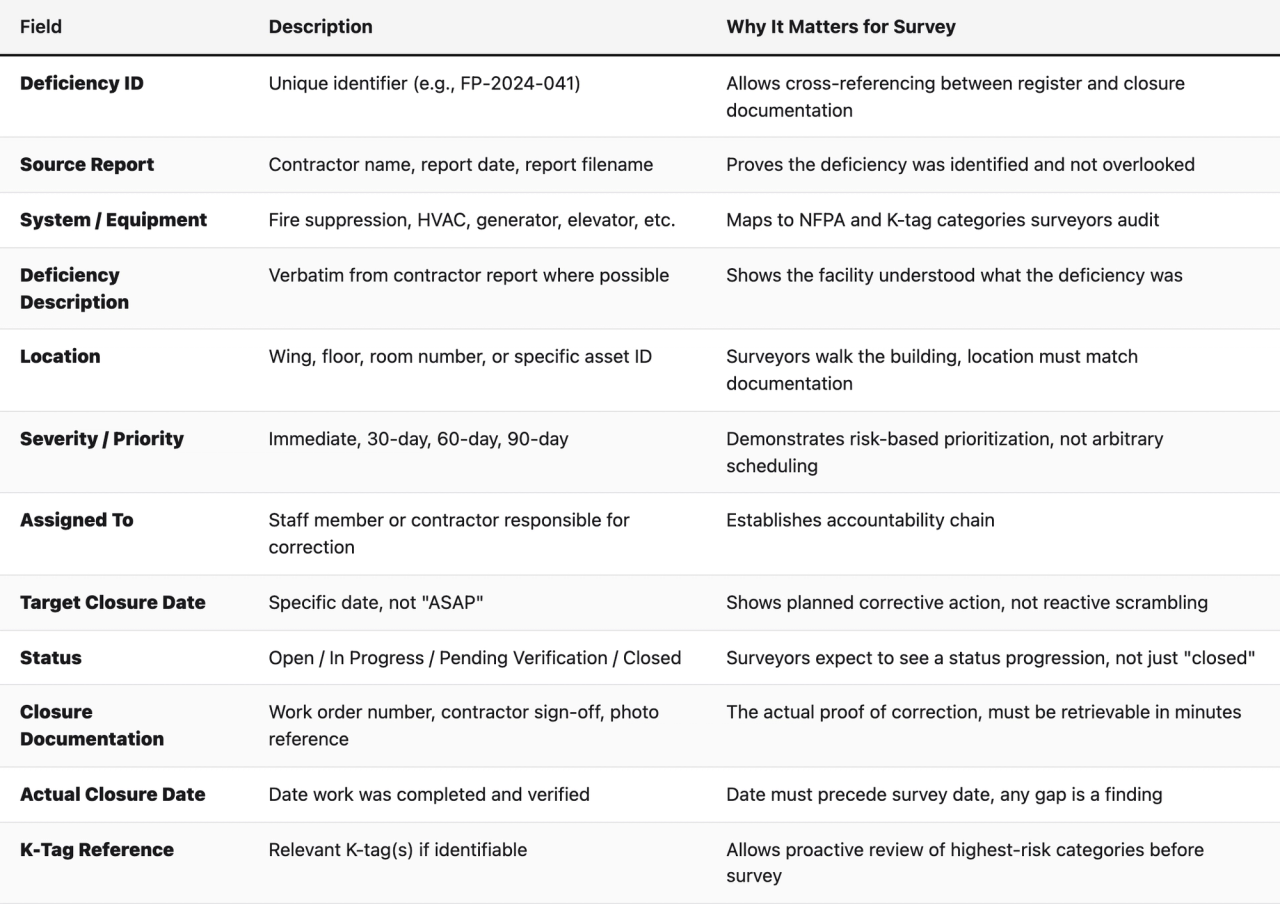
A deficiency register is the operational heart of your contractor report reconciliation workflow. It is the single document that shows every open deficiency from every contractor report, who is responsible for correcting it, when it is expected to be closed, and what its current status is. Without this register, reconciliation is impossible because there is no authoritative source of what is open.
The register does not need to be sophisticated. A well-structured spreadsheet works. A compliance platform with a deficiency tracking module is better. What matters is that the register is used consistently, that every deficiency from every contractor report enters it, and that it is reviewed on a defined schedule. A register that exists but is not reviewed is just as useless as no register at all.
Required Fields in the Deficiency Register
Who Owns the Register?
The maintenance director is the primary owner, but the register should not be a document only they can access. The administrator and the director of nursing should have read access at minimum. In multi-site operations, the regional facilities manager should have visibility across all facility registers. If a single person has exclusive control of the register and that person leaves, is on leave, or is simply overwhelmed, the entire reconciliation system collapses. Build shared access into the structure from day one.
Step 3: Triage Every Deficiency by Risk and Regulatory Exposure
Estimated time: 15–30 minutes per report, requires knowledge of NFPA 101/99 and K-tag categories.
Not all deficiencies carry equal regulatory weight, and your corrective action timeline should reflect that. The goal of triage is to identify which open items pose immediate life safety risk, which items map to high-frequency K-tag citation categories, and which items are lower-priority maintenance observations that can be scheduled into a normal work cycle. Getting this wrong in either direction creates problems: over-prioritizing minor items wastes resources, while under-prioritizing high-risk items creates citation exposure.
The Three-Tier Triage Model
Tier 1: Immediate Corrective Action Required (0–72 hours)
These are deficiencies that create an active life safety hazard or that CMS would consider an Immediate Jeopardy condition. Examples include non-functioning fire suppression components, inoperative emergency egress hardware, generator failures affecting life-critical systems, and non-functioning smoke detection in resident sleeping areas. Any deficiency in this tier requires same-day escalation to the administrator, documentation of interim protective measures (per NFPA 101 requirements for impaired protection systems), and a written corrective action plan with daily status updates.
Tier 2: High-Priority Corrective Action (4–30 days)
These deficiencies do not create immediate hazards but map directly to K-tag categories that CMS surveys routinely cite. Examples include fire door deficiencies, sprinkler coverage gaps, annual testing overdue, exit sign or emergency lighting failures, and kitchen hood suppression system observations. These items should be assigned to a named responsible party within 48 hours of intake, with a specific target closure date and a scheduled follow-up review.
Tier 3: Scheduled Maintenance (31–90 days)
These are observations that the contractor flagged as recommendations, wear items to monitor, or minor deficiencies that do not affect system functionality. They still enter the deficiency register because surveyors can ask about contractor observations even when they are not formal deficiencies. The key is that they are documented, scheduled, and closed on time rather than allowed to age indefinitely.
Mapping Deficiencies to K-Tag Categories
When you enter a deficiency into your register, take the additional step of identifying the K-tag category it most likely maps to. This is not always straightforward, but it is worth the effort. The CMS K-tag framework organizes life safety citations by system and NFPA code section. Knowing that a fire door deficiency maps to K-223 or K-225, for example, allows you to group all related deficiencies for batch review before survey and to ensure your closure documentation specifically addresses the regulatory expectation, not just the physical fix.
Warning: Avoid the temptation to downgrade deficiency severity to reduce workload. If a contractor flagged something, your documentation shows you knew about it. Surveyors are specifically trained to look for patterns where contractor reports identify problems that facility records characterize as minor. The triaged tier should reflect actual risk, not administrative convenience.
Step 4: Assign Corrective Actions with Specific Accountabilities and Deadlines
Estimated time: 10–20 minutes per deficiency for initial assignment, ongoing tracking per work schedule.
A deficiency in a register with no named owner and no specific deadline is a deficiency that will still be open when surveyors arrive. Assignment is not a formality. It is the mechanism that converts a documented problem into a documented corrective action. The specificity of the assignment determines whether the corrective action happens on time and whether it generates the right documentation when it does.
What a Proper Assignment Looks Like
Vague assignment: "Fix the fire door on the second floor."
Proper assignment: "Replace non-latching hardware on fire door 2-North-07. Assigned to: J. Martinez (maintenance technician). Scheduled: 03/14 AM. Parts ordered: 03/11 (PO #4492). Target completion: 03/14. Verification required: physical latch test and photographic documentation of completed repair. If contractor re-inspection required, schedule with [Contractor Name] by 03/15."
The difference between these two assignments is the difference between a work order that gets done and one that generates a citation. The proper assignment creates a specific, time-bound action with a named person, an expected output (documentation), and a verification step. Every corrective action assignment in your deficiency register should meet this standard.
Internal vs. Contractor-Required Corrections
Some deficiencies can be corrected by your internal maintenance staff. Others require the original contractor or a licensed specialist to return and perform the repair. Identifying this at the assignment stage is critical because contractor-required corrections have longer lead times, require scheduling coordination, and typically require a contractor sign-off on completion rather than internal verification alone.
For contractor-required corrections:
- Contact the contractor within 48 hours of deficiency intake to schedule the return visit.
- Get a written confirmation of the scheduled date and add it to the deficiency register.
- If the contractor cannot return within your target closure window, document the attempted scheduling and the reasons for delay. This record of good-faith effort is important if a deficiency remains open at survey time.
- When the contractor returns, require written documentation of the completed repair, signed by the technician. This becomes the closure documentation for that deficiency.
Pro tip: Build contractor return visit requirements into your service contracts. Specify that any deficiency flagged in a contractor report requires a follow-up written confirmation of corrective action, delivered to your intake address within 5 business days of the repair. Many contractors will not do this automatically, but most will comply if it is in the contract.
Step 5: Document Corrective Actions in Real Time, Not Retrospectively
Estimated time: 5–10 minutes per corrective action, completed at time of work.
This is the step where most SNF reconciliation workflows fail silently. The work gets done, but the documentation happens later, sometimes much later, sometimes never. Retrospective documentation is one of the most common patterns CMS surveyors are trained to identify. When a work order is dated three weeks after a contractor report but the completion notes were clearly written in a single sitting covering multiple items, that pattern raises questions about whether the documentation reflects actual work or reconstructed paperwork.
Contemporary documentation means that every corrective action is recorded at the time it occurs. This does not require elaborate systems. It requires a discipline: the technician who completes the repair documents the completion before they leave the area or end their shift. The documentation should include:
- The deficiency ID from the register (linking the work order back to the source report)
- The specific work performed (not just "repaired" but what was replaced, adjusted, or corrected)
- Date and time of completion
- Name and signature (or login ID) of the technician who performed the work
- Any parts used, with part numbers if applicable
- Photographic documentation where the deficiency is visible (before and after where possible)
- Result of any functional test performed after correction
Using a Kiosk or Mobile Entry to Enforce Contemporaneous Logging
One of the practical advantages of a compliance platform over a paper-based system is that mobile or kiosk-based completion logging creates an automatic timestamp that cannot be backdated. When a technician completes a corrective action and logs it through a mobile device or shared kiosk, the system records the exact date and time of entry. This timestamp is not editable and it is visible to surveyors reviewing electronic records. It provides far stronger evidence of contemporaneous documentation than a handwritten log entry.
For facilities using paper-based systems, the discipline of same-day documentation must be enforced through supervision and routine. The maintenance director should review all open corrective actions at the end of each workday and confirm that completed items have been documented before the day closes. Any item completed but not documented by end of shift should be documented immediately, with a note that documentation was completed the same day as the work.
Common mistake to avoid: Do not allow technicians to mark items as "complete" in the deficiency register before they have been documented in a work order or completion log. The register status of "Closed" should only be set after the closure documentation exists and is linked to the deficiency record. Closing register items prematurely creates a false picture of your reconciliation status and can lead to deficiencies being treated as resolved when they are not.
Step 6: Verify Closure Before Updating the Register
Estimated time: 10–20 minutes per deficiency for verification review.
Corrective action and closure verification are two different steps, and treating them as the same step is a significant workflow error. A technician completing a repair and marking a deficiency as closed is not the same as a supervisor or maintenance director verifying that the repair was adequate, that the documentation is complete, and that the item is ready to withstand surveyor scrutiny. Closure verification is the quality control gate in your reconciliation workflow.
The Closure Verification Checklist
Before any deficiency is moved to "Closed" status in your register, the maintenance director or designated reviewer should confirm all of the following:
- The deficiency description in the register matches the contractor report verbatim. If the descriptions do not match, it raises the question of whether the right problem was addressed.
- The corrective action described in the work order is specific enough to demonstrate that the deficiency was resolved. "Repaired door" is not adequate. "Replaced latch assembly on fire door 2-North-07; door tested for positive latching with 5 lbs force per NFPA 80; passed" is adequate.
- The closure date is documented and precedes the current date. This sounds obvious, but errors in date recording are surprisingly common and create unnecessary audit complications.
- Photographic or physical evidence of correction is attached or referenced. For any Tier 1 or Tier 2 deficiency, photographic documentation should be considered mandatory.
- For contractor-required repairs, the contractor's written confirmation of correction is on file. The register should link directly to this document.
- Any required re-testing or re-inspection has been completed and documented. Some deficiencies require functional testing after correction. That test record should be part of the closure package.
- The K-tag reference has been reviewed. The closure documentation should be sufficient to answer a surveyor's question about that specific K-tag, not just about the physical repair.
The "Surveyor Test" Before Marking Closed
Before marking any deficiency as closed, ask this question: if a surveyor walked in tomorrow, found this deficiency in the original contractor report, and asked to see proof of correction, could you retrieve the closure documentation in under three minutes, and would that documentation answer every question the surveyor would reasonably ask? If the answer is no, the deficiency is not ready to close.
This test sounds demanding, but it is precisely the standard that produces survey confidence. Facilities that pass life safety surveys without citations are not facilities where nothing goes wrong. They are facilities where every problem that gets identified also gets documented, corrected, and verified in a way that holds up to scrutiny. The "surveyor test" is the operational definition of what that looks like at the item level.
Step 7: Conduct a Pre-Survey Reconciliation Audit on a Rolling Basis
Estimated time: 1–2 hours monthly, 4–6 hours quarterly for full audit.
The preceding steps describe how to reconcile individual contractor reports as they come in. This step addresses the facility-level discipline of auditing the entire deficiency register on a regular schedule to ensure that nothing has aged beyond its target closure date, that no reports have been received without deficiency extraction, and that the register accurately reflects the facility's current compliance posture.
Because CMS surveys are unannounced, a facility cannot wait for a scheduled survey notification to conduct its reconciliation audit. The audit must be a standing part of the facility's operational calendar. The practical standard for SNF life safety management is a monthly register review and a quarterly deep audit. Here is what each looks like.
Monthly Register Review (Rolling Compliance Check)
The monthly review is a 60–90 minute working session with the maintenance director and administrator (or their designee). The agenda covers:
- All deficiencies currently in "Open" or "In Progress" status: are they on track for their target closure dates?
- All deficiencies that have passed their target closure dates without being closed: what is the reason for delay, and what is the revised plan?
- All contractor reports received since the last review: have all deficiencies been extracted and entered?
- Any new Tier 1 deficiencies identified since the last review: what interim protective measures are in place and documented?
- Any K-tag categories with multiple open items: is there a systemic issue that needs a broader corrective action?
The output of this monthly review is a brief written summary, dated and signed by the administrator, noting the review was conducted and documenting any items requiring escalation. This written summary becomes part of your compliance record and demonstrates to surveyors that the facility has an active, supervised reconciliation process rather than a passive documentation system.
Quarterly Deep Audit (Pre-Survey Readiness Check)
The quarterly deep audit goes further. It reviews not just the current register status but the quality of closure documentation for recently closed items. Specifically:
- Pull a random sample of 10–15 items closed in the past quarter. For each, apply the "surveyor test" described in Step 6. Would the closure documentation survive surveyor scrutiny?
- Review all contractor reports received in the past quarter. For each, confirm that every deficiency from the report appears in the register. This cross-check catches extraction errors.
- Review the intake log to confirm that all expected contractor reports have been received. If an annual inspection is due from a vendor and no report has arrived, that gap needs to be addressed before survey.
- Review the K-tag distribution of open items. If multiple items cluster around the same K-tag, the facility may have a systemic compliance gap that needs a broader corrective action, not just item-by-item closure.
Step 8: Build the Survey-Ready Documentation Package
Estimated time: 2–4 hours to build the package template, 30–60 minutes to update before each quarter.
When CMS surveyors arrive, they will ask for documentation. The facilities that perform best in life safety surveys are the ones that can produce organized, complete documentation packages quickly and confidently. The facilities that struggle are the ones that spend the first hour of a survey scrambling through binders, folders, and email threads to find documents they know exist but cannot locate.
The survey-ready documentation package is a pre-assembled, organized collection of your key compliance records that can be produced immediately upon surveyor request. For contractor report reconciliation specifically, this package should contain:
- The current deficiency register, showing all items with their status. If the register shows zero open items, that is your first demonstration of compliance. If it shows open items, those items should have documented corrective action plans attached.
- An index of all contractor reports received in the past 12 months, organized by system type (fire suppression, HVAC, elevator, generator, etc.), with the date of each report and a note indicating whether any deficiencies were identified.
- Closure documentation packages for all Tier 1 and Tier 2 deficiencies closed in the past 12 months. Each package should include the original contractor report excerpt identifying the deficiency, the work order or corrective action record, and any contractor sign-off or re-inspection confirmation.
- Interim protection documentation for any Tier 1 deficiencies that were open for more than 72 hours. NFPA 101 requires facilities to implement interim life safety measures when systems are impaired. Documentation of these measures is a specific surveyor ask.
- A copy of the most recent monthly register review summary, signed by the administrator. This demonstrates active oversight.
Organizing the Package for Quick Retrieval
Whether your documentation is paper-based or digital, the organizational structure matters. Surveyors operate under time pressure and will form impressions quickly about whether a facility has organized, complete records or scattered, incomplete ones. A well-organized package signals competence before a surveyor has read a single document.
Organize by system type first, then by date within each system. Use tab dividers in physical binders or clearly named folders in digital systems. Include a table of contents. If documentation is digital, ensure that every document can be opened and read by a surveyor using a standard laptop or tablet without requiring proprietary software.
Step 9: Apply the Reconciliation Workflow to Multi-Site Operations
Estimated time: Additional 3–5 hours to build multi-site oversight layer, then 2–3 hours monthly for regional review.
For SNF operators managing multiple facilities, the individual facility workflow described in the preceding steps needs a regional oversight layer. The challenge in multi-site operations is not that individual facilities lack the knowledge to manage reconciliation, it is that the regional manager has no visibility into each facility's deficiency register without physically visiting or requesting reports. By the time a gap is discovered, it may be survey season and too late to correct it.
Building the Regional Visibility Layer
The regional oversight layer has three components:
Standardized register format across all facilities. Every facility in the portfolio should use the same deficiency register structure, with the same fields and the same status categories. This allows a regional manager to review multiple facility registers without reorienting to different formats each time. It also allows meaningful cross-facility comparison, which is where systemic patterns become visible.
Regular regional reporting cadence. Each facility maintenance director should submit a register status report to the regional manager on a defined schedule, monthly at minimum. The report should summarize open item count by tier, any items that have aged past their target closure dates, and any new high-priority deficiencies identified since the last report. The regional manager should review these reports within 48 hours and follow up on any facility showing aged Tier 1 or Tier 2 items.
Cross-facility K-tag pattern review. When multiple facilities in a portfolio are receiving similar deficiencies from contractors (fire door hardware issues, sprinkler head clearance problems, generator transfer switch observations), that pattern suggests a systemic issue that needs a portfolio-level response rather than facility-by-facility correction. The regional review is where this pattern becomes visible. A coordinated response, including a vendor contract for portfolio-wide assessment and correction, is both more efficient and more defensible to surveyors than independent facility-level responses to the same problem.
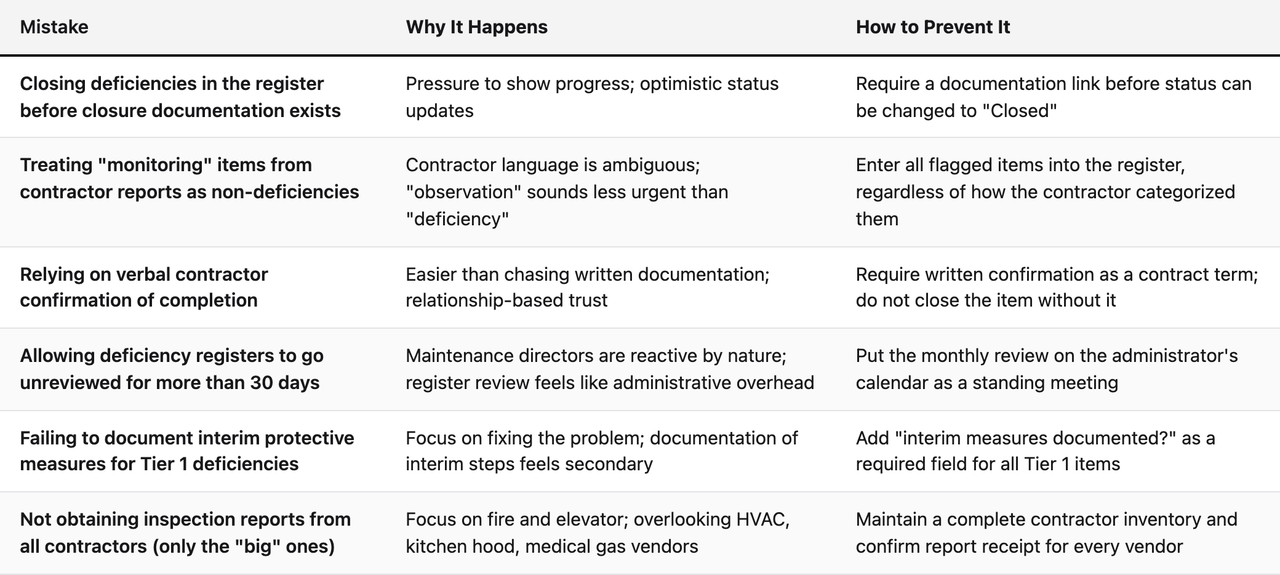
Common Mistakes That Leave Deficiencies Open at Survey Time
Even facilities with well-designed reconciliation workflows make predictable errors. Recognizing these patterns allows you to build specific safeguards against them.
How Technology Changes the Reconciliation Equation
The workflow described in this guide can be implemented with spreadsheets, email, and disciplined paper-based processes. Many facilities do implement it that way, and it works. But the manual approach has an inherent vulnerability: it depends on consistent human discipline across many people and many steps. When the maintenance director is on vacation, when a contractor report arrives during a busy week, when a technician forgets to log a completion, the manual workflow has no automatic detection mechanism. Gaps accumulate silently until someone reviews the register.
Compliance platforms designed for SNF life safety management address this by automating the detection layer. When a contractor report is uploaded, the platform can flag items that match known deficiency patterns. When a deficiency is entered, the platform can send assignment notifications and escalation alerts when target dates approach. When a corrective action is logged, the platform can validate that the required documentation fields are complete before allowing status to be updated. When a monthly review is due, the platform can surface the items that need attention without requiring the maintenance director to manually audit the register.
The practical effect is that the reconciliation workflow becomes harder to skip. The intake step is prompted. The assignment step is enforced. The closure verification step requires documentation to be present. The monthly review is surfaced automatically. This does not eliminate the need for human judgment at each step, but it eliminates the silent gaps that occur when humans are busy, distracted, or simply unaware that a step was missed.
For multi-site operators, the technology advantage is even more pronounced. A regional manager with visibility into every facility's deficiency register through a single dashboard can identify aged items, systemic patterns, and facilities that need intervention without waiting for facility-level reports. The documentation that took days to compile for a regional review is available in real time. This is the operational model that separates portfolios that consistently achieve strong survey outcomes from those that manage citations reactively.
Frequently Asked Questions About Contractor Report Reconciliation
How long should we retain contractor reports and closure documentation?
At minimum, retain all contractor reports and associated closure documentation for three years, as this covers the standard CMS survey lookback window. Many compliance advisors recommend five years for life safety documentation, particularly for systems like fire suppression, medical gas, and generators where long-term maintenance patterns are relevant. Check your state regulations, as some states have longer retention requirements than the federal minimum.
What should we do if a contractor cannot return to complete a repair within our target timeline?
Document the scheduling attempt, the contractor's earliest available date, and the reason for the delay. If the deficiency is Tier 1, implement and document interim protective measures immediately. For Tier 2 items, document the delay and your revised target date. The key is to show a continuous, active effort to close the item rather than a gap in attention. A surveyor finding an open deficiency with a documented corrective action plan and scheduling history is a very different situation from one finding an open deficiency with no record of any follow-up.
Do contractor "observations" (not formal deficiencies) need to be tracked?
Yes. Surveyors review contractor reports directly and can ask about any item flagged in the report, regardless of how the contractor categorized it. An "observation" that was not entered into your deficiency register and was not addressed creates the same documentation gap as a formal deficiency. Enter all flagged items and address them according to your triage criteria.
How do we handle a contractor report that is vague or poorly written?
Contact the contractor and request clarification in writing before completing your intake review. Specifically, ask for the location of each deficiency, the NFPA code section or standard the item relates to if applicable, and whether the contractor considers the item to require corrective action or monitoring. Get the clarification by email and save it with the report. A vague contractor report is not an acceptable reason to leave a potential deficiency unaddressed.
What is the difference between contractor report reconciliation and work order management?
Work order management tracks maintenance tasks generally. Contractor report reconciliation is the specific process of matching deficiencies identified in external vendor reports to corrective action records and documented closure. The two systems should be connected, with each corrective action work order linked back to the specific deficiency in the contractor report. If they operate as separate, unconnected systems, the reconciliation chain is broken even if both systems are well-managed individually.
How should we handle a situation where a surveyor finds an open deficiency that we believed was closed?
Do not argue. Retrieve your closure documentation immediately and present it. If the documentation is complete and the surveyor agrees the item is closed, the finding will be resolved. If the documentation has gaps, acknowledge them, present your corrective action plan, and follow up in writing. The worst outcome in this situation is trying to close a documentation gap retrospectively during the survey itself. The best preparation is ensuring this situation never arises by applying the "surveyor test" at closure verification time.
Can we use photos alone as closure documentation?
Photos are valuable supporting documentation but should not be the only closure evidence. A photo of a repaired fire door latch is useful, but it needs to be accompanied by a work order showing who performed the work, when, and what specifically was done. The photo corroborates the work order. Without the work order, a photo has no documented context and leaves questions about when it was taken and whether it actually shows the deficiency location identified in the contractor report.
How often should we audit our list of active contractors to ensure we have all their reports?
Review your complete contractor list at least quarterly. Compare the list of expected reports against the intake log for the same period. Any contractor who performed work but whose report is not on file should be contacted immediately. Additionally, review your contractor list any time a new vendor is engaged or a contract changes. New contractors need to be given your intake email address and your report format requirements at the start of the relationship, not after the first inspection is complete.
What documentation is required when a deficiency requires a variance or waiver rather than full correction?
If a deficiency cannot be corrected to full code compliance and requires a variance or waiver from the authority having jurisdiction (AHJ), the variance application, the AHJ's approval, any conditions attached to the approval, and the interim protective measures in place during the variance period must all be documented and included in your survey package. The CMS Survey and Certification program has specific guidance on how variances must be documented for Life Safety Code compliance. Consult your state survey agency and AHJ for the specific requirements in your jurisdiction.
How do we manage deficiencies from contractors who use their own portal rather than emailing reports?
Establish a process for downloading reports from contractor portals and saving them to your document management system within 24 hours of the report being posted. Assign a specific staff member as responsible for monitoring each active vendor portal. Do not rely on email notifications from the portal, as these can be missed or filtered. The report is not "received" for reconciliation purposes until it is in your facility's document system and has been reviewed for deficiencies.
Is it necessary to reconcile reports from contractors who only perform preventive maintenance with no deficiencies?
Yes, but the reconciliation is simpler. A report with no deficiencies still needs to be received, filed, and logged as reviewed. The intake checklist entry confirms that the report was received, reviewed, and contained no open items. This creates a positive record that the inspection occurred, was reviewed, and was clean. A missing report, even for a routine inspection with no deficiencies, creates a gap that surveyors will notice.
What role should the director of nursing play in the reconciliation workflow?
The director of nursing is not typically involved in day-to-day reconciliation, but should have awareness of any open Tier 1 deficiencies that affect resident care areas and any K-tag categories that intersect with clinical operations (such as oxygen system deficiencies, egress issues in resident sleeping areas, or kitchen suppression system problems). A monthly briefing from the maintenance director to the DON and administrator covering open Tier 1 and Tier 2 items is a reasonable standard and demonstrates the interdisciplinary oversight that CMS expects in environment of care management.
Key Takeaways
- Unreconciled contractor reports are a preventable citation source. The workflow gap is not awareness of deficiencies, it is the failure to track, assign, document, and verify closure in a connected chain.
- The nine-step workflow creates that chain: single intake point, living deficiency register, risk-based triage, specific assignment, contemporaneous documentation, verified closure, rolling audits, survey-ready packages, and regional oversight for multi-site operators.
- Every deficiency, including contractor "observations", belongs in the register. Surveyors review contractor reports directly and can ask about any flagged item, regardless of how it was categorized.
- The "surveyor test" is the operational standard for closure: if you could not produce complete closure documentation in under three minutes, the deficiency is not ready to close.
- Contemporaneous documentation is non-negotiable. Retrospective documentation is a pattern surveyors are trained to identify. Work order timestamps must reflect when the work actually occurred.
- Monthly register reviews and quarterly deep audits are what convert a documentation system into a compliance program. A register that exists but is not reviewed offers no protection.
- Technology eliminates the silent gaps that occur in manual workflows. Platforms that automate intake prompts, assignment alerts, closure validation, and regional visibility change the reliability of the reconciliation system fundamentally.
- Multi-site operators need a regional oversight layer that makes every facility's deficiency register visible without requiring physical visits or manual report requests.
Building Survey Confidence Through Reconciliation Discipline
The facilities that walk into unannounced CMS surveys without citation anxiety are not the facilities where nothing ever goes wrong. They are the facilities that have built a reliable system for finding problems before surveyors do, correcting those problems with documentation that proves the correction, and maintaining an organized record that can be produced on demand. Contractor report reconciliation is a central pillar of that system.
The workflow in this guide is not theoretical. Each step addresses a specific, documented failure mode that produces citations. Implement all nine steps, maintain the monthly and quarterly review cadence, and you will have closed the most common documentation gap in SNF life safety management. The deficiencies a contractor identifies are not the problem. Deficiencies that a contractor identifies and a surveyor finds still open are the problem. This workflow closes that gap.
For SNF maintenance directors and administrators ready to move from a paper-based or spreadsheet-driven reconciliation process to a platform that automates the detection and tracking layer, the next step is understanding what a documentation-intelligence system built specifically for this operational environment looks like in practice. The workflow is the same. The reliability of execution is not.
About the author
Benjamin Terebelo · Founder
Benjamin is the founder of SEQURA, a compliance platform purpose-built for healthcare facilities. He builds at the intersection of healthcare operations and software, maintaining a focus on bringing modern tooling to systems that the broader industry has largely left behind.
About the author
Benjamin Terebelo · Founder
Benjamin is the founder of SEQURA, a compliance platform purpose-built for healthcare facilities. He builds at the intersection of healthcare operations and software, maintaining a focus on bringing modern tooling to systems that the broader industry has largely left behind.