
How to Conduct a Pre-Survey Life Safety Self-Audit at Your SNF: A Step-by-Step Checklist
It is a Tuesday morning at 8:47 a.m. A surveyor from the state agency walks through your front door, badge in hand, and announces an unannounced CMS life safety survey. Your maintenance director is on the third floor replacing a call light. Your fire drill binder is on a shelf in the plant operations office, last touched three weeks ago. And somewhere in that binder, there is a generator test log with a missing kilowatt load reading from November.
That single missing data point, on a single log sheet, can produce a K-tag citation. And if that citation gets tied to a pattern of incomplete documentation, it can escalate into a condition-level deficiency that triggers a Plan of Correction, a revisit survey, and, in the worst cases, civil monetary penalties.
The surveyor did not discover a maintenance failure. The equipment ran fine. What the surveyor found was a documentation gap, and that distinction matters enormously for how SNFs should think about survey preparation. The facility was operationally compliant. It was documentarily exposed.
This guide walks through a practical, step-by-step SNF self-audit checklist that any maintenance director or plant operations manager can run before an unannounced CMS visit. It is organized the way a surveyor actually moves through your building, covers the most citation-generating K-tag categories, and surfaces the specific documentation gaps that are most commonly missed. Whether you run a single facility or manage a portfolio of post-acute sites, this process is designed to be completed in a single business day with no outside consultant required.
Understanding What a CMS Life Safety Survey Actually Evaluates
Before you can audit yourself effectively, you need to understand what the surveyor is actually measuring. A CMS life safety survey at a skilled nursing facility is not primarily an inspection of your physical plant. It is an audit of your compliance documentation, cross-referenced against the physical environment to verify consistency.
CMS surveys conducted under the Life Safety Code provisions of the State Operations Manual use the NFPA 101 Life Safety Code and NFPA 99 Health Care Facilities Code as their technical standards. These standards define specific inspection frequencies, documentation requirements, and deficiency resolution timelines for dozens of building systems and assets. The surveyor's job is to verify that your records match those requirements, and then spot-check the physical environment to confirm the records are credible.
This means the audit you run internally should mirror that two-part structure: first, verify the documentation, then walk the building to confirm the documentation matches what you actually see. Most maintenance directors do it backwards. They walk the building first, looking for physical problems, and then assume the paperwork is fine. That assumption is where citations are born.
The K-Tag Framework and Why It Matters for Your Self-Audit
CMS life safety deficiencies are coded as K-tags, which correspond to specific sections of NFPA 101 and NFPA 99. Understanding which K-tags generate the most citations at SNFs tells you where to concentrate your self-audit effort. The highest-frequency citation categories at skilled nursing facilities consistently include:
- K-tag 211 / K-tag 212: Corridor and egress maintenance, including obstructions, door hardware, and self-closing mechanisms
- K-tag 321 / K-tag 325: Sprinkler system inspection, testing, and maintenance records
- K-tag 341 / K-tag 345: Fire alarm system inspection and testing documentation
- K-tag 712 / K-tag 714: Emergency generator testing, including load testing with recorded kilowatt readings
- K-tag 521: Fire drill documentation, frequency, and shift coverage
- K-tag 291: Hazardous areas, including storage room closures and rated assembly compliance
- K-tag 511: Smoking policy and designated smoking area compliance
- K-tag 781: Medical gas system documentation and inspection records under NFPA 99
Your self-audit should treat each of these categories as a separate workstation, not a single sweep. The checklist steps below are organized to move through these domains systematically, with specific documentation checks and physical verification tasks for each.
Step 1: Pull and Inventory Your Current Documentation Before You Touch Anything Else
Estimated time: 60-90 minutes. Tools needed: Your existing life safety binder or documentation system, a legal pad or spreadsheet for gap tracking, and a calendar.
The first step of any credible life safety pre-survey audit is a documentation inventory. Do not walk the building yet. Sit down with every inspection log, contractor report, fire drill record, and maintenance log your facility maintains and build a complete list of what you have, what period it covers, and what is missing.
This step is uncomfortable for most maintenance directors because it reveals gaps they would rather not see. Do it anyway. A surveyor will find those gaps in minutes. You need to find them first.
What to Pull and What to Look For
Lay out every document in the following categories and verify the information below for each:
- Fire alarm inspection and testing reports: Confirm you have a current annual inspection report from a licensed contractor. Verify the report is dated within the past 12 months. Check whether the report lists any open deficiencies, and if so, confirm you have written documentation of either the corrective action completed or a formal deficiency tracking record showing the item is being addressed.
- Sprinkler system inspection reports: Under NFPA 25, sprinkler systems require quarterly, annual, and five-year inspections at different depths. Confirm you have the correct interval reports in hand. Look specifically at whether the contractor noted any impairments or obstructions to sprinkler heads, and verify those items have been closed out in writing.
- Emergency generator test logs: CMS requires monthly no-load tests and annual load tests for essential electrical system generators. Pull every monthly log for the past 12 months. Check that each log includes the date, duration of the test, any transfer switch operations, and the kilowatt load reading during the test. A log that records "generator ran for 30 minutes" but omits the kW reading is a citation waiting to happen.
- Fire drill records: Pull every fire drill record for the past 12 months. CMS requires drills on every shift, every quarter, which means a minimum of 12 drills per year covering day, evening, and night shifts. Verify the shift distribution. Verify that each record includes the date, time, shift, number of staff participating, and a critique or post-drill review. Missing night-shift drills are among the most common fire safety documentation gaps found at SNFs.
- Kitchen hood suppression system inspections: These are typically required semi-annually. Confirm the most recent report is on file and within the required window.
- Medical gas system records: If your facility uses piped oxygen or other medical gases, pull the most recent NFPA 99 inspection records. Verify outlet testing, alarm panel testing, and any open service orders.
- Portable fire extinguisher inspection logs: Monthly visual inspections and annual service records should be on file. Pull the tags or logs and verify both frequencies are current.
- Eyewash station flush logs: Weekly flushing is the standard requirement. Pull the log and count backward. A gap of more than seven days without a recorded flush is a problem.
As you pull each document, create a gap log. Write down every missing report, every open deficiency without a resolution, and every log with incomplete entries. This gap log becomes your remediation list and your evidence that you are operating a functioning internal compliance program, which matters to surveyors even when gaps exist.
Step 2: Verify Fire Drill Records Against Shift and Frequency Requirements
Estimated time: 30-45 minutes. Tools needed: Fire drill log binder, calendar, shift schedule records.
Fire drill documentation is one of the highest-frequency citation categories at skilled nursing facilities, and the failures are almost always procedural rather than substantive. Facilities conduct drills, but the records are incomplete, or the shift distribution does not meet the quarterly-per-shift requirement.
Open a spreadsheet or a legal pad and create a matrix. List the 12 months of the past year across the top. Create three rows: Day Shift, Evening Shift, and Night Shift. For each drill record in your binder, place a mark in the correct cell. When you are done, every cell should have at least one mark per quarter, meaning three marks per row over a 12-month period, for a minimum of nine marks total across three shifts and three quarters. If you are auditing against a full 12-month window, you need 12 drills minimum.
What Surveyors Look For Beyond the Count
Beyond frequency, surveyors examine the content of each drill record. A compliant fire drill record for a skilled nursing facility must include:
- The date and time the drill was conducted
- The specific shift covered
- The location or unit where the drill was conducted
- The number of staff participating
- A description of the simulated scenario or activation method
- A post-drill critique or evaluation, noting any deficiencies observed and corrective actions planned
- The signature or initials of the person responsible for conducting the drill
A record that simply states "fire drill conducted, all clear" with a date and a signature is not sufficient. The critique component is what most facilities omit, and it is what surveyors look for specifically because it demonstrates that the drill was a genuine training exercise, not a checkbox event.
If you find drills with missing critiques, write a brief retrospective critique for any drills that occurred in the past 90 days where you can reasonably reconstruct what occurred. For older drills, note the gap and plan to correct the process for all future drills. Surveyors give more weight to evidence that a corrective process is in place than to the absence of historical paperwork.
Step 3: Audit Emergency Generator Test Logs for Completeness
Estimated time: 30 minutes. Tools needed: Generator test logs, manufacturer spec sheet for your generator's rated kW output.
Generator documentation is a consistent source of K-tag citations at SNFs, and the failure mode is almost always the same: the test was performed, but the log is missing one or more required data fields. The kilowatt load reading during monthly tests is the most commonly absent piece of data.
Pull every monthly generator test log for the past 12 months. For each log, verify the following fields are present and completed:
- Date and start time of the test
- Duration of the test (CMS requires a minimum of 30 minutes for monthly tests under NFPA 110)
- Transfer switch operation confirmation (automatic transfer switch must be verified to transfer load)
- Kilowatt load reading during the test (this is the field most often missing)
- Coolant temperature, oil pressure, and battery voltage readings (required by NFPA 110 for monthly operational inspection)
- Fuel level at the start and end of the test
- Any alarms or abnormal conditions observed during the test
- Signature of the person who conducted the test
For the annual load test, verify that the generator was tested at a minimum of 30% of its nameplate rating for a minimum of two hours, or that an alternative load bank test was conducted if the facility load does not reach that threshold. The load test record must include the kW reading at the time of the test and confirm whether the test met the 30% threshold.
What to Do When Logs Are Incomplete
If you find monthly logs with missing kW readings, check whether your generator has a data logger or hour meter that records operating parameters. Many modern diesel generators log this data automatically. If the data is recoverable from the generator's onboard system, print or export it, attach it to the corresponding log, and note the addendum with a current date and your signature. Do not backdate any records. Backdating is fraud and will produce consequences far worse than the original missing reading.
If the data is not recoverable, note the gap in your self-audit log and ensure the next monthly test produces a complete record. A surveyor who sees one or two incomplete historical logs alongside a clear corrective action note will treat that very differently than a surveyor who sees a pattern of systematically incomplete records with no acknowledgment.
Step 4: Walk the Egress Corridors and Document What You Find
Estimated time: 45-60 minutes. Tools needed: A clipboard with the corridor checklist below, a camera or phone for documentation, a measuring tape.
With your documentation gaps identified, it is time to physically walk the building. Start with the egress corridors, because corridor and egress deficiencies are the most common physical-environment citations at skilled nursing facilities and the easiest for a surveyor to observe on a walk-through.
Walk every corridor on every floor, from one end to the other, and check each of the following items. Document what you find, whether it passes or fails, and photograph anything that is out of compliance.
Corridor Compliance Checklist
- Minimum corridor width: NFPA 101 requires a minimum clear width of 8 feet in SNF resident corridors. Measure if you are unsure. Carts, equipment, and furniture that reduce usable width below 8 feet during operational hours are a deficiency.
- Door hardware and self-closing mechanisms: Every resident room door, smoke barrier door, and stairwell door must have a functioning self-closing or automatic-closing mechanism. Walk each door. Push it open and release it. It must return fully to the latched position without assistance. A door that stops short, drags on the floor, or requires a push to close is a K-tag candidate.
- Smoke barrier door pairs: Smoke barrier doors must close with a maximum gap of 1/8 inch at the meeting edge when both leaves are closed. Check every smoke barrier pair in the building.
- Exit signs: Verify that every exit sign is illuminated. Test the battery backup by pressing the test button on each sign. A sign that dims significantly during the test has a failing battery and must be replaced before a survey.
- Emergency lighting: Test every emergency light fixture using the test button. The fixture must illuminate for a minimum of 90 minutes on battery power. Note any fixtures that fail to illuminate or that produce noticeably dim output.
- Corridor storage: Nothing may be stored in an egress corridor, including equipment carts, wheelchairs, or supply carts, for more than 30 minutes without being attended. Document any items currently stored in corridors and verify there is a policy addressing this.
- Fire door labels and ratings: Spot-check fire-rated door assemblies for visible labels. If a label is missing or painted over, the door's rating cannot be confirmed and the assembly is a deficiency.
Hazardous Area Verification
While walking corridors, check every room designated as a hazardous area under NFPA 101. This includes soiled linen rooms, trash collection rooms, storage rooms larger than 50 square feet, and boiler rooms. Each hazardous area must be protected by either a one-hour fire-rated enclosure with a self-closing, positive-latching door, or a sprinkler-protected enclosure with a self-closing door. Verify that the doors to these rooms close and latch completely without assistance. A soiled linen room door propped open with a trash can is a K-291 citation.
Step 5: Inspect the Fire Alarm and Sprinkler Systems Against Contractor Reports
Estimated time: 45-60 minutes. Tools needed: Most recent fire alarm and sprinkler inspection reports, access to the fire alarm control panel.
This step requires you to compare the contractor's written report against what you observe in the building. You are not expected to perform the technical inspection yourself, but you are expected to know what the contractor found and to verify that open deficiencies have been addressed.
Pull the most recent fire alarm inspection report. Find the deficiency section, which may be labeled "items requiring attention," "discrepancies," or "observations." For every item on that list, verify one of the following:
- The deficiency has been corrected, and you have written documentation of the correction (a service invoice, a contractor completion report, or a dated note in your maintenance log)
- The deficiency is in progress, and you have a written service order or contractor proposal documenting the pending work, with a projected completion date
- The deficiency was assessed and determined to be a false positive or a misclassification, with written documentation of that determination signed by a qualified individual
A deficiency that appears on a contractor report and has no documented follow-up is a citation in waiting. The surveyor will ask for the report. The surveyor will find the deficiency list. The surveyor will ask what happened to each item. If you cannot show documentation, the deficiency is treated as unresolved.
Fire Alarm Panel Walk-Through
Go to your fire alarm control panel and check the display for any current troubles or supervisory signals. A panel showing active trouble conditions during a survey will draw immediate scrutiny. Common trouble conditions that should be cleared before a survey include:
- Low battery conditions on wireless devices or panel backup batteries
- Supervisory signals from sprinkler system tamper switches (indicating a valve may be in an abnormal position)
- Ground fault conditions on initiating device circuits
- Open circuit conditions on notification appliance circuits
If your panel is showing any active conditions, contact your fire alarm contractor for service before the next survey window. Document the service call and the resolution.
Sprinkler Head Obstruction Check
Walk through storage areas, mechanical rooms, and any spaces where materials are stored near the ceiling. Sprinkler heads must maintain a minimum 18-inch clearance below the deflector to the top of any stored materials. Check specifically in supply storage rooms, clean and soiled linen rooms, and the kitchen area. A pallet stacked too close to a sprinkler head is a K-tag and a genuine life safety hazard.
Step 6: Review Medical Gas and Utility System Documentation
Estimated time: 30 minutes. Tools needed: NFPA 99 inspection records, medical gas system layout or as-built drawings if available.
Medical gas system compliance under NFPA 99 Health Care Facilities Code is an area where many SNFs have documentation gaps simply because the system is out of sight and the inspection cadence is less familiar than fire alarm or sprinkler requirements.
For facilities with piped oxygen systems, verify the following documentation is current and on file:
- Annual inspection and testing report: Covering outlet testing, alarm panel verification, and pressure testing. This must be performed by a qualified individual and documented in writing.
- Medical gas alarm panel testing records: The master alarm panel and area alarm panels must be tested at defined intervals. Verify the test records are current.
- Bulk oxygen supply records: If your facility uses a bulk liquid oxygen system, delivery records and system pressure logs should be maintained.
- No-smoking signage in oxygen storage and use areas: Verify that appropriate signage is posted at the oxygen storage location and in areas where oxygen is in use.
For electrical systems, verify that your most recent arc flash study and panel directory are current, and that any open electrical work orders from your last inspection have been closed out.
Step 7: Audit Your Written Policies and Procedures for Currency and Accuracy
Estimated time: 45 minutes. Tools needed: Current policy and procedure binder, most recent NFPA 101 and NFPA 99 editions adopted by your state.
CMS surveyors do not only inspect your physical environment and your inspection records. They also review your written policies and procedures for life safety, and they verify that your staff can describe those policies consistently. A policy that was written in a prior regulatory cycle and has not been updated to reflect current NFPA standards is a gap, even if your actual practices are correct.
Pull the written policies for the following areas and verify each is dated within the past 12-24 months or reflects the current edition of the applicable NFPA code:
- Fire response and evacuation procedures (RACE and PASS protocols)
- Smoking policy, including designated areas and prohibited areas
- Hazardous materials storage and handling
- Medical gas safety procedures
- Emergency generator operation and testing procedures
- Interim Life Safety Measures (ILSM) policy for periods when building systems are impaired
- Fire watch policy for sprinkler or fire alarm impairments
For each policy, check that the procedure matches your actual practice. A policy that describes a monthly fire alarm test when you actually conduct quarterly testing, or vice versa, creates a credibility problem when a surveyor cross-references your policy against your logs.
Staff Competency Spot-Check
Pull two or three staff members from different departments, ideally including a direct care aide and a dietary or housekeeping employee, and ask them the following questions verbally:
- "What do you do if you discover a fire in a patient room?"
- "Where is the nearest fire pull station to where you are standing right now?"
- "Who do you call if you smell smoke and cannot find a fire?"
These are the exact types of questions a CMS surveyor may ask any staff member encountered during a life safety survey. If staff cannot answer confidently, that is a training gap, not a documentation gap, but it can still produce a citation under the staff training components of the life safety standards. Document the spot-check and note any training follow-up needed.
Step 8: Compile Your Gap Log and Build a Remediation Plan
Estimated time: 30-45 minutes. Tools needed: Your gap log from Steps 1-7, a spreadsheet or written remediation tracker.
By this point, you have a documented list of every gap found during the self-audit. This step transforms that list into a prioritized remediation plan that can be tracked to completion. The remediation plan serves two purposes: it tells you what to fix, and it tells a surveyor that you are operating a functioning internal quality assurance process, which is itself a positive indicator during a survey.
Organize your gap log into three priority tiers:
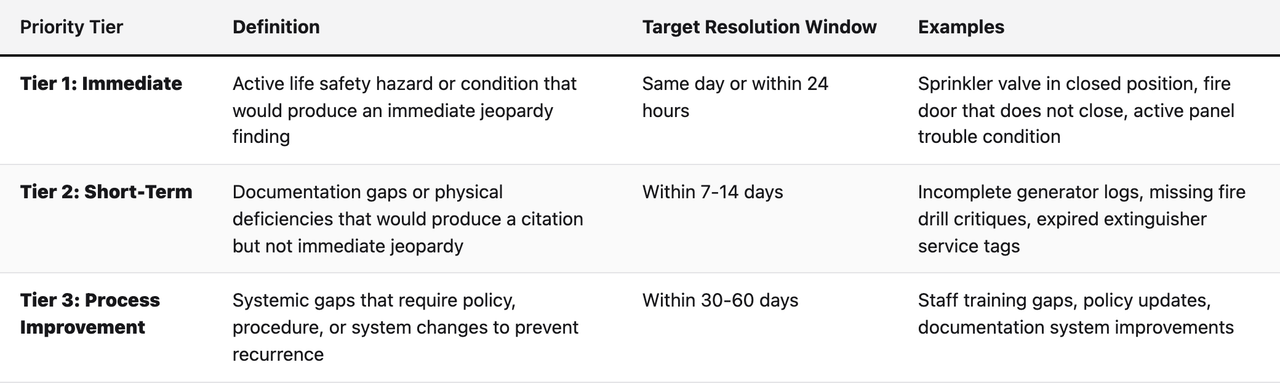
For each item in the remediation plan, assign a responsible person, a target completion date, and a verification method. The verification method is what confirms the gap has been closed, whether that is a signed log entry, a contractor invoice, a policy revision date, or a training sign-in sheet.
Step 9: Run a Mock Surveyor Walk-Through Before You Consider the Audit Complete
Estimated time: 60-90 minutes. Tools needed: The completed self-audit checklist, a second set of eyes (another manager, a DON, or a consultant).
The self-audit is most valuable when it is validated by someone other than the person who runs the building every day. The maintenance director who knows every inch of the facility is also the person most likely to overlook the propped fire door on the second floor because they stopped really seeing it six months ago. Familiarity is the enemy of self-audit accuracy.
Ask a colleague who is less familiar with the day-to-day of the plant operations to walk the building with the self-audit checklist and identify anything they observe that does not match what the checklist says is compliant. This does not require a life safety expert. Any manager with the checklist in hand can walk a corridor and notice that the smoke barrier door does not fully close, or that exit sign batteries are dim, or that a storage room door is propped open.
Alternatively, consider scheduling a formal mock survey with a life safety consultant once per year, and using the internal self-audit process described here for the quarterly check-ins between formal reviews. The internal audit catches process drift. The formal mock survey catches the things that only a trained eye will see.
Documenting the Mock Walk-Through
Whatever format you use for the mock walk-through, document it. Create a written record that includes the date, who participated, what areas were covered, and what was found. This record demonstrates to a surveyor that your facility operates a functioning environment of care quality assurance program, which is a positive indicator even when the program has found deficiencies, because finding deficiencies is evidence the program is working.
Step 10: Establish a Cadence So This Never Becomes a Crisis Again
Estimated time: 20 minutes to set up. Ongoing time investment: 2-4 hours per month.
The most important outcome of a pre-survey self-audit is not the list of gaps you found. It is the recognition that those gaps accumulated because there was no systematic process to catch them in real time. A single annual self-audit, run in a panic before an anticipated survey window, is not a compliance program. It is a fire drill for the fire drill.
A functional CMS survey readiness program runs continuously, not periodically. The practical structure for a single-site SNF looks like this:
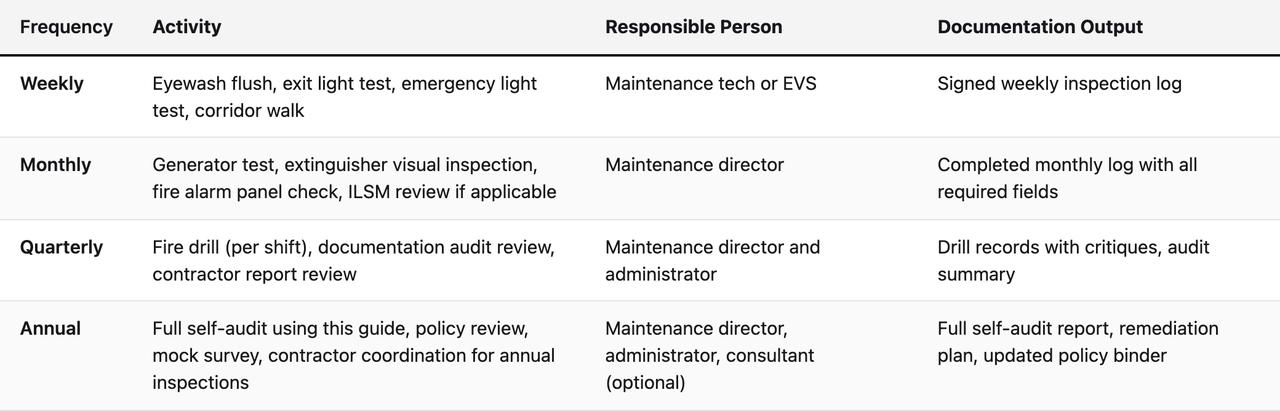
The challenge for most SNF maintenance directors is not knowing what to do. It is having the time to do it consistently, and having a system that surfaces gaps automatically rather than requiring a manual review of every log sheet. That is exactly the problem that documentation-intelligence platforms like SEQURA are built to solve, by running the audit layer continuously in the background and alerting you when a log is incomplete, a task is overdue, or a contractor report contains an open deficiency that has not been documented as resolved.
The Documentation Gap Patterns That Produce Most Life Safety Citations
After reviewing the self-audit process in detail, it is worth stepping back to look at the patterns that produce the most citations at SNFs, because understanding the pattern is what allows you to build a process that prevents it rather than just catching it after the fact.
The most common citation-generating documentation gaps at skilled nursing facilities fall into three categories:
Pattern 1: The "We Did It But Didn't Write It Down" Gap
This is the most common pattern. The generator test happened. The fire drill happened. The sprinkler heads were checked. But the log entry is incomplete, the required field was left blank, or the record was never filed in the right place. This pattern is almost entirely a process failure, not a substantive compliance failure. The facility is doing the work. The documentation system is not capturing it correctly.
The fix is standardized forms with required fields that cannot be submitted blank. Whether that is a paper form with printed fields or a digital task system that requires all fields to be completed before a task can be marked done, the mechanism is the same: make the incomplete record impossible to produce.
Pattern 2: The "Open Deficiency With No Paper Trail" Gap
A contractor finds a deficiency during an annual inspection. The maintenance director knows about it and has even had a conversation with the contractor about getting it fixed. But there is no written service order, no documented follow-up, and no resolution record. From a surveyor's perspective, there is a deficiency on the inspection report and no evidence it was ever addressed.
The fix is a deficiency tracking register, a simple log that captures every deficiency identified by a contractor, the date it was identified, the person responsible for resolution, the target resolution date, and the date it was actually resolved with supporting documentation attached. Every contractor report should be cross-referenced against this register within 48 hours of receipt.
Pattern 3: The "System Knows, Binder Doesn't" Gap
This pattern is specific to facilities that have transitioned some processes to digital systems but still maintain paper records for others. The digital system has data that contradicts the paper binder, or the paper binder has records that are not reflected in the digital system. When a surveyor requests documentation and receives a partial picture from one source and a different partial picture from another, the inconsistency itself becomes a citation risk.
The fix is a single source of truth for life safety documentation. Whether that source is paper or digital matters less than whether it is complete, consistent, and accessible during a survey. Many SNFs find that a fully digital system with a contemporaneous logging requirement, where inspections are recorded at the time they are performed rather than transcribed later, produces the most reliable and defensible records.
How SEQURA Supports This Self-Audit Process
The ten-step self-audit process described in this guide is designed to be runnable without any specialized software. But it is also worth understanding how a purpose-built life safety compliance checklist platform changes the operational reality for maintenance directors who run it every month, not just once a year before a survey.
SEQURA's approach to the documentation problem is to replace the retrospective audit with a continuous one. Rather than pulling the binder and looking backward to find gaps, the platform runs the audit layer in real time, cross-referencing completed task records against the regulatory expectations for each K-tag category and surfacing discrepancies as they occur. A generator log submitted without a kW reading does not get filed. The system flags it and routes it back to the person who submitted it before it becomes a historical gap.
The task library inside SEQURA is built specifically for SNF regulatory requirements, including NFPA 101, NFPA 99, and CMS Conditions of Participation, with inspection cadences, required data fields, and responsible role assignments pre-configured. A maintenance director does not need to know that a monthly generator test requires a kW reading. The task template requires it. The log cannot be completed without it.
For multi-site SNF operators, the platform adds a regional visibility layer, allowing a regional facilities manager or VP of operations to see the compliance status of every site in the portfolio in real time, without requiring a site visit or a manual report request. When a site falls behind on a required inspection cadence, or when a contractor report has been uploaded but no deficiency follow-up has been logged, the platform surfaces that condition to the appropriate level of the organization.
The self-audit process in this guide and a platform like SEQURA are not alternatives. They are complements. The self-audit is a discipline, a way of looking at your facility through a surveyor's eyes on a regular basis. The platform is the infrastructure that makes that discipline sustainable at scale, without requiring a manual review of every log sheet every month. Together, they represent what genuine skilled nursing facility inspection prep looks like in practice.
Frequently Asked Questions About SNF Life Safety Self-Audits
How often should a SNF conduct a life safety self-audit?
A full self-audit using the process described in this guide should be conducted at minimum quarterly, with a comprehensive annual review that includes a mock surveyor walk-through. Many high-performing SNFs run abbreviated versions of the documentation check monthly, and reserve the full physical walk-through for quarterly reviews. The frequency should match your citation risk profile: facilities with a history of life safety citations, recent construction or renovation activity, or high staff turnover should audit more frequently.
Can a maintenance director run this audit without a life safety consultant?
Yes. This guide is designed to be run by a maintenance director or plant operations manager without outside support. The documentation audit steps (Steps 1-3 and Step 7) require only access to your own records and knowledge of the required inspection frequencies. The physical walk-through steps (Steps 4-6) require only the checklist and a willingness to look critically at familiar spaces. A life safety consultant adds value for the annual mock survey and for facilities with complex building systems, but the routine self-audit process does not require one.
What happens if the self-audit finds a serious deficiency right before a survey?
Address it immediately and document everything. Do not attempt to conceal a deficiency discovered during a self-audit. If the deficiency presents an active life safety risk, take the building systems impairment steps required under your NFPA 101-compliant interim life safety measures policy, including initiating a fire watch if required. Document the deficiency, the date it was discovered, the immediate corrective action taken, and the long-term resolution plan. A surveyor who finds a deficiency that is already documented, tracked, and in the process of resolution views that situation very differently than one who finds an unacknowledged deficiency.
Which K-tags produce the most costly citations at SNFs?
The most costly citations in terms of Plan of Correction burden and revisit survey requirements typically come from condition-level deficiencies, which require a pattern of widespread or systemic noncompliance. Generator testing documentation failures, fire drill shift-coverage gaps, and sprinkler deficiency tracking failures are common sources of condition-level findings because they represent repeated failures across multiple records, not isolated incidents. Single-instance physical deficiencies like a propped fire door are serious but more easily corrected.
Do CMS surveyors look at digital records the same way they look at paper binders?
Yes. CMS does not mandate a specific format for life safety documentation, so digital records are fully acceptable. What matters is that the records are complete, contemporaneous (created at the time the inspection was performed, not retrospectively), and accessible during the survey. If you use a digital system, ensure you can produce records on demand during a survey, either on screen or as printed reports, and that the system produces a record of who logged each entry and when.
What is a contemporaneous record and why does it matter?
A contemporaneous record is one created at the time the inspection or task was performed, not filled in later from memory or reconstructed after the fact. Surveyors are trained to look for signs of backdating or batch entry in documentation records. A paper log where 12 monthly generator tests are all recorded in the same handwriting with the same pen, submitted at the end of the year, will raise questions. A digital record where 12 entries are all submitted within a narrow time window will raise the same questions. Contemporaneous logging, where the record is created the moment the task is completed, is the standard that protects you.
How should a SNF handle contractor inspection reports that arrive late?
First, establish in your contractor agreements that inspection reports must be delivered within a defined window, typically 10-14 business days after the inspection date. When reports arrive late, log the date the inspection was performed and the date the report was received, and keep both records together. If a report arrives after a survey window, the fact that the inspection was performed on time and the report is simply pending does not negate the inspection. However, you should be able to demonstrate the inspection occurred, ideally through a work order or service confirmation from the contractor dated at the time of the visit.
Is there a difference between what a state survey agency looks for versus a CMS survey team?
In most states, the state survey agency conducts life safety surveys on behalf of CMS under a federal-state agreement, meaning they are using the same survey protocol and the same K-tag framework. Some states have additional requirements that go beyond the federal baseline, typically related to specific local fire code amendments or state-level building code requirements. Know which edition of NFPA 101 your state has adopted, as some states lag behind the most current edition. Your state's adopted edition of NFPA 101 determines which technical requirements apply to your facility.
What should be in a fire drill critique to satisfy surveyors?
A compliant fire drill critique should document at minimum: the specific observations made during the drill, any deficiencies noted in staff response or evacuation procedures, the corrective actions planned or implemented as a result, and the name of the person conducting the review. Critiques do not need to be lengthy, but they must be substantive. "Drill went well, no issues" is not a critique. "Staff on the south wing were slow to close corridor doors. Retraining on door closure procedures was conducted at the 2:30 p.m. shift meeting on [date]" is a critique.
Can EVS staff complete inspection tasks that count toward life safety compliance documentation?
Yes, for tasks within their competency and scope. Weekly eyewash flush logs, corridor obstruction checks, and exit sign visual inspections can appropriately be assigned to and completed by EVS staff. Tasks requiring technical knowledge or licensure, such as fire alarm testing, sprinkler system inspections, or generator operational checks, must be completed by qualified individuals. The key is that whoever completes the task is competent to perform it, and the record captures who performed it so that competency can be verified if challenged.
How do multi-site SNF operators manage life safety documentation across a portfolio?
The core challenge for multi-site operators is visibility. A regional facilities manager cannot be present at every site simultaneously, and a paper binder at each facility provides no real-time insight into compliance status across the portfolio. The most effective approach is a centralized documentation platform that allows site-level staff to log inspections in real time while giving regional and corporate leaders a dashboard view of compliance status by site, by K-tag category, and by inspection cadence. This allows regional managers to identify sites that are falling behind on required inspections before a survey window, rather than discovering the gap during a post-survey debrief.
What is the most common mistake SNFs make when preparing for a CMS life safety survey?
The most common mistake is treating survey preparation as a discrete event rather than an ongoing operational discipline. Facilities that scramble in the weeks before an anticipated survey window often find gaps that accumulated over months or years, and they either cannot close them in time or they attempt to close them in ways that create credibility problems (batch-entering records, backdating logs, or producing documentation that does not match the physical environment). The facilities that consistently perform well on life safety surveys are the ones that run a continuous compliance process that makes the survey a confirmation of ongoing performance rather than a test of recent preparation.
Key Takeaways for SNF Life Safety Self-Audit Success
- Start with documentation, not the building. The majority of life safety citations at SNFs come from documentation gaps, not physical deficiencies. Audit your records before you walk the corridors.
- Use the K-tag framework to prioritize. Generator logs, fire drill records, sprinkler deficiency tracking, and corridor compliance generate the most citations. Build your self-audit around these categories.
- The kW reading on your generator log is not optional. It is one of the most commonly missing fields on monthly test logs, and its absence is a K-tag citation. Check every log for every required field.
- Fire drill shift coverage is the most common drill-related gap. Verify quarterly coverage for every shift, not just total drill count.
- Every contractor deficiency needs a paper trail. From the moment a deficiency is identified to the moment it is resolved, maintain written documentation of every step. A verbal agreement with your contractor is not documentation.
- A mock walk-through with fresh eyes catches what familiarity hides. The person who runs the building every day is the worst person to audit it alone. Get a second set of eyes on every self-audit.
- Contemporaneous logging is the standard. Records created at the time of the inspection are far more defensible than records reconstructed or batch-entered afterward.
- Survey readiness is a continuous discipline, not a periodic event. The SNFs that perform best on life safety surveys are the ones that treat compliance as an operational system, not a pre-survey sprint.
- Document your self-audit process. The act of conducting and documenting a self-audit is itself evidence of a functioning quality assurance program, which matters to surveyors even when the audit finds gaps.
About the author
Benjamin Terebelo · Founder
Benjamin is the founder of SEQURA, a compliance platform purpose-built for healthcare facilities. He builds at the intersection of healthcare operations and software, maintaining a focus on bringing modern tooling to systems that the broader industry has largely left behind.
About the author
Benjamin Terebelo · Founder
Benjamin is the founder of SEQURA, a compliance platform purpose-built for healthcare facilities. He builds at the intersection of healthcare operations and software, maintaining a focus on bringing modern tooling to systems that the broader industry has largely left behind.