
Life Safety Compliance Software for Regional SNF Operators vs. Single-Facility Tools: An Honest Comparison

Picture a regional director of facilities on a Tuesday morning. She oversees eleven skilled nursing facilities across three states. Her phone buzzes at 7:42 a.m.: an unannounced CMS survey team has arrived at one of her Ohio buildings. She is currently in Tennessee. Her maintenance director at that building is a competent, experienced professional who has been logging inspections dutifully for two years, but his process lives in a color-coded binder, a shared Google Sheet, and a folder of contractor PDFs that nobody has cross-referenced against each other in months.
She knows, because she has been through this before, that the surveyor is not looking for broken equipment. The surveyor is looking for documentation gaps. A fire drill that happened but was logged without the required census count. A generator test where the run-time was recorded but the kilowatt load reading was left blank. A sprinkler deficiency from a third-party contractor report that was never formally resolved in writing. These are the patterns that become K-tags. And right now, at 7:42 a.m., she has no way to know whether those gaps exist in that building.
This scenario repeats itself across regional SNF operators every week. The question it forces is not "do we need compliance software?" The question is "does the software we are looking at actually solve this problem at our scale?" That is the honest comparison this article is built to answer.
The market for multi-site SNF compliance software has grown significantly as CMS survey intensity has increased and documentation expectations have tightened under the CMS Long-Term Care Survey Process. But not all platforms targeting this space are built for the same operator. Single-facility tools can be excellent for what they do. Multi-site platforms introduce a different layer of complexity. Understanding where that line falls, and which category your organization actually needs, is worth spending real time on before signing a contract.
The Fundamental Architecture Difference: Why Scale Changes Everything
The difference between a single facility compliance platform and a regional SNF operator tool is not simply a matter of adding more buildings to a user list. The underlying architecture of how data is structured, surfaced, and acted upon must be fundamentally different to serve a portfolio operator. This distinction is often undersold by vendors and almost always underappreciated by buyers until they are already several months into an implementation.
A single-facility tool is built around the assumption that one administrator, one maintenance director, and one facility are the unit of accountability. The workflow is linear: task is assigned, task is completed, record is stored. Reporting surfaces completion rates for that building. Alerts go to the people in that building. The regulatory calendar is configured for that facility's state and CMS region. This model works extremely well when the operational scope is genuinely contained to one location.
When you add a second facility, the single-facility model forces a choice: either maintain two completely separate accounts with two separate regulatory calendars and two separate reporting dashboards, or try to bolt facilities together inside a platform that was not designed for portfolio visibility. Most operators who have grown from one to three to seven buildings using single-facility tools describe the same progression: it works at one, it gets awkward at three, and it breaks down operationally somewhere between five and eight facilities. At that point, the regional director is spending more time aggregating data from multiple systems than acting on it.
A platform built for regional SNF operator tools inverts this. The unit of accountability is the portfolio. Individual facilities are nodes within a larger compliance picture. A regional director can see, in a single view, which buildings have upcoming high-risk inspection deadlines, which have open deficiencies that have not been formally resolved, and which have fire drill coverage gaps by shift. She can drill into any individual building without switching accounts or toggling between dashboards. And critically, the system's alert logic can be configured to escalate differently based on role: a maintenance director gets a building-level alert, a regional director gets a portfolio-level summary, and a VP of operations gets an exception report showing only the buildings that are materially out of standard.
This role-stratified visibility is not a luxury feature for large chains. It is the operational mechanism that allows a regional director to manage eleven buildings without being operationally present in all eleven at once. Without it, her only option is to rely on self-reporting from building-level staff, which creates exactly the blind spot that produces citations.
The Hidden Cost of Mismatched Architecture
Operators who choose a single-facility tool and attempt to scale it across a portfolio consistently encounter the same hidden costs. First, there is the aggregation burden: someone, usually a regional director or a compliance officer, must manually pull reports from each building and compile them into a portfolio view. This work happens in spreadsheets, takes significant time, and produces a snapshot that is already outdated by the time it is reviewed.
Second, there is the standardization problem. When each building maintains its own compliance system independently, regulatory task templates drift. One building's maintenance director configures generator testing at a monthly cadence. Another does it quarterly. A third has a custom template that was built during initial setup and never updated when a state regulation changed. The result is inconsistent documentation standards across a portfolio, which becomes visible and damaging the moment a surveyor in one building asks for a document type that is formatted completely differently from the one in another building.
Third, single-facility tools typically do not support centralized contractor document management. When third-party life safety contractors submit inspection reports, those reports need to be reconciled against the facility's own inspection records and any open deficiencies need to be formally tracked to resolution. At one building, this is manageable manually. Across eleven buildings, with multiple contractors serving each, it becomes a documentation gap factory.
Single-Facility Compliance Tools: Where They Excel and Where They Stop
Single-facility compliance platforms deserve a fair assessment. For the right operator in the right situation, they represent a genuinely strong option that can meaningfully improve documentation quality over a paper binder or disconnected spreadsheet system.
What Single-Facility Tools Do Well
The best single-facility tools offer an accessible, intuitive interface that does not require significant technical training. A maintenance director who has spent twenty years managing a building's physical plant and has limited software experience can typically get functional within a few days. Task assignment, completion logging, and basic reporting are streamlined. Many platforms in this category have been refined through years of user feedback at the individual-building level, which means the workflows are genuinely practical for the people doing the work.
Pricing is also a genuine advantage. Single-facility tools typically operate at a lower monthly cost, and the total cost of ownership is more predictable because there is no multi-site licensing complexity. For an independent SNF operator managing one or two buildings, this is a real consideration.
Some platforms in this category also offer solid NFPA task libraries and CMS compliance calendars that have been built with genuine regulatory expertise. The task templates can be comprehensive, and for a maintenance director who is not a regulatory specialist, having a pre-built library of required inspections is genuinely valuable.
Where Single-Facility Tools Fall Short
The limitations become visible quickly in four areas:
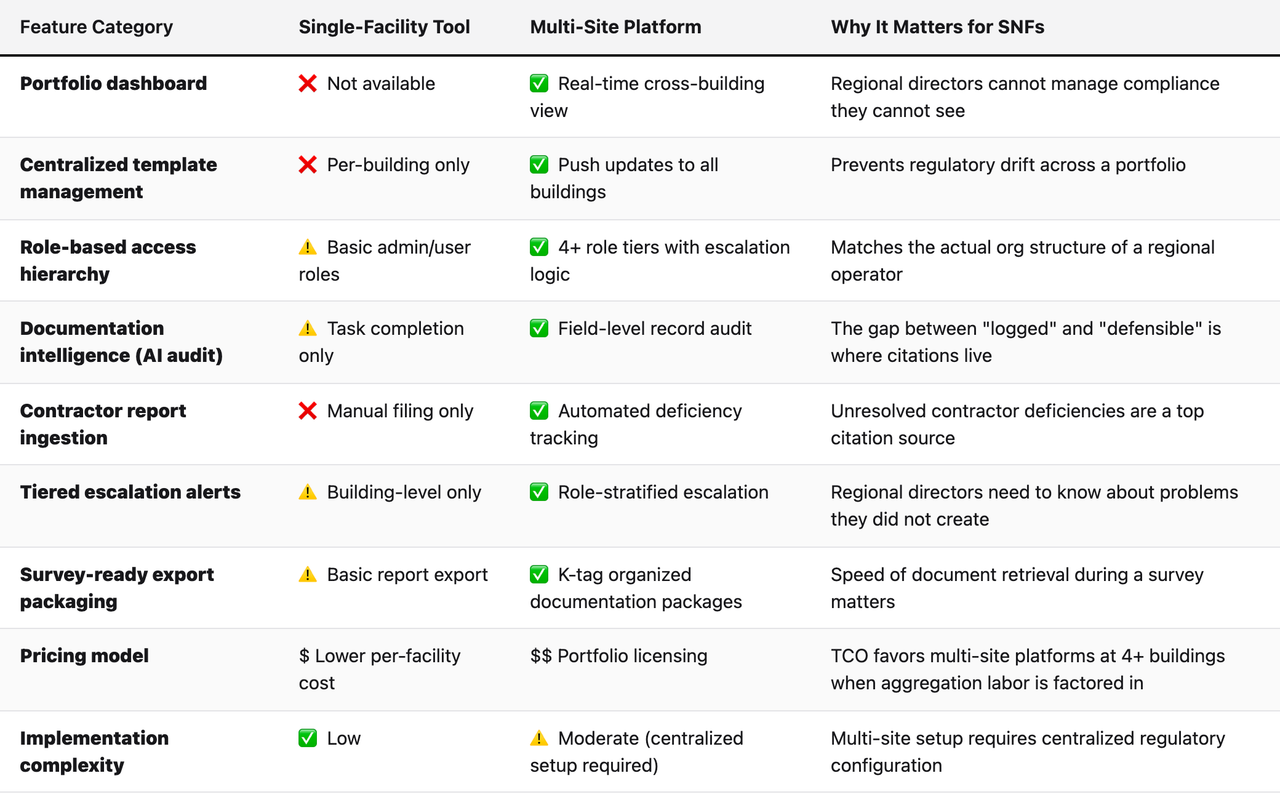
Cross-building visibility: There is none, by design. A regional director trying to use a single-facility tool across a portfolio will always be looking at one building at a time. This is not a configuration issue. It is an architectural one.
Regulatory template management: When a state regulation changes or CMS updates its survey guidance, a single-facility tool typically requires each building to update its own templates independently. There is no central library management that pushes regulatory changes to all buildings simultaneously. For a portfolio operator, this means regulatory drift is almost inevitable over time.
Documentation intelligence: Most single-facility tools log that a task was completed. They do not audit whether the completed log contains all the required data fields. A generator test record that is missing the kilowatt load reading will be marked "complete" in most single-facility systems. It is only when a surveyor reviews that record that the gap becomes visible. A platform with genuine documentation intelligence reads the completed record and flags the missing field before the surveyor arrives.
Contractor document reconciliation: When a third-party fire sprinkler contractor submits an annual inspection report listing deficiencies, most single-facility tools have no mechanism to track those deficiencies to formal resolution. The contractor report gets filed (or not), and the deficiencies exist in a PDF that the system has never read. This is one of the most common sources of life safety citations in SNF surveys.
Multi-Site SNF Compliance Platforms: Features That Actually Matter
When evaluating multi-site SNF compliance software, the marketing language can obscure meaningful differences in actual capability. Every vendor in this space will describe their platform as "enterprise-ready" and "scalable." The questions that reveal real capability are more specific.
Portfolio-Level Dashboard and Reporting
A genuine portfolio dashboard does more than display a list of buildings with color-coded status indicators. It surfaces actionable intelligence at the portfolio level. Specifically, it should answer these questions without requiring the regional director to click into individual buildings:
- Which buildings have life safety inspection tasks overdue by more than seven days?
- Which buildings have open contractor-reported deficiencies that have not been formally resolved?
- Which buildings have fire drill documentation that is missing required data fields?
- Which buildings are approaching a high-risk inspection deadline within the next thirty days?
- Which buildings have had a pattern of repeated documentation gaps in the same K-tag category?
A platform that can surface all five of these answers in a single dashboard view is genuinely useful to a regional director. A platform that requires her to generate individual building reports to answer any of these questions is essentially a single-facility tool with a multi-building login structure.
Centralized Regulatory Template Management
For a regional SNF operator, the ability to maintain a standardized task library from a central account and push it to all buildings simultaneously is not optional. When CMS updates its survey guidance or a state health department issues new inspection requirements, the compliance officer needs to update the task template once and have it reflected in every building's operational calendar automatically.
This centralized template management also solves the drift problem described earlier. When all buildings are operating from the same regulatory library, the documentation format is consistent across the portfolio. A surveyor reviewing records at any building in the chain sees the same structure, the same field completeness, and the same evidence of systematic compliance management. This consistency itself signals operational maturity to a surveyor in a way that building-specific, individually configured systems cannot.
Role-Based Access and Escalation Logic
A multi-site platform needs a role hierarchy that matches the actual organizational structure of a regional SNF operator. This typically means at least four distinct access levels:
- Technician/EVS staff: Can complete assigned tasks and log records at their building only. No visibility into other buildings.
- Maintenance director: Can manage all tasks, view all records, and generate reports for their building. Can receive escalating alerts for overdue or at-risk items.
- Regional director: Can view portfolio-level compliance status, compare buildings, identify outliers, and access records at any building in their region. Cannot modify another building's operational settings without authorization.
- VP/COO/Compliance officer: Full portfolio visibility with executive summary reporting. Can manage regulatory templates, set portfolio-wide standards, and access audit logs.
Escalation logic tied to these roles ensures that the right person is notified at the right time. A missed generator test should trigger an immediate alert to the maintenance director. If that task remains unresolved after 48 hours, the regional director should receive a notification. If it remains unresolved after five days, it escalates to the VP of operations. This kind of tiered escalation is standard in well-designed multi-site platforms and absent in single-facility tools.
Documentation Intelligence and AI-Assisted Audit
This is the category where the most meaningful differentiation exists, and where the marketing language is most likely to obscure real capability differences. "AI-powered compliance" is a phrase that appears in the marketing of platforms ranging from genuinely sophisticated documentation audit systems to simple automated reminder emails.
Genuine documentation intelligence in a life safety compliance context means the system can read a completed inspection record and determine whether it contains all the data fields that CMS and state surveyors expect to see. Not just whether the task was checked off as complete, but whether the record itself is defensible under scrutiny. This includes:
- Verifying that generator test logs include kilowatt load readings, not just run-time duration
- Confirming that fire drill records include census counts, time of drill, staff present, and any deficiencies noted
- Checking that sprinkler inspection reports include all required categories and that any listed deficiencies have a corresponding resolution record
- Identifying patterns where the same K-tag category has produced incomplete records across multiple months, suggesting a systemic documentation gap rather than an isolated error
A platform with this capability is doing something categorically different from a task management system with a compliance skin. It is performing a pre-survey audit function that previously required a life safety consultant to visit the building in person.
Contractor Document Ingestion and Deficiency Tracking
Third-party contractor management is a largely underappreciated feature category in SNF compliance software evaluations. Life safety compliance in a skilled nursing facility is not only about what the maintenance staff does. It depends heavily on licensed contractors: fire sprinkler companies, generator service vendors, elevator inspectors, hood cleaning contractors, and others. Each of these contractors produces inspection reports. Each of those reports may contain deficiencies. Each deficiency requires a documented response and resolution.
A multi-site platform that can ingest contractor reports, extract identified deficiencies, create tracked resolution tasks, and flag unresolved deficiencies in the portfolio dashboard is solving a real operational problem. Without this capability, contractor deficiency management falls back to email threads, paper files, and manual follow-up, which is exactly the process that produces citations when a surveyor asks to see the resolution documentation for a deficiency that appeared in last year's sprinkler report.
Head-to-Head Comparison: Single-Facility vs. Multi-Site Architecture
The True Cost of the Wrong Choice: A Decision Framework for SNF Operators
The most common mistake regional SNF operators make when evaluating facilities management software is treating software cost as the primary variable in the decision. The actual cost of choosing the wrong tool is not the subscription fee. It is the operational overhead of working around the tool's limitations, plus the citation risk created by the documentation gaps those limitations allow to persist.
Quantifying the Aggregation Burden
A regional director or compliance officer spending four to eight hours per month aggregating compliance data from multiple single-facility systems is carrying a hidden labor cost that does not appear in the software budget. At a fully loaded labor rate for a regional director-level position, that aggregation work represents a meaningful annual cost that is invisible until you look for it. More importantly, it represents time that is not being spent identifying and closing actual compliance gaps. The aggregation task replaces the analysis task.
When that same regional director is using a multi-site platform with genuine portfolio visibility, the aggregation work disappears. The four to eight hours spent pulling reports becomes thirty minutes reviewing an exception dashboard and acting on the items that need attention. The delta is not just time saved. It is compliance quality gained, because now the analysis is happening rather than the data collection.
Quantifying Citation Risk
A single K-tag citation for a life safety deficiency in a skilled nursing facility carries real financial and reputational consequences. Under the CMS civil monetary penalty framework, even a per-instance penalty for a condition-level deficiency can reach thousands of dollars, and patterns of repeat citations can trigger enhanced oversight, increased survey frequency, and in severe cases, enrollment actions.
Beyond the direct financial penalty, a life safety citation affects Five-Star Quality Rating, which affects census and referral patterns from hospital discharge planners who routinely check CMS Care Compare before making placement recommendations. The downstream revenue impact of a rating drop attributable to a preventable documentation citation is orders of magnitude larger than the cost difference between a single-facility tool and a multi-site platform.
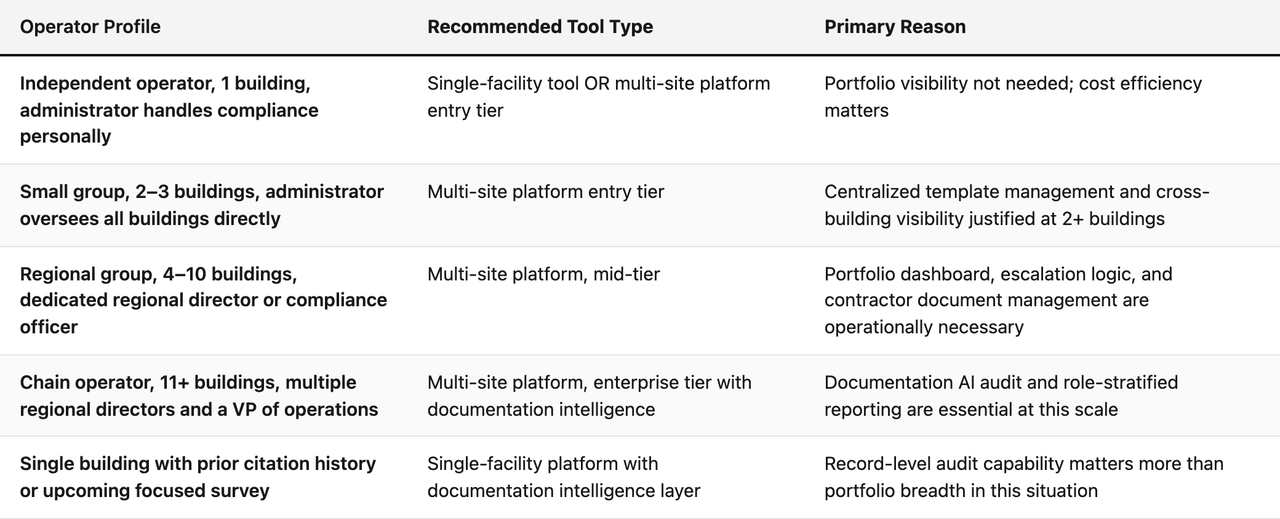
The Decision Matrix: Which Tool Fits Your Situation
What to Look for in a CMMS Software Comparison for Healthcare Facilities
When conducting a CMMS software comparison for skilled nursing facilities, the standard CMMS evaluation criteria, work order management, preventive maintenance scheduling, asset tracking, and vendor management, are necessary but not sufficient. Life safety compliance in a healthcare setting adds a regulatory layer that general-purpose CMMS platforms were not designed to address.
NFPA Task Library Depth and Maintenance
Every life safety compliance platform will tell you it includes NFPA 101 and NFPA 99 task templates. The question that separates genuine regulatory expertise from checkbox marketing is: who built the library, how is it maintained, and how does it handle state-specific requirements that layer on top of federal standards?
NFPA 101 and NFPA 99 are living documents that are revised on a regular cycle. CMS also issues survey and certification letters that update surveyor guidance in ways that affect what documentation is expected at an unannounced visit. A platform whose regulatory task library was built once and has not been updated since is a liability, not an asset. Ask vendors specifically how often the library is reviewed, what triggers a template update, and whether template updates are pushed automatically to existing clients or require a manual update request.
State-specific requirements are equally important and frequently overlooked. A number of states have adopted NFPA standards at earlier editions than the current federal baseline, which creates specific compliance requirements that differ from the federal expectation. Other states have added inspection requirements beyond the federal minimum. A platform that does not account for state-specific overlays will produce a task list that is technically incomplete for your regulatory environment, regardless of how comprehensive its federal template library appears.
Survey Readiness: The Difference Between Filing and Documentation
A fundamental distinction separates CMMS platforms designed for general facilities management from platforms built specifically for healthcare survey readiness. General CMMS systems are optimized for operational efficiency: getting work orders completed, tracking asset maintenance history, and managing vendor relationships. These are legitimate and valuable functions.
Survey readiness requires a different optimization target. The question is not "was the work done?" but "can we prove the work was done in a way that satisfies a CMS surveyor's documentation standard?" These are related but distinct. A generator test that was performed but logged without the required kilowatt load data is operationally complete and documentarily incomplete. A general CMMS marks it complete. A survey-ready compliance platform flags it as deficient.
When evaluating platforms, ask vendors to show you what happens when a generator test record is submitted with a missing data field. Does the system accept it and mark the task complete? Does it flag the incomplete record? Does it prevent submission until required fields are populated? The answer to this question reveals whether the platform is built for operational convenience or regulatory defensibility.
Contemporaneous Documentation and Audit Trail Integrity
One of the more nuanced but genuinely important requirements for SNF life safety documentation is the concept of contemporaneous logging. CMS surveyors are trained to look for signs that documentation was created after the fact rather than at the time of the inspection or task completion. Backdated records, inconsistent timestamp patterns, and documentation that appears to have been created in bulk are all red flags that surveyors are specifically instructed to investigate.
A compliance platform that supports mobile or kiosk-based logging at the point of task completion, with automatic timestamps tied to the system clock, provides a much stronger contemporaneous documentation trail than a system that allows records to be entered retroactively from a back-office computer. Ask vendors specifically about their timestamp architecture: is the timestamp applied at the moment of submission, and is there an audit log that records any subsequent edits to a submitted record?
Integration with Existing Systems
Regional SNF operators typically have existing systems in place: an EHR, a work order management system, a payroll and HR platform, and potentially a building automation system. The question is not whether a compliance platform needs to replace all of these, but whether it can coexist with them without creating data silos or duplicative workflows.
At minimum, a multi-site compliance platform should be able to export documentation in formats that can be shared with external life safety consultants, submitted to state agencies when required, and reviewed by corporate compliance teams who may not have direct system access. The ability to generate K-tag organized documentation packages on demand, rather than requiring a staff member to manually assemble records during an active survey, is a practical capability that has real operational value on survey day.
The Survey Day Experience: How Platform Architecture Shows Up Under Pressure
Return to the regional director from the opening scenario. It is now 8:15 a.m. The surveyor at her Ohio building has asked the maintenance director to produce documentation for fire drill records, generator testing, and sprinkler inspection reports for the past twelve months. The maintenance director has thirty minutes before the surveyor expects the documents.
In a single-facility tool environment, this means the maintenance director opens the software, navigates to each category, exports reports for each, then goes to the filing cabinet or email folder for contractor reports, assembles everything manually, and walks it to the surveyor. If any record is incomplete or a contractor report is missing, he discovers it in that moment, in front of the surveyor.
In a well-designed multi-site platform, the maintenance director navigates to a survey preparation view, selects the relevant K-tag categories, and generates a documentation package that has already been audited by the system for completeness. Any gaps that exist are already flagged in the system. The regional director, watching the portfolio dashboard from Tennessee, can see in real time which documentation categories are being pulled and whether the system has flagged any open issues in those categories. If there is a gap, she knows about it before the surveyor does, and she and the maintenance director can discuss the response before it becomes a citation conversation.
This is not a hypothetical capability. It is the practical outcome of choosing a platform whose architecture was designed around the survey experience rather than around general task management. The difference between these two experiences is not about which team works harder. It is about which tool gives that team the information they need at the moment they need it.
Pricing Architecture: What Regional SNF Operators Actually Pay
Pricing in the life safety compliance software market is not standardized, and vendors rarely publish list pricing because deal structures vary significantly based on portfolio size, contract term, and the features included. That said, there are general pricing patterns that operators should understand before entering a negotiation.
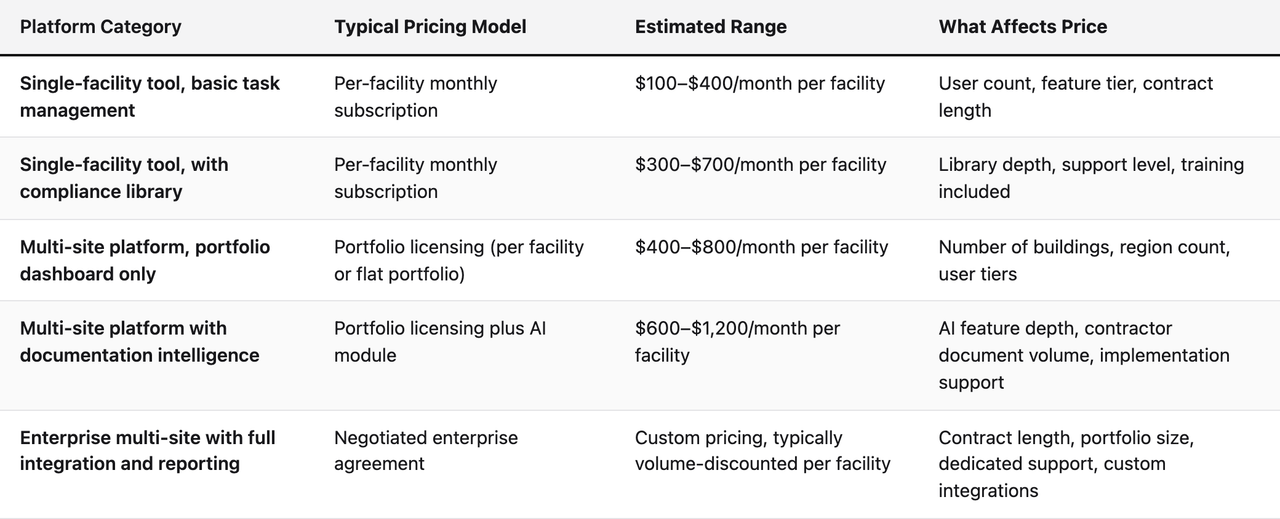
The critical note on these ranges is that the per-facility cost of a multi-site platform typically decreases meaningfully as portfolio size grows. At four to six buildings, the per-facility cost of a multi-site platform with genuine portfolio capabilities often becomes comparable to running individual single-facility subscriptions when implementation and aggregation labor are included in the calculation. At ten or more buildings, the multi-site platform is almost always the more cost-effective choice on a total cost of ownership basis.
Common Evaluation Mistakes Regional SNF Operators Make
Having spent time understanding how regional SNF operators evaluate compliance software, there are several recurring patterns that lead to poor purchasing decisions.
Evaluating the Demo, Not the Workflow
Vendor demos are designed to show the software at its best, with clean data, smooth navigation, and polished reporting views. The demo does not show what happens when a maintenance technician with limited software experience tries to log a generator test from a shared kiosk with a slow internet connection at 6:00 a.m. before his shift officially starts. Ask vendors specifically to walk through the technician-level workflow, not the administrator dashboard, because that is where adoption succeeds or fails. A platform that the maintenance director loves but the technicians cannot figure out will have poor data quality within three months, regardless of its analytical capabilities.
Underweighting Implementation Support
The implementation phase of a multi-site compliance platform is where the regulatory configuration happens. This is when the task library is customized for your state requirements, your asset inventory is built out, your role hierarchy is configured, and your users are trained. For a regional operator with multiple buildings, this process requires real investment from both the vendor and the operator. A vendor that provides minimal implementation support is essentially asking your staff to configure a regulatory compliance system without regulatory expertise. That is a risk that is easy to overlook during the sales process and difficult to recover from once the contract is signed.
Ignoring State Regulatory Specificity
A platform whose NFPA library is built on federal CMS standards without state-specific overlays is incomplete for any operator whose buildings are subject to state health department inspection in addition to CMS survey. Most SNFs in the US are subject to both. States like California, New York, Texas, and Florida each have specific life safety inspection requirements that go beyond the federal baseline. A platform that cannot reflect these state-specific requirements in its task library will produce a compliance calendar that is technically incomplete for those buildings.
Not Asking About Regulatory Update Process
NFPA standards, CMS survey guidance, and state regulations all change over time. Asking a vendor how their regulatory library is maintained, who is responsible for tracking regulatory changes, and what the process is for pushing updates to existing clients is a basic due diligence question that many operators forget to ask. The answer reveals whether the platform has a genuine regulatory intelligence function or whether the library was a one-time build that is already aging.
How SEQURA Addresses the Regional SNF Compliance Gap
SEQURA was built from the premise that the documentation gap, not the operational gap, is where most SNF life safety citations originate. This premise shapes every aspect of the platform's design, from the task template library to the AI audit layer to the portfolio dashboard architecture.
At the operational layer, SEQURA's task library is built in partnership with life safety consultants who specialize in SNF survey preparation. The templates are designed to produce records that are defensible under CMS and state surveyor scrutiny, not just records that demonstrate a task was completed. This distinction, between a completed task and a defensible record, is the organizing principle of the platform.
At the analytic layer, SEQURA's AI review system reads completed records and cross-references them against the documentation standards for each asset category and K-tag. When a generator test log is missing its kilowatt load reading, the system does not mark the task complete. It surfaces the gap and assigns it to the responsible staff member for correction before the record is finalized. When a contractor sprinkler report arrives with listed deficiencies, the system creates tracked resolution tasks and monitors them to closure. When a fire drill log is missing night-shift coverage for a calendar quarter, the system flags the pattern, not just the individual missing event.
For regional SNF operators, SEQURA's portfolio architecture provides the cross-building visibility that single-facility tools cannot offer. A regional director's dashboard surfaces compliance status across all buildings in her portfolio, with exception-based alerting that surfaces only the items that require her attention rather than requiring her to review every building's complete task list. The role hierarchy supports the organizational structure of a regional operator, with building-level, regional, and enterprise access tiers that match how decisions are actually made in a multi-site organization.
Pricing is tiered to serve operators across the range from single-facility to large portfolio, with entry-level pricing designed to be accessible for independent SNF operators replacing a paper binder and enterprise pricing structured for chain operators who need full portfolio intelligence and documentation AI.
Frequently Asked Questions About SNF Compliance Software
At what point does a single-facility tool become inadequate for a growing SNF group?
Most operators find that single-facility tools become operationally limiting around the three-to-four building mark. At that point, the aggregation burden of pulling cross-building compliance data manually becomes significant enough to justify the cost difference of a multi-site platform. The tipping point also depends on whether a dedicated regional compliance role exists: if one person is responsible for oversight across multiple buildings, a portfolio dashboard is necessary for that role to function effectively.
What is the difference between a CMMS and a life safety compliance platform?
A CMMS (computerized maintenance management system) is optimized for operational efficiency: tracking work orders, managing assets, scheduling preventive maintenance, and managing vendor relationships. A life safety compliance platform is optimized for regulatory defensibility: ensuring that completed inspection records meet the documentation standards that CMS and state surveyors expect. Some platforms attempt to combine both functions, but the optimization targets are different enough that platforms purpose-built for healthcare compliance typically outperform general CMMS systems on the regulatory documentation dimension.
How do CMS surveyors evaluate life safety documentation during an unannounced visit?
CMS surveyors conducting a Life Safety Code survey follow the CMS Life Safety Code Surveyor Guidance and use the K-tag citation framework to document deficiencies. They review documentation for completeness, contemporaneity, and consistency with the required inspection cadence. Common documentation targets include fire drill records, generator testing logs, sprinkler inspection reports, emergency lighting tests, and fire alarm inspection documentation. Surveyors are specifically trained to identify records that appear to have been created after the fact or that are missing required data fields.
Can a multi-site compliance platform replace a life safety consultant?
A well-designed multi-site platform with documentation intelligence can significantly reduce the frequency and scope of life safety consultant engagements by performing pre-survey audit functions continuously rather than at discrete intervals. However, it does not replace the judgment of an experienced life safety consultant in situations involving complex NFPA code interpretation, physical plant assessments, or post-citation corrective action planning. The most effective approach for regional operators typically combines a robust compliance platform with periodic consultant review, with the platform reducing the consultant's time spent on routine documentation review and allowing them to focus on higher-judgment advisory work.
What K-tag categories produce the most life safety citations in SNFs?
Based on CMS survey data published by the CMS Long-Term Care Survey enforcement data, the most frequently cited life safety deficiencies in skilled nursing facilities cluster around fire protection systems (sprinkler and fire alarm documentation), means of egress (corridor obstructions and door hardware), emergency lighting, generator testing documentation, and fire drill records. Documentation gaps in these categories are particularly common because they involve both internal staff records and third-party contractor documentation that must be reconciled against each other.
How long does it take to implement a multi-site compliance platform across a portfolio of ten buildings?
Implementation timelines vary by vendor and by the complexity of the operator's existing documentation setup. A typical implementation for a ten-building portfolio with a vendor that provides active implementation support ranges from six to twelve weeks. This includes regulatory library configuration, asset inventory setup, user provisioning and role configuration, staff training at each building, and data migration from existing systems. Operators who attempt to implement without dedicated vendor support typically experience longer timelines and lower initial adoption rates.
Does a life safety compliance platform need to integrate with our EHR?
For most SNF life safety compliance purposes, direct EHR integration is not required. Life safety documentation and clinical documentation occupy largely separate regulatory domains. The primary integration consideration for SNF compliance platforms is with existing work order management systems, if one is in use, and with building automation systems that may already be capturing some inspection data. Census data from the EHR may be relevant for fire drill record requirements, but this is typically handled through manual entry rather than a direct system integration.
What should we ask a vendor during a compliance software demo?
The most revealing demo questions focus on the technician workflow rather than the administrator dashboard: ask the vendor to show you how a maintenance technician logs a generator test from a mobile device, including what happens if a required field is left blank. Ask how the system handles a contractor sprinkler report with listed deficiencies. Ask how a regional director's dashboard differs from a building-level maintenance director's view. Ask what happens when a regulatory template needs to be updated across all buildings simultaneously. These questions reveal architectural decisions that do not show up in polished demo presentations.
How does documentation intelligence differ from automated reminders?
Automated reminders notify staff that a task is due or overdue. Documentation intelligence reads the completed record and evaluates whether it contains all the information required to be regulatory-defensible. These are categorically different functions. A reminder system can improve task completion rates. A documentation intelligence system improves the quality and regulatory defensibility of the records produced. For SNF life safety compliance, where the citation risk lives in the content of records rather than simply in their existence, documentation intelligence is the more valuable capability.
Is cloud-based compliance software secure enough for healthcare facility data?
Life safety compliance documentation in SNFs does not typically contain protected health information (PHI) as defined under HIPAA, since it covers physical plant inspections, equipment testing, and fire safety records rather than patient clinical data. However, operators should confirm with their legal and compliance teams whether any documentation workflows in their specific implementation would involve PHI, and should evaluate vendor security certifications and data handling practices accordingly. Most enterprise-tier compliance platforms maintain SOC 2 Type II certification and operate on cloud infrastructure with healthcare-grade security controls.
What happens to our compliance data if we switch vendors?
Data portability is a legitimate and often overlooked consideration in compliance software contracts. Life safety compliance records need to be retained for specific periods under CMS and state requirements, and switching vendors should not result in losing access to historical documentation. Before signing any compliance software contract, confirm that the vendor provides full data export in a standard format (CSV, PDF, or equivalent) and that historical records remain accessible for the required retention period even after contract termination. Vendors who cannot clearly answer this question should be treated with caution.
How does SEQURA handle facilities in multiple states with different regulatory requirements?
SEQURA's task template library is built to accommodate state-specific regulatory overlays on top of the federal NFPA and CMS baseline. For a regional operator with buildings in multiple states, SEQURA configures each building's compliance calendar to reflect the specific regulatory requirements of that state, including state-adopted NFPA editions and any state-specific inspection requirements that go beyond the federal standard. Updates to state requirements are managed centrally and pushed to affected buildings without requiring individual building administrators to track regulatory changes independently.
Key Takeaways
- Architecture is the primary differentiator. Single-facility tools and multi-site platforms are not the same product at different price points. They are built on fundamentally different assumptions about who needs to see what and when.
- The aggregation burden is a hidden cost. Regional directors spending hours each month manually compiling cross-building compliance data are paying for the wrong tool with their time. A genuine portfolio dashboard eliminates this work.
- Documentation intelligence is not the same as task management. Logging that a task was completed and auditing whether the completed record is regulatory-defensible are different functions. The citation risk lives in the gap between them.
- Contractor document reconciliation is a top citation risk. Unresolved deficiencies in third-party contractor reports that are never formally tracked to resolution are a significant and preventable source of life safety citations.
- The tipping point for multi-site tools is typically three to four buildings. Below that threshold, a strong single-facility tool may be appropriate. Above it, the operational and compliance case for a portfolio platform is compelling.
- State-specific regulatory overlays matter. A task library built only on federal standards is incomplete for most US SNF operators, who are subject to state health department requirements in addition to CMS survey standards.
- Implementation quality determines adoption. A technically superior platform that is poorly implemented and inadequately trained will underperform a simpler tool that staff actually use consistently.
- Survey day is the real performance test. The operational difference between a single-facility tool and a well-designed multi-site compliance platform is most visible when a surveyor walks through the door unannounced. That is the moment the platform architecture either supports or fails the team.
Choosing the Right Scale of Compliance Tool for Your SNF Portfolio
The regional director in the opening scenario eventually made a decision. After the Ohio survey resolved with two documentation-related K-tags that her maintenance director had no way to have anticipated under his existing system, she evaluated four platforms over six weeks. The decision came down to one question that she asked every vendor: "If my Ohio building had been using your platform on the morning of that survey, would those two citations have existed?" Only one vendor could walk her through, specifically and concretely, how their documentation intelligence layer would have flagged both gaps before the surveyor arrived.
That is the right question to ask. Not "does your platform have a mobile app?" or "how many NFPA templates do you have?" Those are table stakes. The question that reveals real capability is whether the platform can find the gaps that your staff cannot find themselves, at scale, before a surveyor finds them for you.
For independent SNF operators managing a single building, a well-designed single-facility compliance tool with a strong NFPA task library is a meaningful upgrade over a paper binder and represents a legitimate path to better survey readiness. For regional SNF operators managing three or more buildings, the operational and compliance case for a purpose-built multi-site platform is strong, and it becomes more compelling with each building added to the portfolio.
The investment in the right tool is not a software budget decision. It is a survey outcome decision, a census protection decision, and a Five-Star rating decision. Framed that way, the cost difference between a single-facility tool and a multi-site compliance platform with genuine documentation intelligence becomes a straightforward calculation for any regional operator who has been through an unannounced survey with documentation gaps they did not know existed.
About the author
Benjamin Terebelo · Founder
Benjamin is the founder of SEQURA, a compliance platform purpose-built for healthcare facilities. He builds at the intersection of healthcare operations and software, maintaining a focus on bringing modern tooling to systems that the broader industry has largely left behind.
About the author
Benjamin Terebelo · Founder
Benjamin is the founder of SEQURA, a compliance platform purpose-built for healthcare facilities. He builds at the intersection of healthcare operations and software, maintaining a focus on bringing modern tooling to systems that the broader industry has largely left behind.