
What a Life Safety Consultant Actually Does During an SNF Survey Readiness Assessment — And How Software Changes the Engagement
Most SNF administrators have met a life safety consultant at least once under pressure. Perhaps a state survey flagged a K-tag deficiency. Perhaps a new administrator inherited a facility whose maintenance records were a mystery. Perhaps a regional VP looked at a portfolio-wide compliance report and realized no one could answer basic questions about fire door inspections or generator load testing with any confidence. In each case, a consultant was brought in to diagnose the situation and build a path forward.
What actually happens during that engagement is far less understood than it should be. The phrase "survey readiness assessment" is used loosely, sometimes to mean a half-day walkthrough, sometimes to mean a forensic audit of months of documentation. The deliverable varies. The methodology varies. The depth varies enormously. And increasingly, what varies most is whether the consultant is working with paper records or a digital platform that surfaces gaps before the walkthrough even begins.
This article explains, in operational detail, what a qualified life safety consultant SNF engagement actually involves from start to finish, what a survey readiness assessment covers at each phase, and how platforms like SEQURA are restructuring that engagement in ways that benefit both the consultant and the facility.
The Problem a Life Safety Consultant Is Actually Hired to Solve
The surface-level answer is simple: SNFs hire life safety consultants to help them pass surveys without citations. The real answer is more specific. SNFs hire consultants because they cannot objectively audit themselves, and the cost of discovering a documentation gap during a CMS or state survey is dramatically higher than discovering it beforehand.
CMS surveys for skilled nursing facilities are unannounced. When a survey team arrives, the facility has no preparation window. Everything that a surveyor will review, from fire drill logs to NFPA 99 medical gas inspection records to K-tag documentation, must already be complete, accurate, and retrievable. The survey does not reward intent or effort. It rewards documentation that is present, contemporaneous, and correctly formatted against the regulatory standard that applies to it.
The challenge is that most SNF maintenance operations are not structured around documentation auditing. They are structured around task completion. A maintenance director's job is to keep the building functioning, respond to work orders, manage contractors, and meet inspection schedules. The documentation that proves all of that happened correctly is often maintained in parallel, in a format that was never designed to be audited against the K-tag matrix a CMS surveyor uses.
This is the gap a healthcare facility consultant fills. Not that the work isn't being done, but that the documentation of the work cannot be verified against the regulatory standard without someone who knows both the standard and the documentation patterns that produce citations. The consultant brings that dual fluency. They know what a surveyor will look for in a fire drill record and whether the record in the binder actually satisfies it. They know which NFPA 101 chapter sections map to which K-tags and what "acceptable documentation" looks like for each one.
That fluency takes years to build. It is not something a facility can develop internally by reading the regulations, because the regulations themselves do not tell you what a surveyor will accept as compliance. That knowledge lives in survey experience, in deficiency pattern data, in the consulting community's shared understanding of how CMS interpretive guidance is applied in the field.
What Happens Before the Consultant Sets Foot in the Building
A rigorous survey readiness engagement begins well before any site visit. The pre-assessment phase is where a skilled consultant separates themselves from a generalist who simply walks the hallways. This phase is also where digital platforms create the most dramatic shift in how the engagement operates.
Document Collection and Pre-Screening
The first task is assembling the documentation that would be reviewed during an actual survey. For a typical SNF, this includes fire drill records for all four quarters and all three shifts, monthly inspection logs for fire extinguishers, exit signs, emergency lighting, and pull stations, annual and quarterly NFPA 25 sprinkler inspection reports, generator test logs including monthly load tests and annual load bank tests, NFPA 99 medical gas inspection records, fire door inspection documentation, corridor and egress inspection logs, and the facility's written fire safety plan and evacuation procedures.
When a facility operates on paper, collecting this documentation is itself a multi-hour task. Records are often split between the maintenance director's binder, contractor files, and archived folders. Completeness cannot be assessed until everything is gathered in one place. The consultant's time begins to be consumed before analysis starts.
When a facility uses a platform like SEQURA, this phase compresses dramatically. The consultant can be granted access to the facility's digital record environment before the site visit. Every completed inspection log, contractor report, and fire drill record is already timestamped, organized by K-tag category, and flagged by the platform's audit layer if it contains a documentation gap. The consultant arrives for the walkthrough already knowing which records are complete, which are missing entries, and which show patterns that a surveyor would likely question.
Regulatory Mapping Against Current Standards
Before reviewing a single document, a qualified consultant maps the facility's regulatory environment. This means confirming which edition of NFPA 101 the facility is surveyed against (CMS currently enforces the 2012 edition for most Medicare/Medicaid-certified SNFs), identifying any state amendments that layer on top of federal requirements, confirming the facility's construction type and occupancy classification, and noting any waivers or equivalencies the facility has in place.
This mapping matters because a documentation gap is only a citation if the regulation the facility is surveyed against actually requires the documentation. A consultant who doesn't perform this mapping may flag issues that don't apply or miss issues that do. Facilities with newer construction or recent renovation may have additional requirements. Facilities with equivalencies on file have different documentation obligations. Getting this wrong in either direction wastes time or creates false confidence.
The Physical Walkthrough: What a Consultant Is Actually Observing
The site visit is the most visible part of the engagement, and the part most people imagine when they think about what a life safety consultant does. It is also the part that requires the most expertise to do correctly, because the consultant is simultaneously evaluating physical conditions and the documentation that is supposed to reflect those conditions.
Egress Path and Means of Egress
The consultant walks every egress path in the building, including corridors, stairwells, exits, and discharge points. They are looking for obstructions, compliant door hardware, correct corridor widths, functioning exit signage, and operational emergency lighting. But they are also cross-referencing what they observe against what the documentation says.
If a monthly exit sign inspection log says all exit signs were functional on a given date and the consultant observes a non-functional exit sign during the walkthrough, that creates two separate findings: a physical deficiency and a documentation credibility issue. The second finding is often more consequential in a survey because it suggests the inspection process itself is not functioning, which can trigger broader scrutiny.
Fire Door and Smoke Barrier Assessment
Annual fire door inspections are required under NFPA 80 for most SNF occupancies, and the documentation requirements are specific. A consultant checks whether the facility has a complete inventory of fire-rated doors, whether annual inspections were performed by a qualified inspector, whether deficiencies identified in inspection reports were corrected and re-documented, and whether the inspection records include the elements required by NFPA 80 (door identification, clearances, hardware function, label verification).
Fire door documentation is a frequent source of citations because it sits at the intersection of multiple requirements. The door must be inspected. The inspection must be documented correctly. Deficiencies must be corrected or placed under an interim life safety measure (ILSM) protocol. Each of those steps has its own documentation requirement, and a gap at any point in the chain produces a finding.
Sprinkler System and Fire Suppression
The consultant reviews the physical sprinkler system for visible deficiencies (obstructions, missing escutcheons, damaged heads) and cross-references the NFPA 25 inspection reports for completeness. A critical but often missed element is the corrective action chain: when a quarterly or annual inspection identifies a deficiency, what happened next? Was a corrective work order generated? Was it completed? Was completion documented by the contractor? Was the documentation filed in a way that connects it to the original deficiency?
This chain, from identification to correction to documentation, is where most sprinkler-related citations originate. The physical system may be in good condition. The inspection may have been performed by a qualified contractor. But if the paper trail between a flagged deficiency and its resolution is broken, the facility cannot demonstrate compliance.
Generator and Emergency Power
Generator documentation requirements for SNFs are governed by NFPA 110 and NFPA 99, and they are among the most technical documentation requirements in the life safety space. Monthly load tests must document runtime, load in kilowatts, and transfer time. Annual load bank tests must meet specific load thresholds with proper documentation of the testing methodology. Battery maintenance records for the automatic transfer switch must be maintained separately.
A consultant reviewing generator records is looking not just for whether tests were performed but whether the records contain the specific data elements that a surveyor will look for. A monthly test log that says "generator tested, pass" without load readings is not compliant documentation, even if the test was performed correctly. This is an example of the gap between task completion and documentation adequacy that characterizes most SNF life safety programs.
The K-Tag Matrix: How Consultants Structure Their Findings
One of the most valuable things a qualified life safety consultant brings to an SNF is fluency with the K-tag numbering system that CMS surveyors use to categorize life safety deficiencies. Understanding K-tags is not simply memorizing a list of citation codes. It is understanding the regulatory citation behind each tag, the documentation standard associated with it, the deficiency patterns that produce it, and the severity weighting that determines whether it results in a standard-level or condition-level deficiency.
A well-structured survey readiness assessment produces findings organized by K-tag category, not by building location or inspection type. This matters because it matches the framework a surveyor will use, which means the facility's corrective action plan can be built in the same structure and tracked against the same categories.
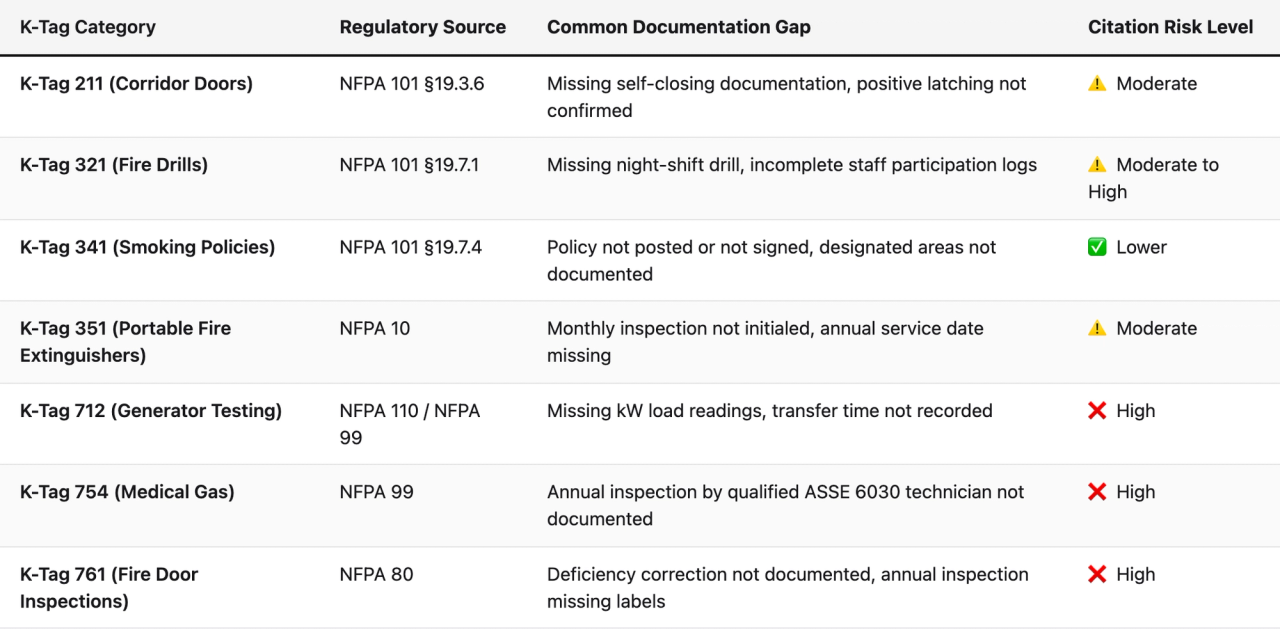
When a consultant's report is structured by K-tag, the facility's maintenance director can use it directly as a corrective action workplan. Each finding maps to a specific regulatory requirement, a specific documentation gap, and a specific corrective action. That specificity is what separates a useful consultant engagement from a generic "areas for improvement" report.
Interim Life Safety Measures: A Frequently Misunderstood Obligation
One of the areas where SNF maintenance teams most commonly have documentation gaps is interim life safety measures (ILSMs). An ILSM is a compensatory action a facility must implement when a life safety feature is impaired, whether by construction, renovation, equipment failure, or an unresolved inspection deficiency.
The obligation to implement and document ILSMs is not optional. Under NFPA 101 §4.6.10 and the CMS survey guidance that references it, when a facility knows that a required life safety feature is not functioning, they must implement defined interim measures, document that those measures are in place, and continue the documentation until the impairment is resolved. The specific ILSM actions required depend on the nature and severity of the impairment.
A life safety consultant reviewing ILSM compliance looks for several things. First, does the facility have a written ILSM policy that meets the requirements? Second, is there a mechanism for triggering ILSM documentation when an impairment is identified, whether by internal inspection or contractor report? Third, are there any currently open impairments that should have triggered an ILSM but didn't?
That third question is where the most common findings appear. A contractor identifies a sprinkler deficiency in a quarterly inspection report. The facility issues a work order to correct it. But during the time between identification and correction, no ILSM documentation was generated. The physical deficiency may be resolved, but the absence of ILSM documentation during the gap period is itself a finding.
A consultant performing a thorough assessment cross-references every open or recently closed contractor deficiency against the facility's ILSM file. When a platform like SEQURA is in use, this cross-reference can be automated: the system flags any contractor-reported deficiency that was open longer than the threshold for ILSM activation and checks whether corresponding ILSM documentation exists. This is the kind of second-order audit that is nearly impossible to perform manually at scale but is exactly what CMS surveyors are trained to look for.
Fire Drill Documentation: The Gap That Generates the Most Friction
Fire drill requirements for SNFs under NFPA 101 §19.7.1 are among the most frequently cited life safety deficiencies, not because facilities aren't conducting drills, but because the documentation of those drills fails to meet the standard a surveyor applies.
CMS requires that SNFs conduct fire drills quarterly on each shift. That means at least one drill per quarter on the day shift, one on the evening shift, and one on the night shift. The night shift requirement is the one most commonly missed or inadequately documented. Facilities that conduct night shift drills sometimes do so at the very beginning of the shift when staffing levels are higher and the drill is less disruptive, which is operationally understandable but creates a documentation question if the surveyor interprets "night shift" as meaning the actual overnight hours.
Beyond the shift coverage issue, fire drill records must include the date and time of the drill, the location where the drill originated (which simulated alarm pull station), staff participation by name or at minimum by count, the response time, any issues identified during the drill, and corrective actions taken. A fire drill log that says "Fire drill conducted, all staff responded appropriately" is not compliant documentation. It contains no verifiable elements.
A life safety consultant reviewing fire drill records applies the same scrutiny a surveyor would: verifying that all four quarters are covered, that all three shifts are covered within each annual cycle, that the records contain the required data elements, and that any issues noted in drill records have corresponding corrective actions. The consultant also looks at whether drills are being conducted during the same time window each quarter (which can suggest the drills are being managed for convenience rather than testing actual response capability) and whether the drill origination locations are being varied across quarters.
When SEQURA manages fire drill documentation, the template enforces completeness at the point of entry. A drill record cannot be submitted without the required fields. The system tracks shift coverage across quarters and flags when a shift cycle is approaching its deadline without a completed drill. For facilities that have historically struggled with fire drill documentation, this single capability often justifies the platform's cost, because it converts a reactive compliance problem into a managed schedule with automated alerts.
How Software Restructures the Consultant Engagement From Start to Finish
The traditional life safety compliance consulting engagement follows a predictable sequence: collect documents, conduct walkthrough, write report, deliver recommendations, return to verify corrective actions. The timeline is typically four to eight weeks from engagement to final deliverable, and a meaningful portion of that time is consumed by document collection, organization, and manual gap analysis.
When a facility uses a digital platform like SEQURA, this sequence is restructured at every stage.
Pre-Visit Intelligence Changes the Walkthrough
Before arriving at the facility, a consultant with platform access already has a prioritized gap list. The audit layer has flagged which records are missing required data elements, which inspection cycles have incomplete entries, and which deficiency chains lack corrective action documentation. The consultant can use this pre-visit intelligence to structure the walkthrough around confirmed gaps rather than searching for them.
This changes the quality of the site visit significantly. Instead of spending time trying to understand whether the generator log from three months ago has load readings, the consultant arrives knowing it doesn't and can focus the walkthrough on verifying the physical generator operation, assessing whether the documentation gap reflects a process failure or a one-time oversight, and advising on corrective procedure. The walkthrough becomes more diagnostic and less investigative.
The Report Becomes Faster and More Precise
Report generation is where consultant time is most heavily consumed in a traditional engagement. Writing a gap analysis report from paper records requires the consultant to manually document every finding, cross-reference it to the applicable regulation, and describe the corrective action required. For a facility with complex documentation history, this can take days.
When the platform has already performed the first-pass audit, the consultant is annotating and validating findings rather than discovering them from scratch. The platform's output becomes the foundation of the report. The consultant adds clinical judgment: determining which findings represent systemic process failures versus isolated documentation errors, prioritizing findings by survey risk, and recommending corrective actions that address root causes rather than symptoms.
The result is a faster deliverable with higher analytical depth. The consultant's expertise is concentrated where it adds the most value: interpretation, prioritization, and recommendation, rather than data assembly.
Ongoing Monitoring Replaces the Point-in-Time Assessment
The most significant structural change that platforms like SEQURA create is the shift from point-in-time assessment to continuous monitoring. A traditional consultant engagement produces a snapshot: here is the state of your documentation as of this date. Between that engagement and the next one (or the next survey), the facility's documentation quality can drift, and there is no mechanism to detect it.
With a platform managing ongoing documentation, the audit layer runs continuously. A documentation gap that opens in February, when a maintenance technician submits an incomplete inspection record, is flagged in February, not discovered during a survey in July or during the next consultant engagement in the fall. The facility's compliance posture is monitored in real time, and gaps are surfaced at the point where corrective action is cheapest and easiest.
For consultants, this creates a new engagement model. Rather than periodic deep-dive assessments, consultants working with platform-enabled facilities can offer ongoing advisory relationships: reviewing platform-generated exception reports monthly, advising on systemic issues as they emerge, and preparing the facility for survey based on real-time documentation intelligence rather than scheduled assessments. This is a higher-value engagement for the consultant and a more effective service for the facility.
What a Corrective Action Plan Actually Looks Like After a Readiness Assessment
The deliverable most SNF administrators expect from a readiness assessment is a list of things to fix. The deliverable they actually need is a structured corrective action plan that assigns responsibility, sets timelines, and establishes verification mechanisms. The difference between those two things determines whether the assessment produces lasting improvement or temporary paper compliance.
A well-structured corrective action plan from a life safety consultant includes several elements that are often missing from generic assessment reports.
First, findings are prioritized by survey risk, not by building location or inspection type. A missing kW reading in a generator log is a higher-priority finding than a fire extinguisher tag that needs updating, even if the extinguisher is physically closer to the front entrance. Survey risk prioritization ensures that the facility's corrective effort is concentrated on the deficiencies most likely to produce citations or, worse, condition-level findings.
Second, corrective actions are distinguished by type. Some findings require a one-time correction: obtaining a missing contractor report, completing an overdue inspection, updating a policy document. Others require a process change: revising the fire drill scheduling protocol, adding a required data field to the monthly inspection form, establishing an ILSM trigger mechanism. Treating process failures as one-time corrections is one of the most common mistakes facilities make after an assessment, and it is why the same findings appear in consecutive surveys.
Third, the corrective action plan includes verification steps. How will the facility confirm that the corrective action was completed? Who will verify it? When? A corrective action plan without verification mechanisms is a to-do list, not a compliance program.
When SEQURA is part of the post-assessment environment, many of these verification mechanisms are built into the platform. A corrective action requiring a process change, such as adding load readings to the generator test template, can be implemented directly in the platform so that future submissions cannot be completed without the required field. Verification is built into the workflow rather than relying on manual oversight.
SNF Survey Preparation as an Ongoing Program, Not an Event
The framing of SNF survey preparation as an event that happens before a survey is one of the most persistent and costly misconceptions in skilled nursing facility operations. Surveys are unannounced. A facility that treats survey preparation as a pre-survey scramble is, by definition, never actually prepared.
The facilities that consistently perform well on life safety surveys share a common characteristic: they maintain survey-ready documentation as an operational standard, not as a temporary state they achieve before a known inspection. Their fire drill logs are complete because the drill documentation process enforces completeness at the point of entry. Their generator records contain load readings because the person performing the test has a form that requires a load reading before the record can be submitted. Their fire door inspection deficiencies have corrective action chains because the process that receives the contractor report has a built-in step for generating a corrective work order.
A life safety consultant's highest-value contribution is not identifying gaps that exist today. It is helping a facility build the processes and tools that prevent those gaps from forming in the future. That work requires both the consultant's regulatory expertise and a documentation infrastructure that can sustain the standards the consultant establishes.
That combination, consultant expertise plus a platform that enforces the standards operationally, is what genuinely transforms a facility's survey risk profile. The consultant sets the standard. The platform holds the line between visits.
Frequently Asked Questions About Life Safety Consultant SNF Engagements
How long does a survey readiness assessment typically take for an SNF?
A thorough assessment for a single SNF typically involves one to two days of on-site time, plus additional time for document pre-review and report preparation. The total engagement, from document collection to final report delivery, commonly runs two to four weeks. Facilities using a digital documentation platform can compress the pre-review phase significantly because the consultant has access to organized, gap-analyzed records before arriving on site.
What credentials should a life safety consultant have to assess an SNF?
Look for consultants with direct experience in CMS healthcare survey processes and familiarity with NFPA 101 Life Safety Code as applied to healthcare occupancies. Relevant credentials include Certified Healthcare Facility Manager (CHFM), Certified Health Facility Inspector (CHFI), or background as a former state or CMS life safety surveyor. Consultants who have experience with the K-tag deficiency framework and CMS interpretive guidance are particularly valuable for SNF-specific work.
What is the difference between a life safety assessment and an environment of care survey?
A life safety assessment focuses specifically on fire protection systems, egress, documentation compliance with NFPA 101 and NFPA 99, and the K-tag categories that CMS life safety surveyors review. An environment of care survey is broader and may include infection control, resident safety, housekeeping standards, and physical plant condition. In an SNF context, life safety compliance is a distinct regulatory domain with its own surveyor team and citation framework.
How often should an SNF engage a life safety consultant?
For facilities with consistent documentation practices and a digital platform managing ongoing compliance, an annual or semi-annual consultant review is often sufficient. For facilities with recent citations, significant turnover in maintenance leadership, or known documentation weaknesses, more frequent engagement (quarterly) is appropriate until the program is stabilized. Facilities in the process of implementing a new documentation system benefit from consultant involvement during implementation to ensure the system is configured to the correct regulatory standard.
What are the most common findings in an SNF survey readiness assessment?
The most consistently recurring findings across SNF assessments involve fire drill documentation (missing night-shift drills, incomplete records), generator testing logs (missing required data elements like kW readings and transfer times), fire door inspection deficiency chains (no corrective action documentation), and ILSM documentation gaps (impairments not triggering ILSM protocols). Medical gas inspection documentation and sprinkler deficiency correction chains are also common problem areas.
Can a consultant guarantee that a facility will pass its next survey?
No qualified consultant makes that guarantee, and any who does should be viewed with caution. What a consultant can do is identify and remediate the documentation gaps and physical deficiencies that are most likely to produce citations, and help the facility build processes that maintain compliance between surveys. Survey outcomes also depend on physical plant conditions and operational practices that are outside the scope of documentation-focused consulting.
What role does the maintenance director play during the assessment?
The maintenance director is the consultant's primary working partner throughout the assessment. They provide access to documentation, explain current inspection processes, identify known problem areas, and are the primary recipient of corrective action recommendations. The quality of the engagement is heavily influenced by the maintenance director's engagement and their ability to explain not just what documentation exists but how it is generated. A consultant who interviews the maintenance director thoroughly before reviewing records often uncovers process gaps that the records alone wouldn't reveal.
How does SEQURA support a consultant engagement specifically?
SEQURA provides consultants with pre-visit access to a facility's complete documentation environment, organized by K-tag category and pre-analyzed by the platform's audit layer for gaps and anomalies. This allows the consultant to arrive with a prioritized gap list rather than spending site-visit time on document discovery. After the assessment, corrective actions that involve process changes can be implemented directly in the platform, so future documentation submissions enforce the corrected standard automatically. The platform also supports ongoing monitoring between consultant visits, so the facility's compliance posture is visible in real time rather than only at assessment intervals.
What happens if a surveyor finds a deficiency that the consultant missed?
This is a realistic risk in any assessment, because surveyors have access to interpretive guidance that is not always publicly available in detail, and individual surveyor interpretations of ambiguous requirements can vary. A well-structured corrective action plan addresses this risk by building documentation processes that are conservative: documenting more than the minimum required, maintaining records that exceed the minimum retention period, and ensuring that the documentation chain for any regulated activity is complete from origination through completion. When the facility's documentation culture is thorough, it is more resilient to variable surveyor interpretations.
Is a readiness assessment useful if a facility was just surveyed and received no life safety citations?
Yes, often more useful than facilities expect. Survey outcomes depend partly on the surveyor assigned and the areas they focus on. A facility that received no life safety citations may still have documentation gaps that a different surveyor would have flagged. A readiness assessment conducted after a clean survey can identify those latent vulnerabilities and close them before they become citations in a future survey cycle. Clean survey outcomes can also create a false sense of security that leads facilities to reduce investment in documentation management, which is precisely when gaps tend to accumulate.
How does consultant involvement differ for multi-site SNF operators?
For multi-site operators, consultant engagements typically add a portfolio-level analysis layer that single-facility assessments don't require. This includes identifying whether the same documentation gaps appear consistently across facilities (which suggests a systemic process issue at the corporate level), comparing documentation practices across facilities to identify best practices that can be standardized, and assessing whether the regional or corporate oversight structure is providing adequate visibility into individual facility compliance posture. Digital platforms are particularly valuable in multi-site contexts because they enable portfolio-level reporting that a consultant can analyze across all facilities simultaneously.
What should a facility do to prepare before a consultant arrives?
Gather all life safety documentation that would be reviewed in an actual survey: fire drill records for the past 12 months, all contractor inspection reports (sprinkler, fire alarm, generator, fire door, medical gas), monthly inspection logs for fire extinguishers, exit signs, and emergency lighting, the current written fire safety plan, and any ILSM documentation. If the facility uses a paper-based system, organize these by inspection type and date. If the facility uses a digital platform, ensure the consultant has been granted appropriate access credentials before the site visit. Brief the maintenance director on the scope of the engagement so they can plan their availability for the on-site portion.
Key Takeaways for SNF Administrators and Facilities Teams
- A survey readiness assessment is a documentation audit, not just a building inspection. The most consequential findings in most SNF assessments are documentation gaps, not physical deficiencies. A qualified life safety consultant evaluates both, and the documentation analysis is where the deepest expertise is required.
- The K-tag framework should structure everything. Findings, corrective action plans, and ongoing monitoring should all be organized by K-tag category, because that is the framework CMS surveyors use. A consultant whose report doesn't map to K-tags is producing a deliverable that is harder to act on and harder to verify.
- Fire drills, generator logs, and fire door deficiency chains are the three highest-frequency gap areas. Facilities that get these three documentation areas right eliminate the majority of their life safety citation risk. Each of these areas has specific data element requirements that many facilities miss because their documentation forms don't enforce completeness.
- ILSM documentation is a frequently missed obligation. Any time a life safety feature is impaired, even temporarily, ILSM documentation must be generated and maintained. The absence of ILSM documentation during a known impairment period is itself a citable finding.
- Digital platforms restructure the consultant engagement from investigative to analytical. When a platform like SEQURA manages ongoing documentation, the consultant arrives with a pre-analyzed gap list and can concentrate their expertise on interpretation and corrective design rather than document discovery. This produces faster, higher-quality deliverables.
- Survey preparation is an operational standard, not a pre-survey event. Facilities that maintain survey-ready documentation as an ongoing practice, rather than a state they achieve before a known inspection, consistently outperform those that treat compliance as episodic.
- Corrective action plans must distinguish one-time fixes from process changes. Treating a process failure as a one-time correction is the most common reason the same findings appear in consecutive surveys. A qualified consultant's corrective action plan addresses root causes and builds in verification mechanisms.
- Multi-site operators need portfolio-level visibility. Consistent documentation gaps across multiple facilities indicate systemic process issues at the corporate level. Digital platforms that aggregate compliance data across a portfolio allow consultants and regional leadership to identify and address these patterns before they produce citations across multiple facilities simultaneously.
About the author
Benjamin Terebelo · Founder
Benjamin is the founder of SEQURA, a compliance platform purpose-built for healthcare facilities. He builds at the intersection of healthcare operations and software, maintaining a focus on bringing modern tooling to systems that the broader industry has largely left behind.
About the author
Benjamin Terebelo · Founder
Benjamin is the founder of SEQURA, a compliance platform purpose-built for healthcare facilities. He builds at the intersection of healthcare operations and software, maintaining a focus on bringing modern tooling to systems that the broader industry has largely left behind.