
Preventive vs. Predictive vs. Reactive Maintenance in Healthcare Facilities: A Practical Explainer

Most healthcare facility teams already know they should be doing more than reactive maintenance. The real problem is not awareness, it is operational confusion about what "more" actually means in a skilled nursing facility, where a missed inspection is not just a maintenance failure but a potential citation that can trigger civil monetary penalties, immediate jeopardy findings, or termination from Medicare and Medicaid programs. The distinction between preventive, predictive, and reactive maintenance sounds like a textbook question. In a SNF, it is a compliance question, and the answer has direct consequences for every unannounced survey your facility will face.
This explainer cuts through the noise. It defines each maintenance approach with precision, maps them against the specific regulatory pressures SNFs face, and builds a practical framework for how maintenance directors and administrators can think about the transition from reactive to proactive operations. It also addresses something most maintenance guides ignore entirely: the documentation layer that sits above all three approaches, and why that layer is where most SNF life safety citations actually originate.
Why the Maintenance Category You Work In Determines Your Survey Exposure
The maintenance approach a facility defaults to determines, more than almost any other operational variable, the kind of documentation trail it produces, and the kind of documentation gaps a CMS surveyor will find. Reactive maintenance leaves the most gaps. Preventive maintenance closes many of them. Predictive maintenance optimizes the process further. But none of these approaches, on their own, guarantees that the documentation meets the specific format, frequency, and content requirements CMS inspectors use when they work through K-tag citations during a Life Safety Code survey.
This is the friction point most facilities never fully resolve: you can have a disciplined maintenance team completing every task on schedule and still receive a citation because the completion record does not capture the right data fields, or because a deficiency was noted in a contractor report but never reconciled in the facility's own log, or because fire drill documentation shows day-shift coverage three quarters in a row with no night-shift drill on record.
Understanding the three maintenance approaches is therefore only half the problem. The other half is understanding the documentation intelligence layer that must sit above all of them, the system that reads your records the way a surveyor would, before the surveyor gets there.
Reactive Maintenance: The Default Most SNFs Are Still Running On
Reactive maintenance is exactly what it sounds like: fix it when it breaks. Also called run-to-failure or corrective maintenance, it is the operational default for any facility that lacks a formal maintenance program. A light fixture fails, a door closer stops latching, a generator alarm triggers, and the maintenance team responds. No advance scheduling, no structured inspection cadence, no documentation beyond a work order that may or may not be filed consistently.
In a general commercial building, reactive maintenance is often defensible for low-criticality assets. In a skilled nursing facility, it is almost never defensible as a primary approach, because SNF life safety assets are not low-criticality. Fire suppression systems, emergency generators, fire doors, exit lighting, medical gas systems, and HVAC equipment all fall under regulatory maintenance requirements that specify inspection intervals, testing protocols, and documentation formats prescribed by NFPA 101, the Life Safety Code and NFPA 99, the Health Care Facilities Code. CMS adopts these standards by reference, meaning a reactive posture toward any covered asset creates automatic citation exposure the moment an inspector asks for your inspection logs.
What Reactive Maintenance Actually Costs a SNF
The cost argument against reactive maintenance in healthcare facilities has two components that most facility managers understand well: emergency repair costs run significantly higher than planned maintenance costs, and equipment downtime in a clinical environment carries patient safety risk. Both are real. But for SNFs specifically, there is a third cost that often dwarfs the first two: survey-related consequences.
A single K-tag citation related to fire door inspection deficiencies, for example, can trigger a plan of correction that requires hiring a third-party consultant, retesting every fire door in the facility, and filing documentation with the state agency within a defined window. A pattern of K-tag citations can result in civil monetary penalties. Immediate jeopardy findings, which can emerge when life safety deficiencies are judged to have created serious harm or risk to residents, carry the potential for Medicare termination. None of these consequences require a catastrophic equipment failure. They require only that your documentation does not demonstrate compliance with the required inspection schedule.
Reactive maintenance, by definition, produces no advance documentation. The inspection log is empty until something breaks. That is the core problem for SNFs, and it is why the transition from reactive to predictive maintenance is not just an operational improvement project, it is a compliance imperative.
Where Reactive Maintenance Is Still Legitimate
It would be inaccurate to say reactive maintenance has no place in a SNF. For assets that are not covered by regulatory inspection requirements and that do not affect patient safety when they fail, run-to-failure is a rational resource allocation decision. A broken desk lamp in an administrative office. A malfunctioning coffee machine in a break room. These assets do not require scheduled inspections, and repairing them reactively is perfectly appropriate.
The discipline is in knowing which assets fall into this category and which do not. Life safety assets, by contrast, must never default to reactive management, not because reactive repair is always inadequate, but because regulatory compliance requires documented proactive inspection regardless of whether the equipment has shown any sign of failure.
Preventive Maintenance: The Compliance Floor Every SNF Must Meet
Preventive maintenance (PM) is the scheduled, proactive servicing of equipment and systems at defined intervals, designed to reduce the probability of failure before it occurs. It is the operational standard that NFPA 101, NFPA 99, and CMS Conditions of Participation effectively mandate for every life safety asset in a skilled nursing facility. When a CMS surveyor asks to see your fire extinguisher inspection records, your emergency generator test logs, your sprinkler system inspection documentation, or your fire drill records, they are asking for evidence that your facility has a functioning preventive maintenance program for those specific systems.
Preventive maintenance is fundamentally calendar-driven. Monthly generator load tests. Quarterly fire extinguisher inspections. Annual sprinkler system inspections. Semi-annual fire drills per shift. The intervals are not arbitrary, they are prescribed by the applicable NFPA standard and adopted by CMS. The documentation that accompanies each completed task is not optional; it is the proof of compliance.
The Gap Between Doing the Work and Proving You Did the Work
This is where most SNF maintenance programs, even well-intentioned ones, break down. The physical work gets done. The generator gets tested. The extinguishers get checked. The fire drill happens. But the documentation that records the work is incomplete, inconsistent, or filed in a format that does not align with what a surveyor expects to see.
Common documentation gaps in preventive maintenance programs at SNFs include:
- Generator test logs that record run time but omit the kilowatt load reading CMS expects under K-tag K481 and related provisions
- Fire drill records that cover only day and evening shifts, leaving no documentation of night-shift drills across all four quarters
- Sprinkler system inspection reports filed by a contractor that note a deficiency with no corresponding record showing the deficiency was resolved within the required timeframe
- Eyewash station monthly checks logged on paper sheets that are not retained in an organized manner accessible during a survey
- Fire door inspection records that do not capture the specific door identification, deficiency code, and repair status required to demonstrate NFPA 80 compliance
These gaps are not evidence of a negligent facility. They are evidence of a preventive maintenance program that is operationally functional but documentarily incomplete. The distinction matters enormously in a survey context, because the surveyor cannot observe your maintenance team doing the work. They can only read your records.
Preventive Maintenance Software and Why Format Matters
The shift to preventive maintenance software in healthcare facilities has accelerated as facilities recognize that paper-based PM programs are too difficult to audit, too easy to let fall behind, and too unreliable in producing the documentation format surveyors expect. Digital PM platforms can schedule tasks, assign them to specific staff members, send reminders when deadlines approach, and log completions with timestamps, all of which significantly improves the consistency and retrievability of maintenance records.
However, not all preventive maintenance software is built for the regulatory environment SNFs operate in. A general-purpose CMMS (Computerized Maintenance Management System) will track work orders effectively, but it typically does not include a pre-built task library aligned to NFPA 101 and NFPA 99 inspection requirements. It will not flag a completed generator test log that is missing a required data field. It will not cross-reference your fire drill records against the CMS requirement that drills occur on all three shifts in all four quarters. It will complete the task of scheduling and logging, but it will not audit the output against regulatory expectations.
This distinction between logging and auditing is at the core of what separates a generic preventive maintenance software platform from a compliance-oriented documentation system built specifically for SNFs.
Predictive Maintenance: What It Is, What It Is Not, and Why SNFs Need to Understand the Difference
Predictive maintenance (PdM) uses real-time data, sensor monitoring, and condition-based analysis to forecast when equipment is likely to fail, enabling maintenance to be performed at the optimal point: before failure, but not unnecessarily early. It is the most technically sophisticated of the three approaches, and it is increasingly available to healthcare facilities through IoT-enabled building management systems, vibration sensors on HVAC equipment, thermal imaging of electrical panels, and continuous monitoring of generator performance metrics.
True predictive maintenance requires sensor infrastructure, data collection systems, and analytical tools capable of translating equipment readings into actionable maintenance recommendations. For large hospital systems with capital budgets to match, full predictive maintenance deployment across critical building systems is achievable. For most SNFs, particularly smaller facilities and multi-site operators working within tighter operational budgets, comprehensive predictive maintenance for all life safety equipment is not yet the operational reality.
The Practical Predictive Maintenance Opportunity in SNFs Today
This does not mean predictive maintenance concepts are irrelevant to skilled nursing facilities. Several specific applications are increasingly practical:
- Generator monitoring: Many modern emergency generators can be connected to monitoring systems that track run-time hours, oil pressure, coolant temperature, battery voltage, and fuel level continuously. This data enables maintenance teams to identify deteriorating conditions before a monthly load test reveals a failure.
- HVAC condition monitoring: Belt wear, bearing degradation, and filter loading can be tracked through vibration analysis and differential pressure readings, enabling planned replacement before equipment failure disrupts resident comfort or indoor air quality compliance.
- Electrical system thermal scanning: Annual or semi-annual infrared scanning of electrical panels identifies hot spots that indicate failing connections or overloaded circuits before they become fire hazards, a particularly high-value application in a facility with a continuous resident population.
- Water temperature monitoring: Legionella risk management in SNF water systems benefits from continuous temperature monitoring, which can flag conditions that support bacterial growth between scheduled sampling events.
The realistic picture for most SNFs is a hybrid: a preventive maintenance framework as the compliance foundation, with predictive monitoring layered onto the highest-criticality, highest-consequence assets where sensor data is economically accessible.
Predictive Maintenance for Documentation: A Concept SNFs Need to Understand
There is a second meaning of "predictive" that is critically relevant to SNFs and is almost never discussed in standard maintenance guides: predictive auditing of documentation. This is not predictive maintenance in the equipment sense. It is the application of pattern recognition and regulatory knowledge to your existing documentation records to predict, before a survey, which gaps are most likely to generate citations.
This is the capability that general-purpose CMMS platforms do not provide, and it is what distinguishes a documentation-intelligence platform built for SNF compliance from a standard work order management system. When an AI review layer reads your completed inspection records and surfaces the fact that your generator test log from three months ago is missing a kilowatt load reading, it is doing something a surveyor would do, but before the surveyor gets there. That is predictive in the most operationally meaningful sense for a SNF.
The Reactive to Predictive Maintenance Transition: What It Actually Requires
The reactive to predictive maintenance transition is often framed as a technology adoption problem. Install the right sensors, buy the right software, and you move from reactive to predictive. This framing is incomplete, particularly for SNFs, where the organizational and cultural dimensions of the transition are as significant as the technical ones.
A realistic transition framework for a skilled nursing facility involves three phases, each with distinct priorities:
Phase One: Establish the Preventive Maintenance Foundation
No facility can transition meaningfully to predictive maintenance without a functioning preventive maintenance program already in place. This phase involves identifying every asset subject to regulatory inspection requirements, mapping those assets to the applicable NFPA standard and CMS K-tag, establishing the correct inspection interval and documentation format for each, and assigning clear accountability for task completion.
For many SNFs, this phase reveals that their existing PM program has significant gaps, assets that have been informally maintained but never formally scheduled, inspection tasks that are being completed at the wrong frequency, or documentation formats that do not capture all required data fields. Closing these gaps is not glamorous work, but it is the prerequisite for everything else. A facility that moves to predictive monitoring without a solid PM foundation will find that its sensor data sits on top of a compliance documentation structure that still generates citations.
The practical tool for this phase is a vetted NFPA and state-regulation task template library, a pre-built set of inspection tasks, intervals, and documentation requirements that reflects the actual regulatory expectations for each asset category. Building this library from scratch is a significant undertaking. Using a platform that provides it as a starting point compresses the timeline considerably and reduces the risk of gaps in the initial program design.
Phase Two: Digitize and Audit the Documentation Layer
Once the PM foundation is established, the next priority is ensuring that completion records are captured digitally, in the right format, with the right data fields, in a system that can be audited before a survey. This is the phase where preventive maintenance software delivers the most immediate value for SNF compliance.
The specific capabilities that matter in this phase:
- Task scheduling aligned to regulatory intervals, not just operational convenience
- Completion logging that captures all required data fields (not just "done/not done")
- Contractor report integration, so that third-party inspection results are reconciled against facility records
- Deficiency tracking that follows a finding from identification through resolution, with timestamps
- Audit-ready reporting that surfaces missing records, incomplete logs, and coverage gaps across shifts and quarters
This phase also addresses the staff workflow dimension: ensuring that maintenance technicians, EVS staff, and other frontline team members can complete documentation easily and consistently, whether through a mobile device, a shared facility kiosk, or a back-office computer. If the documentation system is too cumbersome, compliance with it will erode over time, and the documentation gaps will return.
Phase Three: Layer Predictive Monitoring onto High-Criticality Assets
With the PM foundation and documentation layer in place, the facility is in a position to evaluate where predictive monitoring adds meaningful value. The selection criteria for this phase should be driven by three factors: the consequence of failure (patient safety impact, regulatory consequence, or both), the availability of cost-effective monitoring technology for that asset class, and the volume of maintenance events that predictive data can realistically reduce.
For most SNFs, Phase Three is a selective deployment, not a facility-wide transformation. Emergency generators, HVAC systems, and water systems are typically the highest-value targets. Fire suppression systems, fire doors, and egress lighting remain primarily in the preventive maintenance category because their compliance requirements are based on scheduled inspections regardless of condition, no amount of sensor data replaces the documented annual fire door inspection that NFPA 80 requires.
A Proactive Maintenance Strategy for SNFs: Building the Framework
A proactive maintenance strategy in a skilled nursing facility is not simply a more ambitious version of preventive maintenance. It is a deliberate operational posture that integrates preventive scheduling, documentation auditing, selective predictive monitoring, and compliance intelligence into a unified system that reduces both equipment failure risk and survey citation risk simultaneously.
The distinction matters because facilities that focus exclusively on the equipment maintenance side of a proactive strategy often find that their survey outcomes do not improve proportionally. The generator runs reliably, the HVAC performs well, the fire suppression system is in good condition, and the surveyor still writes K-tags because the documentation does not meet regulatory standards. A complete proactive strategy treats documentation compliance as a first-class operational priority, not a byproduct of good maintenance.
The Compliance-First Lens for Maintenance Planning
In a SNF context, every maintenance planning decision should be filtered through a compliance lens before it is finalized. This means asking a different set of questions than a general facility manager would ask:
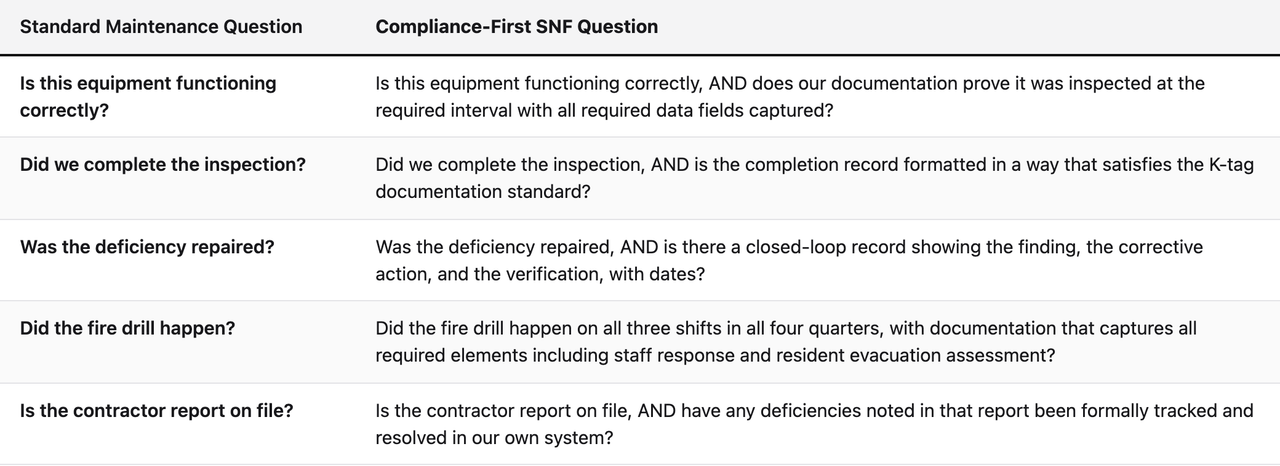
This compliance-first lens is what separates a proactive maintenance strategy built for SNF operations from a generic facilities management best-practice framework. The regulatory environment SNFs operate in is not incidental to maintenance planning, it is the primary driver of what "done correctly" means for every life safety task.
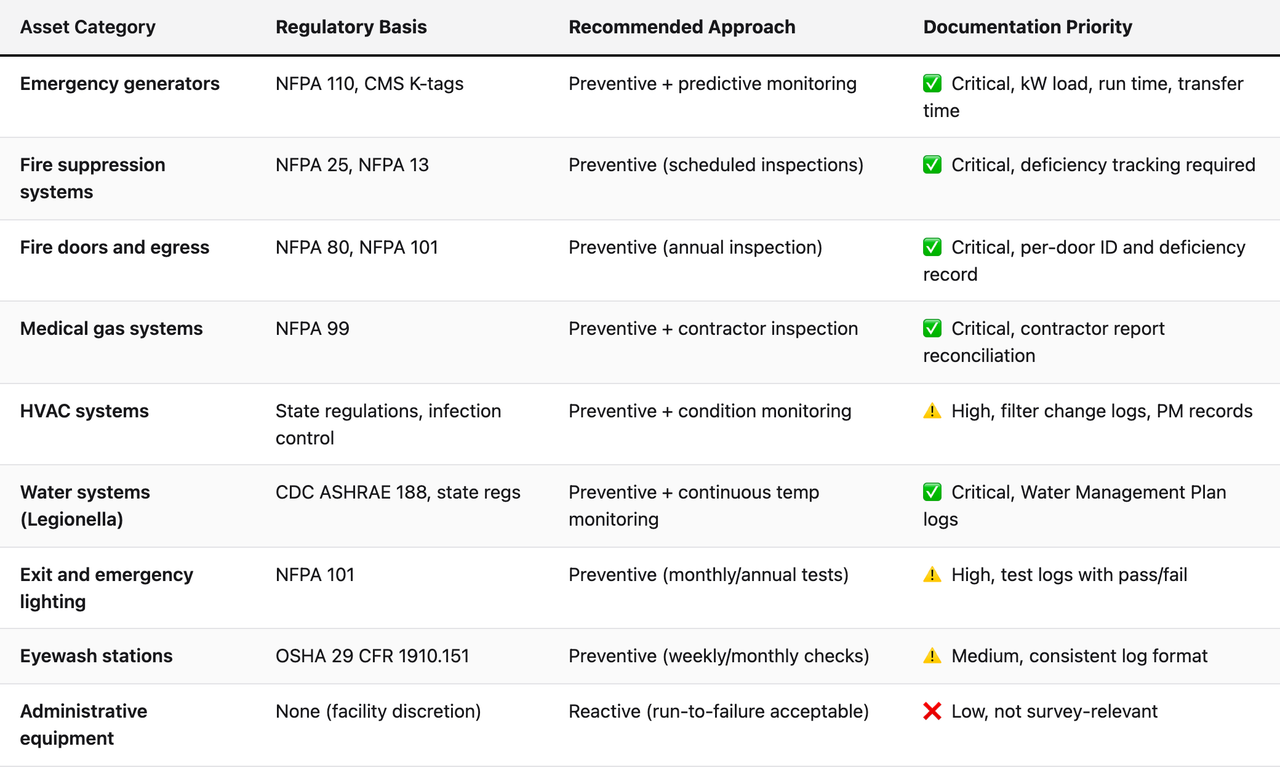
Asset Classification in a SNF Proactive Maintenance Strategy
A practical proactive maintenance strategy requires a clear classification of facility assets by regulatory criticality, not just by operational criticality. The following framework helps maintenance directors allocate attention and resources appropriately:
How Documentation Gaps Become Citations: The Pattern SNF Teams Must Recognize
Understanding the mechanics of how a documentation gap becomes a K-tag citation is essential for any SNF maintenance director or administrator who wants to build a genuinely proactive maintenance strategy. The process is more systematic than most facilities realize, and more predictable.
When a CMS Life Safety Code surveyor enters a facility, they work from a standardized observation and document review protocol. For each K-tag category, they look for specific evidence: the relevant inspection log, the inspection interval, the data captured in each entry, and any deficiency follow-through records. They are not checking whether the equipment works. They are checking whether you can prove, through contemporaneous documentation, that you inspected it at the required interval and addressed any findings.
The most common patterns that produce citations are not the result of negligence. They are the result of documentation systems that were not designed to capture regulatory requirements precisely:
Pattern One: The Incomplete Data Field
A generator test log shows monthly entries for the past 12 months. Run time is recorded. Transfer time is recorded. But the kilowatt load during the test, a specific data element CMS expects to see, is absent from every entry. The surveyor notes the deficiency. The facility receives a K-tag citation for inadequate generator test documentation, despite having completed every scheduled test.
This pattern is extraordinarily common and almost entirely preventable. A documentation system that includes the required data fields in the completion template, and flags entries where those fields are left blank, would catch this before the log ever reaches a surveyor.
Pattern Two: The Unreconciled Contractor Finding
A licensed sprinkler contractor performs the annual NFPA 25 inspection and submits a report noting two deficiencies: a corroded sprinkler head in the laundry area and an impaired waterflow alarm component in the mechanical room. The report is filed in the facility's binder. The maintenance director verbally follows up with the contractor, who repairs both items. But the facility's own records contain no documentation of the repair, no work order, no confirmation log, no updated inspection status. The contractor's report still shows open deficiencies.
The surveyor reviews the contractor report, sees two unresolved deficiencies, and issues citations. The repairs were real. The documentation gap was the problem.
Pattern Three: The Shift Coverage Gap in Fire Drills
CMS requires fire drills on all three shifts in all four quarters. A facility that runs drills reliably on days and evenings but has incomplete documentation for night-shift drills, perhaps because night-shift drills are harder to schedule and the documentation process is less consistent, will receive a citation even if night drills actually occurred. Without contemporaneous documentation, the drill did not happen from a regulatory standpoint.
This is perhaps the most frustrating citation pattern for facilities that have invested real effort in their fire safety programs. The fix is not more fire drills. It is a documentation system that actively tracks shift and quarter coverage and alerts the maintenance director when a coverage gap is emerging before the quarter closes.
Preventive vs. Predictive Maintenance: Choosing the Right Emphasis for Your SNF
The preventive vs predictive maintenance question for most SNFs resolves to a clear hierarchy: preventive maintenance is non-negotiable as the compliance foundation, and predictive capabilities are valuable additions where they are operationally and economically feasible. This is not a knock on predictive maintenance, it is a recognition of the regulatory reality SNFs operate in.
NFPA standards and CMS Conditions of Participation specify inspection intervals for life safety assets that must be met regardless of equipment condition. Even a generator that is performing perfectly, with sensor data showing every parameter within normal range, still requires a monthly 30-minute load test with documented results. The regulatory requirement is not condition-based. It is interval-based. This means predictive monitoring can inform how you maintain the equipment between required tests, but it cannot replace the scheduled tests themselves.
The practical implication: for SNF life safety assets, preventive maintenance documentation is the primary compliance tool, and it must be complete and correct. Predictive monitoring is a valuable risk management and cost optimization layer on top of that foundation, not a substitute for it.
Where Predictive Investment Delivers the Most Value in a SNF
Given the hybrid reality most SNFs will operate within, the highest-value predictive investments are those that reduce the risk of catastrophic failure in assets where failure between scheduled inspections carries serious consequences:
- Emergency generator reliability: A generator that fails during a power outage puts residents at immediate risk. Continuous monitoring of battery condition, fuel levels, and engine parameters reduces the probability of failure between monthly tests.
- Water system temperature management: Continuous temperature monitoring in domestic hot water systems reduces Legionella risk between scheduled sampling events, a high-consequence risk in a SNF population with compromised immune systems.
- HVAC performance in resident areas: Temperature and humidity excursions in resident rooms affect comfort and infection control. Condition-based monitoring enables faster response than a scheduled quarterly inspection would provide.
Assets where predictive investment adds less incremental value in a SNF context are those where the regulatory requirement is fully inspection-interval-driven and the physical inspection itself is the compliance event, fire doors, fire extinguishers, exit lighting. For these assets, the priority is a reliable, well-documented preventive maintenance program, not sensor infrastructure.
The Documentation Intelligence Layer: What SNFs Need That General CMMS Platforms Cannot Provide
The most important concept this article can leave with an SNF maintenance director or administrator is this: the maintenance approach you use determines the quality of your equipment, but the documentation intelligence layer you use determines the quality of your survey outcomes. These are related but distinct problems, and they require different tools.
A general-purpose CMMS, the kind used in commercial real estate, manufacturing, and hospitality, is designed to manage work orders, track asset history, and schedule preventive maintenance. It does these things well. What it does not do is understand the regulatory context of a skilled nursing facility. It does not know that a generator test log missing a kilowatt load reading is a citation risk. It does not know that a fire drill log showing only two shifts in a given quarter is a documentation gap. It does not read your contractor reports and flag unresolved deficiencies.
The regulatory environment SNFs operate in requires a documentation layer that can do those things, a system that does not just log completed tasks but audits them against the specific content requirements CMS surveyors use. This is what the term "documentation intelligence" means in a compliance context: the ability to read your own records the way a surveyor would, and surface the gaps before they become citations.
For SNFs evaluating healthcare facilities maintenance technology, the key evaluative question is not "does this software schedule and log tasks?", almost every CMMS does. The key question is: "Does this software understand what a completed task record needs to contain to satisfy CMS documentation standards, and does it tell me when a record falls short?"
Platforms built specifically for SNF life safety compliance, with vetted NFPA task template libraries and AI-driven documentation review, answer that question differently than general CMMS platforms do. The difference shows up not in daily operations, but in the survey outcome, which is the moment that matters most.
Multi-Site Operators and the Standardization Imperative
For regional SNF operators and multi-site chains, the preventive versus predictive versus reactive maintenance question has an additional dimension: consistency across facilities. A single facility can, with effort, build a compliant PM program from scratch using paper logs and manual tracking. At five facilities, ten facilities, or twenty, that approach becomes organizationally unsustainable, and the variation in documentation quality across sites creates unpredictable survey exposure.
Multi-site operators face a specific challenge that single-facility operators do not: when a surveyor visits a facility that has not been recently surveyed, there is no way for corporate leadership to know in advance what the documentation quality looks like at that specific site. If each site manages its own paper binder with its own informal processes, corporate has no visibility into whether the documentation at Site 7 would survive a survey tomorrow.
A standardized, digitized maintenance and documentation platform resolves this visibility problem. When every site uses the same task templates, the same documentation formats, and the same deficiency tracking workflow, regional managers and compliance officers can audit documentation quality across all sites from a single dashboard, and address gaps before a surveyor finds them. This is the operational value of standardization that goes beyond efficiency: it converts survey preparation from a reactive scramble into a continuous, proactive process.
The standardization imperative also applies to the transition from reactive to proactive maintenance. Multi-site operators that allow each facility director to manage the transition independently will find that the pace and quality of the transition varies enormously across sites, leaving the organization with an inconsistent compliance posture that is difficult to manage and even more difficult to defend in a survey context.
Frequently Asked Questions
What is the difference between preventive and predictive maintenance in a healthcare setting?
Preventive maintenance follows a fixed schedule, monthly generator tests, annual sprinkler inspections, regardless of equipment condition. Predictive maintenance uses sensor data and condition monitoring to forecast when maintenance is actually needed, based on how the equipment is performing. In a healthcare setting, both have a role, but preventive maintenance is the compliance baseline because regulatory requirements specify inspection intervals that must be met regardless of equipment condition.
Is reactive maintenance ever acceptable in a skilled nursing facility?
Reactive maintenance is acceptable for non-regulated, non-life-safety assets, administrative equipment, general fixtures, items with no CMS inspection requirement. It is never acceptable as the primary approach for life safety systems, where NFPA and CMS standards require documented proactive inspection at defined intervals. Running life safety assets reactively creates automatic citation exposure when a surveyor requests inspection logs.
What does a proactive maintenance strategy look like for a SNF?
A proactive maintenance strategy for a SNF combines three elements: a preventive maintenance program covering all regulated assets at the correct intervals, a documentation system that captures completed tasks in the format CMS expects, and a compliance audit layer that reviews records for gaps before a survey occurs. For high-criticality assets like emergency generators and water systems, predictive monitoring is an additional layer that reduces failure risk between scheduled inspections.
What are the most common documentation gaps that generate K-tag citations?
The most common patterns are: generator test logs missing kilowatt load readings; fire drill records that lack night-shift or full-quarter coverage; contractor inspection reports with unresolved deficiencies and no corresponding repair documentation; fire door inspection records that do not capture per-door identification and deficiency status; and sprinkler system records that fail to show closed-loop deficiency resolution within the required timeframe.
What should SNFs look for in preventive maintenance software?
SNFs should prioritize software that includes a pre-built task library aligned to NFPA 101, NFPA 99, and CMS documentation requirements, not just generic work order scheduling. The platform should log completions with all required data fields, track deficiency resolution, integrate contractor report findings, and provide audit-ready reporting that surfaces missing records and coverage gaps. General CMMS platforms typically lack the regulatory-specific template and audit capabilities SNFs require.
How does predictive maintenance apply to fire safety systems in a SNF?
Predictive maintenance has limited direct application to fire safety systems in a SNF because those systems, fire doors, sprinklers, extinguishers, exit lighting, are subject to inspection-interval-based regulatory requirements that must be met regardless of condition. No amount of sensor data replaces a documented annual fire door inspection. The preventive maintenance program, with complete and correctly formatted documentation, is the primary compliance tool for fire safety systems.
What is the reactive to predictive maintenance transition, and how long does it take for a SNF?
The transition involves three phases: establishing a compliant preventive maintenance foundation (identifying all regulated assets, setting correct intervals, standardizing documentation formats), digitizing and auditing the documentation layer (moving from paper to a platform that can review records for compliance gaps), and selectively layering predictive monitoring onto high-criticality assets. For a single SNF, the foundational phases typically take three to six months to complete with active organizational commitment. Multi-site standardization takes longer, depending on the number of facilities and the baseline maturity of existing PM programs.
Can a SNF use a general CMMS like Fiix or eMaint for life safety compliance?
General CMMS platforms can support preventive maintenance scheduling and work order tracking, which provides real operational value. However, they typically do not include NFPA-aligned task templates, CMS documentation field requirements, or AI-driven review of completed records against regulatory expectations. SNFs using general CMMS platforms often find that their maintenance operations improve but their documentation quality, and therefore their survey readiness, does not improve proportionally. A compliance-specific documentation layer is needed to close that gap.
How does documentation intelligence differ from standard preventive maintenance software?
Standard preventive maintenance software schedules tasks, assigns them, and logs completions. Documentation intelligence goes further: it reads completed records and evaluates whether they contain what a CMS surveyor would expect to find. It identifies missing data fields, incomplete deficiency follow-through, shift and quarter coverage gaps in fire drill records, and unreconciled contractor findings, the specific patterns that generate citations. It is the difference between a system that tracks whether work was done and a system that evaluates whether the documentation of that work would survive a survey.
Why do well-maintained SNFs still receive life safety citations?
Because CMS citations are documentation findings, not equipment condition findings. A surveyor cannot observe your maintenance team working. They can only read your records. A facility with excellent maintenance practices and poor documentation discipline will receive citations that a facility with average maintenance practices and excellent documentation would not. This is the most important operational insight for SNF maintenance directors: documentation quality and maintenance quality are related but separate disciplines, and both must be actively managed.
What role does an AI review system play in SNF compliance documentation?
An AI review system applied to SNF maintenance documentation reads completed inspection records, contractor reports, and shift logs against the regulatory expectations for each asset and K-tag category. It identifies the specific gaps, missing data fields, unresolved deficiencies, coverage shortfalls, that a human reviewer might miss in a large volume of records. The practical effect is that documentation gaps are surfaced before a survey, when they can be corrected, rather than during a survey, when they become citations.
How should multi-site SNF operators approach maintenance standardization?
Multi-site operators should implement a single platform with standardized task templates, documentation formats, and deficiency tracking workflows across all facilities. This creates consistent compliance posture across sites and gives regional leadership visibility into documentation quality at every location, enabling proactive gap closure rather than reactive survey preparation. Allowing each site to manage its own informal PM program produces inconsistent outcomes that are difficult to oversee and defend during surveys.
Key Takeaways
- Reactive maintenance is a citation liability for SNFs. Life safety assets require documented proactive inspection at regulatory intervals. A reactive posture produces no advance documentation and creates automatic citation exposure.
- Preventive maintenance is the non-negotiable compliance baseline. NFPA 101, NFPA 99, and CMS Conditions of Participation effectively mandate a preventive maintenance program for all life safety assets. No predictive technology replaces it.
- The preventive vs. predictive maintenance debate resolves to a hybrid. Preventive maintenance with complete documentation is the compliance foundation. Predictive monitoring adds value for high-criticality assets like generators and water systems, but does not substitute for scheduled inspections.
- Documentation quality determines survey outcomes, not maintenance quality alone. A well-maintained facility with poor documentation will receive citations. The documentation layer must be treated as a first-class operational priority.
- The most common citation patterns are preventable with the right documentation system. Missing data fields, unreconciled contractor findings, and shift coverage gaps in fire drill records are the specific patterns that generate most life safety K-tags, and all of them are visible in your own records before a survey, if you have a system that looks for them.
- General CMMS platforms are insufficient for SNF compliance without a regulatory documentation layer. SNFs need a platform that includes NFPA-aligned task templates, CMS-compliant data field requirements, and an audit capability that reviews completed records against regulatory expectations.
- Multi-site operators need standardization, not just software. Consistent task templates, documentation formats, and deficiency workflows across all facilities give regional leadership the visibility needed to manage compliance proactively at scale.
- The reactive to predictive maintenance transition is a phased process. Establish the PM foundation first, digitize and audit the documentation layer second, and layer predictive monitoring onto high-criticality assets third. Skipping phases produces incomplete compliance improvements.
What This Means for SNF Maintenance Directors and Administrators
The operational reality for skilled nursing facilities is that maintenance excellence and compliance excellence are not the same thing, and both are required. A facility that runs every piece of life safety equipment flawlessly but documents its inspections inconsistently will face survey consequences that feel unjust but are entirely predictable. A facility that treats documentation as a compliance discipline, with the same rigor it applies to the physical maintenance work, will find that survey preparation becomes a continuous operational process rather than a periodic crisis.
The transition from reactive to proactive maintenance, in a SNF context, is ultimately a transition in how your team thinks about documentation. Not as paperwork that follows the work, but as the work itself, the evidence that proves compliance, closes citation risk, and gives administrators and corporate leadership the confidence that the next unannounced survey will not produce surprises.
Building that confidence requires the right tools: a vetted task library aligned to NFPA and CMS requirements, a documentation platform that captures the right data fields and makes records accessible, and an audit layer that reads your records the way a surveyor would, before the surveyor gets there. That combination is what a compliance-first proactive maintenance strategy looks like in practice. And it is the standard every SNF should be building toward, regardless of where they are starting from today.
To explore how NFPA 101 Life Safety Code requirements map to specific CMS K-tag categories for skilled nursing facilities, the CMS Life Safety Code survey guidance provides the authoritative crosswalk between NFPA standards and the citation framework surveyors use.
About the author
Benjamin Terebelo · Founder
Benjamin is the founder of SEQURA, a compliance platform purpose-built for healthcare facilities. He builds at the intersection of healthcare operations and software, maintaining a focus on bringing modern tooling to systems that the broader industry has largely left behind.
About the author
Benjamin Terebelo · Founder
Benjamin is the founder of SEQURA, a compliance platform purpose-built for healthcare facilities. He builds at the intersection of healthcare operations and software, maintaining a focus on bringing modern tooling to systems that the broader industry has largely left behind.