
Purpose-Built SNF Compliance Platform vs. Enterprise Asset Management Software: A Practical Feature-by-Feature Breakdown

There is a moment every SNF maintenance director knows well: the surveyor walks in unannounced, and the first thing they ask for is the fire drill log, the generator test records, or proof that the last sprinkler inspection deficiency was corrected. The maintenance director reaches for the binder. Or the spreadsheet. Or the email chain. What happens in the next sixty seconds often determines whether the facility walks away with a citation or not. The question this article answers is a practical one: does enterprise asset management software protect you in that moment, or does a purpose-built SNF compliance platform do something fundamentally different?
This is not a question of which software is "better" in the abstract. Enterprise asset management (EAM) platforms are genuinely powerful tools, and large healthcare systems use them every day to manage complex equipment portfolios. The real question is whether enterprise asset management software was built to do what CMS and state surveyors actually measure, and whether its architecture can close the documentation gaps that produce K-tag citations. The honest answer is: mostly no, and the reasons are structural, not superficial.
This breakdown compares a purpose-built SNF compliance platform like SEQURA against leading enterprise asset management tools on the dimensions that matter most to skilled nursing facility operators: regulatory task coverage, K-tag documentation logic, survey readiness reporting, staff usability, and total cost of compliance. By the end, you will have a clear framework for deciding which category of tool belongs in your facility, and why choosing the wrong one is not just an operational inconvenience but a regulatory liability.
What Each Platform Category Was Actually Built to Do
Understanding where each platform excels starts with understanding the problem each one was designed to solve. Enterprise asset management software and purpose-built SNF compliance platforms share some surface-level vocabulary (work orders, inspections, asset records) but they were engineered for entirely different regulatory environments and user personas.
The Architecture of Enterprise Asset Management Software
Enterprise asset management software emerged from industrial and manufacturing environments where the central problem is equipment reliability and capital asset lifecycle management. Platforms like IBM Maximo, Infor EAM, and SAP Plant Maintenance were built to answer questions like: what is the maintenance history of this asset, when does it need its next PM cycle, and what is its total cost of ownership over its useful life?
These are genuinely important questions in large hospital systems managing millions of dollars of biomedical equipment, HVAC infrastructure, and building systems across dozens of campuses. The CMS Conditions of Participation for hospitals include environment of care standards that align reasonably well with EAM's core strengths: asset inventory, preventive maintenance scheduling, and work order tracking.
The architecture of EAM is asset-centric. Everything radiates outward from a physical object: a boiler, a fire pump, a generator, an elevator. Work orders attach to assets. Maintenance histories attach to assets. Costs attach to assets. This is a logical structure for capital planning and reliability engineering, and it is genuinely useful for facility directors who need to justify equipment replacement decisions or benchmark maintenance spending.
The Architecture of a Purpose-Built SNF Compliance Platform
A purpose-built SNF compliance platform like SEQURA was built to answer a different set of questions entirely: what does CMS expect to see in this facility's documentation on any given day, is that documentation complete and contemporaneous, and would it survive a surveyor's review without producing a citation?
This architecture is regulation-centric, not asset-centric. The organizing logic is the K-tag category, the NFPA 101 or NFPA 99 requirement, or the specific documentation standard that a CMS Life Safety Surveyor will evaluate. Tasks are not attached primarily to a physical asset; they are attached to a regulatory obligation, with the asset as a secondary reference. This distinction sounds subtle but it produces entirely different software behavior.
In a compliance-first architecture, the system knows that a monthly fire extinguisher inspection is not just a maintenance task; it is documentation evidence for K-tag K353 (portable fire extinguishers), and it must be completed by a qualified person, logged contemporaneously, and retained for a specific period. Missing a single month creates a documentation gap that a surveyor can cite. The system's job is to prevent that gap from existing at all, and to surface it immediately if it does.
K-Tag Coverage: The Definitive Dividing Line
If you take nothing else from this comparison, take this: K-tag coverage is the single feature that most clearly separates purpose-built life safety compliance software from enterprise asset management software, and the gap between them is not a matter of configuration or add-ons. It is structural.
What K-Tags Require from Your Documentation System
CMS Life Safety tags (K-tags) are the citation codes CMS surveyors use to document deficiencies under the CMS Life Safety Survey. There are more than 200 active K-tags covering fire protection systems, egress, hazardous areas, emergency lighting, medical gas, generator systems, and dozens of other life safety domains. Each K-tag maps to a specific section of NFPA 101 (Life Safety Code) or NFPA 99 (Health Care Facilities Code).
What makes K-tags challenging for generic software is not the volume; it is the specificity of what each one requires. K-tag K712 (generator testing) does not just require that you ran the generator. It requires that you documented the test duration, the load (in kilowatts), the transfer time, the cooldown period, and the battery electrolyte levels, among other data points. Missing any one of those data fields in your log record is a documentable deficiency, even if the generator itself ran perfectly.
A purpose-built SNF compliance platform encodes this specificity into its task templates. When a technician opens a generator test task in SEQURA, they see exactly the fields CMS expects, in the format CMS expects, with prompts that prevent submission without required data. The system knows what K712 requires because it was built by people who read the interpretive guidelines, not just the NFPA standard itself.
What EAM Systems Offer for K-Tag Compliance (and Where They Fall Short)
Enterprise asset management software can be configured to include custom fields, custom forms, and custom task templates. In theory, a sufficiently resourced implementation team could build K-tag-aligned inspection forms inside an EAM platform. In practice, this configuration work is expensive, requires regulatory expertise the software vendor does not provide, and produces a system that documents tasks but does not audit them.
The deeper problem is that EAM systems do not understand regulatory context. When a generator test record in an EAM system is missing the kW load reading, the system typically treats it as a completed work order. There is no mechanism to cross-reference the submitted record against the regulatory expectation for that specific K-tag and flag the missing data element as a compliance risk. The work order is closed. The gap is invisible. The citation happens at survey.
This is precisely the gap that SEQURA's AI review layer is designed to close. It reads completed inspection records and cross-references them against the regulatory expectations for each K-tag category, surfacing documentation gaps before they become citations. This is not a feature EAM platforms offer, and it cannot be replicated through configuration alone.
Preventive Maintenance vs. Regulatory Task Scheduling: A Critical Distinction
Both EAM platforms and SNF compliance platforms schedule recurring tasks. But the logic governing those schedules, and the consequences of a missed task, are fundamentally different between the two systems.
How EAM Handles Preventive Maintenance Scheduling
In enterprise asset management software, preventive maintenance (PM) schedules are typically driven by manufacturer recommendations, equipment age, or reliability engineering models. A PM task is scheduled because it reduces equipment failure risk or extends asset life. If a PM task is missed, the consequence is increased equipment risk and a work order backlog.
EAM scheduling is highly flexible and sophisticated. Multi-site operators can manage thousands of assets with complex seasonal, meter-based, or condition-based PM triggers. This is genuinely powerful for hospital biomedical engineering departments or large health system facilities teams managing a diverse and expensive equipment portfolio.
But CMS does not cite facilities for missing a manufacturer-recommended PM interval. CMS cites facilities for missing the documentation that NFPA 101, NFPA 99, or the applicable state regulation requires. These are related but not identical obligations, and the distinction matters enormously when a surveyor is reviewing your records.
How SNF Compliance Platforms Handle Regulatory Task Cadences
In a purpose-built life safety compliance software platform, task schedules are driven by regulatory cadence requirements. NFPA 101 requires monthly fire extinguisher checks. NFPA 99 requires monthly generator load testing. CMS requires quarterly fire drills for each shift. These intervals are not suggestions; they are documentation requirements, and missing one creates a citation-eligible gap regardless of whether the underlying equipment is functioning perfectly.
A purpose-built SNF compliance platform maintains a vetted task template library that encodes the correct cadence for every required inspection, built against NFPA standards and CMS interpretive guidelines. When regulations change (as they do with each new edition of the Life Safety Code or CMS update cycle), the template library is updated by regulatory specialists, not by the facility's IT team.
This matters especially for multi-site SNF operators, where regional facilities managers cannot realistically maintain deep expertise in every regulatory nuance across different state survey agencies. The platform carries that knowledge institutionally.
Feature-by-Feature Comparison: SNF Compliance Platform vs. EAM
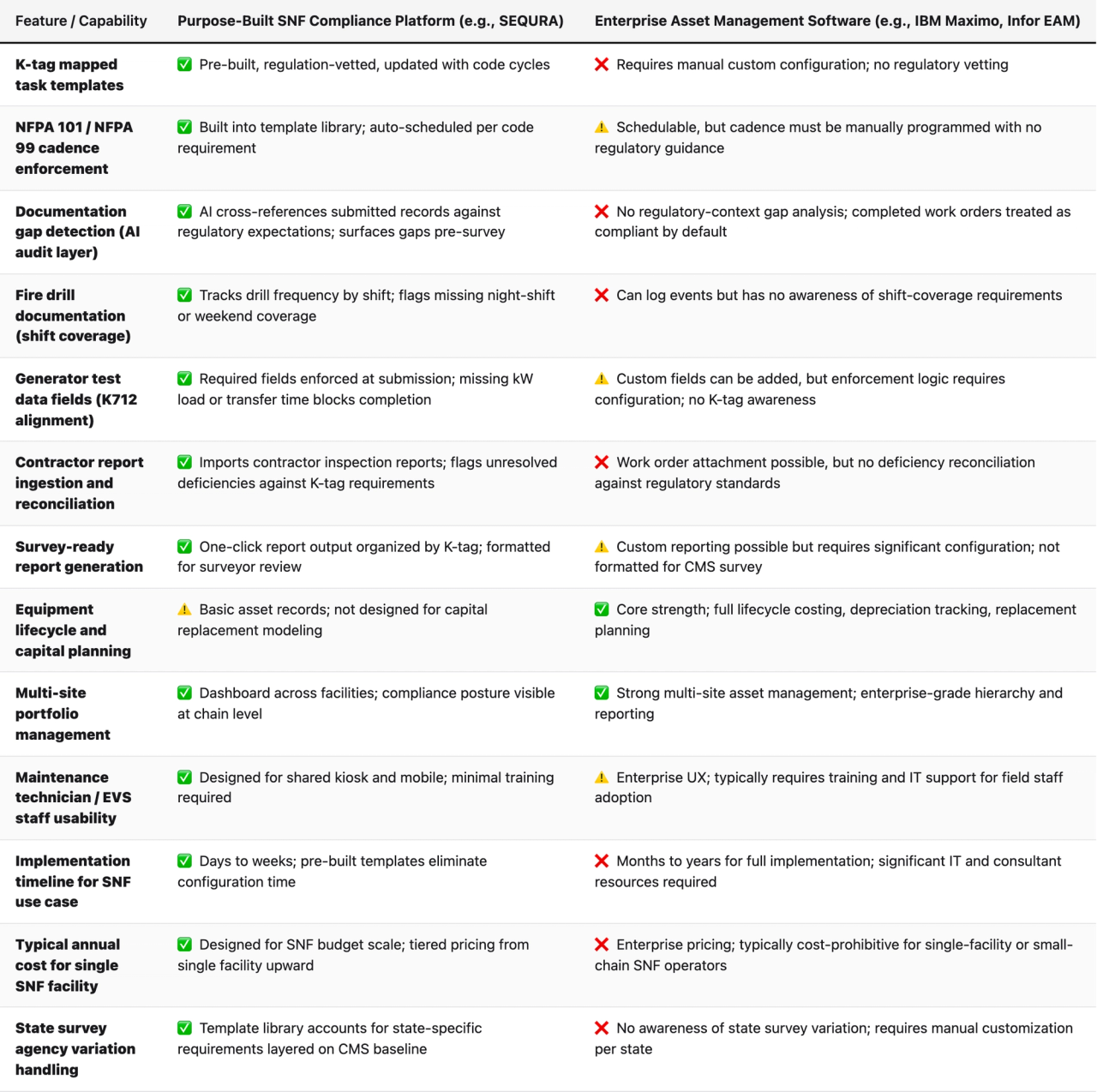
The table below compares the two platform categories across the features that matter most for skilled nursing facility compliance operations. Ratings reflect how well each platform category addresses the specific need out of the box, without extensive custom configuration.
The Documentation Gap Problem: Why "Completed" Is Not the Same as "Compliant"
This is perhaps the most important conceptual distinction in this entire comparison, and it is one that enterprise asset management software simply cannot address without a fundamental redesign. In EAM, a completed work order is treated as a closed event. The task was assigned, it was marked complete, and the system moves on. This is the correct behavior for a maintenance work order: the asset was serviced, the service was recorded, done.
In a CMS survey context, the completed task is not the endpoint. It is the beginning of the documentation review. A surveyor reviewing your fire door inspection records is not asking whether the inspection was completed. They are asking whether every fire door was inspected, whether the inspector was qualified, whether deficiencies were identified, whether those deficiencies were corrected within the required timeframe, and whether the correction was documented with the same specificity as the original inspection finding. A "completed" inspection record that is missing any one of those elements is a potential citation regardless of whether the physical door is in perfect condition.
The Invisible Gap Patterns That Produce Most SNF Life Safety Citations
From working with skilled nursing facilities across survey cycles, several patterns consistently emerge as the source of preventable life safety citations. These patterns share a common characteristic: they are invisible to the person doing the documentation at the time of completion, and they are invisible to generic software that treats task completion as the end of the story.
Missing data fields in generator test logs. A technician runs the monthly generator test, logs the date and duration, and marks the task complete. The record is missing the kilowatt load reading, which NFPA 110 and CMS interpretive guidelines require. The EAM system shows the task as complete. The surveyor shows the facility as deficient under K712.
Fire drill shift coverage gaps. CMS requires fire drills on each shift, including evening and night shifts, at specified intervals. A facility that conducts all its quarterly fire drills during the day shift is not meeting the regulatory standard, regardless of how well-documented those drills are. An EAM system has no concept of shift coverage requirements. A purpose-built SNF compliance platform flags the gap in real time.
Unreconciled sprinkler deficiencies. A licensed contractor inspects the sprinkler system and identifies three deficiencies in their inspection report. The contractor's report is attached to a work order in the EAM system. But no one has formally documented that those deficiencies were corrected, by whom, and when. The work order is closed. The deficiencies are technically unresolved. At survey, the contractor's own report becomes evidence of a citation under K351 (sprinkler system maintenance).
Contemporaneity gaps in inspection logs. CMS surveyors are trained to look for inspection logs that appear to have been back-filled, i.e., a series of monthly checks that were all logged on the same day, or inspection records that were completed significantly after the required inspection date. A purpose-built SNF compliance platform logs completion timestamps automatically and flags records that appear to be retroactively completed. EAM systems typically allow backdated work order completion without flags or alerts.
CMMS vs. EAM vs. SNF Compliance Platform: Clarifying the Three-Way Distinction
Many SNF operators evaluating their options encounter three categories of software that partially overlap: Computerized Maintenance Management Systems (CMMS), Enterprise Asset Management (EAM) software, and purpose-built SNF compliance platforms. Understanding where each category starts and ends prevents misaligned purchasing decisions.
What CMMS Does Well (and Where It Stops)
A CMMS alternative for SNF environments is a common search because many SNFs are currently using CMMS platforms (Hippo CMMS, UpKeep, Maintenance Connection, and similar tools) to manage their work orders and preventive maintenance. CMMS is a step up from paper and spreadsheets, and for basic work order management it is genuinely useful.
But CMMS shares the same core limitation as EAM in the SNF compliance context: it manages tasks, it does not audit documentation for regulatory completeness. A CMMS knows that a fire alarm test was scheduled and completed. It does not know whether the test results meet the documentation requirements of NFPA 72 and the applicable K-tag standard, and it does not surface the gap if they do not.
CMMS platforms are also not built around regulatory task libraries. The facility (or a consultant) must build the inspection templates, set the cadences, and maintain them as regulations change. For a single-facility SNF with a knowledgeable maintenance director, this is manageable but time-consuming. For a multi-site operator managing regulatory compliance across ten or twenty facilities in multiple states, it becomes operationally untenable.
EAM vs. CMMS: Scale and Sophistication
Enterprise asset management software is essentially CMMS at enterprise scale, with the addition of asset lifecycle management, financial integration, procurement workflows, and capital planning capabilities. EAM is appropriate for large health systems with complex biomedical equipment portfolios, hundreds of millions of dollars in capital assets, and dedicated biomedical engineering and facilities departments with IT support staff.
For most SNF operators, EAM is over-engineered for their equipment management needs and under-engineered for their compliance documentation needs. A 120-bed skilled nursing facility does not need full asset lifecycle modeling for a fire extinguisher; it needs proof that the extinguisher was inspected monthly by a qualified person, with the results logged contemporaneously in a format that maps to K353.
Where Purpose-Built SNF Compliance Platforms Fit
Purpose-built healthcare facility compliance tools occupy a distinct category that neither CMMS nor EAM covers. They are built around the regulatory framework (NFPA 101, NFPA 99, CMS Conditions of Participation, state survey agency requirements) rather than around equipment or work order management. They carry the regulatory knowledge institutionally, so the facility does not have to. And they audit the documentation, not just the task completion.
For SNF operators, this means the platform is doing the work that would otherwise require a part-time life safety consultant reviewing documentation binders before every survey cycle, a role that most SNFs cannot afford but desperately need.
Pricing Reality: What Each Platform Category Actually Costs for an SNF
Cost comparisons between enterprise software and purpose-built vertical platforms are rarely straightforward, because the sticker price is only one component of the total cost of deployment. For SNF operators evaluating these options, the relevant cost question is: what does it actually cost to achieve and maintain survey-ready life safety documentation using this platform?
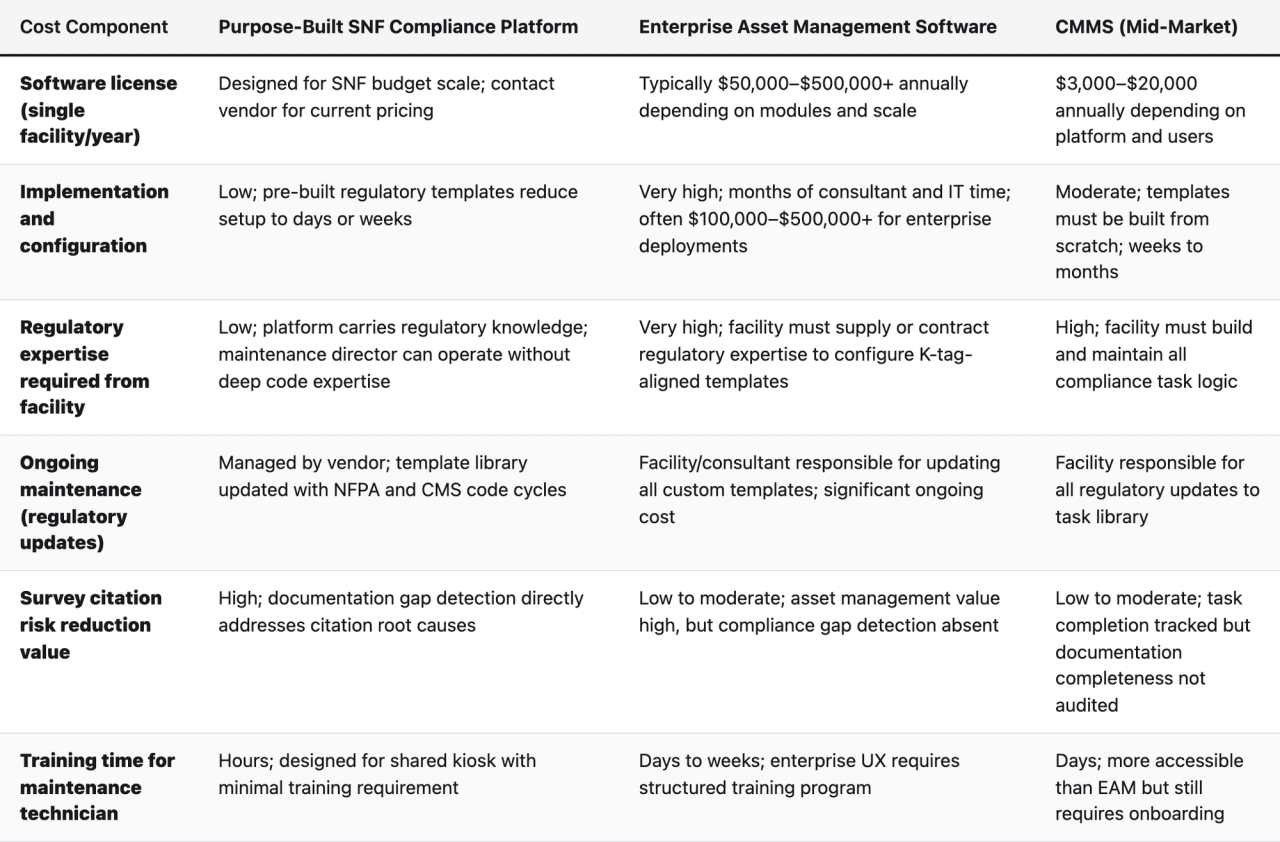
The cost comparison above illustrates a point that matters specifically for SNF operators: the total cost of achieving survey readiness with an EAM platform is not just the software license. It includes the regulatory consulting hours to build K-tag-aligned templates, the IT resources to maintain a complex enterprise system, and the ongoing cost of keeping that configuration current as regulations change. For most SNF operators, that total cost exceeds the purpose-built alternative by a significant margin, while delivering materially less compliance protection.
Staff Usability in the Real SNF Environment
Software that does not get used does not protect the facility. This is an obvious point that nonetheless gets overlooked in software evaluation processes that focus exclusively on features and pricing. For SNF compliance documentation to hold up at survey, it must be completed contemporaneously, by the person who actually performed the inspection, at the time and location of the inspection. That means the software must work for a maintenance technician completing a monthly fire extinguisher check, an EVS staff member documenting a corridor inspection, or a facilities director reviewing overnight generator test records from a different location.
How EAM Platforms Handle Field Staff Usability
Enterprise asset management software is, by design, an enterprise system. Its interface reflects the complexity of the problems it was built to solve: multi-level asset hierarchies, procurement workflows, financial integrations, and detailed technical specifications. For a trained biomedical engineer or facilities operations manager, this complexity is appropriate and useful. For a maintenance technician completing a daily life safety check on a shared facility kiosk, it is a barrier to adoption.
EAM mobile apps have improved significantly in recent years, and platforms like IBM Maximo and Infor EAM offer field-accessible interfaces. But these interfaces were designed primarily for technicians who are already familiar with the platform and are completing relatively complex maintenance tasks. They were not designed for the shared-kiosk, minimal-training environment of a skilled nursing facility where staff turnover is high and the person completing the fire extinguisher check today may not be the same person who completed it last month.
How Purpose-Built SNF Compliance Platforms Handle the Kiosk Reality
SEQURA and similar purpose-built SNF compliance platforms are designed around the actual operational environment of a skilled nursing facility. The shared kiosk model acknowledges that not every staff member completing a compliance task has a personal device or a dedicated computer. The interface is simplified to surface exactly the task at hand, with the required fields for that specific inspection, and nothing else.
This matters for compliance quality as well as adoption. When the interface presents exactly the fields required for K712 generator documentation, in a clean format that a technician can complete in three minutes, the quality of the resulting documentation is higher than when the technician navigates a complex EAM interface, finds the right work order, and fills in whatever fields seem relevant. Simplicity at the point of documentation capture is not a concession to low-tech users; it is a compliance strategy.
Multi-Site SNF Operators: Where the Platforms Diverge Most Sharply
For single-facility SNF operators, the comparison between an SNF compliance platform and enterprise asset management software is relatively straightforward: the compliance platform addresses the actual problem, the EAM does not, and the EAM costs significantly more to implement. For multi-site operators managing five, ten, or twenty SNF facilities, the comparison becomes more nuanced but the conclusion is similar.
What Multi-Site EAM Deployments Look Like in Practice
Large health systems and multi-facility operators that have deployed enterprise asset management software across their portfolios typically did so to solve an equipment management and capital planning problem: how do we track the lifecycle and maintenance cost of thousands of assets across dozens of facilities in a unified system? For that problem, EAM is the right tool.
But even in these large deployments, the life safety compliance documentation function is typically handled separately, through paper binders, supplementary spreadsheets, or a parallel CMMS deployment. The EAM handles the equipment; something else (often less organized) handles the regulatory documentation. This creates exactly the documentation gaps that produce citations, and it creates them systematically across every facility in the portfolio.
What Multi-Site SNF Compliance Platform Deployment Looks Like
For a regional facilities manager overseeing life safety compliance across a chain of SNF facilities, a purpose-built compliance platform provides something EAM cannot: a real-time view of compliance posture across every facility, organized by K-tag category, with gaps surfaced before they become citations.
This is not a reporting feature that can be replicated through EAM custom dashboards. It requires a system that understands what regulatory completeness looks like for each facility, monitors documentation continuously against that standard, and escalates gaps through the appropriate channel (maintenance director at the facility level, regional manager at the chain level). This is the architecture SEQURA is built around, and it is the architecture that makes the platform genuinely useful for COOs and VPs of operations who are accountable for survey outcomes across a portfolio.
When Enterprise Asset Management Software Is the Right Answer
This comparison would be incomplete without an honest assessment of when EAM is genuinely the better choice. There are healthcare facility contexts where enterprise asset management software is the appropriate primary platform, and understanding those contexts clarifies the decision for SNF operators who may be evaluating both.
Large acute-care hospitals with complex biomedical equipment portfolios are the natural habitat of enterprise asset management software. A 500-bed hospital managing millions of dollars of imaging equipment, surgical robotics, HVAC infrastructure, and building systems across multiple towers needs the full asset lifecycle management capability that EAM provides. The compliance documentation function in that environment is typically handled by a dedicated environment of care committee, a life safety officer, and a team of specialists, not a single maintenance director.
Health systems with dedicated IT and facilities operations teams can absorb the implementation complexity and ongoing configuration requirements of EAM in a way that most SNF operators cannot. If the health system has the resources to build and maintain K-tag-aligned inspection templates within the EAM platform, and has the regulatory expertise to keep those templates current, EAM can serve both functions. But this requires a level of organizational investment that is realistic for a 50-hospital system and unrealistic for a 10-facility SNF chain.
Operators who need capital planning and equipment replacement modeling as a primary business function will find EAM's asset lifecycle capabilities genuinely valuable in ways a compliance platform cannot match. If the primary business problem is "when do we need to replace our HVAC systems and what will it cost," EAM is the right tool.
The honest bottom line for SNF operators: if your primary problem is survey readiness and life safety documentation, EAM is not designed for your problem. If your primary problem is capital asset management and you have the resources to layer compliance documentation on top through a separate system or heavy EAM customization, EAM can be part of the solution. For most SNF operators, the purpose-built compliance platform is the faster, cheaper, and more effective path to survey confidence.
The Right Platform for Your SNF Scenario
Rather than a generic recommendation, here is a scenario-based decision framework for SNF operators evaluating these options:
If you are a single-facility SNF administrator or maintenance director replacing a paper binder, a purpose-built SNF compliance platform is unambiguously the right choice. EAM is over-engineered for your equipment management needs and cannot address your compliance documentation needs without extensive custom configuration that exceeds your budget and IT capacity. A CMMS alternative might seem like a middle ground, but it still requires you to build and maintain all regulatory task logic yourself. The purpose-built platform gives you survey-ready documentation from day one.
If you are a COO or VP of operations at a multi-site SNF chain with five to twenty facilities, the purpose-built compliance platform is the right primary tool for life safety documentation, full stop. The multi-site dashboard and chain-level compliance posture visibility are exactly what you need to manage survey risk across a portfolio. If your facilities also need equipment lifecycle management, a lightweight CMMS can run alongside the compliance platform without conflict.
If you are a director of facilities at a large health system that already has an EAM deployed, the question is not whether to replace the EAM but whether to layer a purpose-built compliance platform alongside it. The EAM handles equipment; the compliance platform handles K-tag documentation. These are not competing functions; they are complementary ones, and the combination is often more effective than trying to force the EAM to perform both roles.
If you are a life safety consultant advising SNF clients on survey readiness, the compliance platform is the tool that most directly addresses the documentation gaps you identify in your reviews. It also provides a mechanism to monitor documentation quality between your visits, which addresses one of the most persistent challenges in SNF life safety consulting: the facility looks survey-ready when you are there, and the binder starts to slip the moment you leave.
Frequently Asked Questions
What is the main difference between an SNF compliance platform and enterprise asset management software?
The core difference is the organizing logic. Enterprise asset management software is asset-centric: it manages equipment, maintenance history, and capital planning. A purpose-built SNF compliance platform is regulation-centric: it manages documentation requirements, K-tag obligations, and survey readiness. EAM tells you what happened to an asset. A compliance platform tells you whether your documentation would survive a CMS survey.
Can enterprise asset management software be configured to handle K-tag compliance?
In theory, yes. In practice, the configuration work requires significant regulatory expertise, IT resources, and ongoing maintenance as regulations change. Even a well-configured EAM system will not have the AI audit layer that cross-references submitted documentation against regulatory expectations and surfaces gaps before survey. The configured EAM will track task completion; it will not detect documentation deficiencies within completed records.
Is a CMMS a better fit for SNFs than EAM?
CMMS is a more accessible alternative to EAM for SNFs because it is simpler and less expensive to implement. But CMMS shares the fundamental limitation: it manages task completion, not documentation compliance. The facility must build all regulatory task templates from scratch, maintain them as regulations change, and there is no mechanism to audit completed records for regulatory completeness. A purpose-built SNF compliance platform addresses all three gaps.
What does "documentation gap detection" actually mean in practice?
Documentation gap detection means the platform reads completed inspection records and cross-references them against the specific data requirements for each K-tag category. If a generator test log is missing the kilowatt load reading, or a fire drill record does not reflect night-shift coverage, the system surfaces those gaps as compliance risks before a surveyor sees them. Generic software treats a completed task as compliant; documentation gap detection distinguishes between "completed" and "compliant."
How long does it take to implement a purpose-built SNF compliance platform vs. EAM?
A purpose-built SNF compliance platform like SEQURA is typically operational within days to weeks because the regulatory task templates are pre-built and vetted. Enterprise asset management software implementations for healthcare environments typically take months to years, require dedicated IT resources and often third-party consultants, and require the facility to build all compliance-related templates from scratch.
What are K-tags and why do they matter for software selection?
K-tags are the citation codes CMS surveyors use to document deficiencies in skilled nursing facilities during life safety surveys. Each K-tag maps to a specific requirement in NFPA 101 or NFPA 99 and has specific documentation requirements. Software that does not understand K-tag structure cannot ensure that documentation meets the standard each K-tag requires, which means it cannot protect the facility from life safety citations.
What is the risk of using EAM for SNF compliance documentation?
The primary risk is invisible documentation gaps. Because EAM treats completed work orders as compliant by default, it does not surface missing data fields, shift coverage gaps, unreconciled deficiencies, or contemporaneity issues in inspection logs. These are exactly the patterns that produce life safety citations, and they are typically discovered only when a surveyor reviews the records during an unannounced visit.
Does a purpose-built SNF compliance platform replace the need for a life safety consultant?
Not entirely, but it significantly changes the role. A platform like SEQURA provides continuous documentation auditing that identifies gaps in real time. A life safety consultant provides expertise, regulatory interpretation, and often serves as a credible advisor during the survey process itself. The platform handles the operational documentation function that currently falls on the maintenance director and the consultant's periodic review. Many SNF operators find that deploying a compliance platform reduces the frequency and cost of consultant reviews while improving documentation quality between visits.
How does an SNF compliance platform handle state survey agency requirements that differ from CMS baseline?
Purpose-built SNF compliance platforms maintain task template libraries that account for state-specific requirements layered on top of the federal CMS baseline. This is a significant advantage for multi-state SNF operators, because state survey agencies in states like California, Texas, and New York have requirements that differ from the CMS minimum standard. EAM platforms have no awareness of these variations and require manual customization per state.
Can a small SNF operator with one or two facilities afford a purpose-built compliance platform?
Yes. Purpose-built SNF compliance platforms like SEQURA are priced with the SNF market in mind, with tiered pricing that scales from single facilities to large multi-site operators. This is a fundamental difference from enterprise asset management software, which is priced for health system budgets and is typically cost-prohibitive for small SNF operators. The relevant cost comparison for a small SNF operator is not just the software license but the total cost of achieving survey readiness, including the consultant time, staff hours, and citation risk that the platform replaces.
What happens to the paper binder when an SNF adopts a compliance platform?
The platform replaces the paper binder as the system of record for life safety documentation. Inspection logs, fire drill records, generator test results, contractor reports, and all other K-tag-related documentation are captured digitally and stored in the platform. Survey-ready reports can be generated instantly, organized by K-tag category, which is significantly faster and more reliable than assembling documentation from a physical binder under survey pressure.
Is SEQURA a CMMS, an EAM, or something else?
SEQURA is neither a CMMS nor an EAM. It is a purpose-built life safety compliance and documentation-intelligence platform designed specifically for healthcare facilities, with skilled nursing facilities as its primary market. Its organizing logic is regulatory, not asset-based. It is designed to ensure that every K-tag documentation requirement is met, audited for completeness, and survey-ready at any time, which is a function that neither CMMS nor EAM platforms are designed to perform.
Key Takeaways
- Enterprise asset management software manages assets; SNF compliance platforms manage regulatory documentation. These are different problems with different architectures, and confusing one for the other creates survey risk.
- K-tag coverage is the definitive dividing line. EAM platforms do not understand K-tag structure, cannot enforce K-tag-specific data requirements, and cannot detect documentation gaps within completed records. Purpose-built SNF compliance platforms are built around K-tag logic from the ground up.
- "Completed" is not the same as "compliant." The most dangerous documentation gaps are the ones that look complete to the facility but are missing data elements a surveyor will cite. Only a platform with AI-driven documentation auditing can surface these gaps before survey.
- EAM implementation costs are prohibitive for most SNF operators. Beyond the software license, the regulatory consulting, IT resources, and ongoing configuration maintenance required to use EAM for compliance documentation exceed the purpose-built alternative by a significant margin.
- Staff usability is a compliance strategy, not a convenience feature. Documentation that is difficult to complete correctly will be completed incorrectly. Purpose-built platforms designed for shared-kiosk environments produce higher-quality compliance records than enterprise systems requiring complex navigation.
- Multi-site SNF operators need chain-level compliance visibility. Purpose-built compliance platforms provide real-time compliance posture across all facilities, organized by K-tag. EAM dashboards reflect asset and maintenance status, not regulatory readiness.
- For most SNF operators, the right answer is a purpose-built compliance platform. EAM is the right tool for large health systems with complex equipment portfolios and dedicated IT teams. For SNF operators whose primary accountability is survey readiness and life safety documentation, the purpose-built compliance platform is faster, more affordable, and more effective.
About the author
Benjamin Terebelo · Founder
Benjamin is the founder of SEQURA, a compliance platform purpose-built for healthcare facilities. He builds at the intersection of healthcare operations and software, maintaining a focus on bringing modern tooling to systems that the broader industry has largely left behind.
About the author
Benjamin Terebelo · Founder
Benjamin is the founder of SEQURA, a compliance platform purpose-built for healthcare facilities. He builds at the intersection of healthcare operations and software, maintaining a focus on bringing modern tooling to systems that the broader industry has largely left behind.