
Purpose-Built SNF Compliance Software vs. General CMMS vs. Spreadsheets: A Feature-by-Feature Breakdown
Walk into any SNF maintenance director's office and you will find the same artifact: a three-ring binder, stuffed with inspection logs, fire drill records, and contractor reports, organized by someone's best guess at what a surveyor will ask for. Some binders are color-coded. Some are years out of date. Nearly all of them have gaps that nobody knows about until an unannounced CMS visit makes those gaps impossible to ignore. The question facing every SNF operator right now is not whether to move beyond the binder. It is which category of tool actually solves the problem.
Three options dominate the conversation: purpose-built SNF compliance platforms, general computerized maintenance management systems (CMMS), and spreadsheets. Each has advocates. Each serves real facilities. And each carries a completely different risk profile when a surveyor walks through the door. This breakdown examines all three across the dimensions that determine survey confidence, not just feature checklists, so administrators and maintenance directors can make the right call for their specific situation.
Why the Tool Category Matters More Than Individual Features
Before comparing specific capabilities, it is worth understanding why tool category matters so much in a healthcare compliance context. A feature that works perfectly in a manufacturing plant or commercial real estate portfolio can be actively misleading in a skilled nursing facility, because the underlying regulatory logic is completely different.
General CMMS platforms were built to answer one question: is this piece of equipment working? Their architecture centers on assets, work orders, and maintenance intervals. That framing is entirely appropriate for an industrial operation where equipment uptime is the primary concern. But CMS survey readiness asks a fundamentally different question: is this documentation complete, contemporaneous, and reconciled against the specific regulatory expectation for each life safety system?
Those two questions sound similar. They are not. A fire extinguisher can be fully functional and still generate a K-tag citation because the inspection log is missing a technician signature, or because the documentation does not capture the right data elements for a particular NFPA 10 requirement. The equipment worked. The documentation failed. A CMMS that tracks the first question does not automatically solve the second.
Spreadsheets, meanwhile, answer neither question reliably at scale. They can record what happened. They cannot audit whether what happened is complete, correctly formatted, and mapped to the right regulatory cadence. The person maintaining the spreadsheet would have to know all of that, and remember to check it, every time.
Purpose-built SNF compliance platforms are architected around the second question from the ground up. That architectural difference shapes everything else in this comparison.
Spreadsheets: The Tool Everyone Starts With and Nobody Should Rely On
Spreadsheets remain surprisingly common across the SNF sector, particularly at independent facilities and smaller operators who have not yet formalized their compliance infrastructure. They are free or nearly free, universally understood, and infinitely flexible. For a single-facility operator with a meticulous maintenance director and no staff turnover, a well-maintained spreadsheet system can function adequately, right up until it does not.
What Spreadsheets Actually Do Well
Spreadsheets are excellent at recording completed tasks. A maintenance director who knows what needs to be tracked can build a log that captures inspection dates, technician names, and results. For facilities with simple compliance profiles, low survey risk, and stable staffing, this is sometimes enough to pass a survey. Spreadsheets also have zero learning curve, require no vendor relationship, and can be customized without any technical skill.
Where Spreadsheets Break Down in Compliance Contexts
The fundamental failure mode of spreadsheets is that they are entirely dependent on the person maintaining them knowing what belongs in them. There is no built-in regulatory logic. There is no system that tells a maintenance director that a generator test log is missing a kW load reading, or that a fire drill record does not document night-shift participation, or that a sprinkler deficiency noted in a contractor report has not been reconciled with a corrective action entry. The spreadsheet does not know any of that. It just holds whatever data was entered.
This creates a pattern that appears repeatedly in post-survey analysis: facilities where the maintenance director believed documentation was complete because the spreadsheet was full, but where a surveyor found gaps in the specific data elements required for each K-tag category. The spreadsheet recorded that inspections happened. It did not verify that the inspections captured everything a surveyor would check.
Staff turnover makes this dramatically worse. When a maintenance director leaves, the institutional knowledge embedded in how the spreadsheet was organized, what abbreviations mean, and which tabs are current typically leaves with them. The incoming director inherits a document they did not build, with no way to audit whether it is complete or accurate.
Spreadsheets also create serious problems around contemporaneous documentation. CMS surveyors look for evidence that records were created at the time of the inspection, not reconstructed later. A spreadsheet with entries that appear to have been batch-entered, or with date formats that suggest retroactive completion, is a citation risk regardless of whether the underlying work was actually done.
Spreadsheet Risk Profile for SNFs
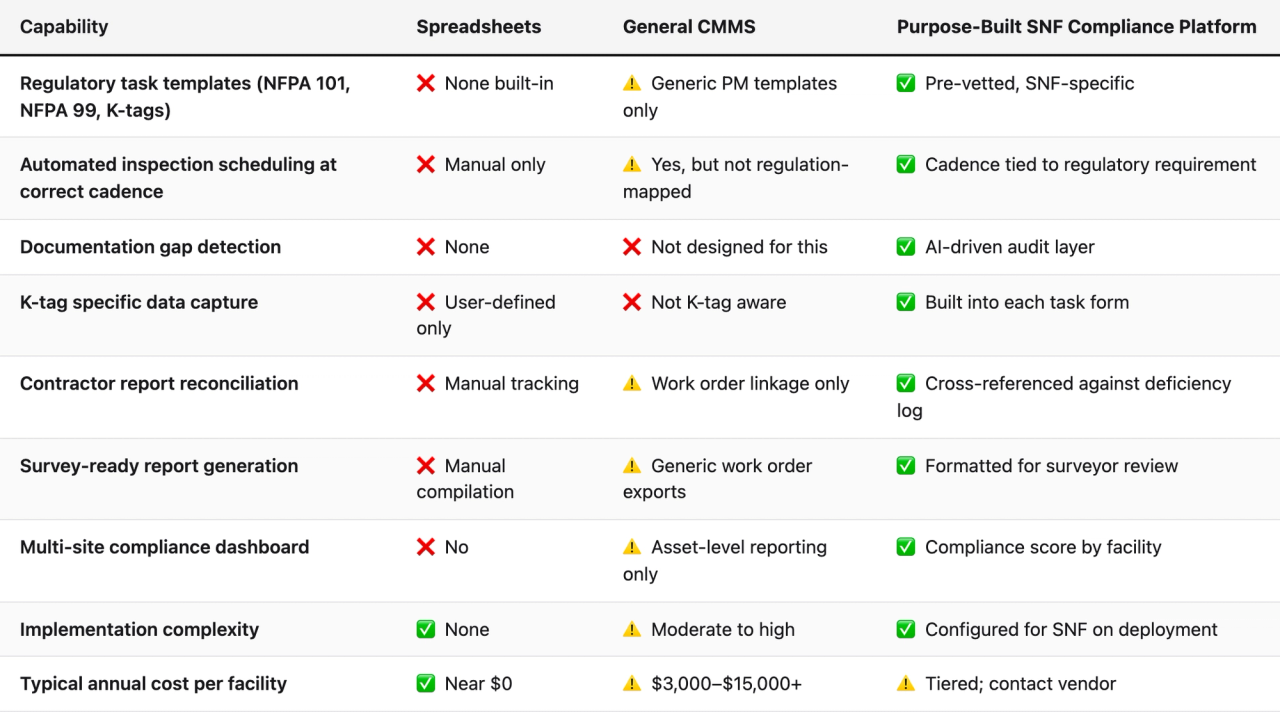
Spreadsheets carry the highest documentation risk of any option in this comparison. They offer zero audit capability, no regulatory logic, no automated scheduling, and no gap detection. For facilities under any kind of survey pressure, operating in states with aggressive inspection programs, or managing multiple life safety systems simultaneously, spreadsheets are not a compliance tool. They are a liability.
General CMMS Platforms: Powerful Tools Solving a Different Problem
General CMMS platforms represent a significant upgrade from spreadsheets in terms of operational discipline, and they are genuinely excellent at what they were designed to do. Platforms like Maintenance Connection, eMaint, Fiix, and similar tools give maintenance teams structured work order management, asset tracking, preventive maintenance scheduling, and reporting capabilities that spreadsheets simply cannot match. The problem is not that these platforms are bad. The problem is that they were built for a fundamentally different regulatory environment.
How General CMMS Platforms Are Architected
Every major CMMS platform organizes its data model around assets and work orders. An asset is a piece of equipment. A work order is a task performed on that asset. Preventive maintenance schedules trigger work orders at defined intervals. Technicians complete work orders and log results. Managers review completion rates and outstanding items. This is a clean, logical architecture that works extremely well for facilities management in hotels, schools, manufacturing plants, and commercial real estate.
In those environments, the primary compliance questions involve equipment warranties, OSHA safety requirements, and general operational uptime. The documentation standard is: did the work get done? A completed work order with a technician signature and a completion date is usually sufficient.
SNF life safety compliance has a completely different documentation standard. The question is not just whether the work was done, but whether the specific data elements required by each NFPA standard and each K-tag category were captured, whether the cadence matches the regulatory requirement exactly, whether deficiencies identified during an inspection have been tracked through to corrective action, and whether the entire record set is organized in the way a CMS surveyor will expect to review it. None of that logic is built into a general CMMS platform, because none of it was needed in the markets those platforms were designed for.
What General CMMS Does Well for SNFs
General CMMS platforms deliver real value for the operational side of SNF maintenance. Work order tracking, technician assignment, parts inventory, and equipment history are all genuinely useful capabilities. For a maintenance director managing a complex mechanical plant, HVAC systems, and a large equipment inventory, a CMMS provides structure that improves operational efficiency.
Some CMMS platforms also include preventive maintenance templates that can be adapted for healthcare environments. A diligent maintenance director can configure inspection checklists that capture relevant data fields, set up recurring tasks at the right intervals, and use the reporting features to monitor completion. With enough customization effort, a general CMMS can be made to approximate some compliance functionality.
The keyword there is "approximate." And the customization effort required is substantial, ongoing, and dependent on the person doing the configuring understanding the regulatory requirements well enough to build them correctly. That is a lot of specialized knowledge to embed in a software configuration rather than in the platform itself.
Where General CMMS Falls Short in SNF Compliance
The gaps between what a general CMMS offers and what SNF compliance actually requires are specific and consequential. Understanding them helps administrators make an accurate assessment of what a CMMS can and cannot cover.
No K-tag awareness. CMS life safety citations are organized around K-tags, each of which maps to a specific NFPA requirement. A general CMMS has no concept of K-tags. It tracks assets and work orders. The connection between a completed inspection record and the K-tag category it satisfies has to be maintained manually by someone who understands that mapping. When that person leaves, the mapping leaves with them.
No documentation gap detection. A CMMS will tell you that a work order was completed. It will not tell you that the completed work order is missing a required data element, that the result recorded does not meet the NFPA specification, or that a deficiency noted in the work order has not been followed up with a corrective action record. Gap detection requires cross-referencing completed records against regulatory expectations. General CMMS platforms do not do this.
No contractor report integration. A significant portion of SNF life safety documentation comes from external contractors: sprinkler inspection reports, fire alarm test records, elevator inspections, generator service records. These contractor reports arrive as PDFs or paper documents. A general CMMS can store these as attachments, but it cannot read them, parse their findings, or flag when a contractor report identifies a deficiency that has not been reconciled with a corrective action in the facility's records.
Preventive maintenance intervals are not regulation-mapped. A CMMS PM schedule can be set to any interval the administrator chooses. The platform does not know whether that interval matches the NFPA requirement for that specific inspection type. A quarterly generator test scheduled on a 90-day interval might drift to 92 or 95 days without triggering any alert, creating a documentation gap that would not be visible until a surveyor calculated the interval from the log dates.
Reports are work-order formatted, not survey-ready. When a surveyor asks to see fire drill documentation, they have a specific format expectation based on what CMS guidance requires those records to contain. A CMMS work order export is formatted for maintenance management, not regulatory review. Converting CMMS output into survey-ready documentation requires manual reformatting, which introduces the risk of errors and the appearance of reconstruction.
The CMMS Customization Trap
Many SNF operators who adopt a general CMMS for compliance purposes find themselves in a customization cycle that consumes significant time without fully closing the gap. They configure templates, realize a required data field is missing, add the field, discover the reporting structure does not support the output they need, build a custom report, and then repeat the process each time a regulatory update changes what is required. This is not a failure of the CMMS. It is a predictable consequence of trying to make a general-purpose tool serve a specialized regulatory function it was not designed for.
The total cost of a CMMS in an SNF environment, properly calculated, includes not just the software license but the ongoing configuration time, the compliance knowledge required to configure it correctly, and the risk premium associated with gaps that the platform is not designed to detect. When those costs are included, the economic case for a general CMMS in a compliance-heavy SNF context is significantly weaker than the license price alone suggests.
Purpose-Built SNF Compliance Platforms: What "Purpose-Built" Actually Means
The phrase "purpose-built" gets used loosely in healthcare software marketing. In the context of SNF compliance platforms, it has a specific and verifiable meaning: the platform's data model, task logic, and reporting architecture were designed from the ground up around the regulatory requirements that determine CMS and state survey outcomes. That design decision shows up in every layer of the product, from the way tasks are created to the way reports are formatted.
Regulatory Logic as a First-Class Feature
The most important structural difference between a purpose-built SNF compliance platform and a general CMMS is where the regulatory knowledge lives. In a CMMS, regulatory knowledge lives in the configuration choices made by whoever set up the system. In a purpose-built compliance platform, regulatory knowledge is embedded in the platform itself, maintained by the vendor, and updated when NFPA standards or CMS guidance changes.
This distinction has enormous practical consequences. A maintenance director using a purpose-built platform does not need to know that NFPA 110 requires generator tests to capture specific data elements including voltage, frequency, and kW load readings. The platform knows that, and the task form for generator testing will not allow completion without those fields being populated. The regulatory requirement is enforced at the point of data entry, not checked after the fact by someone who may or may not know what to look for.
SEQURA's approach illustrates this architecture clearly. The platform's task template library is built with life safety consultants and organized around NFPA 101, NFPA 99, and the K-tag categories that CMS surveyors use. Each template captures the specific data elements required for that inspection type, scheduled at the cadence the regulation specifies, with completion logged contemporaneously via facility kiosk, mobile device, or back-office computer. The system does not just track that an inspection happened. It ensures the inspection produced a complete record.
The Audit Layer: From Record-Keeping to Documentation Intelligence
The capability that most clearly separates purpose-built SNF compliance platforms from both CMMS tools and spreadsheets is the audit layer. This is the functionality that reads completed inspection records, contractor reports, and shift logs, cross-references them against regulatory expectations, and surfaces gaps before they become citations.
Consider what this means in practice for a few common citation scenarios.
Fire drill coverage gaps. NFPA 101 requires fire drills at varying times of day, with specific requirements around shift coverage. A general CMMS will record that fire drills were completed. A purpose-built compliance platform with an audit layer will identify that night-shift coverage has not been documented in the required pattern and flag this before the next survey, not after.
Sprinkler deficiency reconciliation. A contractor performing an annual sprinkler inspection identifies several deficiencies in their report. Those deficiencies need to be tracked through to corrective action, with documentation that each item was addressed. A CMMS can store the contractor report as an attachment. A purpose-built platform reads the report, logs the identified deficiencies, and tracks whether corrective action documentation exists for each one. Unreconciled deficiencies surface as open items, not hidden attachments.
Generator test data completeness. A generator test was performed and logged. But the log entry is missing the kW load reading required by NFPA 110. A CMMS sees a completed work order. A purpose-built compliance platform sees an incomplete record and flags the missing data element as a gap requiring resolution.
This is what SEQURA describes as predictive auditing for documentation. The value is not in predicting equipment failure. It is in finding the documentation patterns that produce K-tag citations before a surveyor finds them first.
Survey-Ready Output and the Documentation Presentation Problem
There is a dimension of survey readiness that rarely appears in software comparisons but matters enormously in practice: the format in which documentation is presented to a surveyor during an unannounced visit.
When a CMS surveyor arrives at a facility and asks to see fire alarm testing records, they have a specific expectation about what complete, properly formatted documentation looks like. They review dozens of facilities. They know what they are looking for and where it should be. Documentation that is technically complete but poorly organized, hard to navigate, or formatted as raw work order exports creates friction that can prompt deeper scrutiny.
Purpose-built SNF compliance platforms generate output that is formatted for regulatory review. Reports are organized around the inspection categories surveyors audit. Records are presented in the sequence and format that matches what surveyors expect to see. This is not a cosmetic feature. It is a practical advantage in the high-stakes, time-compressed environment of an unannounced survey.
Multi-Site Compliance Visibility
For regional directors, COOs, and VPs of operations at multi-site SNF operators, the compliance visibility problem is qualitatively different from what a single-facility administrator faces. The question is not just whether this facility is ready for a survey. It is which of my twelve facilities has the highest documentation risk right now, and what does that risk look like specifically.
A general CMMS can aggregate work order completion data across sites. That data tells you whether maintenance tasks are being completed. It does not tell you whether the documentation produced by those tasks is sufficient to survive a survey at each location.
Purpose-built SNF compliance platforms provide compliance-specific dashboards that score facilities against regulatory requirements, surface the highest-risk gaps across the portfolio, and allow regional managers to prioritize their attention based on actual documentation risk rather than maintenance metrics. This is a fundamentally different kind of visibility, and it is the kind that protects a multi-site operator from the cascading survey risk that a citation at one facility can create.
CMMS vs. Compliance Platform: A Decision Framework for SNF Operators
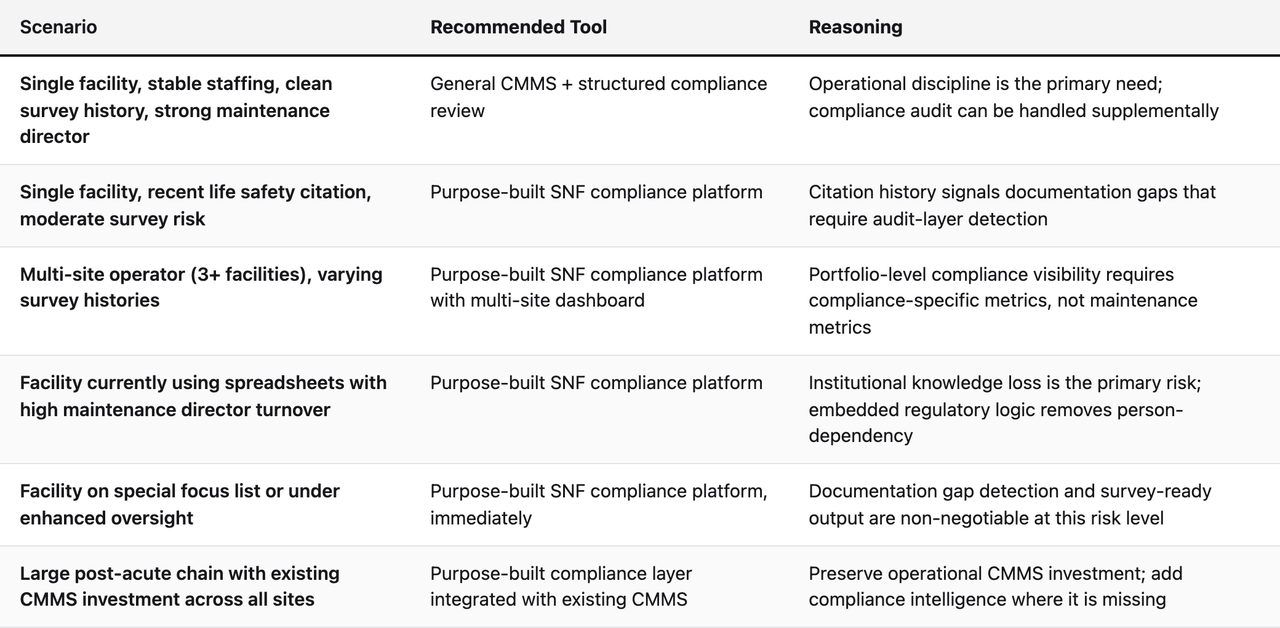
The choice between a general CMMS and a purpose-built SNF compliance platform is not always obvious from a feature list alone. The right decision depends on the facility's current compliance posture, survey history, staffing stability, and operational complexity. This framework is designed to help administrators and maintenance directors think through the decision systematically.
The Survey Confidence Diagnostic
Start with a direct assessment of your current documentation posture. Answer these questions honestly:
- If a CMS surveyor walked in tomorrow and asked to see your last 12 months of fire drill records, could you produce them within 10 minutes in a format that clearly shows shift coverage for all required drills?
- If a sprinkler contractor identified a deficiency six months ago, can you immediately produce documentation showing how and when it was corrected?
- If your maintenance director were out sick during a survey, could someone else navigate your documentation system and answer a surveyor's questions?
- Does anyone at your facility review completed inspection records against the specific data elements required by NFPA 110, NFPA 101, or your state's equivalent standards?
- Do you have documentation gaps you are not aware of?
If the honest answer to any of these questions is "no" or "I'm not sure," a general CMMS will not close those gaps. The gaps exist not because tasks are not being completed, but because the documentation system does not have the regulatory logic to tell you when a completed task produced an incomplete record.
When a General CMMS Is the Right Tool
A general CMMS is genuinely appropriate in specific SNF contexts:
- The facility has a dedicated life safety compliance officer who understands NFPA and K-tag requirements deeply enough to configure and maintain a CMMS for compliance purposes, and who will remain in that role long enough to make the investment worthwhile.
- The facility's primary need is operational work order management and equipment tracking, with compliance documentation as a secondary use case handled separately.
- The facility has an existing CMMS investment with significant configuration already in place, and the cost of transition to a purpose-built platform outweighs the compliance risk of maintaining the current system with supplemental controls.
- The facility is in a low-survey-risk environment with a strong survey history and minimal outstanding citations.
Even in these cases, a general CMMS should be supplemented with a structured compliance review process that explicitly audits documentation against regulatory requirements. The CMMS handles operations. Something else handles compliance audit. The risk is that the "something else" often turns out to be nothing at all.
When a Purpose-Built SNF Compliance Platform Is the Right Tool
A purpose-built platform is the right choice in the following scenarios:
- The facility has received a life safety citation in the last two survey cycles and needs to demonstrate a systematic improvement in documentation practices.
- The maintenance director role has experienced turnover, and institutional knowledge about compliance documentation has been lost.
- The facility is a multi-site operator where regional visibility into compliance risk across facilities is operationally necessary.
- The facility's current documentation system cannot produce survey-ready output without significant manual compilation.
- The administrator or DON has identified that they cannot confidently answer the survey confidence diagnostic questions above.
- The facility is in a state with an aggressive survey program or has been placed on a special focus facility list.
The Hidden Cost Comparison: What You Are Actually Paying For
Software pricing comparisons in the SNF space almost always focus on the wrong number. The license price or monthly subscription cost is visible and easy to compare. The cost of a single deficiency citation, an enforcement action, or a civil monetary penalty is much larger and receives far less attention in the buying decision.
The True Cost of Spreadsheets
Spreadsheets appear to cost nothing. The actual cost structure is different. A maintenance director spending significant hours each month manually compiling, organizing, and formatting compliance documentation is generating a real labor cost that simply does not appear in a software budget. More importantly, spreadsheets carry an actuarial risk: the probability of a documentation gap producing a citation, multiplied by the cost of that citation, is a real expected cost that belongs in any honest comparison.
According to CMS enforcement guidance, civil monetary penalties for life safety deficiencies can range from several hundred to several thousand dollars per day of noncompliance. A single K-tag citation that triggers a revisit survey, a Plan of Correction, and ongoing monitoring creates costs that can easily exceed the annual subscription cost of any compliance software platform. The spreadsheet's apparent zero cost is an accounting artifact, not an economic reality.
The True Cost of a General CMMS
General CMMS licensing for a healthcare environment typically runs in a range that varies widely by platform, feature set, and number of users or assets. Enterprise platforms with robust feature sets can represent a significant annual investment before configuration and training costs. These platforms also require ongoing administration, which typically means a designated person responsible for keeping templates current, managing user access, and building the custom reports needed to approximate compliance output.
The configuration investment to make a general CMMS approximate compliance functionality is substantial. Facilities that have attempted this consistently report that the initial configuration takes months and that ongoing maintenance of the configuration requires continued attention. When a regulatory change occurs or a new K-tag category becomes a survey focus area, the CMMS configuration has to be updated manually. There is no vendor responsible for keeping the regulatory logic current, because the regulatory logic was never the vendor's product.
The True Cost of a Purpose-Built Compliance Platform
Purpose-built SNF compliance platforms are typically priced at a premium over general CMMS tools, reflecting the specialized regulatory knowledge embedded in the product. For a single facility, this premium is often modest relative to the operational cost of managing compliance without it. For a multi-site operator, the economics shift further in favor of a purpose-built platform because the compliance visibility value scales with the number of facilities while the per-facility cost typically decreases.
The correct framing for evaluating this cost is not "how much does this software cost?" but "what is the cost of the documentation gaps this software would find and close?" A platform that prevents a single life safety citation with a civil monetary penalty attached has paid for years of its subscription cost. A platform that gives a regional director accurate compliance risk visibility across twelve facilities during a period of heightened survey activity has a value that is difficult to overstate.
Life Safety Software for SNFs: The Regulatory Landscape Driving Adoption
The shift toward life safety software for SNF operations is not happening in isolation. It is driven by a specific and well-documented pattern in CMS survey activity that has made documentation-quality enforcement a higher priority than it was in earlier survey cycles.
CMS's Fire Safety Survey process, conducted under the auspices of the Life Safety Code survey, has become increasingly sophisticated in how it evaluates documentation. Surveyors are specifically trained to look for the patterns that indicate documentation was reconstructed rather than contemporaneous, that inspection intervals do not precisely match regulatory requirements, and that deficiency tracking lacks the corrective action follow-through that compliance requires. The days when a well-organized binder could survive a survey regardless of what it actually contained are largely over.
State survey agencies have also increased their focus on life safety documentation in response to CMS guidance emphasizing the connection between environment of care deficiencies and resident safety outcomes. In several states, life safety citations now trigger automatic referrals to additional oversight processes that can significantly increase the cost and operational burden of a single documentation gap.
The NFPA standards themselves have also evolved. NFPA 101 Life Safety Code and NFPA 99 are updated on regular cycles, and each update cycle has historically introduced new documentation requirements or clarified existing ones in ways that create new citation opportunities for facilities whose compliance systems are not actively maintained against the current standard. A purpose-built compliance platform whose vendor maintains the regulatory logic as standards evolve is fundamentally more resilient to this risk than a CMMS configured by someone who may not be tracking NFPA update cycles.
Implementation Reality: What Deployment Actually Looks Like for Each Option
The theoretical capabilities of any compliance tool are only as valuable as what actually gets implemented in the facility. Implementation reality varies dramatically across the three tool categories, and the gap between what a tool can do and what a facility actually uses it for is one of the most underappreciated factors in compliance technology decisions.
Spreadsheet Implementation
Spreadsheet "implementation" is instantaneous, which is both its primary advantage and its primary risk. There is no onboarding process, no vendor relationship, no training requirement. The maintenance director opens a blank spreadsheet and starts building. The result reflects whatever knowledge that person has, organized however they think to organize it, capturing whatever fields they think to include.
This means that two facilities with identical regulatory profiles, using identical spreadsheets in theory, can have completely different compliance postures in practice depending entirely on the knowledge and discipline of the person maintaining the spreadsheet. There is no standardization, no regulatory enforcement, and no mechanism for identifying when the spreadsheet's structure has drifted away from current regulatory requirements.
General CMMS Implementation
General CMMS implementation for an SNF typically involves an initial setup phase that can run from a few weeks to several months depending on the complexity of the facility and the platform's configuration requirements. Asset records need to be entered. PM schedules need to be configured. User accounts need to be set up. Checklists need to be built. For a facility attempting to use the CMMS for compliance purposes, additional configuration work is required to approximate regulatory logic that is not built into the platform.
Most CMMS vendors provide implementation support, but that support is typically focused on getting the platform operational for general maintenance management, not on ensuring that compliance-specific configurations are correct. An SNF that wants to use a CMMS for life safety compliance documentation needs either internal expertise to configure it correctly or external consulting support, which adds cost and time to the implementation.
The ongoing maintenance burden is also significant. PM template updates, regulatory changes, new inspection requirements, and staff turnover all require active CMMS administration. In practice, many SNF CMMS implementations drift over time as the person responsible for maintaining the configuration changes or as the administrative burden of keeping the system current falls behind operational priorities.
Purpose-Built Compliance Platform Implementation
Purpose-built SNF compliance platforms like SEQURA are designed to deploy with the regulatory logic already built in. The task template library, inspection cadences, and data capture requirements are pre-configured based on NFPA standards and CMS survey expectations. Implementation focuses on configuring the facility's specific assets and systems to the existing template structure, rather than building that structure from scratch.
This means that implementation timelines are typically shorter and implementation risk is lower than with a general CMMS being configured for compliance use. The maintenance director does not need to know that a generator test requires kW load readings to be captured. The platform already knows that, and the form will not submit without them.
For multi-site operators, purpose-built platforms offer a standardization advantage that is genuinely valuable: the same regulatory logic, the same inspection templates, and the same documentation standards applied consistently across every facility in the portfolio. This standardization is nearly impossible to achieve with CMMS or spreadsheet approaches because both depend on individual facility-level configuration decisions.
The Modern CMMS Alternative: Rethinking What Compliance Infrastructure Should Do
The modern CMMS alternative for SNFs is not simply a CMMS with more features. It is a platform that reframes the entire question from "is maintenance being managed?" to "is documentation complete enough to survive a survey?" That reframing changes the architecture, the data model, the reporting logic, and the user experience in ways that matter at the moment of an unannounced visit.
For maintenance directors and technicians who are the daily users of these systems, the practical difference is also significant. A general CMMS presents them with work orders to complete. A purpose-built compliance platform presents them with task forms that enforce the right data capture at the point of completion, so that the documentation produced is complete by construction rather than by hope. Using a facility kiosk or mobile device, a technician completing a fire extinguisher inspection is prompted for every required data element. There is no opportunity to log "inspected" without capturing the specific information that makes the record defensible.
This is the operational reality that makes a purpose-built platform valuable not just for administrators and compliance officers but for the maintenance team doing the work. The system takes the regulatory complexity off their plate. They do not need to know what a K-tag is or which NFPA section governs today's inspection. They follow the task, complete the form, and the platform handles the rest.
Frequently Asked Questions
What is the difference between a CMMS and an SNF compliance platform?
A CMMS (computerized maintenance management system) is designed to manage equipment assets, work orders, and preventive maintenance schedules. An SNF compliance platform is designed to ensure that documentation produced by life safety inspections meets the specific data requirements of NFPA standards and CMS K-tag categories. A CMMS tracks whether maintenance was performed. A compliance platform tracks whether the documentation of that maintenance is complete enough to survive a survey.
Can a general CMMS be configured for SNF compliance documentation?
Yes, but the configuration requires deep knowledge of NFPA requirements and K-tag categories, significant upfront effort, and ongoing maintenance as standards evolve. Most SNF operators who attempt this find that the configuration burden is substantial and that the result approximates compliance functionality rather than achieving it fully. The absence of a built-in audit layer means that documentation gaps can still exist in a well-configured CMMS without anyone knowing.
Why do spreadsheets fail for SNF life safety compliance?
Spreadsheets fail because they have no built-in regulatory logic, no gap detection capability, and no mechanism for ensuring that completed entries contain the specific data elements required by NFPA and CMS standards. They also create serious risks around staff turnover, contemporaneous documentation concerns, and the inability to produce survey-ready output quickly during an unannounced visit.
What is a K-tag, and why does it matter for compliance software selection?
K-tags are the citation codes used by CMS surveyors to identify life safety deficiencies in skilled nursing facilities. Each K-tag maps to a specific NFPA requirement and has associated documentation expectations. Purpose-built SNF compliance platforms organize their task logic around K-tag categories, ensuring that documentation satisfies the specific requirements that surveyors check. General CMMS platforms have no concept of K-tags and require manual mapping by the facility.
How does an AI audit layer in a compliance platform work?
An AI audit layer reads completed inspection records, contractor reports, and shift logs, then cross-references them against the regulatory expectations for each asset and K-tag category. It identifies patterns that indicate documentation gaps: missing data fields, inspection intervals that do not match regulatory cadences, deficiencies in contractor reports that have not been reconciled with corrective action documentation, and fire drill records that do not demonstrate the required shift coverage. These gaps are surfaced before a survey, not discovered during one.
Is purpose-built compliance software significantly more expensive than a CMMS?
Purpose-built SNF compliance platforms typically carry a pricing premium over general CMMS tools, reflecting the specialized regulatory knowledge embedded in the product. However, the correct comparison is not license cost versus license cost. It is the total cost of each option, including configuration time, compliance risk, and the expected cost of citation-related consequences. A single life safety citation with an associated civil monetary penalty typically exceeds the annual cost of a purpose-built compliance platform.
What happens to compliance documentation when a maintenance director leaves?
With spreadsheets, institutional knowledge about the documentation system typically leaves with the person who built and maintained it. With a general CMMS, the configuration logic and the understanding of how it maps to regulatory requirements can be similarly person-dependent. With a purpose-built compliance platform, the regulatory logic is embedded in the platform itself, so staff turnover does not create the same vulnerability. The incoming director inherits a system that already knows what to capture and how to audit it.
How does a compliance platform handle contractor inspection reports?
Purpose-built SNF compliance platforms are designed to ingest contractor reports, parse their findings, and cross-reference identified deficiencies against the facility's corrective action records. This closes the gap that exists in both CMMS and spreadsheet systems, where contractor reports can be filed as attachments without anyone systematically tracking whether the deficiencies they identify have been addressed. Unreconciled deficiencies are a significant source of K-tag citations.
What is a CMMS software comparison missing when it doesn't include compliance-specific criteria?
Most CMMS software comparisons evaluate platforms on criteria like work order management, asset tracking, PM scheduling, and reporting flexibility. These are all legitimate dimensions for general maintenance management. But for SNF operators, the critical dimensions are K-tag awareness, documentation gap detection, survey-ready output formatting, contractor report reconciliation, and regulatory cadence enforcement. A CMMS comparison that omits these criteria is not useful for an SNF compliance decision.
How do purpose-built platforms serve multi-site SNF operators differently than single-facility users?
For multi-site operators, purpose-built compliance platforms provide portfolio-level compliance visibility that allows regional managers and COOs to identify which facilities carry the highest documentation risk at any given time. They also enable standardization of documentation practices across all facilities, which is nearly impossible to achieve with CMMS or spreadsheet approaches. The per-facility cost of a purpose-built platform typically decreases with scale, improving the economics for larger operators.
What should an administrator look for in evaluating life safety software for SNF operations?
Key evaluation criteria include: whether the platform's task templates are built specifically around NFPA 101, NFPA 99, and CMS K-tag categories; whether the platform includes an audit layer that detects documentation gaps rather than just recording completion; whether inspection cadences are tied to regulatory requirements rather than user-defined intervals; whether the platform can ingest and reconcile contractor reports; and whether it generates output formatted for surveyor review rather than maintenance management reporting.
Can SEQURA integrate with an existing CMMS?
SEQURA is designed as a compliance and documentation intelligence layer that can operate alongside existing operational systems. For facilities with an established CMMS investment that serves operational maintenance management well, SEQURA addresses the compliance documentation gap that general CMMS platforms leave, without requiring a full system replacement. The two layers address different questions: the CMMS asks whether maintenance is being performed, and SEQURA asks whether the documentation of that maintenance will survive a survey.
Key Takeaways
- Tool category is the primary determinant of compliance capability. Spreadsheets, general CMMS platforms, and purpose-built SNF compliance platforms are designed around fundamentally different questions. The right choice depends on which question matters most for your facility's current situation.
- Spreadsheets carry the highest documentation risk because they have no built-in regulatory logic, no gap detection, and are entirely dependent on the knowledge and discipline of the person maintaining them. For any facility under meaningful survey pressure, they are not a compliance tool.
- General CMMS platforms are excellent operational tools that do not solve compliance documentation problems. They track whether maintenance was performed. They do not detect whether the documentation produced by that maintenance is complete enough to satisfy K-tag requirements.
- Purpose-built SNF compliance platforms embed regulatory logic in the platform itself, enforcing correct data capture at the point of completion and auditing completed records against regulatory expectations. This is the only architecture that reliably detects documentation gaps before a surveyor does.
- The audit layer is the capability that separates compliance platforms from everything else. The ability to read completed records, cross-reference them against regulatory expectations, and surface gaps is what makes the difference between a documentation system and a compliance intelligence system.
- True cost comparison must include citation risk, not just license cost. A single life safety citation with associated penalties typically exceeds the annual cost of a purpose-built compliance platform. The spreadsheet's apparent zero cost is not an economic reality.
- Multi-site operators have a qualitatively different problem that only purpose-built compliance platforms address: portfolio-level visibility into compliance risk across facilities, standardized documentation practices, and the ability to prioritize attention based on actual survey risk rather than maintenance metrics.
- Staff turnover is a compliance risk that tool selection either amplifies or mitigates. Systems that depend on individual knowledge to function correctly are fragile when that person leaves. Platforms with embedded regulatory logic are resilient to turnover by design.
About the author
Benjamin Terebelo · Founder
Benjamin is the founder of SEQURA, a compliance platform purpose-built for healthcare facilities. He builds at the intersection of healthcare operations and software, maintaining a focus on bringing modern tooling to systems that the broader industry has largely left behind.
About the author
Benjamin Terebelo · Founder
Benjamin is the founder of SEQURA, a compliance platform purpose-built for healthcare facilities. He builds at the intersection of healthcare operations and software, maintaining a focus on bringing modern tooling to systems that the broader industry has largely left behind.