
The Digital Transformation of SNF Plant Operations: What Compliance-Centered Platforms Do That Generic Maintenance Tools Cannot

Most SNF plant operations teams are not failing because they lack discipline. They are failing because the tools they use were never designed to answer the question that matters most in a skilled nursing facility: would this documentation survive a CMS surveyor's clipboard?
Generic computerized maintenance management systems (CMMS) were built for industrial and commercial facilities. They optimize work order throughput, track asset history, and schedule preventive maintenance by equipment lifecycle. These are genuinely useful functions. But the regulatory environment inside a skilled nursing facility is categorically different from a commercial building or a manufacturing plant, and that difference is not cosmetic. It reaches into the structure of what "compliance" means, what "documentation" must contain, and what the consequences of a gap look like.
This article is not a buyer's guide. It is a structural analysis. The goal is to explain, at a technical and operational level, why compliance-centered platforms designed for SNF plant operations can do things that generic maintenance tools are architecturally incapable of doing, and why that capability gap matters more now than it ever has before.
The Regulatory Environment That Generic CMMS Was Never Built For
Skilled nursing facilities operate under one of the most documentation-intensive regulatory frameworks in American healthcare. The Centers for Medicare and Medicaid Services (CMS) enforces the Life Safety Code requirements under NFPA 101, cross-referenced with NFPA 99 for healthcare facilities, and supplemented by state-level survey protocols that vary considerably across jurisdictions. Surveyors arrive unannounced. They ask for documentation going back 12 months or more. They look for specific K-tags, each of which maps to a discrete regulatory deficiency category.
Generic CMMS platforms were designed around a different compliance model entirely. In industrial and commercial facilities, "compliance" typically means meeting OSHA standards, manufacturer service intervals, or insurance inspection requirements. These are real obligations, but they share one feature that SNF compliance does not: they are largely driven by scheduled, anticipated inspections with defined notice periods. A boiler inspection by a third-party certifier happens on a known date. An OSHA audit follows a complaint or incident. The documentation burden is real but predictable.
In a skilled nursing facility, the surveyor walks in on a Tuesday morning with no advance notice. The maintenance director has, at most, a few minutes to produce documentation that spans months of inspections, fire drills, generator tests, and life safety checks. That documentation must be contemporaneous, meaning it must reflect the actual time and condition at the point of inspection, not reconstructed after the fact. It must be complete, covering every required frequency interval. And it must be internally consistent, with no unexplained gaps between what was scheduled and what was logged.
Generic CMMS tools can tell you that a task was completed. They cannot tell you whether the completed task record contains the specific data elements a CMS surveyor expects to see for that K-tag category. They cannot cross-reference a sprinkler inspection report against the deficiency resolution timeline required by NFPA 25. They cannot flag that your quarterly fire drill log is missing documentation for the night shift, which is a pattern surveyors specifically look for. These are not configuration gaps. They are architectural limitations rooted in the fact that these tools were never designed to model the regulatory expectations of CMS life safety surveys.
What "Documentation Gap" Actually Means in SNF Context
In a generic maintenance environment, a documentation gap means a task was missed or not recorded. In an SNF context, a documentation gap is a potential citation. K-tags are not scored by how many inspections you completed. They are triggered by the presence of a deficiency, and a missing or incomplete record is treated as evidence that the required activity did not occur.
This creates a fundamentally different risk profile. A commercial facility with a missed PM cycle faces deferred maintenance risk. An SNF with a missed fire drill documentation entry faces a K-tag that can trigger immediate jeopardy classification, civil monetary penalties, or in severe cases, termination from the Medicare and Medicaid programs. The CMS State Operations Manual makes clear that surveyors are evaluating documentation as evidence of practice, not as an administrative courtesy.
Generic CMMS platforms were not built to understand this distinction. They record completion. They do not audit sufficiency.
The Structural Difference Between Maintenance Management and Compliance Management
The phrase "digital transformation SNF plant operations" gets used loosely in the market, applied to anything from switching from paper work orders to a mobile app. But genuine digital transformation in this context means replacing a paper-based compliance system with a digital one that actually models the regulatory framework the facility operates under. These are not the same thing, and the distinction has real operational consequences.
Maintenance management, at its core, is about asset reliability. The question it answers is: how do we keep equipment running at the lowest lifecycle cost? The inputs are asset condition data, manufacturer service intervals, parts inventory, and technician labor. The output is a scheduled work order queue and an asset history log. This is a legitimate operational function, and SNF plant operations absolutely need it.
Compliance management, at its core, is about regulatory defensibility. The question it answers is: if a surveyor audited our documentation today, what would they find? The inputs are the regulatory framework itself (NFPA 101, NFPA 99, CMS Conditions of Participation, state survey protocols), the current state of the facility's documentation, and the gap between what is documented and what is required. The output is a prioritized list of documentation risks, not equipment risks.
These are related but distinct functions. A facility can have excellent equipment reliability and terrible compliance documentation. A generator that runs perfectly but has incomplete monthly test logs is a compliance liability even though it is not a maintenance problem. A fire suppression system that was inspected on schedule but whose contractor report contains unresolved deficiency notations without a documented remediation plan is a K-tag waiting to happen, regardless of whether the system is functional.
Why Generic CMMS Cannot Bridge This Gap Through Configuration
The most common response from CMMS vendors when confronted with SNF-specific compliance requirements is to suggest that the platform can be configured to handle them. Custom forms, custom task templates, custom reporting. This is technically true in a narrow sense and practically inadequate in almost every real-world SNF deployment.
Configuration-based approaches fail for three structural reasons:
- The regulatory framework is not static. NFPA 101 and NFPA 99 are updated on regular cycles, and CMS Conditions of Participation change through rulemaking. State survey protocols evolve. A configured CMMS task template reflects the regulatory requirements as they existed when the template was built. When those requirements change, someone has to manually update every affected template, across every asset category, at every facility. Generic CMMS vendors have no regulatory update mechanism. Compliance-centered platforms built for SNFs do.
- Configuration requires regulatory expertise the maintenance director does not have. Correctly configuring a CMMS to capture all required data elements for a monthly generator test, for example, requires knowing exactly what a CMS surveyor expects to see in that record: kW load, runtime, transfer switch operation, fuel level, any observed anomalies, and the technician signature with timestamp. Most CMMS implementations in SNFs are configured by IT staff or facility administrators who do not have this knowledge, which means the configured forms are incomplete in ways that are invisible until a surveyor points them out.
- Configuration does not produce audit intelligence. Even a perfectly configured CMMS that captures all required data elements cannot read a contractor's inspection report and determine whether the deficiencies noted have been properly documented for remediation. It cannot cross-reference a fire drill log against NFPA 101 frequency requirements and flag that the 2:00 AM drill has not been conducted in the required interval. These analytical functions require a system that understands the regulatory logic, not just a system that stores data.
How Compliance-Centered Platforms Model Regulatory Logic
The core architectural difference between a compliance-centered SNF platform and a generic CMMS is that the compliance platform encodes regulatory logic as a first-class system function. It does not store tasks and let users define their own rules. It starts from the regulatory framework and builds the operational workflow around it.
In practical terms, this means the platform's task library is not a blank template system that users populate. It is a curated, professionally validated library of inspection tasks, schedules, and data requirements derived directly from NFPA 101, NFPA 99, and CMS survey protocols. Each task in the library is associated with specific regulatory citations, required frequencies, required data elements, and the K-tag categories that a failure to complete or document correctly would implicate.
When a maintenance director schedules a monthly fire pump test, they are not creating a custom work order. They are instantiating a regulatory task that already knows what data it needs to capture, how often it must occur, and what a complete record looks like versus an incomplete one. When the technician completes the task, the platform does not just mark it done. It evaluates whether the submitted record contains all required elements and flags any that are missing.
The Two-Layer Architecture That Changes Survey Preparation
The most sophisticated compliance-centered platforms operate on two distinct layers that work together to replace the paper binder with something categorically more powerful.
The operational layer handles what the maintenance team does every day: scheduling, assigning, completing, and logging inspections. This is the layer that replaces paper logs and manual calendars. It ensures that the right tasks are assigned to the right people at the right frequency, and that completion is logged contemporaneously with the actual inspection, including the specific data elements the regulatory framework requires for that task category. Mobile completion, kiosk completion, and back-office logging all feed the same central record.
The analytic layer is what separates compliance-centered platforms from everything else. This layer does not just record what the team has done. It reads the accumulated documentation record, cross-references it against regulatory expectations, and surfaces the gaps that a surveyor would find before the surveyor arrives. Missing kW load readings on generator test records. Sprinkler inspection reports from contractors that note deficiencies without documented remediation timelines. Fire drill logs that show three quarterly drills but no documentation of the required shift coverage variation. These are the exact documentation patterns that produce the majority of life safety citations in SNF surveys, and they are typically invisible to the maintenance director reviewing their own paper binder.
This analytic function is not just reporting. It is predictive auditing: the systematic application of regulatory intelligence to the facility's own documentation record to find what a surveyor would find. No generic CMMS offers this capability because no generic CMMS encodes the regulatory logic required to perform it.
The K-Tag Problem That No Work Order System Can Solve
K-tags are the specific deficiency codes used by CMS surveyors to cite life safety violations in long-term care facilities. CMS maps K-tags to specific sections of NFPA 101, and each K-tag has its own documentation requirements, remediation expectations, and citation consequences. Understanding the K-tag framework is essential to understanding why generic maintenance tools are structurally inadequate for SNF compliance.
A work order system answers the question: was this task completed? A K-tag framework answers the question: is the documentation record for this asset category sufficient to demonstrate compliance with the specific NFPA standard that a surveyor is evaluating? These are different questions with different inputs and different evaluation criteria.
Consider K-tag 0345, which relates to fire alarm system maintenance and testing. A generic CMMS might have a task called "fire alarm inspection" scheduled annually. When the contractor completes the inspection and the maintenance director uploads the report, the CMMS records the task as complete. What the CMMS does not do is read the contractor's report, identify any deficiencies noted (even minor ones), verify that each deficiency has a documented remediation status, and confirm that the overall record is sufficient to satisfy the specific requirements of NFPA 72 as incorporated by NFPA 101 for this K-tag category.
A surveyor evaluating K-0345 will look at exactly those elements. They will look at the inspection report. They will ask about any deficiencies. They will want to see documentation of remediation or an active plan with a timeline. If the contractor noted even a minor issue that was not subsequently documented for resolution, that is a potential citation regardless of whether the inspection itself was completed on schedule.
This is the K-tag problem. It is not a scheduling problem. It is a documentation sufficiency problem that requires regulatory intelligence to detect and correct. Generic CMMS platforms do not have that intelligence. Compliance-centered platforms built for SNFs do.
Common K-Tag Vulnerabilities That Generic Tools Miss
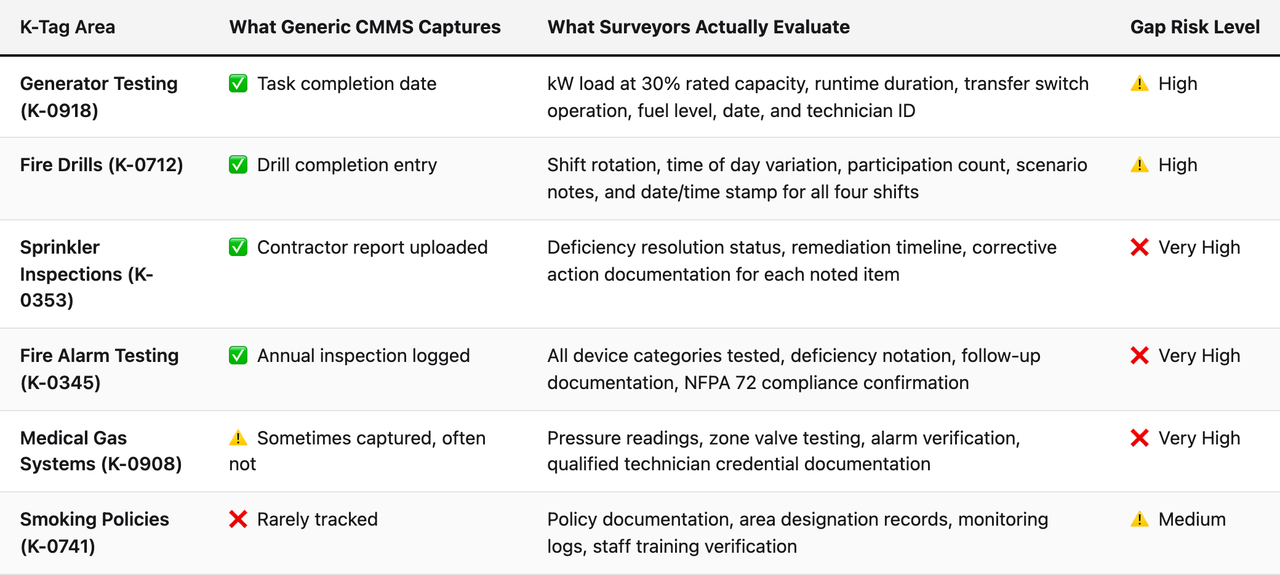
Digital Maintenance Management vs. Digital Compliance Management: A Framework for SNF Decision-Makers
SNF administrators and operations leaders evaluating technology platforms need a clear framework for distinguishing tools that solve different problems. The following decision framework is designed for facilities weighing whether a generic CMMS, a hybrid approach, or a compliance-centered platform is the right fit for their operational and regulatory context.
The Four-Question Diagnostic
Question 1: What is your primary regulatory risk driver? If your facility's highest-risk exposure comes from equipment failure, a CMMS focused on preventive maintenance scheduling may be your most urgent need. If your highest-risk exposure comes from survey citations, particularly life safety K-tags, your primary need is a compliance-centered platform. Most SNFs have both risks, but life safety citations have a direct revenue and operational continuity impact that equipment failures rarely match in severity or speed.
Question 2: What does your documentation record look like under surveyor scrutiny? Pull your last three months of fire drill logs, generator test records, and the most recent sprinkler inspection report. Ask yourself: if a surveyor walked in today, would each of these records contain every element they are trained to look for? If you are not certain, you have a documentation sufficiency problem, not a scheduling problem. A CMMS will not solve it.
Question 3: How does your team currently capture completion data? Paper logs, verbal reports to the maintenance director, and after-the-fact data entry are the most common patterns in SNF plant operations. Each of these creates contemporaneity risk: the record does not reflect the actual time and condition of the inspection. Compliance-centered platforms with mobile and kiosk completion capture data at the point of inspection, which is exactly what CMS expects when it evaluates whether documentation is contemporaneous.
Question 4: Who is responsible for knowing when your documentation has a gap? In most SNFs, the maintenance director is responsible, but has no systematic mechanism for detecting gaps across hundreds of recurring tasks, contractor reports, and shift logs. In a compliance-centered platform, gap detection is a system function, not a human one. The platform surfaces what is missing. The maintenance director acts on it. This is a fundamentally different operational model with fundamentally different survey outcomes.
Platform Capability Comparison: What the Market Actually Offers
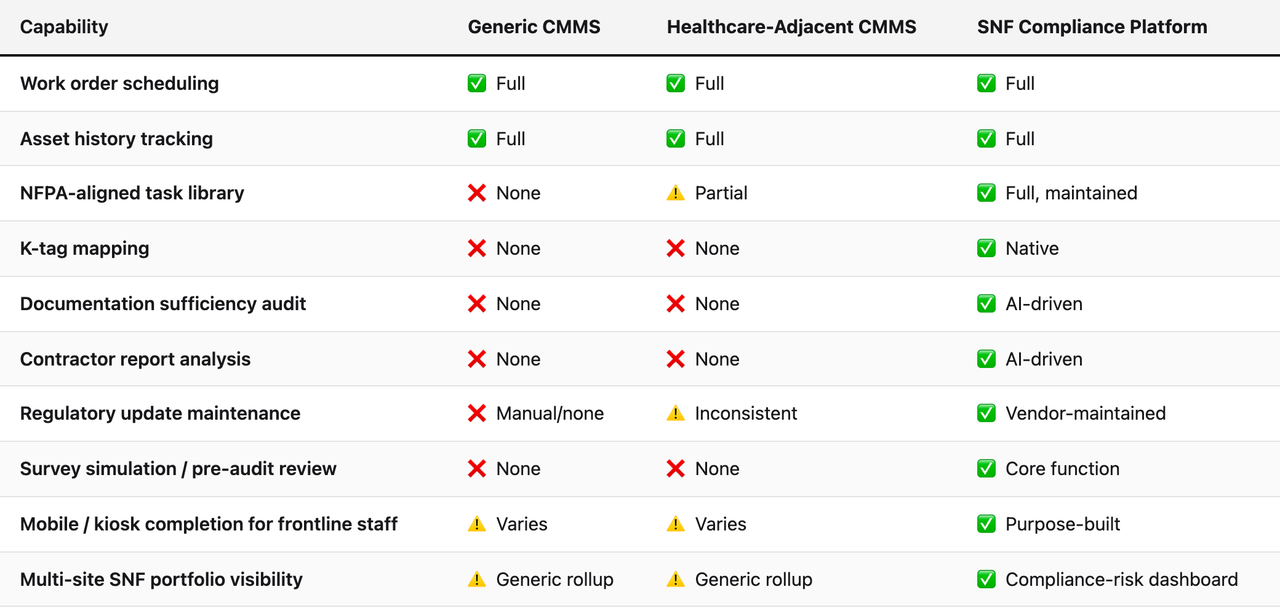
What Contemporaneous Documentation Actually Requires (and Why Most SNFs Fail This Test)
The concept of contemporaneous documentation is central to CMS survey evaluation, and it is one of the most consistently misunderstood requirements in SNF plant operations. Contemporaneous does not simply mean "recorded in a log." It means the record was created at the time of the activity, by the person who performed it, capturing the conditions that existed at that moment.
This distinction has significant practical implications. A maintenance director who walks through the facility, performs a series of inspections, and then enters all the results into a paper log at the end of the day is not creating contemporaneous documentation, even if everything entered is accurate. A surveyor who examines that log and notices that twenty tasks were all recorded at 4:47 PM on the same day will raise serious questions about whether those inspections actually occurred as documented.
The paper binder system that most SNF plant operations teams currently use is structurally vulnerable to this challenge. Tasks get batched. Records get entered after the fact. Contractors submit reports that sit in a folder for weeks before anyone reviews them. The maintenance director, who is typically managing a large facility with a small team and constant competing priorities, does not have the time or the system support to ensure that every record is captured contemporaneously and completely.
The Kiosk and Mobile Capture Advantage
Compliance-centered platforms that support mobile and kiosk-based task completion address contemporaneous documentation at the point of data entry. When a technician completes a monthly eyewash station flush and records it on a kiosk mounted in the utility corridor, the platform captures the timestamp automatically. The record reflects the actual time of completion, not the time the maintenance director reviewed it or entered it into a log.
This is not a minor convenience feature. It is a fundamental shift in the evidentiary quality of the documentation. A surveyor reviewing kiosk-captured records sees timestamps that are distributed naturally across the workday, matching the actual work schedule of the facility. They see completion data that includes the specific technician who performed the task, the exact time, and all required data elements captured in the moment. This is the kind of documentation that survives scrutiny because it reflects reality.
The kiosk model also addresses a staffing reality that is often overlooked in technology discussions. SNF plant operations teams typically include maintenance technicians and EVS staff who are not comfortable with complex software interfaces. A shared kiosk mounted in a common area, with a simple task list and guided data entry, is accessible to the entire team without requiring individual device management, login credential distribution, or technology training overhead. Compliance-centered platforms built for SNF environments design their kiosk interfaces with this operational reality in mind.
The Multi-Site Compliance Intelligence Problem
For regional directors, COOs, and VP-level operations leaders managing portfolios of SNF facilities, the compliance visibility challenge is compounded by scale. A single facility's documentation risk is hard enough to manage. Across a portfolio of five, ten, or twenty facilities, it becomes effectively invisible without purpose-built tooling.
Generic CMMS platforms can produce multi-site work order reports. They can show task completion rates by facility and flag overdue PMs across a portfolio. This is useful operational data. But it answers the wrong question for a VP of Operations whose primary concern is survey risk. The question that matters is not "which facilities have the most overdue work orders?" It is "which facilities have the most significant documentation gaps relative to their CMS survey obligations, and which of those gaps are most likely to produce citations at the next unannounced visit?"
These are different questions. A facility with a 95% PM completion rate might have catastrophic documentation gaps in its fire drill records if the completed drills are not logged with the required shift coverage data. A facility with a modest backlog of routine work orders might have a perfectly defensible life safety documentation record. Generic work order reporting cannot distinguish between these situations because it does not model the regulatory framework that determines what "adequate" documentation looks like.
Portfolio-Level Compliance Risk Scoring
Compliance-centered platforms designed for multi-site SNF operators approach this problem through regulatory risk scoring rather than operational metrics. Each facility's documentation record is evaluated against the same regulatory framework, producing a risk profile that reflects the actual survey exposure at that facility, not just its work order performance.
A regional director using this kind of platform can look at a dashboard that shows, across all facilities in the portfolio, which ones have outstanding sprinkler deficiency documentation, which have fire drill records that are missing required shift rotations, and which have generator test logs with incomplete data elements. This information is actionable in a way that generic work order completion data is not, because it maps directly to the K-tag categories that surveyors will evaluate.
For COOs and VPs of Operations at multi-site SNF chains, this capability transforms compliance from a reactive, site-by-site problem into a proactive, portfolio-level management function. Instead of learning about documentation gaps from surveyors, they learn about them from their own system, with enough lead time to correct them before the surveyor arrives.
The Hidden Cost of "Good Enough" Maintenance Technology in SNF Operations
The technology selection conversation in SNF plant operations is often framed around cost: what does the platform cost per facility, per month, compared to alternatives? This framing systematically underweights the cost of the problem the platform is solving, which is not maintenance inefficiency but regulatory citation risk.
CMS civil monetary penalties for life safety deficiencies are calculated on a per-day basis and can accumulate rapidly during the period between when a deficiency is identified and when it is corrected. For serious deficiencies that trigger immediate jeopardy classification, penalties can reach into the tens of thousands of dollars per day. Beyond the financial penalty, a significant life safety citation can trigger enhanced oversight, more frequent survey cycles, and reputational damage that affects census and referral relationships.
The cost of a compliance-centered platform is measured in hundreds or low thousands of dollars per facility per month, depending on the vendor and the tier of service. The cost of a single serious life safety citation, including penalties, remediation resources, legal review, and the administrative burden of the correction plan, typically exceeds an entire year of platform subscription costs. This is not a hypothetical calculation. It is the operational math that administrators and COOs need to apply when evaluating whether the incremental cost of a compliance-centered platform over a generic CMMS is justified.
The Invisible Cost: Maintenance Director Bandwidth
There is a second cost that is even less visible in technology selection conversations: the time the maintenance director spends managing compliance documentation manually. In most SNFs, the maintenance director spends a meaningful portion of their week reviewing paper logs, chasing down contractor reports, compiling records for anticipated surveys, and reconstructing documentation that was captured inconsistently. This is time that is not spent on actual maintenance work, staff development, or proactive facility improvement.
Compliance-centered platforms reduce this burden not by automating everything, but by making the maintenance director's attention go further. When the system surfaces specific documentation gaps rather than requiring the director to review every record manually, the director can focus on resolving the gaps rather than finding them. The time savings per week, multiplied across the year and across a portfolio, represents a significant operational resource that is effectively invisible in a cost-per-facility comparison.
Facilities Management Software Selection: What SNF-Specific Platforms Actually Require of the Vendor
The facilities management software market is large and growing, with dozens of platforms claiming healthcare applicability. SNF decision-makers evaluating this market need to apply criteria that are specific to the regulatory environment they operate in, not generic healthcare IT criteria.
The following requirements are non-negotiable for any platform claiming to support SNF life safety compliance:
Regulatory task library with documented sources. The platform's inspection task library must be traceable to specific NFPA 101, NFPA 99, and CMS regulatory citations. Vendors should be able to show which regulatory requirement each task template is derived from and how those templates are updated when the underlying regulation changes. A vendor that cannot produce this documentation is selling a generic scheduling tool with healthcare branding.
K-tag mapping as a native function. The platform should organize compliance tasks by K-tag category, not just by asset type or department. This mapping allows maintenance directors to understand their documentation record in the same framework that surveyors use to evaluate it, which is the only framework that matters for survey preparation.
Contractor report integration with deficiency tracking. Life safety inspections are frequently performed by licensed contractors (fire alarm companies, sprinkler inspection firms, generator service companies), and the contractor's report is the primary documentation artifact for those inspections. The platform must have a mechanism for ingesting contractor reports, identifying any deficiencies noted, and tracking the remediation status of each deficiency through to resolution. A platform that treats contractor report upload as document storage rather than compliance intelligence is not solving the K-tag problem.
Contemporaneous capture infrastructure. The platform must support completion capture at the point of inspection, through mobile, kiosk, or both. Platforms that require back-office data entry as the primary completion mechanism are perpetuating the same contemporaneous documentation vulnerability that paper binders create.
Active regulatory maintenance by the vendor. The vendor must have a defined process for updating task templates, data requirements, and compliance logic when NFPA standards or CMS regulations change. This is not a feature request. It is a core service requirement. An SNF that deploys a compliance platform and then discovers two years later that the platform's task templates reflect outdated regulatory requirements has not reduced its survey risk. It has hidden it.
Frequently Asked Questions
What is the difference between a CMMS and a compliance platform for SNFs?
A CMMS (computerized maintenance management system) manages work orders, asset history, and preventive maintenance schedules. A compliance platform for SNFs does those things but also models the regulatory framework that governs life safety documentation, maps tasks to K-tag categories, audits documentation for sufficiency, and surfaces gaps before a surveyor finds them. The core distinction is that a CMMS records what your team did, while a compliance platform evaluates whether what your team did and documented is sufficient to satisfy CMS and NFPA requirements.
Can a generic CMMS be configured to meet SNF life safety compliance requirements?
In theory, a generic CMMS can be configured to capture more compliance-relevant data. In practice, this approach fails for three reasons: the configuration requires regulatory expertise most implementation teams do not have, the templates go stale when regulations change, and no amount of configuration gives a generic CMMS the ability to audit documentation sufficiency or read contractor reports for unresolved deficiencies. Configuration can make a CMMS capture more data. It cannot make a CMMS understand regulatory logic.
What are K-tags and why do they matter for SNF plant operations?
K-tags are the deficiency codes CMS surveyors use to cite life safety violations in long-term care facilities. Each K-tag maps to a specific section of NFPA 101, and citations can trigger civil monetary penalties, enhanced survey frequency, and in severe cases, termination from Medicare and Medicaid. Plant operations documentation is one of the primary sources of K-tag citations because incomplete or insufficient records are treated as evidence that required activities did not occur. Most life safety K-tags are documentation problems, not equipment problems.
What does "contemporaneous documentation" mean in the context of CMS surveys?
Contemporaneous documentation means records that were created at the time of the activity, by the person who performed it, reflecting the conditions that existed at that moment. CMS surveyors are trained to look for patterns that suggest records were created after the fact, such as multiple tasks logged at the same timestamp. Compliance platforms with mobile and kiosk capture address this by recording completion timestamps automatically at the point of inspection, producing a documentation record that is both accurate and defensible.
How do compliance platforms handle contractor inspection reports?
SNF-specific compliance platforms are designed to ingest contractor inspection reports (from fire alarm companies, sprinkler inspectors, generator service firms, and others) and process them as compliance documentation rather than just file attachments. The platform identifies any deficiencies noted in the report, creates tracked remediation items for each, and monitors those items through to resolution. This ensures that a sprinkler inspection that notes a minor deficiency does not become a K-tag citation because the remediation was never documented.
Is digital transformation in SNF plant operations really necessary, or is paper documentation sufficient?
Paper documentation is technically permissible under CMS regulations, but it creates significant practical vulnerabilities. Paper logs are susceptible to gaps, inconsistencies, and contemporaneity challenges that compliance-centered digital platforms address systematically. More importantly, paper binders do not audit themselves. A maintenance director with a paper system has no mechanism for discovering documentation gaps before a surveyor finds them. Digital platforms with analytic layers change this fundamentally by making gap detection a system function rather than a human one.
What should SNF administrators look for when evaluating facilities management software?
Administrators should evaluate whether the platform's task library is traceable to specific NFPA and CMS regulatory citations, whether the platform maps tasks to K-tag categories, whether it can process contractor inspection reports with deficiency tracking, whether it supports contemporaneous capture through mobile or kiosk interfaces, and whether the vendor has a defined process for updating regulatory content when standards change. A platform that cannot satisfy all five of these requirements is not a compliance platform. It is a scheduling tool.
How does a compliance platform help multi-site SNF operators?
For regional and portfolio-level operators, compliance platforms provide regulatory risk visibility across all facilities in a standardized framework. Instead of reviewing individual facility reports to assess survey readiness, regional directors can see a portfolio-level compliance risk dashboard that flags which facilities have the most significant documentation gaps relative to their CMS survey obligations. This transforms compliance management from a reactive, site-by-site function into a proactive, portfolio-level capability.
What is the financial case for investing in an SNF compliance platform over a generic CMMS?
The financial case rests on the asymmetry between the cost of the platform and the cost of a serious life safety citation. CMS civil monetary penalties for life safety deficiencies can accumulate rapidly, and a single significant citation event can exceed a full year of platform subscription costs across a portfolio. Beyond direct penalties, citations trigger enhanced survey oversight, corrective action planning, and reputational impacts that affect census and referral relationships. The platform cost is predictable. The citation cost is not.
Can compliance platforms be used by EVS staff and technicians who are not technology-savvy?
Yes, and the best SNF compliance platforms are specifically designed for this user profile. Shared kiosk interfaces with guided task lists and simple data entry screens are accessible to technicians and EVS staff without individual device management or extensive technology training. The kiosk model is particularly well-suited to SNF plant operations because it captures completion data at the point of inspection without requiring each team member to have a personal device or complex login credentials.
How often do NFPA standards and CMS requirements change, and how does a compliance platform keep up?
NFPA 101 and NFPA 99 are updated on roughly three-year cycles, with interim amendments possible. CMS Conditions of Participation change through federal rulemaking, which can occur at any time. State survey protocols vary and can be updated by state health departments independently. A compliance platform vendor with an active regulatory maintenance program monitors these changes and updates the platform's task templates, data requirements, and compliance logic accordingly. This is a core differentiator between SNF-specific platforms and generic tools, which have no mechanism for regulatory update maintenance.
What is predictive auditing, and how does it differ from predictive maintenance?
Predictive maintenance uses equipment condition data to forecast when maintenance will be needed before a failure occurs. Predictive auditing uses documentation analysis to forecast what gaps a regulatory auditor would find before the auditor arrives. In an SNF context, predictive auditing means the platform continuously evaluates the facility's documentation record against regulatory expectations, surfacing gaps and inconsistencies that a CMS surveyor would cite, so the maintenance team can correct them proactively. This is the core analytic function that distinguishes compliance-centered platforms from all other maintenance and facilities management tools.
Key Takeaways
- Generic CMMS platforms solve a different problem. They are built for maintenance scheduling and asset management, not for the documentation sufficiency requirements of CMS life safety surveys. Configuring a generic CMMS to handle SNF compliance is a workaround, not a solution.
- K-tags are documentation problems more than equipment problems. Most life safety citations in SNF surveys result from incomplete or insufficient documentation records, not from equipment failures. A tool that records task completion without auditing documentation sufficiency does not reduce K-tag risk.
- Contemporaneous capture is not optional. CMS surveyors are trained to identify after-the-fact record construction. Platforms with mobile and kiosk capture at the point of inspection produce documentation that is both accurate and defensible in a way that paper binders and after-the-fact data entry cannot match.
- Contractor reports are compliance documents, not file attachments. Sprinkler, fire alarm, and generator inspection reports from licensed contractors contain deficiency notations that must be tracked through remediation. A platform that treats these reports as uploads rather than compliance intelligence is leaving the most common K-tag vulnerabilities unaddressed.
- The analytic layer is the differentiator. The capability that separates compliance-centered platforms from all other maintenance tools is predictive auditing: the systematic evaluation of a facility's own documentation record against regulatory expectations, surfacing gaps before surveyors find them. No generic CMMS offers this function because no generic CMMS encodes the regulatory logic required to perform it.
- Multi-site operators need portfolio-level compliance intelligence. Generic work order reporting cannot tell a regional director which facilities have the most significant survey risk. Compliance-centered platforms that provide K-tag-mapped risk scoring across a portfolio transform compliance from a reactive, site-by-site function into a proactive management capability.
- The financial case is asymmetric. Platform subscription costs are predictable and bounded. Citation costs, including CMS penalties, corrective action resources, enhanced survey oversight, and reputational impact, are not. The investment in a compliance-centered platform is justified by the cost of the problem it prevents, not by comparison to the cost of a cheaper tool that does not solve the same problem.
About the author
Benjamin Terebelo · Founder
Benjamin is the founder of SEQURA, a compliance platform purpose-built for healthcare facilities. He builds at the intersection of healthcare operations and software, maintaining a focus on bringing modern tooling to systems that the broader industry has largely left behind.
About the author
Benjamin Terebelo · Founder
Benjamin is the founder of SEQURA, a compliance platform purpose-built for healthcare facilities. He builds at the intersection of healthcare operations and software, maintaining a focus on bringing modern tooling to systems that the broader industry has largely left behind.