29 min read
The Environment of Care Compliance Chain: How a Single Unlogged Generator Test Connects to a K-Tag Deficiency
Trace the compliance chain from a single missed generator test log entry to a formal K-tag deficiency — and understand what documentation controls break the chain.
By Benjamin Terebelo

A generator test happens on a Tuesday afternoon. A technician starts the unit, watches the load transfer, checks the kW readings, and walks away satisfied that everything worked. The equipment performed exactly as designed. By every mechanical measure, the facility passed.
Six weeks later, a CMS surveyor arrives unannounced. She requests the emergency power supply system documentation. The technician's walk-away satisfied feeling does not appear anywhere in the binder. The log entry is incomplete. The kW load value is missing. The transfer time was never recorded. The test was real, but the documentation is not, and under CMS survey methodology, an undocumented test is an uncompleted test.
The result is a K-tag deficiency. Not because the generator failed. Because the paper trail failed. This is the environment of care compliance chain in action: a connected sequence of regulatory requirements where a single missing data point can collapse into a formal citation, a plan of correction, and in worst cases, a Condition of Participation finding that threatens the facility's Medicare certification.
This article traces that chain in full. From the federal requirement that creates the obligation, through the NFPA 110 testing standard that defines what documentation must contain, through the CMS K-tag category that captures the deficiency, to the documentation controls that break the chain before a surveyor ever walks through the door.
How the Environment of Care Compliance Chain Actually Works
The environment of care compliance chain is not a metaphor. It is a literal regulatory architecture in which each layer of requirement depends on the one beneath it. Understanding the structure is the first step toward understanding where documentation failures enter the system and why they produce consequences that feel disproportionate to the underlying act of omission.
At the federal level, CMS conditions of participation for long-term care facilities are codified at 42 CFR Part 483. The physical environment requirements at 42 CFR 483.90 require that SNFs maintain a safe, functional, and sanitary environment. That requirement is general. CMS enforces it through the Life Safety Code, which is NFPA 101, and through the Health Care Facilities Code, which is NFPA 99. These two standards are adopted by reference, meaning the specific testing intervals, documentation formats, and operational requirements inside NFPA 101 and NFPA 99 carry the same regulatory weight as the CFR language itself.
NFPA 101 and NFPA 99 send emergency power requirements to NFPA 110, the Standard for Emergency and Standby Power Systems. NFPA 110 is where the generator testing requirements live. CMS also requires this directly: 42 CFR 483.73(e)(2) says LTC facilities must implement the emergency power inspection, testing, and maintenance requirements of NFPA 99, NFPA 110, and the Life Safety Code. When a surveyor writes a K-tag deficiency for a generator documentation failure, the citation path runs from the CMS survey protocol, through the federal regulations, through NFPA 101 and NFPA 99, to the NFPA 110 requirement. That is several regulatory layers connecting a Tuesday afternoon generator test to a formal deficiency on a Statement of Deficiencies.
The compliance chain matters because every link in it must hold. A facility can have a fully functional, properly maintained generator and still receive a K-tag if the documentation does not reflect the required testing elements. The surveyor cannot observe the generator running on the day they arrived. They can only observe what the documentation says. When the documentation is silent, the surveyor's only reasonable inference is that the requirement was not met.
Why SNF Maintenance Directors Underestimate Documentation Risk
Most maintenance directors who have worked in SNFs for any length of time understand generator testing. They know the monthly 30-minute load test requirement. They know what a transfer switch does. The equipment knowledge is typically solid. The documentation knowledge is where the gap opens.
The reason is structural. A maintenance director's training is technical, not regulatory. They learned to maintain equipment, not to construct audit-ready records. The difference matters because CMS survey methodology evaluates documentation as a proxy for compliance, not just as a record of events. A log entry that says "generator tested, OK" satisfies a personal record-keeping standard. It does not show a surveyor that the NFPA 110 testing requirements were met: the date, the duration, the load on the generator, transfer switch operation, and any deficiencies noted. "OK" is not a load reading. "OK" is not a transfer time. "OK" is a gap waiting to be cited.
What NFPA 110 Actually Requires for Generator Test Documentation
NFPA 110 is the technical standard behind what a compliant generator test record must show. For SNFs operating Level 1 emergency power supply systems (the classification for systems whose failure could result in loss of human life or serious injury), the testing and documentation expectations are specific and non-negotiable.
Under NFPA 110, monthly tests of diesel generator sets must run for at least 30 minutes under load: either at least 30% of the nameplate kW rating or the manufacturer's recommended minimum exhaust gas temperature. NFPA 110 requires a written record of these tests, and to show compliance to a surveyor, each record should capture the following data points:
- Date and time of the test
- Duration of the test in minutes
- Load on the generator during the test, expressed in kilowatts (kW)
- Transfer switch operation confirmation
- Any deficiencies identified during the test
- Actions taken to correct identified deficiencies
The load requirements are more demanding than many logs reflect. NFPA 110 expects diesel units to reach at least 30% of nameplate kW (or the manufacturer's recommended minimum exhaust gas temperature) during the monthly exercise. If they do not, a supplemental annual load bank test is required. Under the 2010 edition of NFPA 110, which CMS adopts by reference, this is a stepped test of about two hours, ending at 75% load. Later editions shortened it, but CMS surveys against the edition it has adopted. In addition, Level 1 systems must run at least once every 36 months for up to four continuous hours at no less than 30% of nameplate kW. These load requirements exist because generators that are consistently tested at very low load can develop wet stacking, a condition where unburned fuel accumulates in the exhaust system, which can impair performance during an actual emergency. Test records must document the load actually achieved, so a surveyor can verify that these thresholds were met.
The Three Most Common NFPA 110 Documentation Failures in SNFs
Three documentation failures come up again and again in SNF generator records:
Missing kW load values. A frequent omission. Technicians record that a test occurred but do not record the kW load at the time of testing. Without this value, the record cannot confirm that the monthly test met NFPA 110's load criterion (for diesel units, at least 30% of nameplate kW or the manufacturer's recommended minimum exhaust gas temperature), or whether an annual supplemental load bank test is required. A surveyor looking at a log with no kW values has no basis to confirm NFPA 110 compliance.
Incomplete transfer switch documentation. Another common gap. Monthly logs confirm that the generator started and ran, but do not document that the transfer switch operated correctly, that power was transferred to the emergency panel, or how long the transfer took. The transfer switch is a separate mechanical component from the generator itself. Documenting one without the other leaves the record incomplete.
Unresolved deficiency notations. When a technician notes a deficiency during a test (a warning light, an unusual reading, a fuel level concern) and subsequent logs do not document corrective action or follow-up, the deficiency notation becomes evidence of a known problem that was not addressed. This is not just a documentation failure, it signals to a surveyor that the facility's maintenance process may be inadequate. A deficiency noted and never closed is frequently more damaging than a deficiency never noted at all.
The K-Tag System: Where Documentation Failures Become Formal Deficiencies
CMS surveys of long-term care facilities use a standardized tagging system to categorize deficiencies. K-tags are the category assigned to life safety code deficiencies, which includes building construction, fire protection systems, means of egress, and utility systems including emergency power. Understanding how a K-tag is assigned and what it means operationally is essential for anyone managing SNF utility compliance documentation.
How Surveyors Evaluate Generator Documentation
CMS surveyors conducting a life safety survey use the Fire Safety Survey Report (Form CMS-2786R), which provides a structured evaluation path for each category of requirement. For emergency power systems, the surveyor will typically request the generator test logs for at least the preceding 12 months. They will review each monthly record against the NFPA 110 documentation requirements and note any gaps.
The evaluation is not subjective. Surveyors are looking for specific data elements in each record. If a required element is absent, the record is deficient for that test date. If deficient records appear across multiple months, the pattern strengthens the citation. A single missing kW value in one month might be noted as an isolated gap. Three months of missing kW values in a 12-month record set is a pattern that supports a K-tag citation with greater weight.
Critically, surveyors are also trained to look at whether the facility's maintenance process demonstrates awareness of what the requirements are. A log format that does not include a field for kW load is evidence that the facility's process was never designed to capture required information. That is a systemic finding, not a one-time oversight, and it often results in a more significant citation than a single missed entry in an otherwise complete log.
What Happens After a K-Tag Is Issued
When a K-tag deficiency is cited on a Statement of Deficiencies (Form CMS-2567), the facility must respond with a Plan of Correction within 10 calendar days. The Plan of Correction must address:
- How the specific deficiency has been corrected for the resident(s) or individuals cited
- How the facility will identify other individuals who may be affected by the same deficiency
- What systemic changes will prevent the deficiency from recurring
- How the facility will monitor the corrective action to ensure sustained compliance
For a generator documentation K-tag, the Plan of Correction must typically include a corrected log entry (where permissible), a revised log format that captures all required data elements, a staff education component, and a monitoring protocol to verify ongoing compliance. The survey agency then confirms that corrections have been implemented, either through a revisit survey or, for lower-level deficiencies, by accepting evidence of correction.
If the deficiency is cited at a scope and severity level that constitutes immediate jeopardy or widespread actual harm, the consequences are substantially more serious, including potential civil monetary penalties, denial of payment for new admissions, and in extreme cases, termination from the Medicare and Medicaid programs. Emergency power failures that cannot be documented as tested and functional create genuine patient safety risk, which is why these citations deserve serious attention.
The Documentation Gap Anatomy: Mapping the Break Points
To understand how a single unlogged generator test becomes a K-tag, it helps to map the specific points in the documentation process where the chain can break. There are more break points than most facilities recognize, and they do not all occur at the moment of the test itself.
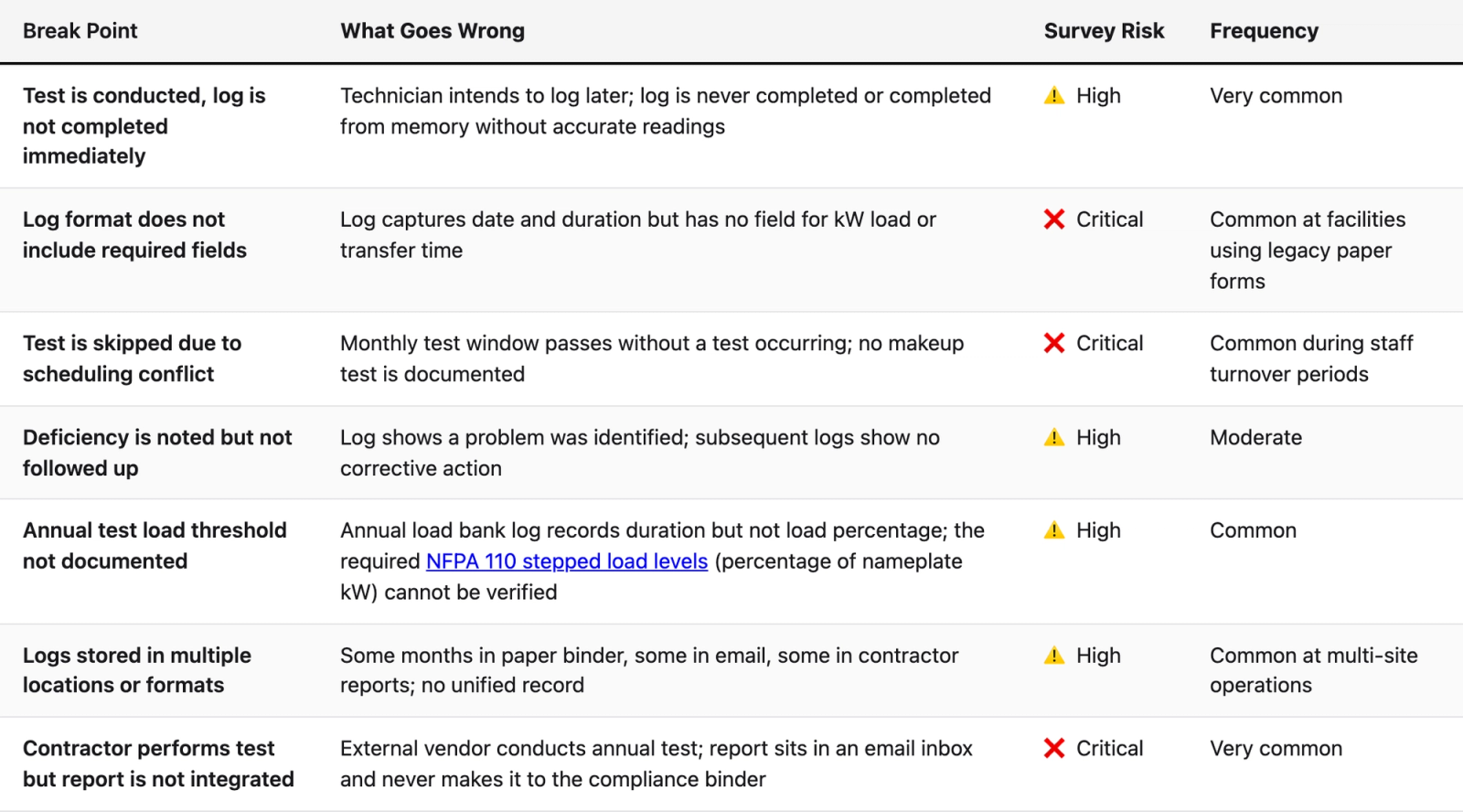
Each of these break points is independent. A facility can fail at any one of them while succeeding at all the others. The compliance chain does not grade on a curve. A log set that is complete for 11 months and missing for one month has a gap, and that gap is what the surveyor will find.
The Contractor Report Integration Problem
One of the most underappreciated break points in SNF generator compliance is the integration of contractor-generated documentation into the facility's compliance record. Many SNFs, particularly those with limited maintenance staff, outsource their annual load bank test to a licensed electrical contractor or generator service company. The contractor arrives, conducts the test, and produces a detailed written report that contains all of the information NFPA 110 requires.
The problem is what happens to that report after it is delivered. In a large proportion of facilities, the contractor report is emailed to the administrator or maintenance director, acknowledged, and filed in an email inbox. It never makes it into the life safety binder. When a surveyor requests generator test documentation for the previous 12 months, the annual test report is missing from the binder. The facility has a compliant test conducted by a qualified contractor, with a fully documented report, sitting in an email thread that no one thought to print and file.
This is a documentation integration failure, not a testing failure. The work was done correctly. The record exists. But the record is not in the location where it can be produced for a surveyor, and it is not cross-referenced against the monthly logs in a way that makes the annual testing cadence verifiable. From the surveyor's perspective, the record that cannot be produced might as well not exist.
The same problem occurs with contractor service reports for transfer switch maintenance, fuel system inspections, and battery testing for generator starting systems. Each of these generates paperwork from an outside vendor. Each piece of that paperwork is a component of the facility's emergency power compliance record. When any piece is missing from the unified record set, the gap becomes a potential K-tag.
What a Unified Compliance Record Actually Looks Like
A unified compliance record for emergency power systems in an SNF contains, at minimum:
- Monthly generator test logs for the preceding 12 months, each with date, duration, kW load, and transfer switch confirmation
- Annual load bank test report where required (when monthly tests do not reach 30% of nameplate kW or the manufacturer's minimum exhaust temperature), plus the 36-month 4-hour test record, each with load percentage and duration confirmed against nameplate rating
- Transfer switch maintenance records, including any service performed by a licensed contractor
- Fuel level logs showing adequate fuel supply is maintained at required intervals
- Battery inspection records for the generator starting system
- Documentation of any deficiencies identified during testing and the corrective actions taken
- Evidence that required testing was completed within the required intervals (not just that tests occurred, but that they occurred on schedule)
When this record set is complete, coherent, and producible within minutes of a surveyor's request, the risk of a generator documentation K-tag is greatly reduced. When any element is missing, scattered across formats, or stored outside the primary compliance record, the risk is real and present regardless of how well the equipment itself has been maintained.
How the Generator K-Tag Connects to Broader Environment of Care Compliance
The generator documentation problem does not exist in isolation. It is one node in a much larger environment of care compliance SNF system, and the same documentation dynamics that produce generator K-tags produce citations across every other life safety category. Understanding the structural similarity helps facilities design documentation controls that work across the entire compliance chain, not just for generators.
Consider the parallel with fire door inspection documentation. Under NFPA 80, fire doors must be inspected annually by a qualified person, and the inspection record must document each door, its location, any deficiencies found, and corrective actions taken. The work is technical. The documentation requirement is specific. The failure mode is identical to generators: the inspection happens, the documentation is incomplete, the surveyor finds the gap. The K-tag is different (fire door inspection and testing is cited under K761), but the compliance chain mechanism is the same.
The same pattern applies to:
- Sprinkler system inspections under NFPA 25, which require quarterly and annual testing records with specific data elements
- Fire alarm testing under NFPA 72, which requires semi-annual or annual device testing with individual device-level documentation
- Fire drill records under NFPA 101, which require documentation of date, time, number of participants, and any problems identified
- Medical gas system inspections under NFPA 99, which require specific testing documentation for each gas outlet category
- Electrical safety testing for patient care equipment, which requires individual device testing records with pass/fail results
Each of these represents a compliance chain with the same structure as the generator chain: a federal requirement, an NFPA standard adopted by reference, a specific documentation requirement within that standard, and a K-tag category that captures failures. A facility that addresses generator documentation in isolation while leaving the same structural gaps in other categories has not solved its compliance problem. It has solved one symptom of a systemic documentation process failure.
The SNF Compliance Documentation Framework: A Decision Architecture
When a maintenance director or SNF administrator asks what it takes to close the compliance chain on generator documentation, the answer is not simply "document everything." The answer requires a decision architecture that addresses three distinct dimensions: what to document, when to document it, and where the documentation lives.
Dimension 1: What to Document
The "what" is defined by NFPA 110 and the CMS survey protocol. For each monthly generator test, the minimum documentation elements are fixed. The practical challenge is that many facilities use log formats that were created before the current NFPA 110 edition or before CMS's current survey methodology was established. These legacy formats often omit required fields, which means even a conscientious technician who completes every field on the form is producing an incomplete record because the form itself is deficient.
The first control is a log format audit. Every log format used for life safety inspections should be evaluated against the current regulatory requirement to confirm that it captures every required data element. For generators, that means confirming the form includes explicit fields for kW load, transfer time, duration, and deficiency notation. A form that does not have these fields will produce deficient records regardless of the technician's diligence.
Dimension 2: When to Document
The "when" question has a clear answer: documentation should be contemporaneous. Best practice is to create records at the time of the activity, not reconstruct them afterward. A log entry created after the fact from memory is not only potentially inaccurate (the technician may not recall the exact kW reading), it is also difficult to defend if a surveyor questions its authenticity.
The practical implication is that the documentation process must be built into the testing workflow, not added as a separate step. If the technician must return to an office to complete a paper log after conducting a test in the equipment room, there is a gap between the test and the documentation. That gap is where entries get missed, data gets approximated, and records become unreliable. The documentation step must occur at the point of the test, with the required data captured in real time.
Dimension 3: Where Documentation Lives
The "where" question is the most operationally complex. Life safety documentation in a typical SNF exists across multiple physical and digital locations: paper binders in the maintenance office, email inboxes containing contractor reports, spreadsheets maintained by the administrator, and potentially a facility management software system. When documentation is distributed across these locations, no single source of truth exists. When a surveyor arrives and requests the generator log for the previous 12 months, assembling that record from four different locations under time pressure is both stressful and error-prone.
The documentation control that addresses this dimension is centralization: a single system where every test log, contractor report, deficiency record, and corrective action is stored and retrievable by date, asset, and requirement category. Centralization eliminates the search problem and makes the compliance record producible on demand.
Life Safety Compliance Chain: What Auditing Documentation Actually Means
The phrase "auditing documentation" sounds like it means reviewing records after they are created. In the context of life safety compliance chain management, it means something more specific and more valuable: systematically comparing the documentation that exists against the documentation that should exist, and surfacing the gap before a surveyor finds it.
This is not the same as confirming that tests occurred. A facility can confirm that a generator test was conducted every month and still have a documentation audit failure if the records from those tests are missing required data elements. The audit function must evaluate not just presence (was a record created?) but completeness (does the record contain everything it is required to contain?) and currency (was the record created within the required interval?).
For a single SNF with one generator, this audit can theoretically be conducted manually. A maintenance director who reviews each monthly log against a checklist of required elements and flags any gaps before they accumulate is doing what an audit function is supposed to do. The challenge is that this manual review is not how most facilities operate. The monthly log is created, filed, and not reviewed again until the surveyor arrives. The gap between creation and review is where deficiencies accumulate invisibly.
At a multi-site SNF operation with 10 or 20 facilities, each with multiple generators, multiple transfer switches, and multiple contractor relationships, the manual audit approach breaks down entirely. The volume of documentation is too large for any individual to review systematically, and the organizational distance between the facility technician creating the record and the regional manager accountable for the compliance outcome makes the gap even wider.
The Pre-Survey Audit as a Compliance Strategy
A pre-survey audit is a systematic review of all life safety documentation conducted before a CMS or state survey occurs. For SNFs, where surveys are unannounced and can occur at any time within the survey window, "before the survey" means continuously. A facility that is always in a pre-survey audit posture has already found and addressed the gaps that a surveyor would find.
The pre-survey audit for generator compliance specifically examines:
- Whether a test record exists for each required monthly interval in the preceding 12 months
- Whether each record contains all required NFPA 110 data elements, including kW load
- Whether any required annual supplemental load bank test record (needed when monthly tests do not reach 30% of nameplate kW or the manufacturer's minimum exhaust temperature) is present, complete, and documents load percentage against nameplate rating
- Whether any deficiencies noted in test records have corresponding corrective action documentation
- Whether contractor-generated reports are integrated into the compliance record
- Whether the testing cadence is consistent with the required intervals (not just that tests occurred, but that they occurred on time)
A facility that can confirm all six of these points for its generator documentation has effectively closed the K-tag risk for that asset category. The same audit framework applies to every other life safety category, and a facility that applies it systematically across all categories has transformed its survey posture from reactive to proactive.
Documentation Technology and the Paper Binder's Limitations
The paper life safety binder has been the standard documentation format for SNF compliance for decades, and it works adequately under certain conditions: a single facility, a stable maintenance staff, a consistent inspection cadence, and a maintenance director who personally reviews the binder regularly. When any of these conditions changes, the paper binder's limitations become compliance risks.
Staff turnover is the most common trigger. When a maintenance director leaves, the institutional knowledge of where documentation is stored, what format it is in, and whether the cadence is current leaves with them. A new maintenance director inheriting a paper binder has no reliable way to assess whether the records in the binder are complete without manually reviewing every page against every regulatory requirement. That review is rarely conducted, because the incoming director has immediate operational priorities and the binder appears, superficially, to be in order.
The paper binder also has no audit function. It stores records but does not evaluate them. A binder full of generator logs that are each missing kW values looks complete until someone checks each record against NFPA 110. The binder cannot flag its own deficiencies. The maintenance director must know to look for them, know what to look for, and have the time to conduct the review. In a busy SNF maintenance operation, that combination is rare.
Digital documentation platforms address the audit function problem by building the evaluation into the record-creation process. A log form that requires a kW value before it can be submitted cannot be completed without the required data. A system that tracks testing cadence against required intervals and flags overdue tests cannot be ignored the way a paper binder can. The technology does not make the test happen, but it makes it structurally more difficult to create a deficient record or miss a required interval.
For multi-site SNF operators, the technology advantage is amplified. A regional director who can view the compliance status of every facility's generator documentation from a single dashboard has visibility that is simply not achievable with paper binders stored in 15 different maintenance offices. The ability to identify a documentation gap at Facility 7 before a surveyor does, and direct corrective action from the regional level, is a qualitatively different compliance posture than waiting for the survey to reveal the gap.
NFPA 110 Generator Testing in SNFs: A Practical Compliance Reference
For maintenance directors and plant operations managers who want a clear reference for what NFPA 110 generator testing SNF compliance requires, the following framework consolidates the key operational requirements.
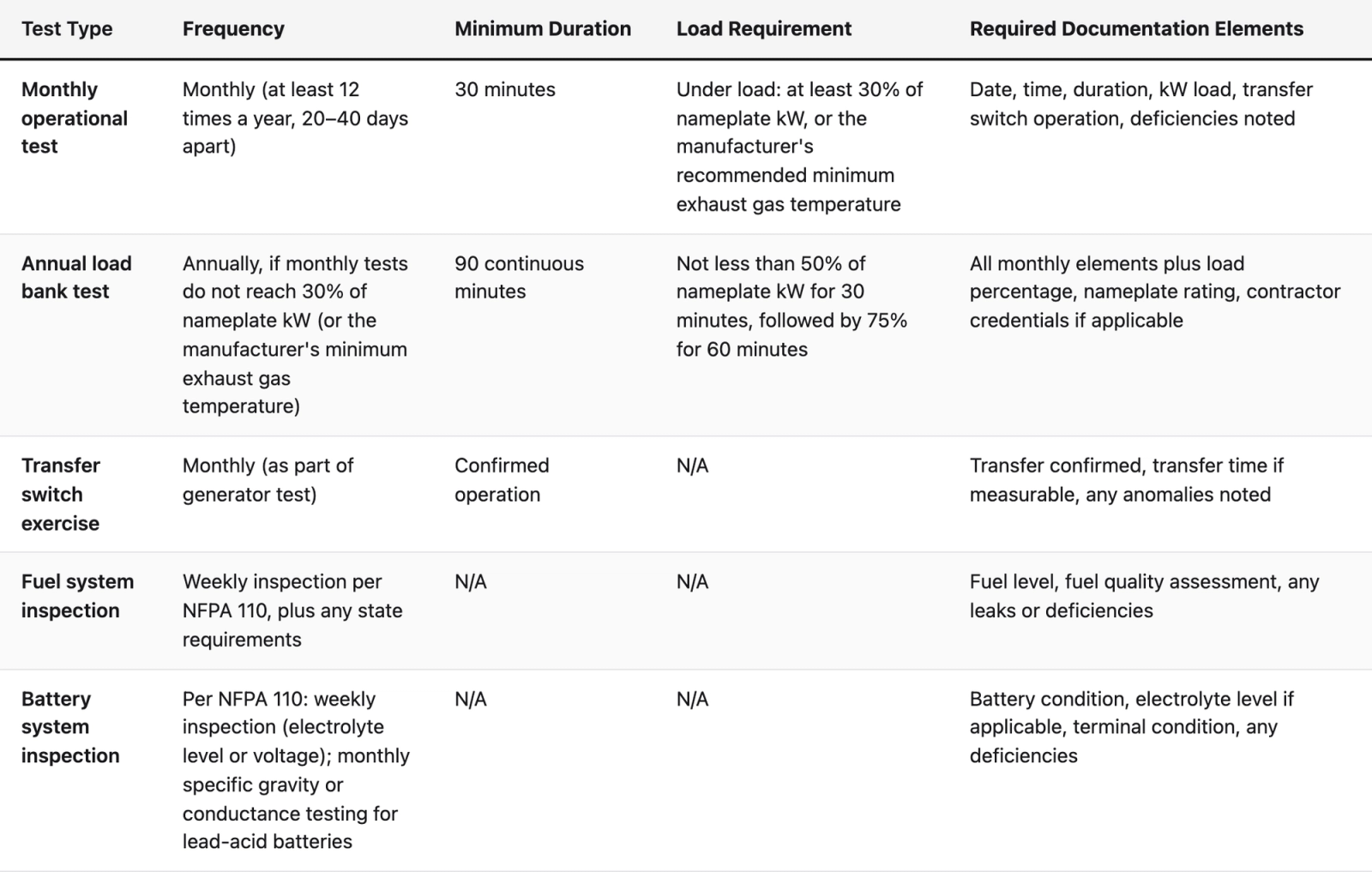
This table summarizes the core recurring documentation requirements; Level 1 systems also require a 4-hour load test at least once every 36 months, which must be documented as well. State health departments may impose additional requirements above the federal floor. Facilities should verify current state-specific requirements with their state survey agency or a qualified life safety consultant.
What Documentation Controls Actually Break the K-Tag Chain
Breaking the compliance chain before it reaches a K-tag requires controls at each of the three documentation dimensions identified earlier. The following controls address the most common break points in SNF generator documentation.
Control 1: Contemporaneous Digital Logging at the Point of the Test
The single most effective control for generator documentation completeness is requiring that the test log be completed at the point of the test, using a device that enforces required field completion before the record can be submitted. A mobile or kiosk-based logging tool with required fields for kW load, duration, and transfer confirmation prevents the most common documentation failure: the test that was conducted but never fully recorded.
This control also addresses the timing problem. A record created in real time at the equipment location is inherently more accurate than a record created later from memory. For kW load values in particular, which require reading a meter at the time of the test, real-time documentation is the only way to capture accurate data.
Control 2: Mandatory Log Format Standardization
Every log format used for life safety compliance documentation should be evaluated against the current regulatory standard and updated to include every required data element as a mandatory field. Forms that do not require kW values should be replaced. Forms that do not include a deficiency notation field should be updated. This is a one-time process with ongoing impact, because a compliant form structure ensures that every record created using the form is at least structurally complete.
Control 3: Interval Monitoring and Overdue Alerts
Monthly generator tests must be conducted 12 times a year, no fewer than 20 days and no more than 40 days after the previous test. A test on January 1 followed by the next test on February 15 exceeds the 40-day maximum, even though each calendar month shows a test. Interval monitoring that tracks the days elapsed since each test and generates an alert when a test is approaching due (or has become overdue) prevents the missed-interval scenario.
This control is particularly important during staff transitions, when the incoming maintenance director may not know the facility's testing schedule or may deprioritize it while learning other aspects of the role.
Control 4: Contractor Report Integration Protocol
Every facility that uses external contractors for any component of its generator compliance program needs a defined protocol for integrating contractor-generated reports into the primary compliance record. The protocol should specify who is responsible for receiving the report, the timeframe for integrating it, and where the integrated record is stored. Without a defined protocol, contractor reports will continue to accumulate in email inboxes and never reach the compliance record.
Control 5: Regular Documentation Audit Against Regulatory Requirements
The audit function must be built into the compliance process, not reserved for pre-survey preparation. A monthly or quarterly review of generator documentation against the NFPA 110 checklist, conducted by someone who knows what required elements look like, catches gaps while they can still be addressed. An annual review conducted only when a survey is anticipated catches gaps only after they have accumulated into a pattern that supports a citation.
Frequently Asked Questions: Generator Compliance and K-Tags in SNFs
What is a K-tag deficiency for generator testing?
A K-tag is the deficiency category CMS surveyors use to cite life safety code violations in long-term care facilities. A K-tag deficiency related to generator testing is issued when the facility's documentation does not demonstrate compliance with the emergency power system testing requirements in NFPA 110, as adopted by NFPA 101. This can result from missing test records, incomplete log entries, failure to meet the annual load test requirements, or unresolved deficiencies.
How often does CMS require generator testing in SNFs?
Through the NFPA 99 and NFPA 110 requirements it adopts, CMS requires generator sets to be exercised under load at least monthly for at least 30 minutes, at a minimum of 30% of nameplate kW or the manufacturer's minimum recommended exhaust gas temperature. Generators that do not reach that threshold during monthly testing need an annual supplemental load test, and Level 1 systems must also be run for up to four hours every 36 months. All of these tests must be documented.
What kW load is required for a monthly generator test in a SNF?
NFPA 110 requires monthly tests to run for at least 30 minutes at a minimum of 30% of nameplate kW, or a load that reaches the manufacturer's minimum recommended exhaust gas temperature. Most monthly tests use the facility's actual building load, transferred through the automatic transfer switch. If the building load does not reach that threshold, an annual supplemental load bank test is required. Record the kW value at the time of every test so the load can be verified.
Can a contractor conduct our annual generator test, and how should the report be filed?
Yes. Where an annual supplemental load bank test is required (because monthly tests do not reach the required load), it is commonly conducted by licensed electrical or generator service contractors who bring portable load bank equipment. The contractor's written test report must be integrated into the facility's life safety compliance record and be producible on demand during a CMS survey. The report should be filed in the primary generator compliance documentation set, cross-referenced with the monthly log for the same calendar period.
What happens if we miss a monthly generator test?
A missed monthly test creates a gap in the 12-month log set that a surveyor will identify. If the test was genuinely missed, the gap should be documented with an explanation, and the next test should be conducted as soon as practicable. If the test was conducted but not documented, any record created afterward should be clearly labeled as a late entry, dated when it was written, based only on actual data available (for example, meter or controller readings), and include a notation explaining the circumstances. Fabricating records or backdating entries is a serious compliance risk and is not an appropriate response.
Does a power outage count as a generator test?
An actual power outage during which the generator operates can satisfy the monthly test requirement, but only if the operation is documented with the same data elements required for a scheduled test: date, time, duration, kW load, and transfer switch operation. The documentation must be completed contemporaneously. An outage that is not documented does not satisfy the testing requirement regardless of how long the generator ran.
What is the scope and severity scale for generator K-tags?
CMS uses a scope and severity matrix to classify all deficiencies. Scope ranges from isolated to widespread. Severity ranges from potential for harm to actual harm to immediate jeopardy. A generator documentation deficiency is typically cited at a level that reflects documentation failure without immediate patient harm, but a pattern of missed testing or an inability to demonstrate that emergency power is functional can escalate to a higher severity level if the surveyor determines that residents were at risk.
How far back do generator test records need to go for a CMS survey?
CMS surveyors typically request the preceding 12 months of generator test documentation as a minimum. Facilities should keep complete records for at least 12 months and ideally longer. Level 1 systems also need a load test every 36 months, so the most recent record of that test must be kept as well, and some state agencies may require a longer lookback period. Records should be organized chronologically and be producible within minutes of a request.
What is the difference between NFPA 99 and NFPA 110 for generator compliance?
NFPA 99, the Health Care Facilities Code, addresses the essential electrical system requirements for healthcare facilities, including the design and operational requirements for the system that distributes emergency power throughout the building. NFPA 110 addresses the generator itself, its installation, testing, and maintenance. Both standards apply to SNF compliance: CMS adopts NFPA 99 directly at 42 CFR 483.90 alongside the Life Safety Code (NFPA 101), and NFPA 110 applies through the references in those codes. Generator testing documentation requirements come primarily from NFPA 110, while the essential electrical system branch requirements come from NFPA 99.
What does "contemporaneous documentation" mean for generator testing?
Contemporaneous documentation means the record is created at the time of the activity, not reconstructed afterward. For generator testing, this means the log entry should be completed during or immediately after the test, with actual meter readings recorded in real time. Contemporaneous records are generally considered more reliable than reconstructed ones, and surveyors may question the authenticity of records that appear to have been created after the fact.
How does staff turnover affect generator compliance documentation?
Staff turnover is one of the most common triggers for documentation gaps in SNF generator compliance. When a maintenance director leaves, knowledge of the testing schedule, log format requirements, and record storage location may leave with them. An incoming director who does not know what the previous director knew may miss test intervals, use incorrect log formats, or be unable to locate prior records when a surveyor requests them. Facilities with high turnover rates benefit significantly from documentation systems that make the compliance process independent of any individual's institutional knowledge.
What should a Plan of Correction include for a generator K-tag?
A Plan of Correction for a generator K-tag must address the specific deficiency cited, identify whether other residents or areas of the facility are affected by the same issue, describe systemic changes to prevent recurrence, and establish a monitoring protocol to verify ongoing compliance. For a documentation deficiency, the Plan of Correction typically includes a corrected or updated log format, staff education on required documentation elements, a designated responsible party for generator testing and documentation, and a schedule for supervisory review of completed records.
Key Takeaways
- The compliance chain is literal, not metaphorical. A generator K-tag traces directly from a documentation gap through four regulatory layers: CMS conditions of participation, NFPA 101, NFPA 110, and the specific log entry requirement. Every link must hold.
- An undocumented test is a failed test. CMS survey methodology evaluates documentation as the proxy for compliance. Equipment that functioned correctly but was not properly documented creates the same K-tag risk as equipment that was not tested.
- NFPA 110 requires a written record of every test, and to show compliance each monthly generator test record should capture date, duration, kW load, transfer switch confirmation, and deficiency notation. A log format that does not capture these elements will produce deficient records regardless of the technician's diligence.
- Load thresholds must be documented. Monthly tests must reach at least 30% of nameplate kW (or the manufacturer's minimum exhaust gas temperature). Generators that fall short need an annual supplemental load test, and Level 1 systems need a load test every 36 months. Test records must document load, not just duration.
- Contractor report integration is a critical control point. Annual test reports from external vendors that are not integrated into the facility's compliance record are invisible to a surveyor. A defined integration protocol is essential.
- The same structural failure produces K-tags across all life safety categories. Generator documentation failures are one instance of a systemic pattern that affects sprinkler records, fire door inspections, fire drill logs, and every other life safety requirement. The documentation controls that fix generator compliance fix the broader problem.
- A pre-survey audit posture is the only reliable protection. Facilities that continuously audit their documentation against regulatory requirements find and close gaps before a surveyor does. Facilities that wait for the survey to reveal gaps pay the consequence in K-tags, Plans of Correction, and revisit surveys.
- Log format standardization is a one-time fix with ongoing impact. Updating log forms to include all required fields eliminates structural documentation failure at the source. Every record created on a compliant form is at least structurally complete.
Closing the Chain Before the Surveyor Arrives
The generator K-tag is almost always preventable. Not because the test was not conducted, but because the documentation that proves the test was conducted is almost always within reach. The gap between what happened and what was recorded is where compliance risk lives, and that gap is a documentation process problem, not an equipment problem.
The generator test documentation CMS requirements are specific, stable, and well-documented in NFPA 110. The log format requirements have not changed in ways that should surprise any facility that has reviewed them. The monthly and annual testing intervals are well-understood by any experienced maintenance director. The problem is not knowledge of the requirements. The problem is that the documentation process in most SNFs was not designed to systematically ensure that those requirements are met in every record, every month, without relying on any individual's memory or initiative.
When documentation is created contemporaneously, on a form that captures every required element, stored in a centralized record that integrates contractor reports and is audited regularly against regulatory requirements, the compliance chain holds. The generator test that happened on a Tuesday afternoon becomes a generator test that can be proved to a surveyor. The K-tag risk that existed in the gap between the test and the record is closed.
That is what environment of care compliance looks like when it is working: not just work that gets done, but work that gets documented in a way that survives scrutiny. The chain from a single log entry to a K-tag runs in both directions. A complete, accurate, contemporaneous record breaks the chain before it reaches the surveyor's clipboard.
About the author
Benjamin Terebelo · Founder
Benjamin is the founder of SEQURA, a compliance platform purpose-built for healthcare facilities. He builds at the intersection of healthcare operations and software, maintaining a focus on bringing modern tooling to systems that the broader industry has largely left behind.
Related reading
About the author
Benjamin Terebelo · Founder
Benjamin is the founder of SEQURA, a compliance platform purpose-built for healthcare facilities. He builds at the intersection of healthcare operations and software, maintaining a focus on bringing modern tooling to systems that the broader industry has largely left behind.
Topics
- environment of care compliance SNF
- generator test documentation CMS
- K-tag deficiency generator
- NFPA 110 generator testing SNF
- SNF utility compliance documentation
- life safety compliance chain USA


