27 min read
What Happens to SNF Life Safety Compliance During a Merger or Acquisition — And How to Standardize Documentation Across Inherited Facilities
SNF mergers and acquisitions inherit compliance risk alongside physical assets. Learn how documentation standardization across inherited facilities protects survey outcomes.
By Benjamin Terebelo

The wire transfer clears on a Thursday. By Friday morning, the acquiring organization's regional VP is on a plane to tour three newly inherited skilled nursing facilities. By Monday, the operations team is fielding calls about staffing ratios, dietary contracts, and therapy billing. Nobody, not the COO, not the VP of operations, not the newly inherited maintenance directors, is talking about the life safety binder sitting in the mechanical room of Building Two.
That binder is where the compliance risk lives.
Mergers and acquisitions in the skilled nursing space move fast, and the due diligence process rarely gives adequate attention to life safety documentation. Financial audits scrutinize census trends, payor mix, and accounts receivable. Operational reviews examine staffing hours, therapy utilization, and quality measures. But the stack of inspection logs, fire drill records, generator test sheets, and sprinkler maintenance reports that surveyors will examine during the next unannounced visit? Those get a cursory glance at best, or they get skipped entirely.
The consequence shows up months later, when a CMS surveyor walks through the door of a facility the acquiring organization has owned for six months and finds that the life safety documentation culture of the previous operator is still very much in place. Missing log entries. Incomplete drill records. Contractor reports that reference deficiencies never reconciled. In that moment, the acquiring organization is accountable for every gap, and the clock on enforcement started the day the deal closed, not the day the surveyor arrived.
This article is a practical guide to what actually happens to SNF life safety compliance during a merger or acquisition, why the documentation risk is larger than most operators realize, and how multi-site SNF operators can build a standardization framework that converts inherited chaos into survey-ready consistency.
Why SNF Merger Compliance Risk Is a Documentation Problem First
The physical assets of a skilled nursing facility, sprinkler heads, emergency generators, fire doors, egress lighting fixtures, are relatively easy to evaluate during due diligence. A qualified life safety consultant can walk a building in a day and produce a capital needs assessment. What cannot be assessed in a single walkthrough is the documentation culture: how consistently inspections have been recorded, whether contractor reports have been reconciled, whether fire drill logs reflect all required shifts, and whether the facility's records would hold up under the systematic review that a CMS surveyor applies during a Life Safety Code survey.
Documentation is what surveyors actually cite. A facility can have a fully functional fire suppression system and still receive a deficiency if the maintenance and testing logs are incomplete. A generator can start and run perfectly every month and still produce a citation if the test records do not capture the required data elements. The physical condition of the equipment and the documentary evidence of its inspection are two separate compliance domains, and only one of them transfers in an acquisition.
When an acquiring organization takes ownership of a skilled nursing facility, it inherits the physical plant. It does not automatically inherit a compliant documentation record. In many cases, it inherits the opposite: a collection of paper logs, contractor invoices, and partially completed inspection sheets that were assembled by a maintenance director who may or may not still be employed, using formats and practices that may or may not align with current CMS Life Safety Code survey expectations.
This distinction matters because CMS survey outcomes are driven by what documentation shows at the time of the survey, not by what the acquiring organization intended to do, not by when the deal closed, and not by what the prior operator said they had completed. Surveyors review the records available. If those records are incomplete, inconsistent, or missing entirely, the facility receives citations regardless of ownership history.
For operators executing an SNF merger compliance integration, the first and most urgent task is not a systems audit or a staff orientation. It is a documentation audit: a systematic review of what inspection records exist, what they contain, what is missing, and how they compare to the documentation standard the acquiring organization maintains across its existing portfolio.
What the Due Diligence Process Typically Misses
Due diligence in skilled nursing acquisitions has matured considerably over the past decade. Most buyers now include clinical quality metrics, staffing data, and regulatory survey history in their review. CMS's Care Compare database makes it straightforward to pull survey deficiency history, and experienced buyers know how to read a Statement of Deficiencies to identify patterns of regulatory concern.
What most due diligence processes still miss is the gap between what the survey history shows and what the documentation reality is at the time of acquisition. A facility may have had clean life safety surveys for several years, not because its documentation was excellent, but because the previous surveys happened to occur when a particularly diligent maintenance director was in place, or because the surveyor's focus that year was on health inspection deficiencies rather than life safety. Survey history is a lagging indicator. It tells you what was found during past visits. It does not tell you what would be found if a surveyor walked in tomorrow.
The categories of documentation that due diligence teams most consistently underexamine include:
- Inspection log completeness and continuity: Are records present for every required inspection interval, without gaps? Do the logs include all required data elements, or are they formatted in ways that omit information surveyors expect to see?
- Contractor report reconciliation: When third-party contractors identify deficiencies during annual inspections, those deficiencies must be documented and tracked through to resolution. Acquiring organizations frequently find contractor reports with open deficiency items that were never closed out in the facility's records.
- Fire drill documentation completeness: CMS requires fire drills on all shifts, and the documentation requirements go beyond simply recording that a drill occurred. Evaluations, participation records, and corrective action notes are all part of a complete drill record. Incomplete drill logs are among the most commonly cited life safety deficiencies nationally.
- Generator and emergency power system records: The documentation requirements for emergency power systems are specific and technical. Monthly testing logs must capture defined data elements, and there are additional testing and documentation requirements tied to specific intervals. Facilities with paper-based systems frequently have generator logs that are missing key data fields.
- Equipment-specific inspection chains: For certain categories of equipment, CMS expects to see a continuous chain of inspection records linking installation, periodic testing, deficiency identification, repair, and re-inspection. Gaps in that chain, even when the equipment itself is functional, produce citations.
None of these categories appear in a standard financial or operational due diligence checklist. They require someone with specific knowledge of CMS Life Safety Code survey expectations to evaluate, and that expertise is rarely present in the acquisition team.
The Ownership Transfer Window: When Compliance Risk Peaks
There is a period in every skilled nursing acquisition when compliance risk is at its highest. It begins at the moment of ownership transfer and typically extends for three to nine months, depending on how aggressively the acquiring organization moves to integrate its compliance infrastructure. During this window, several dynamics converge to create elevated citation risk.
Staff Transition and Institutional Memory Loss
The maintenance director of an acquired facility often holds the institutional memory of that building's compliance practices. They know which contractor does the annual fire suppression inspection, where the generator test logs are kept, which state-specific documentation requirements the facility has historically addressed, and where the paper binder lives. When that maintenance director leaves, voluntarily or as part of a post-acquisition restructuring, that knowledge walks out the door with them.
The incoming maintenance staff, whether transferred from the acquiring organization or newly hired, must reconstruct the facility's compliance history from whatever documentation exists. If that documentation is disorganized, incomplete, or stored in formats that are not immediately interpretable, the reconstruction process is slow and error-prone. During that reconstruction period, new inspection cycles are beginning, and the facility needs current documentation even as it is still working to understand what historical documentation exists.
Format and Standard Incompatibility
Acquiring organizations that operate multiple skilled nursing facilities typically have internal standards for how compliance documentation should be formatted, organized, and stored. These standards reflect the acquiring organization's interpretation of CMS requirements and its accumulated experience with what surveyors look for.
Inherited facilities almost always use different formats. Paper logs from one facility may organize data differently than the digital records maintained at another. Contractor report formats vary by vendor. Fire drill documentation may capture different data elements depending on who designed the facility's original form. When an acquiring organization attempts to compare documentation across its portfolio, these format differences make systematic quality assessment extremely difficult.
Regulatory Calendar Misalignment
Life safety compliance operates on a calendar of required inspection intervals. Some inspections are monthly. Others are quarterly, semi-annual, or annual. When an acquisition closes, the acquiring organization inherits a facility that is somewhere in the middle of multiple overlapping inspection cycles, and the status of each cycle may not be immediately apparent from the available records.
If the previous operator completed the annual sprinkler inspection six months ago, the next one is due in six months. If the generator monthly test was completed last week, the next one is due next month. But if the records are incomplete or disorganized, the acquiring organization may not be able to determine when these cycles are due, which creates the risk of missing required inspection intervals entirely during the transition period.
Building a Post-Acquisition Documentation Audit Framework
The most effective approach to managing SNF merger compliance risk is to treat the documentation audit as a parallel workstream to the operational integration, beginning at or before the closing date. This requires a structured framework that can be applied consistently across every acquired facility, regardless of its prior documentation practices.
The framework has four phases: inventory, gap assessment, remediation, and standardization. Each phase has specific outputs that feed into the next, and the entire process should be completed within the first 90 days of ownership.
Phase One: Documentation Inventory
The first phase is purely descriptive. The goal is to understand what documentation exists, where it is stored, and how it is organized, without yet evaluating quality or completeness. This requires a physical walkthrough of the facility's documentation storage (typically the maintenance office, a filing cabinet, or a combination of both), combined with a review of any digital records the facility maintains.
The inventory should produce a complete list of every inspection category the facility is required to document, with a notation of whether records exist for that category and how far back they extend. Categories should align with the CMS Life Safety Code K-tag structure so that the inventory can be directly mapped to survey expectations.
Key documentation categories to inventory include records for fire alarm system testing and maintenance, fire suppression system inspection and testing, emergency power system testing, fire door inspections, egress and exit lighting, fire drills, hazardous area inspections, and all HVAC and building systems required under applicable NFPA standards. Facilities in states with additional licensure requirements will have additional categories specific to those requirements.
Phase Two: Gap Assessment
The gap assessment phase evaluates the documentation inventory against a defined standard. For each inspection category, the assessment identifies three types of gaps: missing records (no documentation exists for a required inspection interval), incomplete records (documentation exists but is missing required data elements), and unreconciled deficiencies (contractor or inspection reports identify deficiencies that are not followed through to documented resolution).
The gap assessment should be conducted by someone with direct knowledge of CMS Life Safety Code survey expectations. A facility's maintenance director may not have sufficient familiarity with current CMS survey protocols to conduct this assessment reliably. Many acquiring organizations engage a life safety consultant or use a compliance platform with built-in gap detection capability to ensure the assessment is conducted against current regulatory standards.
The output of the gap assessment is a prioritized list of documentation deficiencies. Priority should be assigned based on two factors: the severity of the citation risk each gap creates, and the difficulty of remediation. Missing fire drill records for a recent shift are high-priority because they are both high-risk and difficult to remediate retroactively. A missing date field on a generator test log is lower-priority if the test clearly occurred and the data can be reconstructed from other records.
Phase Three: Remediation
Remediation addresses the gaps identified in Phase Two. For each gap, there are three possible outcomes: documentation can be reconstructed from available evidence (such as contractor invoices, work orders, or verbal accounts from staff who participated in inspections), the inspection can be re-performed to generate current documentation, or the gap must be accepted as a historical deficiency that will be disclosed to the surveyor if found.
It is important to be precise about what remediation can and cannot accomplish. Documentation that never existed cannot be created retroactively in a way that would represent itself as contemporaneous. If an inspection was not performed, the appropriate response is to perform it now and document it with a current date, not to create a record that appears to show it was completed at an earlier time. Surveyors are trained to review records carefully, and inconsistencies between documentation and physical evidence can create significantly larger compliance problems than the original gap.
Remediation should also include a review of open contractor deficiencies. For every inspection report that identifies a deficiency, there should be a corresponding record showing that the deficiency was repaired or mitigated and that a follow-up inspection confirmed resolution. Acquiring organizations frequently find contractor reports with open deficiency items from inspections conducted months or years before the acquisition. Each of these open items represents a potential citation, and closing them out, through actual repair and re-inspection, is a necessary part of the remediation process.
Phase Four: Standardization
Standardization is where the post-acquisition compliance work transitions from reactive remediation to proactive management. The goal is to bring the inherited facility's documentation practices into alignment with the acquiring organization's portfolio-wide standard, so that the facility's records are indistinguishable from those of facilities the organization has owned and managed for years.
Standardization requires three things: a defined documentation standard (what information must be captured for each inspection category, in what format, at what frequency), a reliable system for ensuring that standard is applied consistently, and a mechanism for monitoring compliance with the standard over time. For organizations managing multiple facilities, this almost always requires a technology platform that can enforce documentation standards at scale.
Multi-Site SNF Documentation Standardization: The Core Challenge
Multi-site SNF documentation standardization is the operational challenge that sits at the intersection of compliance risk management and portfolio management. For operators running five, ten, or twenty-plus skilled nursing facilities, the documentation challenge is not just about any single facility, it is about maintaining survey-ready documentation across an entire portfolio, with different buildings, different staff, different equipment, and different regulatory calendars all running simultaneously.
The core problem with paper-based and facility-specific documentation systems is that they produce compliance visibility at the facility level but not at the portfolio level. A regional VP overseeing ten facilities has no reliable way to know, at any given moment, which facilities have complete fire drill records for the current quarter, which generator test logs are missing data elements, or which contractor inspection reports have open deficiencies. That information exists in ten different binders in ten different mechanical rooms, and assembling it for a portfolio-level review requires manual effort that is rarely prioritized until a survey reveals a problem.
The consequence of this invisibility is that compliance gaps accumulate silently across the portfolio. A missing monthly generator test at one facility, an incomplete fire drill record at another, an unreconciled sprinkler deficiency at a third, none of these individually are visible to regional leadership, but all of them are visible to a surveyor who walks into the respective facility and reviews the documentation.
What Standardization Actually Requires
True standardization across a multi-site SNF portfolio requires more than distributing a common set of forms. It requires a shared understanding of what "complete" documentation looks like for each inspection category, a system that enforces that completeness standard at the point of documentation, and a monitoring layer that surfaces deviations before they become survey findings.
The forms question is where most organizations start, and it is the least important part of the standardization problem. A standardized fire drill form ensures that everyone is collecting the same data elements. But a paper form does nothing to ensure that the form is completed on schedule, that it captures accurate information, that it is stored where a surveyor can find it, or that a regional manager can review it without physically visiting the facility.
Real standardization requires a platform that sits above the individual facility level and provides a consistent interface for documentation, a consistent storage and retrieval structure, and a consistent monitoring capability. That platform must be configurable to the specific regulatory requirements of each state in which the organization operates, because state licensure requirements vary and a one-size-fits-all federal standard is not sufficient for multi-state operators.
The Onboarding Problem for Inherited Facilities
Compliance platform onboarding for an inherited facility is different from onboarding a de novo facility or a facility that has been part of the organization's portfolio for years. An inherited facility arrives with existing documentation practices, existing staff habits, and existing inspection calendars, all of which must be mapped to the platform's structure before the platform can begin providing meaningful compliance monitoring.
The onboarding process must accomplish several things simultaneously. It must migrate or reconstruct the facility's historical documentation into the platform so that the compliance calendar begins with an accurate picture of where each inspection cycle stands. It must configure the facility's specific equipment inventory and inspection requirements so that the task library generates the right inspections at the right intervals. It must train facility staff, particularly the maintenance director and any technicians who will be completing inspection logs, on the platform's interface and documentation standards. And it must establish a baseline gap assessment within the platform so that regional leadership can immediately see the facility's compliance status relative to the portfolio standard.
Organizations that attempt to onboard inherited facilities to a compliance platform without first completing the documentation audit and gap assessment described in the previous section frequently discover that the platform surfaces a large volume of alerts and gaps simultaneously, making it difficult to prioritize remediation. The correct sequence is audit first, then onboard, so that the platform begins with a clean and accurate baseline rather than inheriting the documentation chaos of the previous operator.
The K-Tag Risk Profile of Inherited Facilities
Post-acquisition surveys consistently surface certain categories of life safety documentation deficiency more frequently than others. This pattern is not based on any published CMS dataset of post-acquisition survey outcomes, it reflects the practical experience of compliance professionals who have worked through the documentation audit process at inherited facilities and observed where the gaps most reliably appear.
Understanding this risk profile allows acquiring organizations to prioritize their documentation audit and remediation efforts in the areas most likely to produce citations at the next survey.
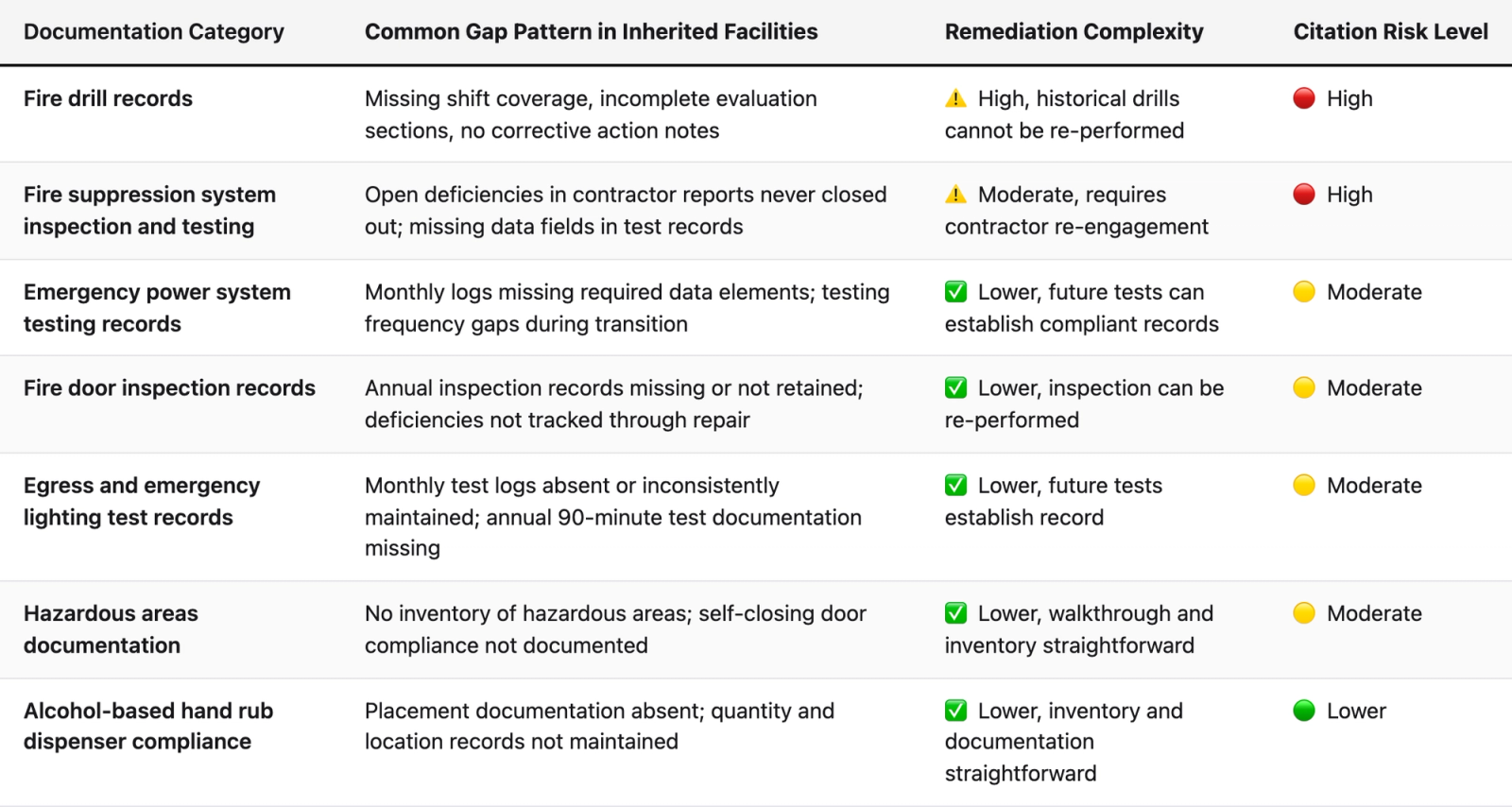
The pattern that emerges from this risk profile is that the highest-risk documentation categories are precisely the ones that are most difficult to remediate retroactively. Fire drill records for past quarters cannot be created after the fact. Open sprinkler deficiencies require active contractor engagement to close out. These are the categories that demand the earliest attention in the post-acquisition documentation audit.
State-Level Documentation Requirements and Multi-State Portfolio Risk
CMS Life Safety Code requirements establish the federal floor for skilled nursing facility compliance. State licensure laws and codes can impose requirements that go beyond that federal floor, and for multi-state SNF operators, managing state-specific variations is a significant compliance challenge.
State-specific requirements vary considerably. Some states require more frequent inspection intervals for certain categories of equipment than the federal standard requires. Others have specific documentation formats or record retention requirements that differ from what CMS surveys examine. Still others require inspections by state-licensed contractors for specific categories of work, which affects not just the documentation but the procurement and scheduling of inspection services.
When an acquiring organization expands into a new state through acquisition, it encounters state-specific requirements that may not be familiar to its compliance team. The inherited facilities' documentation practices may or may not have been meeting those state-specific requirements. A compliance platform configured only to federal CMS standards will not surface gaps in state-specific requirements, which means that a platform deployment must include state-specific configuration for every state in which the organization operates.
This is a meaningful consideration for organizations evaluating compliance platforms as part of a post-acquisition integration strategy. A platform that covers federal K-tag requirements but cannot be configured to state-specific inspection intervals, documentation formats, or record retention rules will leave a portion of the organization's compliance risk unaddressed. For multi-state operators, the state-specific configuration capability of a compliance platform is as important as its federal coverage.
How a Compliance Platform Changes the Post-Acquisition Integration Calculus
The traditional approach to post-acquisition compliance integration is labor-intensive, slow, and dependent on individual expertise. A compliance consultant visits the facility, reviews the binders, produces a gap assessment report, and the operations team works through the remediation list over the following months. The process produces a one-time snapshot of the facility's compliance status, accurate at the moment it was conducted, but immediately beginning to age.
A compliance platform changes this calculus in three important ways.
Continuous Documentation Monitoring Replaces Point-in-Time Audits
A platform that is properly configured and deployed at an inherited facility does not produce a single gap assessment, it produces a continuously updated picture of the facility's documentation status. As inspection logs are completed, the platform validates them against the required data elements and flags incomplete records in real time. As inspection intervals come due, the platform generates task assignments before the deadline passes rather than after. As contractor reports are uploaded, the platform tracks open deficiencies through to documented resolution.
This continuous monitoring capability is fundamentally different from the point-in-time audit approach, because it prevents gaps from forming rather than identifying them after they have formed. The operational goal is to ensure that a CMS surveyor who walks in on any given day would find complete, current, and properly organized documentation, not documentation that was complete three months ago when the last audit was conducted.
Portfolio-Level Visibility Enables Regional Management
For multi-site operators, the most significant capability a compliance platform provides is visibility across the entire portfolio from a single interface. A regional VP or compliance officer can see, in real time, which facilities have outstanding documentation tasks, which have open deficiency items, and which have gaps in their current inspection cycles, without visiting each facility or requesting reports from individual maintenance directors.
This visibility enables a fundamentally different management approach. Instead of relying on maintenance directors to self-report compliance status, regional leadership can monitor compliance proactively and intervene before gaps become citations. Facilities that are newly acquired and still in the integration process can be monitored more closely, with regional management able to see in real time whether the documentation standardization effort is producing the expected improvement.
Standardization Is Enforced by the Platform, Not by Policy
The most common failure mode of compliance standardization efforts is that they produce standards that are not consistently followed. A new documentation form is distributed across the portfolio, training is conducted, and compliance is assumed, until a survey reveals that one facility has been using the old form for the past six months because the maintenance director never transitioned.
A platform enforces standardization structurally rather than relying on policy adherence. When the platform generates a task assignment, it specifies exactly what data elements must be captured and requires that they be entered before the task can be marked complete. The format is the platform interface, which is identical across every facility in the portfolio. The documentation standard is not a policy document that can be ignored, it is the structure of the tool that staff use to record their work.
For operators integrating inherited facilities into a portfolio, this structural enforcement is the difference between a standardization effort that succeeds and one that gradually reverts to facility-specific practices as the attention of the integration team moves to other priorities.
Practical Onboarding Sequence for Inherited SNF Facilities
The following sequence reflects the most effective approach to bringing an inherited skilled nursing facility into a portfolio-wide compliance platform, based on the operational realities of post-acquisition integration. It is not a theoretical framework, it is a practical sequence designed to address the specific challenges that arise when a facility arrives with existing documentation practices, existing staff, and existing compliance gaps.
- Pre-close documentation review: If possible, obtain access to the facility's life safety documentation as part of the due diligence process. Even a preliminary review, without a full gap assessment, allows the acquiring organization to understand the general state of the documentation and plan the integration timeline accordingly.
- Day-one documentation preservation: On the day of ownership transfer, preserve all existing documentation in its current form. Do not reorganize, discard, or modify any existing records before the gap assessment is complete. The existing records, even if incomplete or disorganized, may contain documentation that is needed to establish the facility's compliance history.
- Equipment and inspection calendar inventory (Days 1-14): Compile a complete inventory of the facility's equipment and the inspection requirements associated with each piece of equipment. Map this inventory to the current inspection calendar to identify which inspection cycles are active and when the next required inspection is due for each category.
- Documentation gap assessment (Days 15-30): Conduct the structured gap assessment described in the previous section, producing a prioritized list of documentation deficiencies organized by citation risk and remediation complexity.
- Platform configuration and historical data migration (Days 15-45): Configure the compliance platform for the facility, including equipment inventory, inspection task library, state-specific requirements, and staff assignments. Migrate available historical documentation into the platform so that the compliance calendar begins with an accurate picture of each inspection cycle's status.
- Staff training and task library activation (Days 30-45): Train facility staff on the platform interface, with particular emphasis on the maintenance director and any technicians who will be completing inspection logs. Activate the task library so that upcoming inspection assignments begin generating in the platform.
- Remediation execution (Days 30-90): Work through the prioritized remediation list, addressing high-priority gaps first. For each open contractor deficiency, engage the appropriate contractor to complete repairs and re-inspection. Document all remediation activities in the platform.
- Portfolio integration and ongoing monitoring (Day 90 and beyond): By day 90, the facility should be fully integrated into the portfolio compliance monitoring dashboard. Regional leadership should be able to monitor the facility's documentation status alongside all other portfolio facilities, with no special integration-period exceptions or workarounds.
SNF Portfolio Compliance: The Strategic Case for Documentation Infrastructure Investment
The investment case for a compliance platform in the context of SNF merger and acquisition activity goes beyond the direct cost of citations avoided. There is a strategic dimension to documentation infrastructure that affects the organization's ability to execute its growth strategy efficiently.
Organizations that have invested in a portfolio-wide compliance platform before they begin acquiring facilities can onboard inherited facilities significantly faster than organizations that are building their documentation infrastructure at the same time they are integrating new facilities. The platform provides a ready-made structure that the inherited facility slots into, rather than requiring the acquiring organization to build that structure for each new acquisition while simultaneously managing the operational integration.
There is also a due diligence benefit. Organizations with a mature compliance platform can conduct more rigorous pre-acquisition documentation reviews, because they have a defined standard to compare against and a structured process for assessing gaps. This reduces the risk of acquiring facilities with compliance problems that were not visible during due diligence, and it provides a more accurate picture of the post-acquisition remediation effort required, which can inform purchase price negotiations.
Finally, there is the survey outcome benefit that is the direct purpose of the compliance investment. Facilities that are integrated into a portfolio compliance platform within 90 days of acquisition have current, complete, and properly organized documentation at the point of their next CMS survey, regardless of when that survey occurs. The acquiring organization does not need to hope that the survey happens after the documentation has been cleaned up. The platform ensures the documentation is survey-ready continuously.
For organizations executing an active acquisition strategy in the skilled nursing space, this continuous survey readiness across the portfolio is not a compliance nicety. It is a business requirement. The financial exposure from life safety citations, in the form of civil monetary penalties, directed plans of correction, and the operational disruption of survey-driven remediation, is a material risk that belongs in the acquisition calculus alongside census trends and payor mix.
Frequently Asked Questions
What compliance obligations does an acquiring organization assume on the day an SNF acquisition closes?
On the day ownership transfers, the acquiring organization assumes full responsibility for the facility's compliance with CMS Life Safety Code requirements and applicable state licensure standards. This includes responsibility for the accuracy and completeness of existing documentation. CMS surveys evaluate the documentation record available at the time of the survey, not when gaps occurred or who was responsible for them.
How long does a post-acquisition life safety documentation audit typically take?
A thorough documentation audit for a single skilled nursing facility typically requires two to four weeks, depending on the volume and organization of existing records, the complexity of the facility's equipment inventory, and the availability of the maintenance director and any relevant contractors. Multi-building campuses or facilities with particularly disorganized records may require longer. The audit should be completed before the compliance platform onboarding begins.
Can an acquiring organization disclose documentation gaps to CMS proactively?
CMS does not have a formal self-disclosure program specifically for life safety documentation gaps. However, facilities that identify compliance deficiencies and take documented corrective action before a survey may be viewed more favorably in terms of scope and severity determinations. Consulting with legal counsel and a life safety compliance specialist before making any regulatory disclosures is advisable.
What is the most common documentation gap found in inherited SNF facilities?
Based on the practical experience of compliance professionals conducting post-acquisition audits, fire drill documentation is the most consistently problematic category in inherited facilities. Missing shift coverage, incomplete evaluation sections, and absence of corrective action documentation are the most common specific gaps. This category is also among the most difficult to remediate retroactively.
How should an acquiring organization handle contractor relationships for life safety inspections at inherited facilities?
The acquiring organization should contact all current inspection contractors within the first two weeks of ownership transfer to confirm existing contracts, scheduled inspection dates, and the status of any open deficiency items from prior inspections. Open deficiency items should be prioritized for repair and re-inspection. The acquiring organization should also assess whether the inherited contractors meet its portfolio-wide standards for certification, insurance, and documentation quality.
What role does state licensure play in post-acquisition compliance?
State licensure requirements can impose inspection intervals, documentation formats, and record retention obligations that exceed the federal CMS standard. For multi-state operators, state-specific requirements must be identified for each facility and incorporated into the compliance platform configuration. A compliance platform configured only to federal standards will not surface gaps in state-specific requirements.
How does a compliance platform handle facilities with no prior digital documentation?
Facilities transitioning from entirely paper-based documentation systems require a more extensive onboarding process. Available paper records should be digitized and migrated into the platform to establish a historical baseline. Where paper records are incomplete or missing, the platform's compliance calendar should reflect the current status of each inspection cycle, including gaps that have been identified and are being remediated, rather than assuming a clean history.
What is the typical timeline for a newly acquired SNF to achieve portfolio-standard documentation compliance?
With an aggressive integration effort and a compliance platform that can be configured and deployed quickly, a newly acquired facility can reach portfolio-standard documentation compliance within 60 to 90 days of ownership transfer. Facilities with significant historical documentation gaps, high staff turnover, or complex equipment inventories may require up to six months. The timeline is significantly shortened when the documentation audit and platform onboarding begin before or immediately at closing.
Should the compliance platform onboarding wait until after the documentation remediation is complete?
No. Platform configuration and historical data migration should begin in parallel with the gap assessment, not after remediation is complete. This allows the platform to begin tracking current inspection cycles immediately and ensures that the compliance calendar does not fall further behind during the remediation period. The platform can reflect open gaps and in-progress remediation items, it does not require a clean starting state.
How can regional management monitor the compliance integration progress of multiple acquired facilities simultaneously?
A portfolio compliance platform with a multi-facility dashboard allows regional leadership to monitor the documentation status of all facilities in real time, including the compliance gap profile of newly acquired facilities relative to portfolio-standard facilities. This visibility allows regional managers to allocate remediation resources based on current gap severity across the portfolio rather than relying on self-reporting from individual facility maintenance directors.
What happens if a CMS survey occurs during the post-acquisition integration period before documentation has been fully standardized?
If a survey occurs before documentation standardization is complete, the facility will be evaluated on its documentation as it exists at that moment. Surveyors do not adjust their evaluation based on recent ownership changes. The acquiring organization should prioritize completing the highest-risk documentation gaps, particularly fire drill records and open contractor deficiencies, as early as possible in the integration process precisely because survey timing is unpredictable.
Does SNF merger compliance risk affect the facility's Five-Star Quality Rating?
Life safety citations (K-tag deficiencies) are tracked separately from health inspection citations and do not directly affect a facility's Five-Star Health Inspection rating. However, significant life safety deficiency patterns can affect survey outcomes in other ways, including triggering focused infection control surveys, directed plans of correction, and increased survey frequency, all of which consume operational resources and can affect the overall regulatory relationship with CMS and state survey agencies.
Key Takeaways
- Documentation risk transfers on closing day. The moment an acquisition closes, the acquiring organization is responsible for the facility's life safety documentation, including gaps created under prior ownership.
- Survey history is a lagging indicator. Clean past surveys do not guarantee clean current documentation. The documentation audit should assess current records, not just historical survey outcomes.
- Fire drill and fire suppression records are the highest-priority audit categories in inherited facilities, because they are both high-risk and difficult to remediate retroactively.
- The 90-day integration window is critical. Organizations that complete the documentation audit, gap remediation, and platform onboarding within 90 days of closing significantly reduce their exposure to post-acquisition survey citations.
- State-specific requirements must be configured separately from federal CMS standards in any compliance platform deployment, particularly for multi-state operators.
- Platform onboarding should run parallel to gap remediation, not after it. The platform needs to begin tracking current inspection cycles immediately, even while historical gaps are being addressed.
- Portfolio-level visibility is the strategic advantage of a compliance platform for multi-site operators. Regional leadership cannot manage what they cannot see, and paper-based systems make portfolio-level compliance monitoring functionally impossible.
- Structural enforcement outperforms policy enforcement. A compliance platform that requires complete data before a task can be closed is more reliable than a policy document that instructs staff to collect complete data.
- Pre-acquisition platform investment accelerates integration. Organizations that have a mature compliance platform in place before acquiring new facilities can onboard inherited facilities faster, with lower risk, and with more accurate due diligence.
The life safety binder in the mechanical room of an inherited facility is not a compliance artifact, it is a liability inventory. The acquiring organization's job, starting on the day the deal closes, is to understand exactly what that inventory contains, close the gaps that create citation risk, and replace the binder with a documentation system that maintains survey readiness continuously, across every facility in the portfolio, without depending on any individual's institutional memory. That is what SEQURA's compliance platform is built to do, and for organizations executing an active SNF acquisition strategy, it is the compliance infrastructure investment that makes the growth strategy executable at scale.
About the author
Benjamin Terebelo · Founder
Benjamin is the founder of SEQURA, a compliance platform purpose-built for healthcare facilities. He builds at the intersection of healthcare operations and software, maintaining a focus on bringing modern tooling to systems that the broader industry has largely left behind.
Topics
- SNF merger compliance
- post-acute acquisition life safety
- multi-site SNF documentation standardization
- compliance platform onboarding
- SNF portfolio compliance


