
What Is a K-Tag Deficiency Pattern — And How Recurring Documentation Failures Compound Into Scope and Severity Escalations

A single K-tag citation on a survey report is a problem. A recurring K-tag citation across two or three consecutive survey cycles is something far more dangerous: it is evidence of a pattern. And when CMS surveyors identify a pattern, the rules governing how they assign scope and severity change in ways that can turn a modest deficiency into a condition-level finding with immediate jeopardy exposure. Understanding the mechanics of how that escalation happens is not optional for anyone responsible for life safety compliance in a skilled nursing facility. It is foundational.
The frustrating reality for most SNF compliance officers and maintenance directors is that the documentation failures driving K-tag deficiency patterns are rarely the result of neglect. The fire drills are being conducted. The generator tests are running. The sprinkler inspections are happening. What breaks down is the documentation layer, the contemporaneous recording of those activities in a format that surveyors can verify, cross-reference, and accept as compliant evidence. That gap between doing the work and proving the work is where K-tag deficiency patterns are born, and where scope and severity escalations compound.
This article unpacks the full mechanics of that compounding process: what a K-tag deficiency pattern actually is under CMS survey methodology, how documentation failures specifically (not operational failures) drive pattern formation, and what the escalation pathway looks like once a pattern is identified.
What a K-Tag Deficiency Pattern Actually Means Under CMS Survey Methodology
A K-tag deficiency pattern is not a formal term that appears in the State Operations Manual, but the concept it describes is embedded throughout CMS survey methodology. A pattern forms when surveyors document the same or substantially similar deficiency under the same K-tag code across multiple survey events at the same facility, or when a single survey reveals the same deficiency type recurring across multiple physical locations or time periods within one facility.
To understand why this matters, it helps to understand how CMS categorizes deficiencies. Every life safety finding is assigned a K-tag code that identifies the regulatory requirement at issue, K211 for means of egress, K321 for hazardous areas, K900 for generator testing, and so on. Each finding is then rated on two independent scales: scope (how widespread the problem is) and severity (how dangerous it is to residents). The intersection of those two ratings on the CMS scope and severity grid determines whether a deficiency is an isolated finding, a pattern finding, or a widespread finding.
Scope ratings move from isolated (affecting one or a small number of residents or locations) to pattern (affecting more than a limited number of residents or locations, though not pervasive) to widespread (affecting or having the potential to affect most or all residents). When surveyors observe the same documentation failure in multiple fire drill records, across multiple generator test logs, or in inspection reports from multiple quarters, they do not treat each instance as an isolated deficiency. They treat them collectively as a pattern, and the scope rating climbs accordingly.
The severity dimension adds the second axis of risk. Life safety deficiencies that involve actual harm or immediate jeopardy sit at the top of the severity scale. Deficiencies with the potential for more than minimal harm but no actual harm occupy the middle range. No actual harm with a potential for minimal harm occupy the lowest range. Documentation failures frequently land in the middle tier, there is no documented harm, but a missing generator load test record or an unverified fire drill creates the potential for more than minimal harm if the underlying system fails during an actual emergency.
What happens when a pattern scope rating combines with a mid-range severity rating? The facility moves out of the normal compliance pathway and into a corrective action framework that involves more frequent revisit surveys, potential Civil Money Penalties, and in some states, triggered informal dispute resolution or formal hearing processes. The documentation failure that seemed manageable as a single citation becomes, across two survey cycles, a pattern finding that carries materially different regulatory consequences.
How Documentation Failures Differ From Operational Failures, And Why the Distinction Matters for Escalation
One of the most consequential misunderstandings in SNF life safety compliance is treating documentation failures and operational failures as the same category of deficiency. They are not the same, and the distinction has direct implications for how quickly a facility escalates into pattern territory.
An operational failure means the required activity did not happen. The generator did not run its monthly 30-minute load test. The fire drill was not conducted during the required shift. The sprinkler system was not tested at the required interval. These failures are serious, but they are typically traceable and correctable: a maintenance director can demonstrate that the failure was an isolated scheduling breakdown, implement a corrective action plan, and show evidence that the underlying process has been fixed.
A documentation failure means the required activity may have happened, but the record cannot prove it. The generator ran, but the log entry is missing the kilowatt load reading that demonstrates the test was conducted under adequate load. The fire drill was conducted, but the record does not capture the staff members present, or the building location, or the evacuation time, or the scenario type. The sprinkler inspection was completed by a licensed contractor, but the contractor's report is filed without being cross-referenced against the deficiency tracking log, so open items from a prior inspection appear unresolved.
From a surveyor's perspective, a documentation failure is frequently indistinguishable from an operational failure. CMS surveyors cannot go back in time to observe whether the generator ran. They can only evaluate what the documentation record shows. Under CMS survey protocols for long-term care facilities, the standard is contemporaneous documentation, records created at or near the time the activity occurs, not reconstructed after the fact. When documentation is absent, incomplete, or inconsistent, the surveyor's default position is that the activity cannot be confirmed as compliant, which generates a citation regardless of what actually happened.
The escalation risk from documentation failures is particularly acute because they tend to be systemic rather than isolated. A maintenance director who misses one generator load reading in a log is probably missing that field across multiple entries, because the omission reflects a gap in the recording template or the training, not a one-time oversight. When surveyors pull the generator log and find the same missing field across six months of entries, they do not cite six isolated deficiencies. They cite one pattern deficiency. The scope rating immediately reflects the recurrence across time, and the facility is already one severity level above where it would be for a single isolated finding.
For the SNF compliance officer, this means the internal audit question is never just "did we do this?" It must always be "does our documentation prove we did this in a way a surveyor reviewing a cold file would accept?" Those are different questions, and the facilities that conflate them are the ones most likely to carry K-tag deficiency patterns from one survey cycle to the next.
The Anatomy of a K-Tag Documentation Failure: Where Records Break Down
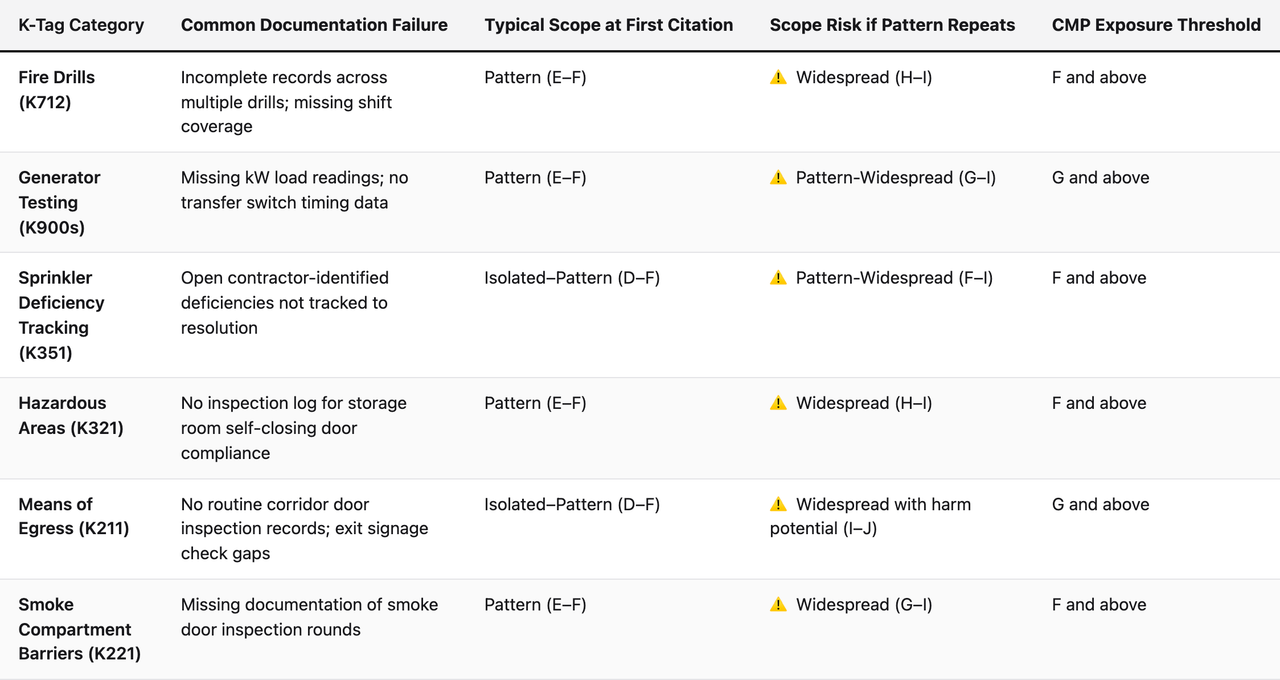
Across the major K-tag categories, documentation failures cluster around a predictable set of structural problems. Understanding those failure modes is the first step toward interrupting the pattern before it reaches survey.
Fire Drill Records: The Most Frequently Cited Documentation Gap
NFPA 101 requires fire drills at specified intervals across all shifts, and CMS surveys routinely pull 12 months of fire drill records. The most common documentation failures are not missing drills, they are incomplete records for drills that were conducted. A compliant fire drill record must capture the date, time, location, shift, number of staff participating, building section covered, scenario description, evacuation time, and corrective actions identified. Records that capture only date, time, and "drill conducted" are not compliant, and when surveyors find that pattern across an entire year's records, the scope rating for the resulting K-tag citation reflects recurrence across multiple time periods, not an isolated omission.
Night-shift drill coverage is a specific recurring gap. Facilities sometimes conduct all required drills during day and evening shifts, with night-shift coverage either underdocumented or conducted at times that do not meet the regulatory distribution requirement. This produces a citation under K712 or related codes, and because the gap spans the entire documentation period rather than a single event, scope is typically rated as a pattern at minimum.
Generator Testing Records: Load Readings and Transfer Timing
Emergency and standby generator compliance under K900-series K-tags requires monthly operational testing and annual load testing, with documentation that includes runtime, kilowatt load, voltage, frequency, and transfer switch operation timing. The most frequent documentation failures are missing kilowatt load readings during monthly tests (which makes it impossible to verify the test was conducted under adequate load) and missing automatic transfer switch timing data. These are fields that many facilities simply do not include in their logging templates, meaning the failure is structural rather than occasional.
When a surveyor reviews generator logs and finds missing load readings across six or twelve months of monthly test records, the pattern scope rating applies immediately. The facility has not had an isolated documentation oversight, it has had a systemic gap in its recording template that has produced non-compliant records for every test in the review period.
Sprinkler System Deficiency Tracking: The Open-Item Problem
Sprinkler system inspection reports generated by licensed contractors routinely identify deficiencies that require correction within specified timeframes under NFPA 25 and CMS requirements. The documentation failure that most frequently produces K-tag citations in this category is not the failure to have the inspection performed. It is the failure to track identified deficiencies through to verified completion. When a contractor's report identifies an impaired sprinkler head or a valve with an incorrect position, the facility must document that the deficiency was received, assigned, and resolved within the required timeframe. Facilities that file the contractor report without creating a deficiency tracking record leave surveyors with an open item that appears unresolved, even if the repair was made.
Hazardous Area and Door Compliance Documentation
K-tags related to hazardous areas (storage rooms, soiled utility rooms, laundry) and corridor door self-closing mechanisms generate citations when facilities cannot produce records of routine inspection rounds that verify compliance. A surveyor who observes a propped-open corridor door during a survey will ask for documentation of the facility's door inspection program. A facility that conducts informal visual checks without a written log cannot demonstrate a compliant inspection program, and the citation that results is not about the propped door in isolation, it is about the absence of a systematic inspection process, which by its nature affects the entire facility and pushes the scope rating toward widespread.
How CMS Scope and Severity Escalation Works When Patterns Repeat Across Survey Cycles
The mechanics of CMS scope and severity escalation across survey cycles are governed by CMS's repeat deficiency framework. A deficiency is classified as a repeat deficiency when the same or substantially similar regulatory requirement is cited in consecutive surveys. Repeat deficiency status does not simply mean the citation appears again, it triggers a separate analytical framework that affects how surveyors weight evidence, how they assign severity, and what remediation pathway the facility must follow.
The critical point is this: a repeat K-tag citation at the same scope and severity level as the prior survey is not a neutral outcome. CMS survey methodology requires surveyors to consider whether the facility's prior corrective action was effective. When the same documentation failure appears in the same K-tag category across two survey cycles, surveyors are expected to assess whether the facility's corrective action plan from the prior cycle actually addressed the root cause, or whether the facility submitted a plan without implementing a durable fix.
When surveyors determine that a prior corrective action plan was not effectively implemented, the severity rating for the repeat deficiency is adjusted upward. A finding that was rated at a D level (isolated, potential for more than minimal harm) in a prior survey may be rated at an F or G level (pattern or widespread, higher harm potential) in the current survey if the same documentation failure persists. That upward adjustment reflects not just the current documentation gap, but the facility's demonstrated inability to sustain compliance, which is a different and more serious regulatory concern.
The Role of the Informal Dispute Resolution Process
Facilities that receive repeat pattern or widespread K-tag citations have access to the Informal Dispute Resolution (IDR) process to challenge findings they believe are inaccurate. However, IDR is not a documentation correction mechanism. Surveyors and the state agency review the documentation that existed at the time of the survey, not records created or completed after the survey exit. Facilities that attempt to reconstruct missing records or complete partial logs after receiving a citation notice are not providing correctable evidence, they are demonstrating to surveyors and state agency reviewers that the contemporaneous documentation was not compliant at the time of the survey.
This is why the window before a survey is the only operationally meaningful window for closing documentation gaps. Post-survey documentation has no evidentiary value in the deficiency dispute process, and in some circumstances, post-survey record alteration can trigger additional regulatory scrutiny.
Civil Money Penalties and the Pattern Threshold
CMS's Civil Money Penalty (CMP) authority under the Nursing Home Reform Act applies when deficiencies reach certain scope and severity thresholds. Life safety deficiencies rated at F, G, H, I, J, K, or L on the scope and severity grid are subject to CMP assessment. Pattern-rated deficiencies, particularly in the G-I range (pattern with actual harm or potential for serious injury or death), trigger per-instance or per-day CMPs that compound for each day the deficiency remains uncorrected after the survey exit date.
For a facility carrying a K-tag deficiency pattern that has escalated from isolated in one survey to pattern in the next, the financial exposure from CMPs can be substantial. Per-day CMPs for pattern findings with higher severity ratings can run into the thousands of dollars per day. A facility that takes 90 days to implement a corrective action plan and demonstrate compliance to a revisit surveyor is accumulating that penalty for 90 days. The documentation failure that started the pattern costs far less to fix before the survey than the CMP exposure it generates after.
Why Corrective Action Plans Fail to Break the Pattern
When a facility receives a K-tag citation, CMS requires the submission of a Plan of Correction (POC) that addresses three elements: what the facility will do to correct the deficiency for the affected residents or locations, what the facility will do to identify whether the same deficiency exists elsewhere, and what systemic changes the facility will implement to prevent recurrence. The POC must include specific completion dates and an ongoing monitoring mechanism.
The reason K-tag deficiency patterns persist across survey cycles, despite POC submissions, is that most corrective action plans address the first two elements adequately but fail on the third. A facility that receives a citation for incomplete fire drill records typically responds by retraining staff on drill documentation requirements and adding missing fields to the drill record form. That addresses the immediate gap. What it does not address is the monitoring mechanism that would catch incomplete records before the next survey.
Without a systematic internal audit of completed documentation records, the retraining fades, the new form template gets used inconsistently, and by the time the next survey cycle arrives, the documentation records for the most recent 12 months contain the same gaps that triggered the prior citation. The POC was technically complete. The systemic change was not durable.
The facilities that break the pattern successfully are the ones that implement a documentation audit function that operates continuously between surveys, not just in the weeks before an anticipated survey window. That audit function needs to be capable of reviewing completed records against the specific fields and criteria that surveyors evaluate, identifying gaps while there is still time to address them, and creating a documented record of the internal review process itself, because surveyors will ask whether the facility conducted internal audits as part of their corrective action monitoring.
The Compounding Effect: How Small Documentation Gaps Stack Into Condition-Level Risk
One of the most important dynamics in K-tag deficiency pattern formation is the compounding effect that occurs when multiple small documentation gaps exist simultaneously across different K-tag categories. Each individual gap may be minor, a missing load reading, an incomplete drill record, an untracked sprinkler deficiency. None of them, in isolation, would constitute a serious finding. But when surveyors conduct a Life Safety Code survey and encounter documentation gaps across fire drills, generator testing, and sprinkler deficiency tracking simultaneously, the picture that emerges is not three isolated problems. It is a pattern of systemic documentation management failure.
CMS survey guidance instructs surveyors to consider the totality of a facility's compliance profile when making scope and severity determinations. A facility with multiple K-tag documentation failures across different categories in the same survey presents a systemic compliance concern, which influences how surveyors approach their overall assessment and how the state agency responds when the survey report is submitted. Facilities in this position are more likely to receive immediate revisit surveys, more likely to be flagged for Special Focus Facility consideration, and more likely to face enhanced oversight from their state agency.
The Special Focus Facility (SFF) program, administered by CMS, identifies facilities with a history of serious quality and life safety problems. Life safety deficiencies, particularly those with pattern or widespread scope ratings and higher severity levels, contribute to a facility's SFF score. Once a facility enters the SFF program, it is subject to more frequent surveys and enhanced enforcement actions, creating a compounding regulatory burden that is extremely difficult to exit. The documentation gaps that contributed to SFF placement are frequently the same K-tag documentation failures described in this article.
The Internal Audit Gap: Why Facilities Cannot Self-Detect Pattern Formation
The fundamental operational challenge that allows K-tag deficiency patterns to form and persist is the absence of a systematic internal audit capability that reviews documentation records with the same analytical lens a surveyor would apply. Most SNF maintenance directors and plant operations managers are executing the work, not auditing the documentation of the work. That distinction is critical.
A maintenance director who conducts a generator test knows the test was run. The entries in the log look complete from the perspective of someone who was present. What that director typically cannot see, without a structured review process, is that the kilowatt reading field has been left blank for the third consecutive month, or that the transfer switch timing entry is absent, or that the test duration falls short of the 30-minute threshold required by NFPA 110. Those gaps are invisible to someone reading the log as a record of an activity they personally completed.
The same dynamic applies to fire drill records. A supervisor who ran the drill knows it was conducted properly. The record they complete reflects their memory of the event. But if the record template does not prompt for every required field, or if the person completing the record is not trained on what constitutes a compliant entry for each field, the resulting documentation will not satisfy a surveyor reviewing it against the NFPA 101 requirements and CMS expectations.
What facilities need is a review layer that sits between the person who completes the documentation and the surveyor who will eventually evaluate it. That review layer has to be capable of identifying field-level gaps, not just whether a record exists, but whether the record contains all required data elements in a format that is compliant. For most facilities, that review layer either does not exist or operates only in the period immediately before an anticipated survey window, which is too late to correct a pattern that has been forming for the prior 12 months.
Building that review capability internally requires dedicated staff time, structured checklists that reflect current regulatory expectations for each K-tag category, and a consistent audit cadence that matches the frequency of the underlying documentation requirement. For a small or mid-size SNF, that is a significant operational investment that competes with every other demand on the maintenance director's time. The facilities that manage it successfully typically have either a dedicated life safety compliance function or external support, whether a consultant, a software platform, or both, that takes the audit function off the maintenance director's plate.
A Decision Framework for Assessing Your Facility's Pattern Risk
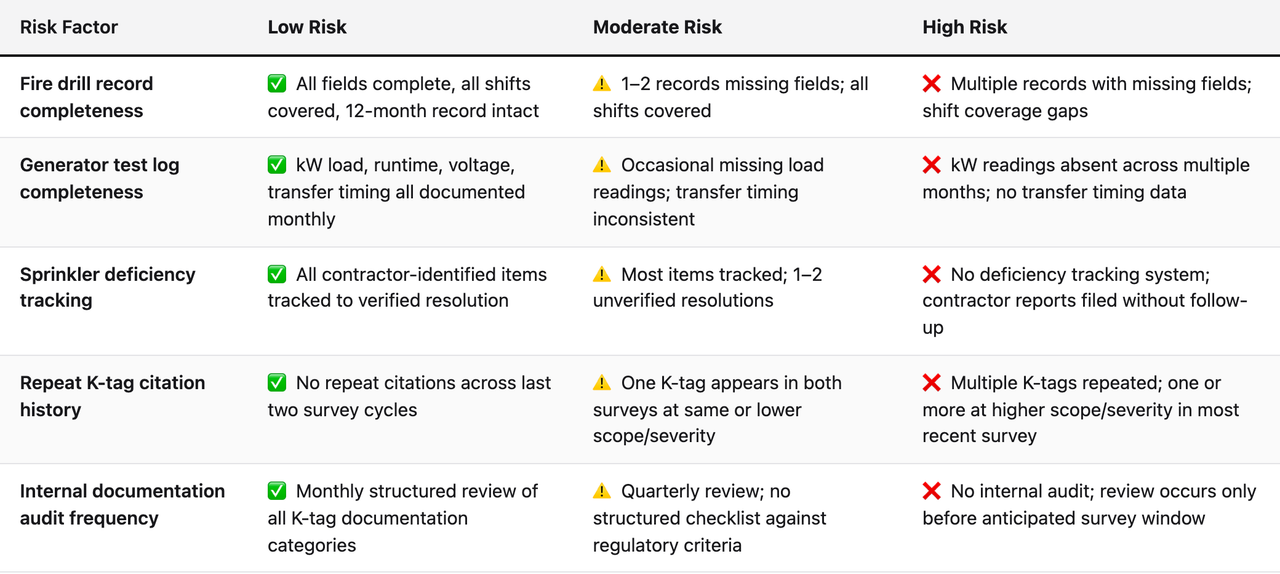
The following framework gives SNF compliance officers and maintenance directors a structured way to assess whether their current documentation practices create K-tag deficiency pattern risk. It is organized around the three dimensions that determine whether a deficiency becomes a pattern citation: recurrence across time, recurrence across locations, and recurrence across survey cycles.
Dimension 1: Recurrence Across Time
Pull the last 12 months of documentation records for each major K-tag category: fire drills, generator tests, sprinkler inspection reports, hazardous area inspection logs, and door compliance records. For each category, ask: does every record contain all required data fields, completed with specific entries rather than checkmarks or blanks? If the answer is no for more than one record in any category, the recurrence-across-time risk is present. Document which fields are missing and across how many records, because that is exactly what a surveyor will do.
Dimension 2: Recurrence Across Locations
For facilities with multiple buildings, wings, or smoke compartments, the across-location dimension applies to any inspection that is conducted separately for different areas of the facility. Fire drills conducted in different building sections, door inspection rounds covering different corridors, and hazardous area checks for different storage rooms all need to be documented separately and completely for each location. If your fire drill records do not specify which building section was covered, or if your door inspection log covers the building generically rather than section by section, the across-location recurrence risk is present.
Dimension 3: Recurrence Across Survey Cycles
Pull the last two completed survey reports for your facility and identify every K-tag citation. For each cited K-tag, identify whether the same tag appears in both reports. If the same K-tag appears in two consecutive surveys, even at a lower scope and severity rating, that is the foundation of a repeat deficiency classification. The third consecutive appearance of the same K-tag, regardless of the corrective action plans submitted, will almost certainly be rated at a higher scope or severity level than the prior citation.
Multi-Site Operators: Why Pattern Risk Compounds Across a Portfolio
For regional facilities managers, VPs of operations, and COOs overseeing multi-site SNF operations, K-tag deficiency patterns present a portfolio-level risk that single-facility operators do not face. When the same documentation failure appears across multiple facilities in the same organization, CMS and state survey agencies begin to assess whether the problem reflects a systemic organizational compliance failure rather than individual facility lapses.
This matters because CMS's enforcement framework for multi-facility operators includes the ability to consider an organization's compliance history across its portfolio when making enforcement decisions for individual facilities. A regional operator with K-tag documentation failures at three of its eight facilities is not facing three independent regulatory problems. It is presenting evidence of an organizational documentation management failure, which can influence enforcement decisions at facilities that have not yet received citations.
The operational challenge for multi-site operators is that documentation practices are typically established at the facility level, with each maintenance director developing their own logging templates, their own inspection schedules, and their own interpretation of what constitutes compliant documentation. Without a standardized documentation framework applied consistently across all facilities, the documentation quality varies from site to site in ways that are invisible at the organizational level until a survey reveals the gap.
Multi-site operators that have successfully reduced their portfolio-level K-tag pattern risk typically share one characteristic: they have implemented a centralized documentation standard that specifies, at the field level, what a compliant record looks like for each K-tag category, and they have a monitoring mechanism that allows regional or corporate compliance staff to review documentation quality across facilities without waiting for a survey to identify the problem. That centralized visibility is operationally significant because it allows the organization to identify when a single facility's documentation practices are drifting from the standard before that drift becomes a citation.
What Surveyors Are Actually Looking For During a Life Safety Code Survey
Understanding the surveyor's perspective during a Life Safety Code survey is essential for building documentation practices that withstand scrutiny. Life Safety Code surveys are conducted by state agency surveyors who have been trained specifically on NFPA 101, NFPA 99, and the CMS K-tag framework. They follow a structured survey process that includes a building tour, interviews with staff and residents, and document review.
During the document review phase, surveyors typically request specific documentation categories rather than asking to review the facility's entire file system. They will request fire drill records for the prior 12 months, generator test logs for the prior 12 months, the most recent sprinkler inspection report and any associated deficiency tracking records, and documentation related to any equipment or system issues observed during the building tour. The key word in that list is "request", surveyors ask for specific documents, and the facility must produce them on demand.
Facilities that maintain their documentation in a disorganized format, across multiple binders or filing systems, create a practical problem during this phase: the time required to locate and compile requested documents can itself raise surveyor concerns about whether the documentation exists. A facility that takes 30 minutes to produce the last 12 months of fire drill records is signaling, unintentionally, that those records are not routinely reviewed and may not be complete.
Surveyors reviewing fire drill records apply a specific analytical framework. They check the distribution of drills across shifts, verify that the required frequency has been met, and then review each record for the required data elements. An experienced surveyor reviewing fire drill records can identify a documentation gap in seconds, the missing fields are immediately apparent when you know what to look for. The facility that has been conducting its own internal reviews with that same analytical framework will have already identified and corrected those gaps before the surveyor arrives.
For generator test records, surveyors compare documented runtime and load data against the NFPA 110 minimums. A monthly test record that shows the generator ran for 20 minutes does not meet the 30-minute minimum. A monthly test record that is missing the kilowatt load reading cannot be verified as compliant with the load threshold. Both produce citations, and both are documentation failures that would have been identified by a structured internal audit.
Building a Documentation Practice That Prevents Pattern Formation
The facilities that consistently avoid K-tag deficiency patterns have documentation practices built around three principles: completeness by design, contemporaneous capture, and systematic internal review. Each principle addresses a different failure mode in the documentation lifecycle.
Completeness by design means the documentation templates and logging tools used for each K-tag category are built to capture every required field, not just the fields the person completing the record thinks are relevant. For a generator test log, this means the template includes dedicated fields for runtime in minutes, kilowatt load reading, voltage, frequency, and transfer switch operation time, with the field label reflecting the regulatory standard it is designed to document. A template that includes those fields by design makes it structurally difficult to submit an incomplete record, because the missing field is visible on the form itself.
Contemporaneous capture means records are completed at the time the activity occurs, not reconstructed from memory at the end of a shift or the end of a week. This is not merely a best practice, it is a regulatory requirement under CMS survey standards. Records that are clearly reconstructed after the fact (because the handwriting is uniform across entries, because the times are suspiciously round, because multiple entries are made in the same ink on the same day for activities spread across a week) raise surveyor concerns about authenticity that can escalate a documentation citation into a more serious finding.
Systematic internal review means someone with knowledge of the regulatory requirements for each K-tag category reviews completed records on a regular cadence, monthly at minimum, against a structured checklist that reflects what a surveyor would look for. That review needs to be documented itself, because surveyors will ask whether the facility has an internal audit process as part of their corrective action monitoring, and a facility that can produce records of its own internal reviews demonstrates a compliance culture that influences how surveyors interpret ambiguous findings.
Technology plays a meaningful role in implementing all three principles at scale. Platforms designed for SNF life safety compliance can enforce template completeness by making required fields mandatory before a record can be submitted, capture timestamps automatically at the point of entry to establish contemporaneous documentation, and run automated reviews of completed records against regulatory criteria to surface gaps before they reach survey. For multi-site operators, those platforms can also aggregate documentation quality data across facilities, giving regional and corporate compliance staff visibility into where documentation practices are drifting from the standard.
Frequently Asked Questions
What is a K-tag deficiency pattern in the context of CMS surveys?
A K-tag deficiency pattern occurs when the same or substantially similar life safety deficiency is documented under the same K-tag code across multiple survey events at the same facility, or when a single survey finds the same deficiency type recurring across multiple locations or time periods within one facility. Pattern status affects the scope rating assigned to the citation, which in turn determines the enforcement pathway and Civil Money Penalty exposure.
How does CMS distinguish between an isolated deficiency and a pattern deficiency?
CMS surveyors assess scope by evaluating how many residents, locations, or time periods are affected by the deficiency. An isolated deficiency affects a small number of residents or a single location. A pattern deficiency affects more than a limited number of residents or locations but is not pervasive throughout the facility. When the same documentation gap appears across multiple records or multiple physical areas, surveyors rate the scope as pattern rather than isolated, which moves the citation up the scope and severity grid.
Can a documentation failure cause the same escalation as an operational failure?
Yes. From a surveyor's perspective, a documentation failure and an operational failure produce the same regulatory outcome. CMS surveyors can only evaluate what the documentation record shows. If the record does not demonstrate that a required activity was performed in compliance with NFPA standards and CMS requirements, the surveyor cites a deficiency regardless of whether the activity actually occurred. Contemporaneous, complete documentation is the only form of evidence CMS accepts.
What triggers a repeat deficiency classification at CMS?
A deficiency is classified as a repeat deficiency when the same or substantially similar regulatory requirement is cited in consecutive standard surveys at the same facility. Repeat deficiency classification influences how surveyors assess the facility's corrective action history and can result in upward adjustment of the severity rating for the current citation, on the basis that the facility's prior corrective action plan was not effectively implemented.
How do Civil Money Penalties relate to K-tag scope and severity ratings?
CMS has authority to assess Civil Money Penalties for deficiencies rated at F level and above on the scope and severity grid. Pattern deficiencies with higher severity ratings (G-I range) are subject to per-day or per-instance CMPs that accumulate from the survey exit date until the facility demonstrates correction to a revisit surveyor. The financial exposure from per-day CMPs over a 60-90 day correction period can be substantial compared to the cost of preventing the underlying documentation failure.
What should a Plan of Correction for a K-tag documentation failure include?
A compliant Plan of Correction must address: the immediate correction for the cited deficiency, a process for identifying whether the same deficiency exists elsewhere in the facility, and systemic changes to prevent recurrence. For documentation failures, the systemic change must include an ongoing monitoring mechanism, typically an internal audit process, that will catch documentation gaps before the next survey. Plans of Correction that address immediate correction without a durable monitoring mechanism tend to fail at the next survey cycle, producing a repeat deficiency citation.
How far back do surveyors typically review life safety documentation?
For most recurring documentation requirements (fire drills, generator tests, sprinkler inspections), CMS surveyors review the prior 12 months of records. This means that a documentation gap that occurred 10 months ago is still within the survey review window and can contribute to a pattern scope rating. Facilities should maintain complete, compliant records on a rolling 12-month basis and should conduct internal reviews across that same window.
What is the Special Focus Facility program, and how does K-tag pattern history contribute to SFF placement?
The Special Focus Facility program identifies nursing homes with a persistent history of serious quality and safety problems based on their survey history. Life safety deficiencies, particularly those with pattern or widespread scope ratings and higher severity levels, contribute to the score used to identify SFF candidates. Facilities in the SFF program are surveyed more frequently and are subject to enhanced enforcement actions, creating a compounding regulatory burden. Preventing K-tag deficiency patterns from forming is one of the most direct ways to reduce SFF risk.
Can facilities challenge K-tag citations through the Informal Dispute Resolution process?
Yes, facilities can use the Informal Dispute Resolution process to challenge K-tag citations they believe are inaccurate. However, IDR reviews the documentation that existed at the time of the survey, not records completed or corrected after the survey exit. Post-survey documentation completion does not provide evidentiary support in the IDR process, which is why identifying and closing documentation gaps before the survey is the only operationally effective strategy.
How do multi-site SNF operators manage K-tag documentation consistency across facilities?
Multi-site operators that successfully manage K-tag documentation consistency typically implement a centralized documentation standard that specifies required fields and formats for each K-tag category across all facilities, combined with a centralized monitoring mechanism that allows regional or corporate compliance staff to review documentation quality at individual facilities without waiting for a survey to identify gaps. Without that centralized visibility, documentation quality tends to vary significantly from facility to facility, creating portfolio-level pattern risk that is invisible at the organizational level until surveys reveal it.
What is the difference between NFPA 101 and NFPA 99 in the context of K-tag citations?
NFPA 101, the Life Safety Code, governs fire protection, means of egress, and building construction standards. NFPA 99, the Health Care Facilities Code, governs medical gas systems, emergency power systems, and other facility systems specific to healthcare environments. CMS K-tags reference both standards, and a single survey may cite deficiencies under both codes. Generator testing requirements, for example, draw on NFPA 110 and NFPA 99 requirements, while fire drill requirements draw on NFPA 101. Facilities need documentation practices that address both standards.
How often should a facility conduct internal audits of its K-tag documentation?
The appropriate internal audit frequency depends on the cadence of the underlying documentation requirement. For monthly requirements (generator tests), a monthly review of the completed record before the end of the month is the minimum effective standard. For quarterly or annual requirements (sprinkler inspections, annual generator load tests), a review within 30 days of the completed activity is appropriate. For continuously maintained records (door inspection logs, hazardous area checks), a monthly review of the rolling record is appropriate. The internal audit process itself should be documented so that facilities can demonstrate an ongoing monitoring function to surveyors.
Key Takeaways
- A K-tag deficiency pattern forms when the same documentation failure recurs across multiple records, locations, or survey cycles, and the scope rating that results carries materially different regulatory consequences than an isolated citation.
- Documentation failures and operational failures produce the same regulatory outcome. Surveyors can only evaluate what the record shows. If the record is incomplete, the activity cannot be confirmed as compliant, regardless of what actually happened.
- The most common K-tag documentation failures are structural, not occasional. Missing generator load readings, incomplete fire drill records, and untracked sprinkler deficiencies typically reflect gaps in the recording template or training, not one-time oversights, which is why they appear as patterns rather than isolated findings.
- Corrective action plans that lack a durable monitoring mechanism fail at the next survey cycle. Retraining and template updates address the immediate gap but do not prevent recurrence unless paired with a systematic internal audit function that operates continuously between surveys.
- Multi-site operators face portfolio-level pattern risk when documentation practices vary by facility. Centralized documentation standards and cross-facility monitoring visibility are the structural solutions.
- The only operationally meaningful window for closing documentation gaps is before the survey. Post-survey documentation has no evidentiary value in the IDR process, and records reconstructed after a citation notice can raise additional regulatory concerns.
- A systematic internal audit function that reviews completed documentation against the specific criteria surveyors apply is the single most effective structural intervention for preventing K-tag deficiency patterns from forming and compounding.
About the author
Benjamin Terebelo · Founder
Benjamin is the founder of SEQURA, a compliance platform purpose-built for healthcare facilities. He builds at the intersection of healthcare operations and software, maintaining a focus on bringing modern tooling to systems that the broader industry has largely left behind.
About the author
Benjamin Terebelo · Founder
Benjamin is the founder of SEQURA, a compliance platform purpose-built for healthcare facilities. He builds at the intersection of healthcare operations and software, maintaining a focus on bringing modern tooling to systems that the broader industry has largely left behind.