
What Is a K-Tag Scope and Severity Matrix? A Practical Explainer for SNF Compliance Officers

Picture this: a CMS surveyor walks into your SNF on a Tuesday morning, unannounced. By noon, she has flagged a documentation gap in your fire door inspection logs. By 2 PM, that gap has been translated into a K-tag citation. By the end of the survey, you are looking at a deficiency that could range from a footnote in your report to a condition-level finding that triggers an immediate jeopardy determination. The difference between those two outcomes is not the gap itself. It is where that gap lands on the scope and severity matrix.
For SNF compliance officers, the K-tag scope and severity matrix is one of the most consequential frameworks in all of post-acute care regulation. It determines whether a life safety deficiency becomes a minor corrective note or a facility-threatening enforcement action. And yet, a surprising number of professionals who live inside survey cycles every year have only a surface-level understanding of how the matrix actually works, how surveyors move through it, and what documentation practices systematically shift citations from the right side of the grid to the left.
This article is a complete, practical explainer of the CMS deficiency matrix as it applies to life safety K-tags in skilled nursing facilities. It covers the architecture of the grid, how scope and severity interact, the specific pathways surveyors use to assign levels, and what SNF compliance officers can do operationally to reduce both the frequency and the weight of citations before the next unannounced visit arrives.
What Is the K-Tag Scope and Severity Matrix?
The K-tag scope and severity matrix is the scoring framework CMS uses to classify deficiencies identified during life safety code surveys of SNFs and other Medicare- and Medicaid-certified facilities. Every citation a surveyor writes during a Life Safety Code (LSC) survey must be assigned a position on this matrix, which defines both the extent of the problem (scope) and the potential harm it creates (severity). The position on the grid determines the regulatory consequences that follow.
The matrix is a 12-cell grid. It runs across a horizontal axis representing scope (how widespread the deficiency is) and a vertical axis representing severity (how serious the actual or potential harm is). Together, those two dimensions produce a letter designation, running from A through L, that becomes the official weight of the citation. That letter does not just describe a deficiency. It drives enforcement pathways, civil monetary penalties, and the public perception of a facility's compliance standing.
The Scope Axis: Isolated, Pattern, and Widespread
The horizontal scope dimension has three levels. An Isolated deficiency affects one or a very limited number of residents, staff members, or situations. A Pattern deficiency affects more than a limited number and is not random. A Widespread deficiency is pervasive throughout the facility or represents a systemic failure in the facility's practices.
For life safety K-tags, scope is often the dimension that compliance officers have the most direct influence over. A single fire door with a missing inspection record is isolated. The same documentation gap across twelve fire doors in three corridors becomes a pattern. Missing inspection records for every fire door in the building is widespread. The underlying physical condition of the doors may be identical across all three scenarios, but the documentation posture transforms a manageable citation into a systemic finding.
The Severity Axis: From Minimal Harm to Immediate Jeopardy
The vertical severity dimension runs through four levels:
- Level 1 (rows A, B, C): No actual harm, with no potential for more than minimal harm. These are technical deficiencies without resident risk.
- Level 2 (rows D, E, F): No actual harm, but with potential for more than minimal harm that does not pose immediate jeopardy. This is the most common zone for routine life safety documentation gaps.
- Level 3 (rows G, H, I): Actual harm that does not rise to immediate jeopardy. A resident was inconvenienced, injured, or placed in a situation of demonstrated risk.
- Level 4 (rows J, K, L): Immediate jeopardy. The deficiency has caused or is likely to cause serious injury, harm, impairment, or death unless immediate corrective action is taken.
Each severity level is paired with each scope level, producing the 12-cell grid. A citation at D (no actual harm, isolated) carries very different consequences than a citation at K (immediate jeopardy, pattern). Understanding where your documentation gaps are likely to land is the first step toward managing survey risk with any precision.
How CMS K-Tags Map Onto the Matrix
Life safety K-tags are a specific subset of CMS deficiency tags used exclusively during LSC surveys. While F-tags cover clinical and operational requirements under 42 CFR Part 483, K-tags are drawn from CMS survey protocols for the 2012 Life Safety Code adopted in the CMS Health and Safety Standards for long-term care. Each K-tag corresponds to a specific NFPA 101 or NFPA 99 requirement, and each can theoretically land anywhere on the scope and severity matrix.
In practice, however, certain K-tags cluster at predictable severity levels based on the nature of the underlying requirement. Understanding those clusters is critical for prioritizing compliance effort.
K-Tags with Elevated Immediate Jeopardy Risk
A subset of K-tags carry heightened immediate jeopardy (IJ) risk because the underlying life safety systems, if compromised, can directly threaten resident life in an emergency. These include:
- K211 (Means of Egress): Blocked, locked, or obstructed exits are among the most direct paths to an immediate jeopardy determination. CMS interpretive guidance notes that any condition preventing residents from reaching a safe location during a fire or emergency can qualify as IJ.
- K321 / K325 (Sprinkler System): Sprinkler systems that are out of service, have unresolved impairments, or lack required inspection documentation can trigger IJ, particularly when the facility houses non-ambulatory residents.
- K341 (Fire Alarm System): Fire alarm systems with documented failures, untested pull stations, or incomplete inspection records involving automatic detection create compounding risk in facilities where residents cannot self-evacuate.
- K712 (Emergency Generator): Generator failures or documentation gaps that indicate a facility cannot guarantee power to life-safety systems during an outage are a known IJ pathway, particularly post-storm events that trigger inspections.
For compliance officers, the operational implication is direct: these K-tag categories warrant the most rigorous documentation controls, the most frequent internal audits, and the most immediate escalation protocols when gaps are found.
K-Tags Most Commonly Cited at D–F Levels
The majority of K-tag citations in routine SNF surveys land in the D-through-F band, representing no actual harm but potential for more than minimal harm. Common examples include:
- K130 (Deficiencies in Multiple Chapters): Miscellaneous NFPA code gaps that do not fit neatly into a single chapter but collectively signal incomplete life safety management.
- K147 (Electrical Wiring and Equipment): Extension cord use, non-UL-listed equipment, and overloaded circuits frequently cited at D or E.
- K900 / K901 (Corridor Conditions): Combustible materials storage in corridors, obstructed paths, and improper door hardware.
- K353 (Sprinkler Inspection and Testing): Missing or incomplete quarterly and annual inspection records. This is one of the most documentation-driven K-tags in the entire framework, and it almost always starts at D and escalates based on scope.
The practical insight here is that D-level citations in isolation are manageable. They require a plan of correction and follow-up, but they do not typically threaten a facility's participation in Medicare or Medicaid. The danger is scope creep: a single D-level finding that, upon further review, reflects a pattern across the facility converts to an E or F. That shift in scope, with no change in severity, meaningfully alters the enforcement posture.
How Surveyors Actually Navigate the Matrix During an LSC Survey
The matrix does not work the way most compliance officers imagine. Surveyors do not walk through a facility, assign raw scores, and then look up where those scores fall. The process is more deliberate and more nuanced, and understanding the actual survey decision pathway gives compliance officers a significant strategic advantage.
The Severity Decision Comes Before the Scope Decision
CMS guidance instructs surveyors to determine severity first, then scope. This is a critical detail. The surveyor begins by asking: if this deficiency goes uncorrected, what is the worst realistic outcome for a resident? That answer drives the initial severity placement. Only after severity is established does the surveyor assess how many residents, staff, or areas of the facility are affected.
For life safety deficiencies specifically, the severity question is heavily influenced by two factors: the nature of the life safety system involved, and the resident population's capacity to self-protect. A SNF housing non-ambulatory residents with cognitive impairment is operating under a higher baseline risk assumption than an assisted living community with mobile residents. Surveyors are trained to account for that resident vulnerability when assessing potential harm from life safety deficiencies.
The Role of Abatement and Mitigation in Severity Assignment
One of the most underutilized concepts in SNF compliance is the role of documented mitigation in limiting severity assignment. When a surveyor identifies a life safety deficiency, the question is not only "what could happen?" but "what has the facility done to limit that risk?" Documented interim fire watch protocols, temporary measures during sprinkler impairments, and written contingency plans for generator failures are all forms of mitigation that, when properly documented and immediately producible, can influence a surveyor's severity determination.
This is not about gaming the survey. It is about demonstrating that the facility's safety management system is functioning, even when a specific component is temporarily compromised. Facilities that can hand a surveyor a contemporaneous fire watch log alongside an identified sprinkler impairment are showing evidence of a functioning safety culture. Facilities that cannot produce that documentation, even if the interim fire watch was actually performed, are presenting the equivalent of an unmitigated deficiency.
How Pattern and Widespread Findings Are Established
Scope escalation from isolated to pattern to widespread follows a specific evidentiary process. Surveyors do not simply count deficiencies. They look for evidence of systemic failure: the same documentation gap appearing across multiple assets, the same maintenance oversight in multiple wings, or a policy or procedure that is structured in a way that would predictably produce the same deficiency facility-wide.
For K-tags, the most common pathway to a widespread finding is documentation infrastructure failure. When a facility's inspection log system is structured in a way that makes it easy to miss entries, or when completion is tracked on paper in a way that does not distinguish between "inspected and compliant" and "not yet inspected," surveyors can legitimately infer that the deficiency is not isolated. The documentation architecture itself becomes evidence of scope.
The Enforcement Consequences of Scope and Severity Placement
Where a K-tag lands on the scope and severity matrix is not merely a classification exercise. It triggers a specific regulatory pathway with real operational and financial consequences. Compliance officers need to understand those pathways with precision.
Standard Survey Pathways: A Through I
Citations at A through C (no harm, isolated to pattern) are technically deficiencies but carry minimal enforcement weight. They require a plan of correction but do not generate civil monetary penalties and do not appear in public-facing quality metrics in a way that drives consumer concern.
Citations at D through F represent the most common enforcement zone for SNFs. These citations require a plan of correction, may be tracked across survey cycles for repeat deficiencies, and can accumulate into a pattern of non-compliance that elevates scrutiny in future surveys. Facilities with multiple F-level citations in a single survey cycle may be flagged for increased monitoring or standard enforcement processes.
Citations at G through I indicate actual harm. These are significantly more serious and can trigger formal enforcement proceedings including directed plans of correction, state monitoring, and in some cases, civil monetary penalties. For life safety G-through-I citations, the harm threshold has been crossed, which means the facility must demonstrate not just that the condition has been corrected but that residents who were exposed to the deficiency have been assessed and their wellbeing confirmed.
Immediate Jeopardy: The J–L Zone
Immediate jeopardy citations at J, K, or L represent the most serious enforcement zone in CMS regulation. Under CMS immediate jeopardy protocols, facilities must abate the IJ condition before the survey team leaves the building, or face mandatory enforcement actions including civil monetary penalties of up to $10,000 per day for each day the IJ continues, and potential termination of Medicare and Medicaid participation agreements.
For life safety K-tags, immediate jeopardy determinations are particularly consequential because the abatement of a life safety IJ is not always as simple as updating a policy. A blocked exit must be physically cleared. A failed fire alarm system must be repaired or an acceptable interim measure must be immediately implemented and documented. The clock starts the moment the IJ is cited, and the facility's ability to demonstrate rapid, documented corrective action is the only pathway out of the enforcement trajectory.
The J-K-L distinction within the IJ zone reflects scope: J is isolated IJ, K is IJ as a pattern, and L is widespread IJ. In practical terms, a facility that has reached a K or L citation is facing evidence that an immediate threat to life is not a localized anomaly but a systemic condition. Those citations represent the apex of regulatory risk for any SNF.
The Repeat Deficiency Multiplier
One enforcement consequence that is frequently underestimated is the compounding effect of repeat deficiencies across survey cycles. A D-level citation for incomplete sprinkler inspection records in one survey cycle is manageable. The same citation in the next standard survey cycle, or on a revisit, activates a pattern-of-non-compliance analysis. CMS enforcement protocols allow for escalating penalties and enhanced monitoring when the same deficiency, or the same type of deficiency, recurs.
This means that the scope and severity matrix is not just a snapshot of a single survey. It is part of a longitudinal compliance record that surveyors actively reference when they enter a facility. A compliance officer who treats each citation as an isolated event, correcting the specific gap without addressing the underlying documentation system, is systematically building a repeat deficiency profile that will increase the weight of future citations.
A Practical Decision Framework for Prioritizing K-Tag Risk
Given the complexity of the matrix and the volume of K-tag categories a SNF compliance officer must manage, a structured prioritization framework is essential. The following matrix is designed to help facilities allocate compliance effort based on the intersection of citation frequency and severity potential.
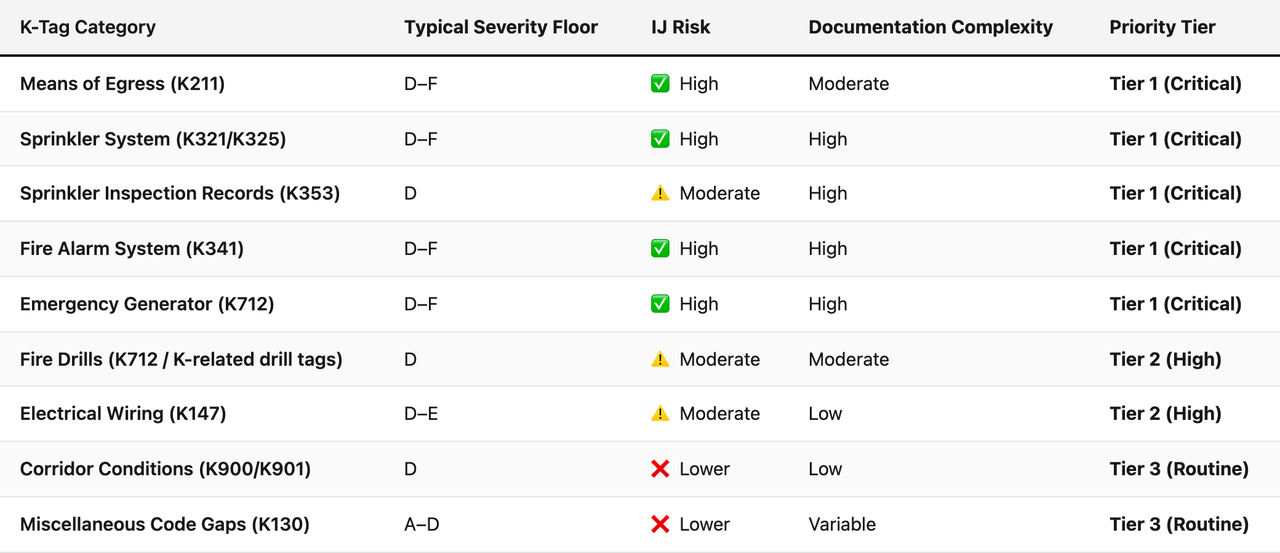
This framework is not exhaustive, and individual facilities will have local risk profiles that shift these tiers. A facility with an aging sprinkler infrastructure should treat K353 documentation with even greater urgency. A facility that recently converted a wing may face elevated means-of-egress risk. The framework's value is in providing a starting mental model, not a universal ranking.
Why Documentation Is the Primary Lever on the Scope and Severity Matrix
Here is a hard truth that every SNF compliance officer eventually learns: in life safety surveys, the physical condition of a facility's systems and the documented condition of those systems are treated as two separate realities. A sprinkler system that was properly tested and maintained last quarter but lacks contemporaneous documentation of that testing is, from a survey standpoint, a sprinkler system with an unknown compliance status. The documentation does not merely record reality. It constitutes the compliance record that surveyors are legally required to evaluate.
This distinction has profound implications for where K-tags land on the scope and severity matrix. Specifically, documentation failures influence the matrix in three distinct ways.
Documentation Failures Lower the Severity Ceiling
When documentation is complete and contemporaneous, a surveyor assessing a potential deficiency has a bounded record to evaluate. They can see exactly what was done, when it was done, and by whom. Even if a gap exists, the surrounding documentation provides context that limits severity assignment. When documentation is incomplete, the surveyor must infer the worst plausible scenario consistent with the available evidence. That inference process systematically pushes severity upward.
Consider the difference between these two scenarios. In the first, a quarterly sprinkler inspection was performed and documented in full, but the contractor's report noted two sprinkler heads requiring replacement, and a follow-up work order was completed and logged two weeks later. The surveyor sees a compliant inspection cycle with a documented and resolved deficiency. In the second scenario, the quarterly inspection was performed but the contractor's report was filed without being reconciled against the facility's internal deficiency tracking system. The two sprinkler heads were replaced, but the work order is on a paper slip that has not been formally closed. The surveyor sees an open deficiency with no documented resolution. Same physical outcome, radically different survey risk.
Documentation Patterns Drive Scope Escalation
Surveyors are trained to look for patterns, and documentation gaps are among the clearest pattern signals available. When a compliance officer's binder contains inconsistent entries, missing dates, unsigned logs, or inspection records that do not cover the facility's full asset inventory, those gaps do not read as isolated oversights. They read as a documentation system that is structurally incapable of ensuring comprehensive compliance.
That systemic inference is precisely what drives scope from isolated to pattern to widespread. The surveyor is not finding twelve separate deficiencies. They are finding one systemic deficiency with twelve observable instances. The scope designation reflects the system failure, not the number of individual errors.
Contemporaneous Documentation Is a Legal Standard
CMS survey guidance consistently distinguishes between documentation that was created at the time of the activity (contemporaneous) and documentation that was reconstructed after the fact. Reconstructed documentation, even when accurate, carries less evidentiary weight and can itself be cited as a documentation deficiency. More importantly, the inability to produce contemporaneous records during a survey is treated as evidence that the documented activities may not have occurred.
For SNF compliance officers, this means that the operational workflow of documentation, not just the content of the documentation, is subject to regulatory scrutiny. A fire drill that was conducted but logged two weeks later on a batch-entry basis creates a different evidentiary picture than a fire drill logged in real time at the point of completion. The difference matters when a surveyor is deciding whether a documentation gap reflects a minor administrative lapse or a facility-wide pattern of non-compliance.
The Compliance Officer's Pre-Survey Self-Assessment Protocol
One of the most valuable tools a SNF compliance officer can deploy is a structured pre-survey self-assessment designed specifically around the scope and severity matrix. Rather than conducting a general life safety walkthrough, this protocol asks the surveyor's questions before the surveyor does: not just "is this compliant?" but "if this is not compliant, where does it land on the grid, and how do we close that gap before it becomes a citation?"
The Four-Question Severity Screen
For each K-tag category in scope, apply the following four-question severity screen:
- Is there any condition in this category that could directly threaten resident life or safety in the next 24 hours? If yes, this requires immediate corrective action, not a compliance note. It is a potential immediate jeopardy condition and must be resolved before any survey risk discussion is relevant.
- Is there any condition that, while not immediately dangerous, represents a degraded state of a life-safety-critical system? These are the G-through-I candidates. They require documented corrective timelines, resident impact assessments, and clear escalation records.
- Is there any documentation gap that would cause a surveyor to infer potential harm even if no physical deficiency exists? These are the D-through-F candidates. They are the most actionable category because they are entirely within the compliance officer's control to resolve before a survey.
- Is the documentation gap isolated to a single asset or record, or does it reflect a structural gap in the documentation system? This is the scope escalation question. A yes answer requires a system-level response, not just a record correction.
Scope Audit: The 10-Asset Spot Check
A practical approach to scope assessment for high-priority K-tag categories is a structured 10-asset spot check. For each Tier 1 K-tag category, pull the documentation records for a random sample of ten assets (ten fire doors, ten sprinkler heads in the current inspection zone, ten emergency lighting units). Evaluate each record against four criteria: completeness of entry, contemporaneity of logging, resolution of any noted deficiencies, and presence of required signatures or credentials.
If two or fewer of the ten records have gaps, the category is likely isolated in scope. If three to six have gaps, the category is trending toward pattern. If seven or more have gaps, the category is at widespread risk, and the compliance officer should treat it as a systemic issue requiring an infrastructure-level response before the next survey.
This 10-asset check is not a substitute for a full internal audit. It is a rapid-cycle diagnostic tool that allows compliance officers to identify where the greatest scope-escalation risk sits without waiting for a complete audit cycle to complete.
Multi-Site SNF Operators and the Matrix: Portfolio-Level Risk Management
For directors of facilities, regional facilities managers, and COOs at multi-site SNF chains, the scope and severity matrix creates a portfolio-level risk management challenge that single-facility operators do not face in the same way. A citation at one facility in a chain does not stay contained to that facility's compliance record. It becomes a data point that CMS and state surveyors use to calibrate scrutiny across the portfolio.
How Repeat Deficiencies Across Facilities Signal Systemic Risk
CMS maintains survey history data across facilities with common ownership and management. A pattern of K353 (sprinkler inspection records) deficiencies across multiple facilities in a chain signals to surveyors that the documentation infrastructure problem is not facility-specific. It reflects a management system that is not adequately supporting documentation compliance at scale. That inference can increase the rigor and duration of surveys across all facilities in the portfolio.
For multi-site operators, this means that a Tier 1 K-tag deficiency at any one facility is effectively a portfolio-level risk signal. Regional facilities managers need visibility into citation data across all facilities, aggregated by K-tag category, to identify where systemic documentation infrastructure failures are creating cross-portfolio exposure.
Standardized Documentation Infrastructure as a Portfolio Risk Control
The most effective risk control for multi-site operators is standardized documentation infrastructure across all facilities. When every facility in a portfolio uses the same inspection templates, the same logging cadence, and the same deficiency resolution workflow, the compliance officer at the portfolio level can conduct cross-facility scope assessments using consistent data. Anomalies at individual facilities become visible against the portfolio baseline, enabling targeted intervention before a survey occurs.
This standardization also creates a defensible narrative for surveyors. A multi-site operator that can demonstrate a consistent, system-wide documentation protocol is presenting evidence that its compliance management is structural and intentional, not facility-by-facility improvisation. That organizational posture influences how surveyors weigh documentation gaps: isolated lapses in an otherwise strong documentation system read differently than the same gaps in a facility with no visible documentation infrastructure.
Life Safety K-Tags and the Role of Third-Party Contractor Documentation
A frequently overlooked dimension of K-tag scope and severity risk is the compliance gap created by third-party contractor documentation. Most SNFs rely on licensed contractors for annual fire alarm testing, sprinkler inspections, generator load testing, and other technically specialized life safety inspections required under NFPA 101 and NFPA 99. Those contractors generate inspection reports that become part of the facility's compliance record. And those reports are directly reviewed during LSC surveys.
The compliance risk here is not whether the contractor performed the inspection correctly. It is whether the contractor's report has been received, reviewed, filed, and reconciled against the facility's deficiency tracking system in a way that is visible and contemporaneous. A contractor report that sits in an email inbox, unreviewed and unfiled, for six weeks after the inspection is technically in the facility's possession, but it does not constitute a functioning compliance record. A surveyor who asks to see the annual sprinkler inspection report and receives a document with an email receipt timestamp from six weeks ago is seeing evidence of a documentation management failure, not just an administrative delay.
The reconciliation step is particularly important. NFPA standards require that deficiencies identified in contractor inspection reports be addressed within specified timeframes. An unreconciled contractor report, where noted deficiencies have not been entered into the facility's work order or deficiency tracking system, creates an open-loop documentation condition that can drive scope escalation. The surveyor sees not just one unresolved deficiency but a documentation system that is structurally unable to close the loop between contractor findings and facility corrective action.
For SNF compliance officers, the practical protocol is straightforward but requires consistent execution: every contractor inspection report must be reviewed within a defined timeframe upon receipt, all noted deficiencies must be entered into the facility's deficiency tracking system with assigned owners and resolution timelines, and the report itself must be filed in a location that is immediately producible during a survey.
What "Survey Confidence" Actually Means in the Context of the Matrix
The phrase "survey confidence" is often used loosely in compliance circles to mean something like "we think we will pass." That is not what it means in a rigorous operational sense. True survey confidence, as it applies to the K-tag scope and severity matrix, means something much more specific: it means that a compliance officer can walk into any survey moment, at any time, and produce contemporaneous documentation that demonstrates the facility's life safety management system is functioning, that known deficiencies are being tracked and resolved, and that the documentation infrastructure itself reflects the kind of systemic, intentional compliance management that limits scope escalation.
That confidence is not built by conducting a pre-survey scramble to fill in documentation gaps. It is built by operating a documentation system that generates contemporaneous, complete, reconciled records as a byproduct of normal daily operations. The fire door inspection is logged at the moment of completion, not batched on Friday afternoon. The contractor's sprinkler report is reviewed and reconciled within 48 hours of receipt, not filed unread until the next internal audit. The generator load test result, including the kW reading, is entered into the inspection record in real time, not reconstructed from a technician's memory three weeks later.
This operational posture is what separates facilities that consistently maintain D-and-below citation profiles from facilities that cycle through D-to-F escalations every survey cycle. It is not about the physical condition of the facility. It is about the documentation system's ability to produce evidence of compliance on demand.
Platforms like SEQURA are built specifically to operationalize this posture. By replacing the paper life safety binder with a system that schedules inspections at the correct NFPA-required cadence, logs completion contemporaneously via mobile or facility kiosk, and audits completed records against regulatory expectations for each K-tag category, SEQURA transforms the documentation function from a retrospective record-keeping exercise into a real-time compliance management system. The AI review layer surfaces the exact patterns that produce scope escalation: missing kW load readings, unreconciled sprinkler deficiencies, fire drill logs missing night-shift coverage. Those patterns are identified and flagged before a surveyor arrives, not after.
Frequently Asked Questions About K-Tag Scope and Severity
What is the difference between a K-tag and an F-tag in a CMS survey?
K-tags are used exclusively during Life Safety Code surveys and correspond to requirements drawn from NFPA 101 and NFPA 99. F-tags are used during health and safety surveys and correspond to clinical and operational requirements under 42 CFR Part 483. A SNF can receive both K-tag and F-tag citations during the same survey cycle, as LSC surveys and standard health surveys are conducted separately but often concurrently.
Can a documentation gap alone generate an immediate jeopardy citation?
In most cases, immediate jeopardy requires evidence of an actual physical or operational condition that creates serious risk to residents, not a documentation gap in isolation. However, documentation failures can contribute to an IJ determination when they make it impossible for surveyors to verify that a life-safety-critical system is functioning. A complete absence of fire alarm testing records, for example, combined with a non-functional detection component, can support an IJ finding because the documentation failure prevents the facility from demonstrating the system was ever confirmed operational.
How does a surveyor determine whether a deficiency is a pattern versus isolated?
Surveyors assess scope by looking at the number of instances of a deficiency, whether those instances appear random or reflect a systemic condition, and whether the facility's documented policies and procedures would predictably produce the same deficiency in other areas. For life safety K-tags, documentation infrastructure gaps, where the same type of missing or incomplete record appears across multiple assets or areas, are the primary driver of pattern and widespread scope determinations.
What is the fastest way to reduce scope escalation risk in a SNF?
Standardizing the documentation workflow for Tier 1 K-tag categories, specifically sprinkler, fire alarm, egress, and generator systems, is the highest-leverage intervention. Ensuring that every inspection is logged contemporaneously, every contractor report is reconciled within a defined timeframe, and every identified deficiency has an assigned owner and resolution timeline in the facility's tracking system reduces the pattern signals that drive scope escalation.
Do state surveys use the same scope and severity matrix as CMS surveys?
Most state surveys for Medicare- and Medicaid-certified SNFs use the CMS scope and severity framework because they are conducted under federal oversight protocols. Some states have supplemental survey processes with their own scoring systems for state-licensed-only facilities. Compliance officers should confirm with their state survey agency whether a separate scoring framework applies to state-specific citations.
How long does a facility have to correct a K-tag citation before enforcement escalates?
The correction timeline depends on the severity level. Immediate jeopardy conditions must be abated before the survey team leaves, or enforcement begins immediately. For non-IJ deficiencies, the facility submits a plan of correction with a completion date, and compliance is verified at a revisit survey. Failure to achieve compliance by the stated date can result in civil monetary penalties and, for repeat deficiencies, enhanced enforcement actions.
What documentation should a SNF have immediately available for a life safety surveyor?
At minimum, a SNF should be able to immediately produce: current fire alarm inspection and testing reports (quarterly and annual), current sprinkler inspection and testing reports, generator test logs including monthly no-load and annual load test results with kW readings, fire drill records for all four required shifts in the preceding 12 months, fire door inspection logs, emergency lighting test records, and any contractor reports with open deficiencies and their documented resolution status.
Can a facility reduce a citation's severity level after it is issued?
Once a citation is issued, the severity level is part of the official record and is not typically adjusted through a correction process. A facility can dispute a citation through the Informal Dispute Resolution (IDR) process, which allows the facility to challenge both the factual basis and the severity assignment of a citation. If the IDR is successful, the citation can be removed or downgraded. However, the IDR process is not a substitute for preventing citations through strong pre-survey documentation management.
How are life safety K-tags different from environment-of-care F-tags?
K-tags are rooted in the NFPA 101 Life Safety Code and focus on the physical systems and conditions that protect residents in emergencies, specifically fire, egress, and related hazards. Environment-of-care F-tags under 42 CFR Part 483.90 address broader physical environment standards including maintenance, temperature, lighting, and sanitation. Both sets of requirements intersect in a SNF, but they are surveyed under separate protocols and cited under separate tag systems.
What is a Condition-Level deficiency in the context of life safety surveys?
A Condition-Level deficiency is a finding at or above the threshold that triggers mandatory enforcement actions under CMS regulations. For life safety surveys, a single immediate jeopardy citation (J, K, or L) constitutes a Condition-Level finding. Condition-Level findings require specific enforcement responses and are publicly reported in a way that can affect a facility's Five-Star Quality Rating and its standing with referral networks.
How should a SNF compliance officer handle a contractor who submits incomplete inspection reports?
The compliance officer should have a documented protocol for receiving, reviewing, and accepting contractor reports. If a report is incomplete, specifically if required data fields such as kW readings, device counts, or deficiency lists are missing, the report should be returned to the contractor with a written request for correction before it is filed. Filing an incomplete contractor report creates a documentation gap that is the facility's responsibility, not the contractor's, from a survey standpoint.
Does the scope and severity matrix apply differently to assisted living facilities than to SNFs?
The CMS scope and severity matrix applies specifically to Medicare- and Medicaid-certified facilities surveyed under federal protocols, including SNFs and nursing facilities. Assisted living facilities are generally regulated at the state level and may use different scoring frameworks depending on state licensing requirements. However, many state assisted living survey programs have adopted analogous scope and severity frameworks, and the underlying logic of assessing both the extent and the potential harm of a deficiency is consistent across most healthcare facility survey systems.
Key Takeaways for SNF Compliance Officers
- The matrix has two axes, and both are within your influence. Severity is driven by the nature of the life safety system and the resident population's vulnerability. Scope is driven heavily by documentation patterns. Compliance officers have more direct control over scope than they often realize.
- Severity is determined before scope in the surveyor's decision process. Understanding which K-tag categories carry the highest IJ risk allows compliance officers to prioritize documentation controls where the potential consequences are most severe.
- Documentation gaps do not just represent missing records. They represent elevated scope risk. A structural documentation gap, one that appears across multiple assets or reflects a system-level failure, is the primary mechanism by which isolated D-level citations become pattern-level E or F citations.
- Contemporaneous logging is a legal standard, not just a best practice. Records created at the point of activity carry more evidentiary weight than batch-entered or reconstructed documentation. The timing of logging is itself a compliance variable.
- Contractor report reconciliation is a high-leverage compliance control. Unreviewed, unfiled, or unreconciled contractor reports are among the most common sources of open-loop documentation conditions that drive scope escalation.
- Multi-site operators face portfolio-level scope risk. Repeat deficiencies of the same K-tag category across multiple facilities in a chain signal systemic management failure and increase surveyor scrutiny across the entire portfolio.
- Pre-survey self-assessment should use the matrix's logic, not a general checklist. Applying the four-question severity screen and the 10-asset spot check to Tier 1 K-tag categories translates the matrix from a reactive classification tool into a proactive risk management framework.
- Survey confidence is an operational posture, not a pre-survey scramble. Facilities that consistently maintain low citation profiles do so because their documentation systems generate contemporaneous, complete, and reconciled records as a byproduct of normal daily operations, not because they prepare intensively before each survey cycle.
About the author
Benjamin Terebelo · Founder
Benjamin is the founder of SEQURA, a compliance platform purpose-built for healthcare facilities. He builds at the intersection of healthcare operations and software, maintaining a focus on bringing modern tooling to systems that the broader industry has largely left behind.
About the author
Benjamin Terebelo · Founder
Benjamin is the founder of SEQURA, a compliance platform purpose-built for healthcare facilities. He builds at the intersection of healthcare operations and software, maintaining a focus on bringing modern tooling to systems that the broader industry has largely left behind.