
What Is Contemporaneous Inspection Logging — And How a Compliance Platform Enforces It Operationally

The maintenance director has been at this facility for eleven years. She knows every inch of the building, every quirk of the fire alarm panel, every contractor who's walked through the door. When a CMS surveyor arrives unannounced on a Tuesday morning and asks to see the generator load bank test records, she walks to her binder with total confidence. She finds the log. It's signed. It has the date. It has the kW readings.
The surveyor looks at it for about forty seconds, then asks one question: "What time was this completed?"
The log doesn't have a time. It has a date, written in the same pen as the technician's signature. There's no way to verify whether that entry was made during the test or three days later when someone realized the binder was going to be reviewed. The surveyor marks it as a potential documentation concern and moves to the next item.
That moment, multiplied across dozens of inspection records across dozens of tasks, is how facilities with genuinely good life safety practices end up with K-tag citations. Not because the work wasn't done. Because the documentation can't prove when it was created. That gap between "we did the work" and "the record proves we did the work at the time we did it" is exactly what contemporaneous inspection logging is designed to close, and it's the operational problem that compliance platforms like SEQURA exist to solve.
What "Contemporaneous" Actually Means in a Regulatory Context
Contemporaneous documentation means a record was created at the time the event or observation occurred, not reconstructed afterward from memory. In a clinical context, this principle is well understood: nurses and physicians know that charting must happen in real time because the medical-legal and regulatory consequences of backdated entries are severe. In the life safety and facilities management world, the same principle applies with equal force under CMS standards, but it's far less consistently enforced at the operational level.
Under CMS survey protocols, inspectors evaluating a skilled nursing facility's compliance with Life Safety Code requirements (NFPA 101 and NFPA 99) are looking not just at whether documentation exists, but at whether that documentation is credible. A credible record is one that was generated during or immediately after the inspection or test activity, captures the actual conditions observed (not just a checkbox), and contains enough metadata to establish a chain of custody from the physical event to the paper or digital record.
The word "contemporaneous" does not appear as a defined term in every CMS interpretive guidance document, but its operational meaning is embedded throughout the survey process. When F-tag and K-tag citations reference "documentation shall be maintained" or "records shall be available," the regulatory intent is that those records reflect what actually happened, when it actually happened. A log sheet filled out collectively at the end of the week, or a binder entry reconstructed before a survey visit, does not satisfy that intent, even if every factual entry happens to be accurate.
Why Timestamps Matter More Than Content
Most facility staff focus on the content of their inspection logs: did we write down the right readings? Did we note the deficiency? Did we get the signature? But from a survey standpoint, the timestamp is often the more consequential element, because it's the only thing that can establish whether the record was created contemporaneously or reconstructed.
A fire door inspection log that lists every door, every condition, and every corrective action but shows all entries completed on the same date at the same handwriting pressure with identical ink is a documentation red flag. A digital log that shows door-by-door entries staggered across a six-hour inspection window, each with a unique device ID, GPS tag, and user credential, tells an entirely different story, even if the substantive content is identical. The timestamp architecture of the record is what separates documentation that survives scrutiny from documentation that creates citation risk.
The Regulatory Landscape That Makes This Urgent
CMS survey intensity for SNFs has increased substantially in recent years. The CMS Nursing Home Initiative introduced strengthened enforcement pathways, increased frequency of unannounced inspections, and expanded scrutiny of life safety and environment of care compliance. State survey agencies operating under CMS delegation have followed with their own intensification cycles.
The practical consequence is that documentation quality, not just documentation existence, is being evaluated with more rigor than at any point in the prior decade. Surveyors who previously might have accepted a paper binder at face value are now asking questions about when entries were made, who made them, and what system of controls ensures they reflect real-time activity. Facilities that have relied on retrospective documentation practices are finding those practices produce citations even when the underlying inspections were genuinely completed.
How Backdated Logs Create Compliance Risk Beyond the Obvious
The most obvious risk from backdated documentation is a K-tag citation for incomplete or inaccurate records. But the compliance exposure from backdated logs extends well beyond the initial citation, and understanding the full risk architecture is important for administrators and operators who are evaluating whether their current documentation practices are sustainable.
The Citation Cascade Problem
When a surveyor identifies a documentation credibility issue with one category of inspection records, standard survey protocol involves expanding review to adjacent categories. A question mark over the generator test logs leads to a review of the fire pump records. A concern about fire drill documentation leads to a closer look at egress inspection logs. This is not punitive behavior; it reflects the logical inference that a facility with inconsistent documentation practices in one area likely has inconsistent practices across the board.
The citation cascade from a single backdated log issue can therefore produce a survey outcome that is dramatically more severe than the underlying documentation problem would suggest. A facility that had one marginal practice around generator log completion can find itself defending K-tags across six categories because the credibility of its overall documentation system has been called into question. This is one of the primary mechanisms by which facilities with genuinely compliant physical life safety programs still receive substantial citation packages.
Civil Monetary Penalty Exposure
K-tag citations related to life safety documentation are categorized under different scope and severity levels depending on the nature of the finding. Immediate jeopardy findings, which can arise when documentation gaps suggest that life safety systems may not have been properly maintained or tested, carry civil monetary penalty exposure that can reach thousands of dollars per day. Even non-immediate-jeopardy findings at the pattern or widespread level can trigger significant financial consequences and mandatory correction plans.
The financial modeling for operators should account not just for the per-day penalty, but for the operational cost of the survey response: corrective action plans, follow-up surveys, consultant fees, staff time diverted from operations, and reputational damage in referral markets. For a multi-site operator, a documentation credibility finding at one facility can trigger heightened scrutiny across the entire portfolio under CMS's multi-site review protocols.
The Whistleblower and False Claims Dimension
In an environment where facility staff are aware of the regulatory stakes of documentation accuracy, backdated or reconstructed records create a secondary exposure that many operators do not fully consider: the False Claims Act dimension. When a facility certifies to CMS through its cost reports and conditions of participation that it is in compliance with life safety requirements, and when documentation records are later found to be retrospectively created, the gap between the certification and the underlying reality can become the basis for a False Claims Act allegation.
Whistleblower protections under the False Claims Act mean that current or former employees who are aware of documentation practices they believe are fraudulent have legal mechanisms to bring those concerns to federal attention with potential financial recovery. This is not a theoretical risk; it is an active enforcement pathway that has been used in healthcare fraud cases involving documentation integrity. Facilities that treat documentation reconstruction as a routine administrative practice are building structural legal exposure that does not resolve simply by correcting the practice going forward.
What CMS Documentation Standards Actually Require
CMS documentation standards for life safety in SNFs are anchored primarily in the NFPA 101 Life Safety Code and NFPA 99 Health Care Facilities Code, which CMS has adopted by reference into its Conditions of Participation. Understanding what these standards actually require at the record level is essential for building documentation systems that survive scrutiny.
Record Retention and Accessibility Requirements
NFPA 101 and NFPA 99 specify minimum inspection frequencies for hundreds of life safety systems and components, from quarterly fire extinguisher checks to annual fire pump tests to semi-annual fire drill requirements with specific shift-coverage mandates. For each of these inspection categories, the standards specify that records shall be maintained and available for review. The availability requirement is not merely about physical access; it encompasses the completeness and legibility of the record in a form that allows a reviewer to assess compliance.
CMS interpretive guidelines expand on this by specifying that records must reflect the actual conditions observed during inspection, not merely the fact that an inspection occurred. A fire door inspection log that records only "inspected, satisfactory" without noting the specific elements checked, the door locations, and any deficiencies observed does not satisfy the standard. Surveyors are trained to distinguish between records that document an inspection and records that document a checkbox exercise.
Deficiency Tracking and Corrective Action Requirements
One of the most commonly cited documentation failures in SNF life safety surveys involves not the inspection records themselves, but the deficiency tracking records that are supposed to accompany them. When an inspection identifies a deficiency, NFPA and CMS standards require that the deficiency be documented, that a corrective action timeline be established, and that completion of the corrective action be recorded. The chain from identification to resolution must be documentable through records that exist contemporaneously with each step.
Facilities that complete inspections and identify deficiencies but fail to maintain contemporaneous records of the corrective action process face citation risk even when the physical deficiency has been corrected. The surveyor's job is to assess compliance through documentation; if the documentation chain is broken at any link, the underlying physical compliance is effectively invisible to the survey process.
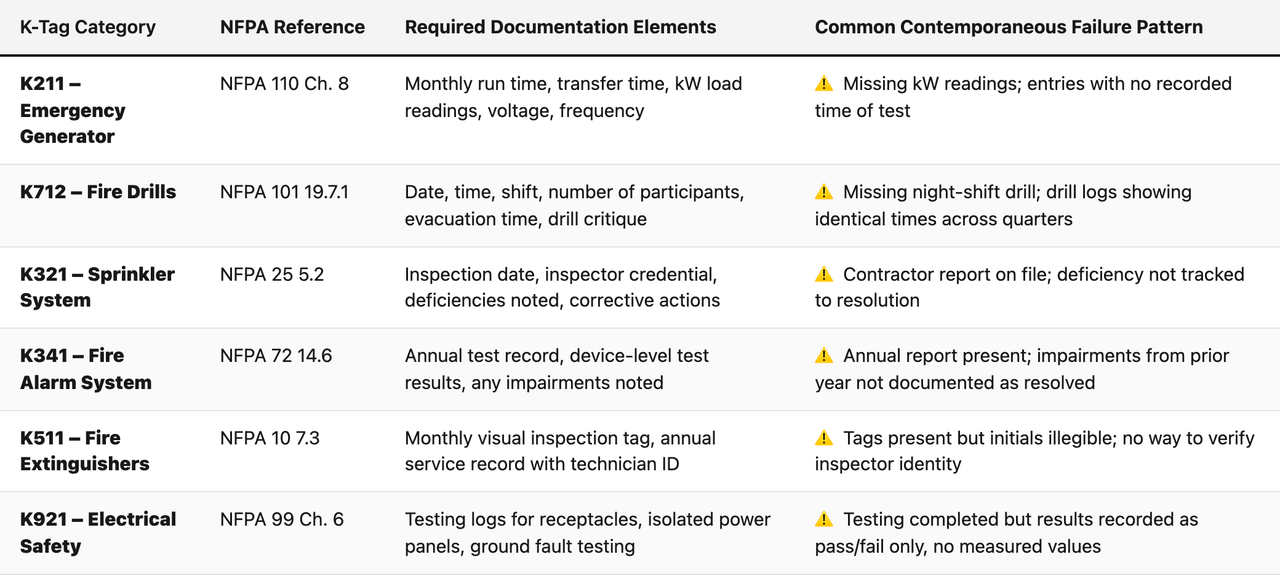
The K-Tag Documentation Matrix
The following table summarizes the primary K-tag categories most commonly associated with contemporaneous documentation failures, the regulatory basis for each, and the documentation elements that distinguish compliant from non-compliant records.
The Operational Reality of Paper-Based Documentation Systems
Paper binders are not fundamentally broken as a documentation medium. They are broken as a contemporaneous documentation system, and that distinction is critical for understanding why even well-run facilities with paper systems face survey vulnerability.
The maintenance director who has been in her role for eleven years knows the inspection schedule by memory. She knows which contractor handles the sprinkler system and which one does the fire alarm. She knows that the generator gets tested every month and that she's supposed to keep three years of records. Her knowledge and diligence are not in question. The paper binder's ability to prove that her knowledge and diligence translate into real-time, timestamped, auditable records is what's in question.
The Reconstruction Temptation
Paper systems create a structural temptation toward documentation reconstruction that digital systems with proper controls eliminate. When a technician completes a monthly fire extinguisher walk-around but doesn't fill out the log sheet until the following week, they are reconstructing, not documenting. When a maintenance director realizes three days before a quarterly review that two inspection logs are missing and fills them out from memory, they are reconstructing. Neither person necessarily intends to falsify records; they are managing the administrative load of a busy facility with imperfect tools.
But from a regulatory standpoint, the intent is not the determining factor. The credibility of the record is. A paper log sheet has no mechanism to distinguish between an entry made during the inspection and an entry reconstructed afterward. The absence of that distinction is exactly what makes paper-based documentation systems structurally incompatible with contemporaneous inspection logging as a regulatory standard.
The Binder Audit Problem
Another structural limitation of paper systems is the auditing bottleneck. A comprehensive SNF life safety binder contains hundreds of inspection records across dozens of categories, updated throughout the year. The maintenance director is typically the only person who understands the full scope of what should be in the binder, what the cadence requirements are for each category, and how to interpret whether any given record is complete. This creates a single point of failure for compliance review.
When a new maintenance director joins, when the existing one takes a leave of absence, or when the facility needs to demonstrate compliance to a regional operations manager or a lender, the binder audit process is manual, time-consuming, and prone to gaps. The person doing the audit typically does not know which records are missing, because the binder only shows what's present, not what should be there. Missing records are invisible in a paper system until a surveyor's checklist makes them visible.
Staff Turnover and Documentation Continuity
SNF maintenance and EVS departments experience meaningful staff turnover rates, consistent with broader healthcare workforce trends. Each staffing transition introduces documentation continuity risk. When a technician who has been managing a specific inspection category leaves, the institutional knowledge of how those records were maintained, where they were filed, and what the cadence requirements were does not automatically transfer to their replacement. Paper systems have no mechanism to surface this gap until an inspection reveals it.
The practical result is that facilities often discover documentation gaps not during routine internal review but during survey preparation, when a consultant or administrator works through the binder and finds that several months of a particular inspection category are simply missing. By that point, the options are limited and none of them are good: the facility can acknowledge the gap and face citation risk, attempt to reconstruct the records and face a more serious credibility problem if the reconstruction is detected, or demonstrate that the inspections were completed through some alternative evidence trail that may or may not satisfy the surveyor.
How a Compliance Platform Enforces Contemporaneous Logging Operationally
A purpose-built life safety documentation platform enforces contemporaneous inspection logging not through policy or training, but through the architecture of the documentation process itself. When a system is designed so that documentation can only be created at the point of activity, the contemporaneous requirement shifts from a behavioral expectation to a technical constraint. That shift is the fundamental operational value that separates a compliance platform from a digital filing cabinet.
Scheduled Task Dispatch and Mandatory Completion Windows
The first enforcement mechanism in a platform like SEQURA is the task dispatch architecture. Inspection tasks are not presented as a static list of things to do; they are dispatched to specific assignees with defined completion windows based on the regulatory cadence for each inspection category. A monthly generator load test appears in the assigned technician's task queue at the beginning of the compliance window, with a defined deadline that reflects the regulatory requirement and includes a buffer for follow-up before the window closes.
This architecture means that documentation gaps become visible in real time, not in retrospect. If the generator test is due on the 15th and the technician hasn't logged completion by the 14th, the platform surfaces that gap to the maintenance director and, depending on configuration, to the facility administrator or regional manager. The gap is identified while there is still time to complete the inspection and document it properly, rather than being discovered during survey preparation or, worse, during an actual survey.
Point-of-Activity Capture Through Kiosk and Mobile
The second enforcement mechanism is point-of-activity capture. SEQURA is designed to be used at the moment of inspection, not afterward. Technicians complete inspection logs through a facility kiosk, a mobile device, or a back-office computer, with the system capturing a timestamp, user credential, and in applicable configurations, location data at the moment of entry. This creates a metadata envelope around each record that establishes when and by whom it was created, independently of the content of the record itself.
For inspections that involve measurable readings, such as generator kW load values, transfer times, or electrical test results, the platform's input fields require those values to be entered rather than allowing a simple pass/fail checkbox. The structured data capture serves two purposes: it forces the documentation to reflect actual observed conditions rather than a completion signal, and it creates a data record that can be audited for consistency and completeness independent of the narrative content of the log.
Contractor Report Integration and Deficiency Reconciliation
One of the most sophisticated operational enforcement functions in a life safety documentation platform is the handling of contractor inspection reports. In most SNFs, annual fire alarm testing, sprinkler inspections, and similar third-party inspections generate contractor reports that are filed in the binder, often without any systematic process for tracking whether deficiencies noted in those reports have been resolved. The contractor report is present; the deficiency resolution chain is missing.
A platform built for this purpose ingests contractor reports and cross-references them against the facility's deficiency tracking log. When a contractor report notes a deficiency, the platform creates a linked corrective action task with a required completion date. That task remains open and visible in the facility's compliance dashboard until a resolution record is logged. If the resolution window passes without a logged completion, the platform escalates the open deficiency to facility management. The result is that the documentation chain from deficiency identification to resolution is contemporaneous at every step, not reconstructed at survey time.
AI-Driven Documentation Gap Analysis
Beyond the task management and capture functions, platforms like SEQURA add an analytical layer that operates on the documentation record itself. An AI review system reads completed inspection records and cross-references them against the regulatory expectations for each asset and K-tag category, looking for patterns that indicate documentation gaps rather than just missing records.
This distinction matters because not all documentation gaps are visible as missing entries. A generator log that has been completed every month but consistently lacks kW load readings is a documentation gap that a paper audit might not surface, because the log is present and signed. An AI system that understands what a compliant generator log must contain flags that gap automatically, surfacing it to the maintenance director before a surveyor sees it. This predictive auditing function is qualitatively different from any capability available in a paper system or a generic digital filing tool.
Audit Trail Architecture for Survey Response
When a CMS surveyor asks to see inspection records, the response from a facility using a compliance platform is fundamentally different from the response from a facility using a paper binder. Instead of presenting a physical binder and allowing the surveyor to work through it, the facility can generate a structured audit report that presents inspection records by category, by date range, by K-tag classification, and with the full metadata envelope showing when each record was created, by whom, and on what device.
This audit trail architecture serves two functions in the survey encounter. First, it demonstrates contemporaneous documentation in a way that a paper binder cannot, because the timestamp and user credential metadata are embedded in the record structure rather than being asserted by the facility. Second, it allows the facility to respond to surveyor inquiries with precision rather than manually searching through physical records. The survey response time is compressed, the probability of an overlooked record is reduced, and the overall impression of documentation discipline is significantly stronger.
Building a Contemporaneous Documentation Culture: Operational Playbook
Technology enforces contemporaneous logging at the system level, but the operational culture of the facility determines how completely the technology's capabilities are utilized. Facilities that get maximum survey protection from a compliance platform are those that have aligned their operational workflows with the documentation requirements, not just installed the software and hoped for the best.
Integrating Documentation Into the Physical Inspection Workflow
The most important operational alignment is between the physical act of inspection and the documentation act. In facilities where documentation is treated as a separate administrative step that happens after the inspection is complete, the contemporaneous requirement is structurally at risk even with a digital system. A technician who does a fire extinguisher walk and then returns to the office to log the results in the platform is still reconstructing, even if the reconstruction happens within the same shift.
The operational playbook for true contemporaneous documentation requires that the logging device, whether a mobile phone, tablet, or kiosk card reader, is part of the physical inspection workflow. The technician logs each extinguisher location as they inspect it, not after they finish the round. This is a workflow design question, not just a technology question, and it requires training and reinforcement at the supervisory level to implement consistently.
Supervisor Review Cadence and Escalation Protocols
A compliance platform provides real-time visibility into documentation completeness, but that visibility only creates value if someone is looking at it on a defined cadence and acting on what they see. Facilities should establish a daily supervisor review protocol in which the maintenance director or their designee reviews the platform's compliance dashboard for overdue tasks, open deficiencies, and any AI-flagged documentation gaps. This review should take no more than fifteen minutes in a well-configured system and should be treated as a non-optional operational checkpoint, not a periodic administrative task.
Escalation protocols should define clear thresholds for when gaps are elevated beyond the maintenance director: to the facility administrator for any overdue task more than 48 hours past its deadline, to the regional manager for any open deficiency more than 30 days past its resolution target, and to the compliance officer for any AI-flagged pattern that suggests systemic documentation weakness in a K-tag category. These thresholds should be configured in the platform's notification architecture so that escalation is automatic rather than dependent on the supervisor's judgment to escalate.
Onboarding New Staff to Documentation Standards
Staff turnover is a persistent operational reality in SNF environments, and the documentation continuity risk it creates has already been discussed. The operational playbook for managing that risk in a platform environment is different from the paper binder environment, but it requires intentional design. New maintenance technicians and EVS staff should receive platform orientation as part of their standard onboarding, with documentation expectations framed not as administrative requirements but as survey protection for the facility and for their own professional accountability.
The platform's task assignment and completion architecture makes it possible to verify that a new staff member is completing documentation correctly from their first shift, rather than discovering weeks later that their documentation practices don't meet the facility's standards. This early visibility into documentation behavior is one of the most underutilized features of compliance platforms and one of the most valuable for managing turnover-related risk.
Multi-Site Operators: The Documentation Standardization Imperative
For operators running multiple SNFs, the contemporaneous inspection logging challenge is compounded by the variability that naturally develops across facilities when each site manages its own documentation system. A paper binder approach at a three-facility operation means three different binder formats, three different inspection cadence interpretations, three different contractor relationships, and three different levels of documentation discipline, all of which create survey risk that is invisible at the portfolio level until a survey reveals it at a specific site.
Portfolio-Level Compliance Visibility
A multi-site compliance platform creates portfolio-level visibility that is qualitatively different from anything achievable through aggregated paper systems. A regional facilities manager or VP of operations can review the compliance status of every facility in the portfolio from a single dashboard, seeing which facilities have overdue inspections, which have open deficiencies past their resolution targets, and which have AI-flagged documentation patterns that suggest survey risk. This visibility allows proactive intervention before survey, rather than reactive response after citation.
The value of this portfolio visibility is particularly high for operators in states with active survey calendars, where the probability of an unannounced visit at any given facility in a quarter is meaningful. A regional manager who can see on Monday morning that Facility B has an overdue generator test and an unresolved sprinkler deficiency from three months ago has the information needed to intervene before Friday's survey visit. That intervention capability does not exist in a paper system regardless of the regional manager's diligence.
Standardized Task Templates Across the Portfolio
One of the most operationally significant features of a platform built specifically for healthcare life safety is the template library. When every facility in a portfolio is operating from the same vetted task template library, the interpretation of what needs to be inspected, at what frequency, and with what documentation elements is standardized across the portfolio. This eliminates the variation that develops when each facility's maintenance director interprets the NFPA and CMS requirements independently.
Standardization also creates a common language for compliance review. When a regional manager or compliance officer reviews documentation across facilities, they are reviewing records with the same structure and the same required fields, which makes comparison and gap identification faster and more reliable. The efficiency gain at the portfolio review level is substantial and is one of the primary drivers of ROI for multi-site operators adopting a platform approach.
The Survey Encounter: What Changes When Documentation Is Platform-Generated
The unannounced survey visit is the moment of truth for any documentation system. Understanding how the survey encounter changes when a facility is operating on a compliance platform, rather than a paper binder, illustrates the concrete value of the contemporaneous logging architecture in the highest-stakes operational scenario.
The First Thirty Minutes
When a CMS survey team arrives, the initial documentation request typically comes within the first thirty minutes: the facility's life safety binder or equivalent records. In a paper system, this request initiates a physical retrieval process that can itself create anxiety: is the binder complete? Are all the records where they're supposed to be? Has anything been misfiled?
In a platform environment, the request is answered by generating a structured compliance report. The report can be filtered by any K-tag category, any date range, or any inspection type, and it presents records with their full metadata including timestamps, user credentials, and completion status. The generation of this report takes minutes, not hours, and the result is a document that presents the facility's documentation posture in a format that is unambiguous and auditable.
Responding to Surveyor Inquiries
During the survey, surveyors typically ask follow-up questions about specific records: "Can I see the corrective action documentation for the deficiency noted in your sprinkler inspection report?" In a paper system, this question may require the maintenance director to search through multiple filing locations to find the relevant records, and there is a meaningful probability that the corrective action documentation does not exist as a distinct record at all.
In a platform environment, the deficiency and its linked corrective action task are connected records that can be pulled up immediately. The surveyor can see when the deficiency was identified, when the corrective action task was assigned, when it was completed, and by whom, with the full timestamp metadata that establishes the contemporaneous nature of each step. This level of documentation transparency is the operational manifestation of survey confidence.
The Post-Survey Documentation Request
Surveyors frequently make post-survey documentation requests, asking facilities to provide additional records related to specific findings within a defined timeframe. In a paper system, this request can require a manual search through months of records across multiple categories. In a platform environment, the records are fully indexed and searchable, and the facility can respond to the request with precision and speed that itself communicates documentation discipline to the survey agency.
Frequently Asked Questions About Contemporaneous Inspection Logging
What does "contemporaneous" mean in CMS survey language?
In CMS survey practice, contemporaneous means a record was created at or immediately following the event it documents, with sufficient metadata to verify the timing. A record created days or weeks after the event, even if factually accurate, does not satisfy the contemporaneous standard because there is no mechanism to verify its accuracy or timing.
Is there a specific CMS regulation that requires contemporaneous logging?
CMS does not use the word "contemporaneous" in a single discrete regulation, but the requirement is embedded in the documentation standards of NFPA 101, NFPA 99, and NFPA 110, which CMS has adopted by reference. These standards specify that records "shall be maintained" in ways that allow verification of compliance, which surveyors interpret to include verification of the timing and authenticity of the record.
Can a facility be cited for documentation issues even if all the physical inspections were actually completed?
Yes. CMS survey citations are based on what can be documented, not on what was actually done. If the documentation record cannot establish that an inspection was completed at the required time and to the required standard, the inspection is treated as if it did not occur for survey purposes. This is one of the primary reasons why documentation quality is as important as operational compliance.
What is a K-tag citation and how does it relate to documentation?
K-tags are the citation designations used in CMS Life Safety surveys for skilled nursing facilities. Each K-tag corresponds to a specific NFPA or CMS requirement, and citations are issued when a surveyor finds evidence that the requirement has not been met. Many K-tag citations involve documentation deficiencies rather than physical life safety failures, including missing records, incomplete records, and records that cannot be verified as contemporaneous.
What's the difference between a life safety documentation platform and generic document management software?
Generic document management software stores and retrieves documents; it does not enforce inspection cadences, require specific data fields, track deficiency resolution, or analyze records for compliance gaps. A purpose-built life safety documentation platform like SEQURA is designed around the specific K-tag and NFPA requirement structure, dispatches tasks based on regulatory cadences, enforces contemporaneous capture at the point of activity, and applies AI analysis to identify documentation gaps before they become citations.
How does a compliance platform handle contractor inspection reports?
A compliance platform designed for this purpose ingests contractor reports, identifies any deficiencies noted, and creates linked corrective action tasks with required resolution timelines. The platform tracks each deficiency from identification through resolution, maintaining a contemporaneous record at every step. This closes the most common documentation gap in SNF life safety records: the contractor report that is filed but never reconciled against corrective action completion.
What happens to documentation records when a maintenance director leaves?
In a paper system, staff turnover creates significant documentation continuity risk because institutional knowledge leaves with the departing employee. In a platform environment, all documentation records are stored in the system and accessible to authorized users regardless of staffing changes. The incoming maintenance director can review the full compliance history of the facility from day one, and the platform's task dispatch system ensures that inspection cadences continue without interruption during the transition.
How do multi-site SNF operators benefit from a centralized documentation platform?
Multi-site operators using a centralized platform gain portfolio-level compliance visibility that is impossible with paper or facility-level systems. Regional managers can see the documentation status of every facility in real time, identify overdue inspections and unresolved deficiencies across the portfolio, and intervene before issues become survey findings. Standardized task templates ensure consistent documentation practices across all facilities, eliminating the compliance variability that develops when each site manages its own documentation system independently.
Does a digital compliance platform satisfy CMS record retention requirements?
Yes, provided the platform stores records in a format that is accessible, complete, and reproducible for the required retention period. Most CMS and NFPA record retention requirements specify minimum periods of one to three years for life safety inspection records. A platform that maintains records with full metadata and allows export in readable formats satisfies these requirements and typically exceeds the accessibility and completeness standards of paper-based retention systems.
What is the civil monetary penalty risk from backdated or reconstructed inspection logs?
The financial exposure depends on the scope and severity of the citation, the facility's compliance history, and whether the documentation issue is characterized as a pattern or widespread finding. Immediate jeopardy findings, which can arise from documentation gaps that suggest life safety systems may not have been properly maintained, carry the highest penalty levels. Beyond direct CMS penalties, facilities with documented reconstruction practices face potential False Claims Act exposure if federal certifications of compliance were made while documentation practices were known to be deficient.
How does AI-driven documentation analysis work in a life safety platform?
AI analysis in a life safety documentation platform operates on the content of completed inspection records, cross-referencing each record against the regulatory requirements for that inspection category. The system identifies records that are present but incomplete, such as a generator log without required kW readings, or records that show patterns inconsistent with contemporaneous documentation, such as all entries in a category completed on the same date. These gaps are surfaced to facility management before survey, allowing correction while time remains to document the inspection properly.
What should an SNF administrator look for when evaluating a life safety documentation platform?
Key evaluation criteria include: whether the task template library is built around NFPA 101, NFPA 99, and NFPA 110 requirements with K-tag alignment; whether the platform captures timestamps and user credentials at the point of activity rather than allowing retrospective entry; whether it tracks deficiency-to-resolution chains for contractor reports; whether it provides AI-driven gap analysis rather than just record storage; and whether it offers portfolio-level visibility for multi-site operators. The question to ask any vendor is not "does your platform store inspection records?" but "does your platform prevent documentation gaps from being invisible until survey?"
Key Takeaways
- Contemporaneous inspection logging means documentation created at the time of the event, not reconstructed afterward. The timestamp architecture of a record is often more consequential to a surveyor than its content.
- Backdated or reconstructed logs create layered compliance risk: direct K-tag citation exposure, citation cascade into adjacent documentation categories, civil monetary penalties, and in some circumstances, False Claims Act exposure.
- CMS documentation standards under NFPA 101, NFPA 99, and NFPA 110 require records that reflect actual observed conditions, deficiency tracking to resolution, and documentation that can be verified as authentic and timely.
- Paper binder systems are structurally incompatible with contemporaneous logging because they have no mechanism to distinguish between entries made during inspection and entries reconstructed afterward. The reconstruction temptation is built into the architecture.
- A purpose-built life safety documentation platform enforces contemporaneous logging through task dispatch with mandatory completion windows, point-of-activity capture with timestamp metadata, contractor report deficiency reconciliation, and AI-driven gap analysis.
- The survey encounter changes fundamentally when documentation is platform-generated: records are immediately accessible, metadata establishes contemporaneous creation, and the facility can respond to surveyor inquiries with precision rather than physical search.
- Multi-site operators gain portfolio-level compliance visibility that is impossible with paper or facility-level systems, allowing proactive intervention before survey findings at any site in the portfolio.
- AI-driven documentation gap analysis identifies incomplete records that are present but non-compliant, such as generator logs without kW readings, before a surveyor does. This predictive auditing function is the highest-value capability that separates a compliance platform from a digital filing tool.
From Documentation Discipline to Survey Confidence
The maintenance director who walked to her binder with confidence eleven years of experience behind her was not wrong to be confident in what she had done. The work was real. The inspections were completed. The facility's life safety systems were maintained. What her binder could not give her was the ability to prove, to a surveyor asking a single question about timing, that the documentation was created at the moment the work was done.
That gap, the distance between operational compliance and documentable compliance, is the problem that contemporaneous inspection logging addresses and that a purpose-built life safety documentation platform closes. The goal is not to replace the expertise and dedication of the maintenance director. It is to give that expertise a documentation infrastructure that survives scrutiny, that makes gaps visible before surveyors find them, and that translates the real work of life safety compliance into records that tell the truth about when they were created.
For SNF administrators, maintenance directors, and multi-site operators evaluating their current documentation posture, the relevant question is not whether the work is being done. It is whether the documentation can prove it, contemporaneously, to a CMS surveyor who will be in the building before the end of the month. If the answer to that question is uncertain, the risk is not theoretical. It is the next unannounced visit.
Platforms built for this purpose, like SEQURA, exist specifically to make that uncertainty go away, not by doing the work of life safety compliance, but by ensuring that the documentation record of that work is complete, contemporaneous, and auditable at the moment a surveyor asks to see it. That is what SNF compliance software built for survey confidence actually delivers, and it is the operational standard that CMS documentation standards increasingly require.
About the author
Benjamin Terebelo · Founder
Benjamin is the founder of SEQURA, a compliance platform purpose-built for healthcare facilities. He builds at the intersection of healthcare operations and software, maintaining a focus on bringing modern tooling to systems that the broader industry has largely left behind.
About the author
Benjamin Terebelo · Founder
Benjamin is the founder of SEQURA, a compliance platform purpose-built for healthcare facilities. He builds at the intersection of healthcare operations and software, maintaining a focus on bringing modern tooling to systems that the broader industry has largely left behind.