
How Unreconciled Contractor Reports Become CMS Life Safety Citations: A Plain-English SNF Explainer

The contractor left three weeks ago. The boiler inspection report is sitting in a manila folder on the maintenance director's desk, underneath a stack of work orders and a half-finished coffee cup. The deficiency on page four, the one about the pressure relief valve needing re-inspection within 30 days, has not been entered into any log, has not been assigned to anyone, and has not been cross-referenced against the facility's K-tag documentation. The 30-day window closed nine days ago.
A CMS surveyor walks in tomorrow morning.
This is not a hypothetical constructed to alarm you. It is a pattern that plays out across hundreds of skilled nursing facilities every survey cycle. The work was done. The contractor showed up, performed the inspection, and produced a written report. But somewhere between the contractor handing over that document and the maintenance director closing out the deficiency in the facility's records, the chain broke. And when a surveyor asks for documentation that a cited deficiency was resolved, the answer is a folder on a desk, not a closed-loop record.
This article breaks down exactly how that chain breaks, why CMS life safety surveyors are trained to look for it, what the resulting citations look like in K-tag language, and what skilled nursing facilities can do structurally to close the gap before it becomes a deficiency on Form CMS-2567.
What "Contractor Report Documentation SNF" Actually Means to a Surveyor
When CMS surveyors evaluate a skilled nursing facility's life safety compliance, they are not just looking at the condition of the physical environment. They are auditing the documentation system that is supposed to prove ongoing compliance with NFPA 101, the Life Safety Code, and its companion standards. Contractor report documentation in a SNF context refers to the complete record chain that begins when a licensed third-party vendor performs an inspection or test and ends when the facility can demonstrate, with contemporaneous written evidence, that every deficiency identified in that report was assessed, assigned, remediated, and re-verified.
That is a longer chain than most maintenance departments manage on paper.
The typical workflow looks like this: a contractor performs an annual fire sprinkler inspection, finds two heads with corrosion, documents them in a written inspection report, and leaves a copy at the front desk. The maintenance director picks up the report, notes the deficiencies, calls the contractor back to schedule repairs, and moves on to the next task. The repairs happen. But unless the facility's documentation system captures four specific things, the original deficiency, the corrective action taken, the date of completion, and verification that the re-inspection confirmed resolution, the surveyor sees a gap.
From the surveyor's perspective, an undocumented remediation is an unperformed remediation. That is not bureaucratic pedantry. It reflects the core logic of how CMS evaluates life safety: the facility must demonstrate ongoing compliance, not just assert it. Verbal assurances and recalled timelines do not satisfy the documentation standard. The record has to exist.
The Gap Between "We Fixed It" and "We Can Prove It"
This is the distinction that catches facilities off guard. Maintenance staff often believe, sincerely and correctly, that a deficiency was corrected. The contractor came back, replaced the sprinkler heads, and left. From the operations perspective, the issue is closed. But if the facility's records do not contain a completed corrective action log tied to the original contractor report, a re-inspection confirmation signed by a licensed contractor, and a notation in the relevant K-tag documentation file, the surveyor's worksheet shows an unreconciled deficiency.
The word "unreconciled" is important. It does not mean the work was not done. It means the documentation record does not confirm that the work was done in a way that can be independently verified. Surveyors are trained to treat unreconciled deficiencies as active deficiencies until the facility produces documentation proving otherwise. The burden of proof sits entirely with the facility.
For SNF operators, this means contractor report documentation is not an administrative afterthought. It is a core compliance function with regulatory teeth. Every report that enters the facility from a licensed contractor needs to be logged, reviewed for deficiencies, assigned to a responsible party, tracked through remediation, and closed out with verifiable evidence. That is not a binder project. That is a system.
How CMS Life Safety Citations Are Generated from Contractor Reports
CMS life safety citations in skilled nursing facilities originate from a surveyor's comparison of two things: what the Life Safety Code and CMS interpretive guidelines require, and what the facility's documentation actually shows. When those two things do not align, a deficiency is cited. Contractor reports are one of the most common sources of that misalignment because they introduce deficiencies into the record that the facility's own documentation may not acknowledge.
Here is how the citation pathway works in practice.
Step One: The Surveyor Requests Contractor Records
During an unannounced life safety survey, the surveyor will typically request the facility's complete inspection and testing records for the survey period, which is generally the preceding 12 months. This request covers fire alarm inspection reports, sprinkler system inspection reports, generator test logs, fire drill records, kitchen hood suppression system reports, emergency lighting test records, and any other third-party inspection documents required by NFPA 101 or state regulation.
The surveyor is looking at these records not just as proof that inspections occurred, but as a source of deficiency data. A contractor report that identifies a deficiency is, from the surveyor's standpoint, an admission that a compliance problem existed. The follow-up question is whether the facility documented its response.
Step Two: Cross-Referencing Deficiencies Against Corrective Action Records
Once the surveyor has the contractor reports, they compare them against the facility's corrective action documentation. This is where unreconciled deficiencies become visible. If a fire alarm inspection report from six months ago notes that a smoke detector in a corridor had a dirty chamber requiring cleaning, the surveyor will look for a corresponding corrective action record showing that the detector was cleaned and re-tested.
If no such record exists, the deficiency is treated as unresolved regardless of its actual current status. The surveyor will note the discrepancy on the survey worksheet. If the facility's representative cannot produce contemporaneous documentation during the survey to close the gap, the item proceeds toward citation.
Step Three: K-Tag Assignment and Scope/Severity Determination
Once a deficiency is confirmed, it is assigned to the relevant K-tag, which is the coding system CMS uses to categorize life safety deficiencies in skilled nursing facilities. The K-tag system maps to specific sections of NFPA 101 and the CMS State Operations Manual. A single unreconciled contractor report can produce citations across multiple K-tags if the deficiencies within the report touch different regulatory categories.
The scope and severity of the citation depend on factors like how many residents were potentially affected, how long the deficiency was unresolved, and whether the facility had any mechanism for identifying the gap. A missing corrective action record for a deficiency that has been open for eight months will receive a higher severity rating than one that is three weeks old and has a documented corrective action plan in progress.
The Most Commonly Unreconciled Deficiencies in SNF Life Safety Records
Across the full range of contractor inspections that skilled nursing facilities manage, certain deficiency types consistently appear in survey citations because they are the ones most likely to fall through the documentation gap. Understanding which deficiencies are statistically most likely to be unreconciled helps maintenance directors prioritize their records review.
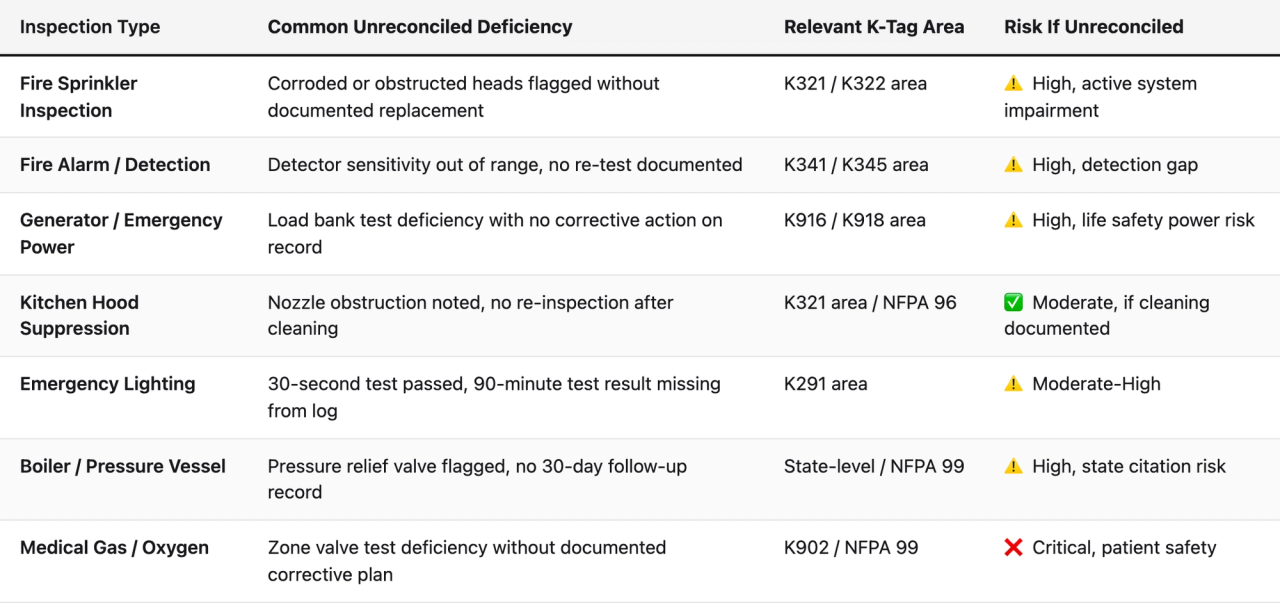
The pattern across all of these is consistent: the contractor performed the inspection correctly, documented the deficiency accurately, and the facility did the remediation work. The citation risk comes from the space between the contractor's report and the facility's records. That space, when it is not systematically managed, is where K-tags are born.
K-Tag Documentation Gaps: What Surveyors Are Actually Looking For
K-tag documentation gaps are the specific missing or incomplete record elements that CMS life safety surveyors flag when reviewing a facility's compliance documentation. Understanding what constitutes a documentation gap, rather than just a missing document, helps SNF operators build more targeted remediation processes.
A documentation gap is not simply the absence of a record. It is any condition in the record that prevents a surveyor from independently verifying that a required inspection, test, or corrective action occurred in the manner and timeframe required by NFPA 101, NFPA 99, or CMS guidance. That definition is broader than most maintenance directors realize.
The Seven Most Common K-Tag Documentation Gap Patterns
These are the patterns that appear with greatest frequency in CMS survey findings related to contractor report documentation in SNFs:
- Missing deficiency acknowledgment. A contractor report containing deficiencies is present in the facility's files, but there is no record showing that the facility reviewed the report and acknowledged the deficiencies. Surveyors need to see that the facility was aware of the problem, not just that the contractor documented it.
- No assigned corrective action owner. The deficiency is noted but there is no record of who was assigned to remediate it and by what date. Corrective action records without ownership and deadlines do not satisfy the documentation standard.
- Corrective action completed but not re-verified. The facility documents that the repair was made, but there is no contractor re-inspection report or licensed technician sign-off confirming that the deficiency was resolved. For life safety systems, self-certification of repair is generally insufficient.
- Timeframe exceeded without interim risk mitigation documentation. Some deficiencies allow a remediation window (commonly 30, 60, or 90 days depending on the deficiency type and state requirements). When that window passes without either a completed corrective action or documented interim risk mitigation measures, the deficiency escalates. Most facilities do not document interim measures even when they implement them.
- Contractor report filed but not cross-referenced to K-tag log. The report exists in the facility's files, but it has never been entered into the life safety documentation system in a way that connects it to the relevant K-tag category. Surveyors reviewing the K-tag log see no entry; the actual report is in a different folder. This disconnect is a classic paper-binder failure mode.
- Partial test results with no explanation for missing data. A generator test log shows load readings for some intervals but not others. An emergency lighting test record shows the 30-second test result but not the annual 90-minute test result. Incomplete records are treated as non-compliant records, not partial-credit records.
- Contractor credential documentation absent. Some state regulators and CMS interpretive guidance require that the contractor performing life safety inspections be licensed for that specific work. If the contractor's license or certification is not documented in the facility's records along with the inspection report, the legitimacy of the inspection itself can be questioned.
Each of these gaps represents a failure of the documentation system, not necessarily the physical safety system. Facilities can be physically safer than their documentation suggests, which is precisely why the documentation system needs to be treated as a compliance asset in its own right.
Why Paper Binders Structurally Fail at Deficiency Reconciliation
The paper life safety binder has served SNF maintenance departments for decades, and it is worth understanding why it fails at the specific task of deficiency reconciliation before moving on to what replaces it. The failure is not about effort or intent. Maintenance directors who maintain paper binders are often meticulous, experienced professionals. The failure is structural.
The Binder Is Organized by Document Type, Not by Deficiency Status
A typical paper binder is organized with tabs: fire alarm, sprinkler, generator, fire drills, emergency lighting, and so on. Within each tab, inspection reports are filed chronologically. This organization is logical for retrieval but completely inadequate for deficiency tracking. A deficiency identified in a sprinkler inspection report filed in April and remediated by a contractor callback in May requires a human being to manually connect those two documents across time and potentially across two different folders. If the remediation report is filed in a different section than the original inspection report, the connection exists only in the maintenance director's memory.
Memory is not a documentation system. It does not survive staff turnover. It does not produce the cross-referenced paper trail a surveyor needs. And it creates exactly the kind of unreconciled deficiency that generates citations.
The Binder Has No Audit Function
A paper binder holds documents but does not review them. When a contractor report arrives containing three deficiencies, the binder does not alert anyone to the fact that those deficiencies need corrective action records. It does not count down the remediation window. It does not flag when a 30-day deadline passes without a closure record. The binder simply holds whatever is put into it, in whatever state of completeness the person filing it happens to maintain.
This means the audit function, the process of reviewing records for completeness and flagging gaps, falls entirely on the maintenance director's manual review cycle. In a busy facility, that review cycle competes with equipment failures, resident requests, state inspections, and dozens of daily operational demands. It is not that the review does not happen. It is that it happens inconsistently, and inconsistency in life safety documentation is what surveyors are trained to find.
Binder-Based Documentation Is Invisible to Leadership
For a SNF administrator or a regional director overseeing multiple facilities, the paper binder offers no visibility. The administrator cannot tell, without physically sitting with the maintenance director and reviewing every document, whether the facility's contractor report documentation is current, whether deficiencies are reconciled, or whether the next survey would find a clean record. This opacity means that compliance gaps accumulate without organizational awareness until a survey forces them into view.
At a multi-site operator level, this problem multiplies. Ten facilities with ten binders and ten maintenance directors represents a documentation risk profile that no regional manager can meaningfully monitor without a systematic approach.
The NFPA 101 Inspection Records Framework Every SNF Needs to Understand
NFPA 101 is the foundational document for life safety compliance in skilled nursing facilities, and understanding its inspection records requirements in plain terms helps maintenance directors build documentation systems that satisfy surveyors rather than confusing them. NFPA 101 does not just require that inspections happen. It specifies, system by system, who can perform inspections, at what frequency, under what test conditions, and what the resulting record must contain.
What NFPA 101 Actually Requires in a Completed Inspection Record
For most life safety system inspections in a SNF, a complete NFPA-compliant inspection record includes the following elements:
- The name and license or certification number of the individual or firm performing the inspection
- The date of the inspection or test
- The specific system, equipment, or area inspected
- The test methodology or standard used (e.g., NFPA 25 for sprinklers, NFPA 72 for fire alarm)
- The results of each component tested, not just an overall pass/fail
- Any deficiencies identified, described with enough specificity to allow independent verification
- The recommended corrective action and timeframe for each deficiency
- Signature of the inspector
When a contractor's report does not contain all of these elements, the facility faces a secondary documentation problem: even if the contractor did the work correctly, the record is not NFPA-compliant on its face. Facilities sometimes assume that because a licensed contractor produced a report, the report meets the documentation standard. That assumption is not always correct.
The Facility's Own Documentation Obligation
NFPA 101 and CMS guidance place documentation obligations on the facility itself, not just on the contractors it hires. The facility is responsible for maintaining complete, organized, and current inspection records. This means that when a contractor produces a report, the facility's obligation is not satisfied simply by filing that report. The facility must also:
- Review the report against the applicable NFPA standard to confirm the inspection covered all required components
- Log any deficiencies into the facility's corrective action tracking system
- Document its response to each deficiency, including the plan, the timeline, and the assigned owner
- Obtain and file a re-inspection confirmation for each corrected deficiency
- Ensure that the completed record is accessible for survey review in a format that allows the surveyor to trace the full deficiency-to-closure chain
This is the framework that most paper-based systems cannot reliably execute at scale. Each step requires a deliberate handoff between the contractor's record and the facility's internal documentation system. Without a structured process, handoffs fail.
How Life Safety Compliance Platforms Close the Contractor Report Gap
A life safety compliance platform for SNFs addresses the contractor report documentation problem at the system level rather than the individual task level. Instead of relying on a maintenance director to manually connect contractor reports to corrective action records and K-tag logs, a modern platform automates that connection through structured data capture and cross-reference logic.
The operational model works like this. When a contractor completes an inspection and submits a report, the platform provides a structured intake process that separates the report into its component elements: inspection date, inspector credentials, components tested, results for each component, and any deficiencies identified. Each deficiency is logged as a discrete record with a status of "open" and a remediation clock that begins running immediately.
What Structured Deficiency Intake Looks Like in Practice
When a sprinkler contractor submits an inspection report showing two corroded heads and one obstructed head, the platform does not file the report as a single document. It creates three separate deficiency records, each with:
- A unique identifier tied to the asset (the specific sprinkler zone and head location)
- The deficiency description as noted by the contractor
- The applicable NFPA standard section and remediation timeframe requirement
- An assignment field linking the deficiency to a responsible internal party
- A status field that moves from "open" to "in remediation" to "pending verification" to "closed" only when a re-inspection confirmation is uploaded
- An automatic escalation that alerts the maintenance director and, at configurable thresholds, the administrator or regional manager if the deficiency remains open past its remediation deadline
This is what "reconciled" means in a platform context. The deficiency record is not closed until the full chain of documentation, from identification through remediation to verification, is complete. A surveyor reviewing the facility's records through the platform sees a complete, timestamped chain for every deficiency. There are no manila folders with disconnected documents. There are no gaps between what the contractor reported and what the facility's records show.
The AI Audit Layer: Finding Gaps Before a Surveyor Does
Beyond structured data capture, a more sophisticated compliance platform includes an analytic layer that reviews completed records for compliance gaps that a maintenance director might not catch manually. This is the function that transforms a documentation tool into a compliance intelligence tool.
The analytic layer reads completed inspection records and cross-references them against the regulatory expectations for each asset type and K-tag category. It surfaces patterns like:
- A generator test log with load readings recorded for every monthly test except one, where the kW column is blank
- A fire drill record that shows four drills for the year but all four occurred on day shifts, with no night-shift coverage documented
- A contractor report for a fire alarm inspection that is missing the sensitivity test results for detectors in two zones
- A corrective action record showing a deficiency as "repaired" without an attached re-inspection confirmation
Each of these patterns is a documentation gap that would likely produce a citation on survey day. By surfacing them in advance, the platform gives the facility an opportunity to close the gap, obtain missing documentation from the contractor, or document interim risk mitigation measures before a surveyor sees the record.
This is not predictive maintenance for equipment. It is predictive auditing for documentation. The distinction matters because the problem being solved is not mechanical failure. It is the gap between physical reality and the documented record of that reality.
The Multi-Site Operator's Documentation Risk Multiplier
For SNF operators managing multiple facilities, the contractor report documentation problem scales in a way that single-facility operators do not experience. Each additional facility adds its own set of contractor relationships, inspection schedules, deficiency records, and K-tag documentation requirements. At ten facilities, a regional director overseeing life safety compliance is managing potentially hundreds of open or recently closed deficiencies across dozens of different contractors, with no reliable mechanism for knowing which ones are reconciled and which ones are not.
This creates what can be described as a documentation risk multiplier. The probability that at least one facility has an unreconciled deficiency on any given day is not additive across facilities. It is compressive, because the maintenance staff at each facility are managing the same operational demands with the same limited documentation infrastructure, and the regional oversight layer has no visibility into the record state at any individual facility without physically visiting and reviewing the binder.
How Regional Visibility Changes the Risk Profile
A life safety compliance platform that aggregates documentation data across facilities gives regional managers and COOs a fundamentally different view of their compliance risk. Instead of finding out about unreconciled deficiencies during a survey, leadership can see, in real time, which facilities have open contractor-reported deficiencies, how long they have been open, whether corrective action plans are in place, and which facilities have documentation gaps that match common citation patterns.
This regional visibility does not replace facility-level accountability. It supplements it. The maintenance director at each facility still owns the day-to-day documentation work. The platform gives regional leadership the ability to prioritize attention on facilities where the documentation risk is elevated, rather than distributing oversight evenly across facilities regardless of their actual compliance state.
For multi-site operators who have experienced a pattern of life safety citations across their portfolio, this kind of risk visibility is often the first meaningful structural change they can make without rewriting operational procedures at every facility.
Building a Contractor Report Reconciliation Protocol That Survives Staff Turnover
One of the most underappreciated risks in SNF life safety documentation is staff turnover in the maintenance director role. The maintenance director is typically the person who holds the documentation system together. They know which contractors to call, which reports are outstanding, which deficiencies are in process, and where the relevant records are filed. When they leave, that institutional knowledge leaves with them.
A reconciliation protocol that exists only in the maintenance director's practice rather than in a documented system is not a protocol. It is a dependency. And dependencies on individual staff members are one of the most common root causes of documentation gaps that produce survey citations.
The Five Elements of a Turnover-Proof Reconciliation Protocol
- Contractor report intake procedure. Every contractor report that enters the facility must go through a defined intake process before it is filed. That process includes logging the report's receipt date, scanning or uploading it to the documentation system, reviewing it for deficiencies, and creating a corrective action record for each deficiency identified. The intake procedure should be written down and posted at the point of intake.
- Deficiency ownership assignment. Every deficiency identified in a contractor report must have a named owner and a documented remediation deadline within 48 hours of the report's intake. The owner is accountable for either completing the corrective action or documenting why it cannot be completed within the standard timeframe.
- Remediation deadline tracking system. Whether paper-based or digital, the facility needs a mechanism that surfaces approaching and overdue remediation deadlines without requiring the maintenance director to remember them. Calendar reminders, tickler files, and task management systems all serve this function to varying degrees of reliability.
- Re-inspection confirmation requirement. No deficiency can be marked as closed in the facility's records without a re-inspection confirmation from a licensed contractor or qualified technician. The confirmation must reference the original deficiency and the corrective action taken.
- K-tag cross-reference documentation. When a contractor report deficiency is closed, the closure record must be cross-referenced to the relevant K-tag category in the facility's life safety documentation log. This ensures that the K-tag log reflects the current state of all deficiencies, not just the ones that were easy to track.
These five elements, taken together, create a protocol that a new maintenance director can step into without relying on institutional memory. The documentation system holds the state of every deficiency. The procedure tells them what to do with new reports. The tracking mechanism alerts them to deadlines. The cross-reference requirement ensures the K-tag log stays current.
What Happens When a Surveyor Finds Unreconciled Deficiencies: The Citation and Its Consequences
Understanding the downstream consequences of unreconciled contractor report deficiencies helps SNF operators appreciate why the documentation investment is not optional. CMS life safety citations, particularly those in the K-tag series, carry consequences that extend well beyond the immediate survey.
The Immediate Survey Outcome
When a surveyor identifies an unreconciled deficiency during a life safety survey, the finding is documented on Form CMS-2567, the Statement of Deficiencies. The facility has a defined window, typically ten calendar days from receipt of the 2567, to submit a Plan of Correction (PoC) that describes how the deficiency will be remediated and how the facility will prevent recurrence. The PoC must address both the immediate deficiency and the systemic failure that allowed it to remain unreconciled.
For facilities with multiple unreconciled deficiencies, the PoC process becomes a significant administrative burden. Each deficiency requires its own corrective action description, completion timeline, and quality assurance mechanism. A facility that has allowed contractor report documentation to lapse across multiple systems may find itself preparing a PoC for ten or fifteen separate K-tag citations from a single survey.
Financial and Operational Consequences
Beyond the administrative burden, K-tag citations from life safety surveys carry financial and operational consequences. CMS has the authority to impose civil money penalties (CMPs) for life safety deficiencies at higher scope and severity levels. Repeated citations in the same K-tag category, which can happen when a facility's documentation system fails to address the systemic root cause, may escalate toward more serious enforcement actions including denial of payment for new admissions (DPNA) or, in extreme cases, termination of the facility's Medicare and Medicaid provider agreement.
State survey agencies, which conduct their own life safety surveys independently of CMS federal surveys, may also impose state-level financial penalties for the same deficiencies. Facilities in states with active enforcement programs can face simultaneous CMS and state penalties for documentation gaps that a properly designed reconciliation system would have prevented.
For facilities that appear on CMS's Special Focus Facility (SFF) list, life safety citations receive elevated scrutiny and can accelerate the enforcement timeline. SNF operators with facilities on or approaching the SFF list should treat contractor report documentation reconciliation as an immediate operational priority.
Reputational and Market Consequences
CMS publishes survey findings through the Care Compare website, where prospective residents, family members, and referring hospitals can review a facility's deficiency history. Life safety citations are visible in the public record. Facilities with repeated K-tag citations related to inspection and documentation failures may see referral volume decline as hospitals and discharge planners prioritize facilities with cleaner compliance records.
In competitive markets, where multiple SNFs serve the same geographic area, a pattern of life safety citations can meaningfully affect census. The documentation investment required to prevent those citations is almost always smaller than the revenue impact of even a modest census reduction.
Frequently Asked Questions About Contractor Report Documentation and CMS Life Safety Citations
What makes a contractor report deficiency "unreconciled" in CMS survey terms?
A deficiency is unreconciled when the facility's documentation record cannot demonstrate, through a complete and continuous chain of contemporaneous records, that the deficiency was identified, assigned for correction, remediated, and verified as resolved. The absence of any link in that chain, including the re-inspection confirmation, creates an unreconciled deficiency even if the physical work was completed.
How far back do CMS surveyors typically look at contractor reports?
CMS life safety surveyors typically review inspection and testing records for the preceding 12 months, which aligns with the annual inspection cycle required for most life safety systems under NFPA 101. However, for deficiencies that are still open or were identified more than 12 months ago, surveyors may request older records to assess how long the condition has existed.
Can a facility self-certify that a deficiency has been corrected, or does it need a licensed contractor to confirm?
For most life safety system deficiencies, particularly those involving fire protection systems, emergency power systems, or medical gas systems, a licensed or certified contractor must provide the re-inspection confirmation. Self-certification by facility maintenance staff is generally insufficient and may itself be a documentation gap. The applicable NFPA standard for the system in question specifies who is qualified to perform and document inspections and re-inspections.
What is the remediation timeframe for a contractor-reported deficiency, and what happens if it passes?
Remediation timeframes vary by deficiency type, system, and state regulation. Some deficiencies, particularly those affecting the operability of a life safety system, require immediate corrective action or interim risk mitigation. Others allow 30, 60, or 90 days for correction. When a timeframe passes without documented completion or documented interim measures, the deficiency escalates in severity on survey. Facilities should document interim risk mitigation measures whenever a deficiency cannot be corrected within the standard timeframe.
What K-tags are most commonly cited due to contractor report documentation failures?
The K-tag categories most frequently associated with contractor report documentation failures include those covering sprinkler system inspection and testing, fire alarm system inspection and testing, emergency generator testing and documentation, and emergency lighting testing. These are the systems with the most frequent required inspection intervals and the most detailed NFPA documentation requirements, which creates the most opportunities for documentation gaps.
Does filing the contractor's report in the life safety binder satisfy the documentation requirement?
Filing the report is the beginning of the documentation requirement, not the end of it. The facility must also document its review of the report, its response to each deficiency identified, the corrective action taken, and the re-inspection confirmation. A binder containing only the contractor's original report, without the subsequent corrective action chain, does not satisfy the documentation standard for any deficiency identified in that report.
How should facilities handle a contractor report that is itself incomplete or missing required elements?
When a contractor report does not contain all required elements under the applicable NFPA standard, the facility should contact the contractor immediately to obtain a corrected or supplemental report. The facility should document that it identified the deficiency in the contractor's report, when it contacted the contractor, and when the corrected report was received. Accepting and filing an incomplete contractor report without action exposes the facility to a citation both for the missing report elements and for any underlying deficiencies the incomplete report may obscure.
What is the difference between a life safety deficiency and a physical environment deficiency in CMS survey terms?
Life safety deficiencies are cited under the K-tag series and relate to NFPA 101, NFPA 99, and associated standards governing fire protection, emergency power, and other life safety systems. Physical environment deficiencies are cited under the F-tag series and relate to general resident environment requirements. Both types of deficiencies can arise from documentation failures, but they are surveyed by different survey teams and carry different regulatory pathways. Contractor report documentation failures most commonly produce K-tag citations.
How does staff turnover in the maintenance director role affect life safety documentation compliance?
Staff turnover in the maintenance director role is one of the most common triggers for documentation gaps. When institutional knowledge about contractor relationships, outstanding deficiencies, and documentation practices exists only in an individual's memory rather than in a structured system, turnover creates an immediate compliance risk. Facilities with high maintenance staff turnover should prioritize building documentation systems that do not depend on individual knowledge to function correctly.
What role does a life safety compliance platform play in preparing for an unannounced CMS survey?
A life safety compliance platform prepares a facility for unannounced surveys by continuously auditing the documentation record for gaps, surfacing incomplete or unreconciled contractor report deficiencies before a surveyor sees them, and maintaining a complete, timestamped, cross-referenced record of every inspection, test, deficiency, and corrective action. The goal is to ensure that the documentation state the facility is in on any random day is the same documentation state it would want a surveyor to see, because that is precisely what an unannounced survey tests.
Can a SNF be cited for a deficiency that was actually corrected if the documentation is incomplete?
Yes. CMS surveyors evaluate the documentation record, not just the physical state of the facility. A deficiency that was corrected but not documented through the complete required chain, including re-inspection confirmation, will be treated as an active deficiency or as a documentation failure. The facility may have an opportunity during the survey to produce documentation that closes the gap, but if that documentation does not exist, the citation stands regardless of the actual physical condition.
What should a SNF do immediately after receiving a contractor inspection report with deficiencies?
Within 24 hours of receiving a contractor inspection report with deficiencies, the facility should: log the report in the documentation system with the date of receipt, create a separate corrective action record for each deficiency identified, assign each deficiency to a named owner with a documented remediation deadline, notify the administrator of any deficiency that requires immediate action or interim risk mitigation, and contact the contractor to schedule any required follow-up inspections. This immediate response protocol creates the documentation foundation that surveyors will look for if the facility is surveyed before remediation is complete.
Key Takeaways
- Unreconciled deficiencies are a documentation problem, not just a maintenance problem. The most common pathway to a K-tag citation from a contractor report is not failed remediation. It is a broken documentation chain between the contractor's finding and the facility's corrective action record.
- Filing a contractor report is not the same as reconciling it. A filed report with an unresolved deficiency is an admission of a known problem. Without the corrective action chain, that admission becomes a citation.
- NFPA 101 inspection records requirements are more specific than most facilities realize. Both the contractor's report and the facility's internal documentation must meet specific standards. Incomplete contractor reports should be corrected before filing.
- The paper binder fails at deficiency reconciliation by design. It holds documents but does not audit them. The reconciliation function requires a system that actively tracks open deficiencies, approaching deadlines, and missing closure documentation.
- Staff turnover is a documentation risk multiplier. Any protocol that depends on a single person's institutional knowledge will fail when that person leaves. Reconciliation protocols must be embedded in the documentation system, not in the maintenance director's practice.
- Multi-site operators face compressive documentation risk. The probability of at least one facility having unreconciled deficiencies on any given day increases with portfolio size. Regional visibility into documentation state is not a nice-to-have. It is a compliance requirement at scale.
- A life safety compliance platform functions as predictive auditing for documentation. By surfacing gaps before a surveyor sees them, it converts the documentation system from a passive record-holder into an active compliance intelligence tool.
- The consequences of unreconciled deficiencies extend beyond the immediate citation. Financial penalties, public reporting on Care Compare, and potential referral volume impacts make the documentation investment far less expensive than the alternative.
The contractor report sitting on the maintenance director's desk is not just a piece of paper. It is a compliance event that begins a documentation clock the moment it enters the facility. How a SNF manages that clock, whether through a structured reconciliation protocol, a digital compliance platform, or a combination of both, determines whether the next unannounced survey finds a closed record or an open deficiency. The facilities that understand this distinction, and build their documentation systems around it, are the ones that walk out of surveys with clean worksheets.
About the author
Benjamin Terebelo · Founder
Benjamin is the founder of SEQURA, a compliance platform purpose-built for healthcare facilities. He builds at the intersection of healthcare operations and software, maintaining a focus on bringing modern tooling to systems that the broader industry has largely left behind.
About the author
Benjamin Terebelo · Founder
Benjamin is the founder of SEQURA, a compliance platform purpose-built for healthcare facilities. He builds at the intersection of healthcare operations and software, maintaining a focus on bringing modern tooling to systems that the broader industry has largely left behind.