
The Documentation Audit Trail: Why Contemporaneous Logging Is the Standard CMS Expects
The call came on a Tuesday morning, three days after a CMS surveyor left the building. The administrator at a 120-bed skilled nursing facility in the Midwest thought the survey had gone reasonably well. A few verbal observations. A couple of areas to monitor. Nothing that signaled a citation was coming.
Then the draft report arrived. K-tag after K-tag, not for failed equipment, not for sprinkler heads that had corroded or fire doors that wouldn't close, but for documentation that couldn't hold up under scrutiny. Generator test logs that recorded the outcome of the test but not the actual kilowatt load. Fire drill records that showed drills were completed but couldn't prove who was present or what shift the drill covered. Eyewash station checks logged in batches, four weeks of entries made on the same afternoon, with identical handwriting and identical timestamps. The surveyor's notes were clinical and precise: records that do not reflect contemporaneous documentation cannot be accepted as evidence of compliance.
That phrase, "contemporaneous documentation," is the operational standard that separates a defensible life safety record from a piece of paper that creates more liability than it resolves. Understanding what it actually means, why CMS has made it the baseline expectation for SNF inspection records, and where facilities consistently fall short is the difference between survey confidence and survey exposure.
What "Contemporaneous" Actually Means in a CMS Context
Contemporaneous documentation means that a record is created at the time the activity occurs, by the person who performed it, in a format that captures the specific data required to demonstrate compliance. It is not a synonym for "completed." It is not satisfied by entering records after the fact, even if the underlying work was genuinely performed. The temporal link between the action and the record is the evidentiary foundation CMS surveyors are trained to evaluate.
This standard is not arbitrary. It derives from the same legal and regulatory logic that governs medical records, clinical documentation, and financial auditing. In each of those domains, the question is not just whether something happened, but whether the documentation of what happened can be trusted as an accurate reflection of reality at the moment it occurred. A medical record entered two weeks after a patient encounter is not a contemporaneous record. A fire drill log completed on a Friday for drills that allegedly happened Monday through Thursday is not a contemporaneous record. The gap between the event and the entry is itself a form of non-compliance.
For skilled nursing facilities, the implications are layered. CMS surveys of life safety compliance operate under the Life Safety Code Survey process, which references NFPA 101 and NFPA 99 as the baseline technical standards. Both codes require that inspections, tests, and maintenance activities be documented. But the documentation expectation doesn't stop at "write it down." The broader regulatory context, including CMS's own Surveyor Guidance and the State Operations Manual, frames documentation as evidence. Evidence has authenticity requirements. Authenticity requires contemporaneity.
The Three Elements Surveyors Test
When a CMS or state surveyor reviews a life safety log, they are typically evaluating three distinct dimensions:
- Temporal credibility: Does the date and time of the entry align plausibly with the claimed activity? Are there patterns that suggest batch entry, back-filling, or pre-completion?
- Data specificity: Does the record contain the specific readings, observations, or outcomes required by the applicable standard? A generator test log that says "passed" without recording load, voltage, frequency, and duration does not satisfy NFPA 110 requirements.
- Authorship clarity: Is it clear who performed the task and who documented it? Anonymous entries, illegible signatures, or logs where a single person documents tasks across multiple departments raise authenticity questions.
All three elements must be present for a record to function as genuine compliance evidence. A log that is timely but vague fails on specificity. A log that is specific but clearly back-filled fails on temporal credibility. A log that is both timely and specific but lacks authorship fails on authentication. The interaction between these three dimensions is where most SNF documentation problems actually live.
Why CMS Audit Trail Requirements Focus on Life Safety Records
Life safety documentation occupies a distinct category within CMS survey compliance, and understanding why helps explain the intensity of scrutiny it receives. Unlike clinical documentation, which is tied to individualized patient care and is assessed in relationship to patient outcomes, life safety documentation is systemic. It speaks to the safety environment for every resident in the building at every hour of every day.
This systemic character means that a documentation gap is not merely an administrative oversight. A missing fire drill record for the overnight shift doesn't just mean a form wasn't completed. It means the facility cannot demonstrate that its staff on that shift are prepared to execute an evacuation procedure. A generator test log without a kilowatt load reading doesn't just mean a number was omitted. It means the facility cannot demonstrate that its backup power system was genuinely tested under realistic load conditions.
CMS has structured the K-tag citation framework to reflect this logic. K-tags are not primarily about whether physical equipment meets code. Many K-tags are issued specifically because documentation fails to demonstrate compliance, even when underlying practices may be adequate. The documentation gap is the deficiency.
The Audit Trail as Regulatory Infrastructure
The concept of an audit trail in healthcare compliance refers to a chronological sequence of records that, taken together, allow a reviewer to reconstruct what happened, when it happened, who was responsible, and what the outcome was. In financial systems, audit trails are maintained automatically by software. In clinical systems, electronic health records generate audit logs as a byproduct of normal operation. In life safety documentation, particularly at facilities still relying on paper binders, the audit trail is entirely manual, which means it is entirely dependent on the discipline and consistency of the people maintaining it.
CMS surveyors are trained to read these manual audit trails with skepticism proportionate to the stakes. A surveyor reviewing a generator test log will look for internal consistency: Do the test dates align with the required testing frequency? Do the recorded load values make sense given the facility's square footage and equipment profile? Are there any signatures that appear across an implausibly large number of tasks in a single day? These are not gotcha questions. They are the natural questions a competent auditor asks when evaluating the reliability of a manual record system.
The practical implication for SNFs is that the audit trail is not something that can be assembled retrospectively when a survey is announced. It has to be built in real time, record by record, task by task, across every required inspection cycle throughout the year. A facility that has maintained genuinely contemporaneous records for the past twelve months arrives at a survey with an audit trail that largely speaks for itself. A facility that has been back-filling, summarizing, or delegating documentation to people who weren't present for the actual inspections arrives with a liability.
The Life Safety Logging Standards That Demand Real-Time Records
Several of the most commonly cited life safety standards have documentation requirements that are only satisfiable through contemporaneous logging. Understanding the specific requirements of each helps clarify why generic record-keeping systems so frequently produce citation-worthy gaps.
NFPA 110 and Generator Testing
NFPA 110, the Standard for Emergency and Standby Power Systems, requires that generators be tested monthly under load and annually under full load conditions. The documentation requirements for these tests are specific: records must capture the date and time of the test, the duration, the load achieved (expressed in kilowatts), voltage, frequency, and any alarms or abnormal conditions observed. A record that notes only "monthly test completed, generator operational" does not satisfy this standard.
The contemporaneous requirement here is particularly meaningful because load values are dynamic. A generator test that records a load of 65 kW requires that someone actually read that value from the generator panel at the time of the test. It cannot be estimated after the fact. If a technician performs the test, notes the readings mentally, and then enters the log entry two days later from memory, the resulting record is not contemporaneous. Even if the technician's recollection is accurate, the evidentiary value of the record is fundamentally compromised.
NFPA 101 Fire Drills
The Life Safety Code requires fire drills at specified frequencies, varying by occupancy type, with specific requirements for timing and shift coverage. For SNFs operating as healthcare occupancies, drills must cover each shift, including night shifts where resident evacuation presents distinct challenges. Documentation must capture the date, time, shift covered, staff participants, evacuation procedure followed, and any observed deficiencies.
This is one of the most frequently cited areas in SNF life safety surveys, and the most common deficiency pattern is not that drills weren't conducted but that the documentation fails to demonstrate adequate shift coverage or staff participation. A drill log that lists a date and a generic "passed" notation does not satisfy the requirement. A drill log that shows only daytime drills for three consecutive quarters raises an obvious question about overnight shift coverage.
Sprinkler System Inspections
NFPA 25, the Standard for the Inspection, Testing, and Maintenance of Water-Based Fire Protection Systems, requires inspections at multiple frequencies: weekly (for gauges and control valves in certain configurations), monthly, quarterly, annual, and five-year intervals. Each inspection frequency has a defined scope and a documentation requirement.
For SNFs, the most common documentation gap in sprinkler records involves the reconciliation of deficiencies identified by third-party contractors. When a contractor conducts a quarterly or annual inspection and notes a deficiency, that deficiency must be documented, a correction timeline established, and the correction itself documented when completed. Facilities that file contractor reports without tracking deficiency resolution create an incomplete audit trail, one where the problem is documented but the closure is not.
Eyewash Stations and Weekly Activations
ANSI/ISEA Z358.1 requires that eyewash stations be activated weekly to verify operability and to flush the supply line. This is a simple task, but it generates a documentation requirement that perfectly illustrates the contemporaneous logging standard. Weekly activation logs must reflect a genuine weekly cadence. A log showing four weeks of activations entered on the same date, in the same handwriting, with the same notation, is a textbook example of non-contemporaneous documentation. It is visually obvious to any surveyor trained to look for it.
How Facilities Actually Fall Short: The Four Failure Patterns
Across SNF life safety compliance, the documentation failures that produce K-tag citations fall into four recognizable patterns. These are not exotic edge cases. They are the predictable consequences of manual documentation systems operating under the real-world pressures of healthcare facilities.
Pattern One: Batch Entry and Back-Filling
This is the most common and most recognizable failure mode. A maintenance technician or EVS staff member performs the required inspections throughout the week or month but delays documentation until a convenient time, often end of month, end of quarter, or the day before a known survey. The resulting log entries share timestamps, handwriting, and notation styles in ways that make the batch entry visually obvious.
The practical problem is that batch entry, even when it reflects genuinely performed work, cannot serve as contemporaneous documentation. The temporal link between the task and the record has been severed. A surveyor who identifies batch entry patterns is within their authority to question the authenticity of the entire record set, not just the suspicious entries.
Pattern Two: Incomplete Data Fields
Many facilities have documentation forms that include all the required data fields, but staff fill in only the fields that seem most important or most familiar. Generator test logs missing load readings. Fire drill records missing shift designations. Sprinkler inspection logs that record "no deficiencies" without documenting the scope of the inspection. Each omission, individually, may seem minor. Collectively, they produce a record that fails to satisfy the applicable standard.
This pattern often reflects a training gap rather than deliberate non-compliance. Staff who are handed a form without understanding why each field matters will naturally prioritize fields that seem consequential and skip fields that seem administrative. The result is documentation that looks complete at a glance but collapses under survey scrutiny.
Pattern Three: Proxy Documentation
Proxy documentation occurs when one person completes records for tasks performed by someone else. A maintenance director who reviews completed tasks and then enters the log entries himself. An EVS supervisor who signs off on room checks performed by her team. A technician who documents generator tests based on verbal reports from the person who actually ran the generator.
Proxy documentation is particularly problematic because it severs the authorship link that gives documentation its evidentiary value. The person whose signature appears on the record was not present for the activity. If a surveyor asks that person to describe what they observed during the inspection, their answer will reveal the gap. The documentation is not a lie, necessarily, but it is not a contemporaneous record either.
Pattern Four: Contractor Record Gaps
Many life safety inspections, particularly for fire alarm systems, sprinklers, and elevators, are performed by third-party contractors. SNFs often receive contractor inspection reports, file them in a binder, and consider the documentation requirement satisfied. But contractor reports frequently identify deficiencies, and the facility's documentation obligation doesn't end when the contractor's report is received. It extends to tracking the deficiency, scheduling correction, and documenting completion.
Facilities that treat contractor reports as the end of the documentation chain rather than the beginning of a deficiency-management process routinely arrive at surveys with incomplete audit trails. The contractor report shows a deficiency was identified. The facility record shows nothing about what happened next. This gap is a citation waiting to be written.
The CMS Survey Process and How Documentation Is Evaluated
Understanding how surveyors actually evaluate documentation during an unannounced visit clarifies why the contemporaneous standard is so consequential in practice. CMS life safety surveys are conducted by trained surveyors, often with fire marshal or engineering backgrounds, who follow a structured process defined in the CMS Life Safety Survey Procedures.
The survey typically begins with a request for the facility's documentation package: the binder or equivalent record set containing inspection logs, test records, fire drill documentation, and related materials. Surveyors will review this package before conducting the physical walk-through, which means documentation deficiencies are often identified before the surveyor has seen a single piece of equipment. A facility with strong physical compliance but weak documentation can receive citations before the tour begins.
The Cross-Reference Method
Experienced surveyors use a cross-reference method when evaluating documentation. Rather than simply checking whether a record exists, they compare the record against multiple data points: the date of the inspection, the required frequency under the applicable standard, the specific data fields required, the identity of the person who performed and documented the task, and the physical condition of the equipment observed during the walk-through.
When these data points don't align, the surveyor has grounds for a citation. A generator test log showing a successful monthly test for the previous month, combined with a generator that shows no evidence of recent operation during the physical inspection, is internally inconsistent. A sprinkler inspection log showing "no deficiencies" for a system that has visible issues during the walk-through is contradicted by observation. These contradictions don't just produce a citation for the specific deficiency. They undermine the credibility of the entire documentation package.
Interview as Documentation Audit
CMS surveyors routinely interview staff during life safety surveys, and these interviews serve a documentation audit function. A surveyor who asks a maintenance technician to describe the monthly generator test procedure is not making small talk. They are verifying that the person whose name appears on the log actually performed and understands the task. A technician who can accurately describe the test procedure, including the specific data points they record, corroborates the contemporaneous documentation. A technician who cannot describe the procedure, or who describes it inconsistently with what the log shows, raises questions about the entire record set.
This is why proxy documentation is so particularly dangerous. If the person who completed the log wasn't present for the task, a routine interview question can expose the gap in ways that amplify rather than resolve the citation risk.
What Inspection Record Compliance Actually Requires at the System Level
Achieving genuine inspection record compliance is not primarily a technology problem or a policy problem. It is a systems problem. The documentation standard CMS expects requires that a facility have, in place and operational, a system that makes contemporaneous logging the path of least resistance for every person responsible for life safety tasks.
This is a meaningful design challenge. The people doing the work, maintenance technicians, EVS staff, facilities managers, are not documentation specialists. Their primary orientation is toward the physical tasks: running the generator, activating the eyewash, checking the fire door. The documentation is, from their perspective, administrative overhead. Any system that treats documentation as a separate step, something to be done later, at a desk, from memory, will produce non-contemporaneous records as a predictable byproduct of normal human behavior.
The Task-Capture-Record Sequence
Effective life safety documentation systems are built around a task-capture-record sequence in which the documentation happens at the point of task completion, not after. This means the person performing the task has a documentation mechanism available at the location where the task is performed: a mobile device, a facility kiosk, a tablet mounted near the equipment. When the generator test is complete, the technician enters the readings immediately, at the generator panel, before leaving the mechanical room. When the eyewash station activation is done, the EVS staff member logs it immediately, at the station, not at the end of the shift.
This sequence is not merely convenient. It is what produces contemporaneous documentation. The timestamp on the record reflects the actual time of the task. The data entered reflects what was actually observed, not what was later recalled. The author of the record is the person who performed the task. All three elements of contemporaneous documentation, temporal credibility, data specificity, and authorship clarity, are satisfied as a byproduct of how the work is done.
The Required Frequency Matrix
A second systems requirement is that the facility have a clear, comprehensive map of every required inspection, its frequency, its applicable standard, and its documentation requirements. Without this map, even well-intentioned staff will miss inspections simply because they don't know they are required. The following matrix illustrates the complexity of this requirement for a typical SNF:
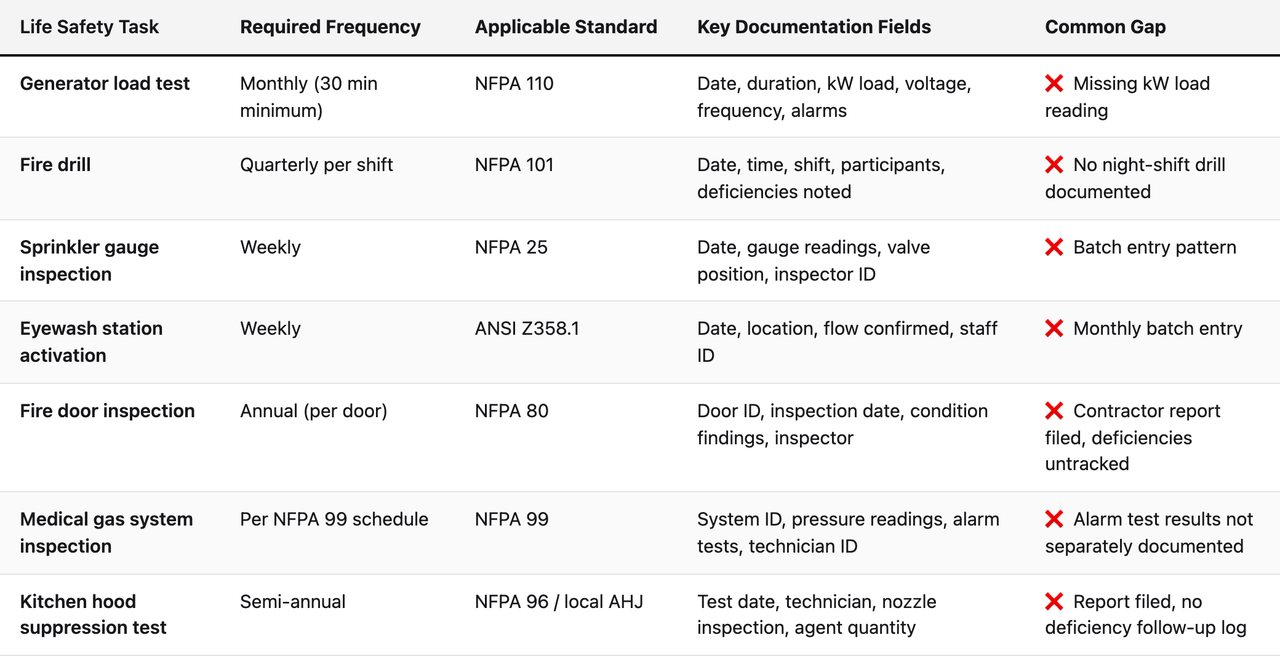
No maintenance director carries this entire matrix in their head. No paper binder system reliably surfaces upcoming inspections, tracks overdue items, or flags missing data fields before the record is finalized. The complexity of the requirement is itself a driver of documentation gaps, independent of staff intent or facility culture.
The Digital Documentation Advantage: More Than Convenience
Digital life safety documentation platforms change the compliance equation in ways that go beyond eliminating paper. The substantive advantage is structural: a well-designed digital system makes the contemporaneous documentation standard achievable as a byproduct of normal workflow, rather than requiring extraordinary discipline from staff who are primarily focused on physical tasks.
When a maintenance technician opens a generator test record on a mobile device at the generator panel, the system can require that specific data fields be completed before the record is saved. It can timestamp the entry automatically at the moment of submission. It can attach the submitting user's identity to the record. And it can flag the submission if the recorded values fall outside expected ranges for that generator's profile. None of these functions require the technician to understand NFPA 110 documentation requirements. They are built into the workflow.
Audit-Ready vs. Audit-Prepared
There is a meaningful distinction between a facility that is audit-prepared and one that is audit-ready. An audit-prepared facility has all its documentation organized and accessible. An audit-ready facility has documentation that will hold up under the cross-reference scrutiny of an experienced surveyor. The difference lies in whether the documentation was built for compliance or organized for convenience.
Digital systems that apply regulatory logic to documentation, checking that required fields are complete, that inspection frequencies are being met, that contractor deficiencies have corresponding closure records, that fire drill logs reflect the required shift coverage, produce documentation that is audit-ready by design. They surface the gaps before the surveyor does. They create the opportunity to close a documentation deficiency before it becomes a citation.
This is the operational logic behind platforms designed specifically for SNF life safety documentation. The goal is not to generate more records. It is to generate records that satisfy the contemporaneous documentation standard that CMS surveyors are applying, consistently, across every required inspection cycle.
Multi-Site Documentation Consistency: The Chain Operator's Challenge
For SNF operators managing multiple facilities, the contemporaneous documentation challenge is multiplied by the number of sites and complicated by the absence of centralized visibility. A regional facilities manager overseeing eight or ten SNFs has no reliable way, using paper-based systems, to know whether each facility's documentation is current, complete, and contemporaneous. They learn about documentation gaps when a survey citation arrives, at which point the gap has already become a deficiency.
The multi-site documentation problem has a structural dimension that single-facility operators don't face. Documentation practices at individual facilities reflect the habits, training, and workload of individual maintenance directors. One facility may have a maintenance director who maintains meticulous contemporaneous records. Another may have a director who routinely back-fills logs, not from negligence but from a workflow that separates task completion from documentation entry. Without centralized visibility, the regional manager cannot identify the second pattern until it produces a citation.
Standardization Across Sites
Effective multi-site documentation compliance requires standardized task templates, standardized data field requirements, and centralized reporting that surfaces overdue inspections and incomplete records across all facilities in real time. This level of standardization is simply not achievable with paper binder systems, which are inherently local, variable, and opaque to anyone who isn't physically present at the facility.
Digital platforms that support multi-site operations change this dynamic by creating a single documentation standard that applies uniformly across all facilities, with centralized visibility into compliance status at every site. A regional manager who can see, from a dashboard, that three of eight facilities have generator test logs with missing load readings, and that one facility has no documented night-shift fire drill for the current quarter, can intervene before those gaps become citations. That is a fundamentally different operational posture than the one that produces the Tuesday morning call described at the opening of this article.
Preparing for the Unannounced: What Documentation Discipline Actually Looks Like
CMS surveys of skilled nursing facilities are unannounced by design. The regulatory intent is to observe facilities in their normal operating state, not in a prepared-for-survey state. This design element makes the contemporaneous documentation standard not just a compliance requirement but an operational philosophy: the documentation should always be in survey-ready condition because the survey can happen at any time.
Facilities that achieve this standard don't do so through heroic effort at survey time. They do so through documentation discipline embedded in daily operations. Every required inspection is logged at the time it is performed. Every data field is completed. Every contractor report is reviewed, deficiencies are tracked, and closure is documented. The audit trail builds itself, one record at a time, through the normal rhythm of facility operations.
The Pre-Survey Self-Audit
Even facilities with strong documentation practices benefit from a periodic self-audit that applies surveyor-level scrutiny to their own records. This means reviewing documentation not just for completeness but for the patterns a surveyor would flag: batch entry signatures, missing data fields, incomplete deficiency tracking, fire drill logs without adequate shift coverage. The Joint Commission's Life Safety standards and CMS's own interpretive guidance provide a framework for this kind of self-evaluation.
A self-audit conducted monthly or quarterly creates the opportunity to find and close documentation gaps before they accumulate into a survey liability. It also creates a record of the self-audit itself, which can demonstrate to surveyors that the facility has a functioning internal compliance process, a mitigating factor in survey outcomes when minor deficiencies are found.
Training That Connects Documentation to Consequence
Staff training on life safety documentation is most effective when it connects the specific documentation requirement to the consequence of non-compliance. A technician who understands that a missing kilowatt load reading on a generator test log can produce a K-tag citation, and understands what a K-tag citation means for the facility, has a different relationship to that data field than one who sees it as an obscure administrative detail.
This kind of training requires that someone, typically the maintenance director or a compliance officer, understand the regulatory framework well enough to translate it into operational terms. "We need to record the kW load because NFPA 110 requires it and CMS uses that requirement to evaluate our backup power compliance" is a more effective training message than "fill in all the fields on the form."
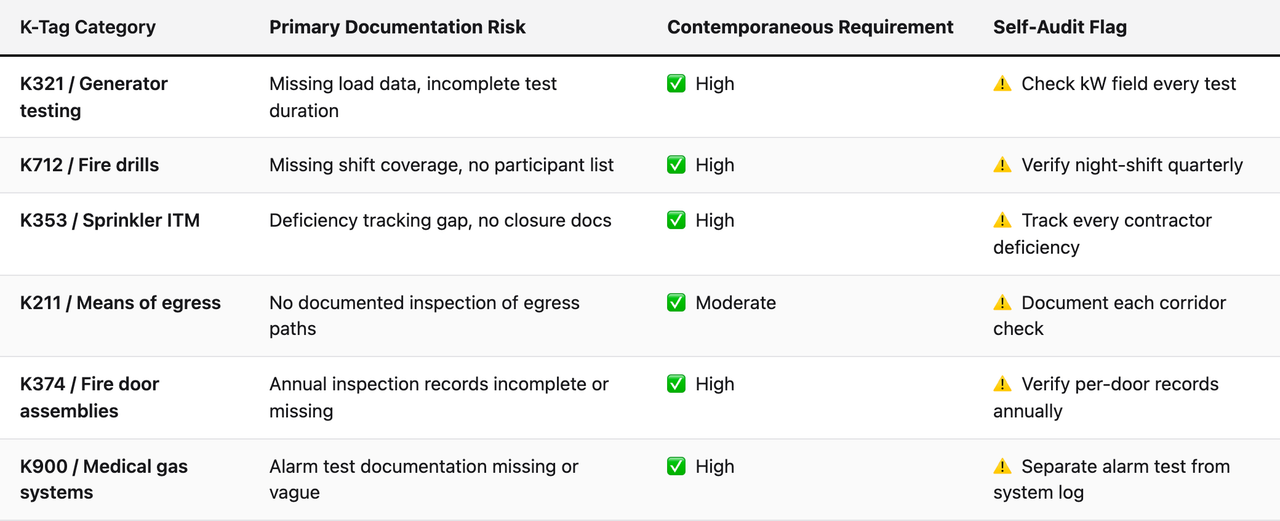
The K-Tag Documentation Scorecard: Where Most Citations Actually Come From
A review of common K-tag citation patterns reveals that documentation deficiencies cluster around a predictable set of inspection categories. Understanding which categories produce the most documentation-related citations helps facilities prioritize their documentation improvement efforts.
Frequently Asked Questions
What does "contemporaneous documentation" mean in the context of CMS surveys?
Contemporaneous documentation means a record is created at the time the activity occurs, by the person who performed it, capturing the specific data required by the applicable standard. It is not satisfied by entering records after the fact, even if the underlying work was actually performed. The temporal link between the event and the record is what gives the documentation its evidentiary value.
Which NFPA standards require contemporaneous documentation for SNFs?
Several NFPA standards carry documentation requirements that are only satisfiable through real-time recording. NFPA 110 governs emergency generator testing records. NFPA 101 governs fire drill documentation. NFPA 25 governs sprinkler inspection and testing records. NFPA 80 governs fire door assembly inspection records. NFPA 99 governs medical gas system documentation. Each has specific data field requirements that must be satisfied to demonstrate compliance.
Can a facility receive a K-tag citation for documentation failures even if the underlying equipment is compliant?
Yes. Many K-tag citations are issued specifically because documentation fails to demonstrate compliance, regardless of whether the physical equipment or practice is actually compliant. If a facility cannot produce records that satisfy the applicable standard's documentation requirements, the surveyor has grounds for a citation based on the documentation gap alone.
What is the difference between an audit trail and a simple inspection log?
An inspection log is a single record of a single event. An audit trail is a chronological sequence of records that, taken together, allows a reviewer to reconstruct the full compliance history for a system or asset: what was inspected, when, by whom, what was found, and how deficiencies were resolved. CMS surveyors evaluate the audit trail, not just individual records.
How do surveyors identify batch entry or back-filled records?
Surveyors look for patterns that are inconsistent with genuine contemporaneous documentation: entries with identical timestamps across multiple tasks, records showing a single day with an implausibly large number of completions, identical handwriting and notation across entries that should have been made by different staff, and internal inconsistencies between the recorded data and the physical condition of the equipment observed during the walk-through.
Are digital timestamps sufficient to establish contemporaneous documentation?
Digital timestamps provide strong contemporaneous evidence when they are system-generated at the moment of submission, tied to the authenticated user who submitted the record, and cannot be retroactively altered. A digital system that allows users to backdate entries does not produce contemporaneous documentation, regardless of the timestamp format. The integrity of the timestamp depends on the integrity of the system generating it.
What is the facility's documentation obligation when a contractor identifies a deficiency during an inspection?
When a contractor's inspection report identifies a deficiency, the facility's documentation obligation extends beyond receiving and filing the report. The facility must document the deficiency in its own records, establish a correction timeline, and document the completed correction when the deficiency is resolved. A contractor report that identifies a deficiency, with no corresponding facility record of resolution, represents an incomplete audit trail and a citation risk.
How frequently should a facility conduct a self-audit of its life safety documentation?
Monthly self-audits are sufficient for most facilities to catch emerging documentation gaps before they accumulate. Facilities that have recently received K-tag citations, facilities operating under a Plan of Correction, or facilities that have changed maintenance staff should increase self-audit frequency. The self-audit should apply the same cross-reference scrutiny that a surveyor would apply, not just check that records exist.
Does CMS require electronic documentation, or is paper still acceptable?
CMS does not currently require electronic documentation for life safety records. Paper records are acceptable if they satisfy the contemporaneous documentation standard. However, paper systems are significantly more vulnerable to the failure patterns that produce documentation citations: batch entry, incomplete data fields, proxy documentation, and contractor record gaps. Electronic systems that enforce contemporaneous logging through workflow design provide a structural advantage for achieving and maintaining compliance.
What role do fire drill records play in CMS life safety surveys?
Fire drill records are among the most scrutinized documents in a CMS life safety survey. Surveyors verify that drills have been conducted at the required frequency, that all required shifts have been covered, that participant information is documented, and that any deficiencies observed during the drill have been recorded and addressed. Missing or inadequate fire drill documentation is one of the most consistently cited documentation deficiencies in SNF surveys.
How should a facility document inspections performed by staff who rotate across shifts?
When inspection tasks are performed by staff rotating across shifts, each inspection record must identify the specific staff member who performed the task on that occasion, along with the date, time, and shift. Generic entries that attribute tasks to "staff" or to a department rather than a named individual do not satisfy the authorship requirement of contemporaneous documentation. Systems that require user authentication before logging a task ensure that the authorship link is maintained regardless of shift rotation.
What happens if a facility cannot locate historical documentation during a survey?
If a facility cannot produce documentation for a required inspection during a survey, the surveyor has no basis to conclude that the inspection was performed. The absence of documentation is treated as evidence of non-compliance, not as an administrative oversight. The consequence is a citation for the specific deficiency, which may trigger a Plan of Correction requirement and, depending on severity, additional oversight.
Key Takeaways
- Contemporaneous documentation is a legal and regulatory standard requiring records to be created at the time of the activity, by the person who performed it, with the specific data required by the applicable standard. It is not satisfied by after-the-fact entry, even when the underlying work was genuine.
- CMS surveyors evaluate audit trails, not just records. The cross-reference scrutiny applied during a life safety survey examines temporal credibility, data specificity, and authorship clarity simultaneously. All three must be present for documentation to function as compliance evidence.
- The four failure patterns that produce most documentation citations are batch entry and back-filling, incomplete data fields, proxy documentation, and contractor record gaps. Each is a predictable consequence of manual documentation systems under real-world operational pressure.
- Physical compliance is not sufficient. A facility can have fully functional equipment and still receive K-tag citations if the documentation fails to demonstrate compliance under the applicable standard's specific requirements.
- Digital systems that enforce contemporaneous logging through workflow design change the compliance equation by making real-time documentation the path of least resistance, automatically timestamping entries, requiring specific data fields, and surfacing gaps before they become citations.
- Multi-site operators face a compounded challenge because documentation practices vary by facility and are opaque to regional management without centralized visibility. Standardized task templates and centralized reporting are the structural solution.
- The unannounced nature of CMS surveys makes documentation discipline a daily operational requirement, not a survey-preparation activity. The audit trail must always be in survey-ready condition.
- Self-audits conducted with surveyor-level scrutiny are the most reliable mechanism for finding documentation gaps before they become citations, particularly when applied monthly and cross-referenced against the full matrix of required inspections and their applicable standards.
About the author
Benjamin Terebelo · Founder
Benjamin is the founder of SEQURA, a compliance platform purpose-built for healthcare facilities. He builds at the intersection of healthcare operations and software, maintaining a focus on bringing modern tooling to systems that the broader industry has largely left behind.
About the author
Benjamin Terebelo · Founder
Benjamin is the founder of SEQURA, a compliance platform purpose-built for healthcare facilities. He builds at the intersection of healthcare operations and software, maintaining a focus on bringing modern tooling to systems that the broader industry has largely left behind.