
What CMS Surveyors Actually Look for in a Life Safety Inspection: A Practical Inside View

Most SNF administrators believe their facilities are survey-ready. They have binders. They have logs. They have a maintenance director who has been through a dozen surveys and knows the drill. And then a CMS surveyor walks through the door unannounced, spends three days reviewing documentation, and hands the facility a list of K-tags that nobody saw coming.
This is not a story about negligent facilities. It is a story about the gap between what facility teams think surveyors are looking for and what surveyors are actually looking for. That gap is where citations live. Understanding how a life safety surveyor thinks, moves through a building, and evaluates documentation is the single most practical thing an SNF operations team can do to close that gap before the next unannounced visit.
This article takes you inside the surveyor's perspective: the sequence they follow, the documentation patterns that immediately raise red flags, the specific K-tag categories that generate the most citations, and the operational habits that distinguish facilities that consistently pass from those that consistently struggle. If you manage, operate, or consult on skilled nursing facilities, this is the view from the other side of the clipboard.
Why the "We've Always Done It This Way" Mindset Gets Facilities Cited
The most dangerous assumption in life safety compliance is that a facility's historical survey performance predicts its future results. CMS periodically updates its Survey and Certification guidance, and the Life Safety Code Survey Protocol has been refined to increase the precision with which surveyors evaluate documentation. A facility that passed cleanly three years ago may be operating under inspection standards that have since tightened.
More importantly, the facilities that accumulate citations are rarely the ones with genuinely unsafe buildings. They are facilities with documentation that cannot demonstrate safety. That is a critical distinction. A fire door that functions correctly but lacks a documented annual inspection on the required form, with the required data fields completed, is a citation. A generator that has performed every monthly test without failure but whose logs contain missing kW load readings is a citation. A sprinkler system with zero deficiencies but a contractor report that was never reconciled against the facility's own documentation is a potential citation.
CMS surveyors are evaluating your documentation system as much as they are evaluating your building. They are asking a specific question: does this facility have a functioning compliance process, or does it have a collection of paperwork assembled reactively around survey cycles?
The Reactive Documentation Trap
Facilities that operate in reactive mode typically share a common pattern. Inspections are completed, but logs are filled in at the end of the week rather than at the time of the inspection. Fire drill records are consolidated by the administrator rather than recorded by the drill supervisor at the moment of the drill. Contractor reports arrive and are filed without being reviewed against the facility's own records. Equipment test logs are complete for the months immediately preceding a survey but thin for the months in between.
Surveyors are trained to look for these patterns. A log where every entry is written in the same ink with the same handwriting style suggests batch documentation. Contractor reports that do not reference specific deficiencies from the previous report suggest nobody is tracking open items. Drill records that show perfect scores across every shift, every quarter, suggest the records are aspirational rather than contemporaneous.
The surveyors are not trying to catch facilities in procedural traps. They are trying to verify that the facility's safety systems are actually being monitored. When documentation patterns suggest they are not, the investigation deepens.
How a CMS Life Safety Surveyor Actually Moves Through a Facility
Understanding the physical sequence of a CMS life safety inspection is practical knowledge that most facility teams do not have. Surveyors follow a structured protocol, but within that structure there is significant judgment applied to what gets examined in depth versus what gets a surface review.
The entry conference is shorter than most administrators expect. Surveyors will ask for specific documents upfront: the most recent fire inspection report, the most recent generator test log, the fire drill log for the past twelve months, and the facility's written fire safety plan. They are evaluating your response to this request as much as the documents themselves. Facilities that can produce these documents immediately, in organized form, signal a functioning compliance culture. Facilities that need to search for them signal the opposite.
The Physical Tour: What Surveyors Are Actually Looking At
During the physical tour, the surveyor is simultaneously evaluating the building and building a hypothesis about the documentation. They are looking for visible conditions that should have generated inspection records. A fire door with a worn sweep generates the question: is there a documented inspection record for this door, and does it note the condition? A corridor with items stored near the sprinkler heads generates the question: does the facility's housekeeping inspection log reflect this kind of observation?
Specific physical elements that consistently draw attention during a CMS life safety inspection include:
- Corridor clearance: Equipment, carts, and furniture stored in corridors in ways that could impede egress or sprinkler coverage. The physical observation leads to a documentation review of housekeeping inspection logs and corridor compliance checklists.
- Door hardware and function: Fire doors must self-close and latch. Hold-open devices must be connected to the alarm system. Surveyors will manually test doors throughout the building, not just in a sample area.
- Penetrations in fire-rated assemblies: Unsealed conduit penetrations, gaps around pipes, uncovered junction boxes in fire-rated walls. These are among the most common K-tag citations and among the easiest to miss during routine facility rounds.
- Exit signage and emergency lighting: Surveyors will test emergency lighting units during the tour. A unit that fails the test requires an immediate documentation review to determine when it was last tested and what the test record shows.
- Sprinkler system components: Sprinkler heads that are painted, corroded, or have debris accumulation. Escutcheon plates that are missing or improperly installed. These physical observations lead to a review of the facility's sprinkler inspection records and any open deficiencies from the most recent contractor report.
- Electrical panels and hazardous areas: Panel doors that do not close fully, missing knockouts, storage near electrical equipment. These observations are cross-referenced against the facility's electrical inspection documentation.
The Documentation Deep Dive
After the physical tour, or in parallel with it when multiple surveyors are present, the documentation review begins in earnest. This is where most citations are generated. The surveyor is working from a structured protocol that corresponds to specific K-tag categories, and they are looking for the same elements in every log they review.
The first thing a surveyor evaluates in any inspection log is whether the documentation is contemporaneous. This means the record was created at the time the inspection occurred, not assembled after the fact. Contemporaneous documentation has specific characteristics: it contains the actual observations made during the inspection (not just "pass" or "fail"), it is signed or initialed by the person who performed the inspection, and the dates and times are consistent with the facility's operational schedule.
The second element surveyors evaluate is completeness. Every required data field must be present. For generator testing, this means the kW load reading, the run duration, the transfer switch function confirmation, and the coolant and oil levels. For fire drills, this means the date, time, shift, participating staff count, the name of the supervisor who conducted the drill, and notes on any deficiencies observed and how they were corrected. Missing fields, even on an otherwise complete log, are citations.
The K-Tag Categories That Generate the Most Citations
Not all K-tags carry equal weight, and not all K-tag categories are equally likely to produce citations. Facility teams that understand where citations cluster can direct their compliance energy more strategically. The following categories are consistently among the highest-citation producers in SNF survey compliance reviews.
K211: Means of Egress
Means of egress deficiencies are among the most frequently cited K-tags in skilled nursing facility surveys. The category is broad and covers everything from door hardware and corridor clearance to exit sign placement and travel distance. What makes K211 particularly productive for surveyors is that egress deficiencies are visible during the physical tour and almost always traceable to documentation gaps.
The most common K211 citations involve fire doors that do not self-close and latch completely, items stored in corridors that reduce the clear width below the required minimum, and hold-open devices that are not connected to the facility's alarm system. Each of these conditions should be identified and documented during routine life safety rounds, and the absence of documentation noting these conditions raises the question of whether rounds are actually being performed.
K353: Sprinkler System Inspection, Testing, and Maintenance
Sprinkler system documentation is a major citation generator because the documentation requirements are detailed, the contractor reports are often complex, and the reconciliation between contractor records and facility records is frequently incomplete. NFPA 25, which governs sprinkler inspection and testing, requires that deficiencies identified during inspection be corrected within specific timeframes or documented as impairment events with the appropriate mitigating measures in place.
Facilities frequently receive K353 citations not because their sprinkler systems are deficient, but because their documentation does not demonstrate that identified deficiencies were tracked and resolved. A contractor report that notes a corroded sprinkler head as a deficiency, followed by no subsequent documentation showing the head was replaced, is a citation even if the head was actually replaced. The work happened; the documentation did not.
K712: Emergency Generator Testing and Documentation
Generator documentation is one of the most technically specific documentation requirements in the CMS life safety survey protocol, and it is one of the most consistently incomplete areas in facility documentation. The NFPA 101 inspection requirements for emergency power supply systems, as interpreted through CMS survey guidance, require monthly testing under load with specific data points recorded for each test.
The most common generator documentation gaps include:
- Missing kW load readings (the generator was run but the load was not measured and recorded)
- No documentation of transfer switch function (the test confirmed the generator started but not that the transfer switch operated correctly)
- Annual load bank test records that do not show the facility meeting the minimum load requirement or the appropriate duration
- Logs that show a consistent pattern of test dates that do not align with the required monthly cadence
- Missing maintenance records for the generator itself, separate from the test logs
K521: Fire Alarm System Inspection and Testing
Fire alarm documentation citations typically arise from two sources: incomplete annual testing records and missing documentation for system modifications or repairs. NFPA 72, which governs fire alarm systems, requires specific testing frequencies for different system components, and the inspection record must demonstrate that all required tests were completed.
A common citation pattern involves facilities that have had alarm system repairs or component replacements performed by a contractor, but where the contractor's completion report was filed without being reviewed for completeness. If the contractor's report does not document that the specific components were tested after repair, the facility's documentation is incomplete regardless of whether the contractor actually tested them.
K363 and K372: Fire Doors and Smoke Barriers
Fire door and smoke barrier citations have increased in frequency as CMS survey guidance has become more specific about annual inspection requirements. Every fire door in the facility must receive a documented annual inspection that evaluates specific functional elements: the door's ability to self-close and latch, the condition of the door and frame, the hardware function, and the integrity of any glazing or louvers.
The inspection must be performed by a qualified inspector, and the documentation must reflect that each door was individually inspected, not that a general inspection of fire doors was conducted. Facilities that have a single log entry noting "fire doors inspected" without individual door records are consistently cited.
What Surveyors Tell You When They Are Not Talking to You
The way a surveyor interacts with facility staff during the documentation review communicates a great deal about where the investigation is heading. Understanding these signals gives facility teams the opportunity to respond appropriately rather than inadvertently making the situation worse.
When a surveyor asks to see a specific document a second time, or asks for a document that seems adjacent to the one they are already reviewing, they have found an inconsistency and are looking for corroboration. The correct response is to provide the document promptly and without commentary. Offering explanations before a question has been asked signals defensiveness and sometimes introduces information the surveyor was not aware of.
When a surveyor asks staff members (rather than the administrator or maintenance director) about how a specific task is performed, they are checking whether the documented procedure matches the actual practice. The most common version of this interaction involves fire drills: the surveyor asks a floor nurse about the last fire drill, and the nurse's description of the event does not match the drill record. This inconsistency is a citation.
The Contractor Report Problem
One of the most underappreciated documentation gaps in SNF life safety compliance is the failure to reconcile contractor reports against facility records. Every time an external contractor performs a fire alarm test, sprinkler inspection, or generator service, they produce a report. That report contains findings, including any deficiencies identified. Those deficiencies must be tracked to resolution.
The typical facility process is to receive the contractor report, file it in the binder, and consider the matter closed. The surveyor's process is to review the contractor report and then look for evidence that deficiencies were tracked and resolved. If the contractor noted three sprinkler heads requiring replacement in their inspection report, the surveyor will look for documentation showing those heads were replaced. If no such documentation exists, the facility has a citation regardless of whether the heads were actually replaced.
This is one of the most structurally important gaps in SNF compliance documentation, and it is almost entirely invisible to the maintenance director who is managing dozens of active tasks. A platform like SEQURA is specifically designed to surface these reconciliation gaps by cross-referencing contractor reports against open deficiency records, flagging items that have been noted but not closed.
The Fire Drill Documentation Standard That Most Facilities Miss
Fire drill documentation is one of the most frequently incomplete areas in SNF life safety records, and it is also one of the most straightforward to get right once the requirements are clearly understood. CMS requires that fire drills be conducted on each shift, at least once per quarter, for a total of at least twelve drills per year. The documentation for each drill must meet specific standards.
The element that most commonly generates citations is the shift coverage requirement. Facilities often conduct drills reliably on day shift and evening shift but have thin or missing documentation for night shift drills. Night shift drills are operationally challenging because they involve a smaller staff, and the documentation is often less formal. Surveyors know this and look for it specifically.
What a Complete Drill Record Actually Looks Like
A complete fire drill record for an unannounced CMS survey must contain the following elements, all recorded at the time of the drill:
- Date and exact time the drill began
- Shift designation (day, evening, night)
- Name and title of the person who conducted the drill
- Number of staff participating
- Areas of the facility covered by the drill
- Specific observations about staff performance (not just "satisfactory")
- Any deficiencies identified and the corrective actions taken
- Confirmation that residents were not disturbed (for resident safety documentation)
The most common failure is the "satisfactory" notation. A drill record that simply notes "drill conducted, all staff performed satisfactorily" provides no evidence that the drill was actually evaluated. Surveyors treat these records as incomplete because they do not demonstrate that the drill supervisor made specific observations. A record that notes "staff on wing B were slow to implement evacuation procedures in room 204 corridor; corrective coaching provided at post-drill debrief" demonstrates an actual evaluation process.
Why Night Shift Drill Documentation Is the Most Vulnerable
Night shift drills are conducted at 2 AM or 3 AM with a skeleton crew and no administrative oversight. The documentation is often completed by a charge nurse who has no formal training in life safety documentation requirements. The result is records that are technically present but substantively incomplete: they show that a drill occurred but not that it was evaluated.
Facilities that have a standardized drill documentation form, with specific required fields that must be completed before the form is considered done, consistently produce better night shift drill records. The form itself becomes the training. If the form requires a field for "specific observations," the person completing it knows they need to make specific observations.
The Unannounced Survey Dynamic: What Changes When the Surveyor Walks In
The defining feature of the unannounced CMS survey is that it eliminates the facility's ability to prepare. Every documentation gap that exists on the day the surveyor arrives is a potential citation. This reality has a specific implication for how facilities should think about compliance: the standard is not "what would we do if we knew a survey was coming?" The standard is "what is our documentation status right now, at any random moment?"
Facilities that maintain their documentation to the "survey-ready" standard continuously, rather than cyclically, perform dramatically differently on unannounced visits than facilities that operate in preparation cycles. The difference is not primarily about compliance culture or leadership commitment, though those matter. The difference is structural: facilities with continuous documentation systems do not have gaps to close because gaps are identified and closed in real time.
The First Hour of an Unannounced Survey
The first hour of an unannounced CMS life safety survey is the highest-stakes period. The surveyor arrives, presents credentials, and requests the initial set of documents. The facility's response to this request sets the tone for everything that follows.
Facilities that can produce an organized, complete documentation package within minutes signal a functioning compliance system. The surveyor notes this and calibrates their investigative approach accordingly. They will still conduct a thorough review, but their hypothesis going in is that this is a facility with good systems.
Facilities that respond to the document request with visible stress, extended searching, and incomplete packages signal the opposite. The surveyor's hypothesis shifts: this facility does not have a functioning compliance system, and the documentation gaps found during the review are likely to be systemic rather than isolated.
This is not about appearances. It is about the genuine information value of the facility's response. A facility that cannot quickly produce its fire drill log for the past twelve months either does not have a complete log or does not have an organized documentation system. Either condition is a red flag that warrants deeper investigation.
Staff Interactions During the Survey
Surveyors are trained to speak with staff at multiple levels during the life safety review. They will speak with the maintenance director about specific documentation, with floor staff about fire drill procedures, and sometimes with EVS staff about routine life safety tasks like corridor clearance checks. Each of these conversations is an opportunity for the surveyor to compare what the documentation says against what staff describe.
The most consistent vulnerability in these staff interactions is the gap between documented procedures and actual practice. If the facility's fire safety plan describes a specific procedure for corridor clearance checks that no EVS staff member can accurately describe, the plan is not a functioning operational document. It is a compliance artifact.
What Life Safety Compliance Officers Know That Most Facilities Don't
Experienced life safety compliance officers who have worked across multiple facilities and multiple survey cycles develop a pattern-recognition capability that is difficult to replicate without that breadth of experience. They know which documentation failures are cosmetic (missing a signature field on an otherwise complete record) and which are structural (an entire category of required inspections that was never implemented).
The structural failures are the ones that produce immediate jeopardy findings and CMP recommendations. The cosmetic failures produce citations that are serious but manageable. Understanding the difference helps facilities prioritize their compliance investments.
The Structural Failures That Produce the Most Serious Outcomes
Structural documentation failures are those where an entire required process was either never implemented or was implemented in a way that does not meet regulatory standards. The most common structural failures in SNF life safety compliance include:
- No functioning fire door inspection program: The facility has never implemented an annual fire door inspection process and has no records to show. This is not a missing field; it is an entire required program that does not exist.
- Generator testing without load measurement: The facility has been running monthly generator tests but has never measured or recorded the kW load. Every test log for the past year is incomplete by regulatory standards.
- Sprinkler deficiencies that were never tracked to resolution: The facility's contractor has noted deficiencies in multiple inspection reports over several years, and none of them have documented resolution. This is a pattern that suggests the facility does not have a functioning deficiency tracking system.
- Fire drill records that are fabricated or consolidated: Records that show all drills conducted on the same date, or records whose handwriting and ink color suggest they were all produced at the same time, raise the question of whether the drills actually occurred.
These structural failures are what the life safety compliance officers embedded in multi-site SNF operators spend most of their time preventing. They review documentation across their portfolio not to verify that inspections are being performed, but to verify that the documentation reflects a functioning compliance process rather than a compliance artifact.
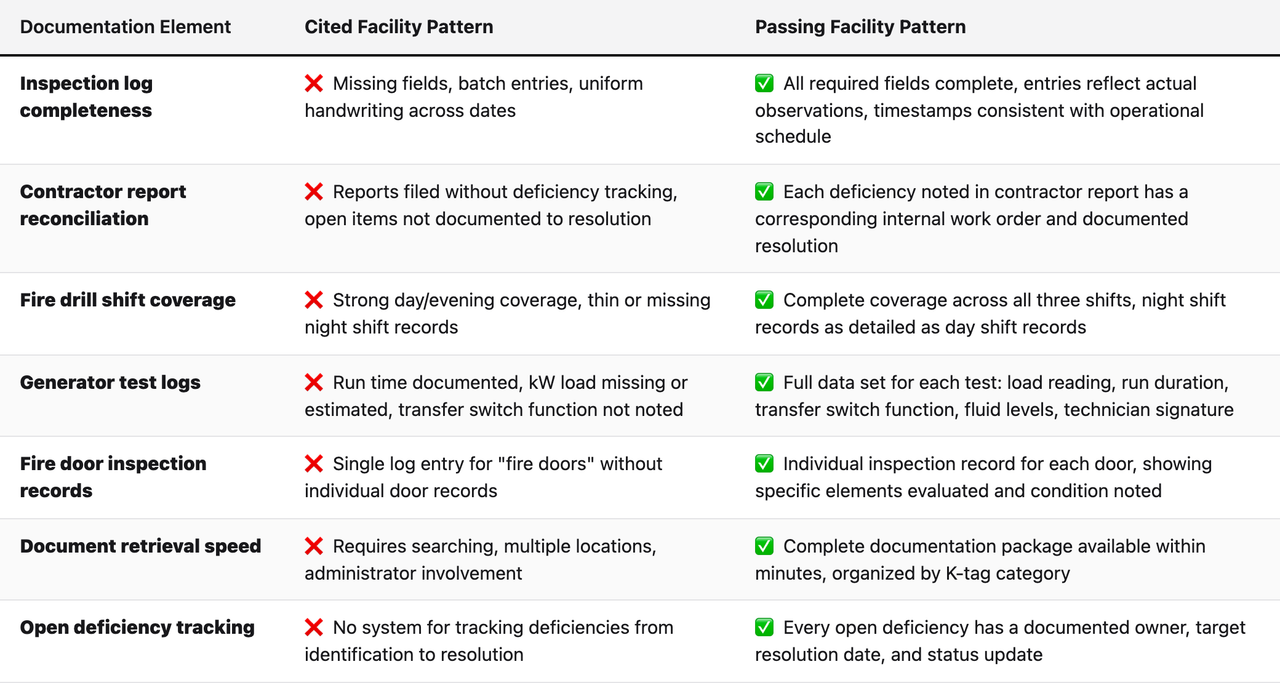
The Documentation Patterns That Distinguish Passing Facilities from Cited Facilities
After examining the common patterns of cited facilities, it is worth being equally specific about what passing facilities look like. The documentation characteristics that distinguish consistently passing SNFs are identifiable and replicable.
How to Conduct an Internal Pre-Survey Documentation Audit
The most effective preparation for an unannounced CMS life safety survey is a structured internal documentation audit that mirrors the surveyor's own review process. This is not a checklist review. It is a deliberate attempt to find documentation gaps before a surveyor does.
The audit should be conducted by someone who was not involved in producing the documentation being reviewed. This removes the blind spots that come from familiarity. A maintenance director reviewing their own logs will not see the same gaps that a surveyor sees because they know what was intended, not just what was written.
A Practical Framework for the Internal Audit
The following framework organizes the internal audit around the same K-tag categories that generate the most citations. It is designed to be used by a life safety compliance officer, a regional facilities manager, or an external consultant conducting a pre-survey review.
Step 1: Pull the past twelve months of documentation for each required inspection category. Do not pull a sample. Pull everything. The audit is looking for patterns, and patterns are only visible in complete data sets.
Step 2: Check each log for contemporaneous documentation indicators. Are dates and times consistent with the facility's operational schedule? Are entries written in different handwriting and different ink colors across different dates, as you would expect from a real operational log? Are specific observations noted, or just outcomes?
Step 3: Pull all contractor reports from the past twelve months and create a deficiency register. List every deficiency noted in every contractor report. For each deficiency, identify the corresponding internal documentation showing resolution. Flag every deficiency without documented resolution as an open item.
Step 4: Verify fire drill shift coverage. Map every drill record against the shift calendar for the past twelve months. Identify any shifts where the required quarterly drill is missing or where the documentation is incomplete by the standards described above.
Step 5: Review generator test logs for required data fields. Create a simple matrix with each test date as a row and each required data field as a column. Mark each cell as complete or missing. Any missing cells are potential citations.
Step 6: Verify that the fire door inspection program is functioning. Pull the annual inspection records and confirm that individual door records exist for each door in the facility. If the facility does not have a door inventory, that is the first gap to close.
Step 7: Organize all documentation by K-tag category. The final step is to organize the documentation in the same structure the surveyor will use to review it. This serves two purposes: it makes document retrieval fast during an actual survey, and it surfaces any categories where documentation is thin or disorganized.
The Role of Digital Documentation Systems in Survey Confidence
Paper-based documentation systems have a structural vulnerability that digital systems address directly: they cannot audit themselves. A paper binder contains whatever was put into it. It cannot identify that a required field was left blank, that a contractor deficiency was not tracked to resolution, or that the past three months of night shift drill records are missing. Those gaps are invisible until a surveyor finds them.
Digital life safety documentation platforms change the compliance dynamic by making documentation gaps visible before the survey. When an inspection record is submitted with a required field blank, the system flags it. When a contractor report is uploaded and cross-referenced against the deficiency tracking register, unresolved items surface automatically. When the drill schedule shows that the night shift Q3 drill has not been logged, an alert goes to the responsible party before the quarter ends.
This is the difference between a documentation system and a compliance system. A documentation system stores records. A compliance system evaluates them.
For SNF operators managing multiple facilities, the value compounds. A regional facilities manager reviewing paper binders across ten locations cannot see the pattern that one facility consistently has incomplete generator logs. A digital platform that aggregates compliance status across the portfolio makes that pattern immediately visible, allowing the regional manager to direct attention where it is actually needed rather than applying equal scrutiny everywhere.
The CMS Fire Safety Requirements for Certified Providers define the documentation standards that surveyors apply. Meeting those standards consistently across an SNF portfolio requires systems that match the complexity of the requirement, not paper binders that match the complexity of a single facility's historical practice.
Frequently Asked Questions About CMS Life Safety Inspections
How long does a CMS life safety survey typically take?
A standard life safety survey at a skilled nursing facility typically takes one to three days, depending on the facility's size and the number of surveyors present. Larger facilities and those with previous life safety citations tend to receive more extended reviews. Facilities with obvious documentation deficiencies discovered early in the survey may also see the review extended as surveyors investigate additional categories.
Can a facility request advance notice of a CMS life safety survey?
No. CMS life safety surveys of skilled nursing facilities are conducted without advance notice. This is a statutory requirement designed to evaluate facilities in their normal operating state. The only exception is revisit surveys conducted to verify correction of previously cited deficiencies, which may be scheduled. Standard recertification surveys and complaint-triggered surveys are unannounced.
What is the difference between a K-tag citation and an immediate jeopardy finding?
A K-tag citation documents a deficiency under the Life Safety Code that does not place residents in immediate danger. Immediate jeopardy (IJ) findings represent conditions where the surveyor determines that the deficiency has caused, or is likely to cause, serious injury, harm, or death to residents. IJ findings require immediate corrective action during the survey and carry significantly more severe regulatory consequences, including potential suspension of Medicare and Medicaid payments.
How does CMS determine which K-tags to cite during a life safety survey?
CMS surveyors follow a structured protocol that covers specific K-tag categories during every survey. The depth of review within each category is influenced by what the surveyor observes during the physical tour and initial document review. Physical conditions that suggest documentation gaps lead to deeper investigation. Facilities with clean physical conditions and organized documentation typically receive a more efficient review, though all required K-tag categories are evaluated in every survey.
What documentation must a facility produce at the start of an unannounced survey?
While surveyors may ask for additional documents as the review progresses, the standard initial document request typically includes the most recent fire inspection report, the most recent generator test log, the fire drill log for the past twelve months, the facility's written fire safety plan, and the most recent sprinkler inspection report. Facilities should be able to produce these documents within minutes of the surveyor's arrival.
How often are fire drills required in skilled nursing facilities?
CMS requires that fire drills be conducted on each shift (day, evening, and night) at least once per quarter, for a minimum of twelve drills per year. All drills must be documented with specific required elements. Night shift drills are among the most commonly cited as deficient, either because they were not conducted or because the documentation does not meet the required standard.
What are the most common reasons SNFs receive K-tag citations?
The most common citation sources in SNF life safety surveys are incomplete fire drill documentation (particularly night shift coverage), generator test logs with missing required data fields, failure to track contractor-identified deficiencies to documented resolution, fire door inspection records that do not cover individual doors, and unsealed penetrations in fire-rated assemblies. Documentation failures account for a significant share of all K-tag citations, meaning many facilities are cited not for unsafe conditions but for incomplete records.
Can a facility challenge a K-tag citation after it is issued?
Yes. Facilities may challenge K-tag citations through CMS's informal dispute resolution (IDR) process. The IDR process evaluates whether the citation was supported by the evidence gathered during the survey. Successfully challenging a citation requires demonstrating that the surveyor's finding was not supported by the evidence or that the regulatory standard cited does not apply to the condition observed. Facilities with organized, contemporaneous documentation are better positioned to mount effective IDR challenges when warranted.
What is the regulatory basis for NFPA 101 inspection requirements in SNFs?
CMS requires that certified skilled nursing facilities comply with the NFPA 101 Life Safety Code as a condition of participation in Medicare and Medicaid. The specific edition of NFPA 101 that applies is referenced in the CMS conditions of participation and may be updated as CMS adopts newer editions. The K-tag numbering system used by CMS surveyors corresponds directly to sections of NFPA 101 and related standards including NFPA 25 and NFPA 72.
How does a multi-site SNF operator maintain consistent life safety compliance across locations?
Multi-site operators face a structural challenge: the compliance status of any individual facility is only as visible as the reporting systems that connect it to regional oversight. Operators that rely on paper binders and periodic site visits have significant blind spots between visits. Operators using digital compliance platforms can monitor documentation status across their portfolio continuously, identify facilities with emerging gaps before they become citations, and ensure that compliance standards are applied consistently regardless of which maintenance director or EVS staff member is doing the work.
What should a facility do immediately after receiving K-tag citations?
The immediate priority is to develop a Plan of Correction (POC) that is submitted to CMS within ten calendar days of receiving the Statement of Deficiencies. The POC must address how each cited deficiency was corrected, how the facility will prevent recurrence, and the date by which full correction was or will be achieved. Facilities should treat the POC development process as an opportunity to audit the root cause of each citation, not just the surface condition. Most citations have a documentation process failure at their root, and the POC should address the process, not just the physical condition.
Is a life safety survey the same as a standard health survey at an SNF?
No. Life safety surveys are conducted separately from standard health surveys and are specifically focused on the physical environment and fire safety systems of the facility. Health surveys evaluate clinical care, staffing, and resident outcomes. The two surveys may be conducted simultaneously or separately, depending on CMS's scheduling. Life safety surveys may be conducted by CMS directly, by the State Survey Agency acting on behalf of CMS, or by an accreditation organization with CMS-recognized deeming authority.
Key Takeaways
- CMS life safety surveyors evaluate your documentation system, not just your building. Physical conditions matter, but documentation gaps are where most citations originate. A safe building with incomplete records is a cited building.
- Contemporaneous, complete, specific documentation is the standard. Logs that show "pass" without specific observations, records that appear to have been completed in batches, and contractor reports filed without deficiency tracking are all citation risks regardless of the underlying physical conditions.
- Contractor report reconciliation is a major vulnerability. Every deficiency noted in a contractor inspection report must have a corresponding internal record documenting resolution. Filing the report without tracking deficiencies to closure is a structural documentation failure.
- Night shift fire drill documentation is the single most consistent gap in SNF life safety records. Standardized drill documentation forms with required fields are the most practical tool for improving night shift record quality.
- Generator test logs must include kW load readings. Running the generator without measuring and recording the load is not a compliant test, regardless of how many years the practice has continued.
- The first hour of an unannounced survey sets the trajectory. Facilities that produce organized, complete documentation quickly signal a functioning compliance system. Facilities that cannot signal the opposite, and surveyors investigate accordingly.
- Internal pre-survey audits must be conducted by someone outside the documentation process. Familiarity blinds document creators to the gaps that external reviewers and surveyors see immediately.
- Digital compliance platforms change the structural dynamic by making documentation gaps visible before the survey. The shift from documentation systems to compliance systems, systems that evaluate records rather than just store them, is the most significant operational change available to SNF life safety programs today.
About the author
Benjamin Terebelo · Founder
Benjamin is the founder of SEQURA, a compliance platform purpose-built for healthcare facilities. He builds at the intersection of healthcare operations and software, maintaining a focus on bringing modern tooling to systems that the broader industry has largely left behind.
About the author
Benjamin Terebelo · Founder
Benjamin is the founder of SEQURA, a compliance platform purpose-built for healthcare facilities. He builds at the intersection of healthcare operations and software, maintaining a focus on bringing modern tooling to systems that the broader industry has largely left behind.