24 min read
What Is a Scope and Severity Escalation Pathway — And How Missed Fire Drill Logs Trigger It in SNFs
A plain-English breakdown of how CMS scope and severity escalation works — and why incomplete fire drill logs are one of the fastest triggers for SNF operators.
By Benjamin Terebelo

Most SNF operators know what a K-tag citation feels like after the fact. What very few understand is the mechanism that determines whether a single citation stays a minor deficiency or escalates into something that threatens the facility's Medicare certification. That mechanism is the CMS scope and severity escalation pathway. It is not left entirely to surveyor discretion: surveyor judgment is structured by a grid and CMS guidance. And certain documentation failures, particularly around fire drill records, can push a citation up that grid toward the categories associated with immediate jeopardy, federal civil monetary penalties, or denial of payment.
This article explains exactly how that pathway works, why fire drill log gaps are among the fastest and most common triggers for escalation in skilled nursing facilities, and what the difference looks like between a documentation program that contains the damage and one that amplifies it.
How the CMS Scope and Severity Grid Actually Works
The CMS scope and severity escalation system is the standardized framework surveyors use to characterize every deficiency identified during a survey visit. It is not a simple pass/fail determination. It is a two-axis matrix that assigns every citation a letter grade from A through L, with each letter representing a specific combination of scope (how widespread the problem is) and severity (how serious the harm potential is). Understanding this grid is prerequisite knowledge for any SNF operator serious about survey preparation.
The severity axis has four levels:
- No actual harm, potential for minimal harm (lowest severity)
- No actual harm, potential for more than minimal harm
- Actual harm that is not immediate jeopardy
- Immediate jeopardy to resident health or safety (highest severity)
The scope axis has three levels:
- Isolated: Affects one or a very small number of residents
- Pattern: Affects more than a limited number of residents, or the same residents multiple times
- Widespread: Affects or has the potential to affect a large number of residents throughout the facility
When you combine these axes, you get the familiar letter grid. A citation at severity level 1 and isolated scope is an "A" deficiency. A citation at severity level 4 and widespread scope is an "L" deficiency. The letters in between represent every combination of the two dimensions. Citations in the "D" through "F" range reflect no actual harm but potential for more than minimal harm, citations in the "G" through "I" range represent actual harm that is not immediate jeopardy, and citations in the "J" through "L" range represent immediate jeopardy, the most serious category in the entire CMS regulatory framework.
What Triggers Escalation Within the Grid
The critical concept most SNF operators miss is that escalation is not only about the nature of the underlying deficiency. It is heavily influenced by what the documentation record reveals about the facility's awareness of the problem and its response to it. A surveyor who finds a single incomplete fire drill log in isolation is likely to cite at the lower end of the grid. A surveyor who finds a pattern of incomplete fire drill logs across multiple quarters, combined with evidence that the facility's administrator signed off on the log as complete, is looking at a pattern- or widespread-scope finding, and the severity level can rise further if the surveyor concludes that the deficiency put residents at serious risk during an emergency.
This is where the escalation pathway becomes consequential. The CMS State Operations Manual, Appendix PP contains the interpretive guidelines surveyors use for long-term care requirements, and Appendix Q governs immediate jeopardy determinations. Surveyors look at how long a deficiency persisted and whether the facility's own oversight systems should have caught it. Documentation records, including the absence of documentation where documentation was required, are the primary evidence base surveyors use to answer those questions.
K-Tags, Life Safety, and Why They Escalate Differently
K-tag scope severity determinations follow a distinct logic from clinical deficiency tags, and SNF operators who conflate the two can underestimate their life safety citation risk. Life safety K-tags are typically assessed on the potential for harm, because the nature of fire and life safety deficiencies is inherently probabilistic. A fire that has not happened yet can still support a serious finding, up to immediate jeopardy, if surveyors conclude that the conditions make serious harm likely.
The CMS Life Safety Code Survey Procedures in Appendix I of the State Operations Manual govern how surveyors apply the scope and severity grid to K-tag deficiencies. Several features of this framework are worth understanding in detail.
The "Widespread" Default for Fire Safety Systems
When a deficiency involves a building-wide system, such as a fire suppression system, an emergency evacuation procedure, or a fire alarm system, surveyors are instructed to consider whether the deficiency has the potential to affect all residents throughout the facility. In most cases, the answer is yes, because the system itself is facility-wide. This means a single documentation deficiency related to a facility-wide fire safety system can be characterized as "widespread" in scope even if it involves only one document, because the underlying risk it represents is not confined to one resident or one wing of the building.
This is not a technicality. This is the core mechanism by which a single incomplete fire drill log can become a widespread-scope citation, such as an "F" on the scope and severity grid, rather than the isolated, minimal-harm citation where most facilities assume their paperwork issues will end up.
The Pattern Problem in Documentation
Pattern-scope findings are particularly dangerous for facilities whose documentation gaps are recurring. CMS surveyors reviewing life safety records are trained to look across time, not just at the current state of a document. When a surveyor pulls fire drill logs for the preceding twelve months and finds that drill records from the overnight shift are consistently missing specific required elements, that is not an isolated deficiency. That is a pattern. Pattern findings at severity level 2 already land at "E" on the grid. Pattern findings at severity level 3 land at "H," which is in actual-harm territory, where enforcement remedies such as civil monetary penalties become considerably more likely and more severe.
Fire Drill Documentation: The Specific Requirements SNFs Get Wrong
SNF fire drill documentation requirements are more specific than most maintenance directors realize, and the specificity is exactly where the gaps appear. The National Fire Protection Association's NFPA 101 Life Safety Code, which CMS has adopted by reference in its conditions of participation, establishes minimum standards for fire drill frequency, timing, and documentation. State fire marshals often layer additional requirements on top of these federal minimums. The intersection of federal NFPA requirements and state-specific overlays creates a documentation target that is more complex than a simple "did we do the drill or not" question.
What a Compliant Fire Drill Log Must Contain
Federal requirements (K712 and NFPA 101) set when and how drills must be held rather than a fixed list of record fields. A defensible fire drill record for a skilled nursing facility should typically document:
- The date and time the drill was conducted
- The shift during which the drill occurred
- The location of origin (simulated fire location)
- Whether all staff on duty participated
- The total evacuation or response time
- A description of any deficiencies observed during the drill
- Corrective actions taken for any observed deficiencies
- The name and signature of the person conducting and documenting the drill
Many facilities document most of these elements but omit one or two consistently. The most commonly missed elements, based on patterns visible across SNF compliance documentation, are the deficiency description and corrective action fields. Facilities that conduct drills without identifying any deficiencies, and document accordingly, are not necessarily compliant. If a drill reveals no deficiencies in every quarter for multiple years, a surveyor is likely to scrutinize whether the drills are genuinely evaluative exercises or simply checkbox events where the documentation is being completed without meaningful observation.
Shift Coverage: The Night-Shift Documentation Problem
NFPA 101 requires that fire drills in healthcare occupancies be conducted on each shift, which in SNF operations typically means day, evening, and night shifts must all be represented across the drill schedule for each quarter. The night shift requirement is where facilities most frequently create documentation gaps. Night shift drills are operationally inconvenient, they are conducted with skeleton staff, and the person responsible for documenting them is often a charge nurse or on-call supervisor who does not have fire drill documentation as a primary job function.
When a surveyor reviews twelve months of fire drill logs and finds that night shift drills are either absent or documented with fewer required elements than day and evening shift drills, that inconsistency is direct evidence of a pattern deficiency. A facility will have great difficulty arguing that the drills occurred but were simply not documented, because in survey practice, the working assumption is that if it was not documented, it did not happen. This principle is not limited to clinical care. It applies to every life safety inspection, test, and drill record a surveyor reviews.
Quarterly Distribution and the Common Scheduling Mistake
NFPA 101, as enforced through K712, requires that fire drills be conducted at least quarterly on each shift. That means every shift must be drilled in every quarter (twelve drills per year for a facility with three shifts), not simply "four drills per year." Drills must also be held at expected and unexpected times under varying conditions. This anti-predictability requirement exists to ensure that drills function as genuine preparedness exercises rather than anticipated events that staff can prepare for and perform without the realistic pressure of a surprise.
Facilities that conduct all four quarterly drills on the day shift, or that rotate shift coverage but conduct every night-shift drill at 2:00 AM because "that's when census is lowest and disruption is minimal," are violating the spirit and often the letter of the NFPA requirement. Surveyors who identify this pattern have a basis for a deficiency finding independent of whether the drills were otherwise well-documented.
How Incomplete Logs Trigger the Escalation Pathway
The connection between fire drill log compliance and CMS deficiency pathway escalation becomes much easier to follow once you understand how surveyors are trained to work through their findings. Surveyor judgment is not exercised in isolation. It is structured by the scope and severity grid and CMS guidance, and fire drill documentation gaps fit that framework in ways that are largely predictable and preventable.
Step One: The Initial Finding
A surveyor reviewing fire drill records identifies that one or more required elements are missing from a drill log. On its face, a single gap may look like an isolated, lower-severity finding, although, as noted above, gaps tied to facility-wide fire safety systems can be characterized more broadly. The surveyor has found a documentation gap. That gap represents a potential compliance failure, but it has not yet been contextualized within the broader record.
Step Two: Temporal Pattern Analysis
The surveyor does not stop at one drill record. Life safety surveys typically involve reviewing fire drill records for the preceding twelve months. If the initial finding recurs across multiple records in that period, the scope may be characterized as pattern rather than isolated. If the gap relates to a facility-wide risk, as fire drill documentation often does, the scope may be characterized as widespread. The severity level is determined by whether the deficiency created conditions that could result in harm.
Step Three: The "Knew or Should Have Known" Assessment
This is the step where documentation management practices become directly relevant to the escalation outcome. If a facility's administrator, director of nursing, or quality assurance committee regularly reviewed and signed off on fire drill documentation as part of their QAPI process, and that documentation contained gaps that any reasonable reviewer would have identified, that is evidence the facility "knew or should have known" about the deficiency and failed to correct it. That evidence can weigh against the facility in the surveyor's assessment and in enforcement decisions such as civil monetary penalties.
Conversely, a facility that has a documented process for auditing its own fire drill records, that identifies gaps, and that has evidence of corrective action, is in a substantially stronger position even when the underlying gap existed. The existence of a self-correction mechanism does not eliminate the deficiency finding, but it provides evidence that the facility's governance systems are functioning and that the risk exposure from the deficiency was managed rather than ignored.
Step Four: Cross-Tag Correlation
Life safety citations rarely appear in isolation. A surveyor who finds fire drill documentation gaps is also reviewing fire alarm test records, sprinkler inspection reports, emergency generator logs, and corridor maintenance documentation. When multiple K-tags are deficient in the same survey, the overall picture of the facility's life safety program matters: a pattern of documentation deficiencies across multiple K-tag categories suggests a systemic failure in the facility's life safety management program, and it can increase the facility's overall enforcement exposure.
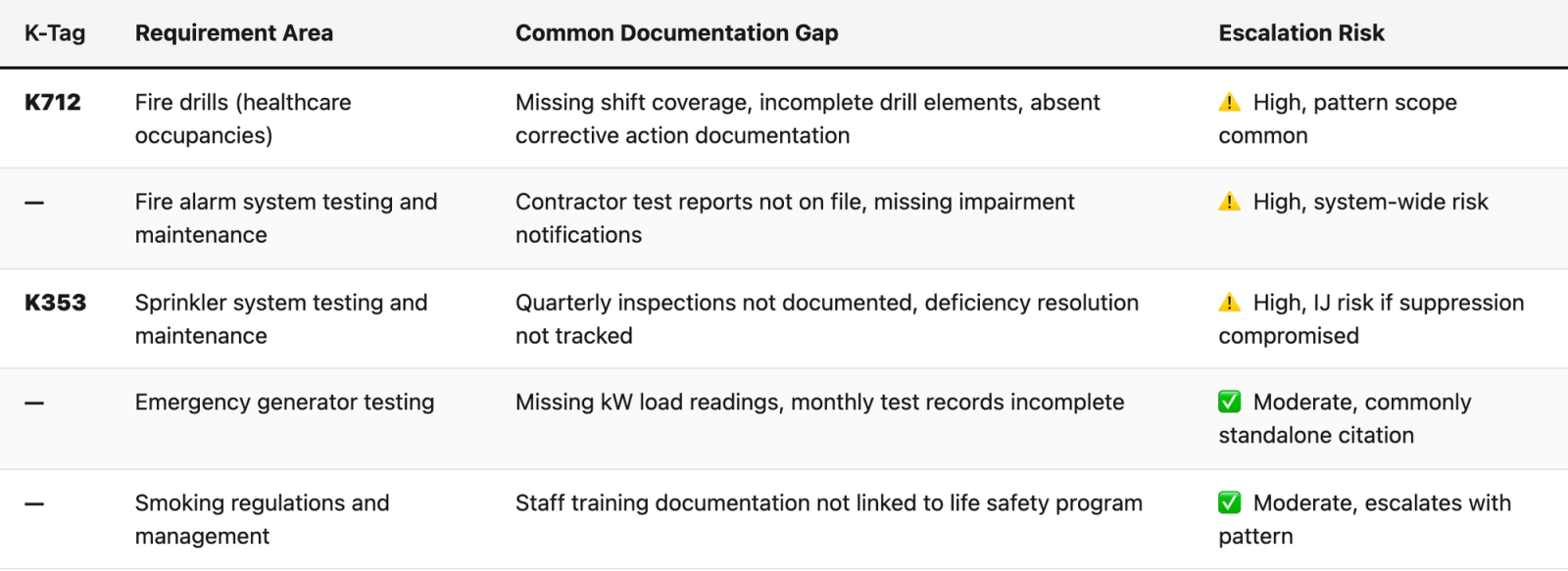
The Five K-Tags Most Commonly Associated with Fire Drill Escalation
Fire drill documentation deficiencies do not exist in isolation within the K-tag framework. Understanding which related life safety tags are commonly reviewed alongside fire drill records helps operators understand the full scope of their exposure.
What "Life Safety Citation Escalation" Costs Operationally
The financial and operational consequences of life safety citation escalation extend well beyond the immediate civil monetary penalty. SNF operators who focus only on the penalty amount when assessing their citation risk are systematically underestimating their exposure. The full cost of an escalated life safety citation includes several distinct categories of harm.
Five-Star Rating Damage
CMS's Five-Star Quality Rating System calculates the Health Inspections rating from health deficiencies cited on standard and complaint surveys. Fire safety (K-tag) citations are not counted in that score, but they are published separately on the CMS Care Compare website, where families, hospital discharge planners, and managed care organizations can see them. Fire drill problems also rarely stay confined to K-tags: related emergency preparedness or clinical findings can be cited as health deficiencies, and those do affect the rating. Visible citation histories and lower star ratings affect census, referral relationships, and contract rates, all of which have revenue implications that can far exceed the underlying penalty.
Focused Survey Exposure
Facilities with a sustained history of serious deficiencies across multiple survey cycles can become candidates for the CMS Special Focus Facility (SFF) program, which is based on health inspection results. Escalated citations of any kind can also bring more frequent revisit surveys. SFF designation is publicly visible and carries reputational consequences that are difficult to reverse, and the more frequent unannounced visits that come with it create operational strain and ongoing risk exposure.
Civil Monetary Penalties
CMS civil monetary penalties for life safety deficiencies are calculated using a formula that accounts for the severity and duration of the deficiency. Per-day penalties for immediate jeopardy citations can reach into the tens of thousands of dollars per day, and the penalty clock runs from the date CMS determines the deficiency began, not the date it was cited. When a fire drill documentation gap represents a pattern spanning multiple quarters, the potential penalty duration is measured in months, not days.
The Corrective Action Burden
Almost every cited deficiency above the lowest severity level requires a formal Plan of Correction (POC) that satisfies CMS and state agency reviewers, and the stakes rise sharply for citations in the "G" or higher range. A credible POC must address not only the specific deficiency cited but also the facility's systems for preventing recurrence and how compliance will be monitored. Developing, implementing, and documenting a credible life safety POC typically requires significant time from the administrator, director of maintenance, and often an outside consultant, with associated costs that compound the direct financial penalty.
The Documentation Audit Gap: Why Most SNFs Can't See Their Own Risk
The central operational challenge for SNF life safety compliance is not that facilities fail to conduct required drills and inspections. Most facilities complete the underlying activities. The challenge is that the documentation of those activities is systematically incomplete in ways that are invisible to the people completing the documentation. This invisibility is structural, not a function of negligence or indifference.
A charge nurse or supervisor completing a fire drill log at 3:00 AM on a night shift does not have a checklist of the specific elements that a CMS surveyor will look for in that record. They have a form, and they fill in the fields that are on the form. If the form is missing a field for corrective action documentation, or if the form does not prompt for the simulated origin of the fire, those elements will not be documented. The staff member completed the task as they understood it. The documentation is nonetheless deficient from a regulatory standpoint.
The Binder Auditing Problem
Traditional paper-based life safety binder management creates a secondary problem: the binder is only as good as the last time someone reviewed it critically, and critical review of a paper binder is labor-intensive, time-consuming, and dependent on the reviewer knowing exactly what they are looking for. Administrators who review their fire drill logs before a survey typically identify obvious gaps, a missing date, an unsigned record. They rarely identify subtle pattern deficiencies, such as the fact that every night-shift drill from the preceding year was conducted at the same time on the same day of the week, which undermines NFPA 101's requirement that drills be held at unexpected times under varying conditions.
This is the gap between documentation and compliance. A binder full of completed forms is not the same as a binder that would survive surveyor scrutiny. The difference between those two things is what an audit layer in a documentation platform is designed to identify before a surveyor does.
Cross-Shift Accountability Failures
In SNF environments, life safety documentation responsibilities are distributed across multiple staff members on multiple shifts. The day-shift maintenance director may be responsible for most recurring inspections, but night-shift fire drills fall to the charge nurse or supervisor on duty. There is no natural mechanism in a paper-based system for the maintenance director to verify that the night-shift drill documentation is complete and compliant. By the time the maintenance director reviews the log in the morning, the window for correcting the record with contemporaneous information has closed.
Documentation platforms that assign drill records to specific staff, require completion of all mandatory fields before the record can be submitted, and flag incomplete submissions in real time address this cross-shift accountability failure structurally. The platform enforces completeness at the point of documentation rather than catching gaps after the fact.
What a Defensible Fire Drill Documentation Program Looks Like
Building a fire drill documentation program that holds up under surveyor scrutiny requires addressing four distinct dimensions of compliance: content completeness, temporal distribution, audit trail integrity, and corrective action closure. Facilities that get all four right are in a fundamentally different risk category from those that get two or three right.
Content Completeness
Every drill record must capture all required elements without exception. The required element list should be derived from NFPA 101 requirements as interpreted by CMS, not from a generic fire drill form that a facility has been using for years without reviewing against current regulatory requirements. NFPA 101 is a living document that is revised on a cycle, and CMS updates its adoption by reference over time. A drill form that was compliant when it was designed may not capture all currently required elements.
Required elements should be treated as mandatory fields, not optional. A system that allows a drill record to be submitted without a corrective action field completed (even if the corrective action entry is "no deficiencies observed, no corrective action required") creates the conditions for the exact pattern deficiency that surveyors target.
Temporal Distribution and Anti-Predictability
Facilities should maintain a drill schedule that documents the planned timing of each drill across shifts and quarters, and that is designed from the outset to satisfy the anti-predictability requirement. The schedule should vary both the shift and the time within the shift for each drill, and it should be documented and retained as evidence that the facility's drill program was designed with regulatory intent rather than operational convenience.
Audit Trail Integrity
Every drill record should have a clear chain of custody: who completed it, when they completed it (with timestamp evidence), and whether any subsequent modifications were made and by whom. Paper records make this chain of custody harder to verify. Digital records with automatic timestamping and immutable audit logs create a chain of custody that is easier to defend than a paper form with a handwritten date.
Corrective Action Closure
When a drill identifies deficiencies, the corrective action record must close the loop. The deficiency must be described specifically, a corrective action must be assigned to a responsible party with a target completion date, and the completion of that corrective action must be documented separately from the drill record itself. Facilities that describe deficiencies in drill logs but have no mechanism for tracking whether the corrective action was actually completed are creating evidence of a systemic management failure that surveyors can use to support escalated severity findings.
Multi-Site Operators: How Scope and Severity Escalation Compounds Across Facilities
For regional and national SNF operators managing multiple facilities, the CMS deficiency pathway creates risks that compound in ways that single-facility operators do not face. Surveys and enforcement apply to each facility individually, but a chain with consistent fire drill documentation gaps across its facilities has a systemic risk profile that is qualitatively different from an isolated facility with the same gaps, and repeated similar findings across commonly owned facilities can draw regulatory attention to the operator.
Chain-Wide Survey Risk
When similar deficiency patterns show up across multiple facilities in the same chain, they can invite closer regulatory attention to the operator as a whole. A single facility's fire drill documentation problem is a localized risk. The same problem replicated across ten facilities points to a corporate-level systems failure, which reaches above the individual facility's administrator to the operator's executive leadership and compliance infrastructure.
The Aggregation Problem for Regional Managers
Regional facilities managers and VPs of operations at multi-site operators face an aggregation problem that is difficult to solve with paper-based systems. They cannot simultaneously review the fire drill logs of fifteen facilities to identify which ones are developing pattern deficiencies before a survey. They rely on facility-level self-reporting, which is subject to all of the visibility limitations described earlier. By the time a regional manager is aware that a specific facility's night-shift drill documentation is consistently incomplete, that facility may already have a pattern that would support a scope characterization of "pattern" or "widespread" if a surveyor reviewed the same records.
Centralized documentation platforms that aggregate audit findings across facilities give regional managers the visibility they need to identify developing risks across their portfolio before those risks become citations. A regional manager who can see, from a single dashboard, that three of their fifteen facilities have incomplete night-shift drill records from the preceding quarter is in a position to intervene before the next survey. A regional manager who only sees this information when a surveyor cites it is managing the consequences of the risk rather than the risk itself.
Documentation Intelligence vs. Documentation Management
There is a meaningful distinction between tools that help SNF operators manage their documentation and tools that help them audit it. The distinction matters because it defines what the tool actually prevents. Documentation management tools, including paper binders, shared drives, and basic digital form systems, help facilities organize and store their records. They do not evaluate whether those records would survive regulatory scrutiny.
Documentation intelligence, the layer that analyzes completed records against regulatory requirements and surfaces gaps before they become citations, is what actually changes the risk profile. A platform that reads a completed fire drill log and flags that the shift distribution for the quarter does not satisfy NFPA 101 requirements, or that the corrective action field was left with a non-specific entry that would not satisfy surveyor scrutiny, is doing something qualitatively different from a platform that simply stores the form.
This distinction is particularly important for facilities operating in states with aggressive survey programs or with recent citation histories that have put them under enhanced scrutiny. For those facilities, the gap between "we have documentation" and "our documentation is defensible" is the gap between passing the next survey and receiving another round of escalated citations.
Frequently Asked Questions
What is CMS scope and severity escalation in plain English?
It is the process by which CMS surveyors determine how serious a deficiency is, using a grid that combines how widespread the problem is (scope) with how harmful it is or could be (severity). A deficiency that starts as a minor isolated finding can escalate to a serious citation if surveyors find that the problem is recurring, that it affects many residents, or that the facility knew about it and did not fix it.
How many fire drills does a skilled nursing facility need to conduct each year?
Under NFPA 101 as enforced by CMS (K712), healthcare occupancies including SNFs must hold fire drills at unexpected times under varying conditions, at least quarterly on each shift. For a facility with three shifts (day, evening, and night), that means at least one drill per shift every quarter, or a minimum of 12 drills per year. Drill times should vary so they do not follow a predictable pattern. Some state requirements are stricter than this federal minimum.
Can a facility be cited for a K-tag deficiency even if no residents were harmed?
Yes. Life safety K-tag deficiencies are assessed based on the potential for harm, not just actual harm that occurred. The nature of fire safety is that the harm it prevents is a future event. A deficiency in fire drill documentation can be characterized at severity level 2 (potential for more than minimal harm) or higher even if no fire or evacuation emergency has occurred at the facility.
What is the difference between a pattern and a widespread deficiency in CMS scope determinations?
A pattern deficiency affects more than a limited number of residents or recurs multiple times, even if it does not affect the entire facility. A widespread deficiency affects or has the potential to affect a large portion of residents throughout the facility. For fire and life safety deficiencies involving building-wide systems, surveyors often characterize deficiencies as widespread because the risk, if a fire occurred, would not be limited to one wing or unit.
How far back do CMS surveyors typically look when reviewing fire drill records?
In practice, life safety surveyors generally review records covering the current survey cycle, which often means roughly the preceding twelve months or the period since the last standard survey. This means that documentation gaps from the preceding year are fully within the scope of a current survey review. Facilities that correct their documentation programs going forward but have legacy gaps in older records remain exposed to pattern findings during that look-back window.
What happens if a surveyor finds that a facility's administrator signed off on incomplete fire drill records?
This finding is evidence that the facility's governance and oversight systems failed to identify and correct a compliance gap. Surveyors can weigh that evidence when they assess how serious and how widespread the deficiency is, and it affects the credibility of any Plan of Correction the facility later submits.
Is there a difference between state and federal fire drill documentation requirements?
Yes. CMS enforces compliance with NFPA 101 as adopted by reference in the federal conditions of participation. State fire marshals and state health agencies may impose additional requirements that are more stringent than the federal minimum. Facilities must comply with both, and documentation programs should be designed to satisfy the more demanding of the two standards in each applicable area.
What is an immediate jeopardy finding in the context of life safety citations?
Immediate jeopardy (IJ) is the highest severity level on the CMS scope and severity grid. An IJ finding means that the surveyor has determined that the facility's failure to comply with a regulatory requirement has caused, or is likely to cause, serious injury, harm, impairment, or death to a resident. Life safety IJ findings are more common than many operators realize, particularly when fire suppression or alarm system deficiencies are involved, because the potential for catastrophic harm from a fire in a healthcare occupancy is inherently high.
How does a Plan of Correction for a life safety citation differ from one for a clinical deficiency?
A life safety Plan of Correction must address not only the specific deficiency cited but also the facility's systems for ensuring the deficiency does not recur. For fire drill documentation gaps, this typically requires the facility to describe its revised documentation process, identify who is responsible for oversight, and commit to an ongoing audit mechanism. CMS and state agencies review POCs for credibility, and a POC that simply promises to do better without describing a structural change to the documentation system is likely to be rejected.
Can digital documentation platforms eliminate the risk of fire drill citation escalation?
No platform can eliminate regulatory risk entirely, because surveyors can always find deficiencies in the underlying activities rather than the documentation. However, platforms that enforce content completeness at the point of documentation, flag pattern deficiencies before a survey, and maintain immutable audit trails can reduce the likelihood that documentation gaps will be the source of citation escalation.
What is the Special Focus Facility program and how does life safety escalation trigger it?
The CMS Special Focus Facility program identifies SNFs with a history of serious quality problems across multiple surveys. Under the CMS SFF scoring methodology, candidates are selected using a deficiency score based on health deficiencies from the last three standard surveys and recent complaint surveys, weighted by scope and severity, plus a revisit score for facilities that needed repeated revisits to show compliance. Life safety code citations are not the basis of that candidate score, but they still matter once a facility is in the program: CMS counts life safety code deficiencies when determining whether an SFF can graduate. Repeated fire drill or other life safety documentation deficiencies can therefore prolong a facility's time under enhanced scrutiny.
How should a multi-site SNF operator prioritize life safety documentation audits across their portfolio?
Multi-site operators should prioritize facilities based on three factors: recency of the last unannounced survey (facilities that have not been surveyed recently are statistically due for a visit), current citation history (facilities with existing K-tag citations are at elevated risk of escalation on the next survey), and documentation audit score if a centralized platform is in use. Facilities that score poorly on documentation completeness audits before a survey are the facilities most likely to receive citations when a surveyor arrives.
Key Takeaways
- The scope and severity grid is structured, not arbitrary. Surveyors apply CMS guidance that tends to move deficiency characterizations toward higher severity and broader scope when documentation reveals systemic or recurring failures. Understanding the grid is the first step toward managing it.
- Fire drill documentation gaps escalate faster than most operators expect because fire safety deficiencies are assessed on potential harm, not just actual harm, and because building-wide systems support widespread scope characterizations from a single documentation gap.
- Night-shift drill coverage is a common single-point failure in SNF fire drill documentation programs. It is operationally inconvenient, often assigned to non-specialist staff, and frequently incomplete in ways that can create pattern findings across twelve-month look-back reviews.
- Oversight records cut both ways. Administrators who sign off on life safety records without auditing them for compliance create evidence that the facility's oversight failed to catch the problem, which surveyors can weigh when characterizing the deficiency and reviewing the Plan of Correction.
- Multi-site operators face compounded risk when the same documentation gaps exist across multiple facilities. What is a localized problem at one facility points to a systemic failure at the corporate level, and it multiplies citation exposure across the portfolio while inviting closer regulatory scrutiny.
- Documentation management is not the same as documentation intelligence. Storing completed records does not protect a facility if those records contain the pattern deficiencies that surveyors are specifically trained to identify. The audit function, not the storage function, is what changes the risk profile.
- Corrective action closure is not optional. A drill record that identifies a deficiency but contains no evidence that the corrective action was completed is worse than a drill record that identifies no deficiencies, because it documents both the problem and the facility's failure to resolve it.
About the author
Benjamin Terebelo · Founder
Benjamin is the founder of SEQURA, a compliance platform purpose-built for healthcare facilities. He builds at the intersection of healthcare operations and software, maintaining a focus on bringing modern tooling to systems that the broader industry has largely left behind.
Related reading
About the author
Benjamin Terebelo · Founder
Benjamin is the founder of SEQURA, a compliance platform purpose-built for healthcare facilities. He builds at the intersection of healthcare operations and software, maintaining a focus on bringing modern tooling to systems that the broader industry has largely left behind.
Topics
- CMS scope and severity escalation
- SNF fire drill documentation
- K-tag scope severity
- life safety citation escalation
- CMS deficiency pathway SNF
- fire drill log compliance USA


