
What Is an Environment of Care Survey Risk? A Director of Nursing's Practical Guide to K-Tag Exposure
Most directors of nursing think of environment of care compliance as someone else's problem. The maintenance director owns the binder. The plant operations manager handles the fire drills. Life safety is a facilities function, and the DON's job is clinical. This division of responsibility is logical, intuitive, and partially responsible for why nursing directors get blindsided during CMS surveys every single year.
The reality is more uncomfortable: K-tag citations in skilled nursing facilities are not solely a maintenance failure. Several of the most commonly cited K-tags carry direct exposure for directors of nursing, either because the regulatory language explicitly names nursing's role in the evacuation and emergency response framework, or because the documentation gaps that trigger citations exist in workflows the DON supervises. Surveyors know this. They cross-reference nursing staff interviews with life safety records, and inconsistencies between what staff say and what the binder shows produce citations regardless of who "owns" the program.
This guide maps the environment of care risk landscape from a DON's perspective. It explains which K-tags create direct exposure, how surveyor methodology creates cross-department citation risk, and what a nursing director needs to do operationally to close the gaps before the next unannounced visit.
Why the Environment of Care Is a Nursing Problem, Not Just a Facilities Problem
The CMS State Operations Manual, Appendix PP governs the survey process for skilled nursing facilities and defines the environment of care requirements under the life safety and physical environment tags. But understanding who is surveyed matters as much as understanding what is surveyed.
When CMS or state surveyors arrive for an unannounced Life Safety Code survey, they do not interview only the maintenance director. They conduct staff interviews across departments, including nursing supervisors and charge nurses on the unit. These interviews are specifically designed to test whether staff can correctly describe evacuation routes, explain their role in a fire emergency, demonstrate knowledge of smoke compartment assignments, and articulate how the facility responds to a Code Red. If nursing staff cannot accurately answer these questions, the surveyor has grounds to document a deficiency under the training and staff knowledge provisions, even if the fire drill records in the maintenance binder show full compliance.
This is the core of the DON's exposure: nursing staff knowledge and behavior during emergencies is a K-tag variable that the director of nursing directly controls. The maintenance director can conduct perfect fire drills, but if nursing staff rotate shifts, new hires skip orientation modules, and the DON does not verify that staff can demonstrate emergency response competency, the facility has a documentation gap and a training gap simultaneously.
The Shared Accountability Framework CMS Uses
CMS organizes the environment of care survey process around two parallel tracks. The first is physical plant compliance: fire alarm systems, sprinkler coverage, emergency generator function, corridor clearances, hazardous materials storage. This track is primarily the maintenance director's domain. The second track is operational and human: staff training, emergency response drills, evacuation procedures, fire watch protocols, and resident safety during an emergency event. This track runs directly through nursing leadership.
Where DONs consistently underestimate their exposure is in the overlap between these two tracks. Consider fire drills as an example. Under NFPA 101 requirements adopted by CMS, SNFs must conduct fire drills at varying times, including during sleeping hours, and must document staff performance during those drills. Drill documentation is typically maintained by the maintenance director. But the staff being drilled are predominantly nursing staff, and the supervisor accountable for nursing staff competency is the director of nursing. When a surveyor finds drill logs showing that night-shift nursing coverage is consistently thin, or that the same staff members appear across multiple drills without rotating, the question about accountability lands on the DON's desk, not the maintenance director's.
The K-Tags That Create Direct DON Exposure
Not every K-tag creates equal risk for nursing directors. Some tags are purely physical plant, and a DON has no realistic path to citation under those categories. But several K-tag categories carry genuine nursing leadership exposure, and understanding the specific regulatory language behind each one is the starting point for managing the risk.
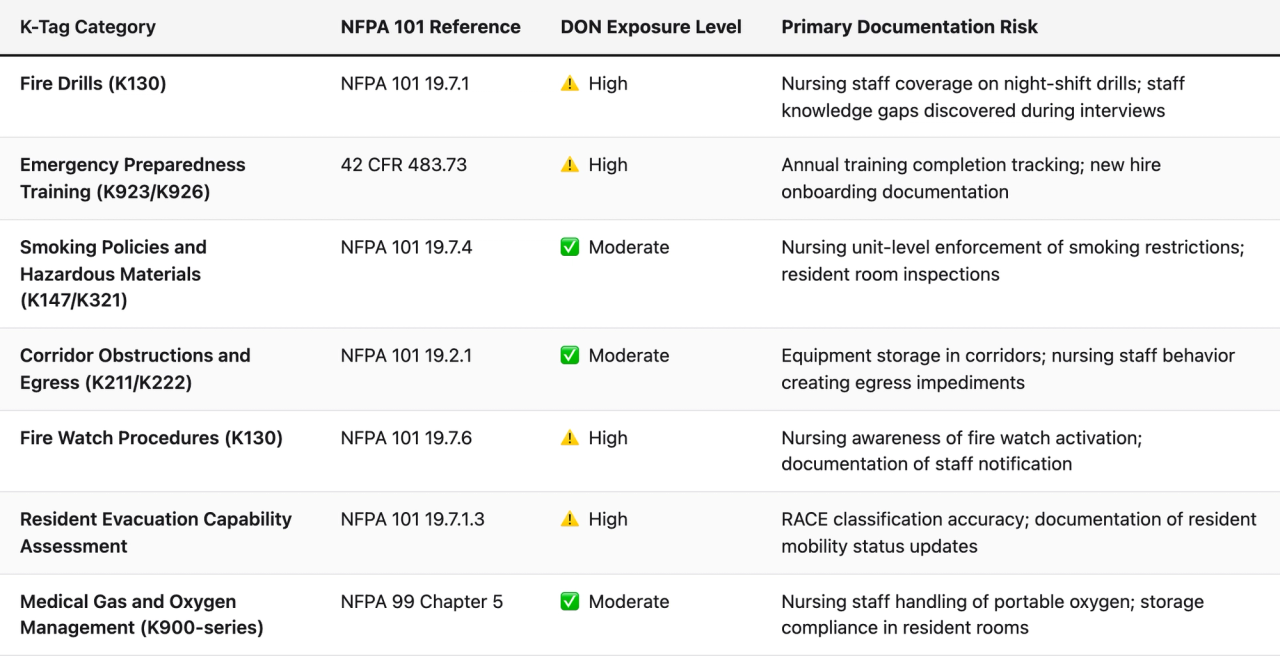
K-tag Categories with Nursing Leadership Exposure
Fire Drills: Where Nursing Accountability Is Most Visible
Fire drill requirements under NFPA 101 Section 19.7.1 specify that drills must be conducted at least quarterly on each shift and at varying times. The word "varying" is operationally significant. Surveyors look for patterns in drill logs that suggest a facility is conducting drills during predictable, convenient windows rather than genuinely simulating unannounced emergency conditions. A facility that always conducts its overnight drill at 2:15 AM on a Tuesday will attract scrutiny.
But the deeper nursing exposure is not in the scheduling. It is in the documentation of staff performance during drills. NFPA 101 requires that drills test staff knowledge and response, not merely that they happen. When drill logs consist of a date, a time, and a signature with no narrative of staff response, equipment tested, or areas covered, surveyors treat the documentation as incomplete. The DON's role is to ensure nursing staff participate meaningfully, that their participation is documented, and that staff who miss drills receive documented makeup training. None of this happens automatically if the DON delegates the entire fire drill program to the maintenance director without a feedback loop.
Resident Evacuation Capability: The Most Underestimated DON Responsibility
This is the area where nursing directors carry the clearest direct regulatory exposure and are most frequently unprepared for surveyor scrutiny. NFPA 101 requires that facilities maintain current documentation of resident evacuation capability, and that this information inform the facility's emergency response plan. The clinical classification system used most commonly in SNFs for this purpose is the RACE (Rescue, Alert, Confine, Extinguish/Evacuate) framework, though facilities use various nomenclatures for the underlying concept: identifying which residents require assistance to evacuate, what type of assistance they need, and how many staff are required to move them safely.
The documentation gap that creates citations here is not that facilities fail to classify residents. Most do. The gap is that resident evacuation classifications are not updated when clinical status changes. A resident admitted ambulatory who subsequently develops hip fracture or significant cognitive decline may still be coded as requiring minimal assistance in the evacuation documentation. When a surveyor pulls the evacuation capability records and cross-references them against nursing assessments, the inconsistency produces a citation. This cross-reference is a standard surveyor technique, and it falls directly within nursing's documentation domain.
How Surveyor Methodology Creates Cross-Department Citations
Understanding how CMS and state surveyors actually conduct a life safety survey is more useful for DONs than memorizing the K-tag list. Surveyors are trained to work from observation to documentation to interview, and each step creates a new opportunity to surface a deficiency that a single-department review would miss.
The Observation-Documentation-Interview Triad
A surveyor walking a nursing unit during an environment of care survey is simultaneously observing physical conditions (corridor clearance, door hardware, signage), reviewing documentation on the unit (emergency response protocols posted, evacuation maps current), and forming interview questions based on what they see. If a surveyor observes a portable oxygen concentrator stored in a resident room without appropriate storage documentation, the next step is an interview with the charge nurse on the unit, not the maintenance director. The charge nurse's inability to explain the facility's oxygen storage policy is a nursing department deficiency, regardless of whether the policy lives in a binder maintained by facilities.
This is the mechanism through which nursing directors inherit K-tag risk from what they assume is a facilities-only domain. The physical plant observation creates the interview question. The interview question lands on nursing staff. The nursing staff's answer either confirms or refutes compliance. If nursing staff cannot demonstrate knowledge of policies that intersect with their daily work, the surveyor has documentation for a deficiency under the training and staff competency provisions of the environment of care standards.
Night-Shift and Weekend Vulnerability
CMS surveyors are specifically trained to conduct portions of their survey during off-hours, including evening and overnight shifts, precisely because compliance behavior during off-hours often differs from daytime behavior. For nursing directors, this creates a specific category of risk: the gap between what the day shift does and what the night shift does in terms of life safety compliance.
The most common patterns that produce citations in off-hour surveys include: corridor equipment left in egress paths by night-shift nursing staff who know the day charge nurse will clear it before rounds; fire doors propped open overnight on nursing units; and smoking or open flame incidents in resident rooms that are not properly documented and escalated through the incident reporting chain. Each of these is a nursing behavior pattern, and each creates K-tag exposure under the physical plant and hazardous materials categories. The DON's accountability is for establishing expectations, verifying compliance, and maintaining documentation that demonstrates the training and monitoring program exists across all shifts.
The Staff Interview as a Survey Tool
Staff interviews during life safety surveys follow a structured pattern. Surveyors typically ask nursing staff to describe their role in a fire emergency, identify the nearest exit from their current location, explain what "defend in place" means, and describe the steps they would take if a resident's room was found to be on fire. These questions are not trick questions. They are designed to verify that the fire drill and emergency training program the facility documents actually translates into staff knowledge.
When multiple nursing staff give inconsistent answers, or when any staff member cannot answer a basic emergency response question, the surveyor has evidence of a training program deficiency. This evidence supports a citation under K923 (emergency preparedness training) or K130 (fire drills), depending on the specific gap identified. The DON is the accountable leader for the training program that should prevent these gaps, and a pattern of nursing staff knowledge failures during surveyor interviews is difficult to defend if there is no documentation of a robust, ongoing training verification process.
Emergency Preparedness vs. Life Safety: Understanding the Two Frameworks
One source of significant confusion for directors of nursing is the distinction between the CMS Emergency Preparedness rule (42 CFR 483.73) and the Life Safety Code requirements (NFPA 101 and NFPA 99). These are separate regulatory frameworks with different documentation requirements, different survey processes, and different K-tag categories, but they share substantial overlap in terms of staff training and nursing department accountability.
What 42 CFR 483.73 Actually Requires from Nursing
The CMS Emergency Preparedness rule, which applies to all Medicare- and Medicaid-certified SNFs, requires facilities to maintain an emergency plan, conduct annual training for all staff, conduct annual exercises (drills), and document staff participation in both training and exercises. The rule applies to "all staff," which means nursing staff are explicitly included in the training and exercise documentation requirement.
The documentation requirements under 42 CFR 483.73 that create the most citation risk for nursing directors include:
- Annual training completion for all nursing staff: Including agency and contract staff who work regularly at the facility. The gap most frequently cited is incomplete documentation for per-diem and registry staff who are not captured in the facility's standard training tracking system.
- Tabletop exercise participation: The rule requires at least one full-scale exercise and one tabletop exercise annually, with documented participation. Nursing leadership is expected to participate in the tabletop exercise, and documentation of their participation must exist in the emergency preparedness file.
- After-action reviews: Following exercises and actual emergency events, the facility must document an after-action review that identifies gaps and corrective actions. If a nursing unit experienced a fire watch event during the survey period, the after-action documentation for that event should exist, and the DON should be able to produce it.
The Life Safety Code Layer
Separately, NFPA 101 (Life Safety Code), as adopted by CMS for SNF surveys, imposes its own set of requirements that overlap with nursing accountability. The most important distinction for DONs is that NFPA 101 requirements are surveyed under the Life Safety Survey process, which CMS conducts separately from the standard health survey. Life Safety Surveys can occur independently, and a facility that recently passed its health survey without a K-tag citation may still face a standalone Life Safety Survey that produces significant findings.
The life safety requirements most directly relevant to nursing operations include the fire drill standards (quarterly per shift, varying times, documented staff performance), the smoking and open-flame prohibition enforcement, the corridor and egress clearance requirements, and the requirements around notification and response when a fire protection system is impaired. Each of these intersects daily nursing unit operations in ways that create ongoing documentation obligations for the DON.
The Documentation Architecture a DON Should Demand
Understanding the risk is only useful if it leads to operational changes. For directors of nursing, the practical response to K-tag exposure in the environment of care domain is building a documentation architecture that demonstrates ongoing oversight, not just periodic compliance. This is the distinction that separates facilities that survive unannounced surveys from those that accumulate citations.
What "Contemporaneous Documentation" Actually Means for Nursing
CMS surveyors are trained to distinguish between documentation that was created at the time of the activity and documentation that was created in anticipation of a survey. Retroactive documentation, even when accurate, is treated with suspicion. Contemporaneous documentation, meaning records created at or near the time of the event they describe, is the standard that surveyors use to assess whether a compliance program is operational or cosmetic.
For nursing directors, contemporaneous documentation requirements create specific operational demands. Fire drill participation records for nursing staff must be signed at the time of the drill, not filled in later from a roster. Resident evacuation capability updates must be documented in the clinical record at the time of the assessment change, not backdated to the admission assessment. Staff emergency training completion must be recorded in real time through a system that creates a timestamp, not entered into a spreadsheet after the fact. Each of these requirements points toward a documentation workflow that is integrated into daily nursing operations rather than managed as a separate compliance task.
The Three Documentation Categories Every DON Should Monitor
Rather than attempting to track every possible K-tag documentation requirement, directors of nursing can organize their oversight around three categories that capture the majority of nursing-accountable life safety documentation:
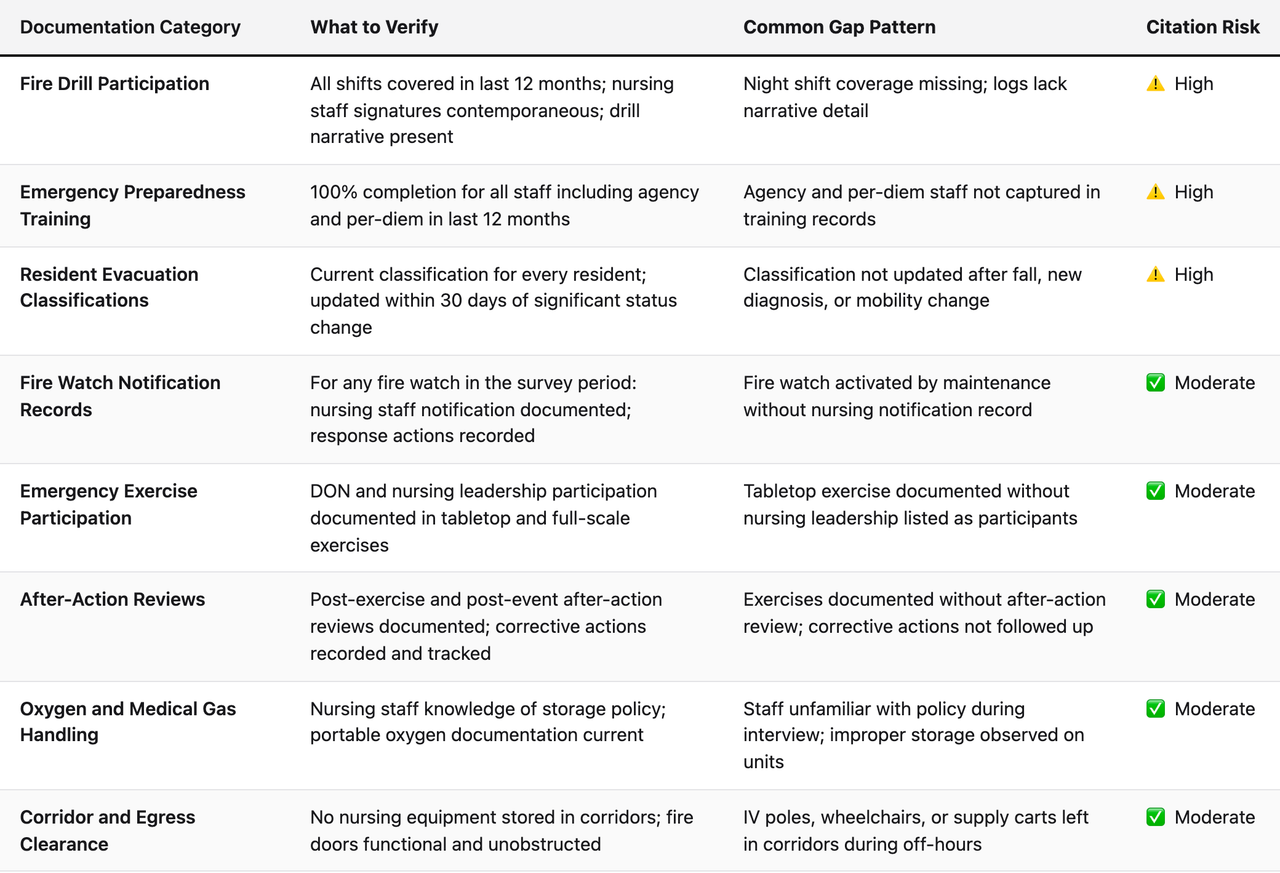
Category 1: Staff Knowledge and Training Records. This includes fire drill participation logs (broken down by shift and unit), emergency preparedness annual training completion (including agency and per-diem staff), and documentation of any corrective training provided when gaps are identified. The DON should be able to produce a complete, current record for every nursing employee and regular contract staff member at any time.
Category 2: Resident Evacuation and Emergency Response Documentation. This includes current evacuation capability classifications for all residents, documentation of updates when clinical status changes affect evacuation capability, and the unit-level emergency response assignments that identify which staff member is responsible for which residents during an emergency. These records must be current to the resident's current clinical condition, not their admission status.
Category 3: Incident and Event Documentation. This includes any fire alarm activations, smoke events, oxygen incidents, or fire watch activations that occurred during the survey period, along with the after-action documentation demonstrating nursing's notification, response, and follow-up. A gap in this category, such as a fire watch activation with no corresponding nursing staff notification record, is highly visible to surveyors and difficult to explain.
Common Mistakes That Turn Minor Gaps into Serious Citations
Survey citations rarely emerge from a single catastrophic failure. More commonly, they develop from a pattern of minor documentation gaps that individually seem insignificant but collectively demonstrate systemic non-compliance. Understanding the escalation patterns that turn minor gaps into serious citations gives DONs a practical framework for prioritizing their compliance oversight.
The Aggregation Problem
A surveyor finding a single fire drill log with incomplete staff participation documentation is unlikely to write a citation based on that finding alone. But a surveyor finding three consecutive quarterly drills with incomplete night-shift nursing documentation, combined with a nursing staff interview revealing uncertainty about evacuation procedures, combined with a resident evacuation capability record that has not been updated in 18 months, has the evidence for a pattern-based citation. The individual findings are minor. The pattern is serious.
This is the aggregation problem, and it is the most common mechanism through which DONs who feel they are "doing most things right" end up with significant K-tag citations. The antidote is not perfection in any single documentation category. It is consistent completeness across all three categories identified above, maintained over the entire survey period rather than refreshed in the weeks before a survey is expected.
The Delegation Trap
Directors of nursing who delegate life safety documentation responsibilities to charge nurses or unit managers without a verification and feedback loop create a specific category of risk: the documentation that appears to exist at the unit level but has never been reviewed by someone with the authority and knowledge to identify gaps. A charge nurse who faithfully completes fire drill attendance logs without understanding that logs must include a narrative of staff response has created documentation that looks complete but will not survive surveyor scrutiny. The DON who never reviewed those logs cannot claim ignorance when the citation is written.
The practical solution is a monthly documentation review cadence, at minimum, in which the DON or a designated compliance-focused nurse leader reviews the nursing department's life safety documentation for completeness and accuracy. This review should be documented, meaning there should be a record that the review occurred, what was found, and what corrective action (if any) was taken. This review record itself becomes a compliance asset during a survey, demonstrating that the facility has an active oversight program rather than passive binder maintenance.
The New-Hire and Agency Staff Gap
One of the most consistently cited gaps in nursing department emergency preparedness documentation is the failure to capture training completion for staff who are not on the permanent payroll: agency nurses, per-diem staff, and travel nurses who work at the facility for a defined contract period. The regulatory requirement applies to all staff who work regularly at the facility, regardless of employment classification. A surveyor who requests training completion records for all staff working on a specific unit during the survey period will ask about agency staff by name if they appear on scheduling records, and the absence of training documentation for those individuals is a citable deficiency.
For DONs managing staffing mix challenges, this gap is particularly acute because agency staff turnover is high, tracking their training completion is operationally difficult, and the responsibility often falls between the DON and the staffing agency without clear ownership. The solution is a facility-level policy that requires all agency staff to complete or provide documentation of facility-specific emergency response orientation before their first shift, with that documentation maintained in the facility's training records rather than relying on the agency's records.
What Good Looks Like: The DON's Environment of Care Compliance Model
Moving from risk awareness to operational compliance requires a concrete model that integrates life safety accountability into the DON's existing leadership framework without creating an entirely separate compliance program. The most effective approach treats environment of care compliance as a component of nursing department quality management rather than an external regulatory requirement managed by another department.
Integrating Life Safety into Nursing Department QA
Most SNF nursing departments already operate quality assurance processes for clinical outcomes: fall rates, pressure injury incidence, infection control metrics. Adding life safety documentation metrics to the same QA framework creates accountability without adding a separate administrative structure. The metrics that belong in this framework include fire drill participation rates by shift and unit, emergency preparedness training completion rates by employee category (permanent, per-diem, agency), resident evacuation capability documentation currency (percentage of residents with a current classification), and incident documentation completeness rates.
Tracking these metrics monthly, reviewing them at nursing department QA meetings, and documenting corrective actions when metrics fall below threshold creates exactly the kind of ongoing oversight record that demonstrates to surveyors that the facility has an active, functioning compliance program. This is the difference between a facility that can show a surveyor a binder and a facility that can show a surveyor a program.
The Cross-Department Partnership the DON Needs
Effective environment of care compliance for nursing directors requires a structured partnership with the maintenance director or life safety officer that goes beyond the assumption that "they handle the binder." The DON and maintenance director need a regular communication cadence, at minimum monthly, that covers:
- Any fire protection system impairments or outages during the period, including fire watch activations, and confirmation that nursing staff were notified and documentation exists
- Upcoming fire drills, including the planned shifts and timing, so the DON can ensure appropriate nursing staff coverage and prepare charge nurses for their role in the drill
- Any life safety inspection findings from the period that require nursing department action, such as a sprinkler inspection identifying an obstruction caused by nursing unit equipment storage
- Emergency preparedness exercise planning and documentation, to ensure nursing leadership participation is scheduled and will be documented
This partnership structure transforms the environment of care compliance program from a facilities-only function into a facility-wide program with visible nursing leadership engagement, which is precisely what CMS surveyors look for when they assess whether a facility has a functioning rather than a cosmetic compliance program.
How Modern Documentation Tools Change the DON's Risk Profile
The traditional model for environment of care compliance documentation, a paper binder maintained by the maintenance director, creates structural documentation gaps that are difficult for nursing directors to overcome regardless of how diligently they manage their department. The binder does not track nursing staff participation in fire drills against the scheduling system. It does not cross-reference resident evacuation capability records against nursing assessment updates. It does not alert the DON when a quarterly drill cycle is about to expire without night-shift coverage. These are invisible gaps, meaning they exist in the documentation without anyone knowing they exist until a surveyor finds them.
Platforms like SEQURA address this visibility problem by operating as an audit layer on top of documentation rather than simply a storage system for completed records. When a fire drill is logged, the system cross-references the participating staff against the unit's shift schedule and flags if night-shift nursing coverage falls below the threshold required by NFPA 101. When a resident's nursing assessment is updated to reflect a significant change in mobility status, the system can flag the corresponding evacuation capability record for review. When a fire watch is activated, the system creates a notification trail that includes confirmation of nursing staff notification, not just maintenance department response.
For directors of nursing, the practical value is not just better documentation. It is the elimination of the invisible gap, the situation where the documentation appears complete to everyone internally but contains a specific deficiency that a trained surveyor will find immediately. The DON cannot close gaps they cannot see. A documentation intelligence platform that audits records against regulatory expectations gives the DON the same visibility into compliance status that a surveyor would have, before the survey begins rather than during it.
Building Your Pre-Survey Environment of Care Checklist
Every director of nursing should maintain a personal pre-survey environment of care checklist that covers the documentation categories within their accountability domain. This checklist is not a substitute for an ongoing compliance program, but it is a useful tool for identifying the specific gaps that are most likely to produce citations when a surveyor arrives unannounced.
The DON's Environment of Care Pre-Survey Checklist
The Intersection of CMS Survey Frequency and DON Risk Timing
CMS requires that each SNF receive a standard health survey at least once every 15 months, with the average interval for the state not exceeding 12 months. Life Safety surveys are conducted separately and may occur concurrently with health surveys or independently. For directors of nursing, the practical implication is that environment of care survey risk is not a periodic, predictable event. It is a continuous state.
Facilities that treat survey preparation as a cyclical activity, meaning they ramp up compliance activity in the months before they expect a survey and allow documentation to drift in the intervening period, are systematically more vulnerable than facilities that maintain consistent documentation throughout the year. A surveyor who arrives in month 14 of a 15-month survey cycle will have access to 14 months of documentation history. If the documentation shows a pattern of declining completeness or a cluster of gaps concentrated in the months before the expected survey window, the pattern itself becomes a finding.
For nursing directors, this means that the environment of care compliance program must be sustainable at its steady-state level, not at an elevated pre-survey level. A documentation system that requires extraordinary effort to maintain is a system that will produce gaps. The goal is a program that runs at the same quality level in month 3 as it does in month 14, and the only way to achieve that is to integrate life safety documentation into nursing department operational workflows rather than treating it as a separate compliance function.
Frequently Asked Questions
Is a director of nursing personally named in K-tag citations?
K-tag citations are written against the facility, not individual staff members. However, the Statement of Deficiency will describe the pattern of non-compliance in terms that make clear which department's practices produced the finding. When a citation involves nursing staff training or resident evacuation documentation, the narrative will reference nursing department practices, and the Plan of Correction will require the facility to demonstrate corrective action at the nursing leadership level. The DON's role in the deficiency and in the corrective response is visible in the survey record even when their name does not appear in the citation.
What is the difference between a health survey citation and a Life Safety Survey citation?
CMS conducts two distinct survey types for SNFs. The standard health survey (under Appendix PP of the State Operations Manual) covers clinical care, resident rights, nutrition, and the physical environment as it relates to resident safety. The Life Safety Survey (under Appendix I of the State Operations Manual) specifically evaluates compliance with NFPA 101 and NFPA 99. Both can produce K-tag citations, but they operate on different regulatory foundations. A facility can pass its health survey and receive K-tag citations from a concurrent or subsequent Life Safety Survey. For directors of nursing, both survey types create exposure in the areas described in this guide.
How often do CMS surveyors conduct staff interviews during Life Safety Surveys?
Staff interviews are a standard component of Life Safety Surveys, not an exception. Surveyors conducting life safety evaluations routinely interview nursing staff to assess their knowledge of evacuation procedures, their understanding of their role during a fire emergency, and their familiarity with the facility's emergency response protocols. The CMS Life Safety Code Survey Protocol (Appendix I) includes staff interview as a required survey activity, and deficiencies arising from staff knowledge gaps are citable under the training provisions of both NFPA 101 and 42 CFR 483.73.
Can a facility be cited for K-tags solely based on nursing staff interview responses?
Yes. When a surveyor documents a pattern of nursing staff unable to correctly describe emergency procedures, identify evacuation routes, or explain their role during a fire emergency, the surveyor has evidence of a deficiency in the staff training program that is citable without a corresponding physical plant finding. The citation would typically fall under the emergency preparedness training requirements (K923) or fire drill provisions (K130), depending on the specific gaps identified. Documentation of the interviews becomes part of the Statement of Deficiency.
What should a DON do when the maintenance director does not share fire drill documentation?
The DON should establish a formal documentation sharing protocol with the maintenance director, ideally supported by facility policy, that specifies what documentation the nursing department receives after each fire drill and on what timeline. This protocol should include the drill log with nursing staff participation by name and shift, the drill narrative, and any findings or corrective actions identified. If the maintenance director does not maintain documentation to this standard, the DON has grounds to escalate to the administrator and to initiate their own supplementary documentation of nursing staff drill participation. Waiting for a surveyor to identify the gap is not an acceptable risk management strategy.
How does resident census turnover affect evacuation capability documentation?
High census turnover, which is characteristic of post-acute SNF populations, creates a continuous documentation maintenance obligation for evacuation capability records. Every new admission requires an initial evacuation capability classification. Every discharge closes a record. Every significant clinical change during a stay requires an update. In a facility with high turnover, this creates a documentation workflow that must be integrated into the nursing admission and assessment process rather than managed as a periodic compliance task. Facilities that conduct evacuation capability classification only on admission and annual assessment are systematically underdocumenting the dynamic nature of their resident population's emergency needs.
What is the most common K-tag citation pattern involving nursing departments?
The most consistently observed pattern in K-tag citations with nursing department involvement is the combination of incomplete fire drill documentation for night-shift nursing staff and nursing staff knowledge gaps identified during surveyor interviews. These two findings together create a compelling pattern that demonstrates a training program deficiency, not just a documentation clerical error. The second most common pattern is the failure to update resident evacuation capability documentation when clinical status changes, particularly following falls, new diagnoses affecting mobility, or significant cognitive decline events.
Does the Emergency Preparedness rule apply to contract therapy and agency nursing staff?
Yes. The 42 CFR 483.73 emergency preparedness training requirements apply to all staff, which CMS interprets to include individuals who work regularly at the facility regardless of their employment classification. Facilities are expected to ensure that contract therapy staff, agency nurses, and travel nurses who work regularly at the facility have completed the required emergency preparedness training and that documentation of their completion is maintained in the facility's records. The responsibility for ensuring this documentation exists typically falls to the DON for nursing staff and to the therapy director for therapy staff.
How should a DON respond if a fire watch is activated during their shift?
The DON on duty during a fire watch activation has both an operational and a documentation responsibility. Operationally, they must ensure nursing staff are informed of the fire watch, understand its implications for their emergency response procedures, and are prepared to implement defend-in-place protocols if needed. From a documentation standpoint, the DON should create a contemporaneous record of nursing staff notification, the time of notification, and the instructions provided. This record should be preserved in a location that will be accessible during a survey, separate from or in addition to the maintenance department's fire watch log. A fire watch event with no nursing department notification documentation is a citation waiting to happen.
What is the role of the DON in the facility's emergency operations plan?
Under 42 CFR 483.73, the emergency operations plan (EOP) must address the facility's response to various emergency scenarios and must identify staff roles and responsibilities. The DON should be named in the EOP as the accountable leader for nursing department emergency response and should be involved in the plan's annual review and revision. A common gap is an EOP that names the administrator and maintenance director but does not specifically address nursing leadership's role, leaving a gap in the facility's accountability structure that surveyors can cite as a deficiency in the plan's completeness.
How frequently should resident evacuation capability records be reviewed?
At minimum, evacuation capability records should be reviewed quarterly, aligned with the MDS assessment cycle for long-term residents. However, the more operationally sound approach is to trigger an evacuation capability review any time a resident's nursing assessment documents a significant change in functional status, mobility, or cognitive condition. A quarterly review cycle without a change-triggered review process will miss the clinical changes that occur between assessment periods, and those missed updates are the most common source of surveyable discrepancies between nursing assessment records and evacuation documentation.
Can a DON use SEQURA to manage nursing department life safety documentation?
SEQURA is designed for the full spectrum of life safety compliance documentation at SNFs, including the nursing-accountable categories described throughout this guide. The platform's task template library includes nursing-specific life safety tasks such as evacuation capability documentation review, emergency preparedness training tracking by employee category, and fire drill participation logging by shift and unit. The AI audit layer cross-references nursing department records against regulatory expectations, flagging gaps like incomplete night-shift drill coverage or resident classification records that have not been updated following a documented clinical change. For DONs seeking to close the visibility gap in their environment of care compliance program, this kind of documentation intelligence is the operational complement to the risk awareness this guide provides.
Key Takeaways
- K-tag exposure is not limited to the maintenance department. Several of the most commonly cited K-tag categories involve nursing department practices, training programs, and documentation, and the DON carries direct accountability for those domains.
- Surveyor methodology creates cross-department citations. The observation-documentation-interview triad used in Life Safety Surveys means that physical plant findings lead to nursing staff interviews, and nursing staff knowledge gaps produce citations regardless of the maintenance binder's contents.
- Resident evacuation capability documentation is the most underestimated DON responsibility. Classifications must reflect current clinical status, not admission status, and must be updated whenever significant changes in mobility or cognition occur.
- Night-shift and agency staff are the highest-risk documentation gaps. Fire drill coverage for night-shift nursing staff and training completion documentation for agency and per-diem staff are the patterns most likely to produce citations when a surveyor looks at the full 12-month documentation history.
- Contemporaneous documentation is the standard. Records created at the time of the activity are treated very differently from records that appear to have been created or completed in anticipation of a survey.
- The DON's compliance program must be sustainable at steady state. Survey preparation ramp-ups that are not supported by ongoing program maintenance create a documentation pattern that experienced surveyors recognize and cite.
- Cross-department partnership with the maintenance director is not optional. A structured monthly communication cadence covering fire watch events, upcoming drills, and inspection findings is the operational foundation for integrated environment of care compliance.
- Documentation intelligence platforms eliminate invisible gaps. The gaps most likely to produce citations are the ones that appear complete from the inside but fail under surveyor scrutiny. Systems that audit documentation against regulatory expectations give nursing directors the same pre-survey visibility that surveyors have during the survey.
What Every DON Should Do Before the Next Survey Arrives
The environment of care is not a side issue for directors of nursing. It is a direct accountability domain with real citation consequences, and the gap between how most DONs understand their exposure and what a CMS surveyor will actually evaluate is wide enough to produce significant deficiencies in facilities that believe they are compliant.
The practical starting point is a documentation audit of the three categories described in this guide: staff training and drill records, resident evacuation capability documentation, and incident and event records. Not a review of whether the records exist, but a review of whether they are complete, current, and contemporaneous by the standard a trained surveyor would apply. Most facilities will find gaps in this audit. The question is whether those gaps are found by the DON before the survey or by the surveyor during it.
The facilities that consistently achieve clean life safety surveys are not the facilities with the most perfect physical plants. They are the facilities where the DON and the maintenance director operate as genuine compliance partners, where documentation is maintained as a continuous operational practice rather than a periodic compliance event, and where the gap between what the records show and what staff actually know has been closed through an ongoing training and verification program. That combination, not any single document or any single binder, is what survey confidence actually looks like in practice.
About the author
Benjamin Terebelo · Founder
Benjamin is the founder of SEQURA, a compliance platform purpose-built for healthcare facilities. He builds at the intersection of healthcare operations and software, maintaining a focus on bringing modern tooling to systems that the broader industry has largely left behind.
About the author
Benjamin Terebelo · Founder
Benjamin is the founder of SEQURA, a compliance platform purpose-built for healthcare facilities. He builds at the intersection of healthcare operations and software, maintaining a focus on bringing modern tooling to systems that the broader industry has largely left behind.