
6 Reasons SNF Owner-Operators Choose a Purpose-Built Compliance Platform Over Generic Maintenance Software

Most skilled nursing facility operators who switch off generic maintenance software say the same thing afterward: they didn't realize how much of their compliance burden the old tool was simply ignoring. Not failing to handle, ignoring. A standard computerized maintenance management system (CMMS) tracks work orders. It does not know what a K-tag is. It cannot tell you that your fire drill log is missing a second-shift entry, or that the generator test your contractor submitted last month omits the required kW load reading. It just files the record and moves on.
That gap between "the work got logged" and "the documentation would survive a CMS survey" is exactly where SNF owner-operators get cited. And it is the gap that has driven a growing segment of small and mid-sized facility operators to abandon generic tools in favor of purpose-built life safety compliance platforms. This article makes the case in concrete terms: six reasons the switch happens, why it matters operationally, and what it looks like in practice for a facility running one to ten buildings with a lean maintenance team.
1. Generic CMMS Tools Have No Concept of CMS Survey Logic
The single most important reason SNF owner-operators move away from generic maintenance software is that those platforms were not designed with the CMS Long-Term Care Interpretive Guidelines in mind. They track assets, assign tasks, and close work orders. That is their job. But CMS surveyors do not audit work orders, they audit life safety documentation against a highly specific regulatory framework built on NFPA 101 (the Life Safety Code) and NFPA 99 (Health Care Facilities Code), cross-referenced with the K-tag citation structure that governs what gets cited and how.
The difference is not subtle. When a CMS surveyor walks into a skilled nursing facility for an unannounced Life Safety Code survey, they are working from a structured checklist of K-tags, each one tied to a specific code provision. K211, K291, K341, K353, K372, each represents a category of documentation your facility must be able to produce on demand, in a format that demonstrates contemporaneous completion, correct frequency, and proper coverage. A generic CMMS can store a PDF. It cannot tell you whether that PDF satisfies K353 requirements for automatic sprinkler system testing, or whether a missing date field would produce a citation under K211.
What This Means for a Lean Maintenance Team
For an SNF owner-operator running two or three buildings with one maintenance director per site, this distinction is operationally critical. Your maintenance director is not a regulatory specialist. They are skilled at the physical work: inspections, repairs, coordination with contractors. They should not be expected to cross-reference every completed inspection record against the K-tag framework to verify survey compliance. That is not a reasonable job expectation, and it is also not where their time should go.
A purpose-built platform embeds that regulatory logic into the system itself. Task templates are built against specific K-tag categories. Required fields for each inspection type are enforced at the point of entry, not discovered missing during a survey. The platform knows that a generator test log needs a kW load reading, a voltage reading, and a duration entry, because those are the fields CMS surveyors check. Generic CMMS tools have no mechanism for this. The operator has to know what is required and build it manually, if the tool even supports custom fields at that level of granularity.
The Documentation Gap You Cannot See
The most dangerous compliance failures are not the ones where no work was done. They are the ones where the work was done, the log exists, and the log still does not satisfy the regulatory requirement because a field is missing or a date is ambiguous. These gaps are invisible to the person who completed the record in good faith. A purpose-built compliance platform surfaces them before a surveyor does. That is the fundamental capability gap between a generic best CMMS for small and mid-sized businesses and a system built specifically for healthcare life safety compliance.
2. The Task Library Is the Product, Not a Configuration Project
One of the most underappreciated costs of implementing a generic CMMS in an SNF setting is the configuration burden. Off-the-shelf maintenance platforms ship with blank or generic task templates. Before a facility can use them for life safety compliance, someone has to build out the full inspection schedule: every required task, at the correct frequency, with the right fields, tied to the right regulatory category. For a skilled nursing facility operating under NFPA 101, NFPA 99, and state-specific life safety amendments, that is not a weekend project.
The task library for a single SNF includes hundreds of recurring inspection items. Weekly fire alarm tests. Monthly emergency generator tests. Quarterly and annual sprinkler inspections. Bi-annual and annual fire drills covering all shifts. Eyewash station verifications. Kitchen hood suppression checks. Medical gas system inspections. Corridor door checks. The frequency, documentation requirements, and responsible party for each task are all regulated, and they vary by state, because most states have adopted NFPA 101 with local amendments.
Configuration Risk and the "Good Enough" Trap
When an owner-operator tries to build this task library inside a generic CMMS, two things typically happen. First, the configuration is incomplete because the person building it does not have deep expertise in the full scope of CMS and NFPA requirements. Gaps in the template library become gaps in compliance coverage. Second, even where tasks are configured, the required fields are often wrong or insufficient. A generator test task that does not enforce entry of kW load, voltage, and run duration will produce records that look complete in the system but fail scrutiny under K291.
A purpose-built platform ships with a vetted task template library built by life safety consultants who know the specific documentation requirements for each K-tag category. The operator does not configure compliance, they activate it. This is not a convenience argument. It is a risk argument. The configuration burden of a generic tool is not just an implementation cost. It is an ongoing liability, because every gap in your task library is a potential citation at your next unannounced survey.
Multi-Site Consistency as a Structural Advantage
For an owner-operator running three to ten facilities, a standardized, vetted task library is also a quality control mechanism. When every site operates from the same regulatory template, documentation quality becomes consistent across the portfolio. When a regional director reviews compliance status, they are comparing apples to apples. When a new facility is onboarded, the task library deploys immediately rather than requiring weeks of custom configuration. This is one of the clearest structural advantages a modern CMMS alternative offers over generic tools for multi-site SNF operators.
3. Contemporaneous Documentation Is Not Optional, and Generic Tools Do Not Enforce It
CMS surveyors are specifically trained to look for documentation that was not completed at the time of the inspection. Back-filled logs, date inconsistencies, and entries that appear to have been completed in bulk are all red flags that can convert a documentation gap into a broader credibility problem during a survey. The standard is contemporaneous: the record should reflect what happened, when it happened, as close to the moment of completion as practical.
Generic maintenance platforms typically accept entries at any time, from any device, with no enforcement of when the record was created versus when the task was due. This creates a compliance exposure that is invisible in normal operations but becomes significant during a survey. If your fire drill logs for the past quarter were all entered on the same afternoon the week before survey, a CMS surveyor will notice. The metadata tells the story even when the dates in the record look correct.
The Kiosk Model and Point-of-Completion Logging
Purpose-built life safety platforms address this by designing the documentation workflow around the moment of completion. Facility kiosk access, a shared terminal in the maintenance office or near the primary work areas, lets technicians log inspections immediately after completing them, in the physical location where the work occurred. Mobile access extends this to the field. The system timestamps the entry at submission, creating a contemporaneous record that reflects actual completion patterns rather than administrative batch entry.
This is not about catching people cutting corners. Most maintenance teams are doing the work. The problem is that logging it afterward, days later, in batches, from the back office, produces records that look suspicious under survey scrutiny even when the underlying work was legitimate. An easy to implement CMMS software designed for healthcare settings solves this by making the point-of-completion workflow the path of least resistance. The kiosk is there. The task is in the queue. Logging takes sixty seconds. The record is timestamped and filed.
Contractor Documentation and the Chain of Custody Problem
Contemporaneous documentation is not only a maintenance team problem. Contractor-generated records, fire alarm inspection reports, sprinkler testing certificates, generator service logs, are a major source of documentation gaps in SNF life safety files. Contractors submit reports in their own formats, on their own timelines, with their own field conventions. A generic CMMS has no mechanism to validate that a contractor-submitted report contains all the fields required for the relevant K-tag category.
A purpose-built platform can ingest contractor reports and run them through the same documentation review logic applied to staff-completed records. Missing fields are flagged. Incomplete certifications are surfaced. The maintenance director does not have to read every contractor report line by line to find the gaps, the system finds them and generates a remediation task. This is one of the highest-value capabilities in next generation maintenance management platform design for healthcare settings.
4. The AI Audit Layer Does What No Human Review Process Can Sustain
Even the most diligent maintenance director cannot systematically review every completed inspection record, contractor report, and shift log against the full matrix of CMS and NFPA documentation requirements on an ongoing basis. The volume is too high, the regulatory detail is too specific, and the work of actually running the facility competes for every available hour. This is not a personnel problem, it is a structural one. Manual review processes are inherently incomplete, and incompleteness is what citations are made of.
This is the problem that an AI-driven audit layer is specifically designed to solve. Not predictive maintenance for equipment, that is a different product category. Predictive auditing for documentation: continuous, systematic review of completed records against regulatory expectations, surfacing gaps before they become citations. The distinction matters because it defines what the system is actually doing. It is not analyzing vibration data from motors. It is reading a fire drill log and determining whether it documents the correct number of drills, the correct shift coverage, the correct participant count, and all required fields, then flagging any deficiency before a surveyor can find it.
The Specific Patterns That Produce Most Life Safety Citations
Life safety citations at SNFs are not random. They cluster around a predictable set of documentation failures that appear across facilities and operators with remarkable consistency. Missing kW load readings on generator test logs. Fire drill logs without documentation of night-shift coverage. Sprinkler inspection deficiency reports that were received but never formally resolved. Corridor door inspection records with incomplete field entries. Medical gas system maintenance logs with missing technician credentials.
These patterns are predictable because they reflect the points where the documentation process is most susceptible to human oversight: the fields that are easy to skip, the records that arrive from outside and get filed without review, the tasks that get done but logged incompletely under time pressure. An AI audit layer that is trained on CMS citation patterns and K-tag documentation requirements can identify these patterns systematically, at scale, without fatigue. A generic CMMS has no equivalent capability, it stores records but does not read them for regulatory compliance.
Survey Confidence as the Measurable Outcome
The practical output of continuous AI auditing is what SEQURA calls survey confidence: the operational certainty that the documentation gaps a CMS or state surveyor would find at the next unannounced visit have already been found and closed. This is a meaningfully different value proposition than "better documentation software." It is a risk management outcome. For an SNF owner-operator, a life safety citation is not just a fine, it is a potential threat to the facility's participation in Medicare and Medicaid, a reputational event that affects census, and a trigger for more frequent follow-up surveys. The value of preventing citations is concrete and substantial.
5. Small and Mid-Sized Operators Need Implementation That Does Not Require an IT Department
One of the persistent myths in the CMMS market is that "enterprise-grade" features require enterprise-grade implementation. For large health systems with dedicated IT staff, dedicated implementation teams, and months-long go-live timelines, a complex generic CMMS with extensive custom configuration may be workable. For a skilled nursing facility owner-operator running four buildings with a lean regional operations team, it is not.
The implementation reality for small and mid-sized SNF operators is that the administrator or director of operations is likely managing the software rollout alongside their regular job. The maintenance directors being onboarded may have limited experience with software platforms. The timeline for getting a facility survey-ready is measured in days, not months. Any platform that requires weeks of configuration, technical training, or IT infrastructure work before it delivers value is a barrier, not a solution.
What "Easy to Implement" Actually Means in an SNF Context
Easy to implement CMMS software for SNFs means something specific: the regulatory task library is pre-built and activates on setup. The facility's assets can be entered in a guided workflow rather than a blank database. The kiosk interface is simple enough that a maintenance technician can use it without a training class. The mobile interface works on any device without a dedicated app installation requirement. Reporting is pre-configured for the compliance categories that matter, not a blank reporting engine that requires custom query building.
This is not a low bar. Many platforms marketed to healthcare facilities still require significant configuration work before they are operationally useful. The question to ask during any software evaluation is: how long until a maintenance director at one of our facilities can log their first compliant inspection record? If the answer requires IT involvement, a configuration consultant, or more than a day of onboarding work, the platform is not built for the operational reality of a small or mid-sized SNF operator.
Tiered Pricing That Scales With the Operator's Portfolio
Implementation complexity and cost structure are related. Generic enterprise CMMS platforms are typically priced for large facility portfolios and large IT budgets. Per-seat licensing, implementation fees, and annual maintenance contracts can make the total cost of ownership prohibitive for an operator running three to five SNFs. A purpose-built platform designed for the SNF market should offer tiered pricing that makes sense at the single-facility level and scales efficiently as the operator's portfolio grows.
For an owner-operator evaluating their options, the pricing question is not just "what does it cost per month?" It is "what is the total cost of getting compliant documentation across all my facilities, including implementation time, training, and ongoing configuration maintenance?" When that full cost is calculated, purpose-built platforms with pre-configured regulatory templates and simple onboarding often deliver better value than generic tools that appear cheaper per seat but require substantial configuration investment to become useful.
6. Multi-Site Visibility Changes the Role of the Regional Director
For an SNF owner-operator with more than one facility, the most significant operational gap in generic maintenance software is the absence of portfolio-level compliance visibility. A generic CMMS shows you the status of work orders at a facility. It does not show you the comparative compliance posture of five facilities side by side, with the ability to identify which site is most exposed heading into the next survey cycle and why.
This visibility gap has real consequences. Regional directors and COOs managing multi-site SNF portfolios typically know their highest-risk sites by intuition and incident history, the facility that got cited last year, the one with the highest maintenance director turnover. But they do not have systematic, real-time data on which sites have documentation gaps right now, in which K-tag categories, with what severity. That information asymmetry means that compliance resources, additional support, training, attention, get allocated based on historical pattern rather than current need.
The Portfolio Dashboard as a Risk Management Tool
A purpose-built life safety compliance platform with multi-site architecture gives regional leadership a fundamentally different operational picture. Compliance status across all facilities is visible in a single dashboard. Overdue tasks, documentation gaps flagged by the AI audit layer, and unresolved contractor deficiencies are surfaced at the portfolio level. A regional director can see at a glance that Facility A has three unresolved K-tag gaps and Facility C has a generator test log with missing fields, without waiting for a site visit or a manual compliance review.
This changes the role of the regional director from reactive auditor to proactive risk manager. Instead of discovering compliance problems during a survey or a pre-survey walkthrough, they are managing a live compliance dashboard that surfaces problems in time to fix them. The operational model shifts from "find out what went wrong after the survey" to "close the gaps before the surveyor arrives."
Standardization Across Sites as a Competitive Advantage
Multi-site visibility also enables standardization in a way that generic tools cannot support. When every facility in a portfolio is operating from the same vetted task library, using the same documentation format, and feeding into the same compliance dashboard, the owner-operator has created a standardized compliance infrastructure. New sites onboard faster because the template is already built. Staff who move between facilities already know the system. Compliance audits, whether internal or by a life safety consultant, are more efficient because the data is in a consistent format.
For an operator growing their SNF portfolio through acquisition, this standardization capability has direct financial value. Acquired facilities can be brought to documentation compliance faster, reducing the survey risk window post-acquisition. Compliance performance across the portfolio becomes a measurable, manageable operational metric rather than a site-by-site unknown.
How to Evaluate Whether Your Current CMMS Is Leaving You Exposed
Before committing to a platform switch, SNF owner-operators should run a structured assessment of their current documentation environment. The following diagnostic framework identifies the most common exposure points and maps them to the capabilities that purpose-built platforms address.
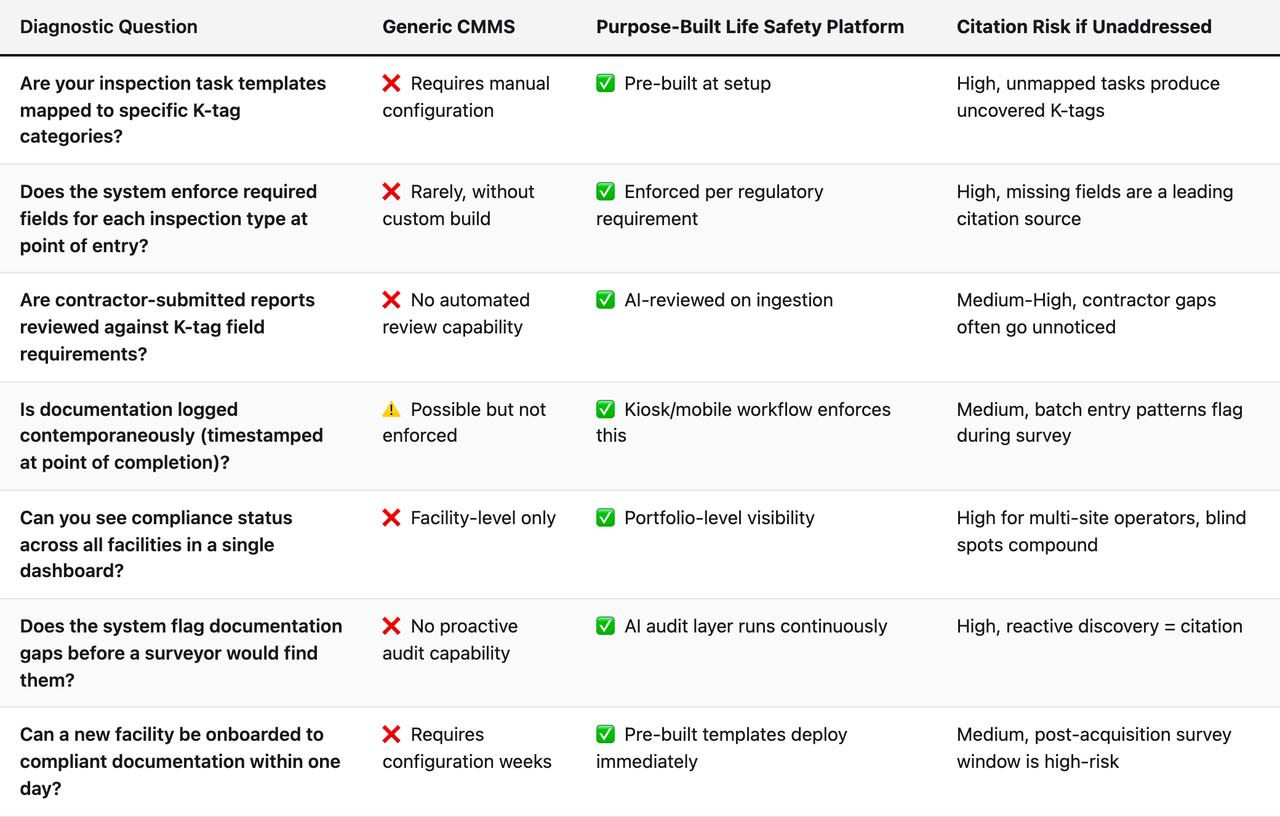
If your current tool produces mostly "❌" answers in the second column, the compliance exposure is real and ongoing. The question is not whether to switch, it is how to sequence the transition to minimize the window of risk.
The SNF Operator's Platform Evaluation Checklist
When evaluating any life safety compliance platform, purpose-built or otherwise, the following criteria should be applied systematically. These are the questions that separate platforms built for SNF compliance from general maintenance tools with healthcare marketing language applied to them.
- K-tag coverage: Does the task library explicitly cover all major K-tag citation categories, including K211 (means of egress), K291 (emergency power), K341 (sprinkler systems), K353 (automatic sprinkler), and K372 (fire alarm systems)?
- State amendment support: Does the platform account for state-specific NFPA 101 amendments, or does it only address the federal Life Safety Code baseline?
- Contemporaneous logging enforcement: Is there a kiosk or mobile workflow that makes point-of-completion entry the standard path, not an optional feature?
- Contractor record review: Can the platform ingest and review contractor-submitted reports against K-tag field requirements, or does it only manage staff-completed tasks?
- AI audit capability: Does the platform run continuous documentation review against regulatory expectations, or does it only store and retrieve records?
- Multi-site dashboard: Is portfolio-level compliance visibility a standard feature, or a premium add-on available only at enterprise pricing?
- Implementation timeline: Can a facility be fully operational with compliant task templates within one business day of setup?
- Pricing transparency: Is pricing tiered to be accessible at the single-facility level, with clear scaling for multi-site operators?
- Survey-ready reporting: Does the platform generate reports formatted for CMS survey review, or does it require custom report building?
- Training burden: Can a maintenance technician with no software background use the kiosk interface effectively within one hour of introduction?
No generic maintenance platform passes this checklist without significant custom development. Purpose-built platforms designed for SNF compliance should pass it out of the box.
What the Switch Actually Looks Like in Practice
Understanding the operational difference between generic and purpose-built platforms in the abstract is useful. Seeing what the transition looks like in practice makes it concrete. The following scenario describes a common pattern for small SNF owner-operators making the switch.
The Starting Point: The Paper Binder and Its Digital Equivalent
Most SNFs currently manage life safety documentation through one of two systems: a physical binder kept in the maintenance office, or a digital equivalent, a shared drive, a generic CMMS, or a combination of spreadsheets and PDF storage. In both cases, the documentation exists but is not being audited. Records are filed, but no systematic process checks whether they satisfy CMS documentation requirements. The maintenance director knows the binder is there. They do not know whether it would survive a survey.
The trigger for switching is often a survey event, a citation received for a documentation gap the maintenance team genuinely did not know existed, or a near-miss where a surveyor flagged a deficiency during an unannounced visit. The operator realizes that the current documentation system is reactive: it records what happened but does not verify whether what was recorded is compliant. That realization drives the evaluation process.
The Transition: Activation, Not Configuration
With a purpose-built platform, the transition begins with facility setup rather than configuration. The operator's facilities are entered into the system. The vetted task template library, already built for NFPA 101 and NFPA 99 compliance, activates for each facility. The maintenance director reviews the task list, confirms asset assignments, and begins logging. The first contemporaneous inspection records are created within the first day.
Within the first week, the AI audit layer has already reviewed the existing documentation that has been entered and surfaced any gaps. The maintenance director has a prioritized list of documentation items to address. The administrator has a compliance dashboard showing current status. The regional director, if there is one, can see status across all facilities in the portfolio.
The contrast with a generic CMMS implementation is stark. A generic tool at the same point in the process would still be in configuration, building out task templates, setting up custom fields, training staff on a workflow that was not designed for their specific use case. The purpose-built platform is already producing compliance value.
The Ongoing Operational Model
Once implemented, the operational model is straightforward. Maintenance technicians log inspections at the kiosk or on mobile as they complete them. Contractors submit reports through the designated intake process. The AI audit layer reviews all incoming records continuously. Flagged gaps generate remediation tasks assigned to the appropriate person. The administrator and regional director monitor the compliance dashboard. Before each survey cycle, the operator runs a pre-survey documentation review using the platform's reporting tools, closes any open items, and enters the survey with documentation that has already been reviewed against CMS expectations.
This is what SNF owner-operator compliance looks like when it is managed proactively rather than reactively. The survey is not an event the facility prepares for in the weeks before, it is an event the facility is always ready for, because the documentation gap-finding process is continuous.
Frequently Asked Questions
What is the difference between a CMMS and a life safety compliance platform?
A CMMS (computerized maintenance management system) is designed to track work orders, assets, and preventive maintenance schedules. A life safety compliance platform is designed to ensure that documentation of inspections and tests satisfies specific regulatory requirements, in the case of SNFs, the CMS K-tag framework and NFPA 101/99 standards. A CMMS stores records. A compliance platform audits them.
Can a generic CMMS be configured to handle SNF life safety compliance?
Technically, some generic CMMS platforms can be configured to support life safety task scheduling. However, the configuration burden is substantial and requires deep knowledge of CMS K-tag requirements and NFPA inspection standards. The resulting system will lack the AI audit layer and regulatory field enforcement that purpose-built platforms provide. Most small SNF operators do not have the internal expertise or time to build and maintain this configuration correctly.
What are K-tags, and why do they matter for maintenance directors?
K-tags are the citation codes used by CMS surveyors when documenting life safety deficiencies at skilled nursing facilities. Each K-tag corresponds to a specific provision of NFPA 101 or NFPA 99 and has specific documentation requirements that must be met to avoid citation. CMS Appendix I of the State Operations Manual provides the full framework. Maintenance directors are responsible for maintaining the documentation that satisfies these requirements.
How does AI auditing of documentation work in practice?
The AI review layer reads completed inspection records, contractor reports, and shift logs, then cross-references them against the documented requirements for each K-tag category and asset type. It identifies missing fields, inconsistent dates, unresolved deficiencies, and frequency gaps. The output is a prioritized list of documentation items that need to be addressed, with enough specificity for the maintenance director to take immediate action. It is not general-purpose AI, it is trained on the specific documentation patterns that produce life safety citations.
What is contemporaneous documentation, and why do CMS surveyors care about it?
Contemporaneous documentation means that inspection records are created at or near the time the inspection was completed, rather than reconstructed or back-filled later. CMS surveyors look at metadata, date patterns, and entry timestamps to assess whether records were created contemporaneously. Documentation that appears to have been batch-entered after the fact raises credibility concerns during a survey, even when the underlying inspections were performed correctly.
How long does it take to implement a purpose-built life safety compliance platform at a single SNF?
A purpose-built platform with pre-built regulatory task templates can typically be operationally active at a single facility within one business day. Facility asset entry, task library activation, and basic staff onboarding for the kiosk interface are the primary setup steps. This contrasts sharply with generic CMMS implementations, which require custom configuration that can take weeks before the system is producing compliant documentation.
Does SEQURA replace the paper life safety binder entirely?
SEQURA is designed to replace the paper life safety binder with a digital system that not only stores documentation but actively audits it for compliance. All inspection logs, contractor reports, fire drill records, generator test logs, and other life safety documentation are maintained in the platform. Survey-ready reports can be generated on demand. The paper binder is no longer needed as the primary compliance record, the platform serves that function with the added capability of continuous AI-driven gap detection.
Is SEQURA appropriate for a single-facility SNF owner-operator, or only for multi-site operators?
SEQURA is priced and designed to work for single-facility operators as well as multi-site chains. The core value proposition, a vetted task library, contemporaneous logging, and AI audit capability, is equally relevant at one facility as at ten. The multi-site dashboard and portfolio-level reporting become more significant as the operator's portfolio grows, but the single-facility compliance benefits are substantial on their own.
What happens to existing documentation when switching to a purpose-built platform?
Most purpose-built platforms support document ingestion, allowing existing records to be uploaded and stored in the new system. The AI audit layer can then review historical records for gaps, giving the operator a baseline assessment of their current compliance posture. Going forward, all new documentation is created natively in the platform through the kiosk or mobile workflow.
How does a purpose-built platform handle state-specific NFPA amendments?
Most states have adopted NFPA 101 with local amendments that modify specific requirements. A purpose-built platform designed for the SNF market should include state-specific task library variations that account for these amendments. During onboarding, the facility's state determines which version of the task library is activated. Generic CMMS tools have no mechanism for this, the operator must track state amendments manually and configure tasks accordingly.
What is the cost comparison between a purpose-built compliance platform and a generic CMMS for SNFs?
The per-seat or per-facility license cost of a purpose-built platform may be higher than a generic CMMS. However, the total cost of ownership calculation must include the configuration investment required to make a generic tool compliant, typically weeks of internal or consultant time, plus the ongoing cost of maintaining that configuration as regulations change. When implementation cost, configuration maintenance, and the risk cost of citations are factored in, purpose-built platforms typically deliver better total value for SNF operators.
Can maintenance technicians with limited software experience use these platforms effectively?
Purpose-built platforms designed for SNF settings are built for users with varying levels of technology comfort. The kiosk interface is designed for simplicity: a technician selects their task from a queue, enters required fields, and submits. The interface is not a general-purpose software application, it is a guided documentation workflow. Most maintenance technicians can complete their first inspection log entry within minutes of introduction to the system, without formal software training.
Key Takeaways
- Generic CMMS tools have no concept of CMS survey logic. They store work orders but cannot evaluate whether those records satisfy K-tag documentation requirements. This gap is the root cause of most documentation-related life safety citations.
- The task library is the most important implementation variable. A pre-built, vetted task library mapped to NFPA 101, NFPA 99, and K-tag categories eliminates the configuration burden that makes generic tools impractical for lean SNF teams.
- Contemporaneous documentation is a regulatory requirement, not a best practice. Purpose-built platforms enforce this through kiosk and mobile workflows that make point-of-completion logging the default, not an option.
- AI auditing of documentation is the capability gap that matters most. Continuous review of completed records against regulatory expectations is the only way to find the invisible gaps, missing fields, unresolved deficiencies, incomplete contractor reports, before a surveyor does.
- Implementation complexity is a real cost. For small and mid-sized operators, the difference between a one-day activation and a weeks-long configuration project is not just a convenience, it is a risk window. Every week without compliant documentation is a week of survey exposure.
- Multi-site visibility changes the operational model for regional leadership. Portfolio-level compliance dashboards shift the regional director from reactive auditor to proactive risk manager, enabling resource allocation based on current need rather than historical pattern.
- The right evaluation framework separates purpose-built platforms from generic tools with healthcare marketing language. Apply the checklist in this article to any platform under evaluation, K-tag coverage, contemporaneous logging enforcement, AI audit capability, multi-site dashboard, and survey-ready reporting are the criteria that matter.
The bottom line for SNF owner-operators is this: the best CMMS for small and mid-sized businesses in the skilled nursing space is not the one with the most features or the lowest per-seat price. It is the one that was built to answer the specific question a CMS surveyor will ask at your next unannounced visit, and that is running the answer to that question on your documentation, continuously, before the surveyor arrives.
About the author
Benjamin Terebelo · Founder
Benjamin is the founder of SEQURA, a compliance platform purpose-built for healthcare facilities. He builds at the intersection of healthcare operations and software, maintaining a focus on bringing modern tooling to systems that the broader industry has largely left behind.
About the author
Benjamin Terebelo · Founder
Benjamin is the founder of SEQURA, a compliance platform purpose-built for healthcare facilities. He builds at the intersection of healthcare operations and software, maintaining a focus on bringing modern tooling to systems that the broader industry has largely left behind.